


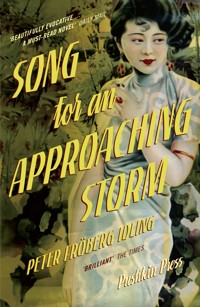
Erhalten Sie Zugang zu diesem und mehr als 300000 Büchern ab EUR 5,99 monatlich.
- Herausgeber: Pushkin Press
- Kategorie: Gesellschafts- und Liebesromane
- Sprache: Englisch
In the hot, rainy summer of 1955, Cambodia is in upheaval. The first democratic elections, just weeks away, will determine not only the future of a country, but the happiness of three people.Sar is a quiet, serious schoolteacher, officially campaigning for the opposition, who is secretly working for an armed Communist takeover. Many years later, he will become known to the world as Pol Pot.Somaly - young, fragile, beautiful - refuses to be tied down. She is the woman Sar loves, the woman for whom he is willing to sacrifice his most dearly held beliefs.And Sary is the ruthless deputy prime minister - determined to keep the opposition from power by any means, and to make Somaly his lover.Amidst the poverty and the cocktail parties, the silk dresses, the divided loyalties and betrayals, a love triangle unfolds which will decide the fate of a nation.
Sie lesen das E-Book in den Legimi-Apps auf:
Seitenzahl: 498
Veröffentlichungsjahr: 2014
Das E-Book (TTS) können Sie hören im Abo „Legimi Premium” in Legimi-Apps auf:
Ähnliche




















PETER FRÖBERG IDLING
SONG FOR AN APPROACHING STORM
a fantasy
Translated from the Swedish by Peter Graves
PUSHKIN PRESS
LONDON
Later the real war was unleashed, to be conducted in secret by radio through the U.S. Embassy in Pnom Penh. South Vietnam was already a wasteland, deluged by high-explosives, poisons and fire. Mr. Kissinger had said that the dominoes were falling, so now it was the turn of Cambodia and Laos, delivered to the greatest holocaust ever to be visited on the East. It consumed not only the present, but the past; an obliteration of cultures and values as much as physical things. From the ashes that remained no phoenix would ever rise. Not enough survived even to recreate the memory of what the world had lost.
Norman Lewis, A Dragon Apparent
Contents
I. SAR
Now we are sitting here in our weightless waiting
With far too many wristwatches in a ticking little living room
[…]
—while silence lets its wasted croquet ball
roll against the wall
SVEN ALFONS
Rear-view Mirror Towards Dawn
MONDAY, 22 AUGUST 1955
You put the heavy matt-black bakelite handset back on its cradle. Your thoughts are already elsewhere, not at the other end of the wire.
TUESDAY, 23 AUGUST 1955
You’re standing in front of a car. It’s a black car and it belongs to you. You inherited it. You inherited it from a sister who got it from her lover. It’s not a new car, but twenty years ago it was a car for kings and prime ministers and its chrome and paintwork are gleaming. The headlamps are two big yellow eyes high up on the curve of the mudguards. There are two inverted Vs on top of the slim flutings of the radiator grill. The steering wheel is white.
You’re holding the car keys in your hand.
Presently you are going to get into the car and drive through the city, which has already been emptied by darkness. But stay a little while, stay for the few minutes of honey-coloured light that precede sunset.
The evening is close and still. You can if you wish take your wallet from your portfolio case and take out the photograph. Let her smile at you, her head inclined slightly to the left. The well-manicured fingertips of her left hand are lying against her collarbone. Her dark hair has been curled and let down so that it frames her pale smooth face. Looking out beneath eyebrows that are just a shade too thick, her eyes meet yours. She is laughing her bright laugh, lips closing in a smile over even teeth, eyes holding yours for a moment before moving on. Then she stretches her back and the shot silk of her blouse shifts from chalk white to greyish pink. The waiter pours more wine but she moves her hand over her half-full glass to forestall him. And finally you succeed in dragging your eyes away from her and, still with the hint of a smile, look down at the white china in front of you. You cut a piece of duck breast, draw it through the gravy and slice a potato. Then you see one of her hands gently grasp her wine glass and involuntarily you follow the curving movement the glass makes on its way back up to her mouth.
You’re standing in front of a car. Go and sit in the car. Start the engine, listen to its even rhythm. Then engage first gear and begin the journey as planned. Don’t take any detours apart from avoiding the district around Marché Abbatoir where the streets are muddy and potholed. Drive to the river smoothly, staying in the higher gears. The eye of the lighthouse will be drawing circles in the darkness of the bank where the Mekong and the Sap meet, and you will drive on along Quai Sisowath and Quai Norodom and Quai Lagrandière until you can park under the big trees outside the cathedral. You will have to wait there for a little while again, until the big silent shadow of a cyclo comes gliding up. After you’ve exchanged passwords, take a seat in the cyclo.
Take a seat in the cyclo.
He will take you somewhere quite different, somewhere far from starched linen napkins and dresses with high necks and gold embroidery.
You are somewhere different. You are standing outside a simple house built on tall stilts. A glow in the windows suggests that there is a paraffin lamp alight inside. A pig can be heard grunting away in its pen. The dense banana palms are a darkness darker than the surrounding darkness. Behind you the cyclo departs after you have a momentary glimpse of its driver’s face, as he lights a fat cigarette rolled from green tobacco leaves. An elderly man, whose face seems to you almost frightening in the fluttering flame.
Walk towards the house. Even though it may be a trap, walk towards the house with its steep steps. It could always be a trap. Push your hat back so you can look up without bending backwards. Tuck your handkerchief down into the breast pocket of your jacket so it won’t offer a white target for a marksman to aim at.
You climb a steep concrete staircase. The night is full of all the animal sounds of night, but no other sounds. You’re carrying a portfolio case in your hand and in the portfolio there’s an elegant wallet and in the wallet is a photograph of a young woman who lies in your heart behind that white handkerchief.
You have climbed a steep staircase and now you are standing on a veranda. The heels of your shoes have left a mark for every step you took across the check pattern of ceramic tiles on the veranda. Place the palm of your hand on the polished wood of the door and stand there for a moment. Consider your choices yet again. What might happen now? Anything at all might happen, but just think what will happen if a security policeman opens the door. It will be a tall slim man with sinewy hands and a scar on his left forearm. Or, perhaps, a thickset man with a low centre of gravity and with short hair like pig’s bristle on the back of his neck. Irrespective of what kind of man opens the door he will be the same sort of age as you, and he will be moving very quickly to catch hold of the sleeve of your jacket or to aim a kick at your crotch. There is also the possibility that he will strike the side of your head with a bamboo baton or will even be holding a loaded revolver in a two-handed grip.
You think about what will happen after that, about how the story develops, branching and splitting time after time. Some of the lines it takes always lead to the men listening being impressed by your unsentimental and pleasant smile. How, against all odds, they let themselves be convinced by your explanation of why you are at this very place at this very time with a portfolio crammed with compromising material. And then they let you go with a stern warning and a wink. Or, at a later stage, you are granted a meeting with the prison governor, who believes the righteous indignation you feel at being lumped together with communists and assassins when you are innocent.
But you know that this is just wishful thinking on the part of a mind under extreme tension, that the real story is the one in which the bamboo baton strikes the side of your head, in which you are confused by pain and tripped up before you can reach the staircase. The one in which the thickset man ties you in a chair with your hands behind your back and then without warning smashes your molars with a kick that knocks over both you and the chair. The one in which the bones in your fingers are broken one by one, even though you have betrayed your friends one by one.
You stand there with the palm of your hand against the wooden door and those behind the door are waiting for you.
Knock on the door.
Knock once, twice, three times and wait for the whisper from inside.
Answer the whisper.
You are sitting by a paraffin lamp. You are sitting in a room that loses itself in darkness beyond the circle of yellow light from the lamp. Two illuminated faces are suspended in front of you, one thin, the other wide across the jaw. The table is covered with sheets of paper with French words and long lines in your own language. A mosquito net is hanging furled up over a low bed. Like you, your companions are dressed in short-sleeved shirts and dark trousers. Their jackets are hanging over the backs of the chairs.
You know the two men in front of you. You have known them for a long time. You met them at the discussion club at Vannsak’s place in Paris. Together you have fantasized about the life you are now leading, you have discussed it in cafés, after lectures, over cheap meals at cheap restaurants. The face with the wide jaw is called Yan. The thin face is Sok. You used to meet regularly on rue Lacepède at what, with time, came to be called a party cell. That is what you are doing now, too, even though the name of the street outside is unknown to you.
You talk in low voices. If anyone were to be standing quietly beneath the window and listening, he would hear no more than a mumble. Your talk is concentrated, you exchange thoughtful glances and, with your fountain pens, scratch down words on sheets of paper the wet season has caused to swell.
The meeting is marked by the feeling that there is a great deal at stake and that there is no time to lose. You listen attentively to the others but always with an ear open for noises that are not the normal noises of the night—dogs that begin to bark and the direction the barks are coming from, a car door closing, a shout of command, the pounding of running feet on the stairs.
The day’s agenda lies in front of you. It was written in haste and there are many items—they form a blue-ink column that slopes inwards towards the centre of the page. There is less than three weeks left to the parliamentary election and even though you are not letting on about it, you have a feeling that the ground is shifting. That things are moving, moving almost imperceptibly, but moving in the wrong direction. But on an evening like this, with Yan and Sok on the other side of the table, it is not the right thing to say. Perhaps they too can sense the inexorable slide, but the three of you are here to plan for something different. You are here to plan for victory. It is a night to be serious and to be enthusiastic.
There are tall drinks glasses on the table. Five of them, in spite of the fact that there are only three of you. Anything to confuse uninvited guests. The glasses contain dark jasmine tea and it glows the colour of amber in the weak light. A small round coaster sits on top of each glass to prevent it filling with drowning insects.
You deal with point after point, passing documents to one another and drinking the lukewarm tea. Outside there is night, darkness and a blessed silence. Yan asks the American question. You have nothing new to say about it and you say so: in the current precarious situation Vannsak thinks you should leave it aside—and you agree with him.
Yan asks the Chinese question, and then the French one, before returning to the American question. But you stick to your view.
How to relate to the new imperialism, the new colonialist, can be addressed or not be addressed in the election campaign. The fact that the prince has signed a cooperation agreement with Washington is a weak point. It can be used. But your intuition tells you to steer clear of it. The prince has some hidden reason for the agreement. What it is, you don’t know.
It is difficult to argue for something as personal as a feeling with men such as those sitting opposite you. So you remain silent behind your unwillingness to record the question on the order paper.
Yan and Sok look at you but you stay silent, and in the end Sok makes a note and says, let’s proceed. Let’s proceed, he says, and although you cannot decipher his writing there is no need to. You know that your silence will be reported back to the centre. But you count on them understanding. It is not your job to push through the policies of the Organization. You are to be pragmatic. From your prominent but hidden position within the Democratic Party, your primary task is to keep Yan and Sok informed about that party’s internal affairs. Only secondarily to influence policy. The former is risky, the second directly dangerous.
It is Sok’s responsibility to report those who fail to subordinate themselves to collective decisions. With his illegible writing he is putting his loyalty to the Organization above his friendship with you. The cause is more important than the individual. That is absolutely right and proper and you approve of his discipline and lack of sentimentality. It also means it is easier to read him. You recognize that Sok is a comrade the Organization can rely on, even if you can’t rely on him.
You continue. Quicker now. The risk of discovery grows with every minute the three of you spend in the same room. The tension is infectious.
You give an account of the strategies of Vannsak and the Democrats. Vannsak seems to you to have boundless energy and you tell that to your companions. Each of them runs an index finger down all the entries in his diary, which you have copied. You all feel it’s a pity he is no longer one of you. It is a long time since he—as a self-proclaimed proletarian—cut his ties with his well-off family.
There was a time when he was red. Now he is more like pink.
You mix dry cigarette smoke and tea and Yan reports the latest information about losses suffered by the People’s Party, the part of the Organization that does not work in secret. There have been disappearances and hospitalizations. The authorities dismiss any violence aimed at you as the settling of private grievances and it does not even merit a mention in the newspapers. It is hardly a sophisticated tactic, but it’s an effective one. Yan states that things are close to collapse.
You read the names on a list in Yan’s handwriting but you cannot put a face to any of them. All of them are Meas’s men. Meas himself has managed to evade both batons and handcuffs. Acting as the official leader of the People’s Party as he does is a risky business. He is completely exposed to the state’s machinery of violence. But if he survives the election he will probably become the next chairman of the Organization. That will correspond to his perception of his own importance. Meas is a man to be watched. And to learn from. You work in secret, he in the open. Which is the more effective strategy is something you will soon be able to demonstrate empirically.
Yan then gives a summary of the latest developments abroad. Your own country may be the target of your work but oppression is global, as is the struggle. In Paris you had friends from the whole French-speaking world, from countries you had not even known existed. The sense of being part of a worldwide context, of being one with a brotherhood that will force history to turn in a new and previously unforeseen direction, that sense is a constant source of comfort and inspiration. That is why you all carefully follow developments not just in the countries bordering your own but also in distant states. There are lessons to be learnt, for even if the preconditions are different, the resistance is the same. Yan reports on the French terror bombing that wiped out whole villages in Morocco, with hundreds of deaths. And you remember your Moroccan friends who joined the liberation movement. Yan tells of various attacks in Algeria, of French mobilization and of the mass arrests of Arabs in Paris. Of the disturbances in Tunisia. He moves on to the hard fighting in Gaza and you think of a Lebanese acquaintance, a friendly lanky fellow who was one of the founders of the Arab nationalist movement.
A really motley collection, but nevertheless inextricably involved in a common vision of the future.
Was that a noise or wasn’t it?
Your eyes meet Yan’s. They meet Sok’s. Their faces remain utterly expressionless, only their eyes move. You all sit absolutely still and silence reigns outside. If there was a someone who revealed his presence a moment ago, that someone is now as motionless as the three of you. You and Yan quickly begin to gather up your papers. You lay one sheet carefully on top of another and place them silently in the portfolio case.
Sok raises his hand and you all freeze again. You wish you could stop the dull thumping of the pulse in your ear but, you think, a heart is not like a knee that can be bent at will.
You are sitting in a room with two revolutionary university teachers and a paraffin lamp that is burning with a steady flame. Outside there is silence and in that silence you imagine there are crouching men, their eyes gleaming in the moonlight as they approach.
There was a time when you would have felt ill. You would have felt your limbs paralysed by panic. But that was then. You get used to things, even to things like this. Now you feel heavy and solid and prepared. In the sense that you have accepted what may happen.
Yan gets up slowly, nods to you and to Sok. You see his face by the light of the paraffin lamp, the shape his mouth makes and then it all disappears. Nothing is left but sounds.
You hear his footsteps moving towards the door.
A grey panel opens in the blackness and his silhouette is outlined against it. The door closes on noiseless hinges and you wonder whether that is luck or a sign of careful preparation.
You sit in the darkness with Sok and listen to him breathing slowly on the other side of the table. The sweat makes the palms of your hands prickle and you wait for Yan to take a look around, and then come and knock gently on one of the stilts supporting the house. You are waiting for the two small dry knocks that will free you from this situation.
WEDNESDAY, 24 AUGUST 1955
Your black Citroën is parked round the corner, its lights off and its engine cooling. It is standing on a street that until quite recently was still called rue Van Vollenhoven. You can’t remember what the street has been rechristened. They all have new names now. An independent country should have streets with independent names. But it does take a little time for people to change the habit of eighty years. So people apologize, say things like you know how it is, what’s it called again, and then they smile and use the old name.
Your car is parked on what used to be rue Van Vollenhoven, right by the only newspaper stand on the street, Les nouvelletés françaises, and before going to sit in the open-air restaurant of the Hôtel International on rue Angkor, which has remained rue Angkor, you bought today’s edition of Cambodia. The printing costs of the newspaper are paid with French money, and as a result of that it is a paper a schoolteacher with conservative values could well be seen reading.
If the scene is viewed from the other side of the street: an open-air restaurant in shadow. The hotel stands on a street corner and the sun has sunk down behind the frontage. The rays of the sun have moved on past the painted sign and the windows, which now look grey. They are now only shining on the dome up on the hotel roof and on the thin sharp spire. A waiter dressed in black and white has closed the parasols. Spread out among the tables are a young couple, two men on their own and a small group. The traffic at the crossroads is light and you are one of the men on his own.
Short-sleeved white shirt, dark trousers and an immaculate side parting.
You are sitting drinking a cup of coffee from the hotel’s French coffee set, the moss-green one with gold rims. A cigarette is slowly burning to ash in the ashtray and you are reading a respectable conservative newspaper.
You are apparently reading a respectable conservative newspaper, but if anyone were to sit behind you, he or she would see that what you are actually leafing through is a different paper. A newspaper in a smaller format with worse print and with opinions of a substantially more radical kind. It is called Solidarity and your older brother is the editor. But no one can see it because the only thing behind the back of your chair is the ochre-coloured wall of the Hôtel International.
You are waiting for company to join you and while you wait you look over the top of the newspaper every so often and watch the people going through the crossing. The street is the busiest street in the city, with cafés and dirty shoeshine boys. It runs through the swarming centre of the Chinese quarter but ends at the square in the French Premier Quartier, surrounded by ponderous official buildings in the French style. The Post Office, the Banque de l’Indochine, the Hôtel Manolis, the police station, the Café de la Poste, the Restaurant La Tavèrne. In other words, a street between two worlds.
You let your gaze follow first one person, then another. People of Chinese origin are common in districts such as this. But there are even more foreigners here than other places. Various kinds of Westerner for the most part, but also bearded men in turbans.
And apart from them you can also see your own countrymen. They are like you, but you are not like them. There is a sort of tenderness in the way you think that thought.
You are one of the few people here who has seen the world beyond the horizon. Who has had the benefit of being educated at the world’s leading seat of learning. You are not, however, referring to the lectures on wireless technology you missed at the Ecole Violet in Paris. No, the actual process of leaving your home country as one of the twenty-two scholarship holders of 1949 is—in your view—the most important examination anyone can take. You have lived at the heart of the empire and met people from its every corner. It was more than just a shared experience: you all shared the same longing for freedom and independence for your native countries. Together with young people from all over the world, you worked as a volunteer road-builder in Yugoslavia. You have seen what people can achieve if there is just one goal and everyone is working towards it.
Unlike your countrymen, you have seen things like that. You know the kind of things they can’t know.
It is because of experiences of that sort that comrades such as Samouth and Van Ba have chosen you. The men who are the leaders of the movement that is going to liberate the people you can see in front of you; the men who are going to take them on beyond national independence; the men who are going to give them real justice.
You can admit it to yourself: you are a man with possibilities. Compared to your fellow-countrymen you have the qualifications to achieve something of real importance. Through Somaly, your fiancée, you have contacts at court and you know both the revolutionaries in the jungle and the politicians in the capital. You have a background few others can match, a position that no one can.
But though the future may well be yours, it has not arrived yet. That is something you learned during your months with the partisans. They thought you were more use to them emptying the latrines than as an ideologist. You resigned yourself to that fact. All work is of equal importance. Someone has to dig shit into the fields if soldiers are to have food on their plates.
When you went to join the partisan movement, you thought you would be able to say later that you took part in the armed struggle. You steer clear of that these days. That sort of claim could rebound on you if anyone in your circle happened to talk to the people who actually filled the latrine buckets.
But at least the march to the front turned out to be the short cut you had thought it might be. It has given you an advantage over better educated people who have been involved longer than you but who are still in Paris. They are undoubtedly superior to you when it comes to theory, but not any longer when it comes to practice.
You are drinking your coffee from a moss-green cup with a gold rim and you are waiting for someone to join you, someone who is arriving in a cyclo at this very moment. He is a man the same age as you, with a receding hairline and restless movements. His name is Vannsak and he pays the driver more than he is asked. As usual. His black tie-knot is crooked and you get up to shake hands with him, as has become the habit in the city among modern men like you.
Vannsak, who lived across the street from you in Paris. Vannsak, the poet, and now the politician too. He was the one you new arrivals could always turn to with questions and problems. You had nowhere to live. He fixed a flat for you. You didn’t have any pots and pans. He lent you his. Your Paris years would have been quite different without him.
And you, too, would have been quite different. This man, who is now squeezing your right hand with his right hand and placing his bulging briefcase on the table with his left, is the man who took you to discussion clubs with him. It was in his living room that you met most of those who now make up the Organization. You have sometimes described your personal development as dependent on certain key figures, people able to open the doors that you yourself cannot. There have been several key figures of that kind, people you’ve had electrifying conversations with. Who have enabled you to see completely new connections when your thoughts were wearing thin.
There have been a number of them, like Mumm, Samouth and Meas. But none of them has been as important as Vannsak, for he was the first.
But that was then. Now you think he lacks the courage to remain a true visionary. You feel that his arguments have become more and more muddled, when you compare them with the spellbinding clarity they had when you first met. Instead of summoning all his strength in order to raise reality to the vision, he takes the easy way out and drags the vision down to reality.
But you are not sitting here at the Hôtel International outdoor café in order to confront Vannsak with his ideological compromises. There is another reason. Or, to be more precise, reasons, since your role is a double rather than a single one. And neither of those roles involves being his secretary, which is your actual official function. On the contrary, the two of you have equal status in the discussion. In a couple of weeks’ time this independent country’s first independent parliamentary election will take place, and both you and Vannsak have belonged to the Democrats for the last decade. Even as a teenager you used to distribute their flyers as part of the well-orchestrated make-believe democracy of the colonial period. From a political point of view things hadn’t really been properly thought through, but then, in a political sense, you hadn’t thought things through for yourself at that time. In those days, moreover, the item at the top of the party agenda was something as straightforward as national liberation.
Vannsak has manoeuvred his way into the party leadership since then. You have followed. Now the two of you meet on working days and holidays to discuss strategies, produce statements and formulate responses. Unlike your opponents the two of you stick to the issues. You don’t accuse your adversaries of drunkenness and bigamy. You put forward concrete proposals for concrete improvements to real schools and real health care and real administration. You name names, you add up figures. You talk about what is achievable and what is not achievable. And it seems to work. Your audiences grow in number with every meeting—in spite of the fact that you avoid bandying insults or wooing the public in the crudest manner possible. The voters seem prepared to shoulder the responsibility which, as you are constantly telling them, is theirs and theirs alone.
Both of you don’t tell them, however. It is Vannsak who shouts this mantra into the microphones. You stay at a proper distance from any platform. That’s a necessary precondition of your other role. The role that considerably fewer people know about. What Vannsak and the others do not know is that you also carry a very different party card. Back in your modest house on the southern outskirts of the city. It’s a little book with thin paper covers on which the words Parti communiste français are printed, and you have hidden it well. Consequently, Vannsak has no idea that the conversation you are about to begin once he’s ordered his coffee will be reported back to the centre of the Organization. To people whose names even you don’t know, whose faces could pass along the street in front of both of you without either of you reacting.
But what you do know is that somewhere in that dark centre your loyalty is being recorded, along with every small radical formulation you manage to place in Vannsak’s speech. It is not a case of rewriting a whole party programme. But every slight shift can be of service to the Organization. If not now, then later. And that is why you must never be seen in the company of representatives of the People’s Party.
There are presumably people who knew you in France and now wonder why you only associated with revolutionaries in Paris whereas here you have joined the Democrats. Why you seem to have completely changed your social circle. On the other hand, no one is more radical than when a student and you are now over thirty. And, of course, the man whose portfolio case you carry is your old mentor Vannsak, a man who had moved from red to pink.
So their thoughts remain just that—thoughts, not suspicions.
Outwardly you are a Democrat and nothing but a Democrat, the respectable secretary to one of the leading figures in the opposition party. Inwardly you are the Organization’s indispensable link-man.
And then there is yet another role, one that no one but you knows that you are playing. It is confusingly like your first role.
It involves a twenty-three-year-old woman whose photograph you have in your wallet. A woman whose significance you deny to the Organization. Like a man devoted to the cause, you sometimes think. Like the disciple Peter, you think rather more often. Because the door the Organization believes you have closed is still wide open.
If events take their proper course Vannsak and the Democrats are going to win the election. The two of you have definitely not discussed what will happen after that. But the work you are currently doing at his side is hardly going to come to an end once the voting papers have been counted. You can’t really hope to be a minister, but permanent secretary is a possibility. Your organizational talents are respected, as is your ability to win the trust of the humble as well as of the elevated. That portfolio case on the table may already contain a draft proposal whereby you are entrusted with a coordinating function in a future government.
A well-paid and well-respected office of that kind is what your fiancée Somaly expects you to get. Her family even more so. You do, of course, come from a good background back in your home district, but oxen and day-labourers are hardly a match for the royal blood that—slightly diluted—runs through the veins of your beloved.
In other words: no state office, no wedding.
You remember that remarkably cool day, the year the rains stopped earlier than anyone could remember, when you stood at the edge of the royal pavilion while the rowing races were taking place down on the brown river. An island of calm in the chaotic sea of people gathered to celebrate the festival. You remember how you saw her among all the other reserved and haughty figures who were slowly circulating in the shade of the gilded roof. In terms of external appearance—dress, hair, jewellery—she blended in with the other young women who had reached an age when they could be introduced into society. But unlike all of the others, who seemed so anxious to please that all their individuality was masked by a kind of blank and nervous smile, she stood out as being consciously unapproachable. As if there were a kind of darkness around her, in contrast to all the gold and the glitter that characterized the context. You yourself had felt uncomfortable in your white court dress, having been invited there by your sister, who was still welcome in the pavilion even though the old king had been dead for a decade.
You remember the way your eyes, with a will of their own, returned time after time to that sulky-looking girl, who could not have been more than sixteen or seventeen years old. You remember how, to your surprise, you saw an acquaintance of yours conversing with her as if they were old friends. How, even though you didn’t really know each other well enough for such confidences, you eventually asked him in a quiet voice: Who is she?
And how he had sighed and answered: Not you too.
You had become flustered and asked what he meant.
All the men ask that, he explained.
Then he said: She is called Somaly, the daughter of Princess Rasmi. And no, she is not promised in marriage. Her father, however, is a reprobate.
You remember what a put-down it felt to be nothing more than one of all the men. No better nor different from all the rest of them. You against all of them—the competition seemed hopeless.
Later, however, she was to become yours.
And the future for the two of you will be decided by a free general election in which only a handful of those with the right to vote know that there is anything at stake for you and her apart from the distribution of seats in the National Assembly.
You are sitting with your back to the wall of the Hôtel International watching Vannsak put sugar into his coffee. The two of you have still not said more than a few words of greeting. It’s as if you have so many important things to discuss that you no longer waste words on idle chat.
Everything seemed so simple during your last year in Paris and your first months back at home. You were completely taken up with the worldwide movement you were part of. You loved the conversations at the discussion club which, after a while, became secret meetings in even more secret cells. With the utmost secrecy you became a member of the French Communist Party.
And then you returned home as a man with a mission. The countryside was totally dominated by liberation movements that were slowly starving the towns of necessities. It seemed to you that the revolution was on the point of happening.
But the conflict did not break out. The colonial power simply packed its bags and left. One by one the posh villas in the Premier Quartier emptied. Their defeat in Vietnam turned out to be a victory for your country too. That meant that the freedom struggle came to a rather inglorious conclusion and the result was that the touchpaper that could have ignited the revolution was snuffed out.
There is no doubt that the unjust system still exists, but the possibility of overthrowing it by violent means has become no more than a hypothetical proposition.
Which is why—without the Organization knowing—you have introduced new factors into your calculation. Might it not be possible to achieve change by parliamentary means? It is not for nothing that the countries around the Mekong River were the diamonds in the French colonial crown. There are resources here that many other undeveloped countries cannot even dream of. It ought to be possible to build a new Uruguay here, surely? By means of a very, very slow revolution, one cloaked in reforms? Because you are well aware of the fact that however unjust the distribution of welfare may be, a number of the important preconditions of revolution are absent. For example: (1) a politically conscious proletariat. Or: (2) serfdom among the agricultural workers. It was possible to mobilize the poor peasant proprietors for national liberation, but they are unwilling to take up arms to solve more complex problems.
The road to revolution seems to be a long and winding one. It may be easier to achieve your aims by democratic means. So which to choose?
Indeed, which to choose? If only it was just a question of politics. But it isn’t. Your fiancée Somaly, whom you almost forgot during your endless discussions with Mumm in Paris or when you were listening to Samouth explain Hegel’s dialectic in the partisan camp, is ever present in your thoughts these days.
That is not the way it was meant to be. When you went to meet her for the first time after four years apart, you intended to break off your engagement. Falling in love is no more than a sentimental and egotistical weakness, something one can free oneself from through dedication and practice. And that is what you had done. How could you ever hope to dedicate your life to the struggle if you had a spoilt bourgeois woman at your side?
With Parisian self-confidence and unimpeachable ideological rectitude, you were going to put an end to what you had promised the Organization to put an end to.
But just the way she entered the room, just the way she walked over to you from the door. Everything that had attracted you so strongly when you first saw her at the rowing races had deepened and matured into something even more beautiful. It drove every rational intention out of your mind. And that was before—without any sign of shyness—she took your hands in hers and said your name.
But it is you after all. You really did come back.
Being in love is one thing, but this is something quite different. Something that lies beyond your control. It’s as if everything else shrinks into insignificance when the two of you are in the same place. You don’t turn up for work and you arrive late at important meetings.
You really did come back.
In the beginning you hated yourself for acquiescing so easily. It was months before you made peace with yourself. Even then it was only on conditions that were dictated by her mere existence.
You are sitting in an open-air restaurant on rue Angkor and you know you have to come to a decision. It is not a matter of both, it is either/or. But your usual decisiveness is not sufficient in this case. And your three-sided game is becoming more and more complicated all the time.
Even though her absence torments you, the situation is simpler when she doesn’t get in touch. Two days have passed since you heard from her and you have already managed to get a good deal more done.
There is nothing unusual about her silence. You have learnt that her unpredictable behaviour is quite predictable. One week she is present at every event, filling the days with her ideas and her apparently unstoppable creativity. She writes, draws and deluges the tailor with new sketches and suggestions. She is always on the way somewhere, always with at least one girlfriend on each side. And the following week, or even two, she stays at home. And then you seldom hear from her. But you have got used to it. You bide your time and devote it to other things.
If these empty days stretch out and become three or four, a couple of pretty words in a letter, or the odd, small, well-chosen present left at her gate are quite sufficient. In return you may receive a slip of paper with a lipstick imprint on which the words je t’aime have been written in tiny letters between the lips. You have saved all of them and keep them in an envelope in one of the drawers of your desk. Under your party membership book, the one with the paper covers.
It is only two days since she last telephoned and there is no need to do anything yet. Her silence is open to many explanations. So you can concentrate on what Vannsak is saying to you.
Being seen out among ordinary voters like this is part of the strategy the two of you have adopted. You show yourselves in places where your opponents do not. Word spreads across the country. You are young, well-educated, privileged people, but you have renounced your privileges in order to be with the people.
It is not completely true, but the two of you understand the value of setting a good example.
In your view, the people who walk behind the plough and the oxen, the people who tap the sap from rubber trees, the people who empty their nets in the light of dawn, are not fit to govern a country. Not yet, anyway. The colonial power intentionally saw to it that the majority remained in ignorance. Only a few were picked out and enabled to become obedient public servants in the lower levels of the machinery of state. The population numbers many millions and the country has no more than perhaps a hundred schools. It is going to take years to educate the electorate to understand the principles of democracy.
So the two of you are very conscious of your responsibility. You are the advance guard sent to mould the people. Your task is to take the lead and draw up plans for the new society that the next generation will build. If you desert the cause there are no others to take your places. In which case new foreign rulers are waiting in the wings. The Vietnamese. The Thais. The Americans. The British. Perhaps even the French again. One as bad as the other.
Which is why you order more coffee and take out your fountain pens and clean sheets of paper. Folders of documents pass from one briefcase to the other. The sun has sunk even lower and the waiters are lighting the lamps. High above the lamps the glow of the stars is beginning to show in the night sky. Inappropriate things have been written in La Liberté. There was a speech in which someone accused you of taking bribes. And some election workers have been roughed up.
The two of you set to work.
THURSDAY, 25 AUGUST 1955
In front of you lie the dark, heavy swirling waters of the river and the eye of the lighthouse. Not the river you grew up by, but a different one.
And behind you the city, with all its cars, its restaurants and its gleaming palace. But also with its darkness. You have taught yourself to see it. Not just to focus—as you used to—on the patches of light, but instead to calculate how much room for manoeuvre exists between those patches. And it is considerable.
Turn around and look at the people strolling along the quay. Elegant young couples arm in arm, in frocks, jackets slung over shoulders. Families, whose carefully combed and plaited children chase one another. Street vendors selling lotus seeds, roast fowl and candyfloss. Fortune tellers with their cards spread out. Bowed widows, hair clipped short, in black skirts and white blouses, rattling the small change in their begging bowls. A thin balloon seller walks past, a colourful cloud of balloons above his head. The glow of cigarettes shows up more as the colour fades quickly from the sky.
Your own countrymen in among delicate-limbed Vietnamese, round Chinese faces and Europeans with noses like the beaks of birds.
Clouds of insects swarm around the heavy lamp standards along the quay.
Electricity is the master here, and Saigon—that huge city—is a boat-trip downstream, after which comes the wide world. But the greater part of your city still relies on paraffin lamps and cooks its food over open fires. It is only the stone buildings here in the Quatrième Quartier that gleam with light.
But one day, or night rather, you think, all the towns and villages in the country will be lit up. One by one by one. The question then will be whether your need for the protective cover of darkness will be greater or smaller than it is now.
You recognize some of your pupils and they recognize you and put their hands together in greeting. In the evening light and freed from school uniform they look older.
Take the packet of Cigarettes du Globe from your breast pocket and allow yourself a cigarette. Let the moisture-laden river air mix with the harsh tobacco smoke. There is no wind and the smoke rises at right angles to the white paper.
High above the heads of the crowds the silhouette of the Wat Ounalom is slowly fading into the night sky. It is a long time since, barefoot and cloaked in orange, you passed in and out through the wheel of life of its iron gates.
Yet another home you have left behind.
Now there are new boys chanting the verses written in miniature script on palm-leaf paper, new boys cleaning the older monks’ quarters. You still remember the words, and where the brooms are kept. The same rituals, the same discipline. But you know your history and you know there was another age, an age of temperamental Hindu gods. And another age even before that. The spirits, though, are constant throughout the centuries. They inhabited the trees and watercourses of your country even before the arrival of the gods.
The palace stands just beyond the pagoda. Religion and monarchy so close that the prince and the abbot could wave to one another from their bedroom windows.
You think: soft oppression and hard oppression respectively.
The prince’s security police and the abbot’s upholding of a regime in which individual freedom can be ignored. A human life always depends on lives that were lived in past times.
Poverty is the well-deserved punishment of the poor; the list of entries in a bank-book is the well-deserved reward of the rich.
Marx is wrong about this, you think. Religion is not the opium of your people. It does not offer the solace of eternal paradise after a life of poverty as Christianity does. There are no angelic wings deluding them into believing in a flight up and out of penury.
Instead, the words of the abbot are shackles that fetter thought and guarantee that the social order will remain as static as it is unjust. Any attempt to exchange one’s lot for a better one is an attempt to effect a minute shift in the order of the cosmos. It is hardly any wonder that people resign themselves to their fate, however unjustly they are treated.
It has taken time for you to recognize this. Religion has many advantages. But you have let yourself to be convinced that the advantages are not so tightly tied to faith that they cannot be achieved in other ways. You kept your objections to yourself when you were first introduced to the discussion club through La Maison de l’Indochine in Paris. The others followed lines of reasoning that were absent from your own thinking. The way they drew apt and appropriate support from philosophers you only knew by name. If that.
But there are nevertheless aspects of the existence of barefoot monks that can serve as examples even in the radical political struggle. In this respect, you think, your people have an advantage over many other nations. The monks live in the very simplest of circumstances. They play no part in the spiralling and stupefying cycle of material consumption. They submit to a higher goal and they strive indefatigably to attain it. It is a way of life that can be learnt from. Devotion worthy of admiration. It is, moreover, an experience which the majority of your countrymen share, so the groundwork is already in place. That will be important when the day comes—as it surely will—when people will have to accept suffering and privation in order to make the reform of society possible. The day when resources and opportunities will be redistributed: from each according to his ability, to each according to his needs.
You learnt the importance of discipline during your time with Prince Chantharangsy, if not before. His forces could have played a decisive role in your country’s fight for freedom, and you went straight to them once the boat from Marseilles had docked in the harbour you can see below you now. But when you were with them you realized that the revolution was not going to be their work. Chantharangsy made a great commotion, demanding first one thing and then another, while he himself lived comfortably in Chbar Morn with his concubines. The preconditions were certainly present, but not the ability.
Consequently, his soldiers refused to sacrifice their lives when they went on the offensive. Instead, they killed civilians, burnt houses indiscriminately and thus brought the wrath of the poor peasants down upon their own heads. The same poor peasants who had silently supported them and voluntarily joined their ranks. You did not stay in that company for long before moving on to the more revolutionary partisan phalanx.
Humility and a preparedness to make sacrifices, along with the importance of setting a good example. Those were some of the experiences you made a note of and later reported to the Organization.
The monks, of course, even have a wheel as their central symbol. You could not avoid noticing the connection when you first encountered Marx’s wheel. But the similarity is one of form alone. The wheel of history is rolling towards a more just future. If anyone sticks a foot in to try to stop it, his leg will be snapped off. The wheel of life, on the other hand, merely stands and spins on the same unjust spot through the decades and the centuries and the millennia.
You are sitting at your desk and in front of you there are piles of pupils’ work waiting to be marked, party reports to read and secret documents for the Organization to prepare.
The paraffin lamp is smelling of smoke because you bought the fuel from a stall on the street. A sooty smell for you and money for the poor woman instead of for the multinational petroleum companies, you think—she was sitting there among her bottles of petrol and paraffin, her eyes glazed by the fumes. In this respect, however, as in many others, you are less than consistent. The petrol that drives your car, for instance, was bought from the pump on Avenue de Verdun.
It is a good evening. You are working in a disciplined way. One thing at a time. You mark mistakes and write figures with your red pen, write cramped lines that are difficult to read with your blue pen. The piles of paper shrink and grow. In the darkness outside the noodle seller can be heard drumming his usual low call-sign with a chopstick on half a coconut. Wood against wood in a lonely and intricate rhythm that slowly comes nearer, reaches a climax and then fades away. But you do not rush out and stop him; you pour more tea into your glass instead.
There is simplicity in this. An escape into a purely mechanical activity. You can put your other concerns aside and work on indefatigably into the silence of the night.
FRIDAY, 26 AUGUST 1955
You are sitting in a dark and empty classroom preparing a lesson on classics of French literature. Strips of light filter through the closed shutters, and a little while ago you saw him. You think of the truth of what your grandmother used to say, that people should be careful what they say. That talk can bring trouble down on your head.
A short time ago you had a quick lunch. Another overcrowded open-air restaurant. Vannsak was sitting beside you, his shirt collar unbuttoned, his tie loose. You watched how he carried on talking without a pause, not even pausing when he shovelled noodles into his mouth.
The conversation between you was a serious one. Not many smiles. You tell him what you were told when you rang party headquarters during the morning. That another two candidates had been reported missing. A thirty-four-year-old in Kompong Speu, a forty-three-year-old in Kompong Thom. You also told him that several more politicians from rural areas have turned up in the capital, hoping to take advantage of its relative safety. And Vannsak stated the obvious—that it is impossible to run a nationwide election campaign when all the candidates are campaigning in one and the same area.
The two of you ate your noodles, supped up the juice and discussed Sam Sary, the deputy prime minister. It looked as if there were no limitations being put on him any longer.
The government used to be satisfied with drowning out the loudspeakers at election meetings by using even bigger speakers. Then there came a stage when they used megaphones and yelling crowds. Recently, however, Sam Sary has taken to emptying the prisons of criminal elements, and that lot are not satisfied just to chant obscenities. Now there are these disappearances, which are becoming more and more common. Some candidates are found in work camps; some are found face down in their own brain matter, hands tied behind their backs; some are not found at all.
The terror, which up to this point has been aimed at the Organization and the People’s Party, has spread to include the Democrats. That is not surprising, perhaps, but you really did not expect it of the prince. Did not expect him to resort to the kind of thing that is quite alien to the European democracies he claims to admire.
The two of you discussed Sam Sary, the prince’s favourite minister. The strange thing is that during his years in France he seems to have adopted the colonialists’ view of his own people. He uses the same methods against his fellow-countrymen as the French are currently using against the freedom fighters in Morocco. Batons and brutality. But—you remind Vannsak—even when Sary was an examining magistrate he used to interrogate suspects to death with his own hands. Yes, Vannsak remembers your telling him, and he says he has since had it confirmed by others.
It was afterwards, when you had finished eating and gone your separate ways after arranging to meet later in the evening, that you saw him. You were taking your usual route. But your usual route was different this time because there was a gleaming black car parked on the rue du Palais in front of the yellow palace wall with its leaf-shaped battlements. And he and his driver and a young newspaper seller were standing between the car and the wall. You passed them, your eyes fixed on Sam Sary and his driver. He was wearing a suit as black as the car; the driver was in a driver’s uniform, complete with epaulettes. The newspaper seller seemed to be crouched between them, smiling uncertainly. You watched this incomprehensible scene as long as you could, until the street curved and a wall blocked the view.
He was shorter than you had thought. Or perhaps his driver was unusually tall? But standing there on the pavement he exuded a kind of pondus, and you don’t know whether it was natural to him or whether it came from the power he enjoys or whether you and your fear simply projected it onto him.
You are sitting in a dark classroom and in a short while you will be teaching a lesson on Rousseau’s Emile. It’s an important lesson. Not because Emile is one of your favourite books but because it is very well suited to the political discussion that will follow. The kind of political discussion that you as a teacher are not allowed to hold but which can easily be concealed behind the book.
Just now, however, you have turned your head towards the window and in your mind’s eye you can see the gleaming black car and the three men in the far distance. You brush away a mosquito, imagine yourself pressing the accelerator to the floor and, when you are about ten metres from them, forcing your car up onto the pavement. The car lurches and bounces on its suspension and the three of them turn towards you, their faces horror-stricken. Then you continue south at high speed, mudguards buckled and the front of the car spattered with blood. Newspaper pages drift slowly to the ground in your wake.
Up to this point the fantasy has been a pleasant one. The fact that two innocent lives have been lost merely serves to underline your decisiveness, your preparedness to commit an unforgivable injustice in order to achieve a more just world, your readiness to relinquish your place in the community of the blameless for their sakes. But then, when you have to dispose of the car and explain why and provide yourself with a convincing alibi, things quickly become complicated. The fantasy loses all its attraction when the prince declares a state of emergency and Sam Sary is given a state funeral and Vannsak and the whole party leadership are executed by firing squad. So you rewind back to where you see the three of them by the palace wall and cut the bit about accelerating away south, engine roaring.
You are sitting at a desk made of dark heavy wood, the whole of its flat surface covered with your books and notes. There are twenty-five minutes to go before the classroom fills with thirteen-year-olds whom you, in turn, will fill with potentially subversive knowledge.
The photograph stands alongside the sheets of words written in pencil. The black and white one in its scalloped white frame. You angle her eyes towards you and think Tuesday, Wednesday, Thursday, and today is Friday.
You have devoted five years to the struggle. In Paris it was initially a matter of company, of filling lonely evenings with discussion clubs that turned out to be dynamic and entertaining. And the conversations and the pamphlets that passed round led you from clarity to clarity, from one insight to the next. How everything fits together, how there is a coherent answer to all the difficult questions with all their contradictions. The fact that history has a direction and that, as a consequence of that, every individual action is a significant part of forward development. And all these individual actions of yours soon began to take over from your studies. They led you to miss lectures and eventually there wasn’t even time for the exams. You felt yourself being absorbed into the body of the revolution




