


6,49 €
Mehr erfahren.
- Herausgeber: Out-Spoken Press
- Kategorie: Poesie und Drama
- Sprache: Englisch
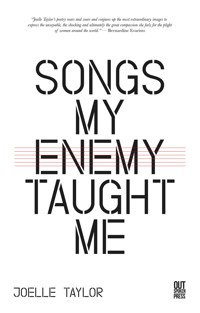
Songs My Enemy Taught Me is a collection of back alley poetry and flick knife tales detailing women's struggle against sexual terrorism and colonisation. Songs of independence. Songs of survival. Songs of uprising. Comprised of poetry, text messages, landays, letters and news flashes these are stories plucked from women's lips across the globe and re-imagined by award-winning poet, playwright, and author Joelle Taylor. Some stories are her own. Others are yours.
Das E-Book können Sie in Legimi-Apps oder einer beliebigen App lesen, die das folgende Format unterstützen:
Seitenzahl: 140
Veröffentlichungsjahr: 2017
Ähnliche











SONGS MY ENEMY TAUGHT ME . JOELLE TAYLOR
Published by Out-Spoken Press
All rights reserved© Joelle Taylor
The right of Joelle Taylor to be identified as the author of this work has been asserted by him in accordance to section 77 of the Copyright, Design and Patent Act 1988.
This book is in copyright. Subject to statutory exception and to provisions of relevant collective licensing agreements, no reproduction of any part may take place without the written permission of Out-Spoken Press.
First edition published 2017
ISBN: 978-0-9931038-7-2
Design & Art DirectionBen Lee
Printed & Bound by:Print Resource
Typeset in: Baskerville
SONGS
MY
ENEMY
TAUGHT
ME
Contents
Introduction
Foreword by Sabrina Mahfouz
Songs of Silence:
canto
flirting with death
my father, the lord of war
skin cells
first they separate the men from the women
pub street
fuck you’s
event horizon
marching song
homs sweet homs
god is an atheist
letters home
wedding present
eulogy for the walking
360
invisible women
the old god
Songs of Survival:
colony
the night butterflies
landmines
the long grass
the hole of us
mary, patron saint of slags
free speech
men who live beneath bridges 1
men who live beneath bridges 2
umbilical
fight club
report card
mass
yarls wood
family tree
dark matter
downwind
the length of a piece of string
form poem
United Kingdom
dead name
crown court. prestwich. 1978
avatar
Songs of Uprising:
landays
sea shanty. 1973
ansisters
concerto for the dead
how to love yourself
the legend of your lost tongue
daughters of the sun
commander pigeon
old wives’ tails
protest song
swimming against the song
cocktail hour
the mother of all bombs
(bone) ghosts
hard Brexit
beautiful revolutionary
fishing
everything you have ever lost
exorcism
hysteria – the wandering womb
the geography of fury
anthem
un-broken
#meninist #notallmen
References
Acknowledgements
Introduction
‘…for the female is, as it were, a mutilated male’
— Aristotle, Generation of Animals
Songs My Enemy Taught Me is a collection of poems themed around the experiences of women globally, but it had simple beginnings. It began with me. It began with a small child in a hotel room not wanting to speak. It began with opera, but the kind that cannot be heard. It began at the point at which I ended.
As a child I was sexually assaulted and sexualised by young men who wore uniforms. It is difficult to remember and harder to forget. But this book is the opening of that hotel room door. This book is a run along a well-lit corridor. It is a parent with an open arm and a simple belief in me, as human, as here, as worthwhile. It is all the things that did not happen.
I was a sun-filled child until I reached adolescence, and then everything broke. The pavements shattered around me, the wallpaper stripped, the trees ran away from me, the sky hung low and breathed down my neck. Many reading this will recognise the symptoms of post traumatic shock disorder – the anxiety, the constant feeling of loss, the darkness, the inability to speak, to think, to love, to earn money, to dress, to wash, to smile, to sit to sit to sit. I was continually moving, trying to break free from the skin that had imprisoned me by birth as a woman. I could have been forgiven for believing that I was transgender. But I am not. I am a woman who is afraid of being a woman, and that is very different.
My personal story includes mental health issues, psychiatric hospital, suicide attempts, a repetitive eating disorder, drug addiction, and one fuck of a lot of dancing. Some of the poems within this book refect that experience, from the moment of apocalypse toward healing, recovery and revolution.
But inside every poem is a poem, and inside that there is another one still. The same principle applies to this book. Once I had begun to see myself, I could not help noticing what was happening to women worldwide. Whilst some of the poems are character based or tell stories of individuals1, they are not based on any living woman, but every living woman; a composite. I tried to develop a technique when writing that I thought of as ‘investigative poetry’ much like investigative journalism. This book is what you might get if you crossed a poet with a photo journalist and broke their camera. It’s a restless collection that travels in both space and time.
To help me create the collection I have worked with two of the strongest and most vital editors working in poetry today: Sabrina Mahfouz and Anthony Anaxagorou. They each provided critical support to the project at different stages: Anthony commissioning me in the first place, as well as giving forensic advice on editing; and Sabrina as the Content Editor. All of these poems came from phone conversations with them, hungover meetings in Covent Garden cafes, and endless train journeys. All of these poems came from the fact that they were both listening, and I will never be able to thank them adequately.
I have tried to explore different forms throughout the writing, some of which have worked while many other attempts failed. A number of the poems are made up of report cards, or are news headlines or government forms or internet arranged-marriage profiles. It’s why some of the poems are character based and in the first person, whilst others are written miles above, shot from the nose of a drone.
There are three sections to the book: Songs of Silence, Songs of Survival and Songs of Uprising. Each section is written to represent a stage in our recovery both as individual women and as universal symbol. Think of it as a symphony in three movements. Think of it as revolution.
The writing of this has taken me across the world without leaving my desk. The research process involved reading, interviews, films and conversations. I also led a series of masterclasses across the UK in the period of writing to enable other women to write and own their stories too. The poetry produced in those workshops can be found online in a developing archive of women’s voices at www.joelletaylor.co.uk. None of the women’s stories from those workshops appear in here, apart from the section of Landays, written by Afghan women refugees from Paiwand. In that section the women write in the poetic form of Landay (short, poisonous snake) about their lives and their losses using the old folk form of chant. It is an act of some rebellion in Taliban controlled Afghanistan for any woman to write, and some have been executed for what amounts to poetry. It seemed to me that the only people entitled to write in that form, rich with blood and loss and longing, was the forbidden poets themselves, the women refugees from Afghanistan. You can read more about them further on in this book and on my website.
Toward the end of the collection I have added a list of references, both personal and academic, listing my sources.
No book that attempts to write about the experiences of women worldwide could even begin without serious discussion and thought around ideas of appropriation, and what it means semantically speaking for a white working class woman living in a privileged world to write about those women of colour worldwide who do not have my privilege of relative safety, access to education, and ultimately opportunities to publish.
Please consider these poems news reports - poetry reportage - and help me work toward increasing access to publishing for all women, so that all stories have the prospect of being told directly. An attempt to redress this imbalance in opportunity and access to the arts has been made with a masterclass tour of the UK focussing on marginalised communities of women, generously funded by the Arts Council, and also in the commissioning and paying of women to contribute to the Landay section of the book. Small steps, but they all face forward.
What can be certain from my studies is that misogyny is prevalent in every country on the planet, no matter the dominant political ideologies or faiths. All of the major religions are misogynist in nature, blaming the separation of Man from God on the fall of Woman. Whilst some regimes are more brutal, leading to mass murders of women - both adult and unborn - others are more insidious; the recent removal of reproductive rights from women in America, and the abortion laws in Ireland.
As I write this 3,537 Yazidi women have been kidnapped with at least a third being sold in chains by Daesh; five queer women were beaten outside a UK pub in a misogynist homophobic attack; you can buy a pretty Asian bride over the internet (you can buy girl children there too. The starting price is around $300); in every war recorded ‘enemy’ women are either deported to rape camps or their routine sexual violation is seen as one of the inevitable consequences of war. In short, women are a weapon of war, used as a means of demoralising the male soldiers of opposing sides. Women are abducted and forced to marry strangers in several countries, prominent among them Pakistan and Kyrgyzstan; in China selective abortions have decimated the female population, leading many men to turn to Vietnam to find partners. Most buy them. Elsewhere, New Delhi is declared the ‘Rape Capital of the World’ and lower caste girls are sexually violated and hung from trees outside villages in India; meanwhile the corrective rape of lesbians in South Africa has reached epidemic proportions. Females are prevented from accessing education in over 20 countries, leading to illiteracy for around 110 million children, 60% of whom are girls, which in turn leads to lower job prospects, which in turn culminates in limited resources which in the end spells early death. Vital services essential to women are being cut still further in the UK, including domestic violence refuges and rape crisis lines. Benefits for working women are slashed. Child care provision is limited. In some of our treasured Western democracies women no longer have the right to freedom over their own bodies, their reproductive rights removed by the democratic decision of white men. The UK Conservative party has announced a coalition government with the DUP, a Northern Irish right wing party that believes LGBTQI rights should be abolished and women should not have control over their reproductive rights.
This is a book about that colonisation and terrorism, about invasion and ownership. It is a survival manual, a map, a photograph, a song. It is internet at 2am. It is the way your mother just looked at you. It is the way the girl in front of you on the soft journey home just reached for her keys. This book is your hand reaching for keys.
Joelle Taylor May 2017
1 with the exception of Commander Pigeon and My Father, the Lord of War which are poems based on fictionalised real lives
Foreword
Joelle Taylor is a writer whose words get me fired up before they even get to the ‘real writing’ part of it. The introductions, the notes, the titles to her work take me immediately to a place I have spent days living in and years escaping from. I know a huge number of people who feel the same way and turn to Joelle’s work when there is an urge to remember that there’s positives to be found cemented amongst the paving slabs of pain – even if these positives are only that there is solidarity, that you are not alone.
The beauty of the poetry in Songs My Enemy Taught Me is so extraordinary, that this too becomes a positive, becomes a peg to keep yourself steady but blowing around with incongruous excitement as you read about ‘those whose smiles are snapped washing lines’ and of ‘a mother who hangs a string of bullets around her neck’. Women who are exceptional and exceptionally ordinary. They are the everyday and the everywoman and they are sufering, yes, but they are never defeated and the war imagery that runs explicitly and implicitly throughout this book doesn’t let you forget that for a moment. Women across the globe are engaged in a perennial battle – for autonomy over their bodies, for education, for equal opportunities, for a life free from violence, coercion and manipulation. Even the Scandinavian countries lauded as the most gender equal in the world are home to women having to fight against at least some of these oppressions, be it in the public or private realm. Countries that are engaged in armed battle with other states or with domestic factions are home to women facing a daily struggle for basic survival, but the other battles remain to make their lives even more onerous.
Joelle has worked with a remarkable number of women from such a wide range of backgrounds and with such unique experiences, that it is heartening to feel the absolute thread of solidarity that runs through the contemporary struggles examined in this book, whilst acknowledging that each struggle is specific and weighed down with its own history of racist, homophobic, ableist, transphobic, Islamophobic, anti-semitic, whorephobic, xenophobic misogyny.
The bravery of sharing her own traumatic experience as a child has in no way held Joelle back in her ingenious use of experimental form and highly metaphorical imagery. If anything, it has strengthened every word, imbued as the reader knows it is with the skin, sky, sun, clothes, smiles and butterflies that have helped hold the writer together over the years and will no doubt now do the same for countless others. A quote from the poem ‘Colony’ stays with me as an image of both exploitation and empowerment that this book encapsulates so movingly and powerfully:
‘the emperor is wearing clothes, daughter and they are yours.’
I hope you feel ready to join the universal fight for all daughters to get those clothes back after reading this startling and stunning book.
Sabrina Mahfouz
“Make it political as hell.
Make it irrevocable beautiful.”
—Toni Morrison
for Ann Hurley and Kathleen Searyand for all our mothers
SONGSOFSILENCE
Silence was a song my enemy taught me
Canto
(i)
I carry the war in my womb.
At night it kicks
and sings stories of the
first night that war came calling.
Blackpool.
1973.
Small. We are refugees of the economic crisis that has cut power lines and muted the mouths of coal mines and left uroborus dole queues failing in its wake.
The seaside hotel flung open its doors for us, and flapped its window sashes, as we arrived to make camp for the winter. Songs were written about us.
We pitched our tents in the living room. It was Christmas. Strangers’ ballroom-danced around us.
At midnight we dug ourselves into our muddy beds. Everybody slept. I stayed on watch. I am still on watch.
When the war came I was eating vol-au-vents from a paper plate. When the war came I was forcing my Cindy doll into a shapeless Eagle Eye action man uniform. When the war came I was sellotaping a rife to the frozen hand of my Barbie.
When the war came it was gentle. When the war came it was singing. The scent of war is Old Spice, is lager, is late night take away. The sound of war is silence. Is a small girl with a mouth as wide as a coal mine that eats the whole town.
In the morning there were boot marks across the board games.
(ii)
The bed is cold and my teeth are abandoned buildings
and somewhere there is the smell of something burning
a book. a fag. a letter.
In my room at the top of the seaside hotel
there is a single bed with a white sheet.
I cannot think of anything to write on it.
The bed is a slowly developing photograph:
Here’s us around the dinner table
we are smiling like carved meat;
no one notices that the daughter is eating herself.
Here’s you walking home from school
your shadow walks behind you as if ashamed
even the trees whisper about you
you have embarrassed the wind.
Here’s him. And him. And him.
A family portrait. Successful. Ironing their uniforms and double-folding
their smiles
catching children delivered from the conveyor belt of their wives’ wombs
and holding them up to the bare lightbulb to bless.
It’s okay. They are boys.
Here are the stairs
and here, the long corridor you are afraid to walk along
perhaps it is your cervix.
It is your cervix.
(iii)
My womb is a war zone after everything is taken.
After the soldiers have left
spitting into the palms of their hands
after the shelves have been emptied and only sell nothing




