


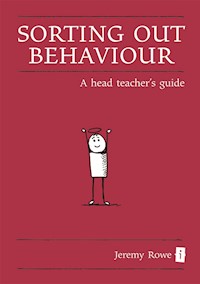
13,19 €
Mehr erfahren.
- Herausgeber: Independent Thinking Press
- Kategorie: Bildung
- Sprache: Englisch
Rob Plevin was an outdoor instructor, corporate trainer and youth worker for young people in crisis before finally following his dream and becoming a teacher. He runs the website www.behaviourneeds.com and provides training courses and resources to help teachers, lecturers, care workers and parents successfully deal with challenging young people. Founder and Managing Director of aptly named Independent Thinking Ltd, Ian Gilbert is the author of the bestselling Essential Motivation in the Classroom. He set up Independent Thinking Ltd to "enrich the lives of young people by changing the way they think". He has worked with thousands of young people, teachers, parents and governors both in the UK and abroad.
Das E-Book können Sie in Legimi-Apps oder einer beliebigen App lesen, die das folgende Format unterstützen:
Veröffentlichungsjahr: 2013
Ähnliche



















Praise for Sorting Out Behaviour
I strongly recommend this extremely useful and practical guide, which demonstrates that effective behaviour management is about clarity, transparency, consistency and a set of manageable policies and procedures which are kept under constant review. Drawing on the author’s vast, first-hand experience, it is a source of common sense and practical pointers which would enable all school staff from trainees to experienced school leaders to review their behaviour policies, practices and procedures.
Brian Lightman, General Secretary, Association of School and College Leaders
Thank you to Jeremy Rowe for providing a plain English, common sense, easy to read guide about behaviour. Perhaps more importantly, he reminds us that children aren’t criminals and that most schools are calm, productive, orderly places that are far removed from the image so often portrayed in the media. We need to hear that message more often.
Fiona Millar, Guardian Columnist
This book is dedicated to the hundreds of thousands of children who, despite leading difficult lives, come to our schools every day in a spirit of generosity and hope. It is an honour and a privilege to have the chance to build schools in which these fantastic children can soar, become great and leave their trace across the sky.
And to Harriet, of course, with love.
Contents
Introduction
Like most of us, I’ve worked in schools that have got their approach to behaviour right and in some that have got it wrong. Right is better. I’ve been lucky to have had the opportunity to work with magnificent teams at Pool Academy in Cornwall and Sir John Leman High School in Suffolk, both of which are packed with colleagues who know it is possible to improve and have been prepared to do what is needed to make that improvement happen.
By working together consistently and strategically, both schools were able to see genuine improvements. This can only be achieved by teams unswervingly operating value-based systems. Without that, staff are out on a limb and the minority of students who can be difficult will have a field day.
Like you, I am doing the job day-in and day-out and, like you, I get it wrong sometimes. In fact, the minute you think you’ve sussed it, a child will literally take your legs from under you! Remembering that is quite helpful, I think.
My basic view is that behaviour is about choice. That doesn’t mean that situations are equally easy for all of us to handle, but I believe that if we factor choice out of a situation we could be robbing an individual of their entitlements and their independence. If we were all predestined to behave in certain ways, all responses would be predictable. People choose how they behave. All of us.
Below is a short quiz:
Can bad behaviour be eradicated in our schools?
Can it be improved?
Should we try to improve it?*
For me, everything became clear as a result of one early conversation I had in which I was told there was no soap in the students’ toilets because ‘they messed around with it’. What this meant was that a couple of students did. What it really meant, though, was both profound and frightening. It did not simply mean that one or two students were running the school. They had in fact, been given the power to do something much more important. They were being allowed to define the school. No child could wash their hands because one or two students didn’t want them to. From that point onwards, I made a virtue out of taking risks with what students could ‘cope with’ – and never looked back.
I hope that this book provides a straightforward description of what we do, and why we feel these approaches work. None of the ideas are patented; all of them are taken wholesale or adapted from other schools. You will know the idiosyncrasies of your own school and what would be successful.
I’m not using a Marxist or feminist perspective – mainly because I don’t understand them. I haven’t done a lot of research either, because I was too busy actually improving our school – so there aren’t twenty pages of references at the back. Sorry.
Incidentally, it is important to remember that children are not criminals and that the negative behavioural choices a minority occasionally make are not crimes. Our job isn’t about retribution; it is about ensuring young people learn from their mistakes, so they can take their place in society and succeed.
My intention is to set out a simple, occasionally slightly difficult, approach to student behaviour that actually works. My school isn’t perfect, but it is better as a result. And that’s important.
Key points
All schools can be made even better
The outcome is worth it
The students are worth it
* Answers: No, Yes, Yes.




