


65,99 €
Mehr erfahren.
- Herausgeber: John Wiley & Sons
- Kategorie: Wissenschaft und neue Technologien
- Sprache: Englisch
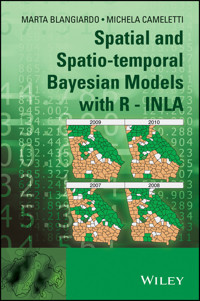
Spatial and Spatio-Temporal Bayesian Models with R-INLA provides a much needed, practically oriented & innovative presentation of the combination of Bayesian methodology and spatial statistics. The authors combine an introduction to Bayesian theory and methodology with a focus on the spatial and spatio-temporal models used within the Bayesian framework and a series of practical examples which allow the reader to link the statistical theory presented to real data problems. The numerous examples from the fields of epidemiology, biostatistics and social science all are coded in the R package R-INLA, which has proven to be a valid alternative to the commonly used Markov Chain Monte Carlo simulations
Sie lesen das E-Book in den Legimi-Apps auf:
Seitenzahl: 437
Veröffentlichungsjahr: 2015
Ähnliche



















Table of Contents
Cover
Title Page
Copyright
Dedication
Preface
Chapter 1: Introduction
1.1 Why spatial and spatio-temporal statistics?
1.2 Why do we use Bayesian methods for modeling spatial and spatio-temporal structures?
1.3 Why INLA?
1.4 Datasets
References
Chapter 2: Introduction to R
2.1 The
R
language
2.2
R
objects
2.3 Data and session management
2.4 Packages
2.5 Programming in
R
2.6 Basic statistical analysis with
R
References
Chapter 3: Introduction to Bayesian methods
3.1 Bayesian philosophy
3.2 Basic probability elements
3.3 Bayes theorem
3.4 Prior and posterior distributions
3.5 Working with the posterior distribution
3.6 Choosing the prior distribution
References
Chapter 4: Bayesian computing
4.1 Monte Carlo integration
4.2 Monte Carlo method for Bayesian inference
4.3 Probability distributions and random number generation in
R
4.4 Examples of Monte Carlo simulation
4.5 Markov chain Monte Carlo methods
4.6 The integrated nested Laplace approximations algorithm
4.7 Laplace approximation
4.8 The
R-INLA
package
4.9 How INLA works: step-by-step example
References
Chapter 5: Bayesian regression and hierarchical models
5.1 Linear regression
5.2 Nonlinear regression: random walk
5.3 Generalized linear models
5.4 Hierarchical models
5.5 Prediction
5.6 Model checking and selection
References
Chapter 6: Spatial modeling
6.1 Areal data – GMRF
6.2 Ecological regression
6.3 Zero-inflated models
6.4 Geostatistical data
6.5 The stochastic partial differential equation approach
6.6 SPDE within
R-INLA
6.7 SPDE toy example with simulated data
6.8 More advanced operations through the
inla.stack
function
6.9 Prior specification for the stationary case
6.10 SPDE for Gaussian response: Swiss rainfall data
6.11 SPDE with nonnormal outcome: malaria in the Gambia
6.12 Prior specification for the nonstationary case
References
Chapter 7: Spatio-temporal models
7.1 Spatio-temporal disease mapping
7.2 Spatio-temporal modeling particulate matter concentration
References
Chapter 8: Advanced modeling
8.1 Bivariate model for spatially misaligned data
8.2 Semicontinuous model to daily rainfall
8.3 Spatio-temporal dynamic models
8.4 Space–time model lowering the time resolution
References
Index
End User License Agreement
Pages
xi
xii
1
2
3
4
5
6
7
8
9
10
11
12
13
14
15
16
17
18
19
20
21
22
23
24
25
26
27
28
29
30
31
32
33
34
35
36
37
38
39
40
41
42
43
44
45
46
47
48
49
50
51
52
53
54
55
56
57
58
59
60
61
62
63
64
65
66
67
68
69
70
71
72
73
74
75
76
77
78
79
80
81
82
83
84
85
86
87
88
89
90
91
92
93
94
95
96
97
98
99
100
101
102
103
104
105
106
107
108
109
110
111
112
113
114
115
116
117
118
119
120
121
122
123
124
125
126
127
128
129
130
131
132
133
134
135
136
137
138
139
140
141
142
143
144
145
146
147
148
149
150
151
152
153
154
155
156
157
158
159
160
161
162
163
164
165
166
167
168
169
170
171
172
173
174
175
176
177
178
179
180
181
182
183
184
185
186
187
188
189
190
191
192
193
194
195
196
197
198
199
200
201
202
203
204
205
206
207
208
209
210
211
212
213
214
215
216
217
218
219
220
221
222
223
224
225
226
227
228
229
230
231
232
233
234
235
236
237
238
239
240
241
242
243
244
245
246
247
248
249
250
251
252
253
254
255
256
257
258
259
260
261
262
263
264
265
266
267
268
269
270
271
272
273
274
275
276
277
278
279
280
281
282
283
284
285
286
287
288
289
290
291
292
293
294
295
296
297
298
299
300
301
302
303
304
305
306
307
308
Guide
Cover
Table of Contents
Preface
Begin Reading
List of Illustrations
Figure 1.1
Figure 1.2
Figure 1.3
Figure 1.4
Figure 1.5
Figure 1.6
Figure 1.7
Figure 1.8
Figure 1.9
Figure 1.10
Figure 1.11
Figure 1.12
Figure 1.13
Figure 1.14
Figure 2.1
Figure 2.2
Figure 2.3
Figure 2.4
Figure 3.1
Figure 3.2
Figure 3.3
Figure 3.4
Figure 3.5
Figure 3.6
Figure 3.7
Figure 3.8
Figure 4.1
Figure 4.2
Figure 4.3
Figure 4.4
Figure 4.5
Figure 4.6
Figure 4.7
Figure 4.8
Figure 4.9
Figure 4.10
Figure 4.11
Figure 4.12
Figure 4.13
Figure 4.14
Figure 4.15
Figure 4.16
Figure 5.1
Figure 5.2
Figure 5.3
Figure 5.4
Figure 5.5
Figure 5.6
Figure 5.7
Figure 5.8
Figure 5.9
Figure 5.10
Figure 5.11
Figure 5.12
Figure 5.13
Figure 5.14
Figure 5.15
Figure 5.16
Figure 5.17
Figure 5.18
Figure 5.19
Figure 6.1
Figure 6.2
Figure 6.3
Figure 6.4
Figure 6.5
Figure 6.6
Figure 6.7
Figure 6.8
Figure 6.9
Figure 6.10
Figure 6.11
Figure 6.12
Figure 6.13
Figure 6.14
Figure 6.15
Figure 6.16
Figure 6.17
Figure 6.18
Figure 6.19
Figure 6.20
Figure 6.21
Figure 6.22
Figure 6.23
Figure 6.24
Figure 6.25
Figure 7.1
Figure 7.2
Figure 7.3
Figure 7.4
Figure 7.5
Figure 7.6
Figure 7.7
Figure 7.8
Figure 7.9
Figure 7.10
Figure 7.11
Figure 7.12
Figure 8.1
Figure 8.2
Figure 8.3
Figure 8.4
Figure 8.5
Figure 8.6
Figure 8.7
Figure 8.8
Figure 8.9
Figure 8.10
Figure 8.11
Figure 8.12
Figure 8.13
Figure 8.14
Figure 8.15
Figure 8.16
Figure 8.17
Figure 8.18
Figure 8.19
Figure 8.20
Figure 8.21
Figure 8.22
Figure 8.23
Figure 8.24
Figure 8.25
Figure 8.26
Figure 8.27
List of Tables
Table 3.1
Table 3.2
Table 4.1
Table 4.2
Table 4.3
Table 5.1
Table 6.1
Table 6.2
Table 6.3
Table 6.4
Table 6.5
Table 6.6
Table 7.1
Table 7.2
Spatial and Spatio-temporal Bayesian Models with R-INLA
Marta Blangiardo
MRC-PHE Centre for Environment and Health, Department of Epidemiology and Biostatistics, Imperial College London, UK
Michela Cameletti
Department of Management, Economics and Quantitative Methods, University of Bergamo, Italy
This edition first published 2015
© 2015 John Wiley & Sons, Ltd
Registered office
John Wiley & Sons Ltd, The Atrium, Southern Gate, Chichester, West Sussex, PO19 8SQ, United Kingdom
For details of our global editorial offices, for customer services and for information about how to apply for permission to reuse the copyright material in this book please see our website at www.wiley.com.
The right of the author to be identified as the author of this work has been asserted in accordance with the Copyright, Designs and Patents Act 1988.
All rights reserved. No part of this publication may be reproduced, stored in a retrieval system, or transmitted, in any form or by any means, electronic, mechanical, photocopying, recording or otherwise, except as permitted by the UK Copyright, Designs and Patents Act 1988, without the prior permission of the publisher.
Wiley also publishes its books in a variety of electronic formats. Some content that appears in print may not be available in electronic books.
Designations used by companies to distinguish their products are often claimed as trademarks. All brand names and product names used in this book are trade names, service marks, trademarks or registered trademarks of their respective owners. The publisher is not associated with any product or vendor mentioned in this book.
Limit of Liability/Disclaimer of Warranty: While the publisher and author have used their best efforts in preparing this book, they make no representations or warranties with respect to the accuracy or completeness of the contents of this book and specifically disclaim any implied warranties of merchantability or fitness for a particular purpose. It is sold on the understanding that the publisher is not engaged in rendering professional services and neither the publisher nor the author shall be liable for damages arising herefrom. If professional advice or other expert assistance is required, the services of a competent professional should be sought.
Library of Congress Cataloging-in-Publication Data
Blangiardo, Marta.
Spatial and spatio-temporal Bayesian models with R-INLA / by Marta Blangiardo and Michela Cameletti.
pages cm
Includes bibliographical references and index.
ISBN 978-1-118-32655-8 (cloth)
1. Bayesian statistical decision theory. 2. Spatial analysis (Statistics) 3. Asymptotic distributiona (Probability theory) 4. R (Computer program language) I. Cameletti, Michela. II. Title.
QA279.5.B63 2015
519.5′42—dc23
2015000696
A catalogue record for this book is available from the British Library.
ISBN: 9781118326558
To MM, Gianluca, Kobi and Clarissa: now we can enjoy life again!
Preface
This book presents the principles of Bayesian theory for spatial and spatio-temporal modeling, combining three aspects: (1) an introduction to Bayesian thinking and theoretical aspects of the Bayesian approach, (2) a focus on the spatial and spatio-temporal models used within the Bayesian framework, (3) a series of practical examples which allow the reader to link the statistical theory presented to real data problems. All the examples are coded in the R package R-INLA, and based on the recently developed integrated nested Laplace approximation (INLA) method, which has proven to be a valid alternative to the commonly used Markov Chain Monte Carlo (MCMC) simulations.
The book starts with an introduction in Chapter 1, providing the reader with the importance of spatial and spatio-temporal modeling in several fields, such as social science, environmental epidemiology, and infectious diseases epidemiology. We then show why Bayesian models are commonly used in these fields and why we focus on the INLA approach. We also describe the datasets which will be used in the rest of the book, providing information on the topics that will be used as illustration.
As all the examples are run in R, in Chapter 2 we introduce the basic concepts of the R language. Chapter 3 describes the Bayesian methods: first we introduce the paradigms of this approach (i.e., the concepts of prior and posterior distributions, Bayes theorem, conjugacy, how to obtain the posterior distribution, the computational issues around Bayesian statistics for conjugated and non conjugated models). We also include a small section on the differences between the frequentist and the Bayesian approach, focusing on the different interpretation of confidence intervals, parameters, and hypothesis testing.
Chapter 4 discusses the computational issues regarding Bayesian inference. After the Monte Carlo method is introduced, we consider MCMC algorithms, providing some examples in R for the case of conjugated and non conjugated distributions. The focus of the chapter is the INLA method, which is a computationally powerful alternative to MCMC algorithms. In particular, the R-INLA library is described by means of a small tutorial and of a step-by-step example.
Then in Chapter 5 we present the Bayesian modeling framework which is used in the fields introduced in Chapter 1 and focuses on regression models (linear and generalized linear models). In this context, we introduce the concept of exchangeability and explain how this is used to predict values from variables of interest, a topic which will be expanded later in the chapters on spatial andspatio-temporal modeling. The last section of this part is devoted to introducing hierarchical models.
Chapter 6 focuses on models for two types of spatial processes: (1) area level—introducing disease mapping models and small area ecological regressions (including risk factors and covariates) and then presenting zero inflated models for Poisson and Binomial data; (2) point level—presenting Bayesian kriging through the stochastic partial differential equations (SPDE) approach and showing how to model observed data and also to predict for new spatial locations. Chapter 7 extends the topics treated in Chapter 6 adding a temporal dimension, where we also include the time dimension in the models.
Finally, Chapter 8 introduces new developments within INLA and focuses on the following advanced applications: when data are modeled using different likelihoods, when missing data are present in covariates, a spatio-temporal model with dynamic evolution for the regression coefficients, and a spatio-temporal model for high-frequency data on time where a temporal resolution reduction is needed.
We would like to thank many people who helped with this book: Håvard Rue for his precious contribution, his endless encouragement and for introducing us to Elias Krainski, who became involved in the book; Finn Lindgren, Aurelie Cosandey Godin and Gianluca Baio for reading drafts of the manuscript and providing useful comments; Philip Li, Ravi Maheswaran, Birgit Schrödle, Virgilio Gómez-Rubio, and Paola Berchialla, who provided some of the datasets; finally, a huge thank to our families who have supported us during all this time.
We hope that this book can be helpful for readers at any level, wanting to familiarize or increase their practice and knowledge of the INLA method. Those who are approaching the Bayesian way of thinking for the first time could follow it from the beginning, while those who are already familiar with R and Bayesian inference can easily skip the first chapters and focus on spatial and spatio-temporal theory and applications.
Marta Blangiardo and Michela Cameletti
Chapter 1Introduction
1.1 Why spatial and spatio-temporal statistics?
In the last few decades, the availability of spatial and spatio-temporal data has increased substantially, mainly due to the advances in computational tools which allow us to collect real-time data coming from GPS, satellites, etc. This means that nowadays in a wide range of fields, from epidemiology to ecology, to climatology and social science, researchers have to deal with geo-referenced data, i.e., including information about space (and possibly also time).
As an example, we consider a typical epidemiological study, where the interest is to evaluate the incidence of a particular disease such as lung cancer across a given country. The data will usually be available as counts of diseases for small areas (e.g., administrative units) for several years. What types of models allow the researchers to take into account all the information available from the data? It is important to consider the potential geographical pattern of the disease: areas close to each others are more likely to share some geographical characteristics which are related to the disease, thus to have similar incidence. Also how is the incidence changing in time? Again it is reasonable to expect that if there is a temporal pattern, this is stronger for subsequent years than for years further apart.
As a different example, let us assume that we are now in the climatology field and observe daily amount of precipitation at particular locations of a sparse network: we want to predict the rain amount at unobserved locations and we need to take into account spatial correlation and temporal dependency.
Spatial and spatio-temporal models are now widely used: typing “statistical models for spatial data” in ™Google Scholar returns more than 3 million hits and “statistical models for spatio-temporal data” gives about 159,000. There are countless scientific papers in peer review journals which use more or less complex and innovative statistical models to deal with the spatial and/or the temporal structure of the data in hand, covering a wide range of applications; the following list only aims at providing a flavor of the main areas where these types of models are used: Haslett and Raftery (1989), Handcock and Wallis (1994) and Jonhansson and Glass (2008) work in the meteorology field; Shoesmith (2013) presents a model for crime rates and burglaries, while Pavia et al. (2008) used spatial models for predicting election results; in epidemiology Knorr-Held and Richardson (2003) worked on infectious disease, while Waller et al. (1997) and Elliott et al. (2001) presented models for chronic diseases. Finally, Szpiro et al. (2010) focused on air pollution estimates and prediction.
1.2 Why do we use Bayesian methods for modeling spatial and spatio-temporal structures?
Several types of models are used with spatial and spatio-temporal data, depending on the aim of the study. If we are interested in summarizing spatial and spatio-temporal variation between areas using risks or probabilities then we could use statistical methods like disease mapping to compare maps and identify clusters. Moran Index is extensively used to check for spatial autocorrelation (Moran, 1950), while the scan statistics, implemented in SaTScan (Killdorf, 1997), has been used for cluster detection and to perform geographical surveillance in a non-Bayesian approach. The same types of models can also be used in studies where there is an aetiological aim to assess the potential effect of risk factors on outcomes.
A different type of study considers the quantification of the risk of experiencing an outcome as the distance from a certain source increases. This is typically framed in an environmental context, so that the source could be a point (e.g., waste site, radio transmitter) or a line (e.g., power line, road). In this case, the methods typically used vary from nonparametric tests proposed by Stone (1988) to the parametric approach introduced by Diggle . (1998).
Lesen Sie weiter in der vollständigen Ausgabe!
Lesen Sie weiter in der vollständigen Ausgabe!
Lesen Sie weiter in der vollständigen Ausgabe!
Lesen Sie weiter in der vollständigen Ausgabe!
Lesen Sie weiter in der vollständigen Ausgabe!
Lesen Sie weiter in der vollständigen Ausgabe!
Lesen Sie weiter in der vollständigen Ausgabe!
Lesen Sie weiter in der vollständigen Ausgabe!
Lesen Sie weiter in der vollständigen Ausgabe!
Lesen Sie weiter in der vollständigen Ausgabe!
Lesen Sie weiter in der vollständigen Ausgabe!




