


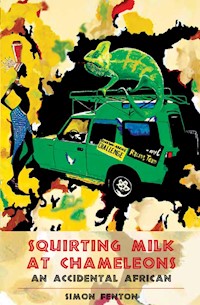
8,39 €
Mehr erfahren.
- Herausgeber: Eye Press
- Kategorie: Gesellschafts- und Liebesromane
- Sprache: Englisch
On the cusp of middle age, Simon Fenton leaves Britain in search of adventure and finds Senegal, love, fatherhood, witch doctors â€" and a piece of land that could make a perfect guest house, if only he knew how to build one. The Casamance is an undiscovered paradise where mystic Africa governs life, people walk to the beat of the djembe, when it rains it pours and the mangos are free. But the fact that his name translates to 'vampire' and he has had a curse placed on him via the medium of eggs could mean Simon's new life may not be so easy.
Das E-Book können Sie in Legimi-Apps oder einer beliebigen App lesen, die das folgende Format unterstützen:
Veröffentlichungsjahr: 2015
Ähnliche



















Published in 2015by Eye Books29A Barrow StreetMuch WenlockShropshireTF13 6EN
www.eye-books.com
ISBN: 978-1-903070-91-8
Copyright © Simon Fenton, 2015Cover by Bert Stiekma and Simon Fenton
The moral right of the author has been asserted. All rights reserved. No part of this publication may be reproduced, stored in a retrieval system, or transmitted, in any form or by any means without the prior written permission of the publisher, nor be otherwise circulated in any form of binding or cover other than that in which it is published and without a similar condition being imposed on the subsequent purchaser.
British Library Cataloguing in Publication DataA catalogue record for this book is available from the British Library
Printed by CPI Group (UK) Ltd, Croydon CR0 4YY
Contents
Senegal and the Casamance
The Gris-Gris
A New Life
Toubab
I Dream of Africa
Bleat, Pray, Love
This is Africa
The Little Baobab
Mango Time
The Soul of Africa
Boily Boily
Cooly Cooly
The Casamance
Palm Wine Drunkards
The Tree of Life
Things Fall Apart
Photographs
Epilogue
Further Information
“Abarakas” (Acknowledgements)
About Eye Books
About the Author
To Khady, Gulliver and Alfie
Senegal and the Casamance
The Gris-Gris
The Baye Fall are Sufi mystics: a whirl of bright patchwork robes, beads and dreadlocks. In Dakar, one is trying to sell me some tourist tat, but he realises I don,t have any money left. So we sit and chat around a fire on the sandy roadside. His name is Ibrahima and before long, he beats a rhythm with a plastic water bottle and chants:
“Simon, I wish you long life, I wish you good life ...”
Later, as I prepare to leave, Ibrahima pulls off one of his many necklaces, which consist of small leather pouches on cords.
“This a gris-gris, wear it to protect you when you travel. Never take it off. Never give it to anyone.”
The day after I nearly died, I sat in the Senegalese gloom, sweating and aching, whilst a bare-chested black man vigorously rubbed my back. He took my head and violently cricked my neck, shoved a knee in my back and pulled on my shoulders. I felt my spine crack, then I rolled exhausted, onto the floor.
I was in a small mud-floored chamber with a dirty mattress and posters of American superheroes pinned to the wall. By my side was Khady, a beautiful Diola tribe girl who worked at the house I was looking after. We’d travelled together to the provincial capital of Ziguinchor to try to connect said house to the electricity grid and to collect her identity card.
The trip was unsuccessful. The man at the electricity company – who was working hard in his hammock when we arrived – said he’d been too busy to complete the connection. Definitely next week, though.
“Okay, great, see you next week.”
“Inshallah,” he replied. This translates as “Yes, if God wills it”. But in real terms it meant that we might have electricity in the next few months or we might not.
If I were a betting man I’d have tended towards the latter.
As for Khady’s identity card, that took a further two years.
The masseuse was named Tierno and he was a marabout – a West African Islamic holy man who is a kind of shaman, sometimes known as a witch doctor. Tierno was also Khady’s brother-in-law. The previous evening, she and I had been on a local bus when a tyre burst, causing us to crash. We were up front near the driver, who was drunk, and everyone was screaming as the top-heavy vehicle swerved from one side of the road to the other. I felt an odd calm knowing that I had a slim chance of surviving this crash. It wasn’t so much my life flashing before my eyes as a satisfaction that despite the mistakes, the struggles and the disappointments, I had lived my life my way, mostly happily, and in a way I was proud of. I was ready, which is not to say I wasn’t shitting myself.
That evening, after the crash, I crouched in the dark and ladled water over myself to wash off the diesel, dust and blood. I felt Ibrahima’s gris-gris around my neck and when I returned to the house, voiced my cynicism. It hadn’t worked; the gris-gris was nothing but superstitious nonsense.
“Of course it worked. You were the only person to walk out of the crash without even a scratch, weren’t you?” Khady replied.
As the crash occurred, the bus skidded on its side for a few hundred metres as everybody screamed. The windscreen popped outwards and I clung to the side window, holding Khady with my left arm for as long as I could before being jolted off. We both fell on the driver.
As we slid to a stop, I felt the warm wet spray of diesel in my face and heard a cacophony of moans and groans. Khady was dead; I was sure of it. I went through the motions of dragging her out, panicking as I thought the whole bus would blow – a Hollywood fallacy, of course. Thankfully, she came around and we were able to assist others to safety.
Apart from my emergence without a single scratch, there were a couple of other remarkable things about this accident. First, we were only a mile or two away from a military hospital, and the medics arrived within minutes. Second, Khady’s uncle lived minutes from this military base. In hindsight, the latter fact seems less remarkable – it doesn’t matter where we are in the province, Khady will always be related to somebody there, often someone useful like Tierno. My bag was lying in a bush about 15 metres away. It had been ejected through the front window. I am writing these words on my laptop, which – along with my camera – was in that bag and survived as unharmed as myself.
At this point, Khady and I could barely communicate through language, but we seemed to understand each other perfectly. Tierno had finished roughing me up and she indicated that he was going to give a reading. These procedures are important after a near-miss with death. He carefully unwrapped a dirty cotton cloth, tied at the corners. Out fell a collection of beads, shells, old coins and bones.
He threw them into the dust, raised his fingers to his temples, closed his eyes and made a pronouncement. Khady translated.
“You will have a child in Africa.”
I laughed. “Yeah, right.” I had tried to have a baby for nearly 10 years with my ex-wife back in England, and had reached the point where I figured it just wasn’t going to happen. I was cool with that. Although I’d have liked a family and the experience of being a dad, I also loved travelling and my freedom. Besides, Khady and I were only just beginning to make tentative steps towards a relationship, and at that point everything felt way too crazy to take seriously.
The date was 31 March, 2011.
A New Life
Khady and I walk along a sand track with our son strapped to her back. There is not a cloud in the sky and the sun beats down as we shuffle along trying to keep in the shade of the cashew trees. Abruptly, Khady halts, beckoning for me to do likewise. Ahead, crossing our path, is a strange creature – a chameleon, almost luminous green in colour – with an alien head and an odd circular motion to its limbs. Without missing a beat Khady pulls out a breast and with a deadly aim, fires milk at it.
“What the …?”
“If I don’t offer it milk, our son will grow up to look like a lizard,” she explains.
Clearly I have a lot to learn about life in Africa.
31 March, 2012
Khady woke me from a deep sleep. Bleary eyed, I pulled together some belongings and guided her, groaning, towards our Land Rover. It was 3am. We set off down the deeply rutted sand tracks through the dark forest towards the small village clinic. I parked and Khady leaned against the truck, clearly in agony.
“Simon, it hurts. Help me, help me.”
I plunged into the darkness, knocking on doors until I found and woke up Ndoumbe, the midwife.
After much deliberation, Khady and I had decided to have the baby at the maternity ward in the local village. Ndoumbe had impressed us and the ward had been recently fitted out by a French philanthropist. When I say “fitted out”, this meant it had basic equipment and a fresh lick of paint, not new incubators and so on. They just had three light bulbs wired in above a bench.
It was mostly me doing the worrying; Khady was casual about the whole affair. It turns out that women have babies all the time in Africa. In the event, she started labour both in the middle of the night and 10 days early, so even had we made the decision to go to a European clinic in neighbouring Gambia, we’d never have been there in time.
Forty minutes later, a little boy popped out. A wriggling blue slimy thing who, after a few minutes, turned surprisingly white.
The previous day, Khady had been swimming in the sea and running up and down the beach. I had to stop her from carrying a 20-litre water drum on her head. African women are strong. In Africa, having a baby is, well, just having a baby.
A little later while looking back through my diaries, I realised that the date was 31 March – exactly one year to the day of Tierno’s premonition.
Khady Mané has always been strong. I first met her when she was working at a house I was staying in. I saw her folding sheets and as she looked up she gave a huge grin that lit up her face. For the next week, she was a distinct and silent presence that I felt inexplicably drawn to. She had no formal education, but a wisdom and presence lacking in many people I’ve met who have strings of degrees, and she spoke seven languages.
Although English was not one of the languages she spoke, we seemed to instinctively understand each another. When the house owner asked me to look after her home while she visited Europe, I leapt at the opportunity. Khady and I quickly became firm friends, but it was the bus crash that jump-started our relationship. I resisted at first as I felt like a burnt-out husk, unable to ever care or love again. But there’s an African proverb: “Wood that has burnt once is easier to set aflame,” and one day I realised I never wanted to leave.
Khady was born in the Casamance province of Senegal in 1981 during a period of upheaval and war. Like many people here, where birthdays aren’t generally celebrated, she doesn’t know her date of birth. When she finally renewed her identity card, she gave her birth year as 1991, knocking a decade off.
When she was a young girl, her father moved his two wives and 14 children to Dakar, the Senegalese capital. He worked as a mechanic for a French company, and brought his children up well. Senegal, although independent since 1960, was colonised by the French and still retains a strong Francophone influence, including the language, which is used in politics and education. The Casamance, 300 miles south of Dakar, is cut off from the rest of Senegal by the Gambia and hence the local Diola tribes have long wanted their independence.
Three of Khady’s siblings are married to Europeans and she tells me they are “sought after” because they are direct, honest and were taught to marry for love. Senegalese women tend to have a reputation for a healthy interest in money and a visa to Europe. While Khady would like to visit, she has a strong sense of her heritage and no wish to live anywhere other than here.
African children are often passed around the family and Khady was sent to her aunt, who promised to educate her but instead made her work throughout her childhood – washing, cleaning and scrubbing from dawn to dusk. In-between, she had to cook for 20 people. Consequently, Khady never attended school. She later confided in me that the same aunt told her that I was just a source of money to be sucked dry.
In that time, without her aunt knowing, she taught herself six new languages on top of her native Diola – French, Fula, Sera, Wolof, Mandinka and Creole. She saw her mother during this time, but not her father. He was very angry when he found out Khady had not gone to school.
Khady’s great passion is traditional dancing and as a young woman she was a professional, joining a dance troupe called Casadamance at the age of nine. When she was old enough, she left to tour the country with them, including long-term residences on the highly touristic coast to the south of Dakar. They were invited to perform in Europe, but disbanded due to power struggles within the group, much to her dismay. I’ve never seen her perform professionally, but occasionally she’ll let rip at a djembe party. It’s an impressive sight.
Having spent several months in Abene, I went back to England with vague plans to return, and then rapidly slipped back into Western life. But Khady was never far from my thoughts and we spoke whenever possible. The African rains were by now so heavy that telephone communications were often down for a week or more at a time. When we did actually connect we could barely hear or understand each other. Although we could by now communicate reasonably well face-to-face with our odd French-English mélange, on a crackly long-distance line it was a different matter.
Before I had left Senegal, Khady’s pregnant sister had told me that if her baby was a boy, he would be named “Simon Fenton”. So during one conversation with Khady I enquired about her sister’s health. Khady misunderstood me and said that yes, she was pregnant. Khady was pregnant. How did I know, she wondered, not realising that I didn’t?
“Did the Gods tell you? Are you a devil?”
“No, no, I was asking after your sister,” I stuttered, my mind reeling. “Oh, never mind about that now.”
Khady was pregnant! My initial feeling was of joy and relief. In fact, I couldn’t wipe the grin off of my face and I was sure I could hear my heart thumping. But had I really understood correctly? Had she really understood me? Perhaps we were in fact discussing her sister’s baby or some other family member – there are babies everywhere in Senegal. What should have been an ecstatic time became a confused mess. After several nerve-wracking phone calls over the next few weeks, I was about 75 percent sure I was going to be a father. Damn the crackly lines and damn, I needed to improve my French. I was only absolutely certain four months later when I returned to Africa and saw her growing figure.
Aside from my joy levels now running at 80 percent (on the Fenton scale, that’s still nearing ecstatic) due to impending fatherhood, no longer did I have any difficult decisions to make about what to do with my life. I’d left it to chance and the decision had been made for me. I wasn’t just deciding to go back and do the right thing out of obligation. Doing the right thing was forcing me to do what my beating heart told me I really wanted – something that I may have been too scared, or too worried about what others might have thought, to have ever done otherwise.
I later realised that I’d only opened myself to the possibility of that chance because that was what I truly desired. I wasn’t entirely sure where I was heading, but I’ve always thought that if I can see past a challenge, then the challenge isn’t big enough. Somehow and sometime soon I’d go back and support Khady. We’d have our baby and build a life together.
Khady lived in Abene, a small rural village full of artists walking to the beat of the drum, situated on the Atlantic coast of the Casamance just a few miles south of the border with Gambia. With its endless beaches, lush forests, fertile soil and friendly people I could quite easily see myself living there with my new family. And I couldn’t wait.
There were hurdles to overcome, of course. Not least telling my family. They’ve always wholeheartedly supported me and encouraged me to live my life my own way. But I’d never before declared that I was off to live in a mud hut and have a baby with an African woman who I had known fewer than six months and who they had never met. On an uncertain income. (More than three years later and having visited me, they’re on board with the idea.)
Besides having the decision made for me to move to Africa, I was happy at the prospect of actually becoming a dad. In 2005 my first wife, Mikaela, finally became pregnant. For three months we read baby books, told those close to us and investigated the prices of prams. All of our friends were having babies and it was what we wanted more than anything.
Then we went for the three-month scan. Mikaela lay there as the doctor slid the probe over her belly and I held her hand. Then I felt her hand squeeze, glanced at her face and saw tears. No words were needed – the doctor’s face said it all. The baby had a chromosomal abnormality, Edwards Syndrome – one of those one-in-several-million chance things. Even if she had been born, the baby wouldn’t have survived more than two or three days.
Sometimes, events in our own lives are mirrored by those in the wider world. One day we were wildly happy, travelling up to London to have the scan. The city had just been awarded the Olympics and everyone was in a jubilant mood. The sun was shining. We were having a baby. Then, as we learned our bad news, London was hit by terrorist attacks. Looking back, this experience was perhaps one of the nails in the coffin of our relationship. We drifted apart until one day we couldn’t remember when we’d last been happy together.
I fell into a new three-year relationship after that, and although we didn’t set out to have a baby, neither did we take any steps not to. We decided to leave it to fate and, probably for the best, nothing happened. I concluded that it was probably not meant to be. Although part of me craved to be a father, an equal part relished my freedom to travel and live the life of a bachelor. Well, that’s what I told myself – until my happiness upon hearing Khady’s words revealed my true feelings.
This jubilation was all very well, but I also had to think about what I would do in Africa. Khady was adamant she wanted to stay in Senegal. It was unlikely she’d be able to land herself much more than a menial job in the UK, or perhaps teach dance. My career had reached a plateau and was ready to start a descent, unless I took radical steps. At that point, quite frankly, I’d lost interest. I wanted family, community, adventure and to nurture my creative side.
In my twenties I’d worked for the private sector and in my thirties in social enterprises, trying to make the world a better place. Now, recently turned 40, I needed to follow my own passions and do something for myself. I’d always loved photography and wanted to pursue it professionally. This would be difficult in the UK and especially in Brighton, where every other person seemed to be an artist and photographer. Perhaps Africa was my chance, where I could take images of extraordinary things. I also wanted to write. So I could write a blog, sell articles and images, host tourists, lead tours, run music-and-photography workshops and other things.
We’d have to look at buying land and building a house, along with rooms for guests to stay in. Not only would paying guests provide me with European companionship, but would help supplement our income. I’d backpacked for years and knew exactly the kind of places I liked to stay in. I could take the best ideas from around the world and create an ideal spot to relax; a base from which to explore; a centre for culture and the arts, as well as a personal retreat for a world-weary man wanting to get away from it all and write his first novel.
It was all starting to look like an exciting – and more importantly – realistic proposition. In Africa, I would only do things I enjoyed and wanted to do. I’ve noticed that when I do that, the money follows.
I tried to discuss this with Khady but rare was the occasion I could get through on the phone. On some occasions I became quite distraught at the thought of her in her parents’ remote village, cut off from the world and with no access to decent nutrition or medical facilities. I decided to book a trip to Senegal to check that she was okay. We could discuss the future and perhaps look at plots of land to make our dream into a reality.
I flew back with the package tourists to the Gambia, which is much closer to our home village, Abene, than to Dakar. I had been telling Khady I would come but hadn’t been able to give a date. Then, finally I called and said: “I’ll be there on Monday.”
“Is it true?”
I could hear her sobs of joy.
There are so many stories in Africa of white guys sowing their seeds and then never being heard of again. Despite my earlier promises, she was never entirely certain. Until now. There are also stories of white Europeans being tricked into returning because of a baby and then when the baby is born, it is black. Although we both trusted each other implicitly, after a long separation with limited communications, doubts creep in. Many of my English friends, who’d never met her, wanted me to exercise caution. Given some of my previous romantic experiences, this was perfectly understandable.
I left Brighton early, exhausted, with a cold, and slightly worried about whether I was doing the right thing. Several hours later I was flying over the Sahara, transfixed by its emptiness and full of memories of having crossed it by land a year earlier. As the tourists around me played with their iPads, I tracked my route past the High Atlas, the dunes and escarpments of Mauritania, across the Senegal River, the dusty Sahel and finally the estuary of the River Gambia, before descending across white sandy beaches, clusters of rusting corrugated-roofed buildings, and the occasional mosque.
One man at Customs recognised me, flashed a grin and said, “Welcome home”. I’ve made many journeys into the Gambia, and they are often eventful. I’ve had two marriage proposals from officials and made several pen friends. You don’t seem to get that at Heathrow any more.
This time, I’d arrived loaded up with solar chargers, torches, two cameras and two laptops. I set the beepers blaring and was whisked off to a small room, where a rotund Customs woman gave me a sheet outlining the tax I was due to pay.
“If only I could have one of these torches,” she said as she gave me a bill for around £100.
“Maybe you can,” I offered.
“No, no, that’s against the rules.”
We discussed the problem for some time and I offered a few solutions. Eventually, she believed my pale lie that I had only £5 in cash.
“So what will we do?” she asked.
“I could give you the £5 and walk out of here?”
“Okay. Next time bring me a torch.”
“It’s a deal.”
I was met by an older Senegalese lady called Diatou and her driver, who fired up his car using a screwdriver. Diatou is my African “mother” and source of much advice as, not only is she very knowledgeable about local culture, but she has also been married to a white man, Tom. When Khady and I had visited the town of Ziguinchor, we’d travelled there with Diatou and Tom. Khady and I were involved in the crash on our return, but tragically during their stay in Ziguinchor Tom had died. It really was a bad trip.
Diatou and I drove down through the Gambia to the Senegalese border, stopping briefly to change money with Mauritanian traders in a market. We turned off the road and travelled through villages where crowds of kids chased the truck shouting “toubab” (white man). Then we drove towards a swamp fringed with lush jungle and teeming with birdlife. A troop of monkeys played on the road as Bob Marley played on the stereo. It felt surreal having been on a train crossing the misty Sussex countryside just a few hours earlier.
I called Khady who said she’d meet me at Diouloulou, the town near the border. We arrived and after 10 minutes I saw a motorcycle approaching. There was a girl on the back in a long, flowing orange gown. It was my girl and she definitely had a bump. It was a relief to know I hadn’t misunderstood those crackly, long-distance phone conversations. Now I really was home.
Five months later, we sat in the concrete room that is Abene’s maternity ward. Our boy was swaddled in brightly patterned African cloths and we were receiving a steady stream of female visitors. Khady is of the Diola tribe, and according to their traditions, no men – including a baby’s father – must view a baby until seven days after it is born. Khady was happy for me to break that rule.
We had decided that the baby would have an English and a Senegalese name. If it was a boy, the English name would come first, and if it was a girl, the African name first. Khady suggested “Rambo”. (Action films are popular here in Senegal.) I talked her out of that and we named our boy Gulliver Bassirou. Bassirou is the name of my good friend who brought me to Abene and introduced me to Khady. Sometimes people ask me why I, a lifelong traveller and bookworm, chose the name “Gulliver”. Well, I thought it would sound cool with the Senegalese-French accent.




