


2,99 €
Mehr erfahren.
- Herausgeber: Bhakti Marga Publications
- Kategorie: Religion und Spiritualität
- Sprache: Englisch
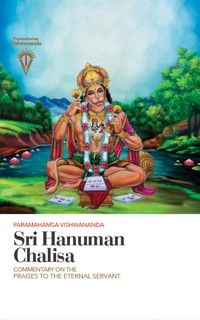
The Sri Hanuman Chalisa is considered one of the most popular Hindu devotional hymns, chanted daily by millions of people all over the world. Many chant these praises of the monkey god, Hanuman, to seek His protection, strength, help and assistance during their struggles.
However, the deeper significance and value of knowing about Hanuman is that He is the ultimate model of Bhakti, humility and surrender, expressed even to this day through His selfless devotional service to Lord Rama.
Fortunately, Paramahamsa Sri Swami Vishwananda has provided a commentary which reveals the deeper meaning behind each of the forty verses of this beautiful hymn.
Verse by verse, Paramahamsa Vishwananda guides us to understanding that, by cultivating devotion, humility and surrender, the inner gates to Divine Love are opened and we are finally able to reach the ultimate goal of life: to become devoted servants of this great Love.
Das E-Book können Sie in Legimi-Apps oder einer beliebigen App lesen, die das folgende Format unterstützen:
Seitenzahl: 107
Veröffentlichungsjahr: 2024
Ähnliche















Sri Hanuman Chalisa: Commentary on the Praises to the Eternal Servant
Bhakti Marga Publications
Copyright © 2018 Bhakti Event GmbH
All rights reserved.
Second Edition
English
ISBN: 978-3-96343-015-2
Printed in Germany
bhaktimarga.org
Bhakti Marga Publications
Am Geisberg 1-8
65321 Springen
Germany
bhaktimarga.org/publications
DEDICATION TO OUR BELOVED GURU
As we begin this book, we give all praises to our beloved Satgurudev, Paramahamsa Vishwananda. By His Grace, we are inspired to deepen our Divine Love relationship with God, and even more, helped to realise that our true purpose in life is to become an eternal servant of that Love.
Sri Guru Gita, Verse 88
Śrīmat parabrahma guruṁ smarāmi
śrīmat parabrahma guruṁ vadāmi
Śrīmat parabrahma guruṁ namāmi
śrīmat parabrahma guruṁ bhajāmi
I remember my Guru who is Parabrahman (the Transcendental Absolute); I praise my Guru who is Parabrahman; I bow to my Guru who is Parabrahman; I serve my Guru who is Parabrahman.
TABLE OF CONTENTS
Dedication to our beloved Guru
About Paramahamsa Vishwananda
Preface
About Hanuman
About Goswami Tulsidas
Sri Hanuman Chalisa: A Verse-by-Verse Commentary
Additional Notes
Resources
About Bhakti Marga
Bhakti Marga Sadhana
ABOUT PARAMAHAMSA VISHWANANDA
Paramahamsa Sri Swami Vishwananda is a fully realised spiritual Master, whose international mission, known as Bhakti Marga, ‘the path of devotion’, is based in the heart of Europe. He travels the world to encourage all people to recognise the universal Love that lies within each human being, and to awaken their innate ability to express that Love in their daily lives.
Effortlessly connecting principles of eastern spirituality with elements of western spiritual tradition, Paramahamsa Vishwananda reveals the underlying oneness of the Divine and inspires a unique experience of spirituality, regardless of culture, religion, gender or age.
Giving Darshans and Satsangs tirelessly throughout the year, Paramahamsa Vishwananda introduces these simple but profound concepts in a very personal way, answering questions about love, life, death, healing, and faith. In addition, His commentaries on supplementary Vedic texts and on the Shreemad Bhagavad Gita, one of the most popular sacred Hindu scriptures in the world, help a worldwide audience gain a deeper understanding of the universal messages they contain, and spread the message of Love, peace and unity to all of mankind.
PREFACE
The Sri Hanuman Chalisa is considered one of the most popular Hindu devotional hymns, chanted daily by millions of people all over the world. People usually chant these praises of Hanuman seeking for His protection, strength, help and assistance during their life struggles. However, the deeper significance and value of knowing about Hanuman is that He is the ultimate model of Bhakti, humility and surrender. He is an example of how our lower animal qualities can be transcended by true devotion and total surrender to the Lord. For this reason, Hanuman is widely known as the greatest servant of Lord Rama, not only in times of old, but even today. In fact, it is accepted by bhaktas all over the world that He is still living on Earth solely to protect, support, and give His blessings to Lord Rama’s devotees, simply because that’s what Lord Rama asked Him to do.
Goswami Tulsidas, a 16th century Hindu saint, a great devotee of Lord Rama, and a Bhakti poet, composed the Sri Hanuman Chalisa. Tulsidas is best known as the author of Ramacharitamanas, a version of the great Hindu epic, Ramayana (The Journey of Rama). Both Ramacharitamanas and Sri Hanuman Chalisa, as well as many other works of Tusidas were written in his own native language, the Hindi dialect, Awadhi. For that reason, Tulsidas is also known as a reformer; in spite of being a great Sanskrit scholar, he wanted everyone to be able to read and chant the glories of Lord Rama. Initially, he had to face great opposition from the traditional Sanskrit scholars, but his efforts were divinely blessed and eventually became accepted by all.
Sri Hanuman Chalisa literally means ‘Forty Verses Dedicated to Sri Hanuman’, and so it consists of forty verses, traditionally referred to as chaupais. It also includes three dohas (couplets), two at the beginning and one at the end.
In the two first dohas, Tulsidas starts by praising the Guru, the spiritual Teacher, because the Grace of the Guru is absolutely necessary for one to be successful in all life endeavours. In the same way, it is only by the Grace of the Guru that we can reach a higher level of understanding, far beyond what the limited human mind allows us to perceive. That’s why a commentary of a true Guru like Paramahamsa Sri Swami Vishwananda on the Sri Hanuman Chalisa is precious indeed!
For this reason, we are very pleased to present this Bhakti Marga publication, ‘Sri Hanuman Chalisa: Commentary on the Praises to the Eternal Servant’, where Paramahamsa Sri Swami Vishwananda guides us into the deeper meaning of each verse of this great hymn dedicated to Hanuman.
As a special introductory segment before this commentary, we have also included two sections of stories told by Paramahamsa Vishwananda on different occasions throughout the last few years. These sections, entitled ‘About Hanuman’ and ‘About Goswami Tulsidas’, help you become acquainted with some background about the lives of Hanuman and Tulsidas, which Paramahamsa Vishwananda also mentions during His commentary.
In the Sri Hanuman Chalisa, Hanuman is referred to as the perfect servant and disciple, as well as the Guru. In fact, the Guru is the greatest servant of the Supreme Lord, Who resides in all beings, and in Whom all beings reside. The Guru is a manifestation of the Supreme Lord, who descends on Earth to live in a body to be close to human beings, to serve and uplift them. There is not a single moment when the Guru is not serving mankind. The Guru is constantly showing by example the ultimate goal of life which is to serve the Supreme Lord, and to be a servant of His Love, the essence of everything. Furthermore, the Guru is not only showing, but also guiding us to, that same Realisation which He perfectly embodies. Even though neither Hanuman nor the Guru requires any of our praise, devotion or service for Themselves, it is by cultivating devotional service on the outside that we grow in humility and surrender on the inside. This is what truly opens the gates to Divine Love and to the ultimate goal of becoming eternal servants of the Lord Himself.
It is this ultimate Bhakti and total surrender which Paramahamsa Vishwananda describes so well with this beautiful declaration and prayer:
‘May my life be at the service of the Supreme Lord, Sriman Narayana. I am not here for myself. Nothing is mine. Everything belongs to the Lord. I am a servant of the Lord, and I am here to serve the Lord. I do not do anything for myself. The Lord just gets things done through me. Whatever I do is only for the pleasure of the Lord.’
May we all be inspired by the Divine wisdom and Love conveyed throughout this book, and become living examples of the ultimate Realisation on Earth.
—The Editors of Bhakti Marga Publications
ABOUT HANUMAN
‘Hanuman stands for power, for strength, and He is the ocean of knowledge. But, above all, what He stands for is His humility. He is Lord Shiva Himself who has incarnated to serve the Lord.’
Paramahamsa Vishwananda
THE REVELATION OF HANUMAN’S BIRTH
Understanding the greatness of Hanuman, His gifts, and His purpose, begins with knowing the story of His birth.
Hanuman’s mother, Anjani, had been an apsara in her previous life: a renowned heavenly dancer for Indra’s court, named Punjikasthala. Even though she danced for Indra, however, her devotion for Lord Shiva was well known in the heavens. She had only one desire: to attain Shiva, nothing else. Because of her devotion, Brihaspati had given her a blessing, saying, ‘May you be blessed to have a son.’ But the apsaras are like angels, they can’t have children.
One day, while flying around the heavens with her friends, her divine vehicle suddenly stopped and could no longer move. Seeing no solution in sight, Punjikasthala said, ‘As our vehicle is not moving, let’s go down and see the beauty of Earth.’
Punjikasthala was mesmerised by the variety and bounty of nature and said, ‘We know about the grandeur of heaven, but look how beautiful the Earth is also!’ At that moment, they saw a pillar of light coming out of an anthill and wondered what it was. Punjikasthala looked carefully and saw a figure that looked like a monkey sitting inside the anthill. So she took a twig from the branch of a tree and poked it down the hole to brush the dirt away to see its face.
Unfortunately, it wasn’t a monkey inside the anthill. It was a sage, meditating. Since Punjikasthala was poking the sage with her twig, he came out from his meditation, and blurted out, ‘Since you have disturbed my sadhana, you will be born on Earth!’ Shocked by this, Punjikasthala quickly begged the sage, ‘Please forgive me! I thought you were a monkey.’ Her words enraged the sage even more and he said, ‘As you thought that I was a monkey, you will be born as a monkey yourself!’
Punjikasthala was frightened by the thought of this, but by now the sage had calmed down a bit and realised, ‘Hmmm, what have I done?’ Seeing that she was sincerely repentant, the sage asked himself, ‘How can I take back what I have said? Even if I want to do it, I can’t do it. What has come out from my mouth, due to my penance, is already manifesting.’
Then, through his divine sight, he could see why he had pronounced this curse. So, he revealed it to the heavenly dancer, saying, ‘Look, what I have said, I can’t take back, because it was Yogmaya Herself who compelled me to say it. Saraswati made me pronounce that curse on you so that you can have Shiva as your son.’ Hearing this, Punjikasthala was overjoyed to be cursed in that way.
In due time, Punjikasthala was born on Earth as Anjani to give birth to Lord Shiva in the form of Hanuman. This is the reason that Hanuman is also called Anjaneya, which means ‘son of Anjani’.
THE BLESSINGS OF THE DEVAS
Hanuman is known for being strong enough to lift mountains, for becoming immensely large or minutely small, and for His ability to jump and fly incredibly long distances. But how did He obtain such an impressive combination of powers? Paramahamsa Vishwananda tells the story this way:
‘Once, little Hanuman, out of pure and innocent childish determination, swallowed the Sun (Surya dev) while flying 96,000,000 miles away from it. Imagine how huge He was to be able to eat the Sun while 96,000,000 miles away!'
'Now, Surya dev in his material aspect is the Sun, but as energy he is also a deva, Surya Narayana. So, Surya Narayana called for Indra, the lord of the devas and Indra came to his rescue. Indra struck Hanuman with his thunderbolt, and Hanuman fell down onto the Earth. 1
'Due to that, Pavan, the wind-god, was very sad and asked, “Who has hit my son?2 Who has dared to do such a thing?” They said, “It was Indra.” So, he became very angry with Indra.
‘Well, everybody gets angry with Indra, from time to time. But you have to understand why. You see, sometimes when a certain duty is allocated to someone, very often pride and arrogance arises, and Indra stands for this pride and arrogance. However, whenever this pride and arrogance arises, it doesn’t last long. The same thing happens in life. When pride or arrogance arises, know one thing: it’s the end, not of the pride, but of the person who has it.
‘So, Indra was very proud about what he had done, so he went very joyfully to his abode, Indra Loka, thinking, “Ah, I have done something great”. Then, Pavan said, “Due to such arrogance, such pride, I will remove all the air from the Earth, from the universe itself”. Without air what would survive? Nothing.
‘Like that, the Earth was dying slowly. All the devas rushed to Brahma, saying, “Please, save us! Save the world! Save Mother Earth!” Without Vayu, without the air, nothing would survive. Without the breath of life, nobody would be alive. And without realising that breath of life, one wouldn’t realise oneself. Thus, since Hanumanji is Pavan Putra, the son of the wind-god, He also stands for this life force.
‘Finally, the gods approached Vayu and said, “Listen, we will revive your son. Please, blow again, be active again.” And then to rectify their mistake, they all blessed Hanuman individually with their own individual strengths. So, the individual power of each deva was given to Him. All the devas blessed Anjaneya and He came back to life. So, imagine how powerful He had become even as a child.’




