


92,99 €
Mehr erfahren.
- Herausgeber: John Wiley & Sons
- Kategorie: Wissenschaft und neue Technologien
- Sprache: Englisch
Stochastic processes are widely used for model building in the social, physical, engineering and life sciences as well as in financial economics. In model building, statistical inference for stochastic processes is of great importance from both a theoretical and an applications point of view.
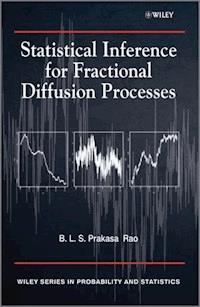
This book deals with Fractional Diffusion Processes and statistical inference for such stochastic processes. The main focus of the book is to consider parametric and nonparametric inference problems for fractional diffusion processes when a complete path of the process over a finite interval is observable.
Key features:
- Introduces self-similar processes, fractional Brownian motion and stochastic integration with respect to fractional Brownian motion.
- Provides a comprehensive review of statistical inference for processes driven by fractional Brownian motion for modelling long range dependence.
- Presents a study of parametric and nonparametric inference problems for the fractional diffusion process.
- Discusses the fractional Brownian sheet and infinite dimensional fractional Brownian motion.
- Includes recent results and developments in the area of statistical inference of fractional diffusion processes.
Researchers and students working on the statistics of fractional diffusion processes and applied mathematicians and statisticians involved in stochastic process modelling will benefit from this book.
Sie lesen das E-Book in den Legimi-Apps auf:
Seitenzahl: 288
Veröffentlichungsjahr: 2011
Ähnliche


















Table of Contents
Wiley Series Page
Title Page
Copyright
Dedication
Preface
Chapter 1: Fractional Brownian Motion and Related Processes
1.1 Introduction
1.2 Self-similar Processes
1.3 Fractional Brownian Motion
1.4 Stochastic Differential Equations Driven by fBm
1.5 Fractional Ornstein–Uhlenbeck-type Process
1.6 Mixed fBm
1.7 Donsker-type Approximation for fBm with Hurst Index H>½
1.8 Simulation of fBm
1.9 Remarks on Application of Modeling by fBm in Mathematical Finance
1.10 Pathwise Integration with Respect to fBm
Chapter 2: Parametric Estimation for Fractional Diffusion Processes
2.1 Introduction
2.2 SDEs and Local Asymptotic Normality
2.3 Parameter Estimation for Linear SDEs
2.4 Maximum Likelihood Estimation
2.5 Bayes Estimation
2.6 Berry–Esseen-Type Bound for MLE
2.7 -Upper and Lower Functions for MLE
2.8 Instrumental Variable Estimation
Chapter 3: Parametric Estimation for Fractional Ornstein–Uhlenbeck-Type Process
3.1 Introduction
3.2 Preliminaries
3.3 Maximum Likelihood Estimation
3.4 Bayes Estimation
3.5 Probabilities of Large Deviations of MLE and BE
3.6 Minimum L1-Norm Estimation
Chapter 4: Sequential Inference for Some Processes Driven by fBm
4.1 Introduction
4.2 Sequential Maximum Likelihood Estimation
4.3 Sequential Testing for Simple Hypothesis
Chapter 5: Nonparametric Inference for Processes Driven by fBm
5.1 Introduction
5.2 Identification for Linear Stochastic Systems
5.3 Nonparametric Estimation of Trend
Chapter 6: Parametric Inference for some SDEs driven by processes related to fBm
6.1 Introduction
6.2 Estimation of the Translation of a Process Driven by fBm
6.3 Parametric Inference for SDEs with Delay Governed by fBm
6.4 Parametric Estimation for Linear System of SDEs driven by fBms with Different Hurst Indices
6.5 Parametric Estimation for SDEs driven by Mixed fBm
6.6 Alternate Approach for Estimation in Models driven by fBm
6.7 Maximum Likelihood Estimation Under Misspecified Model
Chapter 7: Parametric estimation for processes driven by fractional Brownian sheet
7.1 Introduction
7.2 Parametric Estimation for Linear SDEs Driven by a Fractional Brownian Sheet
Chapter 8: Parametric Estimation for Processes Driven by Infinite-Dimensional fBm
8.1 Introduction
8.2 Parametric Estimation for SPDEs Driven by Infinite-Dimensional fBm
8.3 Parametric Estimation for Stochastic Parabolic Equations Driven by Infinite-Dimensional fBm
Chapter 9: Estimation of Self-Similarity Index
9.1 Introduction
9.2 Estimation of the Hurst Index H when H is a Constant and α, β ∈ (½, 1) for fBm
9.3 Estimation of Scaling Exponent Function H(.) for Locally Self-Similar Processes
Chapter 10: Filtering and Prediction for Linear Systems Driven by fBm
10.1 Introduction
10.2 Prediction of fBm
10.3 Filtering in a Simple Linear System Driven by fBm
10.4 General Approach for Filtering for Linear Systems Driven by fBms
References
Statistical Inference for Fractional Diffusion Processes
Index
WILEY SERIES IN PROBABILITY AND STATISTICS
Established by WALTER A. SHEWHART and SAMUEL S. WILKS
Editors
David J. Balding, Noel A. C. Cressie, Garrett M. Fitzmaurice, Harvey Goldstein, Geert Molenberghs, David W. Scott, Adrian F.M. Smith, Ruey S. Tsay, Sanford Weisberg
Editors Emeriti
Vic Barnett, J. Stuart Hunter, David G. Kendall, Jozef L. Teugels
A complete list of the titles in this series appears at the end of this volume.
This edition first published 2010
© 2010 John Wiley & Sons Ltd
John Wiley & Sons Ltd, The Atrium, Southern Gate, Chichester, West Sussex, PO19 8SQ, United Kingdom
For details of our global editorial offices, for customer services and for information about how to apply for permission to reuse the copyright material in this book please see our website at www.wiley.com.
The right of the author to be identified as the author of this work has been asserted in accordance with the Copyright, Designs and Patents Act 1988.
All rights reserved. No part of this publication may be reproduced, stored in a retrieval system, or transmitted, in any form or by any means, electronic, mechanical, photocopying, recording or otherwise, except as permitted by the UK Copyright, Designs and Patents Act 1988, without the prior permission of the publisher.
Wiley also publishes its books in a variety of electronic formats. Some content that appears in print may not be available in electronic books.
Designations used by companies to distinguish their products are often claimed as trademarks. All brand names and product names used in this book are trade names, service marks, trademarks or registered trademarks of their respective owners. The publisher is not associated with any product or vendor mentioned in this book. This publication is designed to provide accurate and authoritative information in regard to the subject matter covered. It is sold on the understanding that the publisher is not engaged in rendering professional services. If professional advice or other expert assistance is required, the services of a competent professional should be sought.
Library of Congress Cataloging-in-Publication Data
Prakasa Rao, B. L. S.
Statistical inference for fractional diffusion processes / B.L.S. Prakasa Rao.
p. cm. -- (Wiley series in probability and statistics)
Summary: "Statistical Inference for Fractional Diffusion Processes looks at statistical inference for stochastic processes modeled by stochastic differential equations driven by fractional Brownian motion. Other related topics, such as sequential inference, nonparametric and non parametric inference and parametric estimation are also discussed"-- Provided by publisher.
Includes bibliographical references and index.
ISBN 978-0-470-66568-8
1. Fractional calculus. 2. Probabilities. I. Title.
QA314.P73 2010
515'.83--dc22
2010010075
A catalogue record for this book is available from the British Library.
ISBN: 978-0-470-66568-8
In memory of my maternal grandfather Kanchinadham Venkata Subrahmanyam
for teaching me the three ‘R's (Reading, Writing and Arithmetic) with love and affection
Preface
In his study of long-term storage capacity and design of reservoirs based on investigations of river water levels along the Nile, Hurst observed a phenomenon which is invariant to changes in scale. Such a scale-invariant phenomenon was also observed in studies of problems connected with traffic patterns of packet flows in high-speed data networks such as the Internet. Mandelbrot introduced a class of processes known as self-similar processes and studied applications of these processes to understand the scale-invariant phenomenon. Long-range dependence is connected with the concept of self-similarity in that the increments of a self-similar process with stationary increments exhibit long-range dependence under some conditions. A long-range dependence pattern is observed in modeling in macroeconomics and finance. Mandelbrot and van Ness introduced the term fractional Brownian motion for a Gaussian process with a specific covariance structure and studied its properties. This process is a generalization of classical Brownian motion also known as the Wiener process. Translation of such a process occurs as a limiting process of the log-likelihood ratio in studies on estimation of the location of a cusp of continuous density by Prakasa Rao. Kolmogorov introduced this process in his paper on the Wiener skewline and other interesting curves in Hilbert spaces. Levy discussed the properties of such a process in his book Processus Stochastiques et Movement Brownien. Increments of fractional Brownian motion exhibit long-range dependence.
Most of the books dealing with fractional Brownian motion look at the probabilistic properties. We look at the statistical inference for stochastic processes, modeled by stochastic differential equations driven by fractional Brownian motion, which we term as fractional diffusion processes. Since fractional Brownian motion is not a semimartingale, it is not possible to extend the notion of the Ito integral for developing stochastic integration for a large class of random processes with fractional Brownian motion as the integrator. Several methods have been developed to overcome this problem. One of them deals with the notion of the Wick product and uses the calculus developed by Malliavin and others. We avoid this approach as it is not in the toolbox of most statisticians. Kleptsyna, Le Breton and their co-workers introduced another method by using the notion of fundamental martingale associated with fractional Brownian motion. This method turns out to be very useful in the context of statistical inference for fractional diffusion processes. Our aim in this book is to consider parametric and nonparametric inference problems for fractional diffusion processes when a complete path of the process over a finite interval is observable. There is no significant work in the area of statistical inference for fractional diffusion processes when discrete data or sampled data from the process is only available.
It is a pleasure to thank Professor V. Kannan and his colleagues in the Department of Mathematics and Statistics, University of Hyderabad, for inviting me to visit their university after I retired from the Indian Statistical Institute and for providing me with excellent facilities for continuing my research work during the last five years leading to this book. Professor M. N. Mishra, presently with the Institute of Mathematics and Applications at Bhuvaneswar, collaborated with me during the last several years in my work on inference for stochastic processes. I am happy to acknowledge the same. Figures on the cover page were reproduced with the permission of Professor Ton Dieker from his Master's thesis “Simulation of fractional Brownian motion”. Thanks are due to him.
Thanks are due to my wife Vasanta Bhagavatula for her unstinted support in all of my academic pursuits.
B. L. S. Prakasa Rao
Hyderabad, India
January 18, 2010
Chapter 1
Fractional Brownian Motion and Related Processes
1.1 Introduction
In his study of long-term storage capacity and design of reservoirs based on investigations of river water levels along the Nile, Hurst (1951) observed a phenomenon which is invariant to changes in scale. Such a scale-invariant phenomenon was recently observed in problems connected with traffic patterns of packet flows in high-speed data networks such as the Internet (cf. Leland et al. (1994), Willinger et al. (2003), Norros (2003)) and in financial data (Willinger et al. (1999)). Lamperti (1962) introduced a class of stochastic processes known as semi-stable processes with the property that, if an infinite sequence of contractions of the time and space scales of the process yield a limiting process, then the limiting process is semi-stable. Mandelbrot (1982) termed these processes as self-similar and studied applications of these models to understand scale-invariant phenomena. Long-range dependence is related to the concept of self-similarity for a stochastic process in that the increments of a self-similar process with stationary increments exhibit long-range dependence under some conditions. A long-range dependence pattern is also observed in macroeconomics and finance (cf. Henry and Zafforoni (2003)). A fairly recent monograph by Doukhan et al. (2003) discusses the theory and applications of long-range dependence. Before we discuss modeling of processes with long-range dependence, let us look at the consequences of long-range dependence phenomena. A brief survey of self-similar processes, fractional Brownian motion and statistical inference is given in Prakasa Rao (2004d).
Suppose {Xi, 1 ≤ i ≤ n} are independent and identically distributed (i.i.d.) random variables with mean μ and variance σ2. It is well known that the sample mean is an unbiased estimator of the mean μ and its variance is σ2/n which is proportional to n−1. In his work on yields of agricultural experiments, Smith (1938) studied mean yield as a function of the number n of plots and observed that is proportional to n−a where 0 < a < 1. If a = 0.4, then approximately 100 000 observations are needed to achieve the same accuracy of as from 100 i.i.d. observations. In other words, the presence of long-range dependence plays a major role in estimation and prediction problems.
Long-range dependence phenomena are said to occur in a stationary time series {Xn, n ≥ 0} if Cov(X0, Xn) of the time series tends to zero as n → ∞ and yet the condition
1.1
holds. In other words, the covariance between X0 and Xn tends to zero as n → ∞ but so slowly that their sums diverge.
1.2 Self-similar Processes
A real-valued stochastic process Z = {Z(t), − ∞ < t < ∞} is said to be self-similar with index H > 0 if, for any a > 0,
1.2
where denotes the class of all finite-dimensional distributions and the equality indicates the equality of the finite-dimensional distributions of the process on the right of Equation (1.2) with the corresponding finite-dimensional distributions of the process on the left of Equation (1.2). The index H is called the scaling exponent or the fractal index or the Hurst index of the process. If H is the scaling exponent of a self-similar process Z, then the process Z is called an H-self-similar process or H-ss process for short. A process Z is said to be degenerate if P(Z(t) = 0) = 1 for all t ∈ R. Hereafter, we write to indicate that the random variables X and Y have the same probability distribution.
Proposition 1.1:
A non-degenerate H-ss process Z cannot be a stationary process.
Proof:
Suppose the process Z is a stationary process. Since the process Z is non degenerate, there exists t0 ∈ R such that Z(t0) ≠ 0 with positive probability and, for all a > 0,
by stationarity and self-similarity of the process Z. Let a → ∞. Then the family of random variables on the right diverge with positive probability, whereas the random variable on the left is finite with probability one, leading to a contradiction. Hence the process Z is not a stationary process.
Proposition 1.2:
Suppose that {Z(t), −∞ < t < ∞} is an H-ss process. Define
1.3
Then the process {Y(), −∞ < <∞} is a stationary process.
Lesen Sie weiter in der vollständigen Ausgabe!
Lesen Sie weiter in der vollständigen Ausgabe!
Lesen Sie weiter in der vollständigen Ausgabe!
Lesen Sie weiter in der vollständigen Ausgabe!
Lesen Sie weiter in der vollständigen Ausgabe!
Lesen Sie weiter in der vollständigen Ausgabe!
Lesen Sie weiter in der vollständigen Ausgabe!
Lesen Sie weiter in der vollständigen Ausgabe!
Lesen Sie weiter in der vollständigen Ausgabe!
Lesen Sie weiter in der vollständigen Ausgabe!
Lesen Sie weiter in der vollständigen Ausgabe!
Lesen Sie weiter in der vollständigen Ausgabe!




