


Erhalten Sie Zugang zu diesem und mehr als 300000 Büchern ab EUR 5,99 monatlich.
- Herausgeber: epubli
- Kategorie: Gesellschafts- und Liebesromane
- Sprache: Englisch
On 2 November 1992 at 4.13 p.m., the earth shook at the Susten Pass in the Bernese Oberland. More than 800 tonnes of ammunition and explosives blew up in a cavern near the Steingletscher glacier. The detonation destroyed the cavern, the entrance area and the ammunition blasting site, leaving behind a huge debris field. Six people were killed. What was the cause? Inspired by two actual events - the arrest of a senior Swiss military officer in August 1976 (Part I) and the explosion at the Steingletscher in November 1992 (Part II) - the author, together with his two heroes, a Swiss intelligence officer and his Dutch friend, develops a breathtaking story in which everything is fictitious.
Sie lesen das E-Book in den Legimi-Apps auf:
Seitenzahl: 282
Veröffentlichungsjahr: 2023
Das E-Book (TTS) können Sie hören im Abo „Legimi Premium” in Legimi-Apps auf:
Ähnliche



















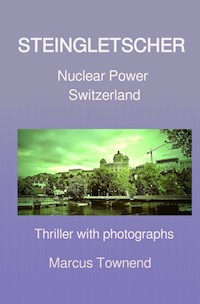
STEINGLETSCHER
Nuclear Power Switzerland
Thriller with photographs
Marcus Townend
Photograph on the cover: The Federal Palace in Bern (Bundeshaus): The Parliament, the government and the federal administration work here.
Original edition in German 2019: Am Steingletscher, Atommacht Schweiz
IMPRINT
all rights reserved
second edition: 2021
translation: Marcus Townend, 2022,
text and photos: Marcus Townend
Sagenriedli 1
CH-6062 Wilen
front photograph: Marcus Townend
cover design: Margrit Naef
print and distribution: epubli, ein Service der neopubli GmbH Berlin
links: www.townend.ch
www.epubli.de
Part I deals in 1976
Part II deals in 1992
"How can a person of faith contemplate the use of nuclear weapons?"
Pirmin König, College Student
"Does anyone really imagine that owners of nuclear weapons would refrain from using them in an emergency situation?"
Hendrik Dorpeind, College Student
Declaration of Principles of the Federal Council
of 11 July 1958:
"In accordance with our centuries-old tradition of defence, the Federal Council is therefore of the opinion that the army must be given the most effective weapons to preserve independence and protect our neutrality. These include nuclear weapons."
Eleven years later, Switzerland signs an international treaty banning the possession and proliferation of weapons of mass destruction.
Chapter 1
Monday, 16 August
At one o'clock in the morning, three foreign military aircraft entered Swiss airspace. They were Antonov Antaeus An-22 Antei transport aircraft, code-named "Cock" by Nato, the largest aircraft in existence anywhere in the world. At the height of Lake Constance, they were met by a two-man squadron of the Swiss Air Force's surveillance squadron.
Sunday, 15 August, 09.30 hrs
Sixteen hours earlier, the politician had been the first to arrive in the building of the valley station. The employee at the ticket counter noticed him immediately because he was short and had his sunglasses on, even though it was darker in here than outside. The man at the ticket counter estimated his customer to be about 30 years old, about one metre and 60 centimetres tall, slim, clean-shaven, blond, with a side-parted blow-dry hairdo, light brown trousers with a crease, a short-sleeved white polo shirt, a beige sliding cap called a barrel cleaner in his left hand, and expensive brown loafers. What's he doing up there on the mountain with those shoes, the clerk shook his head inwardly. The passenger approached him at the counter and put his cap on the shelf. The counter clerk noticed a white gold ring with a large agate seal stone. He could not tell what kind of seal it was because the gemstone was dark. The passenger asked for a ticket and while he took off his sunglasses to better determine the change, the clerk saw his eyes: they were dark, almost black, like the agate in his ring. He handed him a ticket, round trip.
The next passenger who stepped into the poorly lit ticket hall towered at least a head above the members of a hiking group who were looking at the posted timetable opposite. He was wearing light brown calf-length hiking trousers, red woollen socks, black greased hobnailed dress shoes, a red and white checked shirt as well as a military rucksack and no headgear. Clean-shaven, thick brown hair cut short and square and a massive chin, the counterman observed: a stiff posture and a stern, appraising look - a serving officer, he concluded his classification in his mind and handed his guest a ticket, this time only for the one-way journey. The man at the counter had combined well. The 36-year-old passenger had chosen the military career after his studies at the Swiss Federal Institute of Technology ETH because he was looking for clarity, order and security. Thanks to his perceptiveness, which enabled him to grasp multi-layered strategies and complex tactical manoeuvres in a short time, and with his precise memory, he quickly made a career for himself. He held the rank of colonel.
There was no sign that the two customers had anything to do with each other. Therefore, the counter clerk frowned in surprise when he saw the two gentlemen preparing to grab a chairlift together. The group of walkers had spread out over the two-seater chairs when the last of the group invited the politician to share a chair with him. The politician tilted his head slightly and said with a smile, in a low voice and a polite tone: "That's very nice of you, but go ahead" and climbed up to the next seat together with the tall man. Behind them, two foreigners sat down on the following chair. Printed T-shirts, light baseball caps and jeans. The younger one wore trainers, the older one black loafers - American tourists, the ticket seller thought. But this time he was wrong.
You suck-up, thought the big man, and on his palate he realised a sour taste. He didn't like them, these politicians, these wind vanes who didn't seem to shy away from any deception, any lie, as long as they were re-elected. The chair started moving with a jerk and they slowly floated up the slope. That soft, lecturing voice, that insistent way of speaking, that obsequious head posture, he continued to think with a sideways glance at the politician. They had greeted each other with a barely perceptible nod of the head, but it would not have occurred to anyone that the two disparate men had anything to do with each other. It was a warm morning and in the course of the day the temperature would rise to 30 degrees, so a trip to the mountains would be cool and pleasant. The cows were grazing in the shade. There was a smell of damp grass, fresh herbs and cow dung. They were silent and watched, each on his own side, the grazing cows below them, which were not impressed by the quietly rustling armchairs. The politician came from a modest, middle-class background. At grammar school he had assured that he would one day be elected to the national government, to the Federal Council. But that alone was not what had driven him to achieve top performance and to get to know people who could one day serve him in some way. No, he wanted to reach higher. He intended to become an extraordinary representative of the people. Someone who would make history. And he would succeed in this as the initiator and leader of the secret Wehrgemeinschaft 91 (own wording: defence community 91). He had noticed the expression on the face of the military man next to him. You self-important wretch, raised in a highborn patrician family, didn't have to do anything for your career, had your stirrup holders everywhere, right ...! And I have to put up with assholes like that to achieve my goals, he continued to think, forgetting that he was working for his constituents and not for himself. Colonel von Boltigen was the scion of a family that had belonged to the nobility some eight hundred years ago, which after a few centuries had descended to the patrician city nobility.
The ride was quiet, the bells of the cows could be heard below them and from above the quiet and steady rubbing of the pulleys. The officer thought of his son, who would be attending kindergarten in a few days and would surely have a lot to tell him.
You want me to start the conversation and ask you the obvious question. Let's play this power game, the politician thought and asked, "When is the delivery coming?"
The officer turned to the younger man, whom he never greeted by name, and thought: Always these stupid sunglasses! He looked at his neighbour for a long time, as if he had to search for words. As he did so, he imagined himself blowing this sausage of a nerd off his armchair with a loud "fie". The latter held his gaze and waited patiently for the elder's report. In the meadow, a cow began to mount another cow. The regular officer looked down and watched the ruminants as they moved their mouths slowly in circles and chewed the spicy grass. He thought of the fine alpine cheese he would enjoy on the mountain with a glass of white wine and his mood improved.
"Tonight," came the officer's curt reply. "I will be there". His neighbour made no effort to ask further. He continued, without emotional stirring, "At 01 o'clock in the morning' - 20 atomic artillery shells, four atomic bombs for our Mirages, two atomic mines as well as six nuclear-tipped missiles, i.e. ground-launched missiles, will be." Heinrich von Boltigen was a serious man. He could not comprehend that there were scientists who had given the two atomic bombs dropped on Japan pet names like "Little Boy" or "Fat Man".
The politician knew that the officer had just spoken of tactical battlefield weapons. These were used to fight enemy forces close to their own positions. In the Working Committee (AA) 1 Nuclear Policy of the state government, the use of these tools of war had been discussed at length and ultimately rejected. The politician was annoyed that he, in turn, had to restart the conversation: "And Strategic Nuclear Weapons?"
The working committee had more clearly rejected home-made weapons and the use of strategic weapons. Strategic nuclear weapons had a much higher explosive power than operational-tactical ones. They were not used on the home battlefield, but to destroy entire cities and regions in the enemy's rear. The officer hesitated for a long time, for now came the most delicate part of their top-secret conversation. On the first of July 1968, the Soviet Union, together with the USA, France and Great Britain, had signed a Nuclear Non-Proliferation Treaty. In it, it was agreed not to proliferate nuclear weapons. Switzerland signed a little later, but had not yet put the treaty into force. They did not have much time left, according to the politician, to acquire nuclear weapons.
"Yes, two cruise missiles, two medium-range missiles with nuclear warheads already mounted," he answered thoughtfully. These could destroy targets several hundred kilometres away. "The Soviets don't want to give us any more," he therefore added. For him, the possession of nuclear weapons was an effective means of deterring other states from attacking Switzerland. The best protection of all! No one would dare attack, neither with nuclear, chemical, biological nor conventional weapons, because they would then have to reckon with a nuclear blowback! No official declarations, no public justifications, no media contributions would be necessary for this. It would be enough to let it be known to real and potential enemies that they, Switzerland, were in possession of nuclear weapons. Colonel Heinrich von Boltigen looked at his neighbour. He saw his dark eyes shine and his thin lips hint at a smile.
"I congratulate you," the younger man said after a while, but the officer had turned his head away in disgust. Although he would soon be promoted to commander-in-chief of the artillery and thus be able to use the nuclear explosives against any attacker, and although he had always strongly advocated the nuclear option in the committees, he disliked this civilian's barely concealed pleasure. The idea that this power-hungry son of a worker could one day get so far that he was allowed to decide on the use of the weapons that had just arrived displeased him extraordinarily. He probably only wanted nuclear weapons to compensate for his miserable ego! Not least for this reason, he would, if necessary, lobby the Federal Council to ensure that the power to decide on the use of tactical and strategic nuclear weapons lay solely with the soberly thinking and objectively planning military.
"What about our Welsh brigadier?" the civilian resumed the conversation.
"He will be out of the picture tomorrow."
"Must this be?" the other asked, looking at him from below with feigned concern.
"Yes, the Americans have him on their radar."
"How will Bern proceed?" the politician asked after a while.
"The Defence Minister will order the arrest and the Federal President will appear before the media on the same day."
"Will he keep it tight?"
"Of course," Colonel von Boltigen barked at his neighbour, incensed by these seemingly harmless, deceitful questions. "He's an officer!" After a while he added: "And a good patriot!"
Now the distinguished officer has lost his composure after all, the politician smirked inwardly without making a face. Then his expression became hard: he did not reveal to him that it was he who had tipped off the Americans. That was the only way the brigadier would not be able to harm their cause. In prison, the Americans would never be able to question him. For no one, especially the Yanks, was ever allowed to know about the delivery. He stroked the brow of his left eye with his left index finger and put his slider cap on his head.
The two had met at a military event. At the time, Heinrich von Boltigen was a major in the artillery, a branch of the Swiss Armed Forces that uses guns with large barrels and missiles. The professional officer had given an intelligent speech in which he had demonstrated profound knowledge of the current threat situation in and outside Europe and had used impressive arguments to promote a massive rearmament of the Swiss Armed Forces. During the aperitif that followed, the politician had asked him for a confidential conversation. At this covert meeting, they had talked about the accident in the underground experimental nuclear power plant in Lucens at the beginning of 1969. At that time, in their opinion, the opportunity to produce plutonium had been missed. Plutonium was an important fissile material for building nuclear weapons. Likewise, both had regretted the signing of the international Nuclear Non-Proliferation Treaty in the same year. Hereupon, the politician had opened up to him his idea of how their homeland could nevertheless come into possession of nuclear weapons. Since that conversation, the colonel had established several contacts between military authorities and the politician and had taken part in secret meetings of the Wehrgemeinschaft 91. It was also he who had recruited the French-speaking Swiss brigadier and introduced him to the Soviet military attaché.
On the remaining part of their journey, they covered a few hundred metres of altitude difference as the chairlift climbed up a steep rock face. On this last part, they were both silent. When they reached the top at over 2,600 metres, they parted without saying goodbye to each other. The politician remained seated and took the chairlift back down to make his way to another secret meeting. The soldier hung his rucksack around his neck and set off on the short hike towards the mountain restaurant. Two rows behind the politician, the younger of the two American tourists sat back down on a chair to head down. The other followed the colonel.
***
At that time, the wooden terrace, which was on the view side of the restaurant, was empty. A few tables were set, ready for about a dozen hikers or view tourists. The colonel sat down so that he could enjoy the wonderful view of the mountains and the alpine pastures on the one hand and, with a quick turn of his head, keep an eye on the arriving guests. He would worry about his American shadow, who had just climbed the stairs to the terrace, after the meal. The waitress was tall, around fifty years old and she wore a blonde Gretchen braid. Her mischievous expression betrayed a happy nature. He ordered a sausage and cheese salad and a carafe of white wine from La Côte. He was looking forward to the alpine cheese, which would be made from the milk of the grazing cows just seen from the chairlift. Then he thought about tonight's delivery. Both men, the professional officer and the politician, belonged to a small group of patriots who were concerned about the circumstances and consequences of a military attack on Switzerland. This secret group was convinced that the majority of the population, as well as many politicians and military officers, would not correctly assess, or even perceive, the imminent dangers to Switzerland. The waitress put a glass down for him and poured him wine from the carafe. He took a sip and asked himself: Was it good what they realised in this small community? Was it right what he was doing? Was he serving his homeland? The officer was aware of the great importance and responsibility they had taken on with this deal with the Soviets. And he kept asking himself questions about what he was doing: As a devout Christian, was he allowed to acquire these horrific weapons that would destroy people and humanity? What would his father think if he knew, what would he tell his son one day? That he was a hero? Or just a criminal? A few months ago, he had visited a small church.
***
You have heard that it is said: "You shall love your neighbour and hate your enemy. But I say unto you...". Heinrich von Boltigen recognised that he was picking up on one of the most important statements of the Gospel here. What Jesus said in his Sermon on the Mount constituted Christianity for him. He already knew this when he had entertained the idea of becoming a priest at a young age. He sat on the front pew and directed his gaze towards the cross with Jesus. This stood beside the altar and Jesus seemed to be looking at him. They were alone. But the officer had not come here to read the Holy Scriptures. He laid the Bible open on the seat next to him. He wanted to pray. Have a conversation with his Creator. He needed his advice. Reverently, he bowed his head and fixed his gaze on his hands. He folded them and spoke after making sure no one could hear him, "I had to kill someone," he began in a low voice. "He did not want to help us, intended to betray us. Our work, our efforts for the safety of our people ..., your people," he added after a pause. He looked towards the altar. "He was a communist, an infidel! And you don't like such either," he panted for approval, but at the same time he realised the hubris, the inappropriateness of his request for absolution and he lowered his gaze back to his hands. He knelt on the kneeboard and whispered, "I had to do it. For us. For my son's future, for our homeland, for your people. I had to!" He raised his head, looked at the triptych behind the altar for a long time. Then he looked up at the image of St Mary and finally at Jesus. He continued, a little louder this time: "You know I don't make it easy for myself. I am constantly torn by doubts and plagued by my conscience, I often can't fall asleep. Shall I go on? Give me a sign!"
After a while of silence, he sighed and sat down again on the bench. He praised the Lord and concluded with a prayer: " ... for Thine is the kingdom and the power and the glory for ever and ever. Amen!" Then he raised his eyes once more to the statue of Jesus to say goodbye. Jesus did not look directly at him, but looked past him. Heinrich von Boltigen turned around and recognised where Jesus' gaze seemed to be directed. Gripped by a slight excitement, he rose and strode around the benches, closer to the mural, which was painted in the lime plaster of a wall diagonally behind him. In contrast to the colourful depictions of the triptych, the fresco artist had used only lime-fast grey, black and white pigments here. In the foreground, in a kind of deep ravine, lay a mountain of large and small skulls and skeletons, jumbled up and into each other, interspersed with weapons, clothing and other belongings that indicated poorer people. In the background and above the bones, a steep rocky path was indicated, which seemed to lead out of this gorge, carved into the rock. Numerous nobly dressed young and older women and men, as well as dozens of children clasping the hands of adults, climbed up. The sombre painting was titled with the following phrase in large letters: "Keep us safe oh Lord".
Before the soldier turned away from the haunting scene, something caught his eye and so he stepped closer to the fresco.
After a moment's intense contemplation, a smile spread across his face. He had the answer. He turned, drew a cross on his chest with his right thumb and said goodbye to Jesus with a slight nod. Then he left the chapel.
***
The waitress brought a sausage salad richly garnished with various salads and hard cheese, as well as a basket with some slices of bread, Maggi seasoning, salt and pepper. The colonel smiled as he remembered the fresco on the church wall. He had noticed then that the many women and children were protected by only a few men. He had counted seven men who were armed and thus the only ones who could protect the others. On this he had made the following connection: Together with him, there were seven of them in 'his' Wehrgemeinschaft 91, who met regularly and in different compositions playing chess or in their bunker at the end of the pond. So just as many men as in the picture. Equipped with the appropriate weapons, they were able to protect the population. God's Son had shown him the way, his way. Colonel von Boltigen finished his snack and looked into the distance, looked at all the mountains and each peak individually and tried to remember their names. One last time he returned to his doubts. After a short while, he stopped his inner wrestling. It was now too late to turn back.
***
Once down, the politician went to the car park next to the valley station, got into his limousine and drove into a large forest. After a few kilometres on a bumpy road built for forest workers, foresters and lumberjacks, he reached a clearing bordering a small pond. On the other side he saw a cute wooden building with a gable roof and a chimney. The house stood in front of a large piece of rock that seemed to give the house support. On the rock, which was at least twenty metres high, grew some conifers. The artificial red geraniums that stood on the window ledges were reflected in the smooth water. He parked next to a wooden stoop, got out and put on boots and a hunter's jacket. Now he looked like someone who wanted to look like a hunter. Then he set off and walked along a path around the pond. Startled by the vibration of his footsteps, a grass frog jumped into the water and disappeared in a flash under the protruding bank. A few birds warned of his intrusion into this silent scene. The politician reached the chalet. While looking around to see if he was alone, he blew his nose. It was quiet, he heard neither birdsong nor footsteps. No one was there, and yet he felt as if he were being watched. He turned slowly around his own axis and read the saying that was written in white above the windows:
"The faithful watchman of this house, be the Lord God alone".
He twisted the corners of his mouth into a mocking smile, walked around the house and knocked loudly on the door: three times in quick succession, then twice slowly.
***
The American guest did not speak a foreign language, but he spotted the word steak on the small, laminated menu card. More precisely, he found it twice, once with a modest price, once without a price. He therefore asked what the second steak, the one without a price, was. The tall serving woman in a dirndl, which her guest thought was a Swiss traditional costume, said this was a moose steak, "ä Schtiik of se Elch". At this she thrust her chest forward and tried to depict the large head of a moose with its mighty shovel antlers with her hands above her head. "Oh my god," her guest exclaimed, making an impressed face: "The Steak from an Elk! Now that is really something very special!" He hadn't known there were elk here, then lectured her by nodding several times: "In the United States we call 'em moose, you know: moose!"
"Yes, yes," she nodded, "very special!" She wanted to add that there was rarely meat from the elk up here because it usually hid from the hunters in the crevices and especially none at this time of year, as the big game hunt had not yet opened and he was lucky that she would find an elk especially for him. Instead, she raised her shoulders and made a desperate face to go with it and so her guest took pity on her and he ordered the moose as well as a dark-coloured lemonade. No sooner had the waitress closed the door to the kitchen from the inside than she waved to Toni, her cook, whom she amusingly called Knorrli, and then they both had to laugh. Once again, she had succeeded in pulling the wool over the eyes of an foreign wanderer.
The tourist took out his binoculars and observed the steep rock face rising on the other side of the alp. He spotted the somewhat dilapidated mountain station of a second cable car and realised that it was only a dummy. In reality, the only cabin for transporting people and goods was located a few metres inside the rock, as was the powerful motor for it. Nobody, except the most powerful secret service in the world, his Central Intelligence Agency, knew what was hiding up there: a top-secret facility of the Swiss fortress artillery. Inside this mountain were several rooms containing various cannons. He knew he could not follow his mysterious officer of the troop artillery, who seemed to be studying the mountains two tables in front of him, up there, because the cable car could only be controlled by initiates. Even before the First World War, military strategists had drilled holes in the mountains to install their defensive guns there to prevent mechanised attacks.
This first happened at the Gotthard, the most important European Alpine crossing. In the Second World War, from which Switzerland had been spared as in the First, the so-called réduit strategy was established: A delaying battle in the border area was to be supplemented by a first line of fortifications in the Central Plateau and the heavily fortified Central Area. To this end, huge fortifications were built, mostly by the troops themselves, in the entire Alpine region from 1940 onwards under great time pressure. Since 1942, a professional formation of the army, the Fortress Guard Corps, guarded and operated the many installations.
While the agent was thinking about the inventiveness of the Swiss, he was served a plate with a piece of meat and French fries. To him, this looked like a thick veal escalope, but he did not let this, and later when he got the horrendous bill for it, put him out of his good mood. He admired the Swiss. There, all men fit for service served the state as soldiers for three weeks every year. From six o'clock in the morning until late at night, they practised how to defend themselves against an enemy in an emergency, and after work they disappeared into their holes. Like his colonel, who would soon float into his cave up in the rock face. He tried to see with his binoculars how many holes this wall concealed, surely there had to be two dozen and he imagined the following scenario:
Three squadrons of Soviet MiG-25s had narrowly escaped the superior Mirages in their attack on tiny Switzerland and hoped that they would only have to fly over this mountain to outrun the Swiss fighters and then, he lit a cigar at this thought, at least 24 holes would open in the mountain and two dozen twin Oerlikon 35-mm guns would fire full power at a cadence of over 500 rounds per minute per barrel at the enemy interceptors.
The agent's eyes lit up at this idea. He took a pleasure in pulling on his cigar and ordered another cola drink. After the waitress had brought him the drink and turned away from him again, he took a hip flask from his jacket pocket, glancing around furtively, and mixed his sugar cane liquor into his drink. He couldn't stand this black swill without his high-proof rum. ‚Cuba libre!’ he smiled and turned to his memories.
***
The foreigner driving behind the politician saw him turn into the forest. He followed him until he found an opportunity to leave his small car in a side path. He got out and followed the sound of the politician's engine by foot. When he reached the pond, he spotted the politician at the other end of the water. His superior, who had followed the Swiss officer to the alpine restaurant, had explained to him that the Swiss secret service was made up of 26 cells that did not know each other and had no contact with each other. These units united to form the so-called UNA, the sub-group Intelligence and Defence. In an emergency, they would be guided via short-wave radio, or something.
His superior had informed him that Switzerland was neutral but would be on their side, the American side, in an armed conflict. But they had recently received an anonymous tip about contacts between a high-ranking Swiss soldier and the Soviet attaché in Bern. Why the agent should follow this politician, who had just changed clothes for the hunt, was beyond him. Nevertheless, he trusted his chronic mistrust, for perhaps, he rejoiced, the shadowed Swiss would lead him to a secret hideout of one of these intelligence sub-groups.
***
The older agent took a sip and remembered: 15 years ago, his foreign intelligence service, the Central Intelligence Agency (CIA), had planned and organised a military coup against the neighbouring island of Cuba to overthrow the revolutionary government under Fidel Castro. Castro seemed to favour economic forms that did not seem compatible with US capitalism. A landing force consisting of 1,500 Cuban and American mercenaries had landed on Bahia de Cochinos, a 14-kilometre-long bay on the south coast of Cuba, and was to have initiated the conquest from there. The invaders were crushed within the first 72 hours. The unlawful aggression had failed and the United States was reprimanded by the United Nations as well as by several Latin American nations and his intelligence service was made the scapegoat. The mood at his place of work in Langley was sour, his superiors turned up to work sullenly, demotivating their staff anew each day.
One day, he and some colleagues at the management level had an idea. Through an exiled Cuban, he had overheard that the dictator preferred a brand of cigars made especially for him. These cigars did not require two fermentation stages as usual, but three, which not only reduced the tar and nicotine content, but also gave it a special flavour. This specific flavour could vary and that was crucial so that the smoker would not immediately become suspicious if his favourite cigar smelled or tasted slightly different.
The agent sighed at this flashback. He passed over his memories of the installation of the explosives, the test explosions and the transport to Cuba and took a sip from his glass.
His plan had not worked. The cigar prepared as a gift had been intercepted by the dictator's security service, and because it was also not a particularly intelligent plan, he was taken off his assignment. His superiors took his team away from him, he was no longer allowed to have contact with his Cuban contacts and they revoked his permission to kill without orders. A few weeks later, he was transferred to a country where there was simply no one he could kill: here to peaceful, beautiful Switzerland with all its kind, hard-working and hospitable people. This had denied him the chance to convince his superiors of his idea to bring a poisoned rat or a bee infected with a deadly virus into the dictator's bedroom ... He sighed again, but then his mood improved when he thought of the gift he had been given on his last day at work: a wooden box containing 24 bottles of the best Cuban rum, which he took to his new place of work, to Bern, disguised as diplomatic baggage. "A consolation from our Máximo Líder" was written on a note he found under the first bottle of this delicious liquor. Whether this was indeed the gift of an ironic but forgiving survivor of his failed assassination attempt, the agent never found out. He paid. Then he stretched his legs and yawned.
***
The young American spy placed his chewing gum between his upper lip and upper jaw and watched the Swiss man walk around the cute little chalet with its stylish flowers in front of the windows. What he couldn't see because of his sunglasses was the following standardised procedure, which was getting on the politician's nerves. The door opened a crack and he noticed how he was being scrutinised from top to bottom. He said:
"Apple mash and alpine macaroni".
The door opened and a younger man with a sardonic smile stood wide-legged in the doorway. He was the scion of a rich factory owner. They disrespectfully called him just the "son". The politician thought he was a smug good-for-nothing who was waiting to take over the weapons production plant, for which he had done nothing so far. A real freeloader who would be among the first to profit when it came to using weapons to defend himself against an enemy. Actually, he had wanted to recruit his father, but he fell ill and therefore sent his son into the group. The politician grunted, pushed the young man roughly aside and entered.




