


Erhalten Sie Zugang zu diesem und mehr als 300000 Büchern ab EUR 5,99 monatlich.
- Herausgeber: Carcanet Poetry
- Kategorie: Poesie und Drama
- Sprache: Englisch
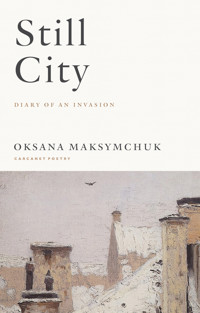
Longlisted for the Griffin Poetry Prize 2025 Longlisted for the PEN/Voelcker Award for Poetry Collection 2025 Highly Commended in the Forward Prizes 2024 Still City, Oksana Maksymchuk's debut in English, reflects life in the wake of extreme and unpredictable violence. Inevitably, there are dramatic shifts in perspective: this diary of an invasion recreates the mood and tone of the context within which a poet's imagination must make sense of the change. Drawing on various sources, including social media, the news, witness accounts, recorded oral histories, photographs, drone video footage, intercepted communication, and official documents, Maksymchuk tells the shared experience. The book began 'as a poetic journal I started keeping in my hometown of Lviv, Ukraine in 2021–22. In the months leading up to the full-scale invasion, my writing has been registering how ways of living, thinking, and feeling have been changing due to the anticipation of a catastrophe, imbuing the everyday rituals with the sense of finality and precarity. While we, as a family and a community, made preparations for air strikes, as well as nuclear, chemical, and biological warfare, our relationships transformed, as did our sense of time, fate, and personhood.'
Sie lesen das E-Book in den Legimi-Apps auf:
Seitenzahl: 51
Veröffentlichungsjahr: 2024
Das E-Book (TTS) können Sie hören im Abo „Legimi Premium” in Legimi-Apps auf:
Ähnliche










3
Contents
Foreword by Sasha Dugdale
On 24 February 2022 Russia launched a full-scale invasion of Ukraine. For months beforehand Ukrainians had been expecting and preparing for total war — and yet, when the invasion came, it was still deeply shocking. Ukraine, a modern European country with its cafes and multiplexes, delivery apps and out-of-town industrial estates, was tipped overnight into a war of medieval brutality. As the hours passed and the columns of Russian tanks advanced, it became clear that the hideous deeds of that one single day would take many lifetimes to set right. Now, of course, with the painful benefit of hindsight, it is clear that on 24 February 2022 history turned a corner, and a long period of peace and stability ended in Europe. Ukraine has borne and continues to bear the brunt of this shift towards bloody conflict and tyranny, its daily casualties are victims of Russia’s murderous drive to destroy what will never belong to it.
Still City: Diary of an Invasion captures the thoughts and images of the months just before and after the Russian invasion. Oksana Maksymchuk and her family were in her hometown of Lviv in February 2024, and in a recent interview with the poet Rachel Galvin, she spoke of the sense of general disbelief in the months leading up to war: ‘But what our own grandparents experienced in the late thirties and forties — the destruction of cities and towns, the execution and torture of civilians, the millions of refugees — it was inconceivable that it could happen within our lifetimes.’ The struggle to grasp the ‘inconceivable’ in order to protect oneself and one’s family is one of many cognitive dissonances driving Maksymchuk’s lyric: ‘Don’t / wait for the moment / presently thought impossible…’ she writes of siege and flight.
Maksymchuk’s tense lyric pieces, their judicious line breaks, their silences, lend themselves admirably to the psychological 10contradictions of conflict: the earlier poems in Still City reflect on the incredulous modern European sensibility, faced with something as ancient and unyielding as military brutality, and on the surprising adaptability of this modern sensibility as it sloughs off its peacetime habits and begins to count the costs of survival. Maksymchuk, a teacher of philosophy as well as a poet, is accustomed to scrutinising the making of thought and has an enviable gift for communicating in images the psychological state of a person being slowly drawn into the state of war: the fleeting impulses, the private arguments with oneself, the stages of acceptance, and the knowledge that this acceptance of the possibility of death and destruction in itself feels like a corruption of the soul, a de-civilising.
As soon as we imagine our cities under fire and their human networks attenuated and destroyed, something has changed in our souls, a change that touches poetic language like an electric shock so that even the word ‘soul’ swerves ‘like an atom’ travelling through a void. The real and present becomes vague and contingent, only the plausibility of the bullet, the rocket, the ending, is a certainty.
There is something of Anna Swir’s short war poems in the detachment of the speaker in Still City. Like Swir, Maksymchuk states the facts of a situation with sharp defiance, an abhorrence of euphemism, unwillingness, or inability to turn away from the irreconcilable: death and life, wonder and grief, are drawn into unholy association. And, like Swir, or the English war poet Keith Douglas, Maksymchuk is a master at shaping the lyric encounter with death, so that artfulnesss and poignancy are maximised. Wryness, even a sort of grim humour, play a part in the encounter: after all, the more one considers the stark ironies of human existence, the more one resembles Lear’s Fool. Walter Benjamin once wrote that the ‘pure joke’ is the essential inner side of mourning — from time to time, like the lining of a dress at its hem or lapel, it makes 11its presence felt. The ‘pure joke’ of the masterly poem ‘Rocket in the Room’, is expressed in the nursery-rhyme alliteration of the title: rockets and children have nothing in common, except, in this murderous case, their location.




