


Erhalten Sie Zugang zu diesem und mehr als 300000 Büchern ab EUR 5,99 monatlich.
- Herausgeber: Nick Hern Books
- Kategorie: Poesie und Drama
- Serie: NHB Modern Plays
- Sprache: Englisch
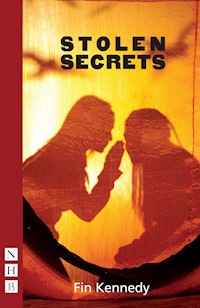
From the heart of London's East End, 'stolen secrets' are urban fairytales, bold, lyrical and gruesome, that can be performed individually or together for maximum shock value. Written by award-winning playwright Fin Kennedy, and created in parnership with Mulberry School in East London, Stolen Secrets is ideal for performance by schools and youth groups. It was first performed at the Edinburgh Festival Fringe in 2008.
Sie lesen das E-Book in den Legimi-Apps auf:
Seitenzahl: 43
Veröffentlichungsjahr: 2015
Das E-Book (TTS) können Sie hören im Abo „Legimi Premium” in Legimi-Apps auf:
Ähnliche
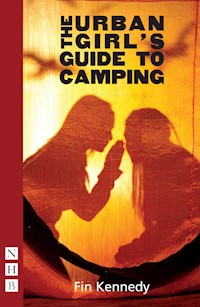














Fin Kennedy
STOLEN SECRETS
NICK HERN BOOKS
London
www.nickhernbooks.co.uk
Contents
Title Page
Foreword
Introduction
Stolen Secrets
About the Author
Copyright and Performing Rights Information
Foreword
When first looking for a writer-in-residence for Mulberry Theatre Company, I knew we would need a playwright who not only had the talent to bring their own voice and creativity to the work, but also was able to listen with care and sensitivity to new young voices. In Fin Kennedy, we found such a talent. He has written in his Introduction of his pleasure at being introduced to a new environment; in return, he has empowered our students, by bringing craft, skill and inspiration to dramatising their authentic voices. This has created a string of successful productions and facilitated a series of extraordinary performances, and in doing so, created a platform for a group otherwise little represented in British theatre.
This publication is a tribute to the collective creativity and artistic endeavour of many people at the school; students, staff and artists-in-residence. There is a belief at Mulberry School in the power of the arts to enrich education and enhance our lives. I am deeply grateful to Vanessa Ogden, Head Teacher, for inspiring and encouraging our work, and to Sarah Dickson, Director of Arts Specialism, for her unwavering support.
I am delighted that this volume of plays will ensure that something very important to our school will now be more widely shared. It is a testament to the courageous and triumphant spirit of all the young women of Mulberry, both past and present, whose determination is heard so clearly in these pages.
Jill TuffeeDeputy Head, Mulberry School
This is the foreword to The Urban Girl's Guide to Camping and other plays; the collection in which this play first appears.
Introduction
When Jill Tuffee, then Head of Expressive Arts at Mulberry School for Girls, first approached me in the foyer of Half Moon Young People’s Theatre in 2004, little did I realise that our conversation would lead onto a creative collaboration that would last for the rest of that decade, and produce six new plays in as many years. I was writer-on-attachment at Half Moon, and Jill’s group had just finished a day working with a short play of mine, B Minor1. Jill’s offer to come into school to collaborate on something further was both an opportunity and a challenge. I had never written anything specifically for teenagers before (though Half Moon’s use of B Minor was the first step in developing one of my first plays for them, later christened Locked In2).
Mulberry is a comprehensive on the Commercial Road in Tower Hamlets. Due to its catchment area, its student population is made up of ninety-eight per cent Muslim students of Bangladeshi heritage, mostly second or third generation. They are a disarming mix of East and West, traditional and modern – and absolutely the rightful heirs to the rebellious spirit of East London, that has run through each community that has settled there over the centuries. They couldn’t have been more different from me, a white middle-class playwright from Brighton and Winchester. But we got on surprisingly well, they took me into their trust, and were soon overflowing with anecdotes, local news, gossip and revelation – all material that went into our first play together, East End Tales3 (to which Stolen Secrets in this volume owes a debt).
The direct-address storytelling style that I developed for this first group, and which recurs in varying forms in every play in this volume, had several motivations behind it. The first was purely practical; teenagers have busy lives and many demands on their time. If you write individual parts for each of them, when availability issues arise it’s difficult to rehearse. But an indeterminate chorus without specific characters can be delivered as a shared narrative with as many or as few actors as you get that week, the lines simply redistributed among them.
The second reason was so that the plays could be performed almost anywhere, with minimal set or props, and free from naturalistic constraints in depicting ‘reality’. Direct address allows the action to move fluidly through space and time – just a few words and the illusion is created, the scene set. Moreover, such a style solves one of drama’s perennial difficulties – how to externalise the internal. A chorus of narrators can be endowed with a certain omniscience about the thoughts and feelings of the subjects of their stories.
But finally, and perhaps most importantly, it is about capturing something of the essence of teenagers – the effervescent tall tales, the excitable outrage, the delight in gossip. Teenage actors want to acknowledge their audience. Indeed, unlike naturalistic writing for this age group, which often produces an awkward, faux-soapopera style of acting, direct-address storytelling actively plays to young actors’ strengths. And, as we discovered when we began to take shows to the Edinburgh Festival, audiences love it too. One critic described their ‘untutored naturalism, refreshingly honest and unrestrained’, while another the ‘glee and openness that you cannot help falling for’. My writing takes its cue from the corridors of Mulberry School itself.




