


4,99 €
Mehr erfahren.
- Herausgeber: Lukeman Literary Management
- Kategorie: Krimi
- Serie: A Beth Drake FBI Suspense Thriller
- Sprache: Englisch
"This is an excellent book… When you start reading, be sure you don't have to wake up early!" —Reader review for The Killing Game ⭐⭐⭐⭐⭐ Army Ranger-turned-FBI Agent Beth Drake is the perfect agent to handle violent serial murders connected to drug crimes. But the serene landscape of Montana's ranchlands belies a deadly undercurrent as meth lab explosions take lives with unsettling precision. When Beth discovers these aren't mere accidents but the work of a calculating assassin, she must navigate an explosive maze of narcotics and revenge where one wrong step could be her last. This is the eighth book in a new series by #1 bestselling mystery and suspense author Kate Bold. The Beth Drake series delivers a page turning thriller of cat-and-mouse, packed with chilling twists. It breathes new life into the mystery genre by featuring a captivating female protagonist who will steal your heart and compel you to read on well past bedtime. Fans of Karin Slaughter, Lisa Regan, and Robert Dugoni are sure to fall in love. "This book moved very fast and every page was exciting. Plenty of dialogue, you absolutely love the characters, and you were rooting for the good guy throughout the whole story… I look forward to reading the next in the series." —Reader review for The Killing Game ⭐⭐⭐⭐⭐ "Kate did an amazing job on this book and I was hooked from the first chapter!" —Reader review for The Killing Game ⭐⭐⭐⭐⭐ "I really enjoyed this book. The characters were authentic, and I see the bad guys as something we hear about daily on the news... Looking forward to book 2." —Reader review for The Killing Game ⭐⭐⭐⭐⭐ "This was a really good book. The main characters were real, flawed and human. The story went along quickly and wasn't mired in too many unnecessary details. I really enjoyed it." —Reader review for The Killing Game ⭐⭐⭐⭐⭐ "Alexa Chase is headstrong, impatient, but most of all brave with a capital B. She never, repeat never, backs down until the bad guys are put where they belong. Clearly five stars!" —Reader review for The Killing Game ⭐⭐⭐⭐⭐ "Captivating and riveting serial murder with a twist of the macabre… Very well done." —Reader review for The Killing Game ⭐⭐⭐⭐⭐ "WOW what a great read! Talk about a diabolical killer! Really enjoyed this book. Looking forward to reading others by this author as well." —Reader review for The Killing Game ⭐⭐⭐⭐⭐ "Page turner for sure. Great characters and relationships. I got into the middle of this story and couldn't put it down. Looking forward to more from Kate Bold." —Reader review for The Killing Game ⭐⭐⭐⭐⭐ "Hard to put down. It has an excellent plot and has the right amount of suspense. I really enjoyed this book." —Reader review for The Killing Game ⭐⭐⭐⭐⭐ "Extremely well written, and well worth buying and reading. I can't wait to read book two!" —Reader review for The Killing Game ⭐⭐⭐⭐⭐
Das E-Book können Sie in Legimi-Apps oder einer beliebigen App lesen, die das folgende Format unterstützen:
Seitenzahl: 267
Veröffentlichungsjahr: 2025
Ähnliche















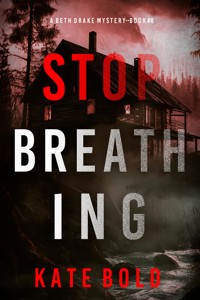
S T O P
B R E A T H I N G
(A Beth Drake FBI Suspense Thriller—Book 8)
K a t e B o l d
Kate Bold
Bestselling author Kate Bold is the author of numerous series in the mystery and thriller genres, including Meg Thorne, Heather King, Brynn Justice, Beth Drake, Maggie Flight, Addison Shine, Barren Pines, Nina Veil, Nora Price, Kelsey Hawk, Alexa Chase, Ashley Hope, Camille Grace, Harley Cole, Kaylie Brooks, Eve Hope, Dylan First, Lauren Lamb series.
An avid reader and lifelong fan of the mystery and thriller genres, Kate loves to hear from you, so please feel free to visit www.kateboldauthor.com to learn more and stay in touch.
Copyright © 2025 by Kate Bold. All rights reserved. Except as permitted under the U.S. Copyright Act of 1976, no part of this publication may be reproduced, distributed or transmitted in any form or by any means, or stored in a database or retrieval system, without the prior permission of the author. This ebook is licensed for your personal enjoyment only. This ebook may not be re-sold or given away to other people. If you would like to share this book with another person, please purchase an additional copy for each recipient. If you’re reading this book and did not purchase it, or it was not purchased for your use only, then please return it and purchase your own copy. Thank you for respecting the hard work of this author. This is a work of fiction. Names, characters, businesses, organizations, places, events, and incidents either are the product of the author’s imagination or are used fictionally. Any resemblance to actual persons, living or dead, is entirely coincidental.
CONTENTS
PROLOGUE
CHAPTER ONE
CHAPTER TWO
CHAPTER THREE
CHAPTER FOUR
CHAPTER FIVE
CHAPTER SIX
CHAPTER SEVEN
CHAPTER EIGHT
CHAPTER NINE
CHAPTER TEN
CHAPTER ELEVEN
CHAPTER TWELVE
CHAPTER THIRTEEN
CHAPTER FOURTEEN
CHAPTER FIFTEEN
CHAPTER SIXTEEN
CHAPTER SEVENTEEN
CHAPTER EIGHTEEN
CHAPTER NINETEEN
CHAPTER TWENTY
CHAPTER TWENTY-ONE
SERIES BY KATE BOLD
MEG THORNE
HEATHER KING
BRYNN JUSTICE
BETH DRAKE
MAGGIE FLIGHT
ADDISON SHINE
BARREN PINES
NINA VEIL
NORA PRICE
KELSEY HAWK
ALEXA CHASE
ASHLEY HOPE
CAMILLE GRACE
HARLEY COLE
KAYLIE BROOKS
PROLOGUE
Justin Fox checked the temperature gauge on the reaction vessel for the third time in five minutes, his breath misting in the frigid air of the converted barn. Outside, the Montana wind howled across the empty plains, rattling the sheet metal walls with a sound like distant thunder. The propane heater in the corner struggled against the December cold, creating pockets of warmth that dissipated before they could reach the far corners of their makeshift laboratory.
"Temperature's still dropping," he called to his brother, who was hunched over a camp stove, stirring something that definitely wasn't dinner. "We might need to fire up the second heater."
Brandon Fox looked up, his face gaunt in the harsh LED work lights they'd strung from the rafters. "Can't. The tank is almost empty, and we can't get more until Thursday. Johnson won't deliver out here more than once a week."
Justin nodded, pulling his jacket tighter. The irony wasn't lost on him—they were literally cooking, producing heat through chemical reactions that could burn skin on contact, yet they were freezing their asses off in this glorified shed. But that was the nature of the business. Nothing about cooking meth in rural Montana matched the glamorous drug dealer lifestyle from movies and TV shows.
He moved to check the pH levels of their current batch, careful not to disturb the delicate process. One wrong move, one moment of inattention, and they could lose three days of work—or worse. Justin had seen plenty of "worse" in his five years doing this. Burns that looked like something from a horror movie. Lungs scarred from inhaling the wrong fumes. And more than a few cooks who'd blown themselves up trying to cut corners.
"Remember when we were kids?" Brandon said suddenly, his voice cutting through the mechanical hum of their ventilation system—another irony, since the thing barely worked. "You said you were going to be a veterinarian."
Justin snorted. "And you were going to play professional baseball."
"Could've made it too, if I hadn't blown out my shoulder senior year."
It was an old conversation, one they'd had a hundred times in the long hours of watching chemicals react, waiting for crystallization, measuring and remeasuring to ensure purity. But tonight, something in Brandon's voice made Justin really study his younger brother. At thirty-one, Brandon looked forty-five. The chemicals aged you—the stress, the irregular hours, the constant paranoia about getting caught or robbed or killed by a deal gone wrong.
Justin was thirty-four, and he knew he didn't look much better.
"Why bring up the veterinarian thing?" Justin asked, adjusting the flow rate on one of their tubes.
Brandon shrugged. "Saw the Hendersons' place when I was getting supplies. They've got a new foal. Made me think of how you used to spend every summer at their ranch, back when old man Henderson was still alive."
Justin remembered. Fifteen years old, mucking stalls for five dollars an hour and loving every minute of it. Learning to gently handle young horses, to read their body language, to treat colic, and wrap injured legs. Mr. Henderson had even offered to help pay for college, saying Justin had a gift with animals.
But then Dad had gotten sick. Lung cancer, despite never smoking a day in his life, was one of those cosmic jokes that made you question everything. The medical bills had piled up faster than Mom's waitressing job could cover them. Justin had taken a job at the slaughterhouse instead of going to college—brutal work, but it paid three times what the ranch had offered.
Still, it wasn't enough. By the time Dad died two years later, the family was so deep in debt that bankruptcy seemed like the only option. Mom had aged twenty years in two, and Brandon's baseball scholarship had evaporated along with his shoulder's range of motion. The American Dream had become the American Nightmare.
And somewhere along the way, Justin had stopped dreaming about anything at all.
"You ever wonder what Mom would think?" Brandon asked, still stirring his pot.
"Every damn day."
Their mother had passed three years ago. Heart attack at fifty-eight, stressed and worn down to nothing. She'd never known what her boys did to pay off the last of the medical debt, to keep the family land from being foreclosed on. Justin had made sure of that, crafting elaborate lies about construction work in North Dakota, oil field money that explained their sudden ability to make payments.
The truth was simpler—and uglier. Justin had learned the basics from a guy at the slaughterhouse who'd done time in California. Just a little cooking on the side at first, small batches to sell to the long-haul truckers who needed something to keep them awake on thirty-hour runs. But small batches became bigger ones, and soon Justin had pulled Brandon in—two people could work faster, more safely, and Brandon had always been good with his hands, precise in a way that meth cooking demanded.
"We're almost clear," Justin said, the same thing he'd been saying for two years now. "Another six months, maybe eight, and we're out."
Brandon laughed, but there was no humor in it. "You've been saying that since we started."
"This time, I mean it. We've got enough saved to pay off the land, plus a cushion. We can sell the equipment to those boys from Billings, let them take over the territory."
"And then what? Go back to the slaughterhouse? Pretend we never did this?"
Justin didn't have an answer for that. The truth was, once you'd cooked meth, once you'd crossed that line, you couldn't uncross it. It wasn't just the money, though the money was better than anything else available to high school graduates in rural Montana. It was the knowledge that you'd contributed to the very plague destroying your community. Every tweaker in the county, every kid who tried it at a party and ended up hooked, every family torn apart—Justin and Brandon had played a part in that.
"At least we cook clean," Justin said, falling back on the one justification that helped him sleep at night. "No battery acid, no drain cleaner. Just pure chemicals, proper ratios."
It was true. Justin ran their operation like a real laboratory, insisting on quality ingredients and careful processes. Their meth was known for being consistent, less likely to cause the immediate health problems that came from the bathtub crank other cooks produced. It was a strange point of pride, but in this business, you took what moral victories you could.
"Still poison," Brandon said quietly.
"Yeah. Still poison."
They worked in silence for a while, the familiar routine taking over. Check temperatures, adjust flows, and monitor reactions. It was oddly meditative, requiring just enough attention to keep your mind from wandering too far into dangerous territory—like thinking about who would ultimately use what you were making.
Justin had just bent down to read the thermometer on the lower reaction vessel when he heard it—a sound that didn't belong. Not the wind, which had been constant all night. Not the creaking of the barn's old bones or the skittering of mice in the walls. This was different. Deliberate.
A footstep on gravel.
He straightened slowly, catching Brandon's eye. His brother had heard it too, was already reaching for the shotgun they kept propped in the corner. Raiders were always a possibility—other cooks or dealers who thought they could take what the Fox brothers had built. Or worse, law enforcement, though they usually came in loud with sirens and demands for surrender.
"Could be a coyote," Brandon whispered. "Or Henderson's dog. That mutt gets out all the time."
Justin nodded, but his instincts were screaming. Five years of cooking had developed a sixth sense for danger, and right now every alarm in his head was going off. He moved toward the door, careful to stay out of the line of sight from the windows, even though they were already covered with black plastic.
"I'll check," he said. "You watch the cook. We're at a critical point—can't let it overheat."
Brandon looked like he wanted to argue, but Justin was already moving. He grabbed the flashlight from the shelf by the door, though he wouldn't turn it on yet. Better to let his eyes adjust to the darkness, to not announce his position to whoever—or whatever—was out there.
The door opened on well-oiled hinges (they kept everything well-maintained, another safety precaution), and Justin slipped out into the bitter night. The wind hit him hard, cutting through his jacket as if it were made of paper. He pulled the door shut behind him, not wanting the light from inside to spill out.
The moon was three-quarters full, providing just enough illumination for him to see the rough shapes of the landscape—the hill rising behind the barn, the rutted dirt road that led to the highway two miles away, the cluster of cottonwoods along the dry creek bed. Justin stood still, listening, letting his vision adjust.
There—movement by the propane tank they used for the heater. Not an animal; the shape was wrong. Too upright, too purposeful.
Justin's hand went to the pistol in his jacket pocket, a .38 revolver that had belonged to their father. He'd never shot anyone, had only fired it at the range to make sure he could if necessary.
"Who's there?" he called out, trying to project an authority he didn't feel. "This is private property."
No response. The figure—definitely human now that Justin was focused on it—seemed to be doing something to the propane tank. Or near it. Justin couldn't quite make out the details.
He took a step forward, then another. "I said—"
The world exploded.
Not the propane tank—that was Justin's first confused thought as the blast wave hit him. The explosion came from behind, from the barn itself. The force of it threw him forward, slamming him into the frozen ground hard enough to drive all the air from his lungs. Heat washed over him, followed immediately by a rain of debris—wood splinters, metal fragments, things he didn't want to identify.
Justin tried to push himself up, but his arms wouldn't cooperate. His ears were ringing, a high-pitched whine that drowned out everything else. He managed to turn his head, looking back at where the barn had been.
Fire. Everything was fire. The structure had been reduced to a skeleton of flaming timbers, the roof completely gone. The heat was intense even from fifty feet away, and Justin could see the snow around the building beginning to melt, creating strange patterns of steam and smoke.
"Brandon," he tried to say, but it came out as a whisper. His brother had been inside, right next to the reaction vessels, surrounded by volatile chemicals.
Justin tried again to get up, to run toward the inferno, but his body wouldn't obey. Shock, some distant part of his mind recognized. He was going into shock.
As his vision began to gray at the edges, Justin saw the figure again—or thought he did. Standing at the edge of the firelight, watching. Then darkness claimed him, and his last coherent thought was that this had been no accident. Someone had murdered his brother, destroyed their lab, and left him alive.
But why?
The question followed him down into unconsciousness, where the cold couldn't reach and the fire couldn't burn, and Brandon was still alive, still stirring his pot, still dreaming of playing professional baseball someday.
CHAPTER ONE
The bed and breakfast overlooked Virginia's Blue Ridge Mountains, its wraparound porch offering views of vineyards that stretched toward the horizon in neat, geometric rows. Beth Drake sat in one of the white rocking chairs, a wool blanket across her lap and a cup of coffee growing cold in her hands, watching the December morning mist burn off the valley below.
Six weeks since she'd jumped between boats in hurricane conditions. Six weeks since she'd been placed on administrative leave. Five weeks since she'd been quietly reinstated with what Harrison had called "a notation in your file that could be read as either a commendation or a reprimand, depending on who's reading it."
Politics. Everything in the FBI eventually came down to politics.
"You're brooding again," Gabe said from the doorway, carrying his own coffee and a plate of the inn's famous apple cider donuts. "I can tell by the way you're strangling that mug."
Beth looked down at her white-knuckled grip and consciously relaxed her fingers. "I'm not brooding. I'm thinking."
"About the case." Dr. Gabriel Romano knew her too well after nearly two years together, the last two months of which had been spent navigating the delicate dance of shared living space in his Dupont Circle condo. He settled into the chair beside her, close enough that she could smell his shampoo—the expensive stuff he insisted was worth the money, unlike her drug store brand that he claimed "smelled like institutional soap."
"About Phantom," she admitted. "It's been three weeks since the Banneker lab raid came up empty. Three weeks, and we're no closer to finding the Doctor."
The raid had been a disaster. By the time the joint task force had descended on the abandoned pharmaceutical building in Rockville, nothing remained but empty rooms that smelled of bleach and a few pieces of equipment too large to move quickly. The Doctor—whatever he was—had been warned. Someone in law enforcement, someone with access to operational planning, had tipped him off.
"You weren't even supposed to be part of that raid," Gabe reminded her gently. "Technically, you're not supposed to be working Phantom at all anymore. Harrison made that clear."
"Harrison says a lot of things." Beth took a sip of cold coffee and grimaced. "But people are still dying. Eighty-three confirmed Phantom deaths now across D.C., Baltimore, Philadelphia, and Richmond. And last week, a suspicious overdose in Pittsburgh that has all the hallmarks."
"Pittsburgh." Gabe offered her a donut, which she declined with a shake of her head. "It's spreading west."
"Like a disease. And we had him, Gabe. We had the location, the lab, everything. If someone hadn't leaked—"
"You don't know it was a leak. It could have been surveillance on their end. Counter-intelligence. These aren't street dealers; this is a sophisticated operation."
Beth wanted to argue, but he had a point. Everything about the Phantom operation suggested a level of organization usually associated with cartels or terrorist cells, not domestic drug manufacturing. The Doctor—a nickname that might be literal, given the pharmaceutical-grade quality of the product—had managed to stay completely off law enforcement's radar. No photos, no real name, no concrete leads except what Susan Tanner had provided before she died.
Susan Tanner. Former chemistry teacher turned poisoner, who'd used a modified version of Phantom to kill her students in some twisted attempt at "salvation." She'd spent her last weeks drifting in and out of consciousness at Penn Presbyterian, occasionally lucid enough to provide fragments of information. The Banneker lab had been her final gift to the investigation, delivered just hours before her heart finally gave out.
Beth pulled out her phone and opened the case file she wasn't supposed to have. Photos from the empty Banneker lab filled the screen—pristine rooms, spaces where equipment had obviously been removed, marks on the floor showing where heavy machinery had been positioned.
"Stop," Gabe said softly. "Beth, stop. We're on vacation. Our first real vacation since we moved in together."
"It's a long weekend at a B&B two hours from home. That barely counts as a vacation."
"It counts if we act like it counts." He reached over and gently took her phone, powering it off before she could protest. "The world will not end if Special Agent Beth Drake takes forty-eight hours to be a normal person with her boyfriend in wine country."
Boyfriend. The word still felt inadequate for what Gabe was to her. He was the person who understood why she woke up at 3 AM sometimes, thinking about cases. He was a forensic pathologist for the FBI, spending his days determining how people died, finding truths in tissue samples and wound patterns. He understood the darkness that came with the job because he lived in it too.
It had taken her months to let him in. After Henry—her fellow Ranger who'd died in her arms in Afghanistan, whose heroin addiction had been both a source of shame and a desperate attempt to manage pain—Beth hadn't wanted to risk that kind of loss again. But Gabe had been patient, persistent without being pushy, until she'd realized she was already in too deep to back out.
Moving in together had been another negotiation entirely. Beth had lived alone since joining the FBI, her apartment a spartan space that reflected her military background. Gabe's condo was warmer, full of things that suggested a life beyond work—comic books he collected, kitchen gadgets for recipes he'd never make, a sound system that was probably too expensive but made music sound like the artists were in the room with you.
"What are you thinking about?" Gabe asked, studying her face with those dark eyes that missed nothing.
"You. Us. How we ended up here."
"In a B&B in Virginia?"
"Together. Living together. Being..." she searched for the word, "...normal."
Gabe laughed. "Beth, we're a lot of things, but normal isn't one of them. Normal people don't discuss decomposition rates over dinner. Normal people don't have a knife collection that would make a serial killer jealous."
"Those are for work—"
"Normal people don't steal Coast Guard boats to chase killers through hurricanes."
"That was one time."
"Once was enough." His voice grew serious. "I could have lost you that night. When I heard that you'd jumped to the yacht, that you'd fought the killer alone..."
Beth remembered the feeling of launching herself through the rain and wind, the moment of weightlessness before her hands found the yacht's rail. Ryan Keene and his salvaged knife, his delusions about sea gods and curses. The gold she'd thrown into the Atlantic to save four lives.
"But you didn't lose me," she said. "I'm right here."
"Are you?" Gabe gestured at the powered-off phone. "Because sometimes I feel like I'm competing with every case, every victim, every killer still out there."
It was an old conversation, one they'd had in various forms since the beginning. The job was consuming. It demanded everything and promised nothing in return except more bodies, more cases, more sleepless nights. But it was also who she was. Beth had been a soldier before she was an agent, and before that, she'd been the daughter of an ER doctor who'd died racing to save someone's life. Service was in her DNA.
"I'm trying," she said softly. "This weekend, being here—I'm trying."
"I know." He reached over and took her hand. "And I'm not asking you to be someone you're not. I fell in love with the woman who pursues justice like it's a personal vendetta. I just also want that woman to occasionally relax, eat apple cider donuts, and pretend to care about wine tasting."
"I do care about wine tasting."
"You care about wine drinking. There's a difference."
She laughed despite herself. "Fine. You're right. No more case talk. What's on the agenda for today?"
"Tour of the Cunningham Vineyard at eleven. Lunch at that French place the innkeeper recommended. Then back here for the afternoon, where I plan to do absolutely nothing productive."
"Nothing productive sounds suspicious. What kind of nothing?"
"The kind where we lock the door and ignore the outside world." His smile turned wicked. "Unless you'd rather discuss the molecular structure of Phantom and its fascinating metabolic pathways?"
"You know about Phantom's structure?"
"Beth, I'm a forensic pathologist. Of course, I know about the synthetic opioid that's killed a dozen people whose autopsies I've performed. The molecular structure is actually quite elegant—whoever designed it has a sophisticated understanding of chemistry. The base compound is similar to fentanyl but with modifications that make it both more potent and more resistant to standard overdose interventions."
Beth sat forward. "Now you're speaking my language."
"Technically, I'm not supposed to discuss active cases with you since you're officially off the Phantom investigation." He paused. "But since we're just having a casual conversation about chemistry..."
"Gabe."
"The most recent body came in last week. Twenty-three-year-old grad student from Georgetown. Bought what she thought was Adderall to help with finals. One pill. That's all it took."
Beth felt the familiar anger rising. The Doctor wasn't just manufacturing drugs; he was manufacturing death, packaged in forms that looked like legitimate pharmaceuticals. The grad student had probably thought she was being safe, buying from someone she trusted, taking something to help her study. Instead, she'd become statistic number eighty-three.
"The pills are getting more sophisticated," Gabe continued. "Perfect pharmaceutical presses, professional coating, even lot numbers that look legitimate. This isn't someone working in a basement with a pill press from Amazon."
"Which is why the Banneker lab made sense. Professional equipment, clean rooms, the ability to manufacture at scale." Beth stood abruptly, pacing to the porch rail. "We were so close."
"You'll get another chance."
"Will we? Every time we get close, he vanishes. The Carpenter—the distributor Susan Tanner identified—disappeared after our warehouse raid. The lab was cleaned out before we got there. It's like the Doctor has a direct line into our operations."
"Or he's just that careful. That's paranoid." Gabe joined her at the rail, wrapping an arm around her shoulders. "You know what your problem is? You're too good at your job. You expect to solve every case, catch every killer, save every potential victim. But some cases take time. Some killers are patient. And you can't save everyone."
She leaned into him, feeling the warmth of his body against the December chill. He was right, of course. The job required a certain acceptance of failure, an understanding that you couldn't win every battle. But Beth had never been good at accepting defeat, not since Afghanistan, not since watching her unit die in that warehouse ambush.
"Anyway," Gabe said, "enough about Phantom. I don't want that to take over the rest of our vacation."
"Then tell me something good," she said. "Something that has nothing to do with death or drugs or any of it."
"My brother's been clean for six weeks."
Beth turned to look at him, surprised. Alex Romano's struggle with opioid addiction had been a constant shadow over Gabe's life. It had started with a legitimate prescription after a sports injury, progressed to heroin when the pills became too expensive, and had nearly killed him multiple times.
"Six weeks? That's wonderful."
"He's in a new program. Something called medication-assisted treatment. Uses drugs like methadone or buprenorphine to manage the cravings while he gets therapy. Mom's cautiously optimistic."
"And you?"
"I'm trying to be." Gabe's expression was complex—hope mixed with the exhaustion of having been disappointed before. "He's relapsed three times in two years. But this time feels different. He's actually talking about the future, making plans. He wants to finish med school."
"That's a good sign."
"Yeah. Maybe." He shook his head. "See? Even my good news comes with qualifications. We're both terrible at this vacation thing."
"We just need practice." Beth checked her watch—a military-style analog that had survived Afghanistan, multiple FBI operations, and one ill-advised trip through a washing machine. "We should get ready for the vineyard tour."
"Enthusiastic about wine or enthusiastic about having a schedule?"
"Both. I can multitask."
They went back inside, where their room waited with its four-poster bed and view of the mountains. It was aggressively quaint, all floral wallpaper and antique furniture, the kind of place Beth never would have chosen on her own. But Gabe had wanted "somewhere romantic," and Beth had learned that sometimes love meant suffering through throw pillows and decorative doilies.
As she changed into something appropriate for wine tasting—jeans and a sweater that Gabe had bought her, insisting she needed clothes that weren't "tactical"—her phone buzzed with an incoming text. She'd powered it back on despite Gabe's protest, unable to completely disconnect even for a weekend.
Unknown number: "Check news. Pittsburgh case confirmed as Phantom. Same signature. He's moving west."
Beth stared at the message. The number wasn't in her contacts, but the area code was familiar. Someone from the Pittsburgh field office, probably, someone who knew she'd been working Phantom despite being officially removed from the case.
"Beth?" Gabe emerged from the bathroom, toothbrush in hand. "You have that look."
"What look?"
"The one that means our vacation is about to end early."
She showed him the text. He read it, sighed, and went back to brushing his teeth. When he returned, his expression was resigned.
"You want to call Harrison."
"I should call Harrison."
"But he'll tell you it's not your case, not your problem, and definitely not something you should be involving yourself with while on administrative probation."
"Probably."
"But you're going to investigate anyway."
"I..." Beth stopped, forced herself to really think about it. The Pittsburgh case was outside her jurisdiction. She was technically on weekend leave. Harrison had made it clear that any further "initiatives" on her part would result in permanent reassignment, possibly to a field office in Alaska.
But people were dying. The Doctor was expanding his operation, moving west with his poison. And she was one of the few people who understood the full scope of what they were dealing with.
"No," she said finally, surprising herself. "I'm not going to investigate. Not this weekend."
Gabe's eyebrows rose. "Really?"
"Really. Pittsburgh has good agents. The DEA is involved now. And you're right—I can't save everyone." She set the phone aside, face down. "Besides, we have wine to taste. Apparently, there's a difference between tasting and drinking, and I need to learn what it is."
"I'm proud of you," Gabe said, and sounded like he really meant it.
"Don't be too proud. I'm absolutely calling Harrison on Monday morning."
"Monday is not today." He grabbed his jacket—a leather bomber that made him look like the kind of bad boy who would never actually be bad. "Come on, Special Agent Drake. Let's go pretend to be normal people who care about tannins and oxidation levels."
"Oh, I know all about oxidation levels."
"In wine, not in blood."
"There's a difference?"
He laughed, and Beth let herself be pulled into the moment. The Phantom case would still be there on Monday. The Doctor, whoever he was, would still be moving his operation west, leaving bodies in his wake. But for forty-eight hours, Beth Drake was just a woman on vacation with her boyfriend, learning about wine and pretending the world wasn't full of monsters that needed catching.
It wasn't much of a vacation, but it was a start.
CHAPTER TWO
The tasting room at Cunningham Vineyard had exposed wooden beams that probably cost more to install than Beth's annual salary. She stood at the marble-topped bar, holding a glass of something the sommelier had described as "exhibiting remarkable terroir with hints of blackcurrant and aged leather," trying to look like she understood what any of that meant.
"You're supposed to swirl it," Gabe whispered, demonstrating with his own glass. "Releases the aromatics."
"It's wine. It smells like wine."
"Such a sophisticated palate."
The sommelier—a thin man named Derek who wore his superiority like cologne—moved down the bar to pour for another couple, giving Beth a moment to actually taste the wine instead of just analyzing it. It was good, she supposed. Dry, with a burn that reminded her alcohol was involved. But fifteen dollars for a taste seemed excessive when you could buy an entire bottle of perfectly adequate wine at the grocery store for the same price.
"You hate this," Gabe said, not accusingly, just observing.
"I don't hate it. I'm just not sure I understand it. Wine is wine."
"Spoken like someone who thinks coffee is coffee."
"Coffee is a caffeine delivery system. Wine is an alcohol delivery system. The rest is just marketing."
An older woman next to them turned with an expression of horror, as if Beth had just suggested burning the Mona Lisa.
"Wine," the woman said with the kind of conviction usually reserved for religious testimony, "is art in liquid form. Each bottle tells the story of its year—the weather, the soil, the winemaker's choices."
"That's beautiful," Gabe said, playing the diplomat. "We're still learning. This is our first time here."
The woman's expression softened. "Oh, how wonderful! Derek, you must give them the premium tasting. They need to experience the 2018 reserve."
Derek looked like he'd rather serve wine to actual barbarians, but the woman was clearly a regular—the kind who bought cases and brought wealthy friends—so he produced a different bottle.
"2018 was an exceptional year," he began, and Beth tuned out the lecture about rainfall and soil acidity, her attention caught by something else entirely.
Two men had entered the tasting room, both in their thirties, both trying too hard to look casual. They wore jeans and flannel-like costumes, too new, too perfectly distressed. City boys playing rural. But it was their movement that caught Beth's attention—the way they scanned the room systematically, checking exits, evaluating threats.
"Beth?" Gabe touched her arm. "You're doing the thing."
"What thing?"
"The thing where you've spotted something suspicious and are about to go into federal agent mode."
She forced herself to look away from the men, to focus on the wine Derek was pouring. "Just observing."
"You're working."
"I'm always working. It's called situational awareness."




