


Erhalten Sie Zugang zu diesem und mehr als 300000 Büchern ab EUR 5,99 monatlich.
- Herausgeber: Antique Editions
- Kategorie: Gesellschafts- und Liebesromane
- Sprache: Englisch
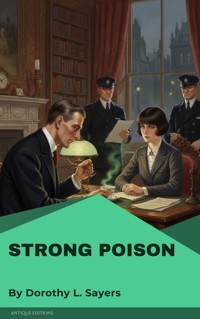
Murder. Deception. A detective who will not be fooled. In Strong Poison, Dorothy L. Sayers introduces the brilliant detective Lord Peter Wimsey in one of his most compelling cases. When a young woman is accused of poisoning her wealthy lover, Wimsey must unravel layers of lies, hidden motives, and cunning schemes to discover the truth. Full of suspense, sharp wit, and clever plotting, this classic mystery showcases Sayers' mastery of the detective genre and her unforgettable protagonist. Unravel the mystery—download Strong Poison today and follow Lord Peter Wimsey in a case of cunning and intrigue.
Sie lesen das E-Book in den Legimi-Apps auf:
Seitenzahl: 388
Veröffentlichungsjahr: 2026
Das E-Book (TTS) können Sie hören im Abo „Legimi Premium” in Legimi-Apps auf:
Ähnliche

















Strong Poison
By Dorothy L. Sayers.
Table of Contents
Strong Poison
I
II
III
IV
V
VI
VII
VIII
IX
X
XI
XII
XIII
XIV
XV
XVI
XVII
XVIII
XIX
XX
XXI
XXII
XXIII
Endnotes
Landmarks
Strong Poison
Endnotes
Cover
I
There were crimson roses on the bench; they looked like splashes of blood.
The judge was an old man; so old, he seemed to have outlived time and change and death. His parrot face and parrot voice were dry, like his old, heavily veined hands. His scarlet robe clashed harshly with the crimson of the roses. He had sat for three days in the stuffy court, but he showed no sign of fatigue.
He did not look at the prisoner as he gathered his notes into a neat sheaf and turned to address the jury, but the prisoner looked at him. Her eyes, like dark smudges under the heavy square brows, seemed equally without fear and without hope. They waited.
“Members of the jury—”
The patient old eyes seemed to sum them up and take stock of their united intelligence. Three respectable tradesmen—a tall, argumentative one, a stout, embarrassed one with a drooping moustache, and an unhappy one with a bad cold; a director of a large company, anxious not to waste valuable time; a publican, incongruously cheerful; two youngish men of the artisan class; a nondescript, elderly man, of educated appearance, who might have been anything; an artist with a red beard disguising a weak chin; three women—an elderly spinster, a stout capable woman who kept a sweet shop, and a harassed wife and mother whose thoughts seemed to be continually straying to her abandoned hearth.
“Members of the jury—you have listened with great patience and attention to the evidence in this very distressing case, and it is now my duty to sum up the facts and arguments which have been put before you by the learned Attorney General and by the learned Counsel for the Defence, and to put them in order as clearly as possible, so as to help you in forming your decision.
“But first of all, perhaps I ought to say a few words with regard to that decision itself. You know, I am sure, that it is a great principle of English law that every accused person is held to be innocent unless and until he is proved otherwise. It is not necessary for him, or her, to prove innocence; it is, in the modern slang phrase, ‘up to’ the Crown to prove guilt, and unless you are quite satisfied that the Crown has done this beyond all reasonable doubt, it is your duty to return a verdict of ‘Not Guilty.’ That does not necessarily mean that the prisoner has established her innocence by proof; it simply means that the Crown has failed to produce in your minds an undoubted conviction of her guilt.”
Salcombe Hardy, lifting his drowned violet eyes for a moment from his reporter’s notebook, scribbled two words on a slip of paper and pushed them over to Waffles Newton. “Judge hostile.” Waffles nodded. They were old hounds on this blood trail.
The judge creaked on.
“You may perhaps wish to hear from me exactly what is meant by those words ‘reasonable doubt.’ They mean, just so much doubt as you might have in everyday life about an ordinary matter of business. This is a case of murder, and it might be natural for you to think that, in such a case, the words mean more than this. But that is not so. They do not mean that you must cast about for fantastical solutions of what seems to you plain and simple. They do not mean those nightmare doubts which sometimes torment us at four o’clock in the morning when we have not slept very well. They only mean that the proof must be such as you would accept about a plain matter of buying and selling, or some such commonplace transaction. You must not strain your belief in favour of the prisoner any more, of course, than you must accept proof of her guilt without the most careful scrutiny.
“Having said just these few words, so that you may not feel too much overwhelmed by the heavy responsibility laid upon you by your duty to the State, I will now begin at the beginning and try to place the story that we have heard, as clearly as possible before you.
“The case for the Crown is that the prisoner, Harriet Vane, murdered Philip Boyes by poisoning him with arsenic. I need not detain you by going through the proofs offered by Sir James Lubbock and the other doctors who have given evidence as to the cause of death. The Crown says he died of arsenical poisoning, and the defence do not dispute it. The evidence is, therefore, that the death was due to arsenic, and you must accept that as a fact. The only question that remains for you is whether, in fact, that arsenic was deliberately administered by the prisoner with intent to murder.
“The deceased, Philip Boyes, was, as you have heard, a writer. He was thirty-six years old, and he had published five novels and a large number of essays and articles. All these literary works were of what is sometimes called an ‘advanced’ type. They preached doctrines which may seem to some of us immoral or seditious, such as atheism, and anarchy, and what is known as free love. His private life appears to have been conducted, for some time at least, in accordance with these doctrines.
“At any rate, at some time in the year 1927, he became acquainted with Harriet Vane. They met in some of those artistic and literary circles where ‘advanced’ topics are discussed, and after a time they became very friendly. The prisoner is also a novelist by profession, and it is very important to remember that she is a writer of so-called ‘mystery’ or ‘detective’ stories, such as deal with various ingenious methods of committing murder and other crimes.
“You have heard the prisoner in the witness box, and you have heard the various people who came forward to give evidence as to her character. You have been told that she is a young woman of great ability, brought up on strictly religious principles, who, through no fault of her own was left, at the age of twenty-three, to make her own way in the world. Since that time—and she is now twenty-nine years old—she has worked industriously to keep herself, and it is very much to her credit that she has, by her own exertions, made herself independent in a legitimate way, owing nothing to anybody and accepting help from no one.
“She has told us herself, with great candour, how she became deeply attached to Philip Boyes, and how, for a considerable time, she held out against his persuasions to live with him in an irregular manner. There was, in fact, no reason at all why he should not have married her honourably; but apparently he represented himself as being conscientiously opposed to any formal marriage. You have the evidence of Sylvia Marriott and Eiluned Price that the prisoner was made very unhappy by this attitude which he chose to take up, and you have heard also that he was a very handsome and attractive man, whom any woman might have found it difficult to resist.
“At any rate, in March of 1928, the prisoner, worn out, as she tells us, by his unceasing importunities, gave in, and consented to live on terms of intimacy with him, outside the bonds of marriage.
“Now you may feel, and quite properly, that this was a very wrong thing to do. You may, after making all allowances for this young woman’s unprotected position, still feel that she was a person of unstable moral character. You will not be led away by the false glamour which certain writers contrive to throw about ‘free love,’ into thinking that this was anything but an ordinary, vulgar act of misbehavior. Sir Impey Biggs, very rightly using all his great eloquence on behalf of his client, has painted this action of Harriet Vane’s in very rosy colours; he has spoken of unselfish sacrifice and self immolation, and has reminded you that, in such a situation, the woman always has to pay more heavily than the man. You will not, I am sure, pay too much attention to this. You know quite well the difference between right and wrong in such matters, and you may think that, if Harriet Vane had not become to a certain extent corrupted by the unwholesome influences among which she lived, she would have shown a truer heroism by dismissing Philip Boyes from her society.
“But, on the other hand, you must be careful not to attach the wrong kind of importance to this lapse. It is one thing for a man or woman to live an immoral life, and quite another thing to commit murder. You may perhaps think that one step into the path of wrongdoing makes the next one easier, but you must not give too much weight to that consideration. You are entitled to take it into account, but you must not be too much prejudiced.”
The judge paused for a moment, and Freddy Arbuthnot jerked an elbow into the ribs of Lord Peter Wimsey, who appeared to be a prey to gloom.
“I should jolly well hope not. Damn it, if every little game led to murder, they’d be hanging half of us for doin’ in the other half.”
“And which half would you be in?” enquired his lordship, fixing him for a moment with a cold eye and then returning his glance to the dock.
“Victim,” said the Hon. Freddy, “victim. Me for the corpse in the library.”
“Philip Boyes and the prisoner lived together in this fashion,” went on the judge, “for nearly a year. Various friends have testified that they appeared to live on terms of the greatest mutual affection. Miss Price said that, although Harriet Vane obviously felt her unfortunate position very acutely—cutting herself off from her family friends and refusing to thrust herself into company where her social outlawry might cause embarrassment and so on—yet she was extremely loyal to her lover and expressed herself proud and happy to be his companion.
“Nevertheless, in February 1929 there was a quarrel, and the couple separated. It is not denied that the quarrel took place. Mr. and Mrs. Dyer, who occupy the flat immediately above Philip Boyes’, say that they heard loud talking in angry voices, the man swearing and the woman crying, and that the next day, Harriet Vane packed up all her things and left the house for good. The curious feature in the case, and one which you must consider very carefully, is the reason assigned for the quarrel. As to this, the only evidence we have is the prisoner’s own. According to Miss Marriott, with whom Harriet Vane took refuge after the separation, the prisoner steadily refused to give any information on the subject, saying only that she had been painfully deceived by Boyes and never wished to hear his name spoken again.
“Now it might be supposed from this that Boyes had given the prisoner cause for grievance against him, by unfaithfulness, or unkindness, or simply by a continued refusal to regularise the situation in the eyes of the world. But the prisoner absolutely denies this. According to her statement—and on this point her evidence is confirmed by a letter which Philip Boyes wrote to his father—Boyes did at length offer her legal marriage, and this was the cause of the quarrel. You may think this a very remarkable statement to make, but that is the prisoner’s evidence on oath.
“It would be natural for you to think that this proposal of marriage takes away any suggestion that the prisoner had a cause of grievance against Boyes. Anyone would say that, under such circumstances, she could have no motive for wishing to murder this young man, but rather the contrary. Still, there is the fact of the quarrel, and the prisoner herself states that this honourable, though belated, proposal was unwelcome to her. She does not say—as she might very reasonably say, and as her counsel has most forcefully and impressively said for her, that this marriage offer completely does away with any pretext for enmity on her part towards Philip Boyes. Sir Impey Biggs says so, but that is not what the prisoner says. She says—and you must try to put yourselves in her place and understand her point of view if you can—that she was angry with Boyes because, after persuading her against her will to adopt his principles of conduct, he then renounced those principles and so, as she says, ‘made a fool of her.’
“Well, that is for you to consider: whether the offer which was in fact made could reasonably be construed into a motive for murder. I must impress upon you that no other motive has been suggested in evidence.”
At this point the elderly spinster on the jury was seen to be making a note—a vigorous note, to judge from the action of her pencil on the paper. Lord Peter Wimsey shook his head slowly two or three times and muttered something under his breath.
“After this,” said the judge, “nothing particular seems to have happened to these two people for three months or so, except that Harriet Vane left Miss Marriott’s house and took a small flat of her own in Doughty Street, while Philip Boyes, on the contrary, finding his solitary life depressing, accepted the invitation of his cousin, Mr. Norman Urquhart, to stay at the latter’s house in Woburn Square. Although living in the same quarter of London, Boyes and the accused do not seem to have met very often after the separation. Once or twice there was an accidental encounter at the house of a friend. The dates of these occasions cannot be ascertained with any certainty—they were informal parties—but there is some evidence that there was a meeting towards the end of March, another in the second week in April, and a third some time in May. These times are worth noting, though, as the exact day is left doubtful, you must not attach too much importance to them.
“However, we now come to a date of the very greatest importance. On April 10th, a young woman, who has been identified as Harriet Vane, entered the chemist’s shop kept by Mr. Brown in Southampton Row, and purchased two ounces of commercial arsenic, saying that she needed it to destroy rats. She signed the poison book in the name of Mary Slater, and the handwriting has been identified as that of the prisoner. Moreover, the prisoner herself admits having made this purchase, for certain reasons of her own. For this reason it is comparatively unimportant—but you may think it worth noting—that the housekeeper of the flats where Harriet Vane lives has come here and told you that there are no rats on the premises, and never have been in the whole time of her residence there.
“On May 5th we have another purchase of arsenic. The prisoner, as she herself states, this time procured a tin of arsenical weedkiller, of the same brand that was mentioned in the Kidwelly poisoning case. This time she gave the name of Edith Waters. There is no garden attached to the flats where she lives, nor could there be any conceivable use for weedkiller on the premises.
“On various occasions also, during the period from the middle of March to the beginning of May, the prisoner purchased other poisons, including prussic acid (ostensibly for photographic purposes) and strychnine. There was also an attempt to obtain aconitine, which was not successful. A different shop was approached and a different name given in each case. The arsenic is the only poison which directly concerns this case, but these other purchases are of some importance, as throwing light on the prisoner’s activities at this time.
“The prisoner has given an explanation of these purchases which you must consider for what it is worth. She says that she was engaged at that time in writing a novel about poisoning, and that she bought the drugs in order to prove by experiment how easy it was for an ordinary person to get hold of deadly poisons. In proof of this, her publisher, Mr. Trufoot, has produced the manuscript of the book. You have had it in your hands, and you will be given it again, if you like, when I have finished my summing up, to look at in your own room. Passages were read out to you, showing that the subject of the book was murder by arsenic, and there is a description in it of a young woman going to a chemist’s shop and buying a considerable quantity of this deadly substance. And I must mention here what I should have mentioned before, namely, that the arsenic purchased from Mr. Brown was the ordinary commercial arsenic, which is coloured with charcoal or indigo, as the law requires, in order that it may not be mistaken for sugar or any other innocent substance.”
Salcombe Hardy groaned: “How long, O Lord, how long shall we have to listen to all this tripe about commercial arsenic? Murderers learn it now at their mother’s knee.”
“I particularly want you to remember those dates—I will give them to you again—the 10th April and the 5th May.” (The Jury wrote them down. Lord Peter Wimsey murmured: “They all wrote down on their slates, ‘She doesn’t believe there’s an atom of meaning in it.’ ” The Hon. Freddy said “What? What?” and the judge turned over another page of his notes.)
“About this time, Philip Boyes began to suffer from renewed attacks of a gastric trouble to which he had been subject from time to time during his life. You have read the evidence of Dr. Green, who attended him for something of the sort during his University career. That is some time ago; but there is also Dr. Weare, who, in 1925 prescribed for a similar attack. Not grave illnesses, but painful and exhausting, with sickness and so on, and aching in the limbs. Plenty of people have such troubles from time to time. Still, there is a coincidence of dates here which may be significant. We get these attacks—noted in Dr. Weare’s casebook—one on the 31st of March, one on the 15th of April and one on the 12th of May. Three sets of coincidences—as you may perhaps think them to be—Harriet Vane and Philip Boyes meet ‘towards the end of March,’ and he has an attack of gastritis on March 31st; on 10th April Harriet Vane purchases two ounces of arsenic—they meet again ‘in the second week in April,’ and on April 15th, he has another attack; on 5th May, there is the purchase of weedkiller—‘some time in May’ there is another meeting, and on the 12th May he is taken ill for the third time. You may think that is rather curious, but you must not forget that the Crown has failed to prove any purchase of arsenic before the meeting in March. You must bear that in mind when considering this point.
“After the third attack—the one in May—the doctor advises Boyes to go away for a change, and he selects the northwest corner of Wales. He goes to Harlech, and spends a very pleasant time there and is much better. But he has a friend to accompany him, Mr. Ryland Vaughan, whom you have seen, and this friend says that ‘Philip was not happy.’ In fact, Mr. Vaughan formed the opinion that he was fretting after Harriet Vane. His bodily health improved, but he grew mentally depressed. And so on June 16th, we find him writing a letter to Miss Vane. Now that is an important letter, so I will read it to you once more:
‘Dear Harriet,
Life is an utter mess up. I can’t stick it out here any longer. I’ve decided to cut adrift and take a trip out West. But before I go, I want to see you once again and find out if it isn’t possible to put things straight again. You must do as you like, of course, but I still cannot understand the attitude you take up. If I can’t make you see the thing in the right perspective this time I’ll chuck it for good. I shall be in town on the 20th Let me have a line to say when I can come round.
Yours,
P.’
“Now that, as you have realised, is a most ambiguous letter. Sir Impey Biggs, with arguments of great weight, has suggested that by the expressions ‘cut adrift and take a trip out west,’ ‘I can’t stick it out here,’ and ‘chuck it for good,’ the writer was expressing his intention to make away with himself if he could not effect a reconciliation with the accused. He points out that ‘to go west’ is a well-known metaphor for dying, and that, of course, may be convincing to you. But Mr. Urquhart, when examined on the subject by the Attorney General, said that he supposed the letter to refer to a project which he himself had suggested to the deceased, of taking a voyage across the Atlantic to Barbados, by way of change of scene. And the learned Attorney General makes this other point that when the writer says, ‘I can’t stick it out here any longer,’ he means, here in Britain, or perhaps merely ‘here at Harlech,’ and that if the phrase had reference to suicide it would read simply, ‘I can’t stick it out any longer.’
“No doubt you have formed your own opinion on this point. It is important to note that the deceased asks for an appointment on the 20th The reply to this letter is before us; it reads:
‘Dear Phil,
You can come round at 9:30 on the 20th if you like, but you certainly will not make me change my mind.’
“And it is signed simply ‘H.’ A very cold letter, you may think—almost hostile in tone. And yet the appointment is made for 9:30.
“I shall not have to keep your attention very much longer, but I do ask for it at this point, specially—though you have been attending most patiently and industriously all the time—because we now come to the actual day of the death itself.”
The old man clasped his hands one over the other upon the sheaf of notes and leaned a little forward. He had it all in his head, though he had known nothing of it until the last three days. He had not reached the time to babble of green fields and childhood ways; he still had firm hold of the present; he held it pinned down flat under his wrinkled fingers with their grey, chalky nails.
“Philip Boyes and Mr. Vaughan came back to town together on the evening of the 19th, and there would seem to be no doubt at all that Boyes was then in the best of health. Boyes spent the night with Mr. Vaughan, and they breakfasted together in the usual way upon bacon and eggs, toast, marmalade and coffee. At 11 o’clock Boyes had a Guinness, observing that, according to the advertisements it was ‘Good for you.’ At 1 o’clock he ate a hearty lunch at his club, and in the afternoon he played several sets at tennis with Mr. Vaughan and some other friends. During the game the remark was made by one of the players that Harlech had done Boyes good, and he replied that he was feeling fitter than he had done for many months.
“At half past seven he went round to have dinner with his cousin, Mr. Norman Urquhart. Nothing at all unusual in his manner or appearance was noticed, either by Mr. Urquhart or by the maid who waited at table. Dinner was served at 8 o’clock exactly, and I think it would be a good thing if you were to write down that time (if you have not already done so) and also the list of things eaten and drunk.
“The two cousins dined alone together, and first, by way of cocktail, each had a glass of sherry. The wine was a fine Oloroso of 1847, and the maid decanted it from a fresh bottle and poured it into the glasses as they sat in the library. Mr. Urquhart retains the dignified old-fashioned custom of having the maid in attendance throughout the meal, so that we have here the advantage of two witnesses during this part of the evening. You saw the maid, Hannah Westlock, in the box, and I think you will say she gave the impression of being a sensible and observant witness.
“Well, there was the sherry. Then came a cup of cold bouillon, served by Hannah Westlock from the tureen on the sideboard. It was very strong, good soup, set to a clear jelly. Both men had some, and, after dinner, the bouillon was finished by the cook and Miss Westlock in the kitchen.
“After the soup came a piece of turbot with sauce. The portions were again carved at the sideboard, the sauce boat was handed to each in turn, and the dish was then sent out to be finished in the kitchen.
“Then came a poulet en casserole—that is, chicken cut up and stewed slowly with vegetables in a fireproof cooking utensil. Both men had some of this, and the maids finished the dish.
“The final course was a sweet omelette, which was made at the table in a chafing dish by Philip Boyes himself. Both Mr. Urquhart and his cousin were very particular about eating an omelette the moment it came from the pan—and a very good rule it is, and I advise you all to treat omelettes in the same way and never to allow them to stand, or they will get tough. Four eggs were brought to the table in their shells, and Mr. Urquhart broke them one by one into a bowl, adding sugar from a sifter. Then he handed the bowl to Mr. Boyes, saying: ‘You’re the real dab at omelettes, Philip—I’ll leave this to you.’ Philip Boyes then beat the eggs and sugar together, cooked the omelette in the chafing dish, filled it with hot jam, which was brought in by Hannah Westlock, and then himself divided it into two portions, giving one to Mr. Urquhart and taking the remainder himself.
“I have been a little careful to remind you of all these things, to show that we have good proof that every dish served at dinner was partaken of by two people at least, and in most cases by four. The omelette—the only dish which did not go out to the kitchen—was prepared by Philip Boyes himself and shared by his cousin. Neither Mr. Urquhart, Miss Westlock nor the cook, Mrs. Pettican, felt any ill effects from this meal.
“I should mention also that there was one article of diet which was partaken of by Philip Boyes alone, and that was a bottle of Burgundy. It was a fine old Corton, and was brought to the table in its original bottle. Mr. Urquhart drew the cork and then handed the bottle intact to Philip Boyes, saying that he himself would not take any—he had been advised not to drink at mealtimes. Philip Boyes drank two glassfuls and the remainder of the bottle was fortunately preserved. As you have already heard, the wine was later analysed and found to be quite harmless.
“This brings us to 9 o’clock. After dinner, coffee is offered, but Boyes excuses himself on the ground that he does not care for Turkish coffee, and moreover will probably be given coffee by Harriet Vane. At 9:15 Boyes leaves Mr. Urquhart’s house in Woburn Square, and is driven in a taxi to the house where Miss Vane has her flat, No. 100 Doughty Street—a distance of about half a mile. We have it from Harriet Vane herself, from Mrs. Bright, a resident in the ground floor flat, and from Police Constable D.1234 who was passing along the street at the time, that he was standing on the doorstep, ringing the prisoner’s bell, at 25 minutes past 9. She was on the lookout for him and let him in immediately.
“Now, as the interview was naturally a private one, we have no account of it to go upon but that of the prisoner. She has told us that as soon as he came in, she offered him ‘a cup of coffee which was standing ready upon the gas ring.’ Now, when the learned Attorney General heard the prisoner say that, he immediately asked what the coffee was standing ready in. The prisoner, apparently not quite understanding the purport of the question, replied ‘in the fender, to keep hot.’ When the question was repeated more clearly, she explained that the coffee was made in a saucepan, and that it was this which was placed upon the gas ring in the fender. The Attorney General then drew the prisoner’s attention to her previous statement made to the police, in which this expression appeared: ‘I had a cup of coffee ready for him on his arrival.’ You will see at once the importance of this. If the cups of coffee were prepared and poured out separately before the arrival of the deceased, there was every opportunity to place poison in one of the cups beforehand and offer the prepared cup to Philip Boyes; but if the coffee was poured out from the saucepan in the deceased’s presence, the opportunity would be rather less, though of course the thing might easily be done while Boyes’ attention was momentarily distracted. The prisoner explained that in her statement she used the phrase ‘a cup of coffee’ merely as denoting ‘a certain quantity of coffee.’ You yourselves will be able to judge whether that is a usual and natural form of expression. The deceased is said by her to have taken no milk or sugar in his coffee, and you have the testimony of Mr. Urquhart and Mr. Vaughan that it was his usual habit to drink his after-dinner coffee black and unsweetened.
“According to the prisoner’s evidence, the interview was not a satisfactory one. Reproaches were uttered on both sides, and at 10 o’clock or thereabouts, the deceased expressed his intention of leaving her. She says that he appeared uneasy and remarked that he was not feeling well, adding that her behaviour had greatly upset him.
“At 10 minutes past 10—and I want you to note these times very carefully, the taxi driver Burke, who was standing on the rank in Guilford Street, was approached by Philip Boyes and told to take him to Woburn Square. He says that Boyes spoke in a hurried and abrupt tone, like that of a person in distress of mind or body. When the taxi stopped before Mr. Urquhart’s house, Boyes did not get out, and Burke opened the door to see what was the matter. He found the deceased huddled in a corner with his hand pressed over his stomach and his face pale and covered with perspiration. He asked him whether he was ill, and the deceased replied: ‘Yes, rotten.’ Burke helped him out and rang the bell, supporting him with one arm as they stood on the doorstep. Hannah Westlock opened the door. Philip Boyes seemed hardly able to walk; his body was bent almost double, and he sank groaning into a hallchair and asked for brandy. She brought him a stiff brandy and soda from the dining room, and after drinking this, Boyes recovered sufficiently to take money from his pocket and pay for the taxi.
“As he still seemed very ill, Hannah Westlock summoned Mr. Urquhart from the library. He said to Boyes, ‘Hullo, old man—what’s the matter with you?’ Boyes replied, ‘God knows! I feel awful. It can’t have been the chicken.’ Mr. Urquhart said he hoped not, he hadn’t noticed anything wrong with it, and Boyes answered, No, he supposed it was one of his usual attacks, but he’d never felt anything like this before. He was taken upstairs to bed, and Dr. Grainger was summoned by telephone, as being the nearest physician available.
“Before the doctor’s arrival, the patient vomited violently, and thereafter continued to vomit persistently. Dr. Grainger diagnosed the trouble as acute gastritis. There was a high temperature and rapid pulse, and the patient’s abdomen was acutely painful to pressure, but the doctor found nothing indicative of any trouble in the nature of appendicitis or peritonitis. He therefore went back to his surgery, and made up a soothing medicine to control the vomiting—a mixture of bicarbonate of potash, tincture of oranges, and chloroform—no other drugs.
“Next day the vomiting still persisted, and Dr. Weare was called in to consult with Dr. Grainger, as he was well acquainted with the patient’s constitution.”
Here the judge paused and glanced at the clock.
“Time is getting on, and as the medical evidence has still to be passed in review, I will adjourn the Court now for lunch.”
“He would,” said the Hon. Freddy, “just at the beastliest moment when everybody’s appetite is thoroughly taken away. Come on, Wimsey, let’s go and fold a chop into the system, shall we?—Hullo!”
Wimsey had pushed past without heeding him, and was making his way down into the body of the court, where Sir Impey Biggs stood conferring with his juniors.
“Seems to be in a bit of a stew,” said Mr. Arbuthnot, meditatively. “Gone to put an alternative theory of some kind, I expect. Wonder why I came to this bally show. Tedious, don’t you know, and the girl’s not even pretty. Don’t think I’ll come back after grub.”
He struggled out, and found himself face to face with the Dowager Duchess of Denver.
“Come and have lunch, Duchess,” said Freddy, hopefully. He liked the Dowager.
“I’m waiting for Peter, thanks, Freddy. Such an interesting case and interesting people, too, don’t you think, though what the jury make of it I don’t know, with faces like hams most of them, except the artist, who wouldn’t have any features at all if it wasn’t for that dreadful tie and his beard, looking like Christ, only not really Christ but one of those Italian ones in a pink frock and blue top thing. Isn’t that Peter’s Miss Climpson on the jury, how does she get there, I wonder?”
“He’s put her into a house somewhere round about, I fancy,” said Freddy, “with a typewriting office to look after and live over the shop and run those comic charity stunts of his. Funny old soul, isn’t she? Stepped out of a magazine of the nineties. But she seems to suit his work all right and all that.”
“Yes—such a good thing too, answering all those shady advertisements and then getting the people shown up and so courageous too, some of them the horridest oily people, and murderers I shouldn’t wonder with automatic thingummies and life preservers in every pocket, and very likely a gas oven full of bones like Landru, so clever, wasn’t he? And really such women—born murderees as somebody says—quite pig faced but not of course deserving it and possibly the photographs don’t do them justice, poor things.”
The Duchess was even more rambling than usual, thought Freddy, and as she spoke her eyes wandered to her son with a kind of anxiety unusual in her.
“Top hole to see old Wimsey back, isn’t it?” he said, with simple kindliness. “Wonderful how keen he is on this sort of thing, don’t you know. Rampages off the minute he gets home like the jolly old warhorse sniffing the T.N.T. Regularly up to the eyes in it.”
“Well, it’s one of Chief Inspector Parker’s cases, and they’re such great friends, you know, quite like David and Beersheba—or do I mean Daniel?”
Wimsey joined them at this complicated moment, and tucked his mother’s arm affectionately in his own.
“Frightfully sorry to keep you waiting, Mater, but I had to say a word to Biggy. He’s having a rotten time, and that old Jeffreys of a judge looks as though he was getting measured for a black cap. I’m going home to burn my books. Dangerous to know too much about poisons, don’t you think? Be thou as chaste as ice, as pure as snow, thou shalt not escape the old Bailey.”
“The young woman doesn’t seem to have tried that recipe, does she?” remarked Freddy.
“You ought to be on the jury,” retorted Wimsey, with unusual acidity, “I bet that’s what they’re all saying at this moment. I’m convinced that that foreman is a teetotaller—I saw ginger beer going into the jury room, and I only hope it explodes and blows his inside through the top of his skull.”
“All right, all right,” returned Mr. Arbuthnot, soothingly, “what you want is a drink.”
II
The scramble for places subsided; the jury returned; the prisoner reappeared in the dock suddenly, like a jack-in-the-box; the judge resumed his seat. Some petals had spilt from the roses. The old voice took up its tale where it had left off.
“Members of the jury—there is no need, I think, for me to recall the course of Philip Boyes’ illness in great detail. The nurse was called in on June 21st, and during that day the doctors visited the patient three times. His condition grew steadily worse. There was persistent vomiting and diarrhoea, and he could not keep any food or medicine down at all. On the day after, the 22nd, he was worse still—in great pain, the pulse growing weaker, and the skin about the mouth getting dry and peeling off. The doctors gave him every attention, but could do nothing for him. His father was summoned, and when he arrived he found his son conscious, but unable to lift himself. He was able to speak, however, and in the presence of his father and Nurse Williams he made the remark, ‘I’m going out, Dad, and I’m glad to be through with it. Harriet’ll be rid of me now—I didn’t know she hated me quite so much.’ Now that was a very remarkable speech, and we have heard two very different interpretations put upon it. It is for you to say whether, in your opinion, he meant: ‘She has succeeded in getting rid of me; I didn’t know she hated me enough to poison me,’ or whether he meant, ‘When I realised she hated me so much, I decided I did not want to live any longer’—or whether, perhaps, he meant neither of these things. When people are very ill, they sometimes get fantastic ideas, and sometimes they wander in their minds; perhaps you may feel that it is not profitable to take too much for granted. Still, those words are part of the evidence, and you are entitled to take them into account.
“During the night he became gradually weaker and lost consciousness, and at 3 o’clock in the morning he died, without ever regaining it. That was on the 23rd of June.
“Now, up to this time, no suspicion of any kind had been aroused. Both Dr. Grainger and Dr. Weare formed the opinion that the cause of death was acute gastritis, and we need not blame them for coming to this conclusion, because it was quite consistent both with the symptoms of the illness and with the past history of the patient. A death certificate was given in the usual way, and the funeral took place on the 28th.
“Well, then something happened which frequently does happen in cases of this kind, and that is that somebody begins to talk. It was Nurse Williams who talked in this particular case, and while you will probably think that this was a very wrong and a very indiscreet thing for a nurse to do, yet, as it turns out, it was a good thing that she did. Of course, she ought to have told Dr. Weare or Dr. Grainger of her suspicions at the time, but she did not do this, and we may at least feel glad to know that, in the doctor’s opinions, even if she had done so, and if they had discovered that the illness was caused by arsenic, they would not have been able to do anything more to save the life of this unfortunate man. At any rate, what happened was that Nurse Williams was sent, during the last week of June, to nurse another patient of Dr. Weare’s, who happened to belong to the same literary set in Bloomsbury as Philip Boyes and Harriet Vane, and while she was there, she spoke about Philip Boyes, and said that, in her opinion, the illness looked very much like poisoning, and she even mentioned the word arsenic. Well, you know how a thing like that gets about. One person tells another and it is discussed at tea parties, or what are known, I believe, as cocktail parties, and very soon a story gets spread about, and people mention names and take sides. Miss Marriott and Miss Price were told about it, and it also got to the ears of Mr. Vaughan. Now Mr. Vaughan had been greatly distressed and surprised by Philip Boyes’ death, especially as he had been with him in Wales, and knew how much he had improved in health while on his holiday, and he also felt very strongly that Harriet Vane had behaved badly about the love affair. Mr. Vaughan felt that some action ought to be taken about the matter, and went to Mr. Urquhart and put the story before him. Now Mr. Urquhart is a solicitor, and is therefore inclined to take a cautious view of rumours and suspicions, and he warned Mr. Vaughan that it was not wise to go about making accusations against people, for fear of an action for libel. At the same time, he naturally felt uneasy that such a thing should be said about a relation who had died in his house. He took the course—the very sensible course—of consulting Dr. Weare and suggesting that, if he was quite certain that the illness was due to gastritis and nothing else, he should take steps to rebuke Nurse Williams and put an end to the talk. Dr. Weare was naturally very much surprised and upset to hear what was being said, but, since the suggestion had been made, he could not deny that—taking the symptoms only into account—there was just the bare possibility of something of the sort, because, as you have already heard in the medical evidence, the symptoms of arsenical poisoning and of acute gastritis are really indistinguishable.
“When this was communicated to Mr. Vaughan, he was confirmed in his suspicions, and wrote to the elder Mr. Boyes suggesting an enquiry. Mr. Boyes was naturally very much shocked, and said at once that the matter should be taken up. He had known of the liaison with Harriet Vane, and had noticed that she did not come to enquire after Philip Boyes, nor attend the funeral, and this had struck him as heartless behavior. In the end, the police were communicated with and an exhumation order obtained.
“You have heard the result of the analysis made by Sir James Lubbock and Mr. Stephen Fordyce. There was a great deal of discussion about methods of analysis and the way that arsenic behaves in the body and so on, but, I think we need not trouble too much about those fine details. The chief points in the evidence seemed to me to be these, which you may note down if you care to do so.
“The analysts took certain organs of the body—the stomach, intestines, kidneys, liver and so on, and analyzed portions of these and found that they all contained arsenic. They were able to weigh the quantity of arsenic found in these various portions, and they calculated from that the quantity of arsenic present in the whole body. Then they had to allow so much for the amount of arsenic eliminated from the body by the vomiting and diarrhoea and also through the kidneys, because the kidneys play a very large part in the elimination of this particular poison. After making allowance for all these things, they formed the opinion that a large and fatal dose of arsenic—four or five grains, perhaps, had been taken about three days before the death.
“I do not know whether you quite followed all the technical arguments about this. I will try to tell you the chief points as I understood them. The nature of arsenic is to pass through the body very quickly, especially if it is taken with food or immediately following a meal, because the arsenic irritates the lining of the internal organs and speeds up the process of elimination. The action would be quicker if the arsenic were taken in liquid than if it were taken in the form of a powder. Where arsenic was taken with, or immediately on top of a meal, nearly the whole of it would be evacuated within twenty-four hours after the onset of the illness. So you see that, although the actual quantities found in the body may seem to you and me very small indeed, the mere fact that they were found there at all, after three days of persistent vomiting and diarrhoea and so on, points to a large dose having been taken at some time.




