


47,99 €
Mehr erfahren.
- Herausgeber: John Wiley & Sons
- Kategorie: Wissenschaft und neue Technologien
- Sprache: Englisch
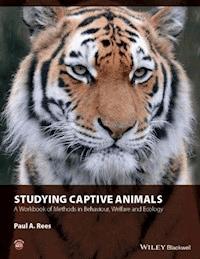
Studying Captive Animals outlines the methods that may be used to study the behaviour, welfare and ecology of animals living under the control of humans, including companion animals, feral populations, and those living on farms and in zoos.
This book is a step-by-step guide to the whole process of conducting a scientific study: from designing the original project, formulating testable hypotheses, and collecting and analysing the data, to drawing conclusions from the work and writing it up as a scientific report or paper. It also illustrates how to write a formal research proposal - a crucial and often difficult element of the student project - and how to deal with the ethical review process.
Sample data collection sheets are provided and the analysis and presentation of data are worked through in diagrammatic form. In addition, exercises are included that enable the reader to practice analysing different types of data and advice is provided on the selection of appropriate statistical tests. The text describes the different types of student projects that may be undertaken in the field, and explains where secondary data may be found for zoos.
This is an insightful resource, particularly for those studying and working with zoo and farm animals. It is essential reading for students studying zoo biology and animal management; it is also suitable for students on courses in animal behaviour, animal welfare, zoology, biology, psychology, animal science, animal production, animal ecology, conservation biology, and veterinary science. This book is primarily intended for undergraduates but will also be of value to postgraduate students who have not previously engaged in field studies. Professionals working in institutions that are members of the World Association of Zoos and Aquariums, the European Association of Zoos and Aquaria and other regional and national zoo organisations will benefit from access to this practical guide.
Sie lesen das E-Book in den Legimi-Apps auf:
Seitenzahl: 543
Veröffentlichungsjahr: 2015
Ähnliche
















CONTENTS
Cover
Title page
Preface
What is This Book For?
Acknowledgements
About the Companion Website
PART 1: Introduction
CHAPTER 1: Studies of Behaviour, Welfare and Ecology in Captive Animals
1.1 What Are Captive Animals?
1.2 Types of Studies
1.3 Possible Study Locations
1.4 Advantages and Disadvantages of Studying Captive Animals
1.5 What Types of Research Have Been Conducted on Animals Living in Zoos?
1.6 What Sort of Study Should I Undertake?
CHAPTER 2: Designing Your Study
2.1 Introduction
2.2 Selecting Subjects for Study
2.3 How Does Science Work?
2.4 Experimental Design
2.5 Data Collection
2.6 Keeper/Trainer Assessments of Animals
2.7 Pilot Studies
2.8 Making Observations
2.9 Submitting a Research Proposal
2.10 Some Problems Associated with Working in Zoos
2.11 Legislation
2.12 Risk Assessment and Health and Safety Considerations
CHAPTER 3: Equipment
3.1 Introduction
3.2 Binoculars
3.3 Voice Recorders
3.4 Personal Digital Assistants (PDAs)
3.5 Still Cameras
3.6 Digital Video Cameras
3.7 Event Recorders
3.8 Trail Monitors
3.9 Accelerometers
3.10 GPS and GIS
3.11 Radio Collars
3.12 Data-Loggers
3.13 Proximity Data-Loggers
3.14 Radio Frequency Identification (RFID) Technology
3.15 Too Much Equipment?
PART 2: Measuring Animal Behaviour and Welfare
CHAPTER 4: Identifying Individuals and Recording Behaviours
4.1 Identifying and Naming Individual Animals
4.2 Describing and Interpreting Behaviour
4.3 Interpreting Behaviours
4.4 How Can Behaviour be Measured?
4.5 How to Sample and Record Behaviour
4.6 When Should Samples be Taken?
4.7 Recording Behaviour in the Field
CHAPTER 5: Activity Budgets and Welfare
5.1 Introduction
5.2 Activity Budgets
5.3 Numerical Rating Scales and Analogue Visual Scales
5.4 Body Condition and Welfare
5.5 Animal Personality
5.6 Preference Tests
5.7 Visitor Studies
5.8 The Parasitology of Captive Animals
5.9 Exercises
CHAPTER 6: Measuring Social Behaviour
6.1 Introduction
6.2 Associations Between Individuals
6.3 Maintenance of Proximity Index (MPI)
6.4 Nearest Neighbour Measurements
6.5 Relationship Indices
6.6 Social Facilitation
6.7 Agonistic Behaviours: Aggression and Appeasement
6.8 Dominance Hierarchies
6.9 Courtship, Mating and Mate Selection
6.10 Exercises
PART 3: Measuring Ecology
CHAPTER 7: Enclosure Use, Habitat Selection and Feeding Ecology
7.1 Introduction
7.2 Enclosure Size and Use
7.3 Feeding Ecology and Behaviour
7.4 Exercises
CHAPTER 8: Population Studies
8.1 Introduction
8.2 How Many Animals Are There and How Are They Dispersed? Counting Animals in the Field
8.3 Studies of Population Growth
8.4 Family Histories
8.5 Long-Term Studies of Zoo Populations
Lesen Sie weiter in der vollständigen Ausgabe!
Lesen Sie weiter in der vollständigen Ausgabe!
Lesen Sie weiter in der vollständigen Ausgabe!
Lesen Sie weiter in der vollständigen Ausgabe!
Lesen Sie weiter in der vollständigen Ausgabe!
Lesen Sie weiter in der vollständigen Ausgabe!
Lesen Sie weiter in der vollständigen Ausgabe!
Lesen Sie weiter in der vollständigen Ausgabe!
Lesen Sie weiter in der vollständigen Ausgabe!
Lesen Sie weiter in der vollständigen Ausgabe!
Lesen Sie weiter in der vollständigen Ausgabe!
Lesen Sie weiter in der vollständigen Ausgabe!
Lesen Sie weiter in der vollständigen Ausgabe!
Lesen Sie weiter in der vollständigen Ausgabe!
Lesen Sie weiter in der vollständigen Ausgabe!
Lesen Sie weiter in der vollständigen Ausgabe!
Lesen Sie weiter in der vollständigen Ausgabe!
Lesen Sie weiter in der vollständigen Ausgabe!
Lesen Sie weiter in der vollständigen Ausgabe!
Lesen Sie weiter in der vollständigen Ausgabe!
Lesen Sie weiter in der vollständigen Ausgabe!
Lesen Sie weiter in der vollständigen Ausgabe!
Lesen Sie weiter in der vollständigen Ausgabe!
Lesen Sie weiter in der vollständigen Ausgabe!
Lesen Sie weiter in der vollständigen Ausgabe!




