


9,99 €
Mehr erfahren.
- Herausgeber: Atlantic Books
- Kategorie: Gesellschafts- und Liebesromane
- Sprache: Englisch
LONGLISTED FOR THE 2015 IMPAC DUBLIN LITERARY AWARD A doctor to the rich and famous goes to extreme lengths to protect his daughter in this dark and addictive novel from the author of the million-copy bestseller The Dinner. Marc Schlosser is a doctor to the rich and famous. When his most famous patient, the actor Ralph Meier, invites him and his family on holiday, Marc finds that he can't refuse. But by the time the suntans fade, Ralph Meier is dead. The medical board accuses Marc of negligence. Ralph's wife, however, accuses him of murder...
Das E-Book können Sie in Legimi-Apps oder einer beliebigen App lesen, die das folgende Format unterstützen:
Veröffentlichungsjahr: 2014
Ähnliche


















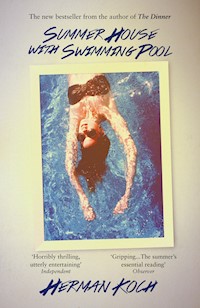
SUMMER HOUSE WITH SWIMMING POOL
First published in the Netherlands in 2011 as Zomerhuis Met Zwembad by Ambo Anthos, Amsterdam.
First published in Great Britain in 2014 by Atlantic Books, an imprint of Atlantic Books Ltd.
Copyright © Herman Koch, 2011 Translation Copyright © Sam Garrett, 2014
The moral right of Herman Koch to be identified as the author of this work has been asserted by him in accordance with the Copyright, Designs and Patents Act of 1988.
The moral right of Sam Garrett to be identified as the translator of this work has been asserted by him in accordance with the Copyright, Designs and Patents Act of 1988.
All rights reserved. No part of this publication may be reproduced, stored in a retrieval system, or transmitted in any form or by any means, electronic, mechanical, photocopying, recording, or otherwise, without the prior permission of both the copyright owner and the above publisher of this book.
This novel is entirely a work of fiction. The names, characters and incidents portrayed in it are the work of the author’s imagination and not to be construed as real. Any resemblance to actual persons, living or dead, events or localities, is entirely coincidental.
10 9 8 7 6 5 4 3 2 1
A CIP catalogue record for this book is available from the British Library.
Trade Paperback ISBN: 978 1 78239 071 8 OME Paperback ISBN: 978 1 78239 099 2 E-book ISBN: 978 1 78239 073 2
Printed in Great Britain
Atlantic Books An Imprint of Atlantic Books Ltd Ormond House 26–27 Boswell Street London WC1N 3JZwww.atlantic-books.co.uk
Contents
Chapter 1
Chapter 2
Chapter 3
Chapter 4
Chapter 5
Chapter 6
Chapter 7
Chapter 8
Chapter 9
Chapter 10
Chapter 11
Chapter 12
Chapter 13
Chapter 14
Chapter 15
Chapter 16
Chapter 17
Chapter 18
Chapter 19
Chapter 20
Chapter 21
Chapter 22
Chapter 23
Chapter 24
Chapter 25
Chapter 26
Chapter 27
Chapter 28
Chapter 29
Chapter 30
Chapter 31
Chapter 32
Chapter 33
Chapter 34
Chapter 35
Chapter 36
Chapter 37
Chapter 38
Chapter 39
Chapter 40
Chapter 41
Chapter 42
Chapter 43
Chapter 44
Chapter 45
Chapter 46
Chapter 47
Chapter 48
Chapter 49
Chapter 50
Chapter 51
Chapter 52
Note on the Author
1
I am a doctor. My office hours are from eight-thirty in the morning to one in the afternoon. I take my time. Twenty minutes for each patient. Those twenty minutes are my unique selling point. Where else these days, people say, can you find a GP who gives you twenty minutes? – and they pass the information along. He doesn’t take on too many patients, they say. He makes time for each individual case. I have a waiting list. When a patient dies or moves away, all I have to do is pick up the phone and I have five new ones to take their place.
Patients can’t tell the difference between time and attention. They think I give them more attention than other doctors. But all I give them is more time. By the end of the first sixty seconds I’ve seen all I need to know. The remaining nineteen minutes I fill with attention. Or, I should say, with the illusion of attention. I ask all the usual questions. How is your son/daughter getting along? Are you sleeping better these days? Are you sure you’re not getting too much/too little to eat? I hold the stethoscope to their chests, then to their backs. Take a deep breath, I say. Now breathe out nice and slow. I don’t really listen. Or at least I try not to. On the inside, all human bodies sound the same. First of all, of course, there’s the heartbeat. The heart is blind. The heart pumps. The heart is the engine room. The engine room only keeps the ship going; it doesn’t keep it on course. And then there are the sounds of the intestines. Of the vital organs. An overburdened liver sounds different from a healthy one. An overburdened liver groans. It groans and begs. It begs for a day off. A day to deal with the worst of the rubbish. The way things are now, it’s always in a hurry, trying to catch up with itself. The overburdened liver is like the kitchen in a restaurant that’s open around the clock. The dishes pile up. The dishwashers are working full tilt. But the dirty dishes and caked-on pans only pile up higher and higher. The overburdened liver hopes for that one day off that never comes. Every afternoon at four-thirty, five o’clock (sometimes earlier), the hope of that one day off is dashed again. If the liver’s lucky, at first it’s only beer. Beer passes most of the work along to the kidneys. But you always have those for whom beer alone isn’t enough. They order something on the side: a shot of gin, vodka or whisky. Something they can knock back. The overburdened liver braces itself, then finally ruptures. First it grows rigid, like an overinflated tyre. All it takes then is one little bump in the road for it to blow wide open.
I listen with my stethoscope. I press against the hard spot, just beneath the skin. Does this hurt? If I press any harder, it will burst open right there in my office. Can’t have that. It makes an incredible mess. Blood gushes out in a huge wave. No general practitioner is keen to have someone die in his office. At home, that’s a different story. In the privacy of their own homes, in the middle of the night, in their own beds. With a ruptured liver, they usually don’t even make it to the phone. The ambulance would get there too late anyway.
My patients file into my practice at twenty-minute intervals. The office is on the ground floor. They come in on crutches and in wheelchairs. Some of them are too fat, others are short of breath. They are, in any case, no longer able to climb stairs. One flight of stairs would kill them for sure. Others only imagine it would: that their final hour would begin on the first step. Most of the patients are like that. Most of them have nothing wrong with them. They moan and groan, make noises that would make you think they see death staring them in the face every moment of the day, they sink into the chair across from my desk with a sigh – but there’s nothing wrong with them. I let them reel off their complaints. It hurts here, and here, sometimes it spasms down to here… I do my best to act interested. Meanwhile, I doodle on a scrap of paper. I ask them to get up, to follow me to the examination room. Occasionally I’ll ask someone to undress behind the screen, but most of the time I don’t. Bodies are horrible enough as it is, even with their clothes on. I don’t want to see them, those parts where the sun never shines. Not the folds of fat in which it is always too warm and the bacteria have free rein, not the fungal growths and infections between the toes, beneath the nails, not the fingers that scratch here, the fingers that rub there until it starts to bleed… Here, Doctor, here’s where it itches really badly… No, I don’t want to see. I pretend to look, but I’m thinking about something else. About a roller-coaster in an amusement park, the car at the front has a green dragon’s head mounted on it; the people throw their hands in the air and scream their lungs out. From the corner of my eye I see moist tufts of pubic hair, or red, infected bald spots where no hair will ever grow again, and I think about a plane exploding in the air, the passengers still belted to their seats as they begin a mile-long tumble into eternity: it’s cold, the air is thin, far below the ocean awaits. It burns when I pee, Doctor. Like there are needles coming out… A train explodes just before it enters the station, the space shuttle Columbia shatters into millions of little pieces, the second jet slams into the South Tower. It burns, here, doctor. Here…
You can get dressed now, I say. I’ve seen enough. I’ll write you a prescription. Some of the patients can barely conceal their disappointment: a prescription? They stand there for a few seconds, staring blankly, their underwear down around their knees. They took a morning off from work, now they want value for money, even if that money has come out of the pockets of healthy taxpayers. They want the doctor to poke at them at least, they want him to pull on his rubber gloves and take something – some body part – between his knowing fingers. For him to stick at least one finger into something. They want to be examined; they aren’t content only with his years of experience, his clinical gaze that registers at a single glance what’s wrong with a person. Because he’s seen it all a hundred thousand times before. Because experience tells him that there’s no sudden need on occasion one hundred thousand-and-one to pull the rubber gloves on.
Sometimes, though, there’s no getting around it. Sometimes you have to get in there. Usually with one or two fingers, sometimes with your whole hand. I pull on my rubber gloves. If you would just roll onto your side… for the patient, this is the point of no return. Finally, he is being taken seriously, he is about to receive an internal examination, but his gaze is no longer fixed on my face. All he can look at now are my hands. My hands as they pull on the rubber gloves. He wonders why he ever let things get this far. Whether this is really what he wants. Before putting on the gloves, I wash my hands. The sink is across from the examining table, so I stand with my back to him as I soap up. I take my time. I roll up my sleeves. I can feel the patient’s eyes at my back. I let the tap water flow over my wrists. First I wash my hands thoroughly, then my lower arms: all the way up to the elbows. The sound of running water blocks out all other sounds, but I know that once I’ve reached the elbows the patient’s breathing has quickened. It quickens for a few seconds, or stops altogether. An internal examination is about to take place, the patient – consciously or unconsciously – has insisted on this. He had no intention of letting himself be fobbed off with a prescription, not this time. Meanwhile, though, the doubts arise. Why is the doctor washing and disinfecting his hands and arms all the way up to the elbows? Something in the patient’s body contracts. Even though what he should be doing is relaxing as much as possible. Relaxation is the key to a smooth internal examination.
Meanwhile I have turned around and am drying my hands, my forearms, my elbows. Still without looking at the patient, I take a pair of plastic-packed gloves from a drawer. I tear open the bag, press the pedal of the rubbish bin with my foot and throw the bag away. Only now, as I pull on the gloves, do I look at the patient. The look in his eyes is, how shall I put it, different from what it was before I started washing my hands. Lie down on your side, I say, before he has a chance to express his misgivings. Facing the wall. A naked body is less disgraceful than a body with trousers and underpants down around its ankles. Less helpless. Two legs with the shoes and socks still on, and bound together at the ankles by trousers and underpants. Like a prisoner in a chain gang. A person with his pants around his ankles can’t run away. You can submit someone like that to an internal examination, but you could also punch him right in the side of the head. Or take a pistol and empty the clip into the ceiling. I’ve listened to these fucking lies long enough! I’m going to count to three… One… two… Try to relax, I say again. Turn on your side. I pull the rubber gloves tighter over my fingers and further over my wrists. The sound of snapping rubber always reminds me of party balloons. Balloons for a birthday party, you blew them up last night in order to surprise the birthday boy. This may be a little unpleasant, I say. The important thing is just to keep breathing calmly. The patient is all too aware of my presence, right behind his half-naked body, but he can’t see me any more. This is the moment when I take time to submit that body, or at least the naked part of it, to a further look.
I have, until now, been assuming that the patient is a man. In the example we are dealing with, a man is lying on the table with his trousers and underpants pulled down. Women are a different story; I’ll get to women later. The man in question turns his head slightly in my direction, but, as I’ve mentioned, he can no longer get a good look at me. Just relax your head now, I say. All you have to do is relax. Unbeknown to the patient, I now turn my gaze to the naked lower back. I’ve already told him that what follows may be a bit unpleasant. Between that remark and the unpleasant feeling itself, there is nothing. This is the empty moment. The emptiest moment in the entire examination. The seconds tick by silently, like a metronome with the sound turned off. A metronome on a piano in a silent film. No physical contact has yet taken place. The bare back bears the mark of the underpants. Red bands left on the skin by the elastic. Sometimes there are pimples or moles. The skin itself is often abnormally pale; it’s one of those places where sunlight rarely reaches. There is, however, almost always hair. Lower down, along the back, the hair only increases. I’m left-handed. I place my right hand on the patient’s shoulder. Through the rubber glove I feel the body stiffen. The entire body tenses and contracts. It would like to relax, but instinct is more powerful, it braces itself, it readies itself to resist invasion from the outside.
By then my left hand is already where it has to be. The patient’s mouth falls open, his lips part, a sigh escapes as my middle finger goes in. Something between a sigh and a groan. Take it easy, I say. It will be over in a moment. I try to think about nothing, but that’s always difficult. So I think about the night when I dropped the padlock key for my bicycle in the mud in the middle of a football field. It was a patch of mud no bigger than one yard square, and I knew for sure my key was there. Does this hurt at all? I ask. Now my index finger joins my middle finger, using both of them will make it easier to find the key. A little… Where? Here…? Or here? It was raining, a few lights were on around the field, but it was still a bit too dark to see well. Usually it’s the prostate. Cancer, or just an enlargement. Usually there’s not much you can say about it after the first examination. I could have walked home and come back the next day, once it got light. But my fingers were already in there, the mud was already up under my nails, there wasn’t much sense in stopping now. Ow! There, Doctor! Fucking hell! Excuse me… Oh, fucking hell! And then there was that one fraction of a second, my fingers feeling something hard amid the goo. Careful, it could also be a piece of glass… I hold it up to the light, the dim light from a lamppost beside the field, but in fact I already know what it is. It glistens, it gleams, and I won’t have to walk home after all. Without looking at my hands I pull off the gloves and toss them in the pedal bin. You can sit up now. You can get dressed. It’s too early to draw conclusions, I say.
It was eighteen months ago when Ralph Meier suddenly appeared in my waiting room. I recognised him right away, of course. Could he talk to me for just a moment? It was nothing urgent, he said. Once we were in my office, he came straight to the point. Was it true, what so-and-so had told him, that I was fairly accommodating with prescriptions for…? here he looked around somewhat skittishly, as though the place might be bugged. ‘So-and-so’ was a regular patient of mine. In the long run they all tell each other everything, which is how Ralph Meier ended up in my practice. It sort of depends, I said. I’ll have to ask you a few questions about your general health, so we don’t run into any unpleasant surprises later on. But if we do that? he insisted. If everything is OK, would you be willing… I nodded. Yes, I said. That can be arranged.
Now we’re eighteen months down the road, and Ralph Meier is dead. And tomorrow morning I have to appear before the Board of Medical Examiners. Not for what I helped him out with that time, but for something else, about six months later: something you might describe as a ‘medical error’. I’m not so worried about the Board of Examiners; in the medical profession we all know each other. Often enough, we even went to school together. It’s not like in the States, where a lawyer can ruin a doctor after a misdiagnosis. In this country you really have to have gone too far. And even then – a warning, a few months’ suspension, no more than that.
All I have to do is make sure the members of the board actually see it as a medical error. I’ll have to keep my wits about me. I have to keep believing in it, one hundred per cent – in the medical error.
The funeral was a couple of days ago. At that lovely, rural cemetery by the bend in the river. Big old trees, the wind blowing through the branches, rustling the leaves. Birds were twittering. I stayed as far to the back as I could, which seemed prudent enough, but nothing could have prepared me for what happened next.
‘How dare you show your face here!’
A brief moment of absolute silence, as though even the wind had suddenly died down. The birds went quiet too, from one moment to the next.
‘You piece of shit! How dare you! How dare you!’
Judith Meier had a voice like a trained opera singer, a voice that could reach the audience in the very last row of a concert hall. All eyes turned in my direction. She was standing beside the open back of the hearse, out of which the pallbearers had just shouldered the coffin containing her husband’s body.
Then she was trotting towards me, elbowing her way through hundreds of mourners, who stepped aside to let her through. For the next thirty seconds, her high heels on the gravel drive were the only sound in an otherwise breathless silence.
Right in front of me, she stopped. I was actually expecting her to slap me. Or to start pounding her fists against my lapels. To make, in other words, a scene; something she had always been good at.
But she didn’t.
She looked at me. The whites of her eyes were laced with red.
‘Piece of shit,’ she said again, much more quietly now.
Then she spat in my face.
2
A general practitioner’s task is simple. He doesn’t have to heal people, he only has to make sure they don’t sidestep him and make it to the specialists and the hospitals. His office is an outpost. The more people who can be stopped at the outpost, the better the practitioner is at what he does. It’s simple arithmetic. If we family doctors were to let through everyone with an itch, a spot or a cough to a specialist or a hospital, the system would collapse entirely. Entirely. Someone did the arithmetic on that once. The conclusion was that the collapse would come more quickly than anyone expected. If every general practitioner referred more than one third of his patients for further care from a specialist, the system would begin to creak and buckle within two days. Within a week it would collapse. The general practitioner mans the outpost. Just a common cold, he says. Take it easy for a week, and if it’s not over then, well, don’t hesitate to come back. Three days later, in the middle of the night, the patient suffocates on his own mucus. That can happen, you say. A rare combination of factors, we see it in no more than one out of every ten thousand patients.
Patients don’t realise that there’s strength in numbers. They let themselves be ushered into my office one by one. There I spend twenty minutes with them, convincing them that there’s nothing wrong. My office hours are from eight-thirty to one. That adds up to three patients an hour, twelve to thirteen a day. For the system, I’m the ideal family doctor. General practitioners who think they can make do with half the time per visit see twenty-four patients in a working day. When there are twenty-four of them, there’s more of a chance of a few slipping through than there is when there are only twelve. It has to do with how they feel. A patient who gets only ten minutes’ attention feels shortchanged sooner than a patient who gets the same song and dance for twenty minutes. The latter patient gets the impression that his complaints are being taken seriously. A patient like that is less likely to insist on further examination.
Mistakes happen, of course. Our system couldn’t exist without mistakes. In fact, a system like ours thrives on its mistakes. After all, even a misdiagnosis can lead to the desired result. But usually a misdiagnosis isn’t even necessary. The most important weapon we general practitioners have at our disposal is the waiting list. The mere mention of the waiting list tends to do the job. For this examination there’s a waiting list of six to eight months, I say. With that treatment your symptoms might be a little less acute, but there’s a waiting list… Half the patients give up as soon as the waiting list is mentioned. I can see it on their faces: relief. One of these days is none of these days, they figure. No one wants to have a tube the size of a garden hose pushed down their throat. It’s not a particularly comfortable procedure, I say. You could also decide to wait and see whether it goes away with a combination of rest and medication. Then we’ll take another look in six months’ time.
How can there be waiting lists, you might ask yourself, in a wealthy country like the Netherlands? For me, the association is always with the gas bubble, with our reserves of natural gas. I brought it up once during an informal gathering with colleagues. The waiting list for hip operations: how many cubic yards of gas would you have to sell in order to do away with that within a week? I asked. How, for Christ’s sake, is it possible that in a civilised country like ours people die before they reach the head of the waiting list? You can’t look at it that way, my colleagues said. You can’t tally gas reserves against the number of postponed hip operations.
The gas bubble is huge, even worst-case scenarios predict that there will be enough natural gas for the next sixty years. Sixty years! That’s bigger than the oil reserves in the Persian Gulf. This is a wealthy country. We’re as rich as Saudi Arabia, as Kuwait, as Qatar – but still, people die here because they have to wait too long for a new kidney, infants die because the ambulance that’s rushing them to the hospital gets stuck in traffic, mothers’ lives are endangered because we, we general practitioners, convince them that home-birthing is safe. While what we should actually say is that it’s only cheaper – here, too, it’s clear that if every mother claimed the right to give birth in a hospital, the system would collapse within a week. The risk of babies dying, of babies suffering brain damage because no oxygen can be administered during a home birth is simply factored into the equation. Every once in a great while an article appears in a medical journal, and sometimes a summary of that article will actually make the Dutch papers, but even those summaries show that infant mortality in the Netherlands is the highest in all of Europe and indeed the Western world. But no one has ever acted on these figures.
In fact, the family doctor is powerless in the face of all this. He can put a patient’s mind at ease. He can see to it, for the time being at least, that a patient doesn’t seek specialist assistance. He can convince a woman that home-birthing poses no risks whatsoever. That it’s all much more ‘natural’. Whereas it’s only more natural in the sense that dying is natural too. We can give them salves or sleeping pills, we can burn away moles with acid, we can remove ingrown toenails. Nasty chores, usually. Like cleaning the kitchen, using a scouring pad to remove caked-on remains from between the burners.
I lie awake at night sometimes. I think about the gas bubble. Sometimes it resembles a bubble like the ones you blow with soapsuds, only it’s right under the earth’s crust, all you have to do is poke a hole in it and it deflates – or blows up in your face. At other times the gas is spread out over a much greater surface. It has permeated into the loose earth. The natural-gas molecules have mixed invisibly with the soil. You can’t smell it. You hold a match up to it and it explodes. The little fire becomes an inferno that spreads within seconds across hundreds of square miles. Underground. The earth’s surface becomes hollowed out, there is no more support for bridges and buildings, not enough solid ground beneath the feet of humans and animals, entire cities sink into the burning depths. I lie there with my eyes open in the dark. Sometimes our country’s undoing takes the form of a documentary. A documentary on the National Geographic Channel, with charts and computer animations, the kind of documentary they’re so good at: documentaries about dam-bursts and tsunamis, about avalanches and mudslides that wipe whole towns and villages off the map, about the entire side of a volcano that breaks off from an island and slides into the sea, causing a tidal wave that, eight hours later and thousands of miles away, reaches a height of almost four thousand feet. The Disappearance of a Country, tomorrow night at nine-thirty, on this channel. Our country. Our country consumed by its own reserves of natural gas.
On rare occasions, lying awake at night like this, I think about Ralph Meier. About his role as the Emperor Augustus in the television series of the same name. The role suits him to a tee; both his fans and his detractors are in total agreement about that. First of all, of course, because of his build, the corpulence he nurtured through the years. An obesity achieved exclusively by means of systematic pig-outs in restaurants with one or more Michelin stars. By lavish barbecues in his garden: sausages from Germany, hams from Bulgaria, entire suckling lambs roasted on a spit. I remember those barbecues as though it were yesterday: his hulking frame beside the smoking fire, singlehandedly flipping the hamburgers, steaks and drumsticks. His unshaven, flushed face, the barbecue fork in one hand, a 16-ounce can of Jupiler in the other. His voice always carried right across the lawn. A voice like a foghorn. A voice that tankers and container vessels might use to find their bearings in distant estuaries and foreign ports. The last barbecue wasn’t even that long ago, it occurs to me now, only about five months. He was already ill by then. It was still he who flipped the meat, but now he had pulled up a plastic lawn chair, he had to sit while he did it. It’s always fascinating, how an illness – an illness like his – attacks the human body. It’s a war. The bad cells turn against the good. At first they attack the body from the sides, a flanking manoeuvre. An orderly little attack is all it is, a glancing blow, designed only to divert attention from the main force. You think you’ve won: you have, after all, repelled this first minor assault. But the main force is still in hiding, deeper inside the body, in a dark place where the X-rays, the ultrasounds, and the MRI scans can’t find it. The main force is patient. It waits until it has reached full strength. Until victory is assured.
The third episode was on TV last night. The emperor consolidates his power. He changes his name from Gaius Octavius to Augustus, and sidelines the Senate. There are ten more episodes to come. There has never been any suggestion of cancelling or postponing Augustus just because its star is dead. Ralph Meier is formidable in his role, the only Dutch actor in a cast of Italians, Americans and Englishmen, but he outplays them all.
Last night, I believe I must have been the only one who watched the series in a different way. Through other eyes, perhaps that’s the way to put it. The eyes of a doctor.
‘Can I go anyway?’ he’d asked me at the time. ‘It’s a two-month shoot. If I have to pull out halfway through, it would be a disaster for everyone involved.’
‘Of course,’ I told him. ‘Don’t worry. It doesn’t usually amount to anything. We’ll just wait for the tests to come back. There will be plenty of time afterwards.’
I watched the Emperor Augustus as he spoke to the Senate. It was an American–Italian co-production, and they hadn’t cut any corners. Thousands of Roman soldiers, entire legions cheering from the hillsides around Rome, tens of thousands of swords, shields and spears raised high, fleets of hundreds of ships before the port of Alexandria, chariot races, gladiatorial contests, roaring lions and mangled Christians. Ralph Meier had the illness in its most aggressive form. It was something you had to act on immediately, otherwise it was too late. Radical intervention: a first strike, a carpet-bombing to knock out the malignant cells at a single blow. I looked at his face, his body. Inside that body, in all likelihood, the main force had already begun its offensive.
‘Senators!’ he said. ‘From this day forth I am your emperor. Emperor… Augustus!’
His voice carried, as always – at least it still did then. If there was anything wrong with him, he didn’t let it show. Ralph Meier was a real trouper. If need be, he could upstage anyone and anything. Even a fatal illness.
3
Over the years, one by one, the normal people have disappeared from my practice. I mean, the people who work from nine to five. I still have a couple of lawyers, and the owner of a fitness club, but most of my patients work in what are called the ‘creative professions’. For the moment, I’m not counting the widows. There are quite a few of those. One could refer to a widow surplus. The widows of writers, of actors, of painters… the women hold out longer than the men; they’re cut from other, tougher cloth. You can reach a ripe old age standing in the shadows. A whole life spent making fresh coffee and running to the wine shop for the geniuses in their studios. Fresh Norwegian salmon for the writers in their studies, where you always have to walk on tiptoe. It looks like a real chore, but of course it’s a cakewalk. The widows grow old. Old as dirt. As soon as their husbands die, they often enter a brief, second bloom. I’ve seen them here in my office. They’re sorrowful, they dab at their eyes with a hankie, but they’re relieved as well. Relief is an emotion that’s hard to hide. I look with the eyes of a doctor. I have learned to see through the tears. A prolonged illness is not an easy thing to endure. Cirrhosis of the liver is a drawn-out, painful affair. The patient often gets to the bedside bucket too late; the blood is already welling up. Changing the bedclothes three times a day, sheets and blankets heavy with puke and shit, that’s more demanding than fixing coffee and making sure there’s enough gin in the house. How long is this going to last? the prospective widow wonders. Will I be able to hold out till the funeral?
But then the day comes at last. The weather is beautiful, blue skies with fluffy clouds, birds singing in the trees, the smell of fresh flowers. For the first time in her life, the widow herself is the centre of attention. She’s wearing sunglasses, so no one can see her tears – everyone thinks. But in fact the dark lenses serve to hide her relief. His best friends carry the coffin to the grave. There are speeches. There is booze. Lots of booze. No watery coffee at an artist’s funeral, just plenty of white wine, vodka, and old gin. No slices of cake or almond pastries with the tea, but oysters, smoked mackerel and croquettes. Then the whole club goes to their favourite haunt. ‘Well here’s to you, old boy, wherever you may be! Old bastard! You old goat!’ Toasts are made, vodka is spilled. The widow has taken off her sunglasses. She smiles. She beams. The puked-on sheets are still in the dirty clothes basket, but tomorrow they’ll go in the washing machine for the very last time. Life as a widow, she thinks, will always be like this. The friends will go on proposing toasts for months (for years!). To her. To their new centre of attention. What she doesn’t know yet is that, after a few courtesy calls, it will all be over. The silence that will follow is the same silence that always falls after a life in the shadows.
That’s usually the way it goes. But there are also exceptions. Rage makes for ugly widows. This morning there was suddenly a ruckus at the front door of my office. It was still early; I had just ushered in my first patient. ‘Doctor!’ I heard my assistant call out. ‘Doctor!’ There was a sound like a chair being knocked over, and after that I heard a second voice. ‘Where are you, you piece of shit?’ the voice shrieked. ‘Are you scared to show your face?’
I smiled broadly at my patient. ‘Excuse me for just a moment, would you?’ I said and stood up. Between the front door of the practice and my office is a corridor, first you have to walk past a desk where my assistant sits, then past the waiting room. It’s actually more of a waiting area than a waiting room; there’s no door separating it from the hallway.
I glanced over as I went by. As I said, it was early, but there were already three patients flipping through old copies of Marie Claire and National Geographic. By that point, however, they had stopped their flipping. They had lowered their magazines to their laps and were staring at Judith Meier. Judith had not become any prettier after her husband’s death, and that was putting it mildly. The skin on her face had reddened, but not everywhere, making it look blotchy. Behind Judith’s back, my assistant was gesturing that there was no way she could have stopped her. Further back, behind my assistant, a chair was lying on the floor.
‘Judith!’ I said, opening my arms as though I were pleased to see her. ‘What can I do for you?’
For a couple of seconds my greeting seemed to stun her – but for no longer than a couple of seconds.
‘Murderer!’ she screamed.
I glanced over at my patients in the waiting space; I knew all three of them by sight. A film director with haemorrhoids, a gallery owner with erectile dysfunction, and a no-longer-so-very-fresh-faced actress who was expecting her first child – albeit not from the blond, hulking and permanently unshaven actor she had married seven months earlier in a Tuscan castle: all paid for by the ‘celebrity’ programme on the commercial TV channel that had been granted exclusive broadcast rights to the entire ceremony and after-party. I shrugged and winked at them. An emergency case, that’s what the shrug and wink were meant to say. A typical case of acute hysteria. Alcohol or drugs – or both. Just to be sure they’d seen, I winked again.
‘Judith,’ I said as calmly as possible. ‘Why don’t you come with me, then I’ll see what I can do for you.’
Before she could reply, I turned and strode back into my office. I placed my hands on my patient’s shoulders. ‘Could I ask you to go to the waiting room? My assistant will write out a prescription.’
4
Judith Meier was sitting opposite my desk. I looked at her face. The red blotches were still there. It was hard to tell, in fact, whether her face was white with red blotches, or red with white.
‘You’re finished,’ she said. Then she continued: ‘This whole flea circus is going to shut down so fast it will make your head spin.’ She nodded towards my office door, with the full waiting room behind.
I put my elbows on the desk. Then, forming a tent with my fingertips, I leaned forward slightly. ‘Judith,’ I said – but suddenly I didn’t know how to go on. ‘Judith,’ I tried then, ‘isn’t it a bit early to draw such drastic conclusions? Maybe I did diagnose Ralph’s illness incorrectly at first. I’ve admitted that possibility already. And that will come up tomorrow at the hearing. But I never intentionally—’
‘Why don’t you just save it and see how the Board of Medical Examiners reacts when I tell them the whole story myself?’
I stared at her. I tried to smile, but my mouth felt the way it had the time I broke my jaw in a cycling accident. A pothole. Men at work. A little barrier had been set up to alert oncoming cyclists to the hole in the road, but some joker had removed it. At the emergency ward they wired my upper and lower jaws together; for six weeks I could neither talk nor consume anything but liquids, through a straw.
‘Are you going to be there too?’ I asked as calmly as I could. ‘That’s not exactly custom—’
‘No, that’s what they told me. But they thought the charges were serious enough to make an exception.’
This time I really did smile. Or at least I succeeded in twisting my mouth into something that could be said to resemble a smile. But it felt as though I was opening my mouth for the first time after remaining silent for a whole day.
‘Wait, let me check with my assistant for a moment,’ I said, rising from my chair. ‘I’ll get together all the test results and the files.’
Now Judith started to get to her feet too. ‘Don’t bother. I’ve said everything I have to say. I’ll see you tomorrow at the hearing.’
‘No, really, I’ll only be a moment. I’ll be right back. I have something that might interest you. Something you don’t know about.’
She was already almost upright. She looked at me. I tried to breathe normally. She sat down again.
‘One moment,’ I said.
This time, without so much as a glance at the patients waiting outside the office, I went straight to my assistant’s desk. She was on the phone.
‘Is that only the ointment, or is it the cream too?’ she was saying.
‘Liesbeth,’ I said, ‘could you just…’
‘Just a moment,’ she said, placing her hand over the mouthpiece.
‘Could you send all the patients home?’ I said. ‘And call the others to cancel their appointments? Come up with some excuse, it doesn’t matter what. And then I need you to leave too. Take the rest of the day off. Judith and I have to… It would be better if I had a little more time…’
‘Did you hear what she called you? You can’t just do…’
‘I’m not deaf, Liesbeth,’ I interrupted her. ‘Judith is extremely upset. She doesn’t know what she’s saying. Maybe I underestimated the seriousness of Ralph’s illness. That’s bad enough. First I’m going to… I’m going to do something with her, go out, grab a cup of coffee somewhere. She needs a little extra attention. That’s understandable. But I don’t want the patients to see me going out with her. So send them all home as quickly as possible.’
When I came back into my office, Judith Meier was still seated.
She turned her head to look at me. She looked at my empty hands and then, questioningly, at my face.
‘I think that file must be in here somewhere,’ I said.
5
A medical practice like mine has its drawbacks. You get invited to everything. The patients think you sort of belong – with the emphasis on ‘sort of’. Gallery openings, book launches, film and stage premieres; not a day goes by without some invitation arriving in the post. Not going is not an option. When they send you a book, you can lie and say you’re only halfway through it, that you don’t want to express an opinion without finishing it first. But an opening night is an opening night. And when it’s over, you have to say something. It’s what they expect, for you to say something. But never tell them what you really thought. Never. What you thought is your own business. For a while, I tried to make do with being non-committal. Things like ‘I thought there were some really good parts’, or ‘What did the rest of the cast think?’ But such inanities aren’t enough, not for them. You have to say that you thought it was amazing, that you’re grateful for the chance to have been present at this historic occasion. Film premieres are usually on a Monday evening. But even so, you can’t just rush off afterwards. You have to put in an appearance. You don’t want to get home too late, you’re the only civilian there; no one else has to start work at a normal time the next morning. You stand with the star or the director and you say that you thought it was amazing. An excellent alternative is to say that you found it ‘compelling’. That’s what you say about the end of the film. You have a glass of champagne in your hand and you look the star or the director straight in the eye. You’ve already forgotten how the film ended, or rather you’ve succeeded in suppressing any memory of how the film ended. You adopt a serious expression. ‘I found the ending entirely compelling,’ you say. Then you’re allowed to go home.
I never know what I loathe more: the film itself, the actual stage performance, or the hanging around afterwards. I know from bitter experience that it’s easier for my mind to wander during a film than it is during a play. At a play you’re more aware of actually being there. Of being there and of the passing of time. Of your watch. I bought myself a watch with a luminous dial, especially for opening nights. Something happens to time during a play. Something I’ve never quite been able to put my finger on. It doesn’t stand still, time, no: it coagulates. You observe the actors and actresses, their movements, you listen to the lines leaving their mouths, and it’s as though you’re stirring some substance that gets thicker and thicker all the time. At a certain point the spoon stops moving altogether. It remains standing upright in the substance. To go on stirring would be impossible. For the first time, I glance at my watch. As surreptitiously as possible, of course. During a play, no one wants to be caught looking at his watch. I draw the sleeve of my jacket up a bit, carefully. I scratch my wrist, as though it’s itching. Then I steal a quick look at the glowing dial. Each time I do that, I witness living proof that real time and stage time are two very different entities. Or rather: two times that run in different, parallel dimensions. You think (you hope, you pray) that half an hour has passed, but your watch tells you that barely twelve minutes has gone by since the lights went down. During a play, you’re not allowed to moan or sigh. By moaning or sighing, you unnecessarily draw attention to yourself. Those who moan or sigh too loudly might just break the actors’ concentration. But not to sigh or moan at all, that’s asking too much. By the same token, that’s also the biggest difference from a film: you can’t get up and walk out. During a film you can sneak away in the dark, unnoticed. Even during a premiere. People think: well, he must have to go to the toilet pretty badly, and then they forget about you. They don’t notice that you never come back at all. You can do that. It’s possible. I’ve done it more than once during an opening night at the cinema. The first time it happened I actually did go to the men’s room, I spent the last hour of the film sitting on the toilet seat, my head in my hands, moaning, sighing and cursing. But also pleased. Pleased and relieved. Anything, anything but the film itself. In time I got better at slipping away unnoticed. I would saunter towards the exit, casually, my hands in my pockets. Just out for a breath of fresh air, I would say, if I ran into anyone in the foyer. The next thing I knew, I was already outside. The street, trams, scooters, people. People with normal faces, with normal voices. Voices that said normal things to each other. ‘One more for the road? Or shall we call it a day?’ Rather than: ‘We have to be awfully damned careful, Martha, that Father’s estate doesn’t fall into the wrong hands.’ How many sentences like that can a person stand in the space of an hour and a half? ‘No daughter of mine goes around dressed like a trollop! And if she does, she’s no longer my daughter!’ Films have a soundtrack. They turn the volume up louder each year. You can sigh and moan without anyone hearing. But it’s like when you’re in pain. Your breathing becomes faster and deeper. When a dog’s in pain, it pants with its tongue hanging out of its mouth. Oxygen. The trick is to direct as much oxygen as possible to where it hurts. Oxygen is still the best painkiller around. I’m out on the street. I see the people. I breathe in fresh air. During a stage performance, you can’t do any of that. There’s no escape clause. If you go out, you have to do that before the play begins. You have no choice, even though it’s not without its attendant risks. Because once you’re out on the street, tempting thoughts besiege you. Don’t go back in, that’s the most tempting thought of all. Go home, kick off your shoes, put your feet up, zap the TV on and watch some old B-movie you’ve seen five times already. Anything, anything but the play.
It also has to do with my profession. In my profession, true relaxation is a necessity. I see and hear things all day long. Things you need to get off your mind at night. The fungal growths. The bleeding warts. The folds of skin between which things have become much, much too warm. The three-hundred-pound woman you have to examine in a place you hoped you’d never have to go again. None of this is what you want to think about during a play. But the lights have barely dimmed when these things start taking liberties with you. It’s dark, they figure. Now we’ve got him! The only light now is on stage. And from the luminous dial of your watch. The endless time begins. The Big Clot. During a working day, there’s nothing I look forward to more than an evening of nothing at all. A meal. A beer or a glass of wine. The evening news on TV. A B-movie or a football match. A working day like that gets off on the right foot. It’s a day with promise. With perspective, I should say. A countryside of hills rolling on and on, and in the distance the glimmer of the sea. But a day that ends with a play is like a hotel room with a view of a blank wall. That kind of day can’t breathe. There’s not enough air, but the window is stuck and won’t open. The moaning begins at eight-thirty in the morning, when I think about it for the first time. Normally I only sort of listen to my patients, but on a working day that ends in a play I don’t listen at all. I run through ten possible escape routes in my mind. Illness. Flu. Food poisoning. A relative killing himself by leaping in front of a train. I think about the scene from Misery in which Kathy Bates shatters James Caan’s ankles with a hammer. I feel like doing something drastic to myself. During the siege of Stalingrad, soldiers on both sides shot themselves in the hand or the foot to keep from being sent to the front. Anyone who was caught faced the firing squad. My patient goes on whingeing about his lower back pain, but all I can think of are gunshot wounds. In Mexico, the drugs cartels’ death squads carve a cross into their bullets to make them spin slower. A bullet that spins slowly causes more damage as it goes through the body. Or doesn’t come out the other side at all. I think about taking drastic steps. No halfway measures. With a broken little finger you can always attend an opening night with your arm in a sling. A hundred-degree fever is seen as a cowardly excuse. No, I think about other things. Like an oyster knife slipping and ramming its way straight through the palm of my hand. The tip of the knife protrudes out of the back. The bleeding only really starts once you pull it out.
The worst plays are the ones that are ‘based on improvisation’. There’s always a lot of mumbling. Bits and pieces of narration and dialogue ‘taken from daily life’. The actors and actresses wear costumes they’ve assembled themselves. Plays based on improvisation tend not to last as long as plays with a regular script, but that’s like the wind-chill factor. Sometimes it feels a lot colder or hotter than the thermometer says. You look at the homemade costumes. According to wind-chill time, half an hour has already passed, but the dial of your watch tells no lies. You raise the watch to your ear. Maybe it’s stopped. But the watch runs on a lithium battery that lasts up to eighteen months. Time passes soundlessly. You have to count to sixty and then look again.




