


5,99 €
Mehr erfahren.
- Herausgeber: Chorabooks
- Kategorie: Religion und Spiritualität
- Sprache: Englisch
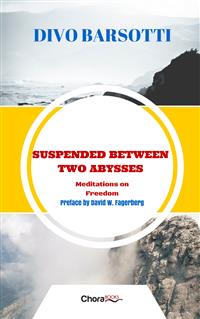
Divo Barsotti (1914-2006) was one of the great mystics of the 20th century. Freedom is one of the fundamental themes not only of human thought, but above all of the religious life, and especially of Christianity. How can the life of a Christian here on earth be really lived in complete freedom, total freedom? Is it not the case that absolute freedom for humanity can only be attained in a future life? We shall now meditate on this subject, and study it; not to understand it, of course, but just to get a clearer picture, which will also be useful in shedding light on the condition of us human beings here on earth; on the condition of humanity in relation to God; on humanity’s relationship with God in Christianity; and finally on life in Heaven.
Das E-Book können Sie in Legimi-Apps oder einer beliebigen App lesen, die das folgende Format unterstützen:
Veröffentlichungsjahr: 2019
Ähnliche





Divo Barsotti
Copyright © 2019 Chorabooks, a division of Choralife Publisher Ltd.
All rights reserved.
14/F office A. Bangkok Bank Building
No.28 Des Voeux Road Central
Hong Kong
Visit our website at www.chorabooks.com
First eBook edition: August 2016
Table of contents
Preface
Created for freedom
Suspended between two abysses
Not servants of the law, but children of God
To live in love
Our life is a walk to freedom
Being human means being hope
The spiritual life is an exercise of freedom
Always faced with a choice
The cross, instrument of victory
Supreme freedom is surrendering ourselves to God
Created to be kings
What follows is the transcript of a meditation given by Fr Barsotti on 20th March 1966 on the subject of freedom. Divo Barsotti (1914-2006) was one of the great mystics of the 20th century.
Freedom is one of the fundamental themes not only of human thought, but above all of the religious life, and especially of Christianity. How can the life of a Christian here on earth be really lived in complete freedom, total freedom? Is it not the case that absolute freedom for humanity can only be attained in a future life?
We shall now meditate on this subject, and study it; not to understand it, of course, but just to get a clearer picture, which will also be useful in shedding light on the condition of us human beings here on earth; on the condition of humanity in relation to God; on humanity’s relationship with God in Christianity; and finally on life in Heaven.
Preface
Readers in the English-speaking world owe a debt of gratitude to Chorabooks, and to Aurelio Porfiri, for making this book available. Divo Barsotti is not yet as well-known outside Italy as he deserves to be, though in Italy he is famously called "the last mystic of the twentieth century." The Dictionary of Italian Spirituality places him among the ten major spiritual figures of the 20th century. Because I am myself still becoming acquainted with Barsotti, I will not try in this introduction to place this book in the context of his larger body of works. But I can say a few biographical words gathered from various sources to set the stage.
Barsotti lived from 1914-2006, born in Palaia, a little village near Pisa. He received the sacrament of orders in 1937, and though he had parish assignments, his real pastoral gift began to appear in 1947 with the spiritual direction of a group of women. This led to the emergence of the Comunità dei Figli di Dio (CFD: Community of God’s Sons and Daughters; web site http://comunitafiglididio.it/Region/home.jsp). It includes widely varied lifestyles: married couples with children, ordinary priests and laypeople, men and women who embrace monastic vows while remaining in the world, or living a community life. Its current head and his successor, Fr. Tognetti, describes their charism thus: “The spiritual foundation of this family, especially for the laity, is a Christian life that has as its major energy resource that of the great monastic tradition: the sacraments, the reading of Scripture and prayer in the Liturgy of the Hours, Community members also learn the method of ‘divine presence,’ that is to live all things of the day by invoking the presence of the risen Christ.” [1]
The Mother House of this community finally settled in Settignano on the outskirts of Florence where Barsotti taught sacramental theology and spiritual theology for more than thirty years at the Theological Faculty of Florence. He held retreats and preached intensively (in 1971 for the annual retreat of the Curia and Pope Paul VI), and he wrote prodigiously, contributing hundreds of smaller essays, articles, journal entries, and producing 160 books.
Many prominent theologians came into dialogue with Barsotti, in person or by print, often as friends and sometimes in confrontation. To cite some of the names more familiar to western readers I mention von Balthasar, von Speyr, Danielou, Bouyer, de Lubac, Evdokimov, Beauduin, Hausherr, Merton, Ratzinger, and Giussani (founder of Communion and Liberation). Barsotti introduced Russian spirituality to his Italian audience, including St. Sergius of Radonezh, St Seraphim of Sarov, and Silvano of Mount Athos, publishing in 1948 a book on Russian Christianity. This spirituality helped him rediscover his own Catholicism, and in fact he called his Mother House Casa San Sergio in honor of the Russian monk, St. Sergius. His masterwork is perhaps The Christian Mystery in the Liturgical Year (1951), but Barsotti did not seek to produce a systematic body of work. He rather presented a consistent penetration of mystical themes laced with liturgical and biblical sensitivity. The Christian Mystery is Jesus, crucified and risen, and the events of the mystery are made real in the Mass.
If we turn now to themes presented within the meditation on freedom in this book, we can identify features of that Christian Mystery which Barsotti holds in fruitful tension: mystical, liturgical, anthropological, Christological, and ecclesial. He further refines an understanding that I would call "liturgical mysticism," and I am grateful to him for advances in it.
To put liturgical mysticism in context, let me speak a quotation that echoed in my mind while reading this book. It comes from one of the ressourcement authors with whose work Barsotti was familiar, namely Jean Danielou.
The Christian faith has only one object, the mystery of Christ dead and risen. But this unique mystery subsists under different modes: it is prefigured in the Old Testament, it is accomplished historically in the earthly life of Christ, it is contained in mystery in the sacraments, it is lived mystically in souls, it is accomplished socially in the Church, it is consummated eschatologically in the heavenly kingdom. Thus the Christian has at his disposition several registers, a multi-dimensional symbolism, to express this unique reality. [2]
Let us break down this dense passage.
The Christian faith has only one object, and we can identify it as the Paschal Mystery. Of course, the heart of the Paschal Mystery is Christ dying and rising, but its full scope includes the incarnation, the obedience he showed toward the Father in his earthly ministry, the cross, the resurrection, and the ascension. Danielou is saying this single mystery subsists under six modes: (i) biblical prefigurement, (ii) the historical Christ, (iii) the sacraments, (iv) mysticism, (v) ecclesiology, and (vi) eschatology. We are most familiar with five of those modes. Biblical scholars will show how this mystery was prefigured in Israel insofar as she was the Church of the Old Testament; Christologists will explore how the historical Jesus manifested personally (as a person) what the pre-incarnate Logos was preparing in salvation history; sacramentologists will explain the mystery gushing forth from the empty tomb to flood the world along sacramental channels; ecclesiologists will note the paradox that this mystery is lived by interior faith, prayer and piety as well as in exterior social, communal, and institutional terms; and eschatologists await the mystery's fulfillment in the last day, when eschatological fullness unites the Church militant and the Church triumphant as one.
But I have left one of the subsisting modes untouched. Danielou said the object of faith is lived mystically in souls, and that is the particular concern of Barsotti as a mystic. Mystics concern themselves with how we can now, already, presently, personally live it mystically in our soul. He pours the salvation economy, the historical death and resurrection of Jesus, the sacramental verities, our ecclesial life, and the final telos of the universe all into an individual human heart. How can this be done?
The Paschal Mystery is uniquely manifested in the death and resurrection of Jesus, but his dying and rising is an expression of the relationship he lived at all times with the Father. More accurately, the cross was what the Son's fidelity to the Father looked like after he assumed our human nature. What is the true picture of the Son's filial obedience to the Father? Freedom! Being fully immersed in his Father in Heaven, being fully obedient to his Father's will, being totally inclined towards God will not cause any friction in a soul without sin. But what does the Son's filial obedience to the Father look like when lived from the midst of the alienation we have created for ourselves? The cross. Though he was himself without sin, he assumed our human nature and now expressed his princely freedom in the mudpits of a spiritual Egypt, where his brothers and sisters lived in slavery to sin and death and the devil. His freedom in the Father now expressed itself in faithfulness through the collision between Satan and God's Kingdom, a collision that resulted in his crucifixion. But in itself, the Paschal Mystery is supreme liberation, freedom of the sort the Son has in the Father. Barsotti writes, "through perfect upbringing, the son [as opposed to a slave] will be almost a single unit with the father: he will live the same life; he will have the same thoughts; he will have the same ideals. They are one." That is the freedom that may now be lived mystically in our souls. That is the paschal freedom Barsotti describes.
On the cross, the Paschal Mystery looked bloody. In the Trinity, the Paschal Mystery looks perichoretic. Perichoresis is the Greek word that means "mutual indwelling, mutual immanence and penetration, making room for and containing the other." The term was first used of the two natures in Jesus: his human and divine natures were perichoretic, for they were not in conflict but rather co-operated. The Catechism of the Catholic Church explains "that Christ possesses two wills and two natural operations, divine and human. They are not opposed to each other, but cooperate in such a way that the Word made flesh willed humanly in obedience to his Father all that he had decided divinely with the Father and the Holy Spirit for our salvation. Christ's human will 'does not resist or oppose but rather submits to his divine and almighty will' [Council of Constantinople]" (paragraph 475). The human and divine natures operate in perichoresis, unity, freely, without opposition.




