


139,99 €
Mehr erfahren.
- Herausgeber: John Wiley & Sons
- Kategorie: Wissenschaft und neue Technologien
- Sprache: Englisch
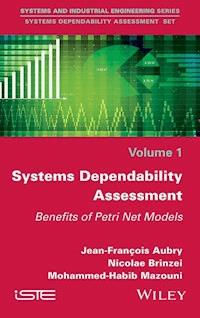
Petri Nets were defined for the study of discrete events systems and later extended for many purposes including dependability assessment. In our knowledge, no book deals specifically with the use of different type of PN to dependability. We propose in addition to bring a focus on the adequacy of Petri net types to the study of various problems related to dependability such as risk analysis and probabilistic assessment.
In the first part, the basic models of PN and some useful extensions are briefly recalled. In the second part, the PN are used as a formal model to describe the evolution process of critical system in the frame of an ontological approach. The third part focuses on the stochastic Petri Nets (SPN) and their use in dependability assessment. Different formal models of SPN are formally presented (semantics, evolution rules…) and their equivalence with the corresponding class of Markov processes to get an analytical assessment of dependability. Simplification methods are proposed in order to reduce the size of analytical model and to make it more calculable. The introduction of some concepts specific to high level PN allows too the consideration of complex systems. Few applications in the field of the instrumentation and control (l&C) systems, safety integrated systems (SIS) emphasize the benefits of SPN for dependability assessment.
Sie lesen das E-Book in den Legimi-Apps auf:
Seitenzahl: 309
Veröffentlichungsjahr: 2016
Ähnliche


















Table of Contents
Cover
Title
Copyright
Introduction
PART 1: Short Review of Petri Net Modeling
Introduction to Part 1
1 Autonomous Petri Nets
1.1. Unmarked Petri nets
1.2. Marking of a PN
1.3. Dynamics of autonomous PNs
2 Petri Nets and Event Languages
2.1. Labeled PNs
2.2. Example
3 Comparison Petri Nets – Finite State Automaton
3.1. Language expression
3.2. Building of the models
3.3. Compactness of the model
4 Some Extensions of Petri Nets
4.1. PN with inhibitor arcs
4.2. Timed PN
4.3. Synchronized PN
4.4. Timed synchronized PN
4.5. Interpreted PN
4.6. Colored PN
Conclusion to Part 1
PART 2: A Formal Approach to Risk Assessment
Introduction to Part 2
5 Ontology-based Accidental Process
5.1. Preliminary definitions
5.2. Elementary entities: HSE and VTE
5.3. Elementary situations and elementary events
5.4. Conclusion
6 Petri Net Modeling of the Accidental Process
6.1. Elementary process
6.2. Sequence of elementary processes
6.3. Modeling the action of a safety barrier
6.4. Modeling of a cumulative process
6.5. PN as a support for risk assessment
6.6. Conclusion
7 Illustrative Example
7.1. Functional description
7.2. Building of an accidental process
7.3. Conclusion
8 Design and Safety Assessment Cycle
8.1. Five essential steps
8.2. Ontological interest
Conclusion to Part 2
PART 3: Stochastic Petri Nets
Introduction to Part 3
9 Basic Concept
9.1. Introductory example
9.2. Formal definition
10 Semantics, Properties and Evolution Rules of an SPN
10.1. Conservatism properties
10.2. Mean sojourn time in a place of a SPN
10.3. Equivalent Markov process
10.4. Example of SPN for systems dependability modeling and assessment
11 Simplification of Complex Models
11.1. Introduction
11.2. System modeling
11.3. Presentation of the quantitative analysis method
11.4. Example
12 Extensions of SPN
12.1. Introduction
12.2. Relationship between stochastic Petri nets and stochastic processes
12.3. The transition firing policy
12.4. Associated stochastic processes
12.5. Synchronization problem in generalized stochastic Petri nets
12.6. Conclusion
PART 4: Applications of Stochastic Petri Nets to Assessment Problems in Industrial Systems
Introduction to Part 4
13 Application in Dynamic Reliability
13.1. Presentation of the system and hypothesis
13.2. System modeling with Petri net
13.3. Methodology application
13.4. Construction of an aggregated Markov graph
13.5. Conclusion
14 Classical Dependability Assessment
14.1. Availability study of a nuclear power plant subsystem
14.2. Common causes failures in nuclear plants (safety oriented)
15 Impact of Failures on System Performances
15.1. Reliability evaluation of networked control system
15.2. Railway signaling
Conclusion
Appendix
A.1. Complements on Petri nets basics
Bibliography
Index
End User License Agreement
List of Tables
6 Petri Net Modeling of the Accidental Process
Table 6.1.
Simulation results of accidental process
13 Application in Dynamic Reliability
Table 13.1.
Control of actuators
Table 13.2.
Description of the places
Table 13.3.
Description of the messages
14 Classical Dependability Assessment
Table 14.1.
Components MTTF and MTTR, (in hour)
Table 14.2.
System performance results
Table 14.3.
The values of occurrence frequencies
μ
and
ω
for non-lethal and lethal shocks as a function of p
Table 14.4.
Real and visible PFD of the protection I&C system for different values of
p
Table 14.5.
Combinations of failed boards leading to the system downtime depending on p
1
and p
2
15 Impact of Failures on System Performances
Table 15.1.
Probability of failure by stability
List of Illustrations
1 Autonomous Petri Nets
Figure 1.1.
The drawing of a PN
Figure 1.2.
A marked PN
Figure 1.3.
PN of Figure 1.2 after firing of transition T
2
Figure 1.4.
PN state of Figure 1.3 after firing of transition
T
1
Figure 1.5.
A marked PN and its reachability graph
2 Petri Nets and Event Languages
Figure 2.1.
PN of an assembly system
3 Comparison Petri Nets – Finite State Automaton
Figure 3.1.
Arborescent automaton equivalent to the language a
n
b
n
Figure 3.2.
Labeled PN equivalent to the language a
n
b
n
Figure 3.3.
Simple case of two PNs synchronization
Figure 3.4.
Resource sharing between two sub-PNs
Figure 3.5.
The three construction primitives
Figure 3.6.
Application example of the primitives
4 Some Extensions of Petri Nets
Figure 4.1.
PN with inhibitor arc
Figure 4.2.
Synchronization mechanism
Figure 4.3.
Introductive example of colored PN
Figure 4.4.
An example of CPN Tools model
Figure 4.5.
Hierarchy in CPN Tools
6 Petri Net Modeling of the Accidental Process
Figure 6.1.
Synchronized PN of an elementary accidental process
Figure 6.2.
Completed elementary accidental process
Figure 6.3.
Chain of elementary processes
Figure 6.4.
Action model of a protection barrier
Figure 6.5.
Modeling of the cumulative process
Figure 6.6.
PN model of the event generator (mean values)
Figure 6.7.
Event generator CPN Tools model (stochastic values)
Figure 6.8.
Simulation model of a sequence of two elementary processes
Figure 6.9.
Simulation model of the elementary process
7 Illustrative Example
Figure 7.1.
The system train – screen doors
Figure 7.2.
Elementary process: “passenger hurt by untimely door closing”
Figure 7.3.
Elementary process “untimely door closing”
Figure 7.4.
The whole accidental process
8 Design and Safety Assessment Cycle
Figure 8.1.
Design and Safety Assessment Cycle
9 Basic Concept
Figure 9.1.
Stochastic Petri net of the machining system with two machines
10 Semantics, Properties and Evolution Rules of an SPN
Figure 10.1.
The hydraulic system
Figure 10.2.
PN of the hydraulic system
Figure 10.3.
PN with repairer sharing
Figure 10.4.
The reachability graph homogeneous to a Markov graph
11 Simplification of Complex Models
Figure 11.1.
Example of a control system modeling and its failures
Figure 11.2.
Example of reachability graph
Figure 11.3.
Modeling into a Markov process
Figure 11.4.
Aggregated Markov graph
Figure 11.5.
Failure modeling and interaction with the control
Figure 11.6.
PN model of the control system
Figure 11.7.
“Stochastization” of the control transitions
Figure 11.8.
Markov graph of the fourth model
Figure 11.9.
Aggregated Markov graph
Figure 11.10.
Two examples of sub-PNs
12 Extensions of SPN
Figure 12.1.
Underlying PN of the model
Figure 12.2.
Emission of a signal X
i
by P
i
and receipt of X
i
by T
j
Figure 12.3.
PN representation of the first entity
Figure 12.4.
PN representation of the repairmen
13 Application in Dynamic Reliability
Figure 13.1.
The “tank-valve-pumps” system
Figure 13.2.
Modeling of the system in Petri nets
Figure 13.3.
The aggregated Markov graph of the system
Figure 13.4.
Probabilitly evolution of the feared event ER
14 Classical Dependability Assessment
Figure 14.1.
Reliability block diagram of the TPAs system
Figure 14.2.
Concurrence of GSPN stochastic transitions
Figure 14.3.
GSPN modeling behavior with a timed CPN
Figure 14.4.
CPN models associated with the case study
Figure 14.5.
Empirical distribution of the MTTFF, MTBF and MMTR of the whole controlled system
Figure 14.6.
Architecture of the case study I&C system for a nuclear power plant
Figure 14.7.
High level colored Petri net of the I&C system
Figure 14.8.
CPN subnet modeling the non-lethal CCF
Figure 14.9.
CPN subnet modeling the lethal CCF
Figure 14.10.
CPN sub-net of an electronic board
Figure 14.11.
CPN sub-net to determine the state of the whole I&C system (available or unavailable)
15 Impact of Failures on System Performances
Figure 15.1.
Structure of an NCS
Figure 15.2.
System-level CPN model
Figure 15.3.
Process CPN model
Figure 15.4.
Sensor CPN model
Figure 15.5.
Controller CPN model
Figure 15.6.
Actuator CPN model
Figure 15.7.
Network CPN model
Figure 15.8.
Probability of failure by overshoot in the presence of variable delays, the x-axis represents the constraint of the D
ov
threshold (expressed in % of the setpoint), the y-axis represents the value of the probability of failure
Figure 15.9.
Probability of failure by overshoot in the presence of losses of information, the x-axis represents the constraint of the D
ov
threshold (expressed in % of the setpoint), the y-axis represents the value of the probability of failure
Figure 15.10.
Probability of failure by overshoot in the presence of the losses and the variable delays, the x-axis represents the constraint of the D
ov
threshold (expressed in % of the setpoint), the y-axis represents the value of the probability of failure
Figure 15.11.
Trend to instability
Figure 15.12.
MA assignment as a function of the lateral signaling
Figure 15.13.
Example of CTPN, transmission of the BAL signaling
Figure 15.14.
Example of token statement
Figure 15.15.
Comparison of real and simulated schedules on the Zoufftgen-Woippy rail network
Figure 15.16.
Comparison ETCS/BAL in case of failure of a track circuit
Figure 15.17.
Comparison ETCS/BAL in case of breaking of the train coupling
Appendix
Figure A.1.
State graph
Figure A.2.
Event graph
Figure A.3.
Lock and trap in a PN
Guide
Cover
Table of Contents
Begin Reading
Pages
C1
iii
iv
v
xi
xii
1
3
5
6
7
8
9
10
11
12
13
14
15
16
17
19
20
21
22
23
25
26
27
28
29
30
31
32
33
35
36
37
38
39
40
41
42
43
44
45
46
47
48
49
51
52
53
55
56
57
58
59
61
62
63
64
65
66
67
68
69
70
71
72
73
74
75
76
77
78
79
80
81
82
83
84
85
86
87
88
89
90
91
92
93
94
95
96
97
98
99
101
102
103
105
107
108
109
111
112
113
114
115
116
117
118
119
121
122
123
124
125
126
127
128
129
130
131
132
133
134
135
136
137
138
139
140
141
142
143
144
145
146
147
149
150
151
152
153
154
155
156
157
158
159
160
161
162
163
164
165
166
167
168
169
171
172
173
175
176
177
178
179
180
181
182
183
184
185
187
188
189
190
191
192
193
194
195
196
197
198
199
200
201
202
203
204
205
206
207
208
209
210
211
212
213
214
215
216
217
218
219
220
221
222
223
224
225
226
227
228
229
230
231
232
233
234
235
236
237
238
239
240
241
242
243
245
246
247
248
249
250
251
252
253
254
255
256
257
258
259
260
261
262
263
Systems Dependability Assessment
Benefits of Petri Net Models
Jean-François Aubry
Nicolae Brinzei
Mohammed-Habib Mazouni
Systems Dependability Assessment Set
coordinated by
Jean-François Aubry
Lesen Sie weiter in der vollständigen Ausgabe!
Lesen Sie weiter in der vollständigen Ausgabe!
Lesen Sie weiter in der vollständigen Ausgabe!
Lesen Sie weiter in der vollständigen Ausgabe!
Lesen Sie weiter in der vollständigen Ausgabe!
Lesen Sie weiter in der vollständigen Ausgabe!
Lesen Sie weiter in der vollständigen Ausgabe!
Lesen Sie weiter in der vollständigen Ausgabe!
Lesen Sie weiter in der vollständigen Ausgabe!
Lesen Sie weiter in der vollständigen Ausgabe!
Lesen Sie weiter in der vollständigen Ausgabe!
Lesen Sie weiter in der vollständigen Ausgabe!
Lesen Sie weiter in der vollständigen Ausgabe!
Lesen Sie weiter in der vollständigen Ausgabe!
Lesen Sie weiter in der vollständigen Ausgabe!
Lesen Sie weiter in der vollständigen Ausgabe!
Lesen Sie weiter in der vollständigen Ausgabe!
Lesen Sie weiter in der vollständigen Ausgabe!
Lesen Sie weiter in der vollständigen Ausgabe!
Lesen Sie weiter in der vollständigen Ausgabe!
Lesen Sie weiter in der vollständigen Ausgabe!
Lesen Sie weiter in der vollständigen Ausgabe!
Lesen Sie weiter in der vollständigen Ausgabe!
Lesen Sie weiter in der vollständigen Ausgabe!
Lesen Sie weiter in der vollständigen Ausgabe!
Lesen Sie weiter in der vollständigen Ausgabe!
Lesen Sie weiter in der vollständigen Ausgabe!
Lesen Sie weiter in der vollständigen Ausgabe!
Lesen Sie weiter in der vollständigen Ausgabe!
Lesen Sie weiter in der vollständigen Ausgabe!
Lesen Sie weiter in der vollständigen Ausgabe!
Lesen Sie weiter in der vollständigen Ausgabe!
Lesen Sie weiter in der vollständigen Ausgabe!




