


7,00 €
Mehr erfahren.
- Herausgeber: Garnet Publishing
- Kategorie: Gesellschafts- und Liebesromane
- Sprache: Englisch
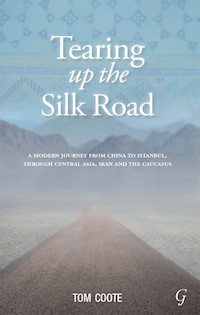
Tearing up the Silk Road is an irreverent travelogue that details a journey along the ancient trade routes from China to Istanbul, through Central Asia, Iran and the Caucasus. As Tom Coote struggles through the often arbitrary borders and bureaucracies of China, Kazakhstan, Uzbekistan, Turkmenistan, Iran, Armenia, Georgia and Turkey, it becomes apparent that the next generation will see themselves in a very different light to their predecessors. New forms of identity are emerging, founded more upon shared cultural preferences and aspirations, than on the remnants of tribal allegiance. While rushing through from East to West, Tom Coote meets, befriends and argues with an epic range of characters; from soldiers and monks to pilgrims, travellers and modern day silk-road traders. All are striving for something more and most dream of being somewhere else. By bus, train and battered car - through deserts, open plains and mountain ranges - Tom finds himself again and again at the front line of a desperate war for hearts and minds. Through rapidly expanding megacities, to ancient ruins, and far more recently created wastelands, it is the West that is winning the souls while the East grows ever stronger. The real clash of civilisations, however, seems set to be not between the East and the West, but between the few who have so much, and the masses now uniting to demand so much more.
Das E-Book können Sie in Legimi-Apps oder einer beliebigen App lesen, die das folgende Format unterstützen:
Veröffentlichungsjahr: 2012
Ähnliche




















TEARINGUP THE SILK ROAD
A modern journey from China to Istanbul, through Central Asia, Iran and the Caucasus
Tom Coote
www.tomcoote.net
Visit the author’s blog to see many photos from his visit to the Silk Road and read his travelogues. Just scan the QR code above with your QR reader.
TEARINGUP THE SILK ROAD
A modern journey from China to Istanbul, through Central Asia, Iran and the Caucasus
Published by
Garnet Publishing Limited
8 Southern Court
South Street
Reading
RG1 4QS
UK
www.garnetpublishing.co.uk
www.twitter.com/Garnetpub
www.facebook.com/Garnetpub
blog.garnetpublishing.co.uk
Copyright © Tom Coote, 2012
All rights reserved.
No part of this book may be reproduced in any form or by any electronic or mechanical means, including information storage and retrieval systems, without permission in writing from the publisher, except by a reviewer who may quote brief passages in a review.
First Edition
ISBN: 978-1-85964-302-0
British Library Cataloguing-in-Publication Data
A catalogue record for this book is available from the British Library
Typeset by Samantha Barden
Jacket design by Sanna Sporrong
Cover images Travel © Bowie15 and Road to Salvation © Wimstime, courtesy of Dreamstime.com
Printed and bound in Lebanon by International Press:
CONTENTS
Introduction
Endings and Beginnings
CHINA
Jinghong
Kunming
Chengdu
Lanzhou
Dunhuang
Urumqi
KAZAKHSTAN
Almaty
Shymkent and Turkistan
UZBEKISTAN
Tashkent
Bukhara
Samarkand
Tashkent (again)
Khiva
TURKMENISTAN
Dashogus and Konye-Urgench
Ashgabat
IRAN
Mashhad
Yazd
Esfahan
Tabriz
ARMENIA
Yerevan and Lake Sevan
GEORGIA
Tbilisi
Batumi
TURKEY
Trabzon
Safranbolu
Istanbul
Selected Bibliography
INTRODUCTION
There is no such thing as the Silk Road. There were actually many Silk Roads that shifted and twisted through Asia, Europe and Africa over hundreds of years. The best known starting and end points were Chang’an (Xian), the old capital of China, and Byzantium (Constantinople/Istanbul), but many Silk Roads would bypass those cities all together. They didn’t even carry mainly silk. About 30 per cent of the trade was made up of silk but these routes would also carry fruit, plants, paper, art, compasses, jewels, gold, gunpowder and the Black Death. More importantly, they carried ideas, skills and DNA.
Many consider the Silk Road to have been the Information Superhighway of its time. It can be seen as the first real instance of globalization, and to have laid the foundations of the modern world. It acted as a bridge between all the major civilizations – Egypt, China, India, Persia, Arabia, Byzantium and Rome – for over a thousand years and acted as a catalyst in their development. It wouldn’t be until the sixteenth century, when new maritime trade routes opened up, that the Silk Road would begin to decline in importance.
Very few traders would ever travel the whole of the Silk Road – they would usually specialize in one particular section before passing their goods on to other merchants with the necessary skills and knowledge to extend the trade. To travel the entire Silk Road would have taken many years and been full of dangers. In 2010 I decided to make this journey from China to Istanbul, through Central Asia, Iran and the Caucasus, using only public transport. I tore through in nine weeks.
ENDINGSAND BEGINNINGS
From East to West • Sedentary vs. Nomadic • Isolationism and Expansionism • Imitation and Identity • Love Will Tear Us Apart
It had been her birthday the day before and the clock was ticking. I had bought her a silver bracelet in the night market in Luang Prebang but what she had really wanted was a baby. I probably could have bought her one in Laos for less than the price of a silver bracelet but she wanted to make her own one.
During our last day together I had been ill for the first time in more than six months of travelling. My head was spinning and my stomach was gurgling. She told me that I didn’t have to go but I felt like I did. After months of being settled in the East, I would now be taking the long, hard road back to the West. She would travel back down through Laos and Thailand to stay with her family in Krabi, while I would carry on into China and beyond. It was something I had to do. I wasn’t sure why.
The sleeper bus from Luang Prebang to Kunming would take twenty-four hours and was due to leave at seven in the morning. I had paid a bit extra to the shop I had bought the bus ticket from to be picked up at 6am from our run-down wooden guest house. We sat at the picnic table outside with our backpacks and waited. Now that it was time to leave, I was surprised to feel a lump rising in my throat. I had never expected to feel this way. After six months of being together every day we had started to snipe and bicker. I thought that it would be a relief to get away but, now that the day had come, it felt like things would never be the same again. At first, she had resisted when I told her of my plans to travel back to Europe overland. I had asked her to come with me but she thought that it would be hard work and that Kazakhstan was a stupid place to go on holiday. And she didn’t want me wandering off on my own as she thought I was too buffalo (the Thai equivalent of a silly cow): she worried that I always believed everything everybody told me; it was better for me to stay where she could keep an eye on me. Recently, however, she had warmed to the idea of sending me off on my own and had seemed quite pleased to be getting me out of the way – or at least until today. When a battered pick-up truck reversed into our alley and tooted its horn, we slid out from under the table and hauled in our backpacks and ourselves. We held our bags between our legs and each other’s hands as we rattled off down the track. Only a few minutes later we stopped outside a Chinese restaurant that was just opening up and the driver told me to get out. We held each other tight for a few seconds and then she was gone.
After half an hour or so, a few Chinese people started to turn up outside with large hold-alls and suitcases. When the bus eventually turned up I was pleased to find a friendly Swedish couple on board who had got on at the bus station. The bus had bunk beds that were too short to allow you to lie straight down but had too little head space to allow you to sit upright. My heart sank. I was inclined to suffer from a bad back, so this could well be a less-than-comfortable journey (although all the time that I was travelling my back seemed fine; it was only when I was sedentary for most of the day that I seemed to get problems).
I settled into the top bunk in front of Jacob and Elsa, who were due to fly back to Sweden from Beijing in a few weeks. It was awkward to talk as I had to keep turning around from a half lying, half sitting position. As I didn’t even have a guidebook for China, Elsa let me have a look through her badly photocopied version of the old China Lonely Planet guide. They had bought it second hand in Laos and it wasn’t until they had taken off the cellophane wrapping that they had realized many of the pages had been ripped out. Apparently the Chinese border guides would often rip out any pages from these guides that had anything to do with the troublesome provinces of Tibet or Xinxiang.
I tried to prop myself up on the top bunk so that I could read the ropey China guidebook, but, every time we swerved across the mountainous road, I would have to grab hold of something so that I didn’t fall out. Spreading out my legs on either side of the bunk and jamming them into the corners kept me wedged in for a while but then I almost crashed head first onto the floor of the bus as we careered around a particularly dramatic switchback. After another couple of near escapes I resigned myself to lying down on my back like everybody else. From the top bunk, I couldn’t even see out of the window. I handed Elsa back her guidebook and put on my headphones. It was going to be a long trip.
It wasn’t long until we came across the first set of road works. The Chinese were helping to finance the building of greatly improved roads all the way from the Chinese border to Thailand, in order to facilitate more effective trade routes between China and its surrounding countries. China was investing billions in its own and other countries’ infrastructure in order to bolster its own long-term economic and political goals. Unfortunately, the work was still going on and looked like it would be for some time. Hordes of local peasants had been dragged out of the fields to slowly and laboriously build the roads virtually stone by stone. They were literally carrying baskets of stones to use as foundations on the existing tracks, and then laying them out one by one. Such a labour intensive approach seemed commendable in areas so deprived of decent paying work but it was causing chaos. At one point we were held up for over an hour before being permitted to crawl past on one side of the semi-demolished track way.
Just as my bladder was about to burst, we pulled into the Laos equivalent of a service station. There were two toilet doors but only a queue for one of them. It might seem obvious that there would be a good reason why nobody was going in but I thought I would have a look anyway. The light inside the wooden shack was dim, but once my eyes adjusted I could make out what looked like a molehill of shit covering the squat toilet. That much shit could never have come out of one human being’s bottom and yet its near perfect conical shape suggested that it had emerged from a single anus. Had they been letting large farm animals use the facilities? As I backed out and joined the queue for the other toilet, an old man pushed in past me. I would have advised him to leave it for a few minutes but I don’t think he would have understood. A few seconds later he re-emerged with a big grin on his face. He approached two of the local ladies and proudly held up a tortoise in each hand. As they lay upside down in his palms, with their legs wriggling, the two ladies looked on admiringly. They all seemed very pleased.
In hindsight I should never have used the stagnant water in the tank to wash my hands – especially as I then went on to eat with them. There wasn’t much on offer but by then we were hungry enough to eat whatever we could find. Jacob and Elsa were planning to go on from Kunming to Dali, one of the most popular tourist towns in the south of China, but I wouldn’t have time for that. It had taken quite a while to sort out what visas I could in Bangkok and, if I was going to make it all the way overland to Istanbul in time to fly back to England and start back at work, then it was going to be a bit of a rush. I would come to wish that I had pushed my luck a bit further and asked for even more unpaid leave.
We were all rushed back on to the bus again only to be held up a few minutes later at yet more road works. We started to worry that the Laos–China border might close before we got there, but there was nothing we could do. We lay out on the bunks with our headphones on, and stared at the ceiling of the bus. Every now and again I would catch glimpses of the grand mountain scenery if I leant around at an angle, but most of the views were obscured from my top bunk. Despite all the delays, we eventually rolled in to the rather unattractive border town of Boten and were at the customs point with thirty minutes to spare. We then queued up outside with our bags for about half an hour or so before being told that they would open up again in an hour’s time. The customs officials shuttered up the windows and disappeared. I walked around to the side of the building to see what was going on and saw them all crowded around an old TV set. I had been warned about this. Apparently, they would always stop at five to watch their favourite soap. As we had been half an hour early – despite all the road works – I had thought we would be fine, but maybe they hadn’t wanted to start letting anybody through in case it took longer than expected and they missed the beginning.
After another hour of waiting around and kicking our heels we were told that only the Chinese would be let through when they reopened. As the bus would then carry on without us and leave us behind, this didn’t go down so well. The driver told us that we would just have to get the bus at the same time tomorrow night but we really weren’t convinced that the same thing wouldn’t just keep on happening for days or that there would even be any spare seats for us on their next buses. Some Chinese let us know that the same thing had been happening almost every day but that that hadn’t prevented the travel agents in Luang Prebang from selling the tickets. Elsa turned out to be particularly persuasive and eventually the bus driver gave in to our relentless moaning. The money he eventually returned was more than I had expected and seemed like just about enough to pay for another bus tomorrow morning to Kunming – if we could find one.
The bus left without us while we hauled our backpacks back down to the ‘town’ in the hope of finding the guest house that we had been assured was down there somewhere. By now it was starting to get dark and it didn’t look like a good place to get lost with nowhere to stay. Border towns in Asia are usually pretty dodgy and Boten didn’t seem like an exception. They are often centres for gambling, prostitution and smuggling, and not much else. After traipsing all the way across town and all the way back in again, we came across two middle-aged Russians who had been sent over here to set up one of the casinos (like the Chinese, the Russians seemed to be doing ‘business’ everywhere). They helped us to find the anonymous guest house – despite still being in Laos, all the signs were now in Chinese – and, after some seemingly nonsensical bartering, we settled into a twin-bedded room for the night. Despite being quite happy to share a double bed, it turned out that Elsa and Jacob weren’t actually a couple at all. Apparently they had known each other for ages and both used to be in the Cubs together. This seemed a little odd as the Cubs are only for boys up to the age of about eleven. I had got used to seeing plenty of lady-boys in Thailand but I found it difficult to imagine that Elsa ever used to have a willy. It turned out that a better translation from the Swedish would have been the Venture Scouts. I was going to ask them why they weren’t together when Elsa mentioned that she couldn’t wait to get to Kunming so that she could contact her boyfriend through Skype. They had started going out with each other after the trip with Jacob had been arranged. Jacob seemed to go a bit quiet but I don’t think Elsa noticed.
CHINA
JINGHONG
Environmental Disaster • The Transposing of Popular Culture Consumption and Identity • Psychotherapy and Dualism Bridges between Worlds
We managed to get up early so as to be there when the border opened again. Elsa was feeling kind of woozy from some patches she had applied to her neck to prevent travel sickness – she had had some kind of allergic reaction to them, come up in a rash and had the eyes of someone who was deeply stoned. This wasn’t a good look for passing through customs. As it happened, after blowing the remains of our Laos money on biscuits, bottled water and assorted snacks, we passed straight through customs in a matter of minutes and soon found another long-distance sleeper bus that was heading for Kunming. We eventually managed to get the driver down on price to the same amount that we had gotten back from the first bus, so we handed over the cash and we were on our way. We couldn’t believe our luck. We were in China and on our way! Rather than having to lie all day on another top bunk, or attempt to sit upright on it without falling out, I opted to sit on the floor and propped my back against the metal sidebars with some blankets. I had just got myself about as comfortable as I was going to get when the bus pulled into a station a few minutes on from the border and we were all told to get off. We couldn’t understand what was happening but one of the other passengers explained that we were going to have a break and that we should come back in six hours. The bus driver had been up all night; he now needed his beauty sleep.
There really wasn’t anything to do in the rather dull border town of Mengla but I was glad that I had Jacob and Elsa to share my misfortunes with – at least we could have a good moan and reassure ourselves that we had only done what seemed sensible at the time. I went off to look around the town with Jacob while Elsa slouched in a wicker chair in the bus station waiting room. After a ten-minute or so walk we had seen everything there was to see in Mengla: a few boring shops, and a handful of restaurants and cafés that only seemed to have menus in Chinese. Quite a few tourists might pass through here but not many would stop for very long. After a bit of half-hearted reading – at least I could check out Elsa’s guidebook without falling out of my bunk every time we swerved around a sudden bend – we wandered off to a ‘coffee shop’ that didn’t actually have any hot water. Still, after a round of iced black coffee we all felt a bit better, and it made a change from the bus station. It had begun to dawn on us that if we carried on to Kunming on this bus then we would be arriving there at around three in the morning – this didn’t seem like a good idea. Unfortunately, as soon as we had gotten off the bus, the driver had driven off with our bags locked up underneath. We would just have to wait – and hope – for him to come back. Eventually we found a decent-looking Thai restaurant with menus that we could understand and a clean toilet (still something of a rarity in much of China). Even by Thai or Laos standards the meal was excellent value, and we all started to feel much better and more optimistic – we would try to get the driver to drop us off somewhere near to Jinghong, the closest main Chinese city, and try to at least get some of our money back. This seemed a bit unlikely, but if Elsa was willing to unleash her full persuasive powers then we might be in with a chance.
Much to my surprise, Elsa did manage to get a reasonable amount of our money back from our driver, and a couple of hours after setting off he dropped us at the junction to Jinghong. We didn’t have to wait long until a minivan came along and we were able to wave it down and negotiate a fare into the city (this wasn’t such a great deal but we weren’t exactly in a strong negotiating position). Jinghong is a large polluted city on the Mekong River. Like many huge Chinese cities with no famous tourist attractions, I had never heard of it. A few backpackers end up there when travelling backwards or forwards from Laos, and a few keen trekkers would use it as a base for visiting the tribal Dai people, but that seemed to be about it. The whole of southern China had been suffering from the worst drought ever recorded, and even the city centre seemed dry, dusty and parched (around 18 million at that time were estimated to be without drinking water, and it was costing the government and charities hundreds of millions of dollars in aid – the government was blaming global climate change but many were blaming the government’s own ambitious hydroelectric projects). We wandered out of the bus station in search of what Elsa’s fake ‘Lonely Planet’ had called ‘The Banana College Hotel’. The map didn’t seem to make much sense and nobody had heard of any hotels or colleges named after bananas. We traipsed up and down for ages but just seemed to get more lost. There were actually plenty of large hotels around but they looked expensive and full of Chinese businessmen or government employees on expense accounts (their actual salaries are rubbish but they can wangle a lot through expenses). As each car pulled up in front of the hotel’s lavish forecourt, a small army of uniformed porters, assistants and assorted lackeys would rush to their assistance and enthusiastically guide them through to reception. None of them had heard of the Banana Hotel either but the few with some English were keen to help us. Between them, they eventually realized that we must have been looking for the College Hotel in Banna, and sent us off in a taxi with instructions to the driver. When the driver spoke to us in Chinese I was rather surprised to find myself answering him. It then dawned on me that what he had said must have been the same in Thai (I can’t really speak Thai properly but I can make out the most-used phrases). Over the next day or so I would quite often be able to pick up on bits of conversation based on this similarity. The Laotian language is more or less the same as the dialect of Thai spoken in the north, but I hadn’t expected this part of China to have so much in common linguistically. (As soon as I got into other parts of China I couldn’t understand a word of their own language – apart from ‘hello’ and ‘thank you’.)
We eventually checked into another shared room for three, in the College Hotel in Banna, just outside the university gates, and down the road from the botanical gardens. Elsa’s main priority was to find an Internet café with webcam so that she could talk to her boyfriend through Skype, but first we needed to sort out our onward bus tickets and get something to eat. This might not seem very adventurous but we were quite pleased to come across a generic-looking fast food restaurant called Dico’s. Along with KFCs, I would find these all over the country. When I had first visited China fifteen years previously, the McDonald’s next to Tiananmen Square in Beijing had been a real novelty. After far too much green sludge with either rice or noodles on excessively long bus journeys, we had been strangely pleased to find somewhere to eat that was so clean and familiar. (I would avoid places such as McDonald’s like the plague if I was at home but weeks of bad and unfamiliar food can play strange tricks with your mind.) The gleaming surfaces and air conditioning lured us into Dico’s in search of burgers, fries and other fattening junk. When I first visited the Far East, you would very rarely see overweight people but now they seem to be catching up with the West in terms of excessive wobbliness. American-style fast food still retains a certain amount of glamour there, which has been lost to all but the youngest and poorest in the West. Apart from offering the options of rice and a few spicier sauces, Dico’s was pretty much the same as any anonymous fast food restaurant in Europe or America. For the moment, at least, that suited us fine.
Although the city was large and busy there wasn’t that much to see except for a few parks and some carved elephants. I was surprised to find a shopping mall with a multiplex cinema showing the latest Hollywood films but they had all been dubbed into Chinese (I found out some time ago that most Hollywood films are watched by more non-English speakers than by native English speakers – this might go some way to explaining why so many of certain types of films still get made). As we shuffled through the slightly tatty mall, bad cover versions of cheesy Western pop music blared out from hidden speakers. Western food and popular culture seemed to be seeping into every part of China but it still had to be transformed and translated into something that was suitable for consumption by the Chinese masses. Any sophistication, subtlety or irony seemed to get lost in the process. After (eventually) booking up the tickets for the overnight buses, we decided to visit one of Jinghong’s premier attractions – the supermarket! Tourists often think that they can get a feel for the local people and culture by visiting such ‘attractions’ as museums and art galleries. This is absolute rubbish. Most such places have about as much to do with the real culture of a country as Morris dancing has to do with the culture of England. It is through the humble supermarket that the real soul of a people is revealed. Their other big advantage is that you can eat the exhibits. We wandered up and down, inspecting the pictures on the packets, and taking a risk on anything that looked interesting but wasn’t too expensive. I bought a fake Cornetto for dessert and dripped chocolate down my front.
***
The next morning we managed to track down an Internet café with webcam, so Elsa could talk to her boyfriend, but they wouldn’t let us use the computers unless we were members and we couldn’t become members without a Chinese ID card. Eventually we found another one that was keener to take our money (fifteen years ago we would often come across people who simply couldn’t be bothered to do their job if they thought it might possibly be any kind of hassle – I guess this stems from the fact that they would get paid the same pittance whatever they did). The PCs were still running ancient software that nobody had bothered to update and seemed to be riddled with viruses. After updating the browser and downloading Skype, Elsa got through to her boyfriend in Stockholm. He waved enthusiastically at us and we all had to wave back. After a while I left Elsa to her boyfriend and Skype and made my way back to our room – I still had a dodgy stomach and wanted to make use of the decent Western-style bathroom in our room before we had to check out.
After completing my ablutions and packing my bag, I wandered onto the terrace outside our rooms and ended up chatting to an older American guy who had just arrived. He had been teaching English in China for a few years now and had come down here to try to sort out a new job at the university. He had already met some of the students and they were offering to take him along and introduce him to the right people. As the students at the university passed by they would often wave and say hello. They weren’t pushy at all but always seemed happy to talk to you and practise their English. It seemed that there were plenty of opportunities for native English speakers to teach in China and that, although the wages were low by Western standards, they were still enough to pay for a reasonable standard of living in most parts of China. Since my first trip here, there were noticeably more young people who could speak some English. While few of the older or middle-aged Chinese had ever had the opportunity or desire to learn, to the younger generation speaking in English seemed to be considered to be quite cool. It might well also have been necessary if they were to land the best jobs at the big international companies. China is set to become a far greater world power and, like it or not, English is still the international language. I had also taught English to Chinese students in England. They were friendly and keen and their parents were rich enough to pay for an international education. They would eventually return to China bringing new skills, ideas and attitudes (some of which might not be compatible with their parents’ world view).
Jacob and Elsa came back just in time to pack up their bags before check out. They said it would seem strange to be in China without me. I had only known them for two days but it seemed longer. They hailed down a taxi on the main road and then they were gone. I still had quite a few hours to kill before catching my overnight bus to Kunming. I wandered around on my own back down in the town but couldn’t find much of interest apart from some European-style bakeries selling animal-shaped cakes. I still wasn’t feeling that great so made do with a chocolate mouse for my tea, and walked back up to the College Hotel. The students held up their arms to wave to me and shouted ‘Hello’ in English. As the computer in reception was free I sat down to check my emails and do a bit more research on where to stay in Kunming. A girl who worked on reception asked if I could help one of the students search on the Internet for information about psychologists. As I was at something of a loose end I was happy to help. She introduced me to a rather anxious-looking young woman who appeared to speak very little English. What did she want to find out about psychology? Was it actually famous psychotherapists she was interested in, such as Sigmund Freud or Carl Jung or R.D. Laing? None of these names seemed to mean anything to her. The receptionist explained that this shy young woman had problems in her head and needed someone to help her. She had asked at the university but they could only recommend some kind of counsellor or therapist who was far too expensive. I wasn’t sure how I could help when we didn’t even speak the same language. I tried searching ‘psychotherapists in China’ but it didn’t look as if psychotherapy had ever really caught on there. Then I tried to explain that I wasn’t really convinced that just talking about psychological problems would necessarily be enough to resolve them – if this were ever actually possible – but I was just saying words. We couldn’t even speak the same language. Psychotherapy itself is deeply rooted in the culture, thoughts and language of the West – it is difficult even to discuss matters of the mind without using terms such as ‘neurosis’ that are alien to Confucian thought. While Chinese culture places great emphasis on harmony and conflict avoidance, Western thought is rooted in a dualism – from God and the Devil, to the conscious and the unconscious, to thesis and antithesis – in which resolution can only be achieved through conflict. Much in the same way that psychoanalysis professes a faith that psychological suffering can somehow be magically cured through simply talking, Confucianism holds that the desirable qualities of a teacher or other figures of authority will somehow be passed on to the subservient through a process of respect and reverence. It is this rigid hierarchy between the analyst and the analysand that is antithetical to the process of psychotherapy; in order for it to work at all there needs to be honesty, openness and genuine collaboration between the two. The Confucian obsession with not ‘losing face’ or not facing up to uncomfortable realities will inevitably put up barriers to the ‘self’ and, if the therapist is then seen as an infallible purveyor of wisdom, then no real dialogue or resolution can ever be achieved.
While I am sceptical about many aspects of psychoanalysis and psychotherapy, I am reasonably convinced that there is a link between the repression of the ‘self’ and depression. According to the German psychologist and psychoanalyst Anne-Marie Schloesser, there are 250,000 recorded suicides a year in China and another 2 million attempts. The Chinese obsession with not losing face would suggest that the real figures are far higher. The authorities have only recently acknowledged the need to address the issue of mental health, and the study and development of psychology and psychoanalysis in China is in its infancy. During the Cultural Revolution it was, to all intents and purposes, banned. Many Western ‘missionaries’ of psychotherapy tried in vain to spread the word to China only to find that their words don’t translate. I tried my best to talk to the girl with the problems but the few words we shared could never be enough to form a bridge between our worlds. As she resigned herself to isolation and left to walk away, she turned and held up her arms to me – not waving but drowning.
KUNMING
Copies of Copies • Babel • Generational Shift • Unity through Art
I had been very silly indeed. For months I had been getting around in just shorts, t-shirts and sandals. This had still been fine in Jinghong. When I emerged from under the stale smelling duvet and crawled down from my cramped bunk to emerge from the bus, I was shocked by the early morning cold in Kunming. Everybody else in the bus station was wearing jackets and scarves and woolly hats, and I was shivering in my shorts and t-shirt. We were still miles from the actual city. I had no idea where to go so just followed some other people with bags who were walking through the main gate. This seemed to be the right thing to do as I ended up in a smaller station where I managed to get a minibus into the city. As we rattled past miles of bland Chinese tower blocks, I covered my bare legs with my backpack in an attempt to repel the cold. I had photocopied some pages from Elsa’s (photocopied) fake Lonely Planet but the maps hadn’t come out well. I had no idea where we were so, when we passed a large McDonald’s in what appeared to be a busy central square, I opted to get off. I tried to figure out where I was but my hands were shaking so much that I couldn’t read the map. A beautiful Chinese girl took pity on me and offered to help. She kept waving down taxis for me and attempting to get them to take me to the hostel that I had read about, but none of them seemed to be interested (they probably took one look at me in shorts in this weather and decided that I mustn’t be quite right in the head). I was just about to give up and attempt to change into my combat trousers in McDonald’s when a nice lady taxi driver agreed to take me for a price that seemed quite reasonable. I squeezed in next to her on the front seat. There was a metal cage around her but she hadn’t bothered to lock herself in. Maybe I just seemed mad but not dangerous? She dropped me off at an office block and pointed upstairs. I got out of the lift and was welcomed into a large modern open-plan office. I really wasn’t sure what I was doing there but they seemed pleased to see me so I emptied out my backpack and began to dress in some clothes that were more appropriate for the weather (rather than taking my shorts off in front of all the office staff, I opted to put my trousers on over the top of them – I feel that it’s important to maintain a certain degree of decorum when dealing with other cultures). I wasn’t sure why I was there and they weren’t sure what to do with me but at least I was a bit warmer now and they had made me a nice cup of tea. It turned out they had something to do with student accommodation and they tried to explain how to get to the hostel. As I was still being a bit slow, they eventually packed me off into another taxi with instructions to the driver who succeeded in dropping me off outside a YHA (it wasn’t until I had checked in that I realized this wasn’t the hostel I had been trying to find at all, but it was going to have to do).
As it was still quite early the dorms weren’t ready yet, but I could go ahead and use the shared bathrooms. This was a relief as, although I’d made it through the night alright, I was still at the mercy of a runny bottom. When I walked into the shared bathrooms, a Chinese guy who was enjoying a quiet smoke nodded to me. He had his trousers around his ankles and was squatting over the toilet. This clearly wasn’t one of those posh toilets with cubicle doors. I was tired and felt grotty and really couldn’t be bothered with this so I went back down to reception and upgraded from the dorm to my own room with an en suite bathroom and a television (I justified this by thinking that as I had got there early in the morning I was getting two uses of the private bathroom for the cost of one night’s sleep). There were some Western programmes being shown on the TV but they had all been dubbed into Chinese. Every now and then as I flicked through, I would think that I had found a channel in English but then some Chinese voice would start talking over the top. I don’t know why they didn’t just add a new soundtrack altogether rather than just having somebody talk on top – surely the Chinese must find it annoying to hear two people speaking at the same time in two different languages? The television might have been unwatchable but it was worth the extra money to have my own bathroom. After I’d got clean and had a bit of a rest I was finally ready to see what Kunming had to offer the discerning tourist.
Kunming, the capital of Yunnan province, is home to over 5 million people. It was once a gateway to the Silk Road and acted as a crossroads for trade between India, Myanmar and Tibet. According to the tourist brochures, Kunming is also ‘the City of Eternal Spring’. I put on two t-shirts, did up my denim jacket and thrust my hands into my pockets before daring to venture back outside. Just around the corner was the popular Green Lake Park. Even on a cold weekday morning, the park was full of people just wandering about. There were pedal boats all around the lake but nobody was using them. They were more interested in eating, chatting, chess and line dancing. In every park in China there always seem to be groups of all ages, and abilities, doing their own kind of choreographed dance routines. It seems similar to US-style country dancing, but like most cultural imports it has been transposed and modified into a uniquely Chinese form of expression. There is none of the inhibition that you find among amateur dancers in the West and neither the dancers themselves nor the crowds that gather to watch them seem particularly concerned about just how good or bad the dancing actually is. It’s just something to do and a bit of fun and some exercise. Outside gym equipment is also often found in Chinese parks and you would still see people using it while wrapped up warm in their coats, gloves and scarves. To be honest, they didn’t seem to be putting a lot of effort into it but at least they were getting out and about (it must have been better than being stuck in a grey tower block with only rubbish TV as amusement).
Not far from Green Lake Park was Yuantong Si, a Chan (Zen) Buddhist temple that was first built in the late eighth or ninth century. Over the centuries it has been restored and rebuilt a number of times. More recently it was expanded with money from Thailand. Unusually, it lies in a natural depression and you go down steps to the temple, rather than ascending. Such attractions bring in huge amounts of tourists but nearly all of them are Chinese. The Chinese love to be tourists but, for the moment at least, they are mainly restricted to visiting their own country. If China’s economy continues to grow at the current rate, then in a few years they will no doubt be getting everywhere. Every tourist attraction in the world will be overflowing with wealthy Chinese consumers, capturing the sights on the latest digital cameras. For the moment, however, they would rather save most of their newfound wealth while the West grows further into their debt (China now owns more US Treasury bonds than Japan and is therefore its principle creditor). In a few years’ time the balance of power could have shifted dramatically. On the other hand, China’s huge debt-backed property boom could make the Western property bubbles look like inconvenient bumps. If the whole thing comes crashing down, it could bring the rest of the world’s economies with it and ruin everybody’s holiday plans.
As the only Western tourist in the temple complex, I edged between the incense lighting worshippers and tried to avoid walking into too many holiday snaps. I tried not to make a nuisance of myself and nobody seemed to mind me wandering around their holy place. Not all Western visitors have been so well tolerated. At the beginning of the twentieth century, one of the French engineers who was working on the Kunming to Vietnam railway project set up house in the temple’s main building. There weren’t many nice places for foreigners to stay in Kunming at the time, so he selected the Yuantong Treasury hall as his place of residence. This didn’t go down too well with the locals who still wanted to be able to get into the temple to pray and burn incense sticks. It took a few months, but they eventually managed to chuck him out. It would be difficult to imagine a Chinese engineer coming over to England and setting up house in the nearest cathedral because he couldn’t find anywhere else that was up to his standards.
Now that I was in Kunming I would at least be able to get the overnight sleeper trains for most of my trip across China. They were much more comfortable than the buses and only slightly more expensive. As the only way to get my ticket to Chengdu was to go to the train station, I set off with my less-than-satisfactory photocopied map. I couldn’t make out the lines of the roads and, although many of the main roads signs did have English translations underneath the Chinese, the spellings varied considerably. A guy who worked at the hostel pointed me in the direction of where to get the buses to the train station and I was moderately surprised that that was where I ended up. Actually buying the ticket didn’t prove to be quite so easy. Nobody at the ‘international’ counter could speak English and I seemed to get waved on from one queue to another. Once I had eventually got hold of a second-class sleeper ticket to Chengdu, I noticed just as I was leaving that the date was for tonight and not for tomorrow. Luckily, I was allowed to change it after going through the whole process all over again. By the time that I had got the bus back to the hostel, the whole ticket-buying expedition had taken up half the day (in contrast, my visit to Yuantong temple had only taken up about ten minutes).
I still didn’t feel up to eating a proper meal but as a reward for all my efforts I decided to treat myself to an ice-cream sundae at a trendy-looking café called Just Fruit. It was full of teenagers playing cards, drinking fruit shakes and smoking. Everyone seemed to be smoking everywhere in China. Apparently the cigarettes weren’t very good but they were really cheap. Even though smoking in public places in England had been banned very recently, it was surprising how quickly everybody had gotten used to it. So to enter a public place and find it full of cigarette smoke seemed strangely exotic. My main reason for choosing this café had been that the menu outside was partly written in English. The café seemed to be aimed at youngsters, and to them speaking English was ‘cool’ (even if they couldn’t really understand it). I sat down in the corner and leafed my way through the selections of desserts. I was extremely tempted by The Heaven of Ice Snow and Heart Deeply Drank in a Romantic Feeling but eventually opted for Love to get Occulty with Black Forest. It sounded exotic and I thought there might be some chocolate in it (the only decent chocolate I could find in China was called Dove, which is a brand of soap in the UK; it was far more expensive than a similar quality product in England but the cheap stuff was dreadful). My choice of a large ice-cream sundae as a main meal was justified by the existence of some fruit that was covered in sweet sauce and fake cream. I wasn’t sure what the fruit was, and it didn’t taste particularly good, but at least I was making an effort.
After a few more hours of traipsing around the city I went back to my room and failed to find anything that I could make sense of on the television. I lay down on my bed and searched through the bootlegged rock and metal CDs that I had bought in Bangkok. A few of the copies were a bit ropey but they had been cheap and would help to keep me amused on the long bus and train journeys. I chose a copy of Paramore’s ‘Brand New Eyes’ and lay there on my back with the CD spinning around in the Discman on my gurgling stomach. Paramore have arguably articulated the hunger, melancholy and yearning of youth more successfully than any other rock band of their generation. Their songs bleed with a longing and passion that could only be understood by the young or the young at heart. The final track on the album, ‘Decode’, had been taken from the soundtrack to the teenage vampire movie Twilight and added on to the end. This song, more than any of their others, captures a kind of darkness and desire that is both universal and deeply American. Their world seemed a long way from China as the final lines of ‘Decode’ rang out (‘There is something I see in you. It might kill me. I want it to be true’). The music shuddered to an end and I fell into a long, deep sleep.
***




