


120,99 €
Mehr erfahren.
- Herausgeber: John Wiley & Sons
- Kategorie: Wissenschaft und neue Technologien
- Sprache: Englisch
This book is a comprehensive and up-to-date review and evaluation of the contemporary status of telomerase research. Chapters in this volume cover the basic structure, mechanisms, and diversity of the essential and regulatory subunits of telomerase. Other topics include telomerase biogenesis, transcriptional and post-translational regulation, off-telomere functions of telomerase and the role of telomerase in cellular senescence, aging and cancer. Its relationship to retrotransposons, a class of mobile genetic elements that shares similarities with telomerase and serves as telomeres in selected organisms, are also reviewed.
Sie lesen das E-Book in den Legimi-Apps auf:
Seitenzahl: 703
Veröffentlichungsjahr: 2012
Ähnliche



















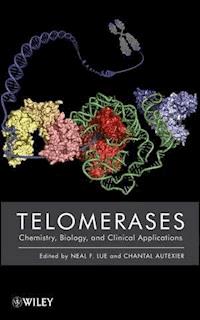
Cover art: Model of telomerase extending telomeric DNA (blue). This model is rendered from available crystal and NMR structures of the telomerase RNA (green; 2K95, 2L3E, 1Z31, and 1OQ0), the telomerase reverse transcriptase (TEN, pink; 2B2A; TRBD, light red; RT, red; and CTE, dark red; 3KYL), the H/ACA snoRNP complex (dyskerin, light blue; Gar1, blue; Nop10, sky blue; and Nhp2, dark blue; 2HVY), and the Pot1-Tpp1 complex (yellow, 1XJV and orange, 2I46; respectively). Image provided by Josh D. Podlevsky and Julian J.-L. Chen (Arizona State University).
Contents
Cover
Title Page
Copyright
Preface
Contributors
Chapter 1: The Telomerase Complex: An Overview
1.1 Conservation of Telomere Function and the Discovery of Telomerase
1.2 The Discovery of the Two Minimal Telomerase Components
1.3 Telomerase Beyond the Minimal Components: Associated Proteins
1.4 Regulation of Telomerase by Telomeric Proteins and RNAs
1.5 Telomerase, Telomere Maintenance, Cancer, and Aging
1.6 Telomerase Beyond Telomere Synthesis
1.7 Telomere Maintenance Without Telomerase
1.8 Conclusion
Acknowledgment
References
Chapter 2: Telomerase RNA: Structure, Function, and Molecular Mechanisms
2.1 Introduction—Telomerase RNA: An Essential Component of Telomerase
2.2 The Unusual Diversity of Telomerase RNA
2.3 The Common Core of TER
2.4 The Assembly/Activation Stem-Loop Element
2.5 Binding Sites for Telomerase Accessory/Regulatory Proteins
2.6 Telomerase RNA Mutations in Human Diseases
2.7 Concluding Remarks
References
Chapter 3: TERT Structure, Function, and Molecular Mechanisms
3.1 Introduction
3.2 Domain Organization and Structures
3.3 Telomerase RNP Assembly
3.4 Interaction with Nucleic Acid and Nucleotide Near the Active Site
3.5 Template Boundary Definition
3.6 Repeat Addition Processivity
3.7 hTERT Mutations in Human Diseases
3.8 Conclusions and Prospects
Acknowledgment
References
Chapter 4: Telomerase Biogenesis: RNA Processing, Trafficking, and Protein Interactions
4.1 Introduction
4.2 Telomerase RNA processing and stability
4.3 Telomerase RNA trafficking and telomerase biogenesis
4.4 TERT trafficking and telomerase biogenesis
4.5 Telomerase associated proteins that regulate RNP biogenesis, assembly, and telomere recruitment
4.6 Concluding remarks
References
Chapter 5: Transcriptional Regulation of Human Telomerase
5.1 The hTERT gene and the hTERT promoter
5.2 Transcriptional regulation of hTERT
5.3 Epigenetic regulation of hTERT
5.4 Transcriptional regulation of hTR
5.5 Cellular microenvironment and telomerase regulation
5.6 Conclusions and perspectives
Acknowledgments
References
Chapter 6: Telomerase Regulation and Telomere-Length Homeostasis
6.1 Introduction
6.2 Telomerase Regulation at Telomeres in Yeast
6.3 Post-Translational Regulation of Mammalian Telomerase
6.4 Concluding Remarks
References
Chapter 7: Telomere Structure in Telomerase Regulation
7.1 Introduction
7.2 Telomere-bound proteins
7.3 Telomere Elongation and DNA Damage Responses
7.4 Single-Stranded Telomere Overhangs as Telomerase Substrates
7.5 Telomerase Regulation by Telomeric Proteins
7.6 Telomerase Regulation in the Context of Cell Division
7.7 Conclusions
Acknowledgments
References
Chapter 8: Off-Telomere Functions of Telomerase
8.1 Evidence for Nontelomere Directed TERT Functions in Malignant Transformation
8.2 Evidence for Nontelomere Directed TERT Functions in Stem-Cell Function
8.3 Multiple TERT Complexes and Biochemical Activities
8.4 Conclusions
References
Chapter 9: Murine Models of Dysfunctional Telomeres and Telomerase
9.1 Introduction
9.2 Telomerase
9.3 Shelterin
9.4 Concluding Remarks
Acknowledgment
References
Chapter 10: Cellular Senescence, Telomerase, and Cancer in Human Cells
10.1 Introduction—the Hayflick Limit
10.2 Telomeres and Senescence
10.3 Telomerase and Cancer
10.4 Small Molecule and Oligonucleotide Telomerase Inhibitors
10.5 Conclusions
References
Chapter 11: Telomerase, Retrotransposons, and Evolution
11.1 Introduction
11.2 Circular Versus Linear Chromosomes in Bacteria
11.3 What Happens When Telomerase Gets Lost?
11.4 Telomeric Repeats and Retrotransposons: Together at the Chromosome Ends
11.5 Transition to Linear Chromosomes and the Emergence of Telomerase-Based Chromosome End Maintenance
11.6 Concluding Remarks
Acknowledgments
References
Color Plates
Index
Copyright © 2012 by John Wiley & Sons, Inc. All rights reserved
Published by John Wiley & Sons, Inc., Hoboken, New Jersey
Published simultaneously in Canada
No part of this publication may be reproduced, stored in a retrieval system, or transmitted in any form or by any means, electronic, mechanical, photocopying, recording, scanning, or otherwise, except as permitted under Section 107 or 108 of the 1976 United States Copyright Act, without either the prior written permission of the Publisher, or authorization through payment of the appropriate per-copy fee to the Copyright Clearance Center, Inc., 222 Rosewood Drive, Danvers, MA 01923, (978) 750-8400, fax (978) 750-4470, or on the web at www.copyright.com. Requests to the Publisher for permission should be addressed to the Permissions Department, John Wiley & Sons, Inc., 111 River Street, Hoboken, NJ 07030, (201) 748-6011, fax (201) 748-6008, or online at http://www.wiley.com/go/permission.
Limit of Liability/Disclaimer of Warranty: While the publisher and author have used their best efforts in preparing this book, they make no representations or warranties with respect to the accuracy or completeness of the contents of this book and specifically disclaim any implied warranties of merchantability or fitness for a particular purpose. No warranty may be created or extended by sales representatives or written sales materials. The advice and strategies contained herein may not be suitable for your situation. You should consult with a professional where appropriate. Neither the publisher nor author shall be liable for any loss of profit or any other commercial damages, including but not limited to special, incidental, consequential, or other damages.
For general information on our other products and services or for technical support, please contact our Customer Care Department within the United States at (800) 762-2974, outside the United States at (317) 572-3993 or fax (317) 572-4002.
Wiley also publishes its books in a variety of electronic formats. Some content that appears in print may not be available in electronic formats. For more information about Wiley products, visit our web site at www.wiley.com.
Library of Congress Cataloging-in-Publication Data:
Telomerases : chemistry, biology, and clinical applications / edited by Neal F. Lue,
Chantal Autexier. – 1st. ed.
p. ; cm.
Includes bibliographical references and index.
ISBN 978-0-470-59204-5 (hardback)
I. Lue, Neal, 1962- II. Autexier, Chantal, 1963-
[DNLM: 1. Telomerase. QU 56]
572.8′6–dc23
2011047556
Preface
This year marks the 27th anniversary of the discovery of telomerase. In retrospect, even though hints of a special activity needed to maintain linear chromosome ends could be traced to earlier theoretical arguments and experimental observations, it was the exposure of an autoradiogram on Christmas day, 1984 that finally brought the activity into sharp focus and enabled it to be captured, dissected, and manipulated. The fascinating story of the discovery of telomerase has been told elsewhere and will not be repeated here. Our goal for this volume is instead to take stock of what has been learned about this fascinating reverse transcriptase in the ensuing 27 years, in the hope of providing more impetus for the investigation into its chemistry, biology, and clinical applications. If the past 27 years can serve as a guide, than the payoff for the next 27 years of telomerase research would be great indeed.
We have organized this compendium with a view toward offering integrated discussions of the three aspects of telomerase covered by the subtitle. The collection starts with an overview of the telomerase complex, followed by in-depth discussions of the chemistry of its two critical components: TERT and TER. The next two chapters highlight the biological regulatory mechanisms that control the synthesis and assembly of the telomerase complex. Equally significant are the regulations imposed by the nucleoprotein complex at chromosome ends, the topics of the two ensuing chapters. Three more chapters accent studies that bring considerable spotlight to telomerase as a promising target and a useful tool in medical interventions. The collection then concludes with an essay that puts telomerase in evolutionary context and illuminates its place in the extraordinarily diverse family of reverse transcriptases.
Although telomerase research is far from unique in the exploitation of model organisms, it has perhaps uniquely benefited from this approach, as evidenced by the initial discovery of the enzyme in ciliated protozoa, and the demonstration of its importance in chromosome maintenance in budding yeast. The proliferation of model system analysis, while arguably indispensable, also made it difficult even for specialists to keep abreast of all the relevant developments, not to say students and investigators newly attracted to a vibrant research field. A main objective for authors of this volume, then, is not only to gather significant experimental observations, but also to provide an integrated discussion of each significant topic across different model systems. We thank all of the authors for their tremendous efforts in this difficult but admirable endeavor.
This project would not have taken place without the initial suggestion and expert guidance of Anita Lekwani at Wiley. Rebekah Amos and Catherine Odal's help in shepherding the initial drafts into the final texts is greatly appreciated. Finally, we thank our coworkers and colleagues for making the study of telomerase an “endlessly” stimulating and fascinating endeavor.
Neal F. LueChantal Autexier
Contributors
Irina Arkhipova, Josephine Bay Paul Center for Comparative Molecular Biology and Evolution, Marine Biological Laboratory, Woods Hole, MA, USA
Chantal Autexier, Departments of Anatomy and Cell Biology, and Medicine, McGill University; Bloomfield Centre for Research in Aging, Lady Davis Institute for Medical Research, Jewish General Hospital, Montreal, Quebec, Canada
Tara Beattie, Southern Alberta Cancer Research Institute and Departments of Biochemistry and Molecular Biology and Oncology, University of Calgary, Calgary, Alberta, Canada
Pascal Chartrand, Département de Biochimie, Université de Montréal, Montréal, Quebec, Canada
Julian J.-L. Chen, Department of Chemistry and Biochemistry, and School of Life Sciences, Arizona State University, Tempe, AZ, USA
Yu-Sheng Cong, Institute of Aging Research, Hangzhou Normal University School of Medicine, Hangzhou, China
Antonella Farsetti, National Research Council (CNR) and Department of Experimental Oncology, Regina Elena Cancer Institute, Rome, Italy
William Hahn, Department of Medical Oncology, Dana-Farber Cancer Institute and Departments of Medicine, Brigham and Women's Hospital and Harvard Medical School, Boston, MA, USA; Broad Institute of Harvard and MIT, Cambridge, MA, USA
Lea Harrington, Wellcome Trust Centre for Cell Biology, University of Edinburgh, Edinburgh, United Kingdom
Joachim Lingner, Swiss Institute for Experimental Cancer Research (ISREC), School of Life Sciences, Frontiers in Genetics National Center of Competence in Research, Ecole Polytechnique Fédérale de Lausanne (EPFL), Lausanne, Switzerland
Yie Liu, Laboratory of Molecular Gerontology, National Institute on Aging, National Institutes of Health Baltimore, MD, USA
Neal F. Lue, Department of Microbiology and Immunology, Weill Medical College of Cornell University, New York, NY, USA
Johanna Mancini, Bloomfield Centre for Research in Aging, Lady Davis Institute for Medical Research, Jewish General Hospital, Montreal, Quebec, Canada
Kenkichi Masutomi, Cancer Stem Cell Project, National Cancer Center Research Institute, Chuo-ku, Tokyo, Japan; PREST, Japan Science and Technology Agency, Saitama, Japan
Jerry W. Shay, Department of Cell Biology, UT Southwestern Medical Center, Dallas, TX, USA
David Shore, Department of Molecular Biology, University of Geneva, Frontiers in Genetics National Center of Competence in Research, Geneva, Switzerland
Emmanuel Skordalakes, Gene Expression and Regulation Program, The Wistar Institute, Philadelphia, PA, USA
Phillip G. Smiraldo, Department of Cell Biology, UT Southwestern Medical Center, Dallas, TX, USA
Jun Tang, Department of Cell Biology, UT Southwestern Medical Center, Dallas, TX, USA
Yehuda Tzfati, Department of Genetics, The Silberman Institute of Life Sciences, The Hebrew University of Jerusalem, Safra Campus, Givat Ram, Jerusalem, Israel
Momchil Vodenicharov, Département de biologie and Département de microbiologie et infectiologie, Université de Sherbrooke, Sherbrooke, Québec, Canada
Raymund Wellinger, Département de biologie and Département de microbiologie et infectiologie, Université de Sherbrooke, Sherbrooke, Québec, Canada
Woodring E. Wright, Department of Cell Biology, UT Southwestern Medical Center, Dallas, TX, USA
Chapter 1
The Telomerase Complex: An Overview
Johanna Mancini and Chantal Autexier
1.1 Conservation of Telomere Function and the Discovery of Telomerase
The concept of a healing factor for chromosome ends or “telomeres” was evoked 80 years ago owing to the recognition by Barbara McClintock and Hermann Muller that the natural end of a linear intact chromosome differs from that of a broken chromosome. Using fruit flies and corn as model organisms, they observed that natural chromosome ends, unlike broken ones, never fuse (McClintock, 1931; Muller, 1938). McClintock reported that during cell division in the embryo a broken chromosome can permanently heal to acquire the functions of a natural chromosome end (McClintock, 1939). One of the healing factors or mechanisms was identified 50 years later, in 1985, by Carol Greider and Elizabeth Blackburn, in the ciliated protozoan, Tetrahymena thermophila, and named telomere terminal transferase or telomerase (Greider and Blackburn, 1985).
While the function and essential nature of telomeres is conserved among eukaryotes, the DNA sequences, associated proteins and structures at telomeres, and modes of telomere maintenance vary. Recombination-based mechanisms of telomere maintenance have been reported in telomerase-negative immortalized alternative lengthening of telomere (ALT) human cancer cells and upon telomerase gene deletion in yeast, known as Type I, Type II, and heterochromatin amplification-mediated and telomerase-independent (HAATI) (see Chapters 7, 10, 11, and subsequent sections of this chapter) (Cesare and Reddel, 2010; Jain et al., 2010). Recombination can occur between telomeric and telomeric, subtelomeric or heterochromatin sequences, and may or may not lead to telomere elongation. In Drosophila melanogaster, one of the two organisms in which the special function of chromosome ends first became evident, retrotransposons and specialized “terminin” proteins, which are structurally distinct from the typical telomere nucleoprotein complex, are nevertheless capable of supplying the capping function at chromosome ends (see Chapters 7, 10, 11, and subsequent sections of this chapter) (Mason et al., 2008; Raffa et al., 2009,2010).
However, the most common mechanism for telomere maintenance is the enzyme telomerase, which is almost universally conserved and active in eukaryotes including ciliated protozoa, yeasts, mammals, and plants (see Chapters 2 and 3) (Autexier and Lue, 2006). Prior to the discovery of telomerase, the first telomere sequences had been identified in T. thermophila, by Elizabeth Blackburn and Joseph Gall, to consist of repeats of the hexanucleotide TTGGGG (Blackburn and Gall, 1978). Most eukaryotes which maintain telomeres by telomerase possess G-rich sequences at their chromosome ends (see Chapter 7). The search for an enzyme that can maintain telomeres was spurred by the recognition of the “end replication problem” by James Watson and Alexey Olovnikov in the 1970s (see Chapters 7 and 10) (Olovnikov, 1973; Watson, 1972). Based on the properties of the conventional DNA replication machinery, they postulated that DNA at chromosome ends could not be completely replicated and that terminal sequences would be lost at each cell division. The identification of an enzymatic activity that adds G-rich DNA sequences to synthetic telomeric oligonucleotides in vitro led to the discovery of the first cellular reverse transcriptase, a ribonucleoprotein (RNP) composed of both RNA and protein (Greider and Blackburn, 1985, 1987, 1989). Two factors were critical to the development of the activity assay: the use of synthetic oligonucleotides with G-rich telomere-like sequences as substrates and the preparation of extracts from Tetrahymena as the source of enzyme. The single-stranded G-rich oligonucleotides mimic the natural substrates for telomerase and can be supplied at high concentrations to drive the reaction (Henderson and Blackburn, 1989; McElligott and Wellinger, 1997). In addition, the enzyme is abundant in T. thermophila due to the large number of chromosome ends that are generated and which must be stabilized following the chromosome fragmentation and amplification that occurs during the development of the transcriptionally active somatic macronucleus in this organism (Turkewitz et al., 2002).
The importance of telomere synthesis by telomerase is highlighted by the discovery that this mode of replication at DNA ends is evolutionary conserved. Linear DNA exogenously introduced into yeast cells is typically degraded or rearranged. However, Elizabeth Blackburn and Jack Szostak performed what they later described as an outlandish experiment. They attached T. thermophila telomeric sequences to the ends of a linear DNA prior to its introduction into yeast and discovered that the DNA was maintained in a stable linear form due to the addition of yeast telomeric sequences to the T. thermophila sequences by a yeast cellular machinery (Blackburn et al., 2006; Szostak and Blackburn, 1982). Moreover, when telomerase activity was identified, Carol Greider and Elizabeth Blackburn also discovered that T. thermophila can add T. thermophila telomeric sequences to a yeast telomeric substrate in vitro, emphasizing the evolutionarily conserved nature of telomere synthesis by telomerase (Blackburn et al., 2006; Greider and Blackburn, 1985). For these pioneering and fundamental discoveries, Blackburn, Greider, and Szostak were awarded the Nobel Prize in Physiology and Medicine in 2009.
1.2 The Discovery of the Two Minimal Telomerase Components
The RNA component of telomerase (referred to as TR or TER in general) contains a short template region, which is repeatedly reverse transcribed into its complementary telomeric DNA sequence (). Initial proof for this function was elucidated using experiments in which an oligonucleotide complementary to the template region of the telomerase RNA was found to inhibit telomerase activity, as did the cleavage of the DNA–RNA hybrid at the RNA template region by RNase H (Greider and Blackburn, 1989). In cells, expression of mutant telomerase RNAs leads to the synthesis of the correspondingly mutated telomeric sequences at chromosome ends, confirming the function of telomerase in telomere synthesis (Yu et al., 1990). Phenotypes elicited by the synthesis of mutated telomere sequences include altered telomere length homeostasis, impaired cell division, severe delay or block in completing mitotic anaphase, and senescence (Kirk et al., 1997; Yu et al., 1990). These phenotypes underscore the critical nature of the sequence at the telomeres and the essential nature of telomere maintenance for cell survival. Telomerase RNAs from other eukaryotes were identified using biochemical and genetic approaches, however, some RNAs, for example, those from and , have only been recently discovered largely due to size divergence and weak primary sequence conservation (see Chapter 2) (Cifuentes-Rojas et al., 2011; Leonardi et al., 2008). Despite the large size variation of the telomerase RNAs (ranging from 150 nucleotides (nt) in ciliates to over 1300 nt in yeasts), the secondary structures of telomerase RNAs are remarkably well conserved (see Chapter 2).
Lesen Sie weiter in der vollständigen Ausgabe!
Lesen Sie weiter in der vollständigen Ausgabe!
Lesen Sie weiter in der vollständigen Ausgabe!
Lesen Sie weiter in der vollständigen Ausgabe!
Lesen Sie weiter in der vollständigen Ausgabe!
Lesen Sie weiter in der vollständigen Ausgabe!
Lesen Sie weiter in der vollständigen Ausgabe!
Lesen Sie weiter in der vollständigen Ausgabe!
Lesen Sie weiter in der vollständigen Ausgabe!
Lesen Sie weiter in der vollständigen Ausgabe!
Lesen Sie weiter in der vollständigen Ausgabe!
Lesen Sie weiter in der vollständigen Ausgabe!




