


Erhalten Sie Zugang zu diesem und mehr als 300000 Büchern ab EUR 5,99 monatlich.
- Herausgeber: The Lilliput Press
- Kategorie: Religion und Spiritualität
- Sprache: Englisch
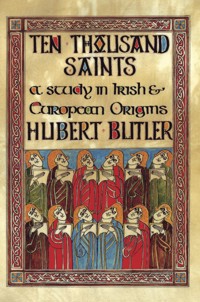
When it was first published in 1972, Hubert Butler's pioneering masterwork was received with scepticism by his contemporaries. He used linguistics to trace the origins of myths and saints back to pre-Celtic Ireland and Europe, and showed how these stories and names – ancestors of half-forgotten tribes – became absorbed by Christian mythology. The early Irish wove their stories, as did the Greeks, the Hebrews and all early peoples, from the migration of tribes and by wordplay with their time-battered, unstable names. Ten Thousand Saints raises fascinating problems that take us beyond the frontiers of recorded history to the remote movements of European peoples, to the clash of tribes and tongues. As modern DNA sampling and genome-mapping, seen in the regional patterning of today's Irish surnames, reinforce Butler's findings, his methods and thesis are now gaining scholarly recognition. This new edition, amplified and updated, demonstrates ingeniously coded histories – via place names, legends, hero-figures, saints and ancestors – that relate to the wanderings and minglings of all the great tribes of Europe', extending back to Neolithic times.
Sie lesen das E-Book in den Legimi-Apps auf:
Seitenzahl: 662
Veröffentlichungsjahr: 2010
Das E-Book (TTS) können Sie hören im Abo „Legimi Premium” in Legimi-Apps auf:
Ähnliche







Ten Thousand Saints
A Study in Irish & European Origins
‘This adventurous book could stimulate a revival of interest in Irish hagiology.’
—Times Literary Supplement
‘A work of great wit and erudition and no reference library should be without a copy.’
—The Irish Press
‘Enchanting. Mr. Butler approaches his subject with the fundamental reverence it deserves and is not anti-saint but antihumbug.’
—The Daily Telegraph
‘This book is ambitious, unusual, provocative.’
—Hibernia
‘A work in which sound learning is combined with distinctive literary grace.’
—The Church of Ireland Gazette
‘I am completely convinced by the argument that our 10,000 saints were “not real people but ingenious and necessary fabrications of the mind”.’
—The Irish Times
‘Has the allure of a detective story.’
—The Irish Independent
‘The book has the courage and simplicity one expects from a private scholar. Mr Butler has just one outstanding theory. He sets it out and if he’s wrong the book will be thrown away. How many professors have such courage?’
—Westmeath Examiner
‘A writer of rare elegance and grace, and with an even more rare moral and intellectual courage. He was a literary artist of vivid and often exquisite prose.’
—The Washington Post
Ten Thousand Saints
A Study in Irish & European Origins
HUBERT BUTLER
To
JACQUES BOUCHER DE PERTHES
(1788–1868)
The customs officer of Abbeville who grew prize pears, wrote plays that were never produced, joined the Kilkenny Archaeological Society, shunned scientists and founded the science of prehistory
and
RICHARD BUTLER
(1794–1862)
I am far from claiming to be a savant or even a very clever man, but I am not blind … What seemed to me ten times worse than any criticism was this obstinate refusal to investigate the facts and the cry, ‘Nonsense! It can’t be so!’ without bothering to go and see.
Hatred and persecution at least can be fought; but indifference is a wall between you and the light, it buries you alive; I’d sooner have an enemy who flung Truth back into her well and crashed the bucket down on her head.
Nothing is more difficult to eradicate than old errors. What is most strange is that Science, when it has adopted and above all professed them, holds to them ten times more tenaciously than does Ignorance. That is because Ignorance has nothing to unlearn; it is a field that has not yet been taken over by the thistle and the nettle. There is no need for it to be harrowed.
Jacques Boucher de Perthes
But it is not likely that legends so widely propagated and so fondly cherished had no foundation in fact; that they were altogether either poetical fictions, or moral and political parables and myths. It is more reasonable to conjecture that they were the forms of historical narrative used by one people, which, falling into the hands of another people of different language, of other habits of thoughts and turns of expression, were understood by them in a sense which they were not intended to bear, and in which they were not used by their authors. We would look upon these strange and portentous narratives as the hieroglyphic records of forgotten but substantial history.
Harriet J. E. Butler
A Memoir of the Very Reverand Richard Butler,Dean of Clonmacnoise and Vicar of Trim, from Butler, R. Introduction to Annals of Clyn
Irish Archaeological Society, 1849
(privately printed, 1863, pp. 242–3)
Note on the Second Edition
The first edition of Ten Thousand Saints was scanned by staff at the Scholars’ Laboratory in the Alderman Library, University of Virginia. This was then correlated line by line, with errors corrected both in the original text and the digital version by Richard S. Crampton.
The integrated text was edited by Crampton, following Hubert M. Butler’s expressed wishes for the second edition. Butler had kept seven much-marked copies of the first edition at Maidenhall, Kilkenny. They contained his corrections, new text, new titles for chapters, new footnotes, additional references for the bibliography and new entries for the indexes. These changes have now been inserted to form a definitive edition. An added sixth index was developed by Crampton, cross-referencing additional items of Butler’s research. Maps and tables have been numbered and referrals indicated where appropriate.
The dedication has been expanded at Butler’s request to include comments by his great uncle, Richard Butler (1794–1862), Dean of Clonmacnoise and Vicar of Trim.
An Afterword by Richard Crampton reconciles Butler’s pioneering research with modern DNA findings in bio-archaeology and linguistics.
Contents
Title Page
Dedication
Epigraph
Note on the Second Edition
Tables, Maps, Illustrations
Introduction, Alan Harrison, 2005
In Memoriam: Alan Harrison (1943–2005), Ross Hinds, 2011
Preface to the Original Edition, Hubert Butler, 1972
Bibliography and Abbreviations
PART 1
1. Saints and Scholars
Saints
Scholars
2. Why did St Locheni Menn Stammer?
3. Puncraft, an Ancient Art and an Explanation of the Glossary
My Glossary
4. How Ancestors and Saints Were Made
In South Leinster
Some Ancestor Saints
How Saints Were Made
5. Who was Lug?
6. The First Invaders of Ireland
Macalister and the Idols
O’Rahilly and the Gods
7. Les Hommes Elégants de la Forêt: Tribal Implications of Gaulish Proper Names
Country Methods
8. Where Did the Irish Come From?
The Bebryces
Iberians and Ligurians
The Veneti
The Thracians
The Getae
The Briges
The Thyni
The Mygdones
Other Peoples
9. Tribal Maps
Amalgamated Tribes
Irish Analogies
Mug Ruith and his Iberian Relations
PART 2
10. Tribal Charts and Tables of Name Variants
The Goban Saints and the Cruithne
Kenneth Jackson and St MoChuda
St Cronan and St MoChua
Terminations
11. St Brigit and the Breac Folk
The Brig Folk in Scotland
The Breac Folk in Decies
12. St Patrick: His Family and Household
St Patrick’s Missionary Journeys
St Lupita, St Patrick’s Sister
St Erc, St Patrick’s Embroideress
The Erc Folk and the Thracians
Restitutus, St Patrick’s Brother-in-Law
St Martin, St Patrick’s Uncle
13. Saints of the Vascones
St Mescan, St Patrick’s Brewer, and St Bescna, his Chaplain
St Escon and the Fish
Continental Relations: Ulysses and Aesculapius
14. Some Saints of the Cunesioi
St Finncu and the Dogs
St Canice and the Head Folk
St Conchind and the Dog Heads
15. Saints of the Veneti
St Fintan Munnu and Others
Their Relations with Other Saints
The Board-Faced Saints and the Birds
St Aenboin and the Units
Aine the Sun Goddess
St Enda
The Gwynn Saints
16. The Carpic Saints
St Corba and the Chariots
(A) THE CHARIOT FOLK
(B) ST CORBA AND ST COBRAN
(C) CONTINENTAL SAINTS
St Fuinche Garb and the Rough Folk
St Gabhran and the Goats
St Seighin Gabal and the Forks
St Crebriu and the Branches
St Gregory and the Greeks
St MacCreiche and the Plunder
St Corcaria and the Purple Folk
St Cruithnechan and the Wheat
St Mac da Cerda and the Craftsmen
St Cairbre Crom and the Crooked Folk
St Gnavan and the Bones
St Cearc and the Hens
St Goban and the Smiths
A Greek Epilogue
17. The Sons of Mil
St Maelcu and the Bald Folk
The Bald Folk
Leitrim and Longford
Sligo and Mayo
Wicklow
Wexford
Westmeath
18. The Tigurini
St Kentigern and the Princes
St Luchtigern and the Mice
St Foirtchern
The Saintly Sons of Vortigern
Some Miscellaneous Tigern Saints
St Tigernach of Clones
19. Saints of the Daii
Da Saints
Who was St Da Goban?
20. St Brendan
21. St Ailbe and the Apples
Apples
22. St Sciath and the Shields
23. St Tartinna and the Heifers
The Tartessii
In County Louth
In Meath and Wicklow
The Dartraige
Other Traces
24. St Fursa and the Frisians
St Fursa’s Irish Family
Irish Stories of Fursa
Fursa’s Companions
Fursa and his Companions in Ireland and Gaul
St Meldan
St Faelan
St Goban
St Algisus
Fursa in East Anglia
St Fursa in Gaul
Could the Frisians Have Reached Ireland?
25. The Cicones
26. The Colours of the Winds
27. The Saints Leave Ireland A Poem
Afterword: Irish Saints, Heroes and Tribes: Bio-Archaeology and Hubert Butler, Richard S. Crampton
Bibliography
Glossary
INDEX 1: Saints
INDEX 2: Ancestors and Heroes
INDEX 3: Irish Tribes (and their Ancestors)
INDEX 4: Continental Tribes (and their Ancestors)
INDEX 5: Historians and Historic Figures
INDEX 6: Miscellany
Copyright
TABLES, MAPS, ILLUSTRATIONS
TABLE 1: Irish Tribal Names18
TABLE 2: Ancestor Saints31
TABLE 3: Tribes of Gaul65
TABLE 4: Continental Tribes with Irish Kinsmen67
TABLE 5: The Thracians and their Variants97
TABLE 6: The Brig-Bard Tribes and their Variants98
TABLE 7: Fer Names104
TABLE 8: Chart of the Carpetani142
TABLE 9: The Carp Folk and their Variants174
TABLE 10: Saints of the Daii196
MAP 1: Spain63
MAP 2: Central Europe64
MAP 3: Gaul65
MAP 4: Britain68
MAP 5: Decies in Waterford80
ILLUSTRATION 1: Scythian Bronze Horse-Trapping from near Amiens, Ashmolean Museum210
ILLUSTRATION 2: From a Cross at Moone, Co. Kildare210
ILLUSTRATION 3: From a Purse in a Ship Burial, Sutton Hoo, Suffolk211
ILLUSTRATION 4: From South Cross Castledermot, Co. Kildare211
ILLUSTRATION 5: From a Cross at Kells, Co. Meath211
Introduction
ALAN HARRISON, 2005
There is an expression in the Irish language which goes ‘Bheadh sé molta dámbeinn I mo thost’ and this can be translated as ‘If I were silent he would still be praised.’ Hubert Butler (1900–91) needs no words of mine to establish or defend his reputation. His own writings are the most eloquent proof of his standing as a thinker and scholar. Since the publication in 1985 of the first collection of essays, Escape from the Anthill, Lilliput Press has published three more volumes of his writings and a fifth one, The Appleman and the Poet, is in preparation at present. The range of subjects, the style that speaks of such a sharp mind, and the sheer humanity of these works produced over a long period display a consistently high standard that is equalled by few other Irish writers. Most of these would fall into the category of essays, which is a medium that lies sometimes uneasily between literature and scholarship. In fact, somewhat like his Irish predecessor Jonathan Swift (with whom he is often compared), the writing itself is so good, the argument so logically produced, that the evidence or scholarship behind them seems to have a secondary place. Nothing could be further from the truth. Hubert Butler based his writings on both experience and evidence and had a natural scholar’s approach towards collecting, collating and assessing his sources. Even a cursory look at his papers confirms this.
About a year ago I came across a collection of essays commemorating Hubert Butler. These were the papers given at a centenary celebration of Hubert Butler’s birth held in Kilkenny in October 2000. Among these essays was one by Dick Crampton, Hubert’s son-in-law and a medical professor at the University of Virginia, in which he discussed the only full-length book published by Hubert, Ten Thousand Saints: A Study in Irish and European Origins. The collection of papers as a whole confirmed my enjoyment and admiration of Hubert’s writings but I returned in my mind often to the statement by Dr Crampton that Hubert Butler considered his work on the saints and Irish origins as his most important contribution to scholarship and that it was a great disappointment that it had been greeted by the scholarly community only with disapproval and with little or no engagement with the ideas he was propounding. I had read the book cursorily when it came out in 1972 and like most of my comrades in Celtic Studies I had subscribed to the orthodoxy that nobody but a person who had spent a lifetime absorbing the intricacies of the Old Irish language could speak with any authority on the meaning of the traces of ancient Ireland contained in the Irish lives of the saints, Irish mythology, Irish genealogy, Irish place names and, of course, according to the dogma of Irish cultural nationalism the folklore and mind of the Irish people required a knowledge of the modern Irish language and all that it entailed. From that viewpoint Butler was an easy target, and he knew it and sought to deflect, it as I will discuss below.
Hubert’s disappointment with the book’s critical reception was even more poignant when we consider the circumstances behind his research and the production of the book. In the aftermath of the event known as the ‘Papal Nuncio Affair’, which resulted in his retirement from the Kilkenny Archaeological Society in 1952, the project he devoted much of his intellectual life to was this study of Irish and European origins. During this period of twenty years Hubert familiarized himself with much more primary material for his study, begun in 1941, and starting classically from the questions of what meaning the material had for Ireland, and the generations of scholars through whose hands and minds it had passed, he began to formulate his theories of Irish origins. He understood better than anyone his own shortcomings – no formal training in Old Irish or in the arcana of Early Irish history – but he also knew his strengths – a formidable intellect, a training in the Classics and a knowledge of other cultures.
He called his approach ‘country scholarship’ and I believe it will be worthwhile to look at what he meant by that and to compare it to the methods of official academic learning. The country scholar, according to Hubert Butler, has no axe to grind and (if the reader can bear the mixing of metaphors) everything is grist to his mill. The so-called ‘trained’ scholar is bound by the conventions of his discipline and must conform to the process that has been laid down for him. In many cases the process itself seems to be more important than the resulting evidence or truth. I have seen some instructions to young scholars, especially in the sociological field, which grant a greater proportion of the marks to the precise adherence to a prescribed process than to the originality of the approach or the value of the outcomes. Butler saw the country scholar approach in the work of several of his predecessors like Edward Ledwich, George Petrie and even Eoin Mac Neill. Though he doesn’t make much mention of them he would also have recognized many of the traditional scholars of the seventeenth and eighteenth centuries as belonging to the same mould. I suspect he was intentionally provocative and perhaps defensive in his coining and usage of the expression. He understood the challenge his ideas would be to those who followed a purely philological or culturally national historical approach and he wished to engage them in debate. He must have been sadly disappointed when his carefully constructed ideas were dismissed as the ravings of one of the charlatan band that inevitably become attached to matters ‘Celtic’ and ‘Irish’.
The shelves of bookshops are now full of so-called Celtic spirituality, mysticism, new-age medicine and the like. There is an industry producing these which has little if anything to do with scholarship let alone Celtic scholarship. The Scottish scholar Donald Meek, from the Department of Celtic at Aberdeen University, has recently written a description and critique of this movement that seeks to piggyback on the genuine article. His was a welcome intervention, authoritative and fair. In connection with this I remember encouraging my colleague in the Archaeology Department at UCD, George Eogan, to write a book for the general public on his research at the mound at Knowth, Co. Meath. I said to him that if he didn’t do it the vacuum would be filled by others without his expertise. And this is the nature of charlatan scholarship.
Whatever else may be said about Hubert Butler he was not a charlatan and the dismissal (by people like me) mentioned above of his life’s work on the Irish saints was unjustified. That is not to say that he is right in every detail and that we were wrong. He would not have expected that himself. Indeed there is plenty of evidence in the book that he anticipated and would have welcomed vigorous debate. For my part, my interest in what he has to say and my confidence in the value of producing it again is strengthened greatly by the discovery that he consulted his ‘friend James Carney’ whom he was certain would disagree with some of his findings. For the non-Celtic/Old Irish scholar I should explain that Professor James Carney of the School of Celtic Studies at the Institute of Advanced Studies could be described as a great speculator and a shining light of interpretation of the culture and history contained in the old texts. Hubert also used texts such as M.A. O’Brien’s Corpus Genealogarium and Ellis Evans’s work on Gaulish personal names. He quotes from Kenneth Jackson’s work but not from that scholar’s Language and History in Early Britain, a book I believe that might have given him support for some of his ideas and that would have delighted him. I can only guess how much he would have welcomed the publication of several books by Pádraig Ó Riain and the speculations of scholars like Joseph Nagy. Butler’s ideas did deserve consideration and if we believed they were wrong we should have supplied other explanations for the evidence he produced.
Hubert Butler’s work involved speculations, guesses if you like, but they were based on a painstaking study of an enormous corpus of evidence. He also had an unusual understanding of the nature of this material that had passed through the minds and imaginations of generations of Irish scholars. As we will see below, this reference to minds and imaginations is of crucial importance for our understanding of his theories and for our acceptance of their validity. During the twenty years from the early 1950s to the publication of TenThousand Saints Butler amassed, by hand, every possible reference to every possible saint in the Irish corpus in Irish and Latin. In Ten Thousand Saints he only showed one example of his methodology from about 250 pages of the type of basic research he had done. Had I realized the extent of this I don’t believe I would have written off his speculations as readily as I must have done in the early 1970s.
Let me give a brief description of this material. It is a single page, larger than foolscap, more like the size of the page of a large folio book divided horizontally into seven columns; the first column deals with a tribal name; the next with the key word associated with that name; then we have the names of saints who also have this key word as part of their makeup; then there is a list of places associated with the saints; followed by heroes that are associated with them; and other places with the same or similar elements; the sixth column mentions possible continental tribes (Celtic or otherwise) that could be related; and the final column gives a commentary on the foregoing material taken from other authors and from his own thoughts on the subject. Each page has between ten and fifteen entries in each column. This was all done by hand and represents itself a valuable corpus for future scholars. Incidentally there is a copy of this material among other papers of Hubert’s in the library of Trinity College, Dublin.
Having pleaded guilty to ignoring at best and at worst belittling Hubert Butler’s work when it came out in 1972, perhaps I can say a little about my own engagement with Irish language scholarship and Early Irish history. I do this in the expectation that the debate and dialogue that Hubert wished for might belatedly be initiated now. In order to do this most effectively I must be more personal than is usual in academic discourse. But then discourse between academia and country scholarship probably leaves room for one’s own individual experiences. First of all, although I am an academic who has spent all his professional life working with material mainly in the Irish language, I am not an Old Irish scholar, nor am I an expert in Early Irish history. Having said that, ever since the early days of my apprenticeship I have read nearly all there is available in and about both domains out of sheer interest. I don’t think of these subjects and my own areas of interest (the late Middle Ages and the seventeenth and eighteenth centuries) as a continuum or a seamless garment, but I am very aware of the connections between them. My training was, first and foremost, linguistic, textual and philological. My instincts as a scholar and my academic output have been primarily literary, interpretative, contextual and cultural. That statement alone should explain why the former approach based on what certainly used to be the common training in Celtic Studies is not sympathetic to Butler’s speculations and why the present me is more open to them.
The philological scholar can find faults in Hubert’s reasoning and the textual scholar can reject the authenticity of the texts he uses. For example one’s immediate reaction on seeing some of Hubert’s ‘interpretations’ of Irish names is to ridicule them. To give an example of one of the most famous of Irish names, that of the hero Cú Chulainn, Butler tells us this means ‘dog-holly’(from cú, hound and cuilleann, holly). This is nonsense to the philologist, especially if he hasn’t followed the argument that has been made about punning (see below for a fuller discussion of this). Hubert will be told that the ‘l’ in the name of the blacksmith Culann is ‘broad’ while the one in cuileann is ‘slender’ and therefore they are not the same word. According to this explanation the name means ‘the hound of Culann’ though there seems to be no explanation of what Culann’s name may have meant. My answer to the philologist is try it with a native speaker of Irish and see if he/she can make the semantic leap proposed by Butler’s theory of word-play. I have heard jokes in the Gaeltacht that demand much greater shifting of sounds to supply the meaning of a funny story. Then to turn to the case of textual scholarship I have plenty of evidence that the best editors (i.e., those who best reproduce the authentic texts as they were originally written) are not always those who understand the importance and significance of their material. Their role is extremely important but the explanation of the cultural meaning of the texts are often provided by others. Indeed Hubert praises very highly M.A. O’Brien’s editions of the genealogical corpus but remarks on the lack of commentary other than the critical apparatus. Too rigorous adherence to the philological or textual orthodoxy can lead one to misinterpret the subtlety of Butler’s arguments and his defence of them. I believe each area of expertise could be used, rather, to refine what Hubert has proposed as a possible model for, not early Irish history but for proto-Irish history.
The canvas on which Hubert Butler has chosen to draw his story is larger than Old Irish language, larger than Early Irish history, larger than folklore and archaeology; it is in short part of the story of Europe. There is no scholarship nowadays that embraces all the disciplines necessary to deal with such a canvas – that is the raison d’être for the ‘country scholar’. In recent years I studied a number of characters from the seventeenth and eighteenth centuries who were intimately associated with the rise of Enlightenment learning; men like James Ussher, James Ware, Narcissus Marsh, William King, Jonathan Swift, Edward Lhwyd, Humfrey Wanley, John Toland and others from the Dublin Philosophical Society and from the Royal Society. All of these touched on the subject areas mentioned above but none of them was an expert in all of them – they were the equivalent of the country scholars of their day. In fact all scholarship then was country scholarship, seeing that the line of distinction between the several disciplines was not drawn as strictly as it is now. When I read Hubert Butler I think of these multi-disciplined, dilettante (not in the pejorative sense of being superficial) scholars. His competencies are wide, embracing Irish (despite his apology for his lack of knowledge of that language), Latin, Greek, Russian, French, German, Serbo-Croatian and several other European histories, languages and cultures. His understanding of Ireland as part of the bigger picture of prehistoric Europe is refreshing and his ability to trace the traditions of the historical Irish back to that picture is exciting. He may sometimes be incomplete in his evidence, even inaccurate in his use of it, but the overall result is ingenious.
At a ceremony to celebrate the life of the great scholar of the early Irish landscape Frank Mitchell, Professor Fergus Kelly compared him to the Irish god/hero Lugh arriving at the royal court at Tara. He knocks at the door and the doorkeeper tells him that everyone who enters must be the possessor of a special skill. Lugh mentions his several skills one by one and after each recitation the doorkeeper informs him that there is already someone inside who excels in that skill. When the list is finished Lugh asks the doorkeeper if there is anyone inside who is master of all the skills already mentioned, and he is thus admitted as a supreme hero because of his versatility. It is not incongruent to mention Hubert Butler in connection with this story also. I don’t believe Frank Mitchell would have been unhappy to be compared with Hubert and I am sure the latter would have admired greatly the country scholar in Mitchell.
The preceding paragraphs are intended to make the case for the decision to re-edit Ten Thousand Saints. I hope I have indicated my own enthusiasm for the project. ‘Re-editing’ is not really the right word for what is necessary. In fact the book was published at Butler’s own expense and apart from others who may have read it in proof, it was never edited. In my experience as an editor it is practically impossible to edit one’s own work. Either the content, the presentation or the copy-editing will suffer. I have no doubt that Hubert Butler’s reputation, which is based on the collections of his essays, owes much to the work of his editors. I say this not to take away from him but rather to affirm my belief that good writing deserves good editing and that there is a synergy between the two that is greater than the two together. There is a difficulty editing work of someone who is no longer alive to avail of an editor’s advice. As an editor I am torn between my desire to interfere as little as possible with the author’s original text and the necessity to impose consistency and clarity on his arguments. I will explain the editorial approach later but I would first of all like to try and summarize and synthesize Hubert Butler’s work on Irish prehistory.
In presenting Butler’s thesis I will often use his own words. He starts with the great number of Irish saints, and especially the fact that saints with the same and similar names tend to cluster in great numbers in contiguous territories. He says of them:
Indeed it is through them [the saints] that I feel myself to be on the trail of a beauty and a truth more ancient, abundant and durable than theirs. If I am wrong I will surely be corrected. Or will I? I do not believe any Celtic scholar will accept my conclusions, which derive from the conviction that the saints had no human reality and must be otherwise explained. The way to refute me totally is to defend their historicity. Will anyone try? I doubt it.
The saints therefore were not real people but rather a ‘Christian by-product of the dying art of ancestor-making’. Ancestor-making or cooking the genealogical books was not an unknown art throughout the Irish Middle Ages. Even as respected historians as the Four Masters or Geoffrey Keating were not above reconstructing history to suit their own biases. The key to understanding Butler’s theory of ancestor-making is to consider seriously the possibility that he is right about what he calls ‘puncraft’. Frankly I don’t like this coinage but the concept and his application of it is quite ingenious. He is referring to the fact that names can change as they travel over territory and over time and that these changes reflect the needs of the different people who use them. And the verbal changes may not obey all the rules of etymology, morphology or phonetics. Language that passes through the ‘mind and imagination’ mentioned previously has no imperative to conform to post-hoc linguistic analysis. When he applies this to the names of saints and the names of people who share elements that are similar, it enables him to speculate that these elements reflect an ancestral memory that can take us back to the tribes that roamed through Europe in pre-historic times. The word ‘tribe’ itself can be confusing, but it generally can be taken to represent a group that derive their origin from a common ancestor. Thus the chain is: ancestor > name > phonetic rationalization > variety of puns/word play > stories that explain the name. This is just a complex form of what has happened in the case of some well-known place names formed within relatively recent times. For example in Dublin 14 there is a road now known as ‘Birches lane’ but it was originally ‘Butchers’ lane’, being close to where the goats were kept in Goatstown. Similarly ‘Leperstown’ has changed into the more genteel ‘Leopardstown’. And if you want to witness the folkloric creativity at work look at the surname ‘Buckley’. This is Ó Buachalla, or ‘grandson of the cowman’ in Irish and as such is commonly anglicized as ‘Buckley’. In his history of the Protestants of Ireland in the eighteenth century Toby Barnard tells of a Cornelius Buckley from Co. Cork who is called ‘Buckley’ because of the silver buckles he wore on his shoes. This is a typical example of a folk rationalization story that arises when the original meaning of the name no longer has any currency. It leaves a vacuum readily filled by those skilled in ‘ancestor-making’.
This concept is not dependent on close correspondence of the original stem of the words or their phonetic realizations. It is a form of etymology that is based on approximations – unloved by those of us trained to have a philological frame of mind, but quite realistic to those who allow the imagination to have sway. Fortunately such approaches are not without parallel in the Irish tradition. Hubert Butler mentions one of the best known of these, namely Cormac’s Glossary. In fact it is a trump card that he underplays. Cormac’s Glossary, attributed to Cormac Mac Cuilleanáin (d. 908), king/bishop of Cashel, includes a large list of old and rare Irish words and names and explains them in Irish often citing stories to illustrate the meanings and origins of them. Many of these fall exactly into the category of Butler’s ‘puncraft’ and to the modern philologist are plainly incorrect. The same could be said of many of the stories in the Dinnshenchas (the lore of famous places). Hubert does not overtly allude to this feature though his list of sources shows us that he consulted the five volumes of the metrical Dinnshenchas edited by Edward Gwynn.
Hubert Butler uses this wordplay device to point to similarities between saints, families, place names in Ireland and on the continent, and connects them to movements of peoples across Europe in prehistoric times. For him the coincidences are too great to ignore and it must be admitted that even when one eliminates some of the more doubtful correspondences the evidence is considerable. Even if he is only half correct, there is a case to answer as he says himself: ‘I do not claim that I am right but that I am looking in the right direction.’ This is a modest enough claim for the result of thirty-one years’ research, especially in an age when the career of a professional academic presses him/her into claiming that his/her findings are the final word on the subject. It would indeed be a fitting ending to his work if this re-edition were not the last word!
As I have already said, my objective in the editing will be to present the author’s own text and make as few changes as possible to it. We have Hubert’s own corrections that should be incorporated. He refers to other writings on the subject that he has not included here due to the exigencies of space imposed by publishing the book himself. These will be consulted with a view to seeing if their inclusion would result in any improvement of the original. Footnotes and other references are not consistent throughout and a uniform style will be applied to these. The book was published without the index – a real loss and its inclusion could, I believe, have lessened the criticism that we can infer from the silence its publication invoked. The printing and publication separately of an index went unnoticed. It looks like an amateur publication – the right hand margin is not justified, the maps are attractive but some of the names on them unreadable. It has a naïve attractiveness and with time will become a book-collector’s item. These are technical matters and easily rectified by a modern publisher. Sometimes the text reads as a collection of discrete pieces and I feel also the text requires some contextualization and linkages. These I will supply as I feel the need through footnotes explaining references or through supplying summaries of the most important points at the end or beginnings of chapters.
In Memoriam: Alan Harrison (1943–2005)
Alan Harrison, Professor of Irish at Trinity College Dublin, died on 22 April 2005. He had written the Introduction to this new edition of Ten Thousand Saints, but had not supplied the footnotes to explain references in the text nor provided the summaries of chapters that he intended to write. Alan and I had known each other since we were twelve years old, and we considered our personal bookshelves as holding mutual property, with no need for duplicate volumes. One of the few exceptions was the essays of Hubert Butler – we both wanted to own a copy of each of them! The Butler commemorative volume, Unfinished Ireland, was another exception, and it was Richard Crampton’s paper there that persuaded Alan to revise, in 2003, his initial dismissal in 1972 of Ten Thousand Saints.
Hubert Butler’s absence of relevant academic qualifications would not have meant much to Alan in his mature years; the supervisor for his PhD at Trinity, Professor David Green, had simply a primary degree, and one of his lecturers in Modern Irish, Martín Ó Cadhain, did not have even a primary degree. Alan was especially keen on interdisciplinary studies; he founded, with Andrew Carpenter and Ian Campbell Ross, the Eighteenth Century Ireland Society in 1986, to provide a space where scholars of history, of literature in both English and Irish, and of the arts, could learn from each other. He had therefore a respect for Butler’s achievement and was an ideal person to relaunch Hubert Butler’s magnum opus. It is sad that he was not able to complete the task, but his Introduction can serve as an invitation to his colleagues in the field to re-examine Butler’s work and begin the long postponed debate (now including the discipline of DNA analysis – see Afterword) on whether Butler was indeed ‘looking in the right direction’.
Ross HindsBrussels, January 2011
Preface to the Original Edition
HUBERT BUTLER, 1972
When I first began to speculate about the Irish saints, I was secretary of the revived Kilkenny Archaeological Society and hoped to model it on the pattern of its famous predecessor, which still survives as a Dublin-based national society. The motives and methods of the old county societies were already forgotten but they seemed to me more enlightened than the current ones. Without any conscious striving after ‘social therapy’, the local scholars had stressed the continuity of our regional history and reminded us that we and our neighbours were the heirs of the people and problems we investigated. The focus of their enquiries was mostly man himself and not his artefacts and his material debris, his food vessels, ashpits, collar bones. Within a restricted area their minds worked with agility and few inhibitions. The past was not so dead that it could not strike sparks out of the present.
I have used these antiquated methods in my study of the ten thousand saints and the fifteen thousand ancestors, on whom, I believe, they depended. These methods are nowadays so peculiar that I must explain them.
Perhaps a jigsaw puzzle addict would understand me best. Spilling on the table a mass of queerly shaped pieces, he assumes they form a picture. It is an enormous puzzle and the reproduction on the lid and many of the pieces are missing. It should have a dozen people working on it, but these co-operative and neighbourly diversions are now unfashionable. Sometimes he groups the pieces by colour, sometimes by shape; he never stops guessing, because every recorded failure, by elimination, brings success a little nearer. Often he fits together a dozen pieces but the interlocked fragment may be upside down; it may be a segment of the setting sun, it may be the red of a woman’s cloak. He has only one rule. Go on guessing!
This analogy is imperfect. I have one conviction so strong that I treat it as an axiom. I believe that the ten thousand saints, though key figures in the unravelling of our past, were, except for a well-known handful, not real people but, like the ancestors, ingenious and necessary fabrications of the mind. And I suspect that, if today the professional scholar, by and large, accepts the ‘historicity’ of the Irish saints, whose lives were mostly written some six centuries after they are said to have died, there is no fresh fervour of belief behind this acquiescence. It is because the saints bore him deeply and because among the pots and bones science has opened up for him a more prestigious field, in which he can reach a sort of certainty with his foot-rule and annoy nobody.
Few men will have even heard of 99 per cent of the ten thousand who come under discussion, though they may revere the 1 per cent that some accident of social history has brought to their attention and those whose human existence no one could dispute. Like the pieces of the jigsaw puzzle, like the fifteen thousand ancestors of the genealogical tables, they all belong to the same picture and not one can be excluded.
In a preliminary way I have grouped the ancestors and saints with different continental tribes, which I believe must have come to Ireland. My groupings must often be wrong but about some I have a dogged certainty. We know that the Brigantes and Menapii reached Ireland, so I hold that their neighbours the Veneti must also have come. They were famous seafarers and left their names wherever they settled in Europe. Among the Iberian tribes. I am confident about the Cunesioi and the Draganum Proles. What about the Carpetani? Is it possible that so large a tribe from central Spain, so closely mingled with the Celts, failed to precede them or accompany them? I am almost confident about the Tigurini, the Scythians, the Vascones, open-minded about the others.
My chapter on the Daii is a grouping of enigmas with an obvious family resemblance. Should the whole group be turned upside down and identified differently? Maybe.
About the Cicones I reckon there is only one chance in five that I am right, but less than one chance in fifty that this group of ancestors, saints and tribes had peculiar breasts, yet that is the alleged meaning of their names. To the Greeks, Amazons were ‘breastless’ and so male-female. My most extravagant guesses are seldom sillier than the accepted explanations.
I am a classical scholar with only ad hoc Irish. I have studied the lives of the saints in the original Latin or in translations from the Irish and I will have made many mistakes, which a Celtic scholar, sympathetic to my arguments, could have helped me correct. Yet I do not believe that the names of the saints and ancestors were originally ‘Celtic’, so though my mistakes may spoil the presentation of my theory, they will not invalidate it.
The way of a country archaeologist in Ireland in 1972 is a very hard one and I hope that I and my tribe will be forgiven for faults that belong to our circumstances. We are forced to depend on secondary sources, to be niggardly and erratic in our references and inconsistent in our spelling of names. What can be expected, when the most obvious books like The Tripartite Life of St Patrick, The Martyrology of Òengus or Silva Gadelica can no longer be bought but must be borrowed from Dublin? Some generations ago an arrogant and suicidal policy of centralization robbed us of our libraries, our museums, our dignity and our independence of mind and made the whole idea of unsubsidized, or, as the subsidized prefer to call it, ‘amateur’, scholarship ridiculous.
The jigsaw addict sits alone at his vast table, shifting the pieces round and round, hoping that an arm will sometime reach across the table and an indignant voice say: ‘Look! you’re wrong! That large block of blue you’ve got there is the sea, not the sky!’ No arm comes, yet some perverse sense of duty keeps him glued to the table, addressing to himself all the reproofs, all the congratulations that are so much sweeter shared.
I have frequently published articles about the saints and tribes, often saying provocative things that would have thrown our ancestors into hysterics of disagreement or approval. But even when I make absurd mistakes, no voice is raised to correct me. Is it that archaeology, as our grandfathers knew it, is dead? Did it succumb to some lethal pox, after first science and then Himmler embraced it?
Or is it that the old reverence for the Irish saints is totally gone? I think this is only half true. We all of us still have an affection for the mysterious beings after whom our churches, Catholic and Protestant, are named. Even the most fabulous of them have always seemed emblems of unworldliness, protectors of innocence and poetry, and nothing I say can make them negligible. Indeed it is through them that I feel myself to be on the trail of a beauty and a truth more ancient, abundant and durable than theirs. If I am wrong I will surely be corrected. Or will I? I do not believe any Celtic scholar will accept my conclusions, which derive from the conviction that the saints had no human reality and must be otherwise explained. The way to refute me totally is to defend their ‘historicity’. Will anyone try? I doubt it.
For practical reasons I cannot here offer an index, but I have already written a sequel, in which I have dealt with some twenty continental tribes, which seem to me as relevant as the Veneti and the others to early Irish history and hagiography. The Thracians and Ligurians would each need a book, still unwritten, to themselves.
Writing as a country scholar, I am proud that my book is printed and its cover designed by friends and neighbours in my own county. If there are misprints, they are surely due to my careless proofreading. No writer could hope for a more careful and conscientious printer of a difficult text than Desmond McCheane of the Wellbrook Press.
I must mention here my old friend, Eric Dorman O’Gowan, a solitary scholar of Cavan, who tried in the old way to relate the history of his county and of Ireland to prehistoric Europe. I owe much to his encouragement and to the many friends who gave me good practical advice. To none do I owe more than to Eleanor Burgess, who both understood what I was trying to say and helped me to say it.
The maps and the drawings, except the untidy one of Britain, are by my wife, Susan Butler, who went on believing in me, when everyone else said I was chasing a will o’ the wisp.
Bibliography and Abbreviations
I have deliberately given a meager bibliography and see no point in referring the reader to the huge corpus of Irish material with which Celtic scholars are familiar. My thesis is a very simple one and even those who can only read what is translated into English or written in Latin and who know no Greek or German, will find enough evidence in the list below to condemn my arguments or to confirm them.
Short as my list is, it is perhaps for the country reader deceptively long. Many of the books such as The Martyrology of Òengus, The Tripartite Life of St Patrick, and SilvaGadelica are unpurchasable and must be borrowed from Dublin libraries. I have not mentioned Baring-Gould’s important Lives of the British Saints, 1907–13 or Rhys’s Early Britain, because even libraries do not usually have them.
A. Arribas, The Iberians, 1960
AH. Butler (ed) Journal of the Butler Society, 1973–4.
BS. Baring-Gould, Lives of the Saints, 1914. Sixteen volumes.
BGP. Bosch-Gimpera, Les Indos-Européens, 1961.
GJ.B. Bury, Life of St Patrick, 1905.
BuryJ. Rhys, Celtic Britain, 1882.
CBCanon Carrigan, History of the Diocese of Ossroy, 1905. Four volumes.
CarrM.A. O’Brien, Corpus Genealogiarum Hiberniae, 1962.
CGHO’Donovan & Stokes (eds.), Cormac’s Glossary, 1868.
CormacW. Ridgeway, Early Age of Greece, 1901&1931. Two volumes.
EA of GChadwick & Jackson (eds) Early British Church, 1958.
EBCT.F. O’Rahilly, Early Irish History and Mythology, 1946.
EIHMW.H. Hennessy (ed), Book of Fenagh, 1875.
FENH. Hubert, Greatness and Decline of the Celts, 1934.
GDCD.E. Evans, Gaulish Personal Names, 1967.
GPNR. Graves, The Greek Myths, 1955.
GravesT. O’Rahilly, Genealogical Tracts, 1932.
GTE. Hogan, Onomasticon Goedilicum, 1910.
HH. Cary, Herodotus, 1882
HDTA. Holder, Alt-Keltischer Sprachschatz, 1896&1961. Three volumes.
HOLP.W. Joyce, Irish Names of Places, 1920
INPJ.H Todd (ed), Irish Nennius, 1848.
Ir NennJohn O’Donovan, Complete works.
J.O’DJournal of Royal Society of Antiquaries, formerly Kilkenny Archaeological Society, 1848 to present day.
JRSAI & KAJR.A.S Macalister (ed), Lebor Gabala (Book of Invasions), 1938–1956.
LGC.H. Plummer, Lives of Irish Saints, 1922. Two volumes.
LISE. MacLysaght, The Surnames of Ireland, 1969.
MacLE. MacNeill, Phases of Irish History, 1919.
MacNR.E. Matheson, Surnames and Christian Names in Ireland, 1901.
MathE. Gwynn, Metrical Dindshenchas, 1903–1935.
MDO’Donovan, Todd & Reeves (eds), The Martyrology of Donegal, 1864.
M of DThe Martyrology of Òengus.
M of OeC.H. Plummer, Miscellanea Hagiographica Hibernica, 1925.
MiscE. O’Curry, Manners and Customs of the Ancient Irish, 1873. Three volumes.
OCJ. O’Hanlon, Lives of the Irish Saints, 1875–1897. Nine volumes.
OHH. d’Arbois de Jubainville, Premiers Habitants de l’Europe, 1889.
Prem.Canon Power, Place Names of Decies, 1952.
PowerR. Butler (ed) Clynn’s The Annals of Ireland, 1849.
RBW. Reeves (ed), Adamnan’s Life of Columba, 1857.
ReevesG. Murray, The Rise of Greek Epic, 1911.
RGEG. Petrie, Round Towers of Ireland, 1845.
RTH.L. Jones (tr.) The Geography of Strabo, 1949. Eight volumes.
SS.H. O’Grady, Silva Gadelica, 1892. Two volumes.
SGRev. J.F. Shearman, Loca Patriciana, 1879.
SHW.F. Skene, Celtic Scotland, 1876. Three volumes.
SKC. O’Rahilly (ed), Tain Bo Cuailgne, 1967.
TBCR. Thurneysen, Die Irische Helden- und Konigsage, 1921.
THUJ.H. Todd, St Patrick, Apostle of Ireland, 1864.
Todd.W. Stokes, Tripartite Life of St Patrick, 1887.
TRIPC.H. Plummer, Vitae Sanctorum Hibernae, 1910.
VSHW.R. Wilde, Lough Corrib, 1867.
WildeW.J. Watson, Place names of Scotland, 1926.
WJWPART 1
CHAPTER 1
Saints and Scholars
Saints
I call this book Ten Thousand Saints, because I am an Irish country scholar and the saints have always seemed to me the central mystery of our past, as they once seemed to the Irish antiquarians of 150 years ago. For them they were the focus of a lively sceptical controversy out of which Irish archaeology, which was then based on country societies, developed. Yet the reader will see I could have called it several other names equally well. For beyond the saints, but attached to them, lie other mysteries, challenges, which only those in whom curiosity is dead could fail to take up. I could call it ‘Fifteen Thousand Ancestors’ or ‘Fifty Tribes’ for instance, or ‘The First Invaders of Ireland’, for it is about all these things. But the saints are the first challenge. Though I have never, since I was a boy, believed they were real people, they are nearest to me and hence dearest.
Looking out of my window as I write I have been able, since the leaves fell, to see the sixteenth-century castle of Kilbline, though the last vestige of St Blaan’s church, from which it took its name, disappeared some years ago. To the south of it I can see the woods, where St Paan’s now unroofed church stands in the demesne of the great house of Kilfane, and under the distant hills I can vaguely locate the cult centres of other saints, St Scothin under Slieve Mairge, St Moling under Brandon, half a dozen at least around Mount Leinster, and, if the mist thins, I will see the round tower of Tullaherin, which belongs to St Ciaran, who before Patrick preached Christianity in Ossory, and within a short walk along the river bank is the well of St Fiachra, who is deeply revered in France. When night comes, the sky to the north is red with the lights of Kilkenny, the city of St Canice, who succeeded St Ciaran in the diocese. And within ten miles of my home I could count at least fifty others. And what I could do every Irishman could do, for every parish in Ireland has one saint or more.
It is still a domestic and settled scene. Though it is the age of the aeroplane, the clergy, Protestant and Catholic, seldom leave their parishes. It is the age of census forms and card-indexes, yet, when they die, they are not remembered for very long and few local sages could tell you their mother’s maiden name. In contrast, the saints I have mentioned all travelled far and wide, in Scotland, Wales, Cornwall, Gaul, Italy, and always came home to Ireland, leaving their names behind them for centuries in the places they visited. And we know the pedigrees of their father and their mother often for twenty generations and the names of all their sisters, brothers, nephews, nieces, both religious and secular. St Paan was the uncle of St David of Wales, and was one of the forty-eight children of Braccan, a buccaneering Irishman, who gave his name to Breconshire, and, though he was a very worldly man, gave it also to Kilbricken church on Hook Head, thirty miles south of here. All forty-eight children were saints, twenty-four of either sex, and many of them have cult centres both in Ireland and Wales.
As for St Blaan or Bledenus, his principal church was at Dunblane in Perthshire, but he was born in Bute and culted in Inverary and Aberdeen. Irish saints, it must be noted, are supposed to have founded or ruled the monasteries and churches that bear their names. The idea of an honorary dedication is a late one.
St Ciaran was also in Bute and Kintyre. In Brittany he is called Sezin and in Cornwall Piran. He died in at least two countries.
Though St Moling’s chief church is here at St Mullins, he is also culted in Kerry and in the Scottish island of Arran.
St Scothin was educated in Wales and twice walked across the sea to visit old friends there. Giraldus Cambrensis identified him with St Swithin of Winchester, and though St Swithin lived some centuries later, he too is a fabulous saint, whose only biography was written close on two centuries after his floruit. So, as Irish saints often lived to be immensely old, Giraldus may well be right.
St Fiachra had several namesakes scarcely distinguishable from himself and cult centres in Carlow and Donegal before he set sail for Gaul, where he established himself as a wonder-working anchorite in a cell at Meaux near Paris.
St Canice is as widely travelled as any other Irish saint. He covered five Irish counties and as many Scottish and Welsh ones with his monasteries and miracles. With St Columba he converted the Picts and their king. For him the Grampians split in half to let light upon Laggankenny and the little toe of his right foot was preserved in a monastery he founded in Italy. The monks had been inconsolable when they learnt that St Canice was to die and leave his relics to Aghabo, until a fiery dragon had come down from heaven and scissored off this modest memento. He may also be that St Kenneth, who stood on one leg and was fed by seagulls in the Gower Peninsula.
Every October St Canice is commemorated in Kilkenny as a busy Irish prelate with widespread diocesan responsibilities. Is this a true picture of him and his saintly colleagues? I do not think so. Can I show that they were not, as we are asked to believe, a dim foreshadowing of a bench of bishops, but the dying echoes of an immemorially old world, which the bishops have superseded? It was pre-Roman, pre-Greek, almost certainly pre-Celtic and it is in the most fabulous passages, which the modern hagiologist rejects, that the features of that world can be most plainly distinguished.
If I were to succeed in this, I do not believe I would be damaging the pietas with which these venerable figures have been regarded for centuries. There are sanctities that depend not on belief but on a long tradition of reverence. By suggesting that these cult centres were holy places centuries before Christianity, am I mocking at the love and respect with which they are still regarded? Am I injuring belief? I do not think so. Last August the bishop of Meaux and a group of French scholars attended the Pattern of St Fiachra at Kilfera. St Fiachra also had a cult centre at Meaux. I cannot think that one of them believed more than a line or two of St Fiachra’s recorded history. Some must have been complete sceptics. Yet they had a good reason for coming. For something important once happened which we can neither remember accurately nor wholly forget, which linked our small neighbourhood forever with theirs. If we could get closer to the truth, we would not be weakening these pleasant ties. We would be strengthening them enormously.
The main impediment to discovery is the refusal to see that the early saints and the vast company of Irish ancestors, with whom they are allied, belong to a single pattern. They were one and all moored to history and to each other by long chains, and, if one chain snaps, they all snap. What happens then to the ten thousand saints and the fifteen thousand ancestors? A whole system collapses (or rather our dull-witted comprehension of it) and we are confronted with the problem of twenty-five thousand imaginary beings, who neither lived nor were gratuitously invented. There is far too much inner consistency among them for them to be the product of druidic or monastic doodling.
Who were they then? The question is never asked and, since without curiosity there is no scholarship, the study of the saints has languished and is almost dead. If it is to be revived, one must spend some pages seeking the reason for the crippling burden of apathy that has extinguished it.
Scholars
A couple of centuries ago, when Irish archaeology started, it was not at all democratic. The first antiquarians were mainly country gentlemen and their clients, doctors, solicitors and the clergy were with few exceptions of the Protestant Church. Being intellectuals, they were real rationalists or real believers and propagated their faith with passion. Historical facts were either true or false and the idea that an untruth could be seen as a beautiful and elevating allegory or a phase in man’s development or something of the kind appealed to nobody. ‘It is corrupting to the mind,’ said one of them, ‘to believe that which is not true.’ Vallancey, one of the great pioneers, a retired civil servant, belonged to the Age of Reason; Ledwich, his chief opponent, was a Protestant clergyman. Neither they nor their disciples thought of the saints as real people. The rationalists thought that the saints were deities, which the Irish had brought with them from the Mediterranean, and Ledwich, who was only sceptical in a sectarian way, believed they were ‘monkish fictions’, from which it was the mission of the Protestant Church, under ‘the fostering care of Britain’, to purge religion (Antiquities of Ireland, Edward Ledwich, 1803). Of Irish descent himself, Ledwich was rector of St Canice’s chief cult centre at Aghaboe and canon of St Canice’s Cathedral Kilkenny, yet he called St Canice ‘an imaginary personage’ and the tales of the other saints, even St Patrick himself, he held to be ‘nugae nugacissimae’, which it was ‘consummate hypocrisy and wickedness to inculcate upon the ignorant’.
This controversy raised provincial archaeology from its torpor. Ledwich’s outburst provoked a violent reaction, in which Anglo-Irish chivalry played as big a part as scholarship or Gaelic sentiment, for many scholars had been influenced by the Young Ireland movement, which was largely Protestant in origin. Out of the commotion some of the great figures of Victorian archaeology, Petrie, O’Donovan, O’Curry, emerged, some of them ascendancy Irish, some native, all of them champions of the Irish saints. In my parish the rector, James Graves, and John Prim, the editor of our local newspaper, started the famous Kilkenny Archaeological Society. For nearly a hundred years this society exercised a dominating influence over the study of the Irish past. Before long it had swollen into a national society; museum, library, journal and administration were gradually transferred to Dublin. Like Frankenstein constructing his monster, these rural enthusiasts had built up the metropolitan organizations, which were later to professionalize archaeology and drive out the provincial ‘amateur’. In the meantime the new archaeology was more cautious and neighbourly than the old, and the society soon repudiated Ledwich, who never appears in the pages of the journal except as ‘a foul-mouthed charlatan’, or an ‘ignorant calumniator’. As the century wore on less and less was said against the Irish saints. The Marquess of Ormonde, the President of the Kilkenny Archaeological Society, who edited and presented to each of its members a life of St Canice, is very tactful about the first founder of our noble cathedral of St Canice. As the Anglo-Irish and their Church began to feel the draught of doom, a reticence, which had originated in chivalry, continued from discretion.
For all the middle years of the Journal of the Royal Society of Antiquaries of Ireland,




