


Erhalten Sie Zugang zu diesem und mehr als 300000 Büchern ab EUR 5,99 monatlich.
- Herausgeber: Sandstone Press
- Kategorie: Gesellschafts- und Liebesromane
- Sprache: Englisch
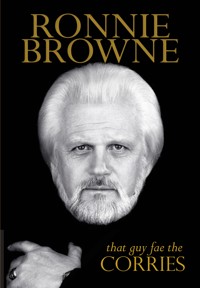
One of the most easily recognised figures on the Scottish scene, Ronnie Browne was one half of The Corries until the untimely death of his musical partner, Roy Williamson, in 1990. He is also a gifted artist, a portraitist of distinction, who has received both critical and commercial success from childhood to the present day. He met his wife, Pat, when they both attended Boroughmuir High School in Edinburgh and formed the most important and enduring partnership of his life, together having three children and four grandchildren. In That Guy Fae The Corries, Ronnie Browne writes revealingly of his childhood in pre-War Edinburgh, of The Corrie Folk Trio with Paddy Bell, and The Corries throughout their existence, of the many famous musical personalities he has rubbed shoulders with through the decades, of family, travel and his life as an artist.
Sie lesen das E-Book in den Legimi-Apps auf:
Seitenzahl: 638
Veröffentlichungsjahr: 2015
Das E-Book (TTS) können Sie hören im Abo „Legimi Premium” in Legimi-Apps auf:
Ähnliche




















THAT GUY FAE THE CORRIES
Ronnie Browne
First published in Great Britain
and the United States of America in 2015
Sandstone Press Ltd
Dochcarty Road
Dingwall
Ross-shire
IV15 9UG
Scotland.
www.sandstonepress.com
All rights reserved.
No part of this publication may be reproduced, stored or transmitted in any form without the express written permission of the publisher.
Copyright © Ronnie Browne 2015
The moral right of Ronnie Browne to be recognised as the author of this work has been asserted in accordance with the Copyright, Design and Patent Act, 1988.
Editor: Robert Davidson
Index: Roger Smith
Technical Support: David Ritchie
The publisher acknowledges support from Creative Scotland towards publication of this volume.
ISBN: 978-1-910124-36-9
ISBNe: 978-1-910124-37-6
Book design by Raspberry Creative type, Edinburgh
Ebook by Iolaire Typesetting, Newtonmore
Contents
Acknowledgements
List of Illustrations
Prologue
Chapter 1
Chapter 2
Chapter 3
Chapter 4
Chapter 5
Chapter 6
Chapter 7
Chapter 8
Chapter 9
Chapter 10
Chapter 11
Chapter 12
Chapter 13
Chapter 14
Chapter 15
Chapter 16
Chapter 17
Chapter 18
Chapter 19
Chapter 20
Chapter 21
Chapter 22
Chapter 23
Chapter 24
Chapter 25
Chapter 26
Chapter 27
Chapter 28
Chapter 29
Chapter 30
Chapter 31
Chapter 32
Chapter 33
Chapter 34
Chapter 35
Chapter 36
Chapter 37
Chapter 38
Chapter 39
Chapter 40
Chapter 41
Chapter 42
Finally
Acknowledgements
To Matthew MacIver, whose infectious enthusiasm and encouragement finally forced me to put pen to paper.
To the Hand of Fate which must surely have decreed that I keep Pat’s and my own diaries together for all these years to form the nucleus of this book.
To Eileen Hetterley (Kinnear) for her invaluable scrapbooks, (and her big brother Bill, for his smile).
To Gavin, Maurice and Lauren for filling in details of family life overlooked by the diaries.
Special mention to Gavin for his technical knowledge of ‘dropboxes’, ‘PDFs’, ‘backups’, ‘jpegs’ and all that stuff which is ‘way over the head of this old man.
To Robert Davidson and his team at Sandstone Press for their patience during the past year.
And, finally, to all you bums on seats out there for your support over, what seems, the most of my life.
List of illustrations
SECTION ONE: Black and White
1. My big brother Ian and me. 1938.
2. The Broons, circ. 1941.
3. My drawing of The Black Watch Memorial, done at age 11. The Memorial stands at the top of The Mound in Edinburgh.
4. I draw my niece, Norma Collie, for the Edinburgh Evening News reporters. Pinned to the easel is my pencil copy of my father’s water-colour copy of The Laughing Cavalier by Frans Hals.
5. Me as a scout aged 13.
6. Boroughmuir School 1st XV, 1954–’55. That’s me, standing third from the left.
7. Pat and me in Paisley for the Grammar School Sevens of 1955. No, it’s not my car.
8. I collect the Braidburn Athletic Club Junior Trophy in 1957.
9. Graduation Day, Edinburgh College of Art, 1959.
10. We met at the church on time, 30/06/59.
11. Lauren and Gavin at Briarbank Terrace.
12. Pat and my niece, May Stuart. Much later, May married Ritchie Laing. Pat and May were always good buddies.
13. The Corrie Folk Trio and Paddie Bell with the BBC stamp of acceptance, 1963.
14. The Corrie Folk Trio and Paddie Bell sing in The Hoot’nanny Show, 1963.
15. Circ. 1968. Roy, with his first wife, Vi, mother of his two girls, Karen and Sheena.
16. Circ. 1968. With Gavin, Pat and Lauren.
17. In the seventies, (l. to r.), Jim Wilkie, Brian Wilson (M.P. to come), and Dave Scott, founders of The West Highland Free Press.
18. 1973? Lauren, Maurice and Gavin in Petticoat Lane, London.
19. The Corries, a publicity shot.
20. Family and friends gather round for the 1977, ‘Peat Fire Flame’ album cover shot.
21. ‘Where did that note go, Roy?’
22. I interview Lonnie Donnegan in our 1983 award-winning STV series, ‘The Corries and other Folk’.
23. My first solo commitment as Founder Member of The Beechgrove Garden Club.
24. My two Grand Slam Commemorative paintings and members of the 1990 Squad.
25. The 1991 Official S.R.U. Calendar.
26. ‘Ah cannae hear ye!’
SECTION TWO: Colour
1. ‘O.K. Roy, so it’s a combolin! Now, do you really expect me to actually play it?’
2. Lee, Roy and me at Eyemouth Harbour.
3. I wonder if this was ‘Killiecrankie’?
4. 1991. My first solo publicity shot.
5. The Java St Andrew Society Ball, 1993. Pat, (purple gown), is led to the top table on the arm of the Canadian Ambassador.
6. ‘My hero!’ I wish.
7. Work in progress.
8. The family. Standing, (l. to r.), Maurice, me and Gavin. Seated, (l. to r.), Kate, Maurice’s wife, (divorced), holding their second, Michael, Lauren, holding Gavin’s first, Rebecca, Pat, holding Maurice’s first, Karlyn, and Michelle, Gavin’s wife (heavily pregnant at the time with Jessica, their second). Confusing, isn’t it.
9. With Craig Brown in Vienna, 1996, for the world qualifier versus Austria, when the S.F.A chose ‘Flower of Scotland’ as their anthem for the first time.
10. I know you’ll never believe it, but Stephen beat me.
11. At a charity event with Brian Leishman, a real gentleman in the Rog Whittaker mould and business manager of the Edinburgh Military Tattoo for 25 years.
12. Pat and me with Prince Philip for the Duke of Edinburgh Awards.
13. Oliver Reid ‘disrobes’ in Peebles.
14. I sing ‘Flower of Scotland’ in 1998, at the Ross Bandstand with the Royal Scottish National Orchestra and Chorus, conducted by a very excited Jerzy Maksymiuk.
15. ‘Hey you wi’ the Hong Kong tartan jacket, ye’ve had enough tae drink. Ye’re gettin’ no more.’
16. Lauren with Paulo Nutini.
17. (l. to r.) Rebecca, Michelle, Gavin and Jessica.
18. Maurice with Karlyn and Michael.
19. Lauren with her ‘Sunshine Project’ children.
20. The Black Douglas.
21. Robert the Bruce in my car.
22. ‘And we’ll all go together, to pull wild mountain thyme.’
23. Pat and me. Guess where?
Prologue
We were in a dressing-room in the Royal Albert Hall, London, which as most people know was designed to resemble the Colosseum in Rome. Its seating capacity at the time was 8,000, although nowadays it has been reduced, so forgive me when I say that we were very proud to be playing to a full house that night.
My brother-in-law, Lee Elliot, was our road-manager and was taking our instruments on stage to lean them against the assortment of chairs that were already assembled behind the microphones. Most of his task had been completed and only the combolins were left to be tuned. These were multi-instruments, designed and made by my partner in The Corries, Roy Williamson, and were always last to go on stage.
It was, of course, close to curtain up, and as Lee came in to the dressing-room for the last time, I asked, ‘Okay Lee, how’s it looking out there?’
He replied with a growl, ‘Aw’ ye need now is the lions!’
Chapter One
My first encounter with felines was when I was about three years old. It’s also the first memory I have of the start of my existence here on Earth. I was sitting on the cobbles of Moncrieff Terrace in Edinburgh, which was the site of the family home, upstairs at No. 3, and there, stretched out in front of me was a dead cat. I was happily smearing powdered glass into the blood of the animal with a stick, and obviously making a fine old mess.
You may well ask what a three-year-old was doing there in the street, alone and unsupervised, but the year was 1940 and, in those days, there weren’t the same dangers for youngsters. I was plastering away when my brother Ian, three years my senior, rounded the corner on his way home from Sciennes Primary School, saw what I was about, and ran upstairs to tell our mother, shouting all the while how much trouble I was in. Inevitably, the window was thrown open and Ma screamed at me to come up immediately. Not thinking what all the fuss was about, I quickly headed upstairs to find myself lying over my mother’s knee and having my arse skelped very hard with an open palm. Maybe that’s why I seemed to spend the rest of her life not getting on with Ma. Or is that what you call bearing a grudge? Give her her due, she was never one to say, ’Just wait till your father gets home’. Maybe she realised that he wouldn’t have meted out such physical punishment, being less of a disciplinarian.
Apart from a skelped arse, I don’t remember as much about my mother as I do about my father in these very early years. It was because of my father that Ian and I were the most popular boys in the district. Not that we possessed scintillating personalities, it was more that my father was a lorry driver during the Second World War and, for a part of that period, he transported loads of Bourneville chocolate round the country. During those years of rationing, chocolate was at a premium, but not for the Browne boys. Keep sweet with us and you were fairly sure to get a few bars now and then.
My father was called John Albert Browne and my mother was Anne. Although he was known to everyone else as ‘Bert’, or ‘Bertie’, I never ever heard my mother call him anything other than ‘Daddy’, although he always referred to her as ‘Nancy’, or ‘Dear’. Ian and I called my mother ‘Ma’, and my father ‘Pop.’
Pop was very good with his hands, and I was particularly fascinated to watch him re-soling and heeling our shoes on his cobbler’s last. A last comes in various shapes and sizes and Pop’s was a piece of heavy metal, curved at both sides. Imagine yourself sitting at a typical upright kitchen chair with your feet firmly planted on the floor and placing this heavy item on your legs with the curved sides down between your thighs. There’s a square hole in the middle of this ‘plate’, into which is fitted another piece of spiked metal with a shoe-shaped top, over which the shoe to be mended is slipped. The necessary tools are: a hammer, a round-headed pair of pliers and a very sharp knife, steeply curved at the end to shape and shave the new leather. With a mouth-full of nails and a pot of glue melting on the gas cooker he was ready to go. Smelly and loud it was, but the end result was always well worth it. It may not have been much cheaper than sending the shoes to the cobbler, but my father found it infinitely more satisfying. As indeed I have, doing odd jobs round the house all my life.
One of the nicest things I remember was a wee motor-car he made by whittling a piece of wood to shape the body. To watch this car emerge from an ordinary slab of wood was, to say the least, exciting, but when he came to make the wheels, that was something else. He had a tin mould, which was in two pieces, into which he pressed some plastic wood. When this had dried, he pulled the two pieces apart to reveal, lo and behold, a perfect wheel. He drilled a hole in the centre and affixed it to the side of the car with a small nail. Once painted and polished, the finished object was just as valuable to me as any of the Dinky Toy Limousines I was given in later years.
Ma was no slouch with her hands either, regardless of her skelping ability. She had been in service as a cook in her early years and taught me how to boil and fry eggs, mix dough and flour for bread and cake-making, and place a porcelain funnel in the middle of the pastry top on a steak pie. She was a dab hand with an embroidery needle too, teaching me a bit of that craft, and many were the nights the family sat round a coal fire making rag rugs to set at the hearth, to stop the sparks burning into the ‘good’ carpet.
Ma was born in East Wemyss, Fife, on March 20th, 1898, and given the name of Annie Grant Stuart. Her father’s name was James Phimister Stuart, Phimister denoting, according to my mother with a certain amount of pride, that we were from a bastard line of Bonnie Prince Charlie. Apart from the Prince, the only references I can find to her family are as coalminers. Her father, for instance, is identified on her birth certificate as a Colliery Engineman which, in my book, is more honourable than being a Jacobite.
I don’t know a lot about her background, but I do know quite a bit about my father’s, taken from a large, Victorian style Family Bible, together with a couple of military medals and the diaries of great-uncles.
Two years after Ma, in 1900, Pop was born on February 26th in 15 Oxford Street, Edinburgh, and given the name of John Albert Browne, exactly as his father before him, who was born in Blackness Castle, near Bo’ness. This is where the military connection comes in because, in 1862, when my grandfather first saw the light of day, Blackness Castle was an arsenal.
Both of my grandfather’s uncles had come over from Limerick, in Ireland, earlier in the 19th century and joined the British Army. I inherited a Crimean War Campaign Medal from one of them, my great –great-uncle Samuel, and a couple of diaries from the other, another John, who was a Proof Sergeant at Woolwich Arsenal. John specialised in the newly acquired Lee Enfield Rifle which was replacing the defunct Brown Bess. In one of his diaries, he mentions meeting some of the crowned heads of Europe at the Paris Universal Exhibition of 1867, where he was exhibiting and demonstrating the new rifle. The medal he received was eventually handed down to me.
In the other of the two diaries he tells of a trip to America where he proof tested 37,000 rifle barrels, travelling extensively across that country. At the beginning of the diary, he writes of a storm which delayed his departure from Liverpool for America, and records his daily expenses together with a tale of dalliance with a Lady of The Night. This last has been all but obliterated in black ink by one of his more prudish Victorian successors. I have placed all of this material, which is of historical interest in military terms, within the Military Museum in Edinburgh Castle.
Born in 1900, Pop would have qualified to fight in the First World War, but the only thing I know for sure is that he and another soldier escorted a prisoner in handcuffs from somewhere in Scotland to Belfast. He and his companion were saved from a lynch mob in Ireland by the prisoner himself, because they had got on very well together on the journey. Later, I’ll recount his abilities at ‘spit and polish’, and as a sharpshooter.
My father was the youngest of four. Robert in 1887, Fanny in 1888, Juliet in 1890 and then, after a rest of ten years, my father in 1900. So, I really did have an Aunt Fanny. She never liked me and I reciprocated. Fanny married a tall, approaching rotund, quiet, very gentle man called John Low but they never had children. You can imagine Fanny’s excitement when, in 1934, her younger brother’s son was born, my brother, Ian. She welcomed him with open arms and treated him as her own. However, when in 1937 the Usurper, me, came along, her comment to my mother was, ‘I don’t know why you did that Nancy, one is more than enough.’
In this way began a stand-off between us which ended about nine years later when I stopped visiting her on Sunday afternoons, as Ian and I were always encouraged to do. We were on our way from Buccleuch Street, via Rankeillor Street to her home at 44 St. Leonard’s Street, when I stopped in my tracks and left Ian to carry on alone, his warnings that I would be in trouble again ringing in my ears.
In spite of not liking my Aunt Fanny, I did feel compassion for her because she had a club-foot and walked with a severe limp. Might that have been why she received a sympathy vote when my grandmother died and left her everything? As I remember, she was always very well dressed and gave the impression of being better off than us. I have to say though, that I never once heard any word against her from Pop. I wouldn’t have heard a word from my Uncle Robert either, because we rarely saw him, except in the street now and again when he would slip us a threepenny bit each.
I don’t know what my Aunt Juliet thought about anything because she emigrated to America and married a guy called Charlie Walter in New York in 1912. I never met her, but after her death in 1948, Uncle Charlie, who had become the Mayor of Flemington, New Jersey, visited us briefly and presented me with my first pair of running-spikes, encouraging immensely my blossoming interest in athletics.
I always sensed that I wasn’t wanted by Fanny. When, as a toddler, I visited 44 with the family, I used to crawl under her table to take refuge from I know not what, but that was my position always in the room, watching legs walk by. A kitchen-cum-living-room with two windows looking out on to St Leonard’s Street, it had a sink in one window and a cupboard in the corner with a gas cooker beside it. In front of the cooker, in a way that seemed ludicrous to me when I got older, a very ornate upholstered easy chair. Crowding the middle of the room was a large mahogany dining table, under which Fanny stacked her laundry basket. It was to this basket, and its content of clothes for the Steamie, that I clung for comfort. Why should I remember it so clearly? Maybe a psychologist could explain.
I think Uncle Johnnie sensed the inequalities in Fanny’s affections for Ian and me and didn’t like it, because I remember only kindness from him. I called him Poltis but cannot remember why. He must have been a bit older than his wife because, by the time I was visiting under my own steam he had retired from his job at Nelson’s Printing Works and become the Weekend Watchman. We would accompany him to the top of Preston Street where Nelson’s stood, right opposite my school, and do his rounds with him. The Finished Book Rooms in the print works had, attached round the walls, a system of rollers set at a slight angle. The books would be stacked on boards and laid on the rollers to slide gently towards the packing department. With no one else present, Ian and I would sit on the boards and have fun guiding ourselves round before continuing with Poltis on his rounds.
One office scared us though. For some reason, a lattice blind was always hanging on the window, which meant that the room was in half-light. Seated at the large desk in the middle of the room, in what you might call the customer seat, was a full-sized dummy of a lady dressed in a long skirt, shawl and bonnet. It was really ghostly, particularly since an eerie silence prevailed throughout, it being Sunday. Although going into the room scared us, we couldn’t wait to go in and be scared, and there was always an ice-cream for us on the way home.
Uncle Johnnie Low possessed a skill that I never tired watching him perform. He would take a sheet of blank paper and, freehand, without using a ruler, draw perfectly straight lines, exactly equally spaced down the length of the sheet. I tried many times, but with no success, and I’ve never seen it done again by anyone.
A few years later Fanny died, and my mother suggested that Poltis should come and stay with us. Even my young mind couldn’t understand why he accepted, because no one could possibly have put up with her house-proud ways, and so it proved. It lasted two days. Poltis moved into lodgings and spent the rest of his life mostly at his bowling club in the Meadows.
At this point, closing this chapter of early memories, I find there is something I must get off my chest. I don’t know when a wee boy is supposed to get interested in his bodily bits and pieces, but my friends and I did from an early age. For instance, most of my pals told me that they had, a ‘willie’, or a ‘queer-thing’, or, a ‘cock’, or, what I really wanted, a ‘tadger’. But no, according to my mother I had a ‘wumpy’. Oh dear, Ma! Where did a wumpy come from? If that had come out in front of my friends, pardon the pun, I would have died of shame. There are some things you can never forgive your parents.
Chapter Two
Wouldn’t it be nice to have total recall? Unfortunately, I don’t. The only other thing I remember about my stay in Moncrieff Terrace is Frankenstein. Why I would be taken to see a Frankenstein film at the tender age of four or five I can’t imagine, but I clearly remember the monster standing at a window in a burning building and his face melting in the flames. It being wartime, there were sandbags in the streets, stairways and shelters, and on the second landing in our stair, the door of the flat at the end of the corridor had a fan-light above it. A couple of sandbags had been placed behind the glass and their silhouette reminded me of Frankenstein’s head. That sight scared me so much that, every time I passed I didn’t just walk but ran like the wind. Thankfully, we moved.
I do remember quite clearly my first skelped arse at 23a St. Leonard’s Bank. Across my mother’s knee again, I was feeling very aggrieved, because, as the blows descended, I looked up at a medal suspended on white tape from the mantelpiece. At Preston Street School I had won the medal as dux of the class at the end of my first year and couldn’t quite equate my skelped arse with having won a medal for excellence.
St. Leonard’s Bank is an Edinburgh street that borders The King’s Park. No. 23a was the basement of the building, and, as we ascended the stairs, at the top we were confronted by the glorious sight of The Lion’s Head, the extinct volcano which dominates the Edinburgh landscape. Directly across from our house stood Jeannie Deans’ Cottage in what was known as The Plantation. That’s where the park ranger, Mr McCann, lived with his family. I went to school every morning with the son of the house, Eddie, and that’s where I fell in love for the first time. Can you fall in love at age six? I don’t know, but that’s the best way I can describe my feelings for Eddie’s big sister, Maureen. She would never have known because I was too young and shy to speak to her and, anyway, she would not have taken any notice of the snotty kid from across the street. Years later, when I was performing in the Hootenanny Show for The BBC in The Place, Victoria Street, I popped into a pub down the hill from the venue, there to find Maureen serving behind the bar. I did speak to her at that time, not that she remembered me, and I found that those first stirrings didn’t bother me anymore. Oh fickle heart!
We were in St Leonard’s for only a couple of years before moving to No. 3 Buccleuch Street, which was still in the catchment area for Preston Street School. I don’t remember Ian being at Pressie, as the school was called, so I assume he stayed on at Sciennes when we moved.
Eddie McCann and I, Billy Hall and Sandy Henderson, all vied for the dux medal over the next few years until we went together to Secondary, and it was during that time that my father took an interest in the match-stick men I had started to draw. I thought that Eddie’s more filled-out drawings of Cowboys and Indians were better than my efforts, but Pop encouraged me to start to copy things, the first of which was a Birthday Card showing a simple round face. Over the years this led to bigger and better things until I was completely embarrassed in my final year by the Headmaster, Mr Moffat, insisting that I take a pastel drawing of Christ Leading the Children to show round all of the classes.
That work of art led to the first of the two nervous breakdowns I’ve had in my life, maybe three. This is not something I have spoken of in public before, but it’s not the kind of thing you shout from the stage of The Usher Hall. More of those later. First, let’s return to when I first realised that I didn’t have only one brother, Ian, but another brother and a sister, Big Jim Stuart and Jenny Collie.
As I’ve said, my mother was born in Fife, where she spent her early years. She appears to have been a bit unfortunate as a teenager because she had two children who didn’t know who their father was and had always resented it. Separately, in later life, they told me this. They did not appear to be the off-spring of the man she married when she was 21 years of age in 1919: P. F. Gray, Coalminer. In her divorce papers from this man, dated December 6th, 1930, she is described as a Housekeeper (Spinster), both parties resident at the same address, 55 Bow Street, Denbeath, Fife. Neither of the children is mentioned.
What I find interesting in the papers is that my mother is noted as ‘Pursuer’ against Peter Forbes Gray as ‘Defender’, with Rose Janetta, Spinster, 267a Canongate, Edinburgh, and Margaret Briggs ‘presently an inmate of Dysart Combination Poorhouse, Thornton, Fife’ as ‘Co-defenders’.
I showed these papers to my niece, May, the daughter of my brother, Big Jim, but she was as bewildered as I because she understood that my mother had been married, but had never entered the home of her husband because he wouldn’t allow her to bring her two children with her.
What I did glean was that my mother, when she was a bit older, left Jim, who was born on December 18th, 1914, when she was 16 years of age, and Jenny, in Buckhaven in the care of her step-mother, whom I knew in childhood as Aunt Betsie. Ma had come to Edinburgh to work in service as a cook on the Wauchope Estates where she met my father who worked as a chauffeur. He helped her with her divorce from Peter Gray, and they were married on January 30th, 1932.
This was confusing for a wee boy, with parents I always felt were very old, and a brother and sister who were both old enough to be my parents, a fact magnified by the knowledge that Jenny’s daughter, Norma, my niece, was but one year younger than I. Also in the mix: my cousin, Betty Stuart, also resident in Fife, had a wee boy called Bobby before marrying a man called Vatrick whose name we were never allowed to mention because (this was said in the quietest of quiet whispers): ‘He’s Polish, you know.’
Years later, Betty and Vatrick attended a Corries concert in Kirkcaldy’s Adam Smith Hall and I went to their flat after the show, there sampling Vatrick’s home-made beer. In the ensuing conversation, and we weren’t talking through drink, because Vatrick was not a drinker, I discovered that he was one of the most gentlemanly, politely soft-spoken souls anybody could meet. I therefore have no hesitation in shouting to the four winds to anyone who is listening that: ‘HE WAS POLISH, YOU KNOW!’
Ian and I would be taken by train to spend school holidays with Big Jim, as we always called him, and his wife, Peggy, at 19 Pirnie Street, Methilhill, Fife. We slept on a mattress in the living-room and were fascinated by the life of a miner, which is what Jim was. I used to run to the corner store to buy anthracite for his lamp, although the smell turned my stomach. Jim could not get home quickly enough from his shift to entertain us by accompanying music on the radio, tapping out a rhythm on his teeth with the stem of his pipe.
When we weren’t digging into the pit bings, burnt waste from the mines, to release the flames from the simmering shale underground, we were probably playing an exciting game in the air-raid shelter at the end of Pirnie Street. A circle of chairs would be laid out and the boys of the district would sit down leaving one chair free. The girls would stand behind all of the chairs and the girl behind the empty chair would wink at one of the boys she fancied. If he fancied her, he would make a dive for her empty chair and, if he made it, she would reward him with a kiss. If he didn’t fancy the winker, but preferred the girl standing behind him, and she fancied him, he would make not too much of an effort to get away, making it easy for her to hold him back so that she could reward him with a kiss. The boys would then change places in the chairs with the girls and the game would start all over again, the result being that, invariably, everybody was a winner. It was all very innocent, not like today, when the kids seem to dispense with the chairs, the winks and the kisses and cut to the chase and jump into bed. Thinking of my mother though, let’s draw a veil at this point.
Visits to Aunt Betsie usually ended up in a run down to the Buckhaven beach and the small fishing boats to grab a live crab in one hand and a lobster in the other. Running back to Betsie’s house we would drop the beasts into a big cauldron of boiling water on a large coal fire in the fireplace. On a shelf above the fire sat a two-foot tall glass dome, within which stood a glass ship in full sail with tiny blue-glass sailors clinging to the rigging. Those were our school holidays.
Most Sundays in Edinburgh, during school term-time, I would take a tram to my sister Jenny’s house at 80a Great King Street, where I would play with her kids, Norma and Brian. Jenny married her husband, Johnnie Collie, before I was born. I have no recollection of him as a guest in our house, the reason being, obviously, that he and my mother didn’t get on. He wasn’t even Polish.
Uncle Johnnie, as I called him before I learned that he was actually my brother-in-law, had a brother, Bill married to Nan, and they of course became my Uncle Bill and Auntie Nan. Afternoon visits on Sundays to Jenny’s house became alternate visits on Sunday evenings to Bill and Nan’s, where we played cards and darts. I was always made to feel more than welcome there, the reason being, as they told me later in life, they felt a bit sorry for me. As they put it, ’Your mother was a bit quick with her hands.’ My arse bore painful testimony to that.
Two tram-cars took me to Jenny’s, a number 27 from Forrest Road, changing to a number 23 on Hanover Street at The Mound (or was it the other way around?). At the tram-stop on Hanover Street stood a jeweller’s shop. Down a flight of five steps, the window seemed always to display collections of Japanese Ivory chess-sets, carvings and, most fascinating of all to me, examples of Netsukes. A Netsuke is a small toggle, usually made of ivory or wood in the shape of human and animal figures, used to secure a purse or container suspended on a sash on a Kimono. Looking at these exquisite objects at such an early age began a lifelong interest in them and Japanese carvings in general. Strangely enough, the first carving which came into my possession was given by Jenny or, more precisely, through Jenny when she became manager of a hotel owned by a man called Murray.
Murray, and that’s all I ever called him, was a very high and powerful Union Representative whose wife had been given, when she was a girl, an eighteen-inch tall Japanese wooden statue of A Mendicant Priest by a sea captain on his return from the Far East. She kept it all her life, finally placing it on a shelf in the hall of the hotel. As a teenager, I worked there after school, and did I not covet that standing figure? Murray never understood my liking for it since he thought it grotesque. When his wife died he passed it on to me. I’m sure that, if he were alive today, he would appreciate even more the profuse thanks I offered at the time because I have kept it all of my life. Indeed, it is standing on an intricately carved Japanese wooden table not six feet from where I am writing at this very moment, unlike some other carvings and chess-sets which I had to sell to help save our bacon when we fell on hard times.
I was to be in Buccleuch Street for the next four years, so, why don’t I show you around?
Our flat was on the corner of Buccleuch Street and West Crosscauseway, sitting above an office/shop complex at Number 1 and entered through a stairway at Number 3. Walk into the stairway for about five metres and you have, facing you, a double glazed doorway which leads into the joiner’s yard of a Mr Baillie. He encouraged me to come into his workshop to watch his men at work, sometimes to help by making a small cut on a plank, a start for the saw, or supporting a large piece of wood they were working on, or simply demonstrating the mechanics of circular saws and other equipment on the bench. Never was I made to feel that I was in the way. I would return the compliment by sweeping up sawdust and shavings or perhaps running an errand for one of the men.
Turn right at Baillie’s door and proceed up the stairs to the first landing where ours is the first flat you’ll see. Turn right again along the landing and you’ll come to the next flat, cheek by jowl with ours, that of the Weinstein family. Say it in a whisper, (we seemed to do a lot of whispering), ’Of course, they’re German Jews, you know.’ Turn right again at their door and proceed further up the stairs to find, facing you, Tommy Hand’s abode. Tommy had a Scottish Country Dance Band, and, since that was where they practised and rehearsed, we always heard a lot from them. Tommy’s mother, Maggie Hand, lived opposite at Number 4 and she had a sure-fire cure for cramp of the foot or lower leg. Simply stick your foot down your toilet and pull the plug. I tried it once and, of course, my foot got stuck, so never again.
Mrs Turnbull and her son, Jimmy, are next to Tommy and are the last family in the stair. They were constantly visiting Mr Turnbull in hospital where he was suffering from, and here’s another whisper, ‘Sleeping Sickness.’ Sleeping Sickness, I have since discovered, is caused by the bite of a Tsetse Fly which has its abode in Africa, so I assume Mr Turnbull was infected during a foreign campaign in the war which had just ended, or perhaps it was simply a euphemism for some kind of mental disorder. Whatever it was, I never saw hide nor hair of him all the time I lived in the district.
Okay, let’s go into the flat.
Open the front door and you’re in a narrow hall. On the left is the door to the kitchen and, following the hall to the right, you come to the door into the toilet. That’s all it is, just a toilet bowl, no bath, not even a hand-basin. You won’t see any rolls of toilet paper either but just squares of newspaper tied together with string and hooked on a nail.
Facing you as you enter the kitchen are two windows. Moving to the right-hand one, the smaller of the two, you pass a standing cupboard and a sink with a short draining board. If you raise the window, you’ll find a meat-safe. This is simply a box sealed to the window-frame and it has fine mesh panels at top and three sides. ‘No fridge?’ you ask. No, that was it!
Stand at the sink with your left shoulder towards the window, and you’ll find your arse is jammed against the gas cooker. On the wall to the right is suspended a gas geyser water-heater with its tiny pilot-light glowing blue. Below that you’ll find two glasses each containing, first thing in the morning, a set of false teeth, deposited there the night before by my father and mother.
Along the wall from the cooker is the large window which looks on Baillie’s yard and, outside the window, a T-shaped clothes pulley. The next wall is filled with an open coal fire. Finally, you turn into an alcove with another standing cupboard. In the middle of the room stands a plain, scrubbed, white-wood table with a hinged flap at the window end, and four plain kitchen chairs rammed underneath.
Coming out of the kitchen into the hall, you’ll find half-a-dozen coat-hooks. Ahead of you is a corner coalhouse and, as the hall turns sharp right, a door on your left into the lounge and a door in front of you into my parents’ bedroom. Move into the lounge and you’re in the room which is on the corner of the property, one window on the right looking on West Crosscauseway, the other on Buccleuch Street. In the middle of the room stands a mahogany oval table on a central column of three curved legs with casters. On the left are two large padded armchairs standing either side of an open fireplace and the door to my bedroom, which I share with Ian, on the end of that wall.
The window in my bedroom looks out on to Buccleuch Street, so let’s open it and see what we can see. Directly opposite is a four-storey tenement, number 2. The tenement wall is attached to a high church wall at the start of Chapel Street which takes you right, and on towards Edinburgh University’s McEwan Hall, where Graduation Ceremonies take place. Further along you would find the Royal Infirmary. To the left, the street snakes down to the Royal Dick Veterinary building which stands facing the Meadows, or, in our colloquial slang, the ‘Meedies’. Both the Royal Infirmary and the Dick Vet have now moved to different sites.
Opening my parents’ bedroom window you would be confronted with, on the left, Chapel Street Church, behind its high wall, and, on the right, another church, Buccleuch & Greyfriars Free Church of Scotland, in West Crosscauseway. The Chapel Street Church always had better pooroots than the Free Church. A pooroot, or ‘pour out’, was the traditional practice of bride and groom saving small change for their wedding day and throwing it from the window of their bridal carriage as they left the church to the eagerly awaiting local waifs. If we were really lucky, we might find the odd threepenny bit or sixpence amongst the pennies and halfpennies in the scramble.
The space between these churches of Chapel Street and West Crosscauseway was a cobbled triangular area dominated, and dissected, by a large cast iron horse-trough. This space was popular with us kids for playing bools (marbles), in the grooves between the cobbles, and peevers (hop-scotch), on the pavements in front of the churches. It was also a convenient space to light our bonfires each year, although, invariably, the fire brigade was called to douse them for fear of the heat breaking the glass in the windows of nearby houses. You would also see, in an open space just down from the Free Church, a concrete air raid shelter in the spot where the large space narrowed down to West Crosscauseway proper.
I’ve mentioned that we had no bathroom in the house and no fridge. In addition, we had neither freezer, washing machine, dish-washer, telephone, television nor Hoover. I can almost hear the youngsters saying, ‘How could they survive without a mobile or iPad to break their fingers on?’
We did have a radio for entertainment, and Pop rigged up a loudspeaker attachment in our bedroom so that, late on a Saturday night, Ian and I could lie in bed and be scared by the very deep voice of a presenter called Valentine Dyall, who would say to his listeners after telling one of his famous ghost-stories, ‘. . . and this is your storyteller, the Man In Black, saying Good-night to you.’
At this point your story-teller, Ronnie Browne, starts the story proper of where I suppose, my life really began.
Chapter Three
I can’t promise that everything will be in perfect chronological order, but what I can say, without any fear of contradiction, is that this is when what I’ll call, ‘The Weinstein Saga’ began.
Within the first few days of occupying Buccleuch Street, Ma made the acquaintance of Mrs Turnbull upstairs, who suggested that perhaps in moving here we had bitten off more than we would be able to chew. When questioned further on the subject, Mrs Turnbull explained that her wee boy, Jimmy, had gone in fear of his life through all his young years because of the Weinsteins who lived below her. To an adult, I suppose, it wouldn’t have seemed much, but to wee Jimmy it was really quite frightening to wake every morning to the banging of a brush on his floor from the flat below and a voice shouting to him to make less bloody noise. To be passed in the street and be given hostile, silent, malevolent stares from a close neighbour, as he was in the habit of receiving, and for that same neighbour, most times when he passed her door, to open it and glare at him, continuing that glare as he progressed upwards, could be most unsettling to a wee person.
A wee person he certainly was, because, although we were the same age, he was only half my size. Half my size he may have been but I think he must have had twice my brain capacity because, did he not end up in later life, a scientist? Where did I end up, but singing for my supper? Wait while I put my fiddle away. Jimmy used to tell me how he always ran past the Weinsteins’ door. I remembered my own terror at the Frankenstein sandbags and fully sympathised.
Mrs Turnbull’s warning proved prophetic because, only a few days later, The Saga began to unfold. As far as we could tell, Mrs Weinstein was housebound and at home by herself all day. Mr Weinstein was a butcher of sorts and out all day plucking chickens, if the feathers clinging to his clothing were anything to go by. It seems he held himself aloof from all the trouble that was to come our way because none of us remember hearing a word pass his lips. Come to think of it, I don’t remember hearing much from Mrs Weinstein. Hilda, the daughter of the house, was a different kettle of fish. Also out all day, she was a scaffie or, to use more modern, politically correct nomenclature, a street-cleanser. She was a thick-set lady (I use the term loosely), probably in her mid-twenties when we moved in, with thick, dark, somewhat windswept hair. She always wore trousers, which was unusual for women when I was a boy. Always too short, they exposed sturdy ankles, and she had very dark eyes that stared from a wild-looking countenance to terrify poor wee Jimmy.
How do bad relationships arise between neighbours? In our case, it was something as simple as a few of Mr Weinstein’s feathers falling from his jacket and wafting over to our front door where they became lodged. Ma, being the house-proud woman she was (she changed her window-curtains throughout the house at least three times a year), would tidy them away at the earliest opportunity and, no doubt, complain to Mrs Weinstein. Possibly Mrs Weinstein would retaliate by telling my mother not to be so silly, I don’t know. Whatever happened, bad blood did arise and continued and would erupt on occasions. Hilda would come in from work and her mother would describe one of these niggles with Ma, whereupon Hilda, perhaps being a bit over-sensitive, and maybe sensing some hint of persecution, would shout through our wall in a banshee wail, something like, ‘Browneeeeeee!’ (you will have noticed that my name is spelt with an ‘e’ on the end). ‘Browneeeeeee, it’s a damn disgrace! Ah’ll thank you tae keep yer tongue off ma mother or you’ll be sorry, Ah’m tellin’ ye.’
Or sometimes when a washing had been put out on our pulley at the window, ‘Browneeeeeee, it’s a damn disgrace! That poor wee laddie’s shirts are still filthy. You should be bloody-well ashamed o’ yersels’.’
Years later, when the poor wee laddie had grown up and married in 1959, Pat and I were living round the corner at 5 West Crosscauseway, three flights upstairs, our kitchen window overlooking Ma’s window and the Weinsteins’. Having had our first child, Gavin, in 1961, and returning home of a Sunday evening after a visit to my in-laws, the lights going on in the flat became the signal for, ‘Browneeeeee, it’s a damn disgrace! Keepin’ that poor wee bairn oot till this time o’ the night, you should be bloody-well ashamed o’ yersels.’
Of course, on many occasions, the police would be called but, in spite of their taking statements from neighbours who had heard the shennanigans, since no blows had ever been struck, and nobody had ever been harmed except by a bit of name-calling, it was always put down as ‘a Domestic’, and they would proceed to spend their valuable time on some other, more worthy crime.
Only once did it threaten to become really serious. It was Hilda’s turn to ‘do’ the stair. She had brushed it down and doused it with hot water, mopping it all up into her bucket which, by the end of the operation, was a swirling, smelly mix of greasy water filled with used matches, fag-ends, chicken feathers, spiders entwined in their webs, old chips dropped from discarded fish-suppers, trodden-on sweeties with their sweetie-papers and, I’ve no doubt, although at my tender age knowing nothing about it, the odd spent condom. The bucket was balanced at the top of the stair on the corner of the landing with the mop beside it and Hilda with brush in hand, when my mother opened our door and made a comment such as, ‘Well, I hope ye made a better job of it than ye did the last time!’
This was a red rag to Hilda, who raised her brush and took a swipe at Ma as she swiftly closed the door. The dent in the lower left panel was still there when I moved out years later. Just at that moment, Pop appeared halfway up the stairs coming home from work, dressed, as was his wont, in cap and scarf atop his air force blue, forces’ supplement, double-breasted, belted overcoat and, peeking out from underneath, his highly polished working shoes. Realising that they were at it again, he exclaimed, ‘Now ladies!’, when , all of a sudden, the bucket was in Hilda’s hands, and she shouted, ‘An’ as for you!!!!’ and poor old Pop was covered, speechless, from head to toe in the matches, grease, spiders, et al, the condom hanging from the pipe which was never out of his mouth.
Realising that this time she had gone too far, Hilda grabbed mop, brush, and bucket and disappeared behind her door. After the Polis left an uneasy silence descended which lasted for fourteen years. Until it all started up again.
Unlike Jimmy Turnbull, I wasn’t intimidated at all. Maybe I thought it was all too stupid, or maybe I was into so many other things it didn’t touch me so much.
‘We’ll Dib, Dib, Dib.’
‘We’ll Dob, Dob, Dob.’
‘Yes, Akela.’
‘No, Akela.’
‘Of course, Akela, I’ll do a good deed for someone every day.’
By now I was a wolf cub, attached to the 79th Newington Boy Scout Troop with Headquarters in Nicholson Street Church, whose Church Hall backed on to the Church Hall of the Buccleuch and Greyfriars Free Church Hall. I’ve explained that it stood opposite our house, but the front of the church was round the corner from West Crosscauseway in Nicholson Street. Although I never saw my mother and father attend any of the churches, they encouraged Ian and me, nay, forced us, to join both the Cubs, and, in Ian’s case, the Scouts, and we couldn’t very well enjoy youth organisations without also going to the Sunday School and Church to which they were attached. I must say, I didn’t mind at all. I enjoyed those days, as did my parents.
My mother took a delight in baking scones, tarts, cakes etc. for sale at fund-raising events for the Church, such as whist-drives and sewing-bees. On one occasion my father really went to town, displaying his artistic talents by making a costume for me to compete in a Cub fancy dress competition. He fashioned a sword out of a piece of wood with a scabbard made of hessian, as were the Viking tunic and chaps, tied round with tape. He took one of Ma’s oval, metal, grooved jelly moulds and attached wings to the sides for a helmet. Who knows, maybe he got them from Mr Weinstein because, as you might know, there can be great cameraderie between men whilst their women-folk are at each other’s throats.
My beard was made with upholstery horse-hair stuck to shaped canvas (Pop refurbished chairs as well), and my shield was made from a circle of wood with a dragon design picked out in round-topped upholstery tacks. He insisted that he be there to dress me on the night and to apply the finishing touches of make-up to face, legs and arms before I presented myself at the Church Hall. He forgot though, that Cubs are youngsters and the competition would take place early in the evening. By the time he got home from work, completed the costume and got us to the hall, it was all over. A compensatory 2/6 (two shillings and sixpence, 12½p in today’s money), was awarded, but I don’t know if he thought it was worth all that effort. I’m sure he would happily have given up the money for the glory of winning.
Chapter Four
Alcoholic beverages were never seen in our house except at Hogmanay when every door was wide open to accept First Footers bearing small gifts of shortbread, black bun, and a lump of coal. A wee dram would be offered to accompany the tit-bits. My father’s favourite tipple was Fowler’s Wee Heavy, a very dark, strong ale made in Prestonpans and sold in a small bottle. Pop wasn’t in the habit of indulging, so when he’d had a few of these wee devils, they went to his head in no mean fashion. This manifested itself in a first stage of false confidence, enough to make him want to stand up and sing his party piece:-
‘Trumpeter, what are you sounding now?
Is it the call I’m seeking?’
When the second stage of inebriation kicked in he forgot the words, his knees buckled slightly and his head started to swoon, forcing him to grab for a seat. End of performance. This same scenario was played out every year and we never ever found out what the trumpeter was sounding.
In a whisper, naturally, with a slight cock of the head, a false, shy smile, and in a very posh voice, Ma would ask for, ‘Just a small sherry, please.’ It sounded as though she had already been at the small sherries on the quiet in the kitchen.
It was at these gatherings that I first started to sing in public. I would stand up, crippled with embarrassment, and give out in a sweet, but trembling soprano:-
‘Ave Maria . . .’
I always managed to finish the song, but couldn’t sit down again quickly enough. I had a certain amount of confidence because I was now singing in a choir, but choirboy singing, surrounded and supported by all your chorister friends, is entirely different to singing solo.
St Peter’s Episcopal Church had its home in Lutton Place, parallel to East Preston Street where Pressie stood, and so it followed that the school was a natural recruiting centre for cherubic choirboys such as myself and other reprobates like Sandy Henderson, Billy Hall and Billy Campbell. What appealed to all of us was, not so much singing in church twice on a Sunday, but the 2/6 we were paid each week for doing it, and also the Wednesday evening boxing club in the Church Hall following choir practice. I’ll admit we all felt like ponces in our red surplices with the stiff, fluted white collars. It’s amazing what we’ll do for money all through life.
Singing in church on Sundays never interfered with listening to Two Way Family Favourites on the radio. If I had been a BBC programme planner then I have to say that I too would have ensured that the shows were slotted between church services. Presenting on that day meant a virtually captive audience. Lest you don’t grasp the import of what I’m saying, since Sundays today are just like any other day of the week, when I was a boy very little was allowed to happen on the Day of Rest. People will tell you that you couldn’t even whistle on a Sunday, and that’s not far from the truth. I wore my good clothes only on that day.
These were the years just after the end of World War II, when many British and Allied troops were still billeted in Europe, particularly Germany, and aching to be home. Cliff Michelmore was there with them, while his wife to be, Jean Metcalfe, was back in London, together hosting this very sentimental radio request programme.
Favourites of ‘Two-way’ were Les Compagnons de la Chanson with their rendering of the song, ‘Jimmy Brown’.
‘There is a chapel, hidden deep in the valley,
Among the mountains high above . . .’,
Vera Lynn herself sang,
‘There’ll be blue-birds over
The white cliffs of Dover . . .’
Josef Locke’s weekly radio programme, The White Horse Inn, was where I picked up some of my first songs, such as ‘Pedro the Fisherman’, ‘Goodbye’, and ‘Hear my Song, Violetta’. It was this last which saw me in my very first stage performance.
Each year the 79th Newington Scout Troup would mount one of the fund-raising ventures I talked of earlier. Of course, it wasn’t all about money. It was just as much a consolidating event to strengthen the ties between the Cubs, Scouts, and, I should say, also the girls of the Guide Movement attached to Nicholson Street Church. Everybody was encouraged to take part and we did so enthusiastically. My contribution was to sing the song I had learned from Josef Locke, ‘Hear my Song, Violetta’, dressed in a tight-fitting shirt which nowadays would be called a T-shirt, with round neck and short sleeves, coloured in narrow stripes of pink and light purple. (A few years later I wore it when I first played rugby and it gave rise to my school nick-name of ‘Pedro’.) I wore a garish pair of silk pantaloons with a wide sash at my waist and topped the lot with a black beret and a black curled false moustache.
Tightly gripping my mandolin I pretended to accompany myself (accompaniment actually came from a piano on the hall floor, stage right), whilst I sang the song, standing precariously on a four-wheeled wooden go-cart with a cardboard gondola silhouette nailed on. I was serenading Skinny Reid, standing in a make-shift wooden balcony halfway up the back stage wall that showed a painted scene of Venice. Skinny was bedecked in a long, blonde wig and full make-up, dressed in one of his mother’s evening dresses with a couple of oranges stuffed down his chest to signify that he was, indeed, a damsel. My ‘gondola’ was attached to a pulley of ropes controlled in the wings by, two on each side, senior Rover Scouts, the Dryllie brothers and the Biggars, who pulled me across the stage. The show ran for a week and, on a couple of nights, as I reached my top note while passing Skinny, the gondola gave a wobble and I was almost tossed out. Was that wobble caused by the reverberation from my powerful voice, or was it a pre-arranged sideways tug on the ropes? Only The Rovers could say.
In another production, Cinderella, Ian took the part of Dandini, Prince Charming’s right-hand man, in a powder blue costume with tights and high-heeled, buckled shoes. He wore a huge white curly wig and strutted around at rehearsals trying to impress the Guides. It was my turn for the oranges, I remember, but I don’t recall a singing part.
A Sunday-school play marked my final exit from Nicholson Street Church. We had a Sunday School Superintendent called Mr Wishart who seemed to be into everything and he it was who took control of the play, acting as director, stage-manager, scene-painter, etc. At the end of one of the Acts he rushed out of the wings and burst through a door at the edge of the stage, only to be confronted by my friend Dinah. Just a wee girl, she was waiting for her cue at the top of a short flight of steps when Wishart crashed into her and, with a snarl, grabbed her by the shoulders and forced her back down the steps and against a wall, where he shouted at her to keep out of the way.
Dinah was shocked and not surprisingly, burst into tears. I witnessed the whole incident and thought to myself that, if this is the kind of behaviour we were to expect from this so-called ‘paragon of all the virtues’, then it wasn’t for me. I stopped attending both Sunday School and Church. I realise now that it was probably worry and overwork that brought on his rage, but I was profoundly unimpressed at the time.
Like most wee boys I was given a certain amount of pocket-money. One day I visited our local sweetie-shop and there I bought a couple of packets of sweetie cigarettes, which came with two ‘cigarette cards’. They showed images such as racing cars, ships, or famous footballers. I was flashing them about the house when my father reached over the table, grabbed my arm, took the cards and said, ‘Where did these come from?’
I thought that I was about to get a row for wasting my money on such rubbish, so I made up a story. I told him that I had been given them by my class-mate, John Todd.




