


Erhalten Sie Zugang zu diesem und mehr als 300000 Büchern ab EUR 5,99 monatlich.
- Herausgeber: Allison & Busby
- Kategorie: Krimi
- Serie: Nighthawk
- Sprache: Englisch
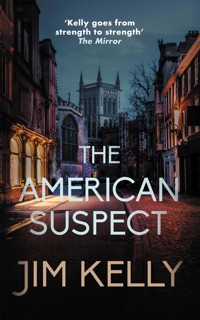
October, 1942. Thousands of American GIs are stationed across eastern England building airfields to bomb Nazi Germany and Cambridge's dance halls and pubs are a hot spot for Yanks on leave. Detective Inspector Eden Brooke is called to the aerodrome east of the city when the remains of an airman, identified by his dog tag, are uncovered by workers extending the runway. However, this is no recent burial. A fresh murder means that a black US serviceman faces the hangman's noose, but Brooke sees through the clouds of tension and prejudice and believes he sees an innocent man.
Sie lesen das E-Book in den Legimi-Apps auf:
Seitenzahl: 446
Veröffentlichungsjahr: 2026
Das E-Book (TTS) können Sie hören im Abo „Legimi Premium” in Legimi-Apps auf:
Ähnliche







1
2
3
The American Suspect
Jim Kelly
4
5
For Faith Evans, literary agent and editor,1942–2025
For setting me firmly on the road
CONTENTS
AUTHOR’S NOTE
It is traditional at this point to assert that all the characters in this book are fictional, but it wouldn’t be entirely true. I have borrowed two ‘real people’ in the interests of the plot. These are John Winant and Herbert Morrison. In each case I hope that their fictional selves chime with the lives they really lived.
Around 150,000 ‘coloured’ (as they were then called) US soldiers of African-American descent passed through the UK ahead of the invasion of Europe. Most were restricted to service and supply roles in segregated units. This was not their choice. Despite stifling prejudice many managed to fight, and were therefore doubly heroic. Indeed, at least one unit, featured in this book, went ashore on D-Day itself.
Elsewhere, I have invented events, institutions, almost all the characters and an entire village, and for good measure a USAAF airbase. I have happily played with history, but always in the interests of drama, pace and clarity. I hope that the Cambridge that emerges here would be instantly recognisable to those who lived in the ‘city’ during the Second World War. (Although in truth, it was not officially made a city until 1963.)8
CHAPTER ONE
Cambridge. Tuesday, 27th October 1942
The presses rolled on, the newsprint a blur, the paper thundering through the great machine, a waterfall of words. Detective Inspector Eden Brooke tipped his hat to one of the printers, picking up a copy of the Cambridge News from the pile. The paper had a waxy, greasy feel, and left dark smudges on Brooke’s pale fingers. The dimly lit press hall, deep beneath the newsroom, was grimy too, inky, smudged by a century of news, stretching back to the Boer Wars, Mafeking, Khartoum and beyond.
Brooke scanned the front page, lighting one of his precious Black Russian cigarettes, another echo of a past war. He’d become addicted to the brand in the officers’ mess in Cairo on his first posting to the Middle East during the Great War. Then his father had pressed a packet into his hand in 1917 when he’d set out again after a month’s leave for the final push towards Jerusalem. It turned out the cigarettes were a lot more comfort than the copy of 10the Iliad which came with them, especially given that the edition was in the original Greek.
The first hit of the nicotine, the racing of the blood, reminded Brooke that there could be a moment of happiness in the bleakest of days.
According to the paper it was Tuesday, 27th October 1942. (His mother had always said the date was the only reliable information in any ‘rag’, but that it was best to double-check.)
His eye slid across the headlines. It was the fourth year of the latest war, and newspapers were losing the struggle against apathy and the censors. Anything of real interest was almost certainly weeks, if not months, out of date. But millions read them because there was no other news except the wireless, and even the BBC was firmly in the grip of Whitehall and Downing Street, as the freedom of the press gave way to the demands of total war. The dead hand of the censor was on everything.
There were snippets of real news, mostly local, but bereft of detail. An inquest had opened into the death of two women, killed while cycling away from the village of Snailwell, hit by an army truck after dark. The roads were lethal, robbed of lights, while vehicles had their headlamps taped over in the blackout. It was a sorry tale often repeated. The roads were deadlier than the Luftwaffe.
The real war was only dimly glimpsed. A second battle had begun at El Alamein, in the Western Desert, but the report, filed three days earlier from Cairo by Reuters, was bereft of any detail and simply stated Montgomery’s determination to drive Rommel back into the sea. There was a short piece on Red Cross boxes reaching Japanese POW camps; an item that would be read and reread in Cambridge, where so many families had sons and fathers behind the wire.
11The rest was local: the Home Guard had mustered 3,500 men on Parker’s Piece for a parade, while American servicemen from the aerodrome at Alconbury had thrown a party on the base, ferrying children out from Cambridge by bus. There was a picture of the youngsters, wide-eyed in front of several hundred ration books’ worth of candy, cakes and fruit. The opulent lifestyle of the ‘GIs’ – as they were becoming known – was a constant unwelcome reminder to the locals of how tawdry life had become for most on the Home Front.
A claxon sounded and the deafening noise intensified as the presses slipped into a higher gear, so Brooke didn’t hear the editor’s approach until a shadow fell over the page.
‘Thanks for coming in,’ shouted Frank Kett, exhibiting wrecked teeth, while breaking open a packet of Piccadilly. ‘Follow me,’ he mouthed, turning on the heels of his polished brogues. The editor affected the attire of a country gentleman: tweed suit, waistcoat, pocket watch. The nicotine-stained right hand told a different story.
They climbed a set of steel stairs to an office marked night editor.
The glass box, which gave a panoramic view of the print hall, provided some protection from the din outside. In daylight hours Kett was to be found in the newsroom, or his office, but at night he worked here, banishing the actual night editor to the shop floor to proofread copies from each edition as they spilt from the presses. The desk was covered in opened wine bottles, and Kett poured two glasses, although Brooke knew it was only water; it was always water with Kett, disguised as alcohol, which hinted at an even darker past than the yellow fingers.
‘Just a heads-up,’ Kett said. ‘I’m running a story tomorrow. It’s been passed by the censor – just. Thing is, we’re not telling the truth, Brooke – well, not the whole truth. I’m left with the dregs 12of a tale. I thought you deserved the full version on the basis this is supposed to be a war in defence of democracy and freedom.’
With a spiteful twist of his leg the editor ground the half-smoked cigarette into the floorboards, then immediately lit a fresh one.
‘You can see why the censors are jumpy,’ conceded Kett. ‘It’s about pets, Brooke. People get very emotional about pets. Especially now, what with missing fathers, missing husbands, kids in bomb shelters. It’s very British. Maudlin, I suppose. But there we are. All it takes is a litter of kittens and half the town’s in tears. And they sell newspapers, oh yes. Something cuddly on the front page and circulation goes up a thousand.’
Brooke had bought his granddaughter a rabbit that very weekend. Iris, now walking, stoically followed it around the house. Kett was right. Whenever he caught his own daughter Joy watching little Iris, he could see she was thinking of Ben, the father, a submariner in the Atlantic. Would he ever get to see Iris walk again? Or would she have to make do with cuddling the rabbit?
‘The story, Frank?’
Kett nodded. ‘Cats keep disappearing, mostly in the Kite. Mostly black. Nasty business. It’ll be for the pelts. But we can’t say that. Just print a couple of sob stories. Good for pictures …’
He turned a large black-and-white photograph around on the desk. An elderly woman, stood in her back yard, holding up a photograph of a black cat.
‘That’s Mandalay, apparently,’ said Kett. ‘Poor woman has put up little posters. Usual thing: half a crown reward to boot. But she’s not going to see Mandalay again. Not with a nice black shiny coat like that.’
The Kite was a close-knit working-class district on the very edge of the city’s colleges. It was a fragment of Manchester, or Newcastle, or the East End, come to rest on the edge of the Fens. 13Half a dozen streets marked its boundary, forming the distinct outline of a kite. It was as impenetrable as a maze. As a child Brooke had felt that sense of mild peril which any ten-year-old enjoys when, breaking all rules set by his father, he’d wander into the Kite on the way home from school and inveigle his way into a game of street football, or join the bustling queue at the sweet shop on City Road.
‘It’ll be kids,’ said Brooke. ‘Dad’s away in the army, we’re down to half a dozen coppers on nights – they’re masters of all they survey. The hoods of tomorrow, Frank.’
‘That’s what I thought. There’s always been a trade. Kids can get sixpence for any old moggy off a bloke with a sack. Plenty of sweatshops will turn you out a fur coat for ten bob.’
Brooke poured more water into his wine glass. ‘And the censor says you can’t print that?’
‘No. Nothing about pelts. You know why, Brooke. You and I both. First months of the war, Whitehall told us there wouldn’t be enough food for cats and dogs. Best get them destroyed. There should be a word for that, a euphemism that’s actually worse than the truth. I mean – destroyed? They sent out a circular, millions of ’em, did you see one?’
Brooke shook his head.
‘The second page carried an advert for a bolt-gun. This is the danger. There’s a war on. Civil servants, unelected civil servants, mind you, wanted people to take their pets out and shoot them. Christ, Goebbels would have thought twice about that. They reckon London, and this is Home Office numbers, London lost 700,000 dogs and cats. About half the lot, they reckon.’
Kett stubbed out the cigarette in a glass ashtray marked Gordon’s. ‘Once bitten twice shy. Changed their tune now. Morale on the Home Front is top priority. They don’t want anything in the local 14rag upsetting pet lovers. The missing Mandalay is all we can show them. So the local ruffians get to earn a few bob and think nobody cares. And they’re right, Brooke. Nobody cares.’
This was what made Frank Kett a dangerous man, thought Brooke. He’d sell his mother for a paragraph in the stop-press, but he had a streak of rectitude which gave him constant access to the moral high ground.
Brooke watched the editor pour himself a glass of water from a bottle with the label Viognier 1937.
‘The thing is, that’s not quite the full story,’ said Kett, stepping closer. ‘We talked to a biddy on Elm Street, near The Cricketers, and she said she heard her cat squeal. She got up and stood by the open window. Middle of the night, silent as the proverbial. Then she hears whistling. Tuneful, she said. Lilting. Then she heard another cat scream.
‘By the time she got out in the street there were two other neighbours out there – this was two o’clock in the morning. There was a saucer of chopped liver on the pavement. No sign of the cats.
‘But here’s the thing, Brooke. Next morning they found they hadn’t taken them at all – they’d left the bodies behind, dumped on a bomb site. Just took the pelts. They’d put some food down, waited for a few to take the bait, then got the knives out.
‘Which takes some skill, and a bit of nerve. Know why they skin them there and then? Apparently, the fur’s better quality, keeps its sheen, if it’s taken off a live animal. Sells for a higher price. As does black fur, and most of the missing cats are black.
‘So that’s not kids, is it? I thought you should know.’
Brooke adjusted his hat, thinking of Iris chasing the reluctant bunny.
CHAPTER TWO
She whistled as she walked home along the back lane, in and out of the moon shadows cast by the poplar trees. It was an hour until dawn, but she was still thinking about the night before, at the Barnwell dance hall, in the Kite, so the tune in her head was ‘Stardust’.
She swung her handbag, whistling, then whispered a version of the lyrics, imagining that her lover would come to her ‘’neath the midnight sky.’
She shook her head, and spoke to herself, ‘Don’t be daft.’
Lighting a cigarette, one of the packet of Chesterfield he’d given her, she looked up through the trees and saw light spreading over the sky.
She always took the back lane home because there’d be no one about. The farms relied on the Land Army girls and they didn’t come in ’til seven by tractor, so she had the world to herself until 16the village came into sight. Nice girls were not to be seen walking home in lipstick. But then she’d never been a nice girl. She’d been a ‘handful’ since sixteen, and the war hadn’t helped, in that her independence had found greater freedom. She did what she liked, and she had her own money in her pocket. She had enough wisdom for a twenty-three-year-old to know these might be the best years of her life.
‘I do what I like,’ she said, out loud, and a hare bolted right across her path.
The village, Dodswell, was in the Domesday Book; her mum always told her this when Molly complained how dull it was, as if it made all the difference. But it wasn’t really in the Domesday Book at all. When they rebuilt the manor house after Trafalgar, they’d decided the old village ruined the view, so they knocked it down and moved it beyond the woods, leaving the church stranded, with its lonely graveyard. So Dodswell was just a hundred years old, not a thousand. It wasn’t quaint, just sturdy and Victorian. And it wasn’t clustered, like a real village – it was airy and spread out, as if its residents couldn’t muster the friendliness required to live next door to each other. The school and the village hall bore the same date: 1887. Both were brick, functional and dull.
Molly hated the place. It made her want to scream. She knew what was round every corner, behind every door. When she spoke to anyone, she could see behind their eyes what they were thinking: I know you, Molly Curtin. And I know all about you.
Which is why she kept secrets, so they didn’t.
She’d reached the green when she saw Mrs Bond walking Windsor the dog. Incidents of night-wandering had begun to accumulate. A widow who’d lost her pilot husband in the Great War, she was often out when she should have been in bed. The 17terrier before Windsor had been called Sandringham. Sandy for short. Molly’s mum always said the old dear had spoken to Queen Alexandra at a WI Jamboree after the Great War and it had gone to her head.
It was just bad luck, being seen, but it meant everyone would know by lunchtime.
‘Mornin’,’ shouted Molly, breezy, flapping the hem of her dress from side to side.
Mrs Bond managed a nod, then looked away, encouraging the dog to do the same. Most days she couldn’t remember where she lived, but it was telling that her narrow propriety never wavered.
Dodswell was the kind of working village which had farms, and farmyards, right in the middle. The road to Royston was black with cow dung. A rooster, which Molly could see on the roof of Manor Farm, delivered an ear-splitting crow.
She sat on the bench by the telephone box and enjoyed a long, slow smoke. In the distance, beyond the woods, she heard an aircraft engine fire into life. When they’d eventually knocked the old manor down, they’d turned the estate into an airfield – that was back before the Great War. Now, thanks to Pearl Harbor, they had half the US Air Force on their doorsteps, which had livened the place up no end.
Dreaming, she watched the dawn until the sun broke free of the fir trees.
She could have swung her legs up onto the seat and gone to sleep, but that would have been a real scandal.
She set off for home, a row of two-up two-down farm-labourers’ cottages, on Spring Lane, which led down to the brook.
Number 12 was at the end, with the bright sky-blue door she’d painted herself.
She could turn the door handle without a whisper. Nobody 18locked their doors in Dodswell. She moved lightly, carrying her dancing shoes, down the short hall to the kitchen with its quarry tiles, always cold. She smoked a second cigarette while the kettle boiled. Its asthmatic rumble marked the start of every day, every working day, since the war had become ‘the Duration’.
The night lingered: his eyes, the shadows on Jesus Common, fingertips and hot breath, then the grass down by the river, over the bridge by the Fort St George. Her dress was still damp, fresh, and she thought she could even smell the scent of river water and Brylcreem.
When the kettle blew, she jumped a foot in the air.
Two cups, two saucers, ferried up the wooden stairs with a steady hand.
Her mum, Ede, was sat up in bed. She was sixty years old, but bedridden by a stroke. But really it was disappointment, another war and regrets. She’d been the village schoolteacher for forty years and missed the children.
‘You’ll be late,’ she said, taking the tea.
They both looked at the clock: 7.23 a.m.
‘I’ve loads of time,’ said Molly, turning to go.
‘You can sit a bit,’ said her mum, patting the counterpane.
Molly settled, using the saucer as an ashtray.
‘Don’t know why he won’t show his face,’ said her mother. ‘What is it? Six weeks now?’
‘He’s shy,’ said Molly. ‘Maybe Christmas, if they’re still in Cambridge.’
‘You want to be careful, my girl. I wasn’t.’
‘And now I’m here. Sorry about that.’
Her mum’s face crumpled. ‘I didn’t mean that. You know I didn’t mean that.’
Molly nodded, but didn’t relent. ‘You sleep alright?’
19‘No point complaining,’ she said, surveying the pill bottles on the bedside table.
Molly described the scene in the Barnwell the previous night: the crowd, the band, the sound of swing. Ede, captivated, saw it all in her daughter’s vivid green eyes. Molly told her who she’d seen, who she’d seen with who. All the gossip.
‘Right,’ she said finally, draining her cup. ‘Quick-change time.’
She took her cup, crossed the hall, and was in her WAAF uniform in under a minute. She checked in the mirror. The blue serge tunic was perfectly cut and had cost her £6, although the price included the addition of her three sergeant’s stripes.
She stood at the foot of her mum’s bed and saluted.
‘Your dad would have been proud of you,’ she said. ‘He would, love.’
‘He’s not here though, is he?’
Ede flinched, as if from a blow. There was a picture on the bedside table, behind the pills. She leant over and readjusted it, so it didn’t catch the light.
‘Sorry,’ said Molly, thinking that she should be kinder, could be kinder.
‘I’ve got nine hours of slapping dope onto aeroplane canvas to look forward to, Mum,’ she said, by way of explanation.
Her mother looked done in, exhausted.
‘I’m a bit chilly. You couldn’t get the Belling could you?’
‘’Course,’ she said. There was a short staircase up to the attic, which had a little dormer window. This had been Molly’s room until her brother moved out. She found the electric fire amongst the junk and brought it down.
As she plugged it in, it began to glow with that strange colour, like Tizer.
‘Lovely,’ said her mum.
20‘They had cocktails at Barnwell,’ added Molly, raising her eyebrows.
‘Good for you,’ said Ede.
Molly, suddenly aware that her mum looked older, bent down and kissed her.
Then she was gone, clattering down the stairs, grabbing her gas mask and handbag, and then out into the lane.
Ede heard her whistling ‘Stardust’, fading away. She thought she might cry, so she steeled herself instead, mustering her strength to get to the loo.
Molly walked on, past the green, past the pond, noting that the duck eggs had gone despite the netting, and then out onto the new military road which cut through the woods to the airfield.
Her shoes scraped on the hard concrete. Half the world was concrete now. Shelters, runways, drove roads, once just dirt tracks, transformed into highways.
A group of ATS girls was just passing through the checkpoint to work in the kitchens, the bar raised to a chorus of wolf whistles.
One of the guards, a military policeman in a white helmet, leant against the hut, smoking, a smile widening, then called out, ‘You girls looking for a good time? I’ll show you a good time. You show me …’
There was laughter from inside the guard hut.
But when Molly got to the bar, it went up in total silence. Molly was five feet five inches tall, slim, with a fine face – sculptured was what her mum said. Those green eyes, and brown curly hair, up now, pinned. She was a looker; she knew she was a looker.
But they never gave her a wolf whistle. Because they knew.
CHAPTER THREE
Brooke slept on the Nile bed in his office, which he’d bought in Alexandria before the journey home on Northbrook, in 1918. It was made of lightweight wood, and slotted together, and with one side down, it made a chaise longue of sorts. The slats were painted with scenes along the great river: ibis, and reeds, and a graceful felucca with a white sail. Since his capture outside Gaza during the final push towards Jerusalem, his sleep patterns had been chaotic. He’d been interrogated – he never liked to use the word ‘tortured’, because he knew the Turks had been desperate, and that death for them might be hours away unless they could make him talk. They’d left him staked out in the sun by day, interrogated him by lamp at night. Since then, he’d shunned the light for the sake of his wounded eyes, a creature of the dark, a nighthawk. When sleep came it was marked by a brutal, sudden collapse.
22A dream circled as he woke, but it was really a memory. Six months before his final capture at the hands of the Turks, he’d escaped a near miss. He’d set out with a group of the local Bedouin to scout out the enemy’s forward positions. They’d walked straight into an ambush down a ravine, were taken prisoner by two Turkish scouts. Luckily, he’d sought to reflect the glory of ‘El Aurens’, the fabled Lawrence of Arabia, and had donned desert robes. So the Turks didn’t know they’d scooped up a British officer, and simply herded all their captives back to their camp and into a hole in the sand, sliding a corrugated iron sheet over the top. Light sizzled along the gap between the outside world and the metal above their heads, which began to radiate heat. He knew that once they got to taking a good look at their prisoners, he’d be spotted and shot as a spy. In the half-light he’d studied his fellow captives, their faces weathered by a lifetime of desert wind and heat, seeing fear in their pale eyes. They were watching him of course, his white skin burnt and blistered, his features a mirror of Empire; dispassionate, aloof, stone-like.
And that was the nightmare – just sitting in the heat, knowing what must lay ahead. Knowing that he’d be betrayed by the colour of his skin, and that there was nowhere to hide. It ended as it always did, with a gasp for air, a heartbeat reaching to his hands and feet, as the corrugated iron sheet was lifted.
In reality it wasn’t the Turks. His own men had come looking for him when he hadn’t returned, and the enemy had fled. But in the nightmare it was the Turks, and they dragged him to a wall of stone already pitted with gunshots. He woke, sweating, shaking.
Now, lying on the Nile bed, he saw light through the slatted blinds, which told him all he needed to know; that he was in his office at the Spinning House, the headquarters of the Borough, one of Britain’s smallest police forces. Outside lay Cambridge, 23its medieval colleges running down to the Backs, the green river sliding by towards the distant sea. The town was awake: he could hear a tram passing, a train whistle from the sidings, a factory hooter summoning workers to the gates.
It was 7.15 a.m. His wife, Claire, was currently working nights at the city’s hospital, Addenbrooke’s. She’d be home by half eight, and given the Indian summer, they’d be able to share breakfast by the river at Newnham Croft, the home his father had left him and where he’d grown up. One of a pair of Victorian villas of eccentric design, it combined a Scottish baronial style with a modest English railway halt. Of all the happy moments in his life the vast majority had taken place within its walls, or the garden’s picket fence, which ran down to his beloved river, in which he swam each day. Claire, who had been his nurse in Scarborough when he’d got back from Palestine, had prescribed swimming to strengthen his legs, as the Turks had put a bullet in each of them, then left him to die when they’d been overrun by the British advance. The habit, the morning swim, had become an obsession.
Downstairs at the front desk Brooke checked the duty book and found that it had been a quiet night: three drunks arrested outside The Champion, a pensioner knocked down by a tram at Speakers’ Corner, while a middle-aged woman who refused to be moved on from her patch off Market Hill had spent the night in Cell 6, calling out repeatedly that she’d be late for work – another reminder that when the men finally came home, they’d discover that their women had fought their own battles.
And there’d been a disturbance in the PX on Hobson Street – the US Army’s version of the NAAFI, which offered a post office and club – but the ‘snowdrops’, the white-helmeted US military police, had arrived in force and the Borough was not required. And no air raid alarm, a welcome respite after weeks of rumours 24that the Luftwaffe was planning further reprisals for attacks on historic cities in Germany. Cambridge had already been subject to a concerted attack with incendiaries, and more were feared. Oxford, according to jealous gossip, was safe and untouched because Hitler wanted to use it as his capital once the invasion of Britain was finally achieved. Brooke felt this was a bit of wishful thinking on the part of Cambridge, which often rejoiced in any hardship which might befall ‘the other place’.
Before setting off for home Brooke checked out with the duty desk.
‘There was a call, sir. From The Bull. A major, military police, but a “special agent”, whatever that means. Must be urgent, he rang at seven. Left a number.’
He gave Brooke a slip of paper.
‘Name of Brogan,’ said the sergeant.
The Bull was a hotel on King’s Parade, and another US PX, but on a much larger scale than the one in Hobson Street. The Military Police HQ was upstairs in the same building, so they were on hand to keep order – not just in The Bull, but across the city, which had been designated a ‘liberty town’ and therefore often thronged with American servicemen on furlough, flooding in from airbases across East Anglia.
Without the snowdrops Brooke would have been overwhelmed. The Borough’s entire CID complement consisted of Brooke, his sergeant and one detective constable. The uniformed branch was better manned, but still depleted by conscription, which had taken many of the younger constables, especially those unmarried. The force as such was dominated by special constables and reservists called back to duty in retirement.
A dispositions board behind the duty desk indicated, by way of moveable wooden slats, the current whereabouts of the force’s 25three radio cars, two motorbike and sidecars, one paddy wagon and single dog unit (one dog, a bloodhound).
Given these thin resources, he thought the might of the US Army’s military police could wait an hour for a call, even if it was urgent.
Pausing on the police station steps, he selected a pair of glasses from his inside pocket, this time the pair with green-tinted lenses. His final desert ordeal by sun and lamp had left him with photophobia, a painful aversion to light. Depending on its intensity he could select any of a set of tinted spectacles, each in its own slim case, ranging in colour from ochre to green, blue to black.
The subtle ritual of selection was as automatic as breathing.
This morning he chose green, which matched the surface of the river, as he followed the towpath towards the southern hills. In ten minutes he came in sight of the house, on a long slow turn beyond Robinson Crusoe Island. At his gate he tried to lift the broken latch without causing it to squeal, but failed, as he always did, and was rewarded with a very specific noise: the sound of small children alerted to the arrival of a grown-up. But these weren’t his children, although one was his granddaughter Iris. His home had become a nursery, run by his daughter Joy. She was newly married, but her husband was a submariner, so they’d rented out their own flat so Joy could stay at home and run the new business. There were currently eight children in residence from seven ’til six. Most of the mothers worked shifts in the city’s factories, or on the buses, or donned a uniform to report for duty in the ATS or the WAAF.
The children spilt out the front door. Brooke had the immediate thought that Joy had surreptitiously increased the roll call. It looked like a dozen this morning and sounded like more.
26Iris had been walking just a year and was therefore last, tearfully so, to take a firm hold of Brooke’s coat.
Joy waited at the door. ‘Home is the sailor, home from the sea,’ she said.
‘The hunter home from the hill,’ added Brooke, raising his hat.
Joy, like her mother, had organised her life around the people she loved. She’d given up a job as a nurse, working alongside Claire, to start the nursery, a vital resource in wartime. She was entirely motivated by the chance it gave her to spend all day with Iris, rather than having to surrender her to Mrs Mullins, a middle-aged woman in the village who ‘took in children’.
‘Just in time for breakfast,’ she said.
Brooke advanced down the path, carrying those children able to hang onto his coat-tails.
A tall man who seemed to walk an imaginary narrow line, he always wore a hat, and kept his hands in his pockets. Claire said she could recognise him from half a mile away because he looked like a nail driven into the ground.
Brooke was often home for breakfast, his routine as a nighthawk making him a denizen of the world after dark. His eyes were beyond a cure, and so when he’d returned in 1919 he’d abandoned his degree and joined the Borough. The job provided intellectual puzzles and met a need to follow a certain moral code. Sir John Brooke, his late father, had won the Nobel Prize for developing a serum for diphtheria. His laboratory lay still in the basement of the house. He cast a long shadow even after his death, out of which Brooke occasionally struggled to emerge.
Joy took his hat and coat and hung them on the stand in the hallway, a duty she’d been allocated as a child, when she’d used the wooden chest which held old shoes to reach the peg.
Iris’s rabbit appeared, lopping across the hall to the foot of the 27stairs, followed by Iris in hot pursuit brandishing one of Brooke’s hats, which she clearly wanted the animal to wear.
‘The river first,’ he said, as Joy herded the children into the kitchen.
Two minutes later he was sat on the grass bank in his swimming shorts, his glasses abandoned, slipping into the dappled Granta, which would mysteriously wind its way into the heart of the city, changing its name en route. By the time it slipped under Silver Street Bridge it was the Cam, only to relinquish the title fifteen miles north, when its clear waters flowed into the muddy depths of the Ouse, which then flowed on to the sea at Lynn.
Whatever its name it was icy cold this autumn morning, despite the Indian summer sunshine, and so he felt his heart beating strenuously, as he struck out up-river to the old tree stump where his son Luke had, it had recently been revealed, hidden cigarettes as a child, thereby explaining a mysterious passion for cross-country running. Floating free he wondered where Luke might be now; he’d trained as a commando, and then volunteered for a far more dangerous life, as an agent for the Special Operations Executive. He could be with resistance fighters in the Balkans, or France, or anywhere else in occupied Europe.
Floating on his back, Brooke spoke his worst fear, ‘Please let it not be Germany.’
He tumble-turned and drifted back.
A man was standing on the bank in front of the house, smoking. Solid, pale, fleshy, with suspiciously black hair, slicked back. Claire, a great observer of humankind, would have said he was ‘doughy’, a category reserved for children who never lost their puppy fat.
The sun was well up now, and his hat brim shielded his eyes as he watched Brooke come alongside.
28‘I guess you’re Inspector Brooke?’ he asked, the accent American, nasal, broad, urban. ‘I did ring the station – hope you don’t mind me tracking you down, sir.’
Brooke guessed New England, maybe Boston.
Up close, he could now see under the brim of that hat and noted the regulation sunglasses – aviator, with the rose tint.
The American opened the right side of his overcoat to reveal a badge on the inside lapel. It was gold, flashy, and bore the words Special Agent in blue. Brooke thought the appellation was laughable. A cross between Hollywood and Philip Marlowe. But he was aware this was the official title of detectives in the US military police.
‘Name’s Brogan, Gerry.’
So, Boston Irish, thought Brooke, although all trace of the Emerald Isle had long gone. The city’s police had a worldwide reputation for uncompromising toughness and random corruption. It wasn’t an encouraging calling card.
Brooke hauled himself out and Joy appeared. ‘Breakfast now, Dad? I can offer tea,’ she added, for Brogan.
Brooke, drip-drying on the bank, felt the sun on his back.
‘Give me a second – Mr Brogan?’
‘Major, sir.’
Changed, Brooke took delivery of two fried egg sandwiches in the kitchen and brought them out with the tea.
Brogan was smoking, sitting on a garden chair.
‘A neighbour keeps hens,’ said Brooke, by way of explanation for the largesse, pouring tea from the pot.
‘Thank you for your time, sir,’ said Brogan, taking out a notebook.
American culture was a baffling puzzle. The manners were often old-fashioned and stiff, but then gave way, on brief acquaintance, to breezy familiarity.
Brogan had taken off the sunglasses to reveal light blue eyes, 29which seemed younger than the rest of him. They brought his face alive, but gave him a calculating look. Brooke was struck by this idea: that there was a younger man inside the stolid police officer he’d become.
‘Two things, sir. First up, we have a problem with a public house. The Zebra. The landlord has put a sign in the window: “Coloured Troops Only”.’
Brooke smiled. ‘Good for him.’
Brogan swallowed hard. The eyes had taken on a glacial chill.
‘Our aim is to avoid antagonism between white and coloured servicemen. They’re allocated separate passes for different days. But as you know, Cambridge is a liberty town. We can’t keep them apart every hour of every day. This sign is causing trouble.’
Brooke lit a Black Russian, while Brogan fished out a packet of Chesterfield and tossed it onto the tea tray.
Brooke felt it was the ideal moment to deliver a lecture.
‘The law, Major – that is, the United States of America (Visiting Forces) Act – stipulates, as I’m sure you know, that US servicemen operate under US law in the United Kingdom, supervised by the US military police. It does not say that any UK citizen falls under your authority. It is up to publicans to run their pubs, Major. Most people find coloured troops friendly and good-mannered, less boastful perhaps than their counterparts in white units. We don’t like “swank”, Major. The coloured troops don’t act like they own the place. That can’t always be said of their white counterparts, can it?’
There was a splash and Brooke turned to see a heron, arrow-like, pierce the water. Concentric circles began to widen.
‘The refusal to segregate the races may lead to unrest on the streets,’ persisted Brogan, who’d ignored the diving bird.
‘In which case the law, the same law that gives you jurisdiction 30over your own men, makes it clear that you, Major, you, have a duty, after we have helped you gather evidence, to prosecute any US citizens responsible for such unrest.’
Brogan filled his lungs and let out a sigh.
Brooke thought honesty wouldn’t hurt. ‘We are more than two nations separated by the same language,’ he said. ‘These things run deep, Major. You can’t just magic them away. I don’t think the people of Cambridge have any special bond with coloured troops. What they do have is a deep-rooted attachment to the concept of fairness. You’ll have heard it a thousand times: it isn’t fair. It’s an idea that holds us all together. We think it’s worth fighting for.’
Brogan had an inability to hold Brooke’s gaze despite the cold blue eyes. The American worked a finger around his collar.
‘I guess we’re gonna have to see what happens,’ he said, looking around the garden. And then he smiled, and there was that younger version of himself.
‘We will,’ said Brooke. ‘Unless you choose to use your men to discourage it from happening. But either way, I’m not using the authority of the Borough to prop up a colour bar.’
Brogan adjusted his back, wincing slightly.
‘Can I help?’ said Brooke. ‘A cushion?’
‘Last lot,’ said the major, shaking his head. ‘Nothing heroic. Shot in the back trying to get my men out of a hole near Amiens.’ There was a brief moment of empathy. ‘You?’ he asked.
‘Palestine. Egypt. It’s a long time ago. My eyes were damaged, hence the need …’
He fished out the ochre-tinted glasses and slipped them on.
‘And your legs?’ asked Brogan. ‘I couldn’t help noticing …’
‘Ah. Yes. Courtesy of the Turks. Hence the daily swim. It’s addictive. You said two issues, Major?’
Brogan reset himself, straightening the injured back again.
31‘Dodswell, the aerodrome? We’re extending the runway, it’s about to become operational for a fighter squadron, new P-51s.’
‘Mustangs?’
‘That’s it, sir. Longer range than the Thunderbolts so we can hold hands with the bombers as they reach Germany. They need a few more yards of runway to be on the safe side, and we want it up and running. The Eighth is already there, the pilots. They’ve trained on the old Thunderbolts, but raring to go with the new kit. The heavy work is being done by a construction battalion based in Bristol, but currently camping out on the aerodrome.
‘They’ve found a body, in a shallow grave, just beyond the end of the old runway. Bones. Old bones.’
He held both hands out, palm upwards.
‘What else do we know?’ asked Brooke.
‘They’re in the way, Inspector.’
‘Are they? Any initial investigation falls to the County force I think, up at the Castle? Dodswell is well out of my jurisdiction.’
Brogan was nodding, as if placating a child. ‘They’re stretched. A VIP visit on the horizon. They’re short of senior officers. Otherwise, they’ll get out there when they can, which could be several days. And General Eisenhower is not a patient man. In the meantime they recommended the Borough, sir. They said they were happy to bend the rules.’
‘I bet they are,’ said Brooke.
‘I’m going there now,’ said Brogan. ‘Jeep’s out the back. Word from you, I can have the bones in a box and we’re ready for action.’
Brooke hesitated. The Americans had built, or were building, 150 aerodromes in eastern England; the bomber bases were constructed to a template, with three runways forming the letter A. Battered bombers flying back from Germany were spoilt for choice. Around these bases were outliers, often one-runway 32aerodromes for a squadron of a dozen fighters, which operated as escorts for the bombers. In effect East Anglia was a giant aircraft carrier.
These airfields might swing the war for the Allies. It wasn’t an issue Brooke could walk away from.
The swim had banished sleep, and there was a hook of intrigue here: a shallow grave, bones, buried at the foot of a runway. Old bones – but how old? Less than fifty years and he’d be justified in bringing in the coroner. His current caseload was heavy, but tedious: a couple of domestic assaults, petty theft on Market Hill, and helping the army out at Madingley Hall to find an ack-ack gunner who’d gone AWOL after a letter from home.
The sun was higher now, and so Brooke swapped glasses to the green.
‘Anything else I should know, Major?’
Brogan shrugged, that smile resurfacing. ‘The body’s in uniform,’ he said. ‘But it’s not ours, and it doesn’t look like yours.’
CHAPTER FOUR
Brooke had flown once in his life, over the Nile and into Sinai, to try and spot the Turkish scouts preparing an attack on the railway his men were helping to build, sleeper by sleeper, inching east towards Palestine and one day, Jerusalem. It was a biplane, a French-built SPAD, which gave a perfect view below and ahead. But it had been the desert, and the sun high, and so all they saw was a sandpit, dotted with tortured ridges of rock, and then, just once, a caravan of Bedouin, trying to dissolve into the shadows beside a wadi. The pilot picked up the railway, and then followed it back towards the sudden green Nile. By then it had been sunset, and the shadows brought the map-like earth into three dimensions. The colours had grown richer, reaching for gold and red, and as they’d circled the dust-track runway on the outskirts of Cairo he’d seen the Pyramids, the Sphinx, as their makers had never seen them.
34So he thought he understood pilots, and their sudden bouts of irrational joy.
As Brogan’s driver, a Corporal Crick, brought the jeep to a half-skid stop at the barrier to RAF Dodswell, he felt the sudden buzz of excitement as a plane took off, banking over their heads then heading south.
‘T-6 Texan, just a trainer,’ said Brogan, showing the guard his pass, watching the aircraft diminish to a distant dot in the rear-view mirror.
A snowdrop climbed aboard, the bar bounced up, and Crick drove at speed around the runway apron. The airfield was a plateau of grassland, a windsock stiff on its mast, the old concrete runway a straight line to the horizon.
A nest of ack-ack guns was set back, and in the distance was a line of tawdry prefabs of pebble-dashed concrete, billets for pilots, their doors and windows open to the air – letting the breeze in, the damp and stench out. The pilots sat outside in a motley collection of deckchairs, stools, armchairs and benches. He could see one game of makeshift pétanque underway, and half a dozen men in singlets and shorts attempting star-jumps.
Further on there was an air raid shelter, which Brooke guessed was for civilians, while more blast shelters dotted the airfield for the mechanics and pilots – little more than reinforced bunkers open to the sky, offering an emergency refuge if a raid came in from the south. There was one hangar, which looked new, and the nose of what Brooke thought was a fighter was just visible inside. The rest of the squadron, a dozen aircraft, were on hardstanding points dotted across the landscape. But there was little sign of activity, and a sleepy drowsiness seemed to have settled over the whole aerodrome. There was no control tower, as Dodswell was an out-station, explained Brogan, effectively a remote runway, but all 35part of operations controlled by the ‘Mighty Eighth’ US air army. But there was a watch office, with a bank of plate glass windows, looking out over the grass, a nest of radio and radar antennae clustered on the flat roof round a pair of loudspeakers. But again, no sign of anyone actually on watch.
Brogan twisted in his seat to speak to Brooke in the back of the jeep. ‘Squadron can’t fly until the runway work’s done. Then they’ll bring the Mustangs in, fly the Thunderbolts out. These men wanna fly, Inspector. The waiting’s far worse than the Luftwaffe.’
‘Let’s just see the bones,’ said Brooke, as they passed an armoury, with shuttered windows and a reinforced doorway, then a signals and electrical workshop for radio and radar repairs, the doors open to reveal workbenches, a few men working on high iron seats, the sudden flare of a welding torch. A canteen, whitewashed, leaked steam, and on the edge of a wood the fuel dump lurked, mostly underground, a bowser parked up. And finally, just before they swung onto the runway, a dope shop, one side open to let the fumes out, women inside with brushes in hand, painting canvas fuselage panels with the chemicals that would dry and leave them strong, if brittle.
Whitewashed pebbles and bricks marked the pathways between distant huts and hidden underground bunkers. A few men were walking to and fro, but again the day was warm and sunny and nobody seemed in that much of a hurry.
One oddity: out to the east, partly lost in some chestnut trees, stood a medieval church tower, lime-washed, plain but fine.
And the wind. There was always a wind on an airfield. It thudded against Brooke’s eardrums, blowing in from the distant coast of north Norfolk, then raced down the runway heading south.
Fifty feet straight off the end of the runway they found a trench, 36guarded by a soldier with a rifle, sat oddly on a canteen chair with a white mug at his feet, rising to meet them as Crick skidded the jeep to a halt.
A sharp salute from the guard won a response from the major, while Crick just managed a lazy swipe with his hand to his white helmet as he walked to the lip of the pit and took a look.
‘One for the museum,’ he said. He had a wooden toothpick in his mouth which he constantly shifted from left to right. Brooke felt he’d been given a lot of latitude, for a corporal, to air his own opinions.
Brooke reached the edge of the pit.
Amongst the clay and stones in the shallow trench lay the half-revealed bones, still held within a perished uniform. The skull was visible, and an airman’s cap.
They heard a motorbike approaching from the gate.
Once the BSA was set up on its stand, the rider got off and removed a soft leather helmet.
‘Sir, quick as I could, like …’
Brooke turned to Major Brogan. ‘Sergeant Holt, the Borough. On secondment from Ely, and before that his native Manchester, as you can probably tell. He’ll take a note. Right, Sergeant, give me your hand.’
Holt gripped Brooke’s arm and helped him down into the pit.
Brogan stood on the lip now, looking bored. Crick had gone back to the jeep and was reading an edition of Stars & Stripes, his feet up on the passenger seat.
Brooke took off his glasses and knelt beside the body. ‘Right, Sergeant. What do we have? Cap badge, gold, letters here …’ He stooped closer. ‘RFC. So that solves that mystery. There’s a wings badge, a crown badge, RFC again, and the motto: Per Ardua Ad Astra.’
He looked up at Brogan. ‘Through hardship to the stars. It’s 37the RAF’s motto now. But it once belonged to the Royal Flying Corps. Which tells us our friend here pre-dates the RAF – so, before April 1918.’
‘But a Brit?’ asked Brogan, relaxing. ‘So he is one of yours.’
‘Yes. Or Commonwealth volunteer. Or, actually, a US volunteer, via Canada. But Royal Flying Corps it is. So later than 1910, something like that. Great War, I suspect.’
Sergeant Holt’s eyes ran over the bones. ‘Flying from ’ere, sir? Reckon? Western Front? Can’t see a Sopwith Camel making a four-hundred-mile round trip, can you?’
‘No, Sergeant. You’re right. We flew from airfields in France, just behind the lines. So did the Americans. So maybe pre-Great War?’
Brooke thought his sergeant was good at questions. He never pretended to know anything he was unsure about, a priceless virtue in detection. He’d left Manchester for a job at Ely, hoping to break into CID. Now, twenty miles south, he’d got what he wanted. He didn’t lack confidence, and so was never slow to ask the obvious. He had a good brain, but had missed out on an education, which made him a student of everything. The only problem was that there was little doubt he’d be called up soon. It was a mystery to Brooke that he’d slipped through the net so far, although he was no spring chicken.
Brogan lit a cigarette. ‘Great. So can we all get back to work?’
‘Not quite, Major,’ said Brooke. ‘The body would have to be more than fifty years in the ground to preclude an autopsy. Unless our friend here invented the aeroplane ahead of the Wright brothers, he’s not that old. And we have no idea how he died, or why he’s been left in a pit ever since. Questions that need answers.
‘But we can move him swiftly, Major. We won’t be in your way for long. Telephone?’
38‘CO’s office, by the flag,’ offered Crick, from the driver’s seat of the jeep. He had the nasal twang of a New Yorker.
‘I’ll get a pathologist out here with a van and we’ll have him out of the ground,’ said Brooke. ‘Hopefully today.’
Brogan scanned the horizon.
‘Can’t we just leave him here? Fill it in?’
The attitude of the US military to criminal justice was, Brooke felt, pretty crude.
‘You’re right, we can’t,’ said Brooke. ‘But we’ll be as quick as we can.’
Brogan, irritated, scrambled down next to Brooke. ‘We’ve got a labour battalion ready and waiting. Shovels drawn. The men, the diggers, the trucks, the mixers, they’re all here. Fired up. A few hours’ work and we’re in business as a squadron. All it takes is eighty yards of concrete. Then we can fly with the bombers. Get more of them to Berlin. Give it to Hitler. Like, we’re trying to help you guys out.’
‘What took you so long?’ asked Brooke.
The American’s blue eyes, locked on Brooke, slid away.
Crick laughed and began to manoeuvre the jeep for an exit.
Climbing back into the pit, Brooke took a closer look at the bones, then called the major back down.
‘You should see this,’ he said.
The sun had risen enough for the light to fall fully on the remains, and Brooke had caught a solitary reflection. A coin, a cigarette lighter, a St Christopher?




