


56,99 €
Mehr erfahren.
- Herausgeber: John Wiley & Sons
- Kategorie: Wissenschaft und neue Technologien
- Sprache: Englisch
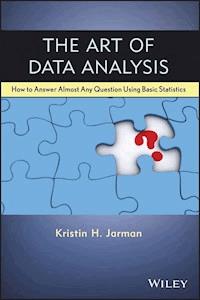
A friendly and accessible approach to applying statistics in the real world With an emphasis on critical thinking, The Art of Data Analysis: How to Answer Almost Any Question Using Basic Statistics presents fun and unique examples, guides readers through the entire data collection and analysis process, and introduces basic statistical concepts along the way. Leaving proofs and complicated mathematics behind, the author portrays the more engaging side of statistics and emphasizes its role as a problem-solving tool. In addition, light-hearted case studies illustrate the application of statistics to real data analyses, highlighting the strengths and weaknesses of commonly used techniques. Written for the growing academic and industrial population that uses statistics in everyday life, The Art of Data Analysis: How to Answer Almost Any Question Using Basic Statistics highlights important issues that often arise when collecting and sifting through data. Featured concepts include: * Descriptive statistics * Analysis of variance * Probability and sample distributions * Confidence intervals * Hypothesis tests * Regression * Statistical correlation * Data collection * Statistical analysis with graphs Fun and inviting from beginning to end, The Art of Data Analysis is an ideal book for students as well as managers and researchers in industry, medicine, or government who face statistical questions and are in need of an intuitive understanding of basic statistical reasoning.
Sie lesen das E-Book in den Legimi-Apps auf:
Seitenzahl: 255
Veröffentlichungsjahr: 2013
Ähnliche


















Table of Contents
Title page
Copyright page
Dedication
Preface
Part 1: The Basics
Chapter 1: Statistics: The Life of the Party
Chapter 2: Lions, and Tigers, and . . . Bigfoot? Oh, My: How Questionable Data Can Screw Up an Otherwise Perfectly Good Statistical Analysis
Getting Good Data: Why It Pays to Be a Control Freak
Footprints, Fur, and a Life-Changing Film
Chapter 3: Asteroid Belts and Spandex Cars: Using Descriptive Statistics to Answer Your Most Weighty Questions
They Mama
Qualitative versus Quantitative Data
The Descriptive Power Of Statistics
How Heavy Is She?
Chapter 4: Baseball, Game Shows, and Sidekicks: Who Cares about Probability Anyway?
Measuring the Three Bs
Probability: The Superhero’s Toolkit
Independent and Mutually Exclusive Events
Sidekicks Are People, Too
Never Leave Home Without One
Chapter 5: What It’s Like to Be Normal: Probability Distributions and One Rule That Could Make You Wildly Popular
The Granddaddy of All Demographic Data Sources
Probability Distributions and Why We Need Them
The Power of N
Part 2: What a Few Estimates and a Little Probability Can Do for You
Chapter 6: Men Are Insensitive and Women Are Illogical. Really: Asserting Your Stereotypes with Confidence
Statisticians Love Big Datasets and Other Half-Truths
Finding Confidence In Your Data
Are Men Insensitive? Are Women Illogical?
The Battle of the Sexes Rages On
Chapter 7: Godzilla versus King Kong: How Hypothesis Tests Can Be Used to Settle the Battle of the Movie Monsters
Hypothesis Tests: Let the Judging Begin
Two Giant Monsters on One Small Island
Godzilla versus Kong
And the Winner Is . . .
Chapter 8: Lab Rats and Roommates: Analysis of Variance and How to Channel Your Inner Mad Scientist
Analysis of Variance: The Scientist’s Toolkit
Let the Judges Be Judged
Unleashing Your Inner Mad Scientist
Chapter 9: When the Zombie Flu Went Viral: Regressing the Myth Out of Urban Myths
Linear Regression and Other Zombie Tracking Tools
Internet Posts and Other Symptoms Of Disease
When the Zombie Flu Went Viral
From Rumor to Myth to Legend
Appendix A: Critical Values for the Standard Normal Distribution
Appendix B: Critical Values for the T-Distribution
Appendix C: Critical Values for the Chi-Squared Distribution
Glossary
References
Index
Copyright © 2013 by John Wiley & Sons, Inc. All rights reserved
Published by John Wiley & Sons, Inc. Hoboken, New Jersey
Published simultaneously in Canada
No part of this publication may be reproduced, stored in a retrieval system, or transmitted in any form or by any means, electronic, mechanical, photocopying, recording, scanning, or otherwise, except as permitted under Section 107 or 108 of the 1976 United States Copyright Act, without either the prior written permission of the Publisher, or authorization through payment of the appropriate per-copy fee to the Copyright Clearance Center, Inc., 222 Rosewood Drive, Danvers, MA 01923, (978) 750-8400, fax (978) 750-4470, or on the web at www.copyright.com. Requests to the Publisher for permission should be addressed to the Permissions Department, John Wiley & Sons, Inc., 111 River Street, Hoboken, NJ 07030, (201) 748-6011, fax (201) 748-6008, or online at http://www.wiley.com/go/permissions.
Limit of Liability/Disclaimer of Warranty: While the publisher and author have used their best efforts in preparing this book, they make no representations or warranties with respect to the accuracy or completeness of the contents of this book and specifically disclaim any implied warranties of merchantability or fitness for a particular purpose. No warranty may be created or extended by sales representatives or written sales materials. The advice and strategies contained herein may not be suitable for your situation. You should consult with a professional where appropriate. Neither the publisher nor author shall be liable for any loss of profit or any other commercial damages, including but not limited to special, incidental, consequential, or other damages.
For general information on our other products and services or for technical support, please contact our Customer Care Department within the United States at (800) 762-2974, outside the United States at (317) 572-3993 or fax (317) 572-4002.
Wiley also publishes its books in a variety of electronic formats. Some content that appears in print may not be available in electronic formats. For more information about Wiley products, visit our web site at www.wiley.com.
Ljbrary of Congress Cataloging-in-Publication Data:
Jarman, Kristin H.
The art of data analysis : how to answer almost any question using basic statistics / Kristin H. Jarman.
pages cm
Includes bibliographical references and index.
ISBN 978-1-118-41131-5 (pbk)—ISBN 978-1-118-51492-4 (ePDF)—ISBN 978-1-118-51494-8 (eBook)—ISBN 978-1-118-51493-1 (ePub)—ISBN 978-1-118-51490-0 (eMOBI) 1. Mathematical statistics–Popular works. I. Title.
QA276.12.J35 2013
519.5–dc23
2013000381
To my father: The dream lives on.
Preface
I remember my first college statistics course. I studied hard and did the homework. I could calculate confidence intervals and perform hypothesis tests. I even earned a good grade. But the subject was so strange to me, I couldn’t keep the different concepts straight. Populations, estimates, p-values, these things were nothing but a jumble of meaningless terms, and what little I learned vanished the moment I turned in the final exam.
Maybe I’m a masochist or maybe just determined, but I stuck with it. I took a second statistics course and then a third. It wasn’t until I’d earned a Ph.D. in the field, worked on a number of real world problems, and made almost every mistake imaginable that I began to feel like I had a working grasp of statistics and its role in the data analysis process.
That’s where this book comes in. It’s driven by examples, not statistical concepts. Each chapter illustrates the application of basic statistics to a real dataset collected in the real world, far from the theorems and formulas and neatly contrived examples of the classroom. Hopefully, this book will provide you with the context you need to apply the basics of this slippery but oh-so-important subject to your own real-world problems.
Visit http://khjarman.com/ to contact the author, read more about the art of data analysis, and tell us your own statistical stories.
Kristin H. Jarman
Part 1
The Basics
Chapter 1
Statistics: The Life of the Party
As I sat in my favorite coffee shop, latte in hand, wondering how to introduce this book, my mind drifted to the conversations around me. At the table to my right sat a couple of college guys, decked out in sweatshirts touting a nearby university. They were arguing baseball, speculating which team was most likely to win the pennant and make it to the World Series. To my left sat three middle-aged women, speaking in quiet voices I had to strain to hear. They were talking about menopause, comparing their own experiences, trying to sort through the conflicting news about which, if any, treatments actually alleviate the symptoms. Behind me was the liveliest conversation of all. Two men were talking politics. Both men seemed to agree about who should win the next presidential election, but that didn’t keep them from arguing. Many words were exchanged, but it came down to this. One of the men, citing a national poll, insisted his candidate was clearly going to be the winner. The other, citing yet another poll, claimed the outcome was anybody’s guess.
Aside from my tendency to eavesdrop, there’s a common theme to the three conversations. Whether they knew it or not, all of these people were talking statistics.
Most people run across statistics on a daily basis. In fact, in this age of instant information, it’s hard to get away from them. Drug studies, stock market projections, sales trends, sports, education, crime reports: the list of places you’ll find them goes on and on. Any time somebody takes a large amount of information and reduces it down to a few bullet points, that person is using statistics. And even if you never look at any raw data, when you use those bullet points to make conclusions or decisions, you’re using statistics as well.
Being a statistician has never made me the life of the party. In fact, when I meet a new person, the reaction to my profession is almost universal. Here’s how a typical conversation might go.
It may not be the life of the party, but when it comes to sorting through mounds of information, statistics is the belle of the ball. And it doesn’t take a graduate degree in the subject to know how to use it. If you can apply a few basic statistical tools and a little practical knowledge to a problem, people think you’re genius, and maybe even a little clairvoyant. These qualities may not draw crowds at the neighborhood mixer, but they do tend to result in big raises and big promotions.
Real-world statistics isn’t only about calculating an average and a standard deviation. And it’s not always a highly precise, exact science. Statistics involves gathering data and distilling large amounts of information down to a reasonable and accurate conclusion. Most statistical analyses begin not with a dataset, but with a question. What will be the impact of our new marketing campaign? Does this drug work? Who’s most likely to win the next presidential election? Answering these questions takes more than a spreadsheet and a few formulas. It’s a process: reducing the question down to a manageable size, collecting data, understanding what the data are telling you, and yes, eventually making some calculations. Often this process is as much an art as it is a science. And it is this art, the art of data analysis, that provides you with the tools you need to understand your data.
There are no proofs in pages that follow. Mathematical formulas are kept to a bare minimum. Instead, this book deals with the practical and very real-world problem of data analysis. Each chapter asks a question and illustrates how it might be answered using techniques taught in any introductory statistics course. Along the way, common issues come up, issues such as:
How to turn a vaguely worded question into a scientific studyHow different types of statistical analyses are well-suited to different types of questionsHow a well-chosen plot can do most of the data analysis for youHow to identify the limitations of a studyWhat happens if your data aren’t perfectHow to avoid misleading or completely false conclusionsEvery chapter is a case study, complete with a question, a data collection effort, and a statistical analysis. None of these case studies addresses society’s fundamental problems (unless you think the lack of appreciation for superhero sidekicks is one of them). None of them will help you improve your company’s sales (unless those sales are dependent on scientific proof that Bigfoot exists). And none of them will help you pick up women (especially not the one about gender stereotypes). On the other hand, all of them can be used as a template for your own data analysis, whether it be for a classroom project, a work-related problem, or a personal bet you just must win. And all of them illustrate how basic data analysis can be used to answer almost any question you can imagine.
The statistical techniques presented here can be found in most spreadsheet programs and basic data analysis software. I used Microsoft Excel throughout, and in some cases, the Analysis Add-In pack was required. Here and there, a specific function is mentioned, but this isn’t a book on statistics using Excel. There are plenty of good texts covering that topic. Some of the most popular, written by a man known as Mr. Spreadsheet, are listed in the Bibliography at the end of this chapter.
The outline of this book follows a typical introductory statistics course. Part One gives you the basic tools you need to ask a question and design a study to answer it. Part Two shows what you can do with a solid understanding of these basic tools. Each chapter is self-contained, but like a typical textbook, the concepts build on one another, and the analyses gradually become more sophisticated as the book progresses. If you’re dying of curiosity and you’ve just got to find out when the zombie flu went viral, then go ahead and jump to Chapter 9. But if you can wait, I recommend you turn the page and read through the chapters in order.
I hope you enjoy reading these case studies as much as I enjoyed writing them.
Bibliography
Walkenbach, John. 2007. Excel 2007 Charts. Wiley.
Walkenbach, John. 2010. Excel 2010 Bible. Wiley.
Walkenbach, John. 2010. Excel 2010 Formulas. Wiley.
Walkenbach, John. 2010. John Walkenbach’s Favorite Excel 2010 Tips and Tricks. Wiley.
Chapter 2
Lions, and Tigers, and . . . Bigfoot? Oh, My: How Questionable Data Can Screw Up an Otherwise Perfectly Good Statistical Analysis
The mountain devil. Jacko. Sasquatch. Bigfoot. These are just a few names for a mysterious apelike creature rumored to be living in mountain forests around the United States. He’s been a legend for generations. Ancient stone carvings of humanlike ape heads have been excavated in the Pacific Northwest (Eberhart 2001). Newspaper articles from the 1800s report “wild men” in such diverse geographic areas as Pennsylvania and California ( 2006). In the early 1900s, settlers and prospectors frequently reported seeing this creature in California, Washington, and Oregon ( 2006). There have been thousands of reported Bigfoot sightings in the last hundred years alone. And yet, no solid scientific proof of the creature exists.
Lesen Sie weiter in der vollständigen Ausgabe!
Lesen Sie weiter in der vollständigen Ausgabe!
Lesen Sie weiter in der vollständigen Ausgabe!
Lesen Sie weiter in der vollständigen Ausgabe!
Lesen Sie weiter in der vollständigen Ausgabe!
Lesen Sie weiter in der vollständigen Ausgabe!
Lesen Sie weiter in der vollständigen Ausgabe!
Lesen Sie weiter in der vollständigen Ausgabe!
Lesen Sie weiter in der vollständigen Ausgabe!
Lesen Sie weiter in der vollständigen Ausgabe!
Lesen Sie weiter in der vollständigen Ausgabe!
Lesen Sie weiter in der vollständigen Ausgabe!
Lesen Sie weiter in der vollständigen Ausgabe!
Lesen Sie weiter in der vollständigen Ausgabe!




