


Erhalten Sie Zugang zu diesem und mehr als 300000 Büchern ab EUR 5,99 monatlich.
- Herausgeber: Nick Hern Books
- Kategorie: Poesie und Drama
- Serie: NHB Drama Classi
- Sprache: Englisch
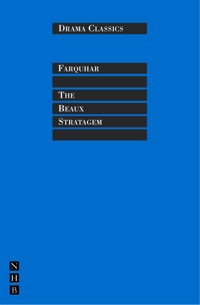
Drama Classics: The World's Great Plays at a Great Little Price George Farquhar's immortal comedy about two young gentlemen with a misguided plan to get enrich themselves at the expense of a series of young heiresses. A pair of London gentlemen, Archer and Aimwell, pose as a Lord and his servant in order to procure one handsome dowry to split between them. While Aimwell, the 'lord', works on the affections of Lady Bountiful's daughter Dorinda, his 'servant' Archer makes his bid for her son's wife. George Farquhar's play The Beaux Stratagem was first produced at the Theatre Royal, London, in 1707. This edition, in the Nick Hern Books Drama Classics series, is edited and introduced by Simon Trussler.
Sie lesen das E-Book in den Legimi-Apps auf:
Seitenzahl: 172
Veröffentlichungsjahr: 2015
Das E-Book (TTS) können Sie hören im Abo „Legimi Premium” in Legimi-Apps auf:
Ähnliche
















DRAMA CLASSICS
THE BEAUXSTRATAGEM
byGeorge Farquhar
edited and introduced bySimon Trussler
NICK HERN BOOKS
London
www.nickhernbooks.co.uk
Contents
Title Page
Introduction
For Further Reading
Farquhar: Key Dates
Advertisement
The Beaux Stratagem
Glossary
Copyright and Performing Rights Information
Introduction
George Farquhar (c. 1677-1707)
George Farquhar was born in Londonderry in northern Ireland, probably in 1677, and would have been verging on adolescence when the recently deposed James II besieged that city in 1689. His father, as an Anglican clergyman, was a prime target for plunder, and died soon afterwards, while the barely teenage George is said to have fought (on King William’s victorious side) in the subsequent Battle of the Boyne in 1690 – which imposed the protestant succession (and a great deal of continuing grief) upon the Catholic majority in Ireland.
Prematurely experienced in both the sorrows and the heroisms of war, Farquhar proceeded from the local grammar school to Trinity College, Dublin, in 1694, then in quick succession fell in love with the theatre, performed at the Smock Alley playhouse in Dublin, gave up acting after accidentally killing a fellow-performer in a stage duel, and, like his lifelong friend and compatriot Robert Wilks, determined on a future in London. Here, Farquhar’s first comedy, Love and a Bottle, was performed in 1698: but his precocious success as a playwright (discussed in more detail in the section ‘The Comic Worlds of George Farquhar’, on p. vii) was interrupted by the renewal of war with France in 1702. In 1704 he was granted a commission as a Lieutenant of Grenadiers and sent off on a recruiting campaign to the Midlands.
Meanwhile, in 1703, Farquhar had married, less from love than in expectations of an income from his wife’s fortune, which proved to be non-existent. Indeed, he very soon found himself needing to provide for their two daughters as well – at a time when he was beginning to feel the effects of the wasting illness which we now suppose to have been tuberculosis. He drew on his provincial experiences in both of his last two plays, The Recruiting Officer and The Beaux Stratagem (as also on his unhappy marriage in the last), but his rapidly declining health prevented him from building on their success, and he died in poverty in late May 1707. His friend Wilks paid for his funeral.
The Beaux Stratagem: What Happens in the Play
A pair of presentable but impoverished London gentlemen arrive at a Lichfield inn, plotting to repair their broken fortunes. One, Aimwell, pretends to be a lord (like his brother) to improve his chances of marrying a rich woman, while the other, Archer, has agreed to act as his servant – on condition that any dowry they secure is equally shared. After some dalliance with the bucolic landlord and his pretty daughter, Cherry, Aimwell sets his sights on Dorinda, the well-endowed daughter of Lady Bountiful – whose son, Squire Sullen, finds himself ill-matched with a spouse of great beauty but no inclination to share his hunting-and-drinking life-style. And so, while his ‘master’ woos the beauteous but innocent Dorinda, Archer makes illicit advances to the more knowing but cautiously receptive Mrs Sullen.
With Sullen safely out of the way, in quest of drinking companions at the inn, Archer inveigles himself into the household to pursue his amorous quest – on the very night chosen by a local band of highwaymen to rob the supposedly unprotected women. Aimwell, summoned by an anxious Cherry, helps to vanquish the intruders. He is renewing his suit to Dorinda when Sullen returns, in the company of his wife’s brother, Sir Charles Freeman, who is determined to rescue her from her unhappy marriage. Freeman also brings news that Aimwell’s brother has died – so Aimwell, now a lord indeed, can legitimise his love for Dorinda, which has by now grown to be real rather than self-serving. Sir Charles persuades the Squire into a divorce by consent – assisted by Archer’s acquisition from the thieves of all the papers which give Sullen title to his wife’s fortune.
This climax is open to all sorts of literal-minded criticism, not only for the coincidences that make it possible (a frequent enough convenience in this kind of comedy), but for the happy-go-lucky way in which Freeman pronounces a divorce for which the harsh legal constraints of the time gave no grounds. Indeed, The Beaux Stratagem, for all its social and psychological realism, treads a stylistic tightrope between such wish-fulfilment and the harsher realities of marriage – as it does also between the ‘mannered’ characters whose love-lives interweave in its main plot and the ‘humours’ characters whose economic needs and ambitions drive the action at a lower level. Among these latter are to be found the innkeeper Bonniface and his daughter Cherry, the highwaymen with whom Bonniface is complicit (Gibbet, Hounslow and Bagshot), and Sullen’s all-purpose servant Scrub. There is also a pair of comic foreigners – Count Bellair, a captured French officer with whom Mrs Sullen has been platonically flirting, and Foigard, an Irishman who is treacherously serving as chaplain to the French prisoners. Such a presence in the neighbour-hood was, of course, a reminder of the events beyond the play which had earlier made recruiting so topical a theme. But it is no less typical here than of Farquhar’s earlier play-worlds that the tensions between actuality and artifice should generate dramatic energy rather than confusion.
The Comic Worlds of George Farquhar
The work of George Farquhar fits awkwardly into that over-extended category which critics have labelled ‘Restoration comedy’. After all, Charles II had been ‘restored’ (following his father’s execution and the ‘interregnum’ under Cromwell) in 1660, and the honeymoon he had enjoyed with his subjects was well over by 1677, the probable year of Farquhar’s birth. Shortly afterwards, the crisis caused by the increasing probability that the Catholic James would succeed his brother to the throne set in motion the struggle for constitutional monarchy – a struggle which eventually led to King James’s deposition during the ‘bloodless revolution’ of 1688-89, and the enthronement of William and Mary. The bourgeois sensibility of this royal couple proved well-suited to the changing national mood, as pursuit of the pleasure principle (so marked a feature of Charles II’s reign) gave way before the sterner demands of the protestant work ethic.
It’s true that Farquhar’s near contemporaries Congreve and Vanbrugh (who both outlived him by some twenty years) continued to develop a dramatic tradition – of high-style, high-life ‘comedy of manners’, rooted in sexual dalliance – begun during the Restoration proper by Dryden, Etherege, Wycherley and Aphra Behn. But both Congreve and Vanbrugh gave up writing for the theatre soon after Jeremy Collier’s influential anti-theatrical polemic, A Short View of the Immorality and Profaneness of the English Stage, published in 1698, had decisively articulated the changed temper of the times. Of the dramatists who have survived in the modern repertoire, Farquhar alone, it seems, found a spiritual as well as a chronological home in the society and the theatre of the years surrounding the turn of the seventeenth and eighteenth centuries.
Even so, he was barely twenty when he wrote his first play, Love and a Bottle, and could not at first afford (or perhaps did not yet know how to manage) so wholly personal a dramatic mode. It was not till his second play, The Constant Couple, of 1699, that he wrote a comedy in which conventional sexual pursuits were driven in part by new imperatives of cash and class – and the play found a responsive audience, proving the success of the season. But Farquhar evidently rested a little too long on the income and the laurels it brought him: and when, after eighteen months, he came up with a sequel, Sir Harry Wildair, the play suffered, as do so many of its kind, from the law of diminishing returns – though it managed a respectable first run, presumably on the strength of public curiosity to see how all the familiar characters would make out after marriage.
Farquhar’s next play, The Inconstant, which took over and simplified the plot of John Fletcher’s late Jacobean comedy The Wild Goose Chase, survived to its sixth night; but the death of King William in March 1702 eclipsed both the play’s and Farquhar’s own fortunes, and he set to work quickly on The Twin-Rivals, which had its first night in December of the same year. Subsequent criticism has been largely shaped by the need to account for the play’s initial failure – which, one suspects, was due not to its relatively high moral tone (now becoming acceptable, indeed expected) but to its formal daring, in portraying unalleviated vice as a proper subject for realistic representation in comedy.
For Farquhar, the play is also very tightly plotted – around a younger brother’s attempt to defraud his marginally older twin out of his inheritance. Sex here not only comes an acknowledged second to money, but is rather more closely connected with childbirth than theatrical convention usually acknowledged. There is more dramatic interest in the fraudulent lordling’s demonstration of his unworthiness than in his eventual exposure, and although the play has not quite caught the tone of voice in which to be ‘seriously funny’, it does strike out in the new direction which Farquhar was shortly to follow through in The Recruiting Officer and The Beaux Stratagem.
In between, the short farce The Stage-Coach – dealing with the ‘mistakes of a night’, as true love blossoms in the attempt to save a girl from her guardian’s preferred suitor – also anticipated Farquhar’s last two plays, in its country setting of an inn. As Eric Rothstein says, ‘it makes one hungry for the work he did not do’ between its production late in 1703 and 1706. On the other hand, it was no doubt precisely Farquhar’s escape from the incestuous world of literary and theatrical London during these years that tempered his final plays with the hard edge of experience – his brief military career providing a background for The Recruiting Officer, and his own unfortunate marriage a deep-felt source for his portrayal of sexual incompatibility in The Beaux Stratagem.
In Farquhar’s mature plays, The Recruiting Officer (1706) and The Beaux Stratagem (1707), he does not abandon ‘mannered’ comedy as such; instead he transplants it, setting the plays outside London and including characters of the middling-to-lower social orders. In the process, not only are old conventions and rivalries – between town and country, between courtly elegance and city greed – made redundant, but the characters gain a capacity for experiencing subtler nuances of pleasure, and (perhaps more significantly) also for experiencing real pain. The modern critic Robert Hume makes an apt distinction – between the ‘hard’ comedy of Congreve and Vanbrugh, as late exponents of the Restoration mode, and the ‘humane’ school which, (along with Collier’s censure) soon provoked both writers into abandoning playwriting. In the work of Farquhar alone do we find the broader sympathies of the new mode combined with the wit and verve of the old.
In the Shrewsbury setting of The Recruiting Officer, Captain Plume (the officer of the title) renews acquaintance with Justice Balance and his daughter Silvia – a pro-active lady, who not only inverts expectations by setting out in amorous pursuit of the negligent visitor, but puts on male breeches to advance her cause. Thanks to her brother’s timely death, an inheritance soon gives a hard economic edge to her attractions; and the casual grief and offhand mourning of both father and sister (far more concerned with the dynastic than the emotional consequences of bereavement) make explicit a lack of family feeling which in earlier Restoration comedies is usually an unstated ‘given’. No less clearly, for that matter, do we see the ready complicity of Justice Balance and his kind in the confidence tricks of the recruiting trade, as Plume and the faithfully duplicitous Sergeant Kite variously turn the heads and twist the arms of the local cannon-fodder.
Farquhar, of course, was here writing from personal knowledge – and whether or not this accounts for the mixture of amused nostalgia and contempt with which he appears to view the goings-on, it creates an interesting and energising balance of sympathies for an audience. Until well into our own century, however, both The Recruiting Officer and The Beaux Stratagem tended to be viewed rather as Restoration comedies manqué, and in revival rougher edges would be apologetically honed, creative tensions resolved rather than dramatically sustained. Ironically, it took a foreigner, Bertolt Brecht, to recognise the sterner stuff of which The Recruiting Officer was made, in his own updated version, entitled Drums and Trumpets: and the English director Bill Gaskill acknowledged this Brechtian influence when, in his National Theatre productions of the nineteen sixties, he worked not to transplant fashionable metropolitan society into the provinces, but to relish and reveal the sharper local colours and broader social spectrum Farquhar brought to these last plays.
Mannered Comedy and the Married State
As the social historian Lawrence Stone has suggested, one side-effect of the Reformation was the displacement of the Catholic ideal of chastity and virginity by a belief in marriage as a state to be preferred and sanctified – ‘holy matrimony’ indeed. Moreover, with the protestant stripping away of all intermediaries between the individual and his or her God came the ‘domestication’ of a patriarchal authority that had previously lain with the parish and its priest: for the husband now found himself translated into a minister of the fireside, leading ‘family prayers’ in households described in 1644 by the puritan writer John Stalham as ‘like so many little churches’.
In preference to the alliances of economic and dynastic convenience which had been the norm for those of any social standing in the sixteenth century, the puritans argued that the proper bases for a marriage were affection and compatibility. But given that authority over a woman passed from father to husband upon marriage, how could a dutiful daughter continue to obey her father if that meant accepting his choice of a husband she found repulsive? After himself making a disastrous marriage, the poet John Milton advocated in The Doctrine and Discipline of Divorce (1643) that divorce on the grounds of incompatibility should be made possible – going so far as to suggest that ‘natural hatred’ was ‘a greater evil in marriage than the accident of adultery’. However, this freedom was to be reserved for husbands, not extended to wives: for, as he asked, ‘who can be ignorant that woman was created for man, and not man for woman?’ (Threatened with prosecution for unlicensed printing of his pamphlet, Milton proceeded to write, in Areopagitica, a resounding but ultimately no more disinterested polemic in favour of the freedom of the press.)
In spite of Milton, divorce on the grounds of incompatibility was not to be permitted for another three centuries – and such few divorces as were allowed remained socially scandalous, legally complicated, and prohibitively expensive. With the Restoration, moreover, the puritan belief in affectionate marriage lost credibility along with the cause of puritanism itself – so while Charles I’s marriage with Henrietta Maria had seemed a very embodiment of the ideal of holy matrimony, his licentious son Charles II legitimised, so to say, adultery as the expected norm. And since the laws of inheritance required a wife to remain faithful (lest doubt be cast on the legitimacy of her offspring), the operation of a sexual double standard in high society became institutionalised. However, the general rule of Restoration comedy was that illicit sexual pursuit was rather more thrilling than its consummation – a rule apparently affirmed by no less an authority than the contemporary philosopher of the pleasure principle, Thomas Hobbes. Marriage, for four acts of a play, was merely an invitation to be cuckolded: only in the fifth did it become the means by which fortunes might be mended, and the necessary closure of the plot effected.
Farquhar accepts the convention that a husband and wife yoked at the outset of a comedy are likely to be in a state of misery. But he takes their unhappiness seriously – and without going to the opposite extreme of indulging the sentimentalist’s urge to moralise over weaknesses and faults. He creates in Aimwell and Archer a pair of ‘heartless’ Restoration rakes, but proceeds to show that although one is impervious to change, the other becomes responsive to circumstance and reciprocated feeling. Archer is from the first the more conventionally manipulative of the two, and remains in every sense his own man (indeed, his possible future with a divorced Mrs Sullen is a matter about which both remain significantly vague). But in the case of the more reflective (even sensitive) Aimwell, there is the slow-maturing of a relationship as ‘real’ as the boundaries of this kind of comedy permit, and a ‘repentance’ which, while somewhat sudden, is neither last-minute nor unprepared. As in The Recruiting Officer, the death of an elder brother is a matter of congratulation, not commiseration, and clears the way for a modified if not exactly reformed rake to marry a woman for whom he appears to have learned respect as well as love.
The women are distinguished conventionally enough, with the innocent but eager-to-learn Dorinda set against the hard-schooled Mrs Sullen. But they are given an independence and, indeed, a prominence which had largely been denied them during the Restoration, other than by Aphra Behn – though more recently acknowledged by Congreve. Of course, female sensibility in the latter’s The Way of the World is largely presented as reactive (however wittily) to male expectations, and so to a degree it is here. But it would be unhistorical to deny Mrs Sullen the typological descent which is implicit in such remarks as ‘pride is the life of a woman, and flattery is our daily bread’. And when (as here) Farquhar shows the women alone together – rather than bantering with their beaux – there is that slight shifting of sexual ground in the debate which had earlier been detectable in his presentation of Silvia and the no less sceptical ‘lady of fortune’, Melinda, in The Recruiting Officer.
‘The couple parted’ are, as Archer observes, as pleased as ‘the couple joined’. Through the intervention of the aptly-named Sir Charles Freeman, Farquhar goes further than Milton in suggesting not only that the incompatibility of the Sullens should be a sufficient ground for their divorce, but that mutual agreement (rather than masculine dictat) is sufficient to effect it: ‘Consent is law enough to set you free.’ Although the Married Women’s Property Acts of the late nineteenth century were a little less historically distant than divorce by consent, Farquhar’s resolution of the economic complications here was no less a legal impossibility at the time than the Sullens’ simple disavowal of their marriage. Yet in a comedy all things are possible, and the boundaries of the play-world are no more stretched by turning the laws of matrimony than the laws of probability on their head.
The Humours of Provincial Life
Ben Jonson remained admired during the Restoration – more so even than Shakespeare, on account of what critics called his greater ‘regularity’. But ‘comedy of humours’, as he had labelled his own distinctive comic style – its intention to laugh people out of their excesses and affectations – was usually no more than window dressing around the edges of Restoration plays. Those (largely minor) characters targeted for unsocial ‘humours’ are as often as not the self-delighted ‘fops’, of high profile and low intelligence. On the other hand, ridiculing ‘humours’ characters from the bourgeois ranks of the ‘cits’ becomes as much a matter of class warfare as of comic correction – part of a political as much as of an artistic agenda.
For these are plays in which privilege is presumed as of right. The servants, such as there are, tend to be collusive confidants of their masters or mistresses rather than in any way to represent a world beyond that of privilege, whether bought by high breeding or by hard cash. But the below-stairs world in The Beaux Stratagem is given far more than such passing prominence. The richness of its texture in part derives, as Peter Womack points out, from the way in which its lesser inhabitants not only assume a comic dignity which is all their own but also ironically employ the idiom of their ‘betters’ (among an inventory of verbal tricks which, for landlord Bonniface, even includes the humble catchphrase). The fact that Archer operates at both levels adds to the complexity – and it is notable that, of all the characters, it should be the perceptive Cherry who most fully penetrates his disguise. What may or may not happen between Archer and Cherry is left to our imagination (just as poor Cherry remains one of the play’s loose-ends), but we have the precedent of Rose in The Recruiting Officer to suggest that being a ‘country girl’ no longer carries quite its earlier dramatic implication of sexual availability. However, no more than Shakespeare in As You Like It




