


1,99 €
Niedrigster Preis in 30 Tagen: 1,99 €
Niedrigster Preis in 30 Tagen: 1,99 €
Mehr erfahren.
- Herausgeber: DigiCat
- Kategorie: Poesie und Drama
- Sprache: Englisch
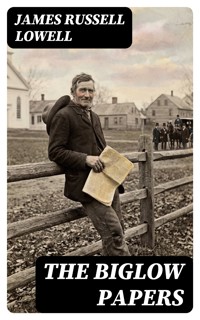
James Russell Lowell's "The Biglow Papers" is a remarkable satirical work that employs a unique mix of lighthearted verse and biting political commentary. Written in a dialect that captures the vernacular of rural New England, the collection comprises a series of poems articulated by the fictional character Hosea Biglow, reflecting Lowell's fervent opposition to the Mexican-American War. The literary style is notable for its use of humor, irony, and dialect, making the poems both accessible and profoundly resonant with the socio-political climate of 19th-century America. This work serves as a satirical response to contemporary issues of nationalism and war, solidifying Lowell's place within the American literary canon as one of its preeminent voices of conscience. James Russell Lowell, a prominent figure in the American intellectual landscape, was a poet, essayist, and critic who championed abolitionism and social reform. His education at Harvard and subsequent exposure to radical ideas undoubtedly influenced his worldview and fueled the creation of "The Biglow Papers." Furthermore, as a member of the Transcendentalist movement, Lowell was deeply invested in social justice, which is reflected in his sharp critiques of governmental authority and militarism expressed throughout the text. "The Biglow Papers" is essential reading for those seeking to understand the interplay between literature and politics, particularly in the context of American history. Its blend of humor and serious commentary invites readers to reflect on moral responsibility and civic duty. Scholars, students, and lovers of poetry alike will find Lowell's work both enlightening and entertaining, urging a critical examination of the complexities surrounding issues of war and national identity. In this enriched edition, we have carefully created added value for your reading experience: - A succinct Introduction situates the work's timeless appeal and themes. - The Synopsis outlines the central plot, highlighting key developments without spoiling critical twists. - A detailed Historical Context immerses you in the era's events and influences that shaped the writing. - A thorough Analysis dissects symbols, motifs, and character arcs to unearth underlying meanings. - Reflection questions prompt you to engage personally with the work's messages, connecting them to modern life. - Hand‐picked Memorable Quotes shine a spotlight on moments of literary brilliance. - Interactive footnotes clarify unusual references, historical allusions, and archaic phrases for an effortless, more informed read.
Das E-Book können Sie in Legimi-Apps oder einer beliebigen App lesen, die das folgende Format unterstützen:
Veröffentlichungsjahr: 2022
Ähnliche










The Biglow Papers
Table of Contents
Introduction
At once a Yankee’s homely voice and a scholar’s barbed pen, The Biglow Papers pits local conscience and plain speech against the abstractions of national ambition, exposing how public language wavers between moral witness and political ventriloquism, how humor becomes a weapon sharper than declamation, and how a small New England town can serve as a sounding board for a republic negotiating war, expansion, and identity in a performance that blends rustic idiom, editorial scaffolding, and nimble satire to test whether a democracy can hear itself think when power speaks loudest.
The Biglow Papers is a sequence of satirical verse and mock-editorial prose by James Russell Lowell, rooted in New England life and first issued in the mid-nineteenth century. The earliest pieces appeared in periodical form during the 1840s and were gathered soon after, with further sequences produced in the era of the American Civil War. As a hybrid of political poetry, comic persona, and regional dialect writing, the work belongs to a lineage of public satire that speaks directly to the moment of its making while cultivating a durable literary voice. Its setting is unmistakably Yankee, yet its targets are national.
Lowell builds a fictional apparatus in which a conscientious farmer, Hosea Biglow, addresses events of the day in pungent dialect, while a fastidious ministerial editor, Parson Homer Wilbur, introduces, annotates, and occasionally corrects him. The resulting alternation of homespun poems, letters, and pedantic commentaries produces a reading experience at once playful and pointed. The humor often turns on mismatches of register, sly etymologies, and local idioms, yet the stakes remain public and ethical. This structure allows readers to enjoy lively voices and nimble wordplay without needing specialized knowledge beforehand, since the framing voice guides, complicates, and sometimes gently misleads.
At its origin the sequence rose from protest against a contemporary war conducted in the name of national interest, and it persistently asks who profits when abstractions outrun civic duty. Questions of citizenship, conscience, and complicity recur as the speakers test the claims of policy against the grounded sense of a town meeting. Later additions from the Civil War era sharpen the book’s attention to the nation’s moral crisis without abandoning comic energy. Across the whole, the satire resists cruelty: it aims not merely to score points but to restore a scale of value where common life can be heard.
Much of the book’s force lies in its treatment of language as a field of power. The Yankee dialect is rendered with affectionate precision, revealing wit, resilience, and a habit of plain dealing, while the editor’s Latin-sprinkled excursuses lampoon learned pretension and official euphemism. Because the forms shift among ballad-like measures, epistolary asides, and scholarly apparatus, readers meet a collage of perspectives that keeps argument agile. The comic spellings and phonetic effects are integral to meaning, but they reward slow reading, and speaking them aloud clarifies rhythm and sense. The result is satire inseparable from voice, character, and place.
For contemporary readers, the book matters because it models how literature can scrutinize policy without surrendering to cynicism. Its portraits of rhetorical spin, partisan maneuver, and the press’s role in shaping opinion feel familiar in an age of platforms and feeds, yet its answer is not outrage for its own sake. Instead, it trusts citizen speech—discipline, humor, and local knowledge—to puncture grandstanding. The work also prompts reflection on who gets to represent a community and how dialect can empower or caricature, a live question wherever identity and politics meet. In this sense, its experiment in voice remains instructive.
Approached today, The Biglow Papers offers a layered conversation rather than a single argument: a citizen talks back, an editor tidies, and history presses in from the margins. Readers new to the period can simply follow the debate’s contours—the tension between expediency and ethics—and enjoy the comic reversals, letting unfamiliar names pass on first encounter. Those attuned to American literary history will also recognize an early, influential model of regional satire that helped naturalize political poetry in the United States. Without revealing outcomes, it is enough to note that the work insists public policy is a moral art.
Synopsis
The Biglow Papers, by James Russell Lowell, is a mid-nineteenth-century collection of satirical verse and prose presented through a set of fictional voices. Chief among them are Hosea Biglow, a young New England farmer who writes in a distinctive Yankee dialect, and the Reverend Homer Wilbur, a learned clergyman who claims to edit and annotate the pieces. Across two series issued years apart, Lowell uses this framework to comment on pressing national controversies. The interplay between rustic plain speech and pedantic editorial apparatus gives the book its structure, establishing a forum in which public arguments about policy, morality, and citizenship can be staged.
The first series emerges in the context of the Mexican–American War, which prompts enlistment drives, patriotic oratory, and partisan maneuvering. Hosea’s poems and letters question the necessity and justice of the conflict, pressing a moral critique of expansion undertaken for political advantage. The putative editor supplies elaborate notes that often miss the point, letting the dialect verse carry the sharper argument. Another voice, Birdofredum Sawin, writes as a recruit eager for adventure and reward, and his correspondence gradually exposes the gulf between recruiting rhetoric and experience. Through these contrasting personas, the book scrutinizes how language shapes consent and disguises costs.
As the first series unfolds, local scenes—town meetings, sermons, and neighborly talk—become a stage for national policy. Campaign slogans and editorial clichés drift into village life, and the work dissects their effect on judgment. The poetry alternates lively stanza forms with starker measures to underscore unease about recruitment tactics, bounties, and the burdens borne by ordinary households. While maintaining focus on the immediate war, the pieces repeatedly invoke the moral implications of slavery and conquest, suggesting that expedient victories can deform civic character. Without resolving every dispute, the sequence culminates in an insistence that conscience, not bombast, should guide collective choices.
The second series, written in the era of the American Civil War, revisits the same voices under changed conditions. Secession, national survival, and the future of slavery recast earlier arguments about duty and dissent. Hosea’s dialect plainness returns to weigh patriotism against partisanship, asking what loyalty demands when the republic itself is imperiled. Parson Wilbur once again supplies prefaces and notes that parody scholarly detachment while reflecting on how a nation reasons under stress. The interplay of speakers examines recruitment, profiteering, and resistance, but also the shaping of public opinion by editors and orators who frame necessity and compromise for their audiences.
Within this wartime setting, the papers track shifts in tone from early fervor to fatigue and reckoning. Sawin’s letters, colored by self-interest and rationalization, contrast with Hosea’s steady moral scrutiny, revealing how incentives can distort both speech and service. The series addresses controversies over wartime measures, civil liberties, and the uses of emergency power, while contemplating the status of formerly enslaved people and returning soldiers. Through satiric portraits of stump speakers and pliant newspapers, the work explores how expediency can erode principle. The editorial frame occasionally widens to consider what kind of peace would honor the sacrifices already made.
Lowell’s method relies on friction between styles. Hosea’s colloquial idiom, rich with regional turns, claims moral immediacy, while Wilbur’s ceremonious prose catalogs authorities, etymologies, and digressions that satirize learned posture. The result is not a continuous plot but a mosaic of documents—songs, letters, prefaces, and mock-scholarly apparatus—whose arrangement imitates a public archive of debate. Refrains, allusions, and recurring characters provide continuity as positions evolve across years. Humor carries much of the argument, yet the pieces repeatedly return to losses measured in homes and habits, insisting that grand policy appears most clearly when filtered through everyday speech and local judgment.
Taken together, The Biglow Papers offers a record of how Americans argued about war, union, and justice while those issues were unsettled. By binding national questions to a particular voice and place, the work preserves New England vernacular and tests the capacity of satire to influence civic thought. Its enduring resonance lies in the tension it dramatizes between convenience and conscience, expertise and common sense, rallying cry and considered principle. Without claiming final answers, it models a public conversation conducted in competing registers, suggesting that a democracy’s health can be heard in the language it uses to explain its choices.
Historical Context
The Biglow Papers, first appearing in the Boston Courier between 1846 and 1848 and collected in book form in 1848, arose within mid-nineteenth-century New England’s bustling print culture and reform politics. James Russell Lowell, a Massachusetts poet linked to the Fireside Poets, adopted a rural Yankee voice to comment on national affairs from a New England vantage. The fictional Hosea Biglow and his circle speak in dialect rooted in Massachusetts village life, reflecting regional speech, Congregational parishes, and town-meeting habits. The immediate backdrop was the Mexican–American War, but the larger setting included Boston’s literati, abolition gatherings, lyceum lectures, and partisan newspapers that mediated political debate.
In 1846 the United States entered war with Mexico after clashes along the disputed Texas–Mexico border, following the U.S. annexation of Texas. President James K. Polk, an expansionist Democrat, pursued territorial acquisition under the banner of Manifest Destiny. Whig politicians, many New England clergy, and abolitionists condemned the conflict as unnecessary or unjust, fearing it would expand slavery into newly seized lands. The Wilmot Proviso debate of 1846–1847 dramatized these concerns. With volunteer regiments mustered and bounties offered, the war generated recruiting rhetoric that Lowell targeted. The Treaty of Guadalupe Hidalgo in 1848 ended the war, ceding vast territories to the United States.
Lowell wrote amid intensifying antislavery activism in Massachusetts. William Lloyd Garrison’s Liberator had, since 1831, agitated for immediate emancipation; Frederick Douglass lectured widely in New England; and churches, colleges, and lyceums hosted abolition debates. The emergence of antislavery politics—first the Liberty Party and then, in 1848, the Free Soil Party with its “Free Soil, Free Speech, Free Labor, and Free Men” slogan—gave reform a new electoral vehicle. Lowell’s satire attacked “doughfaces,” Northern politicians compliant with slaveholding interests, and criticized party maneuvers that subordinated principle to expediency. These pressures shaped The Biglow Papers’ tone, aligning its vernacular moral voice with Northern dissent.
Formally, the work adapted a popular American tradition of satirical “letter” writing in dialect. Earlier models included Seba Smith’s Major Jack Downing letters, which used a Down East persona to comment on national politics. Lowell created Hosea Biglow, the pedantic editor-parson Homer Wilbur, and the hapless soldier Birdofredum Sawin to frame debates in rural idiom, contrasted with Wilbur’s mock-scholarly notes. Spelling and phrasing imitate New England speech without obscuring argument. This mixture of vernacular wit and editorial apparatus let Lowell puncture rhetorical inflation, expose contradictions in policy, and appeal simultaneously to newspaper readers, town-meeting sensibilities, and Boston’s literary audience.
New England’s civic institutions supplied both subject matter and forum. Town militias, recruiting offices, and public meetings disseminated war appeals, while churches and lyceums hosted prayers or lectures contesting them. The region’s Whig-leaning press, including the Boston Courier, debated Polk’s policies with Democratic papers, and the electric telegraph, introduced in 1844, sped battlefield news into editorial rooms. In this atmosphere, antiwar verse and editorials circulated alongside enlistment broadsides. Lowell’s contributions transformed these debates into comic verse that underscored moral costs, highlighting how local speech, parish life, and town governance shaped resistance to expansionist policy and the rhetoric justifying it.
During the American Civil War, Lowell revived the Biglow persona to address the Union crisis. The Atlantic Monthly, founded in Boston in 1857 with Lowell as its first editor, became a principal venue; many Second Series pieces appeared there between 1862 and 1866 before collection in 1867. The new poems treat secession, loyalty to the Union, and slavery’s centrality to the conflict, responding to evolving policy from initial war aims to the Emancipation Proclamation of 1863. They also register home-front concerns—recruiting, morale, and local politics—as New England towns mobilized men and resources for a protracted, brutal national war.
The Civil War’s international dimension also touched the work’s horizon. Britain’s 1861 declaration of neutrality, debates over cotton diplomacy, and episodes such as the launch of the Confederate raider CSS Alabama from British yards strained Anglo‑American relations. Northern commentators criticized perceived foreign sympathy for the Confederacy and pressed claims for damages, later settled by arbitration in 1872. Within this climate, Lowell’s satire occasionally turns outward to transatlantic opinion while reaffirming a democratic, anti‑slavery national identity. The vernacular speaker’s judgments thus extend beyond village boundaries, measuring American policy and character against republican ideals and the world’s scrutiny during a civil conflict.
As a whole, The Biglow Papers harnesses regional speech, newspaper forms, and comic masks to critique mid‑nineteenth‑century American politics. The first series challenges expansionism and the political calculus that tolerated slavery’s growth; the wartime series reaffirms Union and emancipation as moral imperatives. By casting judgment through a plainspoken New England farmer and a fussy village parson, Lowell juxtaposes democratic common sense with elite rationalizations, dramatizing the era’s clashes over conscience, law, and national purpose. The work reflects its period’s institutions—press, church, town meeting—and exposes the rhetoric that sustained war, offering a historically grounded satire of policy, party, and public opinion.




