


Erhalten Sie Zugang zu diesem und mehr als 300000 Büchern ab EUR 5,99 monatlich.
- Herausgeber: Aniara
- Kategorie: Bildung
- Serie: The Futurica Trilogy
- Sprache: Englisch
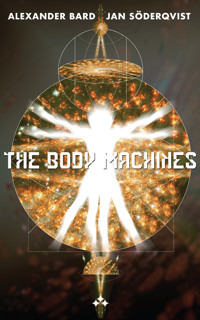
The digital revolution entails that all important aspects of our existence fundamentally change: How we see the world and how we see ourselves, how we think, how we work, how we relate to and communicate with each other, and what is even possible to imagine. Everything is set in motion, which means that Philosophy must also set itself in motion. It must philosophize about its own movement, and even about movement as such. The history of who we are, where we come from, and where we are going must be rewritten. This is what Alexander Bard and Jan Söderqvist perform in The Futurica Trilogy, originally published between 2000–2009. The Body Machines delves into the philosophical consequences of the dissolution of the concept of The Individual, which follows from the new all-powerful network structures.
Sie lesen das E-Book in den Legimi-Apps auf:
Seitenzahl: 436
Veröffentlichungsjahr: 2025
Das E-Book (TTS) können Sie hören im Abo „Legimi Premium” in Legimi-Apps auf:
Ähnliche















The Futurica Trilogy
The body machines
Alexander Bard & Jan Söderqvist © 2025
Aniara Press AB, Stockholm
www.aniara.one
Book cover & typesetting
Per Gustafsson (modernstyle.se)
TABLE OF CONTENTS
1. The Rise and Fall of the Soul
2. A Brief History of the Brain
3. The Problem With Subjectivity
4. The Myth of the Ego
5. The Myth of Free Will
6. The Mechanisms of Thought
7. A Short History of Language
8. The Rise and Fall of Morality
9. The Curse of Cultural Relativism
10. The Ethics of Interactivity
11. The Theory of Schizoanalysis
12. The Practice of Schizoanalysis
+1 (A Sort of Afterword)
Futurica Glossary
1.
THE RISE AND FALL OF THE SOUL
It is an old familiar truth, a well-worn turn of phrase, that taxes and death are the only certainties in life. But let no-one suggest that we human beings have not done our utmost throughout history to wriggle out of both of these. People exhibit the most astonishing creativity in trying as hard as they can to keep their income and fortune to themselves. New talents are constantly being recruited to the hydra-headed and highly paid corps of professionals who spend all of their time doing precisely this for the benefit of the rest of us. And as regards death, the campaign is being fought with a good deal of intensity on a number of fronts.
Efforts to cheat death were a dominant theme in even the very earliest literature. Gilgamesh, the hero of the Sumerian epic that bears his name – and whose oldest versions are over 4000 years old – bitterly mourns the death of his friend and brother-in-arms, Enkidu, and draws far-reaching conclusions regarding himself.
‘What became of my friend Enkidu was too much to bear so on a far path I wander the wild.
How can I keep silent? How can I stay quiet?
My friend, whom I loved, has turned to clay,
my friend Enkidu, whom I loved, has turned to clay.
Shall not I be like him and also lie down,
never to rise again, through all eternity?’
TABLET X, LINES 242-248, TRANSLATION: ANDREW GEORGE
Gilgamesh says this, after a great many adventures, to his friend Utanapishti, who has been granted eternal life by the gods, and who, to Gilgamesh’s astonishment, replies that all our striving for immortality only leads to worse suffering and the devastation of our short lives.
Mere mortals are thus by definition mortal (and Utanapishti is the exception that proves the rule), doomed to return to clay. The decay associated with ageing is hard to deny. But this is not to say that there are no loopholes. There is an elegant solution to the problem if you maintain that material reality, in which ageing and decay take place, is actually only secondary in relation to another, more real, reality. The body – that which ages and decays – becomes in this sense merely a body, a piece of transient materia, a feeble and worldly object. What is important, or, in a literal sense, essential, and that which raises humankind above the rest of creation, is the body’s ghostly inhabitant: the soul. And the point of the soul is precisely that it really belongs to the higher, more real, reality. It is only on a more or less temporary visit to the painfully turbulent transitory world where decay inexorably advances.
In many ways the soul is a brilliant concept, because it solves several different existential problems. It makes the body’s fragility and limitations easier to live with, it eases our fear of death, it gives us at least partial absolution from desires we regard as low and dirty (these get blamed on the bestial body instead). The soul is the eternally constant and immutable lodestar of our unquiet and changeable personality, our link to the supra-real world of ideas, and the part of us that enjoys immortality. It guarantees a continuation of the life we are so reluctant to give up – and which we therefore need not care too much about how we live, or perhaps not even live particularly carefully at all, seeing as time, thanks to the soul, is unlimited – at the same time as it promises a total make-over of everyday greyness and exhaustion for anyone who plays their cards right. The soul thus constitutes the very cornerstone of the construct that imbues everything with a higher purpose. It’s hardly surprising that this concept has proved incredibly popular.
In its early, preliminary prototype-phase, the soul is seen as life itself, the thing which leaves the body at the moment of death to enter, more or less reluctantly, into the underground realm of death. In Ancient Greece the soul was called psyche, a word with its roots in breathing and breath. The Iliad tells of how Achilles stops Hector, his ‘helmet flashing’, with his lance, thrusting it ‘clean through the tender neck’. The mortally wounded warrior asks his slayer to make sure his corpse is not eaten by dogs, but no measure of sympathy is forthcoming:
‘Death cut him short. The end closed in around him.
Flying free of his limbs
His soul went winging down to the House of Death,
Wailing his fate, leaving his manhood far behind,
His young and supple strength.’
BOOK 22, LINES 425-429, TRANSLATION: ROBERT FAGLES
What is evident here is that later ages’ confidence in life after death is absent from this preparatory developmental stage of the concept of the soul. The soul of the dead man wails, and with good reason. Admittedly, final extinction is not, thanks to the existence of the soul, an obligatory consequence of death, but this is nothing to be happy about when the alternative – the House of Death, Hades – is regarded as a fate worse than death. As the years passed, it proved necessary to rectify this unappealing flaw, if for no other reason than to enthuse soldiers on the battlefield. The same ideological development occurred among the Greeks’ neighbours and rivals in Persia and Egypt. As a consequence, those who fought in the Trojan War, whom Homer regarded as perfectly ordinary mortals, are elevated to demigods by Hesiod in the latter half of the eight century BCE. As a result, they avoided passage into Hades and were instead able to spend eternity strolling gently around on The Islands of the Blessed without a care in the world.
Within the Orphic and Dionysian cults several centuries later, the soul starts to undergo a sort of cleansing process which elevated its status to an almost holy level. From having been the power that breathed life into the body, and which left its bodily abode at death, the soul was transformed into an independent phenomenon with a direct connection to the divine. As a result, the soul ended up in an oppositional relationship to the body, longing for liberation. This also brings with it, of course, a dualistic way of thinking: human beings are, on the one hand, the soul, and on the other, the body. The soul represents what differentiates humankind from animals – the elevated, the disciplined, the refined, the civilised – whereas the body represents the bestial in humankind – the low, the wild, the shameful, the barbaric. This division between soul and body is nothing to regret, though. The divorce of the soul from the body is elevated to the decisive existential experience in life, the event in relation to which everything else in life gains its meaning.
Plato adds his full weight to this elevation of the soul. He is also the first of the Greek philosophers to deal systematically with the soul in writing. The imperfect body and its unreliable perception apparatus is a burden and a prison for the soul. Only once it has cast off its physical chains can the soul approach and perceive the truth. When ‘the soul when using the body as an instrument of perception, that is to say, when using the sense of sight or hearing or some other sense’, Plato writes in the dialogue Phaedo,
‘the soul too is then dragged by the body into the region of the changeable, and wanders and is confused; the world spins round her, and she is like a drunkard when under their influence.’
TRANSLATION: BENJAMIN JOWETT
Because Socrates, Plato’s mouthpiece in Phaedo, has devoted his life to philosophy, there is no need for him to fear the death sentence he has received. Anyone who is distraught as death approaches cannot be a true philosopher, he says, no ‘lover of wisdom, but a lover of the body’. Instead, Socrates sees philosophy as a single long preparation for death, an activity intended to distance itself from the body and its desires. He has good reasons for this:
‘For the body is a source of endless trouble to us by reason of the mere requirement of food; and also is liable to diseases which overtake and impede us in the search after truth: and by filling us so full of loves, and lusts, and fears, and fancies, and idols, and every sort of folly, prevents our ever having, as people say, so much as a thought. For whence come wars, and fightings, and factions? whence but from the body and the lusts of the body? For wars are occasioned by the love of money, and money has to be acquired for the sake and in the service of the body; and in consequence of all these things the time which ought to be given to philosophy is lost. Moreover, if there is time and an inclination toward philosophy, yet the body introduces a turmoil and confusion and fear into the course of speculation, and hinders us from seeing the truth.’
A soul which has kept itself pure by the practice of philosophy can be reunited after death with the divine and immutable beauty and wisdom in which it has its ultimate origins. Souls sullied by sensual pleasures become, in contrast, miserable ghosts wandering through Hades as they wait to be reborn into some wretched and lesser creation. As a result, Socrates drinks his poison without hesitation, in the secure knowledge that something better awaits him. He has nothing to gain by postponing the death sentence, as he explains to the miserable disciples who shed misdirected tears as they watch the death sentence being carried out. On the contrary, they should be as happy as Socrates is. Death’s bell is actually tolling for the philosopher’s liberation. At long last, the soul can disentangle itself from the heavy burden of the body and rise into the light to think pure thoughts.
The relationship between body and soul is less antagonistic and more complementary for Plato’s headstrong pupil Aristotle. What Plato saw as a fundamental split between spirit and flesh, Aristotle sees as an indissoluble unity of form and materia, two substances in fusion, each of which can admittedly be dealt with separately in theoretical contexts, but which in practice cannot be separated from one another. According to this view, the body is a piece of materia with a certain potential that the soul realises, and which at that very moment comes alive. To be soulless is thus also to be formless and lifeless. But without a body there is, on the other hand, no potential to realise, so the body has nothing to be ashamed of.
The connection between body and soul is consequently not, as it was for Plato, anything that spiritually aware philosophers have the slightest reason to regret, but instead a precondition for life. And life interests Aristotle far more than pure thoughts in an imagined world that isn’t ours. Everything living has a soul, people and animals and plants, and the various species’ souls vary in their development and degree of refinement. The fact that form is always superior to materia in Aristotle’s hierarchy of world order does not mean that the body must be resisted or condemned. Its nature is decisive for the shift from potential to reality. What Plato saw as a necessary evil is for Aristotle necessarily something good. Body and soul are each other’s eternal companions. Humankind’s bestial nature is not a necessary evil, but a necessary good in order that the humanity in humankind can be realised.
Biblical and early Christian views of the relationship between body and soul vary. It is not merely the saviour’s immaterial soul that leaves the grave and ascends to heaven after the crucifixion, but body and soul together. ‘And if thine eye offend thee, pluck it out,’ Jesus says in Mark’s Gospel, and goes on: ‘it is better for thee to enter into the kingdom of God with one eye, than having two eyes to be cast into hell fire.’ No chance of getting shot of the body, in other words, it’ll go with you to paradise in its current state.
In his City of God, St Augustine brought clarity to the question of the division of guilt where Original Sin was concerned. He claimed that the body could not have led the soul astray. On the contrary, it was the sinful soul that despoiled the feeble but, in this context, innocent body. In Dante’s Divine Comedy, which also offers a detailed catalogue of every imaginable sin and its judicial consequences in the highest court of all, the entire conflict has moved onto the territory of the soul, even if earthly matter happens to be the arena where the conflict arises under unfortunate circumstances. ‘Voluntary love’ can, unlike ‘innate love’ be turned to evil. The trick, or possibly the divine gift, is probity combined with Aristotelian moderation:
‘The natural love can never go astray.
The other, though, may err when wrongly aimed,
or else through too much vigour or the lack.
Where mind-love sets itself on primal good
and keeps, in secondaries, a due control,
it cannot be the cause of false delight.
But when it wrongly twists towards the ill,
or runs towards the good too fast or slow,
what’s made then works against its maker’s plan.
Hence, of necessity, you’ll understand
that love must be the seed of all good powers,
as, too, of penalties your deeds deserve.’
PURGATORIO XVII, LINES 94-105,
TRANSLATION ROBIN KIRKPATRICK
During the early medieval period the much discussed and influential Irish theologian Johannes Scotus Erigena united Platonic metaphysics and Neo-platonic mysticism with Christian thinking about the fall of man. Sin, a form of misdirected and over-ambitious thirst for knowledge, a product of the bestial side of human nature, ruined forever the harmony of the altogether perfect world created by God; sinful man was punished quite literally with death. But death was, on the other hand, in the good Platonic sense, actually not so much death as a passage to another, higher form of life, a real hike upwards in the metaphysical hierarchy. With Erigena, humankind liberates itself from materia and unites with its own idea, becoming itself in spiritual perfection, as an integrated part of the universal whole.
While religious dogma was calcifying in monasteries and cathedral schools, while Erigena’s works ended up on the Vatican’s index of censured heresies, while spokesmen for heretical opinions were being burned at the stake, then both competing ideas and the nuances of this dualism disappeared. The dualism thereafter steadily becomes stricter and more categorical. An image develops of the human soul standing passively beside Jesus, like a bride beside her groom, while the body is associated with Christianity’s infernal opponents. A continual struggle rages over life and death.
René Descartes bears more responsibility than anyone else for recent thinking about body and soul. Even though he is rarely read these days, his reasoning and conclusions have taken firm root in the western self-image. And this in spite of the fact that Descartes’ ambition to balance faith with the natural sciences results in a mixture of riotous independence against philosophical authorities with an either genuine or tactical obsequiousness in the face of the diktats of the Church, a bizarre hybrid that can, admittedly, be seen as the product of one of history’s revolutionary paradigm shifts, but which today leaves a very strange impression.
In his desire to attain total wisdom through a philosophical system which would explain humanity and nature in exhaustive detail, Descartes starts from a position of radical doubt. He not only doubts everything he has ever heard and read, but even doubts the evidence of his own senses. The fire and his dressing-gown could have been conjured forth by an hallucination, or simply dreamed up. Nor can the dogmatic doubter trust the basics of geometry. Certainly, a square always has four sides, but it is impossible to reject entirely the possibility that God or, perhaps more likely, some evil demon wants to spread this perception with the help of metaphysical deception, meaning that it is a false belief, while at the same time those responsible have de facto created the world in such a way that a quadrilateral has three or –why not? – nineteen sides.
No, the only thing a sufficiently doubtful doubter cannot doubt, according to Descartes, is doubt itself. And doubt can only exist if there is a doubter who exercises this doubt, whose existence can thus not be doubted. Therefore he too must exist, and this ‘I’ which undoubtedly exists is the fixed point from which the whole of the philosophical system stems. Cogito ergo sum (or in French: Je pense, donc je suis) – I think (that everything is false), therefore I am.
For Descartes, therefore, thinking precedes existence. The thinking ‘I’ has no justifiable reason to doubt its own existence as long as thinking itself does not cease, whereas, on the other hand, it is a simple matter to think the body out of the thinking process. ‘I thereby concluded,’ writes Descartes in Discourse on Method, ‘that I was a substance, of which the whole essence or nature consists in thinking, and which, in order to exist, needs no place and depends on no material thing; so that this “I”, that is to say, the mind, by which I am what I am, is entirely distinct from the body, and even that it is easier to know than the body, and moreover, that even if the body were not, it would not cease to be all that it is.’ (Discourse 4, translation: F. E. Sutcliffe)
The soul and the body are, in other words, two opposing aspects of life, utterly distinct from one another. Each is all that the other is not; the body is material and possesses extension, the soul is immaterial and possesses consciousness rather than extension. This consciousness devotes itself to thinking in various forms, of which the body is consequently incapable. Descartes even uses the expression ‘body machine’ to underline the fact that the body is incapable of doing anything on its own other than follow pre-programmed instructions.
Only human beings have a soul, which confirms our unique place in creation, a supposition which both the philosopher’s deeply religious contemporaries and the humanists of future generations have noted with great satisfaction. Animals have, and are, only their bodies; in other words, they are soulless automata, body machines. And death can, Descartes claims, never be the fault of the soul, but merely a consequence of one or more body parts failing to function. The living body is a mechanism which, in the same way as a clock, carries out the movements for which it is constructed as long as it is wound up and all the ingeniously designed components are in functional condition. The movements of the muscles are governed through the nervous system by the brain, whose function can be compared to that of a telephone exchange. It distributes signals, but it doesn’t think. The nerves are ‘like little filaments, little tubes’, full of ‘a certain very fine air or wind, called the animal spirits’ (The Passions of the Soul, translator: Stephen Voss).
This strict dualism, which categorically rejects any mix or overlap of the jurisdictions of soul and body, is difficult to maintain for long, however, even for Descartes himself. If we do have a soul, and if its thoughts are to mean anything at all in the material world of the body machines, it is of course impossible to exclude every form of contact. Besides, we can often perceive a link between what is thought, supposedly within the soul, and the actions of the body machine. Perhaps we feel like eating something nice, the soul takes over and thinks about what is in the cupboard and the fridge, and then the body makes a sandwich out of pastrami and pickle. Perhaps we have a brilliant idea in the shower, or wherever brilliant ideas usually occur – resulting in us rushing to the computer to write an essay or a chapter of a book. Or perhaps our souls are simply warmed when we hear a favourite piece of music.
In any case, there must exist somewhere inside the body a sort of coordination centre which translates the nerve impulse into a sensation of the soul, and then back again. We are faced with the so-called psychophysical problem, in other words: the question of how the possibly non-existent but still necessary communication between body and soul takes place. This question is uninteresting and even impossible to ask except within a fairly strict dualistic context, but it is impossible to answer if this dualism is too strict. And, sure enough, the question makes even Descartes soften his position considerably, not that this makes him particularly comprehensible on this point. He never answers the question within the framework of his own system, nor does he adjust his system in accordance with the implications of his own response.
There is a specific part of the body where the ‘the soul exercises its functions in a more particular way than in the other parts,’ writes Descartes in The Passions of the Soul. He has ‘examined the matter carefully’, and can state firmly that this part of the body is within the brain: ‘a certain extremely small gland, situated in the middle of its substance’, in other words: the pineal gland. But how did Descartes identify this particular little gland so emphatically? He used a process of elimination. All other parts of the brain, he says, exist in duplicate. But at any and each moment we have only one thought about any particular object. So there must be a place where the images from both eyes are combined into a unified impression. And there is nowhere else in the body where this could take place except this little gland. From then on, his reasoning disappears inexorably into thick banks of fog. Descartes quite simply believes that his supposition is entirely plausible and suitable. This little gland in the middle of the brain is where the animal spirits of the body and the will of the soul hold regular meetings, even though they, by definition, can never have anything to do with one another because, according to the fundamental rules of dualism, they are two completely different things. It isn’t really surprising that Descartes leaves the details of this impossible interaction somewhat unclear.
The psychophysical question is in fact unanswerable. Somewhere in the dualistic equation Descartes and his followers had to introduce a conjuring trick. The apple had to become a pear, but without anyone noticing how. As a result, the dualistic view is not so much a way of trying to figure out the psychophysical question, but a long-winded way of avoiding the entire issue. The explanation explains nothing. The game of patience works itself out, but only in your imagination. The cards have actually been reshuffled.
It would be great to be generous and regard Descartes’ many failings as limited by statute. But unfortunately they have had wide-ranging consequences that are still evident today. Holding Descartes by the hand has led not only the everyday psychology of ordinary people onto the wrong path, but also many sciences. As the American neurologist Antonio Damasio writes in his book Descartes’ Error, the question is actually where we should start if we are to try to bring order to this vast, post-Cartesian disaster.
To begin with: if thinking really is a precondition for existence, then there is a huge amount in this world that doesn’t actually exist. And that is clearly impossible. In actual fact, thinking developed gradually, of course, out of non-thinking yet absolutely existing creatures. We exist, and then we think, as Damasio says, and it is only insofar as we exist that we can also think, seeing as thinking is actually the product of processes in our body machines. Where else could it be produced?
Admittedly, the idea of thinking developing gradually was unthinkable in the 1600s. This was, after all, long before anyone had heard of the theory of evolution and the development of the species. But it is not unreasonable to claim that Cartesian dualism actually allowed greater room for manoeuvre for empirical research than had previously been the case, by so definitively separating the soul from the tangible world, and thereby indirectly reinforcing the Church’s monopoly on all spiritual matters. Studies into nature and the bodies which were entirely lacking a soul were clearly no threat whatsoever to the true faith, and therefore no longer had to lead to anyone being burned to death.
However, this happened at the expense of the horrible hubris of humanism. Thinking and reason were idealised beyond all reason. The soulful human being began to regard itself as the godlike and rightful lord of all the soulless raw material around it. At the same time, reason became its own blind spot, meaning that its own mechanisms generally and its irrational aspects in particular remained in complete darkness. This blinding arrogance is unfortunately still with us in many ways today. There are, for instance, still people who seriously claim that it is possible to say interesting things about the processes of consciousness without understanding anything about neuropsychology and neurochemistry.
Another consequence of Descartes’ error is that the ‘I’ itself that does the thinking – the individual which is the firm foundation of the Cartesian system – was granted almost sacrosanct status. The ‘I’ became the substitute of secularised and humanistic dualism for the religiously contaminated soul, a backdoor to an imaginary thinking free of materia, and a comforting if mistaken notion of the uniformity and unchanging nature of existence. This is an illusion that remains remarkably unchanged to this day, even though it lacks any basis in what we now know about how our body machines think, remember, feel and act. The ‘I’ became the metaphysical illusion around which developing industrial society constructed its entire worldview, not dissimilar to the way the preceding agricultural society had constructed its worldview around the metaphysical illusion of God.
The truth is that even if thinking seems to exist in the moment the thought is thought, this does not necessarily mean that any ‘I’ has to exist. It merely means that something at that same moment thinks ‘I’ and possibly has an ulterior motive in doing so. And nothing guarantees that the something which thinks in the first place is the same something that then thinks that something is thinking. It is a matter of two different thoughts at two different times, and there is no reason to assume that whatever calls itself ‘I’ on the one occasion has to be identical to the ‘I’ that does the same thing on the second occasion. One can only wonder why the otherwise so radical doubter Descartes never seemed to doubt this.
Descartes and his error are most definitely still with us today. A strictly mathematical approach to the processes of consciousness and thinking are still widely regarded as an expression of vulgar reductionism which undervalues humankind’s rich inner life and which deprives human beings of their dignity and meaning in the world. Because we feel so splendidly unique, and because we so desperately want there to be something beyond the perceptible, we decide that this must indeed be the case. Because it is in the nature of the thing that this spiritual dimension exists beyond perception, the absence of evidence is of no concern. And proving the opposite is just as difficult as proving that Father Christmas doesn’t exist. You can never be completely certain, of course. Maybe there are loads of old men with white beards and sleds pulled by reindeer up in the inaccessible icy wastes of Greenland, after all. You can never be sure.
Modern dualism appears in both hard and soft variants. According to a more compromising version – which appeals to many friends of a less specifically subjectivised faith in ‘something higher’ and various forms of ‘spiritual search’ – it is correct, from what we can see, that the interplay between the brain’s neurones has something to do with consciousness, at the same time as this can never be an all-encompassing explanation. The human capacity for discussing moral questions and maintaining a relationship with God, et cetera, cannot be reduced to chemical processes. Respect for these mysteries also demands that we accept the existence of a spiritual dimension which is somehow woven into life without it actually being here in any vulgar physical sense. The soul retains its role, in other words, albeit often under another name, and with certain limitations in its authority.
Dualism lives on in science in the widespread notion that consciousness and the brain are related in the same way as a computer’s soft- and hardware. The thinking ‘I’ is seen as a programme that uses a certain piece of body-machine equipment, but which in principle could just as easily use a different piece of equipment under different circumstances, with the same result. This is an idea that Damasio is vehemently opposed to. In a similar way, this ostensibly updated and materialistic computer metaphor conceals a dualistic train of thought within the standard model of cognitive science, where perception impulses are seen as ‘input’, compiled and transformed into ‘output’ in a control centre comparable to the computer’s processor, somewhere inside the brain.
This is a model that the philosopher Daniel Dennett energetically tackles in several books. He uses the term ‘the Cartesian theatre’ for this imagined command-centre of thought. The idea is roughly that Descartes was broadly right in his reasoning about the little gland, that there is somewhere inside the brain a special place where the ‘I’ lives and conducts the consciousness. All the impulses from the perceptual apparatus are directed to this coordinating centre and, once they are there, the impulses become conscious and accessible to the critical evaluation of the ‘I’. The theatre thus has a stage and projection screen where the impulses parade past. This constantly changing stream of consciousness-making impulses – in other words, our image of the reality around us – is consequently the performance which is constantly playing in the Cartesian theatre. And the audience is the ‘I’.
Central to this idea is the existence of a centre in the brain where consciousness arises as and when new content is supplied and without which consciousness could thus not exist. And this is probably what it seems like when people think about it: things seem to glide in and out of consciousness like actors making their entry only to slide out of sight once again into the wings. At any given moment there are a number of things that one is conscious of, because at that moment they are on the Cartesian theatre stage, being watched by the ‘I’, and there are simultaneously countless things of which one is more or less happily unconscious, simply because they are not on the stage.
However, this spatial metaphor, with an inside and an outside, is misleading in one Cartesian sense. The fact that something is conscious does not mean that consciousness has to exist in any given space, just as little as thinking itself proves the existence of the ‘I’. And if you examine the workings of the brain more closely, it soon becomes apparent that none of this exists. There is no centre, no superior function which coordinates impulses from other parts of the brain, no ‘papal neuron’, as William James sarcastically put it. Nor is there any specific point in time when ‘input’ changes into ‘output’, when one might be able to localise the activities of the thinking ‘I’.
What actually exists is an indescribably complex, constantly changing, lightning-fast pattern of parallel processes in the brain. That is all there is. In other words: what there is, is this single material reality, plus our experience of things gliding in and out of consciousness like a cavalcade of revue acts. On the one hand are the neurons’ electrochemical signals to each other, and on the other is the subjective perception of consciousness, how it feels right now to be the person one is and be doing what one is doing. The question of how the former produces the latter is, according to a widely accepted definition coined in 1994 by the philosopher David Chalmers, ‘the Hard Problem’ (as opposed to a series of ‘little conundrums’ such as perception, memory, learning, et cetera) within the study of consciousness. This, of course, is Descartes’ old question, albeit somewhat reformulated. The psychophysical question remains, therefore, unanswered. No-one has yet managed to explain comprehensively how that apple can turn into that pear.
Someone who spent years grappling intensively with this difficult problem in his own way was Sigmund Freud, who of course also made great contributions to how our age views the structures of our inner life. One purpose of the psychoanalytical method was, if possible, to build a tenable bridge across the apparently unbridgeable chasm between the Cartesian body machine and the whole of the fascinating provisional map of the more or less anxiety-strewn feelings of the soul. Instinct, a key concept for Freud, which regularly comes into equilibrium-shaking conflict with various censoring impulses, has its ultimate origins in the body. As a result, psychoanalysis was constructed on solid biological ground.
The problem was just that instinct could never be observed empirically, and still less could any connection be mapped between physiology and psychology. Freud was eventually obliged to be content with simply presuming that such a connection existed and moving on. What is interesting here is that the scientifically minded Freud, who admires Darwin and is predisposed to think in terms of human medicinal science, remains, when it comes down to it, a Cartesian dualist in the sense that he reasons in terms of seeking a link between two essentially different phenomena: body and soul. His failure means that the act of transformation, from apple to pear, in practice has to take place behind the closed curtain of the Cartesian theatre.
No-one in modern times has contributed more than Freud to keeping the venerable old theatre running. In The Interpretation of Dreams he guides us round the newly-renovated premises, pointing out the auditorium of ‘consciousness’, the wings of the ‘preconscious’, and the murky cellars of the ‘unconscious’. Here, the ‘ego’ conducts experiments in direction which are occasionally subjected to both internal and external attempts at sabotage, and which are continually observed critically by the artistic direction of the ‘superego’. The show’s script is written by the dreaming, instinct-led ‘id’ down in the cellar. The ‘ego’ and ‘superego’ look on, the ‘ego’ in order to correct and tidy up where necessary, to the best of its abilities, while the ‘superego’ keeps an eye on proceedings and makes major interventions where necessary in order to keep the theatre as a whole in decent condition.
The diluted variant of Freud’s conceptual apparatus has, for better or worse, together with selected extracts of his spectacular model of the human psyche, been incorporated into popular culture and everyday terminology. We therefore believe that we know in broad terms how suppression and sublimation work. And many of us, probably the majority, also subscribe without any great reflection to the Freudian version of dualism, where conscious confronts unconscious, culture confronts nature, and the link between body and soul is and will remain an insoluble problem.
But if a problem remains insoluble over many centuries, perhaps this is because the question is based upon faulty premises? Perhaps it is time to abandon dualism in all its forms, and once and for all shut down the Cartesian theatre? Perhaps it is time to stop asking how neurophysiological processes in the brain give rise to consciousness – or, in other words: how the apple becomes a pear – so that we can at last realise that there are not, and never have been, any pears, that all we have are apples, and that consciousness is precisely the brain’s neurophysical processes, and nothing else?
Of course it is possible to dig one’s heels in and continue to believe in dualism, barricading oneself inside the Cartesian theatre in a heroic effort to shut out all information that goes against everything one has always believed, and which therefore threatens to force a revision of one’s entire self-image. It is an entirely plausible and common reaction, to defend oneself against anything that contradicts one’s intuition and so-called common sense. After all, we can see that the world is flat and that the sun revolves around us, and we may as well burn at the stake anyone who says otherwise. The problem is just that our intuition is not infallible, and, above all else, it is no good basis for reliable knowledge.
Because dualism so well matches our experience of consciousness, its appeal is understandable. The same thing applies to the Cartesian theatre: it feels as though our little ‘ego’ is sitting there, receiving and evaluating sensory perceptions somewhere inside our head, perhaps even within the pineal gland. But in actual fact dualism does not explain anything, and the problem with the theatre, as we have seen, is that it simply doesn’t exist. This ought to be sufficient motivation for a rethink. At the same time, there is also good reason to remind ourselves that it is undeniably a big step to actually bid farewell to dualism, which has at least made it possible to talk about consciousness in a way that has done justice to the sensation of being conscious. Dualism has fulfilled, and still fulfils, many basic functions in our thinking about ourselves and our world, and filling the vacuum that its abolition will leave is no easy task.
This isn’t just about our anxiety about the inevitability of death and a pious wish to somehow live on in another, hopefully better, world. It isn’t just about setting off as a newly-formed pear and leaving everything to do with apples behind us. The soul and its many offshoots – the ego, the individual, free will, et cetera – constitutes, in many people’s eyes, a non-negotiable fundamental precondition if our difficult lives are to have any meaning whatever. If our consciousness does not obey an entirely different set of rules to those governing the rest of nature, we are undeniably reduced precisely to what Descartes so scornfully calls body machines, passive marionettes led astray in an ultra-materialistic inferno. Resistance to such a view of humanity is for obvious reasons robust and comprehensive. Particularly since there is still a lack of considered alternatives.
The philosopher and cognitive researcher Peter Gärdenfors says that one conclusion we must draw from all the collective research into the human brain is that it is evidently constructed to seek for meaning and contexts everywhere. Behind this obvious need is an evolutionary logic: we have an unquenchable thirst for meaning which turns us into compulsive puzzle-solvers, which in turn increases our chances of surviving and reproducing. The consequence is that we do not leave anything to chance, and when the picture is incomplete for whatever reason, we fill in the gaps we believe are there, often unconsciously. And where existential questions are concerned, the meaning of everything, there is undoubtedly a lot to fill in, one way or another.
The soul and a variously diffuse dualism has throughout history been the solution closest to hand, and for a great many people this still works very nicely. But for this solution to continue to work, we have to screw our eyes tight shut against all the new knowledge about the brain and consciousness which is gradually taking firmer shape, pressing ever harder against the doors of the Cartesian theatre. And this is, to a great extent, a matter of vanity. Or pride, if we’re being generous. This isn’t just about us not wanting to be equated to machines; it’s also incredibly important to us that we should in some qualitative way be differentiated from, and superior to, other animals.
Our immense need of a hierarchy blinds us. We don’t seem to be able to cope with not being unique, not being higher, not being superior to the world around us. The fact that the human genome turned out in the end to consist of only 30,000 genes – far fewer than the 100,000 which had generally been expected, and not really much more than for instance the 20,000 or so genes that the little roundworm Caenorhabditis elegans can boast of – was a serious blow to the self-image of modern humankind. Research which goes on to strip us of our immortal soul will not be greeted with universal acclaim.
This business of not being unique is not, of course, anything we need be particularly concerned about. The very fact that we are worried about not being unique makes us very unique indeed. Not to mention the fact that we are mapping our own genome and counting the number of genes. We know things that no other animal knows. What marks humankind out as unique ought therefore to be that we are constantly acquiring new knowledge, particularly knowledge which is counterintuitive and brings entirely new dimensions to what we know. What we really ought to be proud of is our evident ability to accept knowledge which contradicts our original intuition.
In a 1995 episode of the television series The Simpsons, young Bart Simpson is discussing the existence of the soul with his nerdy young neighbour, Millhouse. Bart claims that the soul doesn’t exist, that it’s just used to scare young children, rather like Michael Jackson. Millhouse believes the opposite. The soul is in there somewhere, he says, and it flies away when you die. How does it do that, wonders the doubtful Bart, if you die in a submarine? Well, the soul can swim, is the response of the firm believer. The soul has thus become, even in the USA, something that can be joked about and laughed at in animated sitcoms aimed at youngsters. And, in the focus of our era’s strenuous efforts to avoid the inevitability of death, the body machine naturally stands alone. The question that remains is more one of whether or not we really want to succeed.
If we one day actually manage to conquer ageing and thereafter suffer accidents to the same degree as the average healthy twelve-year-old, we will reach an average life expectancy of a thousand years. Assuming that everyone in society has access to the same technology. This would undoubtedly give rise to almost surreal problems of readjustment. But if, on the other hand, the technology was only accessible to a privileged few, this would mean entirely different but just as convulsive problems. We know, after all, that average life expectancy has increased dramatically over the past 200 years (thanks to better diet, hygiene, healthcare, et cetera), and that women in the western world are choosing to have children later in life, which, if the trend continues, will eventually lead to one of the decisive aspects of biological ageing process being radically modified. But at the same time as we make this claim, we have to set it to one side. Or, to be more precise: we will leave it for a completely different book, which will in all likelihood be written by another author.
We have a different agenda: our old ideas of an immortal soul which lives its own life, separate to the body, may be something dealt with in American television series nowadays, but this doesn’t mean that the vacuum left by this wishful thinking has now been filled by enlightened clarity of vision. These waters are sadly as murky as ever. It is so desperately difficult to look beyond our old, familiar pride and our intuitive misconceptions. Dualism’s comfort blanket is still a source of relief, and materialism still seems comparatively harsh and cold.
So, if there isn’t a soul sitting inside a little gland in the brain – what then? What is it that calls itself an ‘ego’, and which so desperately wants to ‘realise itself’, and which so enthusiastically claims that it is exerting ‘free will’ in every imaginable context (apart from those occasions when it is more practical to fall back on impediments caused by external influence or internal imbalance)? Does this mean that when it comes down to it we are all merely those same body machines that Descartes turned his nose up at?
Or is it that the question is wrongly formulated? What does that ‘merely’ mean? We intend to explore and discuss that reflex, common sense word, ‘merely’. That’s the main reason why we’ve written this book.
2.
A BRIEF HISTORY OF THE BRAIN
So, there’s really no desperate cause for concern: we human beings are unique. We are unique as a species, and we are also all unique as individuals – a fact that is constantly trotted out by well-meaning humanists whenever the biological substratum, our human nature, is mentioned. The real question, however, is: how much of a comfort is this? Every species is unique, of course, that much is obvious, otherwise it would be impossible to differentiate it from other species. And if each and every one of us really is so terribly unique and special as we are supposed to be, it is tempting to conclude that being unique is not in itself particularly unique. Because each and every one of us can make that claim! We are, however, unique in various ways that flatter our own vanity. Compared to other species, for instance, we human beings have a remarkably large brain in relation to the rest of our body. We also have relatively large penises. Some of us take comfort and delight in the former, whereas others attach more significance to the latter. Regardless of which one chooses to emphasise, there is a connection between the two of them, a connection to which we shall return later on.
The size differential between brain and body can be measured using various index systems. One accepted method is to work out a so-called EQ (encephalisation quotient), which attaches a value to the weight of the brain in relation to the weight of the body, compared to an average from other more or less closely related species – other mammals, for instance. The EQ value of any given species therefore reveals how large the brain is in relation to the body compared to how large it might be expected to be in an animal of a certain body-size within a particular category.
Human beings come up with an EQ value of 7.44, compared to the rabbit’s 0.40, the horse’s 0.86, the chimpanzee’s 2.49 and the dolphin’s 5.31. Admittedly, the elephant has a larger brain than us, but because its body is so much larger, it has a lower EQ value (1.87). This means that a remarkable proportion of the elephant’s large brain is tied up with the considerable and demanding routine requirements of maintaining such a large body. Our human brain, on the other hand, uniquely large in relation to our not particularly large body, is, to a uniquely large extent, free to use its uniquely large excess capacity for other purposes, such as worrying about the meaning of life, the universe and everything.
Average brain-volume for us human beings is somewhere around 1,400 cubic centimetres. Our heads are so large that we are born at an earlier stage of our development than would in other respects be regarded as optimal. Few other species produce offspring that are so helpless at birth as we do, and so exposed to the caprices of their parents. The large head with the large brain is the result of what, in terms of evolutionary history, is a dramatic and uniquely rapid development. Our predecessors on the savannah managed to survive and reproduce with a brain-volume of around 500 cubic centimetres. But then something quite revolutionary occurred. We are talking here about the trebling of brain-volume in less than three million years. This level of growth demands an explanation. How is it possible for evolution, which usually moves at such a glacially slow pace, to take such a sudden leap? What on earth could the reason for this be? Let us begin by looking at what the brain actually is, and what is actually does.
The early development of the brain and its original tasks are most clearly evident if we observe the subtle but no less decisive difference between having a minutely small brain and having no brain at all. Our unassuming little relative (we are all related, after all) the sea squirt lives an ostensibly quiet life on the seabed. This transparent little gelatinous sack sits there, firmly anchored by a stalk-like device, and spends all its time filtering water which it draws in through an opening on one side of its slender body, and blows out through another opening on the other side.
Yes, this is what the sea squirt’s entire existence consists of: water in, water out, and the filtration of nutrients into its digestive system. Well, actually, no. That isn’t quite all. Occasionally the accumulation of particles gets too large, whereupon the filter shuts off. On these critical occasions the sea squirt is obliged, through the use of powerful muscular convulsions, to expel the entire contents of its gut. The sea squirt simply throws up. But otherwise the adult sea squirt’s life is noticeably free of what we might call drama. This includes its sex-life. In its capacity as a hermaphrodite it mates quietly with itself and thus avoids having to compete with rivals.
The sea squirt’s childhood is rather more eventful. The microscopic little larva is pumped out into the water and swims about for a day or so looking for somewhere suitable as its permanent abode. At this point it is aided by a brain-like ganglion, a sort of bundle of nerves consisting of some 300 cells. This proto-brain receives sensory information from its surroundings via, among other things, a sense of balance and a light-sensitive strip of skin. Thanks to this system, the larva has a chance of orientating itself in the changing world around it, and can eventually find a new home. Once it has reached the desired spot, it drills down into the seabed and undergoes rapid development to adulthood, thus becoming a stationary sea squirt. An important component in this process is that the sea squirt absorbs, or rather consumes, its own brain, which it no longer perceives itself to need, and so is transformed into food. The sea squirt is done with thinking.
The reason why we have chosen to spend time with this remarkable little chordate, a close relative of us vertebrates, is not to draw parallels to cultural journalists or university lecturers who, after a period of uncertainty and anxiety as part-timers and freelancers, eventually manage to get hold of a permanent post and can therefore settle down and stop thinking. No, the point is to illustrate, following the work of neurophysiologist Rodolfo Llinás and others, the fundamental idea that the evolutionary development of the brain and the nervous system is linked to movement.
An organism that is in motion yet which lacks a brain is quite literally fumbling in the dark. In such circumstances even a miniscule brain, something which can give a rough idea of where light is coming from, is a devastating advantage in the struggle for survival, and consequently something richly rewarded by natural selection.




