


4,79 €
Mehr erfahren.
- Herausgeber: New Island
- Kategorie: Gesellschafts- und Liebesromane
- Sprache: Englisch
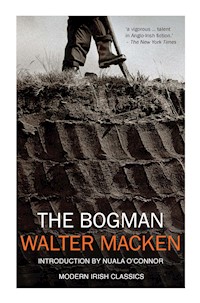
Orphaned as a child, Cahal Kinsella returns from an industrial school in Letterfrack to the small farming village of Caherlo in West Galway, to live under the rule of his tyrannical grandfather. Cahal must learn to assert his individuality if he is to have any hope of freedom from his misery. With humour and humanity, Walter Macken paints a haunting, memorable portrait of the hard life of subsistence farming, of loveless arranged marriages, and rebellion against suffocating social mores. Written in 1952, this masterpiece is brought back to life in New Island's Modern Irish Classics series.
Das E-Book können Sie in Legimi-Apps oder einer beliebigen App lesen, die das folgende Format unterstützen:
Veröffentlichungsjahr: 2020
Ähnliche



















Walter Macken was born in Galway in 1915. A prolific writer, Macken wrote numerous short stories, articles, plays and children’s books, in addition to his ten novels. Much of his early life was bound up with the theatre. A talented actor and playwright, he was involved in the production of some seventy-seven plays between 1939 and 1947 alone, before becoming Assistant Manager and Artistic Advisor with the Abbey Theatre in the 1960s. Following his onstage success, Macken was offered an enormous sum of money to star in a US-based film production. He refused, saying he had to ‘go home to finish a novel’. That novel became The Bogman (1952), and six further novels would follow. He died in 1967 in his native Galway at the age of just fifty-one.
Praise for Walter Macken
‘As a writer, Macken was attuned to the menacing depths that lay behind the physical exterior: the infertile bogland that makes farming problematic, the harsh character of the inhabitants, their callous treatment of one another, their superstitious religiosity and frustrated love affairs.’
The Irish Times (2013)
‘Again, a born story teller has shared his seeing and feeling in words that sing to his readers.’
Kirkus Reviews (1952)
‘This, Walter Macken’s fourth novel in four years, marks the steady rise of a vigorous new talent in Anglo-Irish fiction. His “Rain on the Wind,” published here last year, was a very good novel. “The Bogman,” a fresh, free-flowing, affirmative story of life in a small Irish village of six families, is an even better one.’
The New York Times (1952)
‘Just how influential he had been in Irish theatre in his day and his body of work of plays, novels, short stories and children’s books is incredible. If this man lived anywhere else he would be revered.’
Connacht Tribune (2014)
‘Wise and compassionate and violently Irish’
Harper’s Magazine (1952)
Also by Walter Macken
Novels
Quench the Moon (1948)
I Am Alone (1949)
Rain on the Wind (1950)
Sunset on the Windowpanes (1954)
Sullivan (1957)
Seek the Fair Land (1959)
The Silent People (1962)
The Scorching Wind (1966)
The Brown Lord of the Mountain (1967)
Short Stories
The Green Hills and Other Stories (1956)
God Made Sunday and Other Stories (1962)
City of Tribes (1966)
The Coll Doll and Other Stories (1969)
Children’s Books
The Island of the Great Yellow Ox (1966)
The Flight of the Doves (1968)
Plays
Mungo’s Mansion (1946)
Vacant Possession (1948)
Home is the Hero (1952)
Twilight is the Warrior (1956)
The Bogman
The Bogman
Walter Macken
Introduction by Nuala O’Connor
THE BOGMAN
First published by Macmillan & Co, London 1952
This edition published 2020 by
New Island Books
16 Priory Office Park
Stillorgan
County Dublin
Republic of Ireland
www.newisland.ie
Copyright © Literary Estate of Walter Macken, 1952, 2020
Introduction © Nuala O’Connor, 2020
The right of Walter Macken to be identified as the author of this work has been asserted in accordance with the provisions of the Copyright and Related Rights Act, 2000.
Paperback ISBN: 978-1-84840-773-2
eBook ISBN: 978-1-84840-774-9
All rights reserved. The material in this publication is protected by copyright law. Except as may be permitted by law, no part of the material may be reproduced (including by storage in a retrieval system) or transmitted in any form or by any means; adapted; rented or lent without the written permission of the copyright owner.
British Library Cataloguing Data. A CIP catalogue record for this book is available from the British Library
New Island received financial assistance from The Arts Council (An Comhairle Ealaíon), Dublin, Ireland.
New Island Books is a member of Publishing Ireland.
10 9 8 7 6 5 4 3 2 1
Introduction
Nuala O’Connor
If a good novel is designed to entertain, to give insight into other lives, to help us understand human desire, and to inform us about places different to our own, then The Bogman is a success. That the story of Cahal Kinsella, the eponymous bogman, is delivered in rich Hiberno-English only adds to the charm of this novel. The writing is energetic and lucid, and the descriptions are as vivid as a Paul Henry painting, complete with thatched cottages, potato drills, avenues of silver beeches, teeming waters, and unforgiving farmland. The language is beautifully musical and reads as if translated directly from Irish. Phrases like ‘What’s under you?’ dot the narrative, directly translating ‘Cad atá fút?’ meaning ‘What’s the matter with you?’, and the prose feels richer for them.
Walter Macken knew the language and the people he wrote about. A Galway native, he worked for many years at An Taibhdhearc, the national Irish-language theatre. Born in 1915, he and his siblings were raised in Galway city by their mother, after their father died in 1916, serving in the First World War. As a fatherless boy, living through civil war, Macken may have drawn from his own life experiences for the story of Cahal Kinsella. Certainly he set the novel in a place he knew well; his mother’s hometown of Eyrecourt, near Ballinasloe in East Galway, became Caherlo in the book. The teenage Macken spent summers there, working his stern uncle’s farm, a man believed to be the model for Cahal’s brooding grandfather Barney in the The Bogman.
Cahal Kinsella is a fearless and intelligent sixteen-year-old, unbothered by the surly Barney Kinsella, when he returns to Caherlo from the Industrial School he was sent to as a six-year-old. Caherlo is a scattered rural townland ‘near a bog, near nowhere’. It’s a place of whitewashed thatched cottages with ‘small-mouthed windows’ and the boy has been brought home to work. Cahal is, on the face of it, unaffected by his own past as a son born out of wedlock to Barney’s favourite daughter, who is long gone to America. Cahal is sensitive, strong and able, a quiet balladeer, but a person who draws trouble to himself with terrible ease; he wanders from one catastrophe straight into the embrace of the next. He falls into bogholes; he surprises a swimming, naked girl; he gets into a fight with an angry Traveller at a holy well; he stumbles into a bad love-match. Cahal, though mostly unknowable to himself, is aware of his effect on others, of the ways in which they fear or admire him, and he attempts to keep himself apart, as much for his own protection as that of other people.
Each chapter of The Bogman opens with a ballad, composed by Cahal, that sets up the reader for what follows. These verses employ a quaint, stage-Irishy language, but they serve a purpose and are lively or moving to suit the action. Each chapter has a central moment of drama – some small adventure or major mishap – and unexpected twists are rife, making the book a compelling read.
The novel hinges around Cahal’s mercurial nature and his insider-outsider status in Caherlo, and the troubles that both those things bring. But this story is also an homage to the slow death of the rural way of life and an attempt to preserve the intricacies of old ways. Published in 1952, The Bogman was Macken’s eighth novel for adults. He wrote it while living in Dublin and was, perhaps, homesick for Galway. In the novel, Macken describes, in lovingly detailed set pieces, the way butter is churned, the making of bread in a pot oven, how oats are threshed and haystacks are made. The reader is also witness to two wakes: one American and one ordinary funeral, complete with keening women. All of this is woven into the narrative of the shifting seasons and allegiances in Caherlo, where lives are lived at full tilt, with heart and despair. As one character says ‘…a village is like a family in a house. They get on one another’s nerves over small things. There’s very little drama in it, but since we are all dramatic, we have to create drama from the little things.’
Walter Macken was to face his own drama with The Bogman as it was banned in Ireland, for its alleged sexual and immoral content; previously, his novels Quench the Moon and I Am Alone had also fallen foul of the Censorship Board. In an article of Macken’s, quoted by his son Ultan, in his biography of his father, he wrote: ‘You are writing for your own people. What’s going to happen if they stop your own people from reading you? Is your writing as they say indecent and/or obscene, or is this in their own minds, or are they reading excerpts out of context like picking out the dirty bits from the Bible?’
Macken wrote intimately about the people he knew well – the life of the ordinary man was his great theme – and his portrait of Caherlo is resonant today as new people try to migrate into Ireland’s small towns and find committees ready to tell them that they are not wholly welcome. Caherlo itself has the right mix of harmless souls, decent people and villains, though groupthink hums loud when trouble calls and Cahal embodies disturbance from the moment of his return home. The name Cahal derives from the Irish word ‘cath’, meaning battle, which Macken surely had in mind when he christened his character. Cahal is other and threatening, a rain-sodden cloud that hovers over the peace of Caherlo and he is, largely, resented. Cahal is a wounded child in the body of a strongman, a person of uneasy origins, a silent fellow with a poet’s wit. Some like him but, at the same time, they are afraid to like him. They admire his musical abilities with songs and melodeon, but they don’t like when he satirises them and they don’t understand his reticence. They also fear his vast physical strength and, after many untoward incidents, man by man, they turn against him.
Women have an easier time understanding Cahal Kinsella’s complexity, but they tend to suffer when they get too close to him. In a speech made to his beloved horse, Cahal opines, ‘You don’t know the pain it is to be me. A sort of flame in me, eating and burning away inside me.’ One neighbour, Máire Brodel, wakes Cahal to the possibility of an easier, calmer life and he begins to make that his goal. Máire is ‘the one that had the solving of’ Cahal.
Macken, in constructing Caherlo, details the gruelling hand-to-mouth existence of subsistence farmers, while also having a swipe at the grip of the Catholic church on people’s mindsets. He shows the tight warp-and-weft nature of people and land, the former at the mercy of the latter when Mother Nature makes a fuss and bad weather and rising waters cause havoc. Macken is interested in the politics of place, in who gets to rule and who must obey, and the ways in which tyranny can be defeated by one dissenting voice. In Caherlo the people are ‘in a tight circle’ that can’t be broken and Cahal puts this down to their upbringing, ‘the niggling, puritanical, soul destroying education that had been handed out to them.’
Cahal’s destiny, as the local Canon tells him, is ‘to be a small farmer in a little village’ and the Canon urges him to accept this and not to be the man that God had clearly put ‘a lot of spice into’. But Cahal’s otherness gives him choices and, after several bad beginnings, he determines to find a better way to exist. This brings him into conflict with his wife, Julia, and with their neighbours. As Máire’s father says, ‘Cahal is too highly coloured for Caherlo.’ To his own mind, Cahal feels if he had less imagination, ‘he wouldn’t be unhappy at Caherlo’.
Just as in the work of Eugene McCabe, people feel very deeply in The Bogman and they are willing to bare those feelings in elegant one-on-one conversations. But, more broadly, the villagers try to guard themselves from their ever-watchful neighbours and are content to be two-faced when that is required. When large conflict arises, Máire Brodel observes that she used to feel that Caherlo was ‘peaceful, and placid, and stupid, and benevolent’ and it pains her deeply to realise that things are otherwise.
Women in the narrative are most often noteworthy only in terms of their physicality and how Cahal feels about their looks. Young women, in this equation, are worthy of notice with their white-as-egg thighs, trembling lips and crinkling eyes. A vivacious Traveller woman Cahal gets entangled with is ‘a woman without a soul’ and older women tend to disgust him. His wife Julia is ‘like a hen with a shawl’ and she has ‘coarse, dragging skin’. Her only true crime is that she is several years older than Cahal and he was tricked into marrying her by his grandfather. But Cahal makes no allowances for Julia, shows her no kindness, and her life becomes a blighted slavery, leaving her isolated, over-worked and resentful. It is this dynamic that makes it difficult for the reader to like Cahal or empathise much with him – his hatred of his wife is not based on anything other than her fading looks and his duping, and the reader feels more sympathy for Julia than for the raging Cahal.
Máire Brodel is the exception among the women in the novel. Tall, red-haired and capable, she is insightful and unafraid, and Cahal falls for her instantly, though he doesn’t acknowledge this to himself. He does know, however, that he wants to get his hands on her and ‘soil her with his teeth’ when he looks at her narrow waist and the sheen on her legs from silk stockings. Máire observes that something ‘didn’t grow inside’ Cahal after he was sent away as a child to the Industrial School. She accuses him early on of being ‘a statue’, but she grows to see his better side and is the only one who truly understands him. Cahal, for himself, would like to be ‘an independent clot of blood in the body parochial’, but he can’t help getting embroiled in the drama of other people’s lives. And his neighbours’ opinion of him matters, despite himself.
The Bogman take the reader on a welcome, wild trip through one man’s coming of age and the bucolic yet volatile landscape and climate that often master him. Interestingly, Macken had planned to write a sequel where Cahal Kinsella would suffer yet more grief and it would have been good to see how Cahal fared as a result. But, as it stands, we have a fine novel of rural politics, the harsh realities of surviving off the land, and the conundrum of living shoulder to shoulder with people who may be suspicious of your perceived differences, a situation that continues in Ireland one hundred years after The Bogman is set.
Chapter One
The silver birches grow,
O hóró, o hóró!
The silver birches grow
Near Caherlo, Caherlo.
The road, they say, is grey,
Long and grey,
So they say, so they say,
But I am free to go,
O hóró, o hóró!
Where the silver birches grow
Near Caherlo, Caherlo!
There was nobody at the station to meet him, nobody at all.
It wasn’t lonely there.
It seemed to be in the heart of nowhere. He could see the spires of the churches away about half a mile from the level crossing. That was on the far side. And this side, the green and brown land stretched away to the horizon bisected by the grey road that he remembered. On one side of the road the river and the green pasture land licking its banks. And on the other side of the road the brown boglands.
He stayed there until the Dublin train had puffed importantly away. He saw the people in the carriages smoking pipes, or smoking cigarettes, or looking out superciliously at the little country station. It passed by the white and red level-crossing gates. They closed then with a clatter, releasing from bondage a few horses and carts whose iron-shod wheels rattled on the rails. He watched the train until he could see the tail of it no more. Then he went to the exit. There was only himself, two greyhounds on leashes, four boxes of fish smelling to the heavens, and the porter. The porter was old and soiled and his mustache drooped.
‘Where are you away to now boy?’ he asked as he took the grey pasteboard. ‘Where are you away to now?’
‘I go to Caherlo,’ said the boy.
‘Begod a long way now, a long way,’ said the porter looking at him closely. ‘You are off to work for some man no doubt now?’
‘I’m going back to my grandfather,’ said the boy.
‘Is that so now?’ he asked, stepping back a bit to look at him. ‘Let me see now. Let me see. You mustn’t tell me now.’
‘Devil a tell,’ said the boy, smiling, because to tell the truth he felt good that anybody at all should take an interest in him.
He looked into the blue eyes that peeked inquisitively at him from beneath the low-hanging grey eyebrows. The porter’s hands, soil encrusted, were up, one of them hitting his forehead and the other scratching his unshaven chin. He saw that the boy was as tall as himself, which didn’t make him too tall. About sixteen now he would be, wearing the short pants too. A kind of red-brown suit, awkwardly cut, long stockings, and thick heavy black boots. He knew where he was from, anyhow: the Industrial School. He wasn’t the first to come to the station here to be apprenticed to the surrounding farmers, town cobblers or tailors. Well built. Hard to tell about the hair because they always had it cut short like that; almost bare to the bone with a fringe in front. Black hair, as black as the back of a bee, with black eyebrows and bright eyes. Sloped, his eyebrows were like the devil. But the cut of his jib? What now? Where now? Black, with the straight nose, the full lips, and the powerful chin.
‘For God’s sake,’ he said then, pointing his finger, ‘You’re one of the Kinsellas from Caherlo.’
‘That’s right,’ said the boy, very pleased, and reaching a hard hand to meet the other’s. They shook hands solemnly.
‘Who’d ever?’ the porter asked. ‘I know oul Barney well. I knew your mother too. Knew her well. You’d be the Cahal now that was away in the school in Galway? Am I right now?’
‘You’re right,’ said Cahal, thinking that it was nice of the old fellow to put it like that.
‘I remember her well,’ he went on, lifting his peaked cap and scratching grey hair with his free fingers. ‘Well. Tell me now; you are free of the school. That’s it?’
‘Yes,’ said Cahal, ‘I am free of the school.’ Just like that, as if it wasn’t a great paean of a song that was swamping his whole head inside. I am free, free.
‘And you’re going home now, is that it?’
‘Yes, I’m going home now.’ Home, home, home!
‘Bejay there’s great doin’s in Ireland!’ ejaculated the porter. ‘I’m Tim Sheean.’
They shook hands again on that.
Tim Sheean and Cahal Kinsella. Two names. The names of free men. Cahal felt like dancing a jig on the concrete platform.
‘You’ll see me again, no doubt. I’m part o’ the building here, I am that. “How long have you been here?” they ask me. “Me is it?” I say. “Listen,” I say, “they planted me with the foundations.” That’s true.’
‘Do you welcome everyone like that, everyone coming home?’ asked Cahal.
‘Only our own, amac,’ said Tim. ‘Only our own. To hell with the foreigners, eh lad?’ cackling and poking him in the ribs with a bony elbow.
‘That’s right,’ said Cahal, ‘to hell with the foreigners. We spit on them.’
They laughed again.
‘And they were to meet you?’ Tim asked.
‘I thought they were,’ said Cahal.
He tsk-tsk’ed.
‘The hay,’ he said cryptically. ‘The hay, or the turf. It’s a terrible bloody country. It’s always weeping. It must be the angels weepin’ at all the badness of us. If they get a fine day like today they must be at it. That’s what happened, you’ll find.’
‘I don’t mind,’ said Cahal. ‘I’ll walk home.’
‘It’s a long trot,’ said Tim. ‘It’s all of ten miles.’
They were down the steps outside, on the gravel of the parking space. Nothing there now but the post-car horse tied to the iron railing and drooping his head.
‘And not a lift going down the road,’ said Tim after going to the level crossing and looking at the long half-mile road to the town. ‘Not a lift. It’s a bad day. The middle of the week. And the fine day. Keeps them at home so it does. God bless you, you are strong. Your legs are stretching your trousers. It’ll give you an appetite so it will.’
‘That’s right,’ said Cahal. ‘It’ll give me an appetite.’ And I dying with hunger this very minute. But it didn’t matter. It mattered to be free. You could suffer a slack stomach if you were free.
‘Take the road, so,’ said Tim, pointing down. ‘Four miles down till you come to the cross with the big house, and then turn in towards the flow of the river.’
‘I’ll remember it,’ said Cahal.
‘Ah, so you do, so you do,’ said Tim. ‘Is it long now that you are away?’
‘Ten years, now,’ said Cahal, ‘ten years.’
‘A year for every mile,’ said Tim. ‘That’s it. You were young when you left, lad. Will your memory take you home?’
‘I was six,’ said Cahal, ‘and my memory will take me home.’
He said it in a very determined way, so that the other looked at him, went to say something, changed his mind, and then said: ‘I remember your mother well; she was a fine woman. She was tall, and straight, and as black as yourself. I left her off at this station, time she went.’
‘I’ll go, now,’ said Cahal. To hell with his mother. Imagine that! That was ten years alone now, bottled up with all the generations of boys, her image fading. What did she matter? Nothing mattered except waiting for freedom and the sight of the silver birches by the side of the road.
He swung away, his back to the half-brick station. A funny sight; a station out of sight of the town it served, near a bog, near nowhere. Red brick in the middle of nowhere, but it held Tim who shook his hand and remembered. He turned and waved a hand at the bent old man. Then he was on his own, and the grey road stretched its four miles in front of him. His feet walked faster. Way down over the hump of a bridge he could see the birch trees by the side of the road. That was what he had remembered all those years. Singing in him. The only visible thing to remain with him outside the narrow walls of the school where he had lived for ten years. He hummed the air in his head. With the words that were crowding him. His eyes were bright. The sun warm on his face. What had he now, starting his life? A suit of clothes and a hungry heart and a few old airs hammering in his head. That’s all. And freedom, friend. Don’t forget.
The road was quite broad and in sound condition. The grey gravel gave it its colour. He could smell the river on his right, a broad, lazy, meandering river that wound its weary length past Caherlo. He remembered the bridge there vaguely. When he got to the bridge he could say he would be home. The birches first, and then the bridge over the wide river. That was home. Smell of rushes and fat lands on the right. Great land. There were cattle grazing in the long fields. Sleek cattle; fat rounded cattle; contented cattle; bulging with milk and beef. On his left the bogs were stretching miles away until they were stopped by the birch trees below. There the land got good again. Big brown stacks of turf saved and dried in the sun. Good turf, as brown as the leaves of the copper beech tree.
He was alone in the world.
The sky was blue over his head. He felt he could walk a thousand miles if he had to, not to mind ten. Not a soul to be seen on the long road, in front or behind. Not a soul on the bogs; not a soul on the river. The smell of rushes and the purple heather and the dust of the road. That was all until, his journey down the long road half done, he heard the cart on the road behind him. A steady trot from the iron shoes of a horse pulling a cart with the turf creels erected. He looked behind him. It was a horse, and a cart, and a man in the cart, standing up, swaying. He walked on. He heard the sound closing on him. I wonder would I get a lift now, he was thinking. Hoping that he would, and hoping he wouldn’t. To get there faster would be good; to walk by the birch trees alone would be better, to savour them.
Hush, the man was singing. The man was drunk if you ask me.
Most unmusically he was singing, but on the calm air the words were clear, even above the sounds of the iron on the gravel.
‘Oh, the mare she is goin’,
She’s goin’ in great sthyle,
The mare, she’s behind you an English half mile,
But if you run these rounds as you’ve run them before,
There’s not in England nor Ireland can do any more.’
Cahal grinned, listening close to the noise overtaking and passing him.
‘When Skyball he drew near to the winning post
He cried, “Gentlemen, gentlemen, drink a brave toast,
Drink to Miss Grizzle, that bonny grey mare,
That emptied yeer purses on the plains of Kildare.’”
That was it, and as he passed he flicked the old horse with a whip, crying ‘Hup, y’oul bitch ye!’ jerking the reins, and passing Cahal by, raising his voice again in song.
He wore a tall hat with the crown flat on it, and a cutaway coat of bréidín cloth, and a stiff front with no tie on it. It was curling out of his waistcoat a bit. He had grey whiskers clipped close all round with a scissors, and they were brown with porter. Tiny little eyes over a pug nose that were like two candles in the dark. All that Cahal saw, as the equipage passed him by.
He could have given me a lift, he thought, and then saw the man pulling the horse to a standstill. ‘Whoa, whoa, whoa, y’oul bitch yeh.’ The horse stopped and raised a tired hoof and left the tip of it on the ground, and the old man in the cart turned to the side of it, and proceeded to urinate through the creel, singing away at his song about Skyball. Cahal passed slowly by on the far side, discreetly, as if he didn’t notice anything at all. The man called him. ‘Here, man, here, man!’ he shouted, breaking off his song but proceeding with the function of nature. ‘Whoa-up, will yeh! Isn’t it goin’ my way you are now, or are yeh going the other way? What kind of a stranger are yeh, that’ll let a man pass by and not bid him the time of the day?’
‘How are you?’ asked Cahal, standing at the far side and looking through the bars of the creel to him. The old man was screwing up his eyes to peer at him, his head turned back over his shoulder.
‘Wait a minute now,’ he said then, turning back to fix himself up. ‘The curse a God on that fella and his black porter. Laced he does have it, I tell yeh, so that you can’t go ten minutes without havin’ to get rid of it. Step up on the cart now man and I’ll give you a lift wherever you’re going. Where are you bound for?’
Cahal climbed into the creel. ‘Caherlo,’ he said.
‘Caherlo? Indeed now? A good place. A noble village, but a dunghill when you have seen Ballybla, the village of the flowers. That’s where I live. I’ll be driving you near all the way, man. I’m Peder Clancy.’
Cahal was about to give his own name when the old gentleman burst again into the song about Skyball. He stopped in the middle of his song to peer again at the youth.
‘Caherlo? Caherlo?’ he repeated, screwing up his eyes. He focused them eventually. ‘Be the cross of God!’ he shouted then, ‘you’re Nan Kinsella’s bastard!’
Cahal first felt his face going cold, and then red, and finally the whole complex burst its way out of him in a shout of laughter. Think of the years! Think of the fairytales in the school, accounting for the fact that you had parents so uninterested in you to fire you into an industrial school at the age of six. There could be only two reasons; the main ones poverty or illegitimacy. Think of the romantic tales that you had concocted to cover the yearning and the puzzlement. Think of all that, and see it soar away on the wings of a loud laugh at the voice of a drunken old man.
‘That’s right,’ said Cahal then, ‘I’m Nan Kinsella’s bastard!’
Peder freed one hand from the reins and struck him a great blow on the back. ‘Well, Jaysus Christians boy,’ he roared, ‘you’re a credit to your mother!’
Cahal felt good.
‘She was as beautiful as a black lamb,’ said Peder. ‘Her hair was as long and as black as a night in November. Oh, a grand girl. And oul Barney is bringing you home, you tell me.’
‘That’s right,’ said Cahal. ‘I’m let out now and he wants me back the way home.’
‘You’ll be needed, son,’ said Peder. ‘How many did he rear? Twelve, thirteen, fourteen, and they away like young crows out of the nest when they are all fed. Away on the wind, boy. All the brave children he had, and not one of them left to him. You’ll be a help to him. And your name is Cahal?’
‘That’s right,’ said Cahal, ‘me name is Cahal.’ He wished the old man to be quiet. They were passing into the avenue of the birches. The branches closed over their heads, shutting out the sun. You could see between the trunks the meadows of waving hay, nearly ripe for the cutting. The road ran between the trees for a few hundred yards. Cahal felt a little disappointed. Surely the trees should have been taller and more luxuriant and greater than they were? The barbed-wire fences shutting off the trees from the road were rusted and sagging. But they were nice all the same, the trees, and the bottoms of them were clothed in blackberry bushes and green ferns with fresh fronds uncurling.
‘You must come and see us below in Ballybla,’ said Peder. ‘We’ll have a great welcome for you below in Ballybla. There will be great doings now. It’s good to see a young man coming among us. We are all nearly dead old, so we are. Can you sing now, Cahal Kinsella?’
‘I can sing a bit,’ said Cahal.
‘Rattle up an oul song there now Cahal,’ said Peder. ‘The oul mare does be liking a bit of a song. Raise it now and watch her cock her ears.’
Cahal sang the song about the silver birches. He had a deep voice that was breaking from a boy treble. His voice rose up to the roof of the trees and came back again. The old man listened. The ears of the mare rose on her head and she trotted a little faster. His song took them clear of the birches.
‘That’s powerful,’ said Peder, a hand on his shoulder. ‘That’s bloody miraculous boy. Where did you get that now, tell me? Where did you get it?’
‘I med it up meself at school,’ said Cahal. ‘Med it meself, time I was lonely and it rose up in me like.’
‘Med it yourself! Begod, if I ever heard the like,’ said Peder. ‘A great thing. Sing it again now. It has a powerful refrain. Off with you boy.’
Cahal sang it again. And he sang it again. And Peder applauded, and moved his feet on the turf mould of the cart floor. He was so liking it that he rattled up Skyball again. He insisted on Cahal learning the words of Skyball. He insisted on Cahal singing Skyball with him. It brought them to the forking of the roads.
There was a big house there at the fork. You could see the tall chimneys of it. The good road went off left and the other road, rough and flinty and pot-holed, went right.
They took the right road.
‘Sons of donkeys!’ shouted Peder, waving his whip at the house as they passed it by. ‘Look at that!’ waving his other hand to the left where great long fruitful fields stretched away to the horizon behind the low stone walls.
‘That’s good land,’ said Cahal.
‘That’s the best land in Ireland,’ said Peder, ‘That’s the land that should belong to us now, Cahal. We fought a war for that land. And what happened? When the war was over and we went to take it we had a battalion of Free Staters down poking bayonets at our eyes. I must tell you. I have tales boy. You have songs. We’ll talk. You’ll come to Ballybla. We’ll kill a hen. Eh, boy?’
‘I’d love to visit ye,’ said Cahal.
‘Only meself and the old woman,’ said Peder. ‘That’s all that’s left to us. Our seed and breed, boy, are scattered over the face of the earth. That’s the young for you. They must be off.’
The road before them was as straight as a good potato drill. Away at the end of it he could see the hump of the bridge that crossed the River Ree.
‘Near to the bridge I take you,’ said Peder, ‘and then you can hoof it for two miles and you will be home.’
‘It was good of you to give me the lift,’ said Cahal.
‘Push me down to hell,’ said Peder. ‘Stop your ravin’. Listen: oul Barney is a cross oul man. Do you know that?’
‘No,’ said Cahal, ‘I do not. I have no memory of him at all.’
‘He is a stern man,’ said Peder, ‘but a just man. Some say this, and some say that, but I like a man myself who can laugh. You’ll be welcome there. He wants someone badly. You will answer him. But take him easy, hear now?’
‘I’ll take him as he stands,’ said Cahal. ‘Isn’t he giving me a home?’
‘He is,’ said Peder, ‘and I let you down now. You cross the bridge, and you walk there on the road, and your house is two mile. You will pass by Mark Murphy’s, and you will pass by Tom Creel’s, and you will pass by Mary Cassidy’s, and then you will come into your own. Good luck to you now, and God bless you, and you must visit us beyant.’
He pulled the mare to a halt at a gate on his left that led away from the road.
‘This is my shortcut home. Sometimes I come out from the town the other way and pass by your door. Sometimes I come this way. It all depends what pub I finish the last pint in.’
‘I’m glad you finished it in the right one today,’ said Cahal, climbing down from the cart.
‘Open the gate, boy, now, do me the turn and close it after us.’
Cahal caught the wooden gate in his hands and creaked it open. The horse and cart passed through, the wheels grazing the wooden pillars, and Peder drove on. ‘God bless you now Cahal, God bless you,’ waving his whip and his fist. The way was deeply rutted, and the cart swayed like a ship at sea, but Peder kept his feet and raised his voice in song. Cahal closed the gate and leaned on it a while as he followed the cart with his eyes. He saw it pull to a halt and he saw old Peder performing again, so he grinned, turned away, and climbed the road to the bridge.
He leaned on the bridge; a grey four-arched one, and looked at the deep, smooth water flowing in the broad river below. He liked the look of it. I am home now, he thought. It wound away from him then wound behind him. On either side the meadows sloped down to it, and on his right he could see the cultivated fields, turnip-tops waving, and the straight drills of the potatoes and the mangolds dipping down towards the banks.
The world smelled fresh. Over his head there was a fluttering lark piping away. He heard the plop of a fish in the water behind him, and then he turned and headed for home.
On either side of the road there were trees or bushes. You smelled them, and the smell that came from cleaned stables. Three houses he passed. Long, whitewashed houses with thatched roofs set back from the road with cobblestoned yards in front of them. The first one was the biggest. Whose was that? Murphy’s, Peder had said. A tall, red tin shed behind the house, holding hay. The next house the same. White lace curtains on the small-mouthed windows. A dog running out to bark at him threateningly. Hens picking at the grass growing between the stones. No people to be seen. Not a sinner. The big front doors closed on the half-doors in front of them.
He passed the third house and his heart started to pound.
I’m coming in home now, he thought, as he saw where the yard of the house swept down from the road. He could see the yellow thatch of his own house through the branches of tall plane trees that surrounded it. The road before it was arched with trees too, so the showers that had fallen yesterday had left a residue of rain in the ruts. He got closer and closer and he heard a dog. The dog was crying. Why is the dog crying, he wondered? The dog yelped and cried and whined. He heard dull thumps.
He came free of the trees and stood in front of the opening of the house. It was long and white and there were four windows. The white stables with the corrugated-iron roof came away from it at a right angle. There was a dunghill there, rectangularly spread, and right near this the man was beating the dog with a blackthorn stick.
He was a tall man. He had a beard that was iron grey. It had once been black. His shirt sleeves were rolled, and although the flesh was old the tendons on his arms were strong. They bunched now as he grasped the stick in his right hand. In his left he had the dog held up by the loose fur of the neck. He was holding it high and thumping its ribs with the black stick.
Cahal halted, petrified.
It was a light-brown collie dog with white fur under its neck. Its legs were waving in the air. Its teeth were bared in anguish. The stick rose and fell as regularly as the tick of a clock.
The man paused then. He held the dog high but let the stick low. He turned his head. He saw the startled eyes of the boy looking at him. His eyebrows were thick and almost hid his eyes. His face was deeply tanned by the sun. His eyes were cold.
‘Oh,’ he said, ‘it’s you.’
‘Yes,’ said Cahal, ‘it’s me.’
‘Well, away into the house with you,’ said Barney Kinsella, ‘I’ll be in after you.’ He turned away then, raised the stick again, and went on with the terrible methodical beating of the dog.
Cahal made his way over the stones, the grass, and the droppings of geese, past the horse-cart with its shafts on the ground, and the green and yellow mowing machine, and he opened the half-door into the dark kitchen, and as he went in he thought, a little wryly: I am free to go where the silver birches grow, near Caherlo.
The crying of the dog followed him.
Chapter Two
There is an alder grove that grows
Forninst the River Ree;
O there I saw her one fine day
Is moladh go deo le Dia!
My sowl forsake me
And Oul Nick take me
To hell or Purgat’ry
If there’s an angel
In heaven her aqual,
O moladh go deo le Dia.
The polly’s teats were as soft and pliable as rolled silk in his fingers. The milk was a white rain of music as it was squeezed rhythmically into the canted can between his knees.
He liked the polly. She was placid and he liked the feel of the down of her udder on the backs of his hands. The chain, polished almost to silver from the rubbing of her coat, jingled as she pulled the hay from the stall in front of her. Right behind him he could feel the bulk of the black cow as she leaned against him or flicked his hair with her tail. On the other side of the polly he could hear the busy milking of Bridie who was doing the Friesian.
There was only one difference in the stable this morning: they weren’t singing and they weren’t talking. There was just the sound of the milk making froth in the almost-filled cans. That, and the coming and going of the one sparrow family that had built its nest up near the tin roof where the air-hole was. It was a roomy stable. After two years he no longer smelled it: an odd mixture of baled hay and the manure of the cattle. Up above their heads the wooden platform where the hens roosted bowed under the weight of their accumulations. The stable was divided into two. On the other side the jennet slept in the winter and there you could smell him and the polished harnesses hanging on the walls, and the light glinting on the cold steel of the hayforks, and the pitchforks, and the scythe, and the blades of the mowing machine.
The flow of milk became scanty, so he moved from teat to teat, extracting the last drops, and then he dipped his fingers into the milk and put the sign of the cross on the cow’s hip. He rose then, stretching his back.
‘Are you nearly finished, Bridie?’ he asked, going around the cow’s end to peer at her.
She didn’t answer. Her head was buried in the cow’s side, and her fingers were mechanically pulling away at the teats.
‘Bridie!’ he called again.
‘I’ll be there in a minute,’ said the muffled voice of Bridie.
‘What the hell is wrong with you?’ he wanted to know, coming closer to her.
He soon knew.
He saw her hand coming up and crossing the cow’s hip with the mark and then she rose and her eyes were as red as a boiled beetroot.
‘Oh, Cahal,’ she said then, and wrapped her free arm around his neck. He could feel her tears on his skin and her black, coarse, curly hair on the side of his face.
‘Bridie! Bridie!’ he said, lifting his free hand to pat her back. He was astonished. ‘Sure you don’t have to go at all,’ he said. ‘Nobody is forcing you to go if you don’t want to.’
‘I’m all right now,’ said Bridie, pulling away from him and raising an edge of her dress to rub her eyes. She was up to his shoulder. Her face was big and burned by the sun. She wore a single garment only, as he could feel with his hand, and when she raised her dress he could see her thigh as white as an egg. He dropped his can and moved close to her. He put his hand on her arm.
‘What would you be crying for, Bridie?’ he asked.
‘Oh, I don’t know,’ said Bridie. ‘It’s foolish of me I suppose but I’ll miss ye. And what are ye going to do when I’m gone? Tell me that?’ she demanded, turning her face full to him. He liked Bridie. She had been there in the kitchen the first night he came; a solid, kind young girl with the strength of a man and a big heart.
‘I don’t know what in the name of God we’ll do,’ said Cahal, ‘and that’s a fact. But there’s no need to be crying about it.’
‘No indeed,’ she said, ‘no indeed. It’s just that I got soft. It’s the last day I’ll be milkin’ that oul cow and now you’ll have to do it all on yer own, and how’ll ye get on with nobody to bake a cake for ye or boil a kettle! What’s to become of ye at all?’
‘We’ll probably poison one of us,’ said Cahal, ‘but God save us, if we’re hungry we’ll do it and that’s all that’s to it, and we might be able to get another girl someplace, but nobody like Bridie.’
‘I never thought,’ said Bridie. ‘It’s excitin’ to the time. I am goin’ to America. That’s what your mind says. Me poor sister savin’ up like that to send me the fare. That’s all you think of. And now when the time is up, I feel the stomach fallin’ out of me. And I look at me poor father at home and I say what is to become of him when I’m gone? And me mother is gettin’ old. And what’s to become of her? And then I’m walkin’ away from you and oul Barney and lavin’ ye with nobody to look after ye? All that came over me.’
‘Poor oul Bridie,’ said Cahal, putting an arm around her. He liked the feel of Bridie. It was like the comforting feeling he had sitting down beside the polly. Bridie was bulky. Her chest was swelling her dress. She wasn’t handsome. Her nose was small in a big face and her teeth were prominent and strong, but it came over him now: Bridie will go and I am left alone with oul Barney. Think of the bright kitchen with Bridie out of it.
‘Why are ye all going to America?’ he asked then. ‘The whole village of Caherlo is denuded of young people. Why can’t ye stay at home for God’s sake?’
‘I don’t know,’ said Bridie. ‘What’s the use of talkin’? What good am I to me father anyhow? Let me go away and I will be of real use to him. Even if I only send him five shillings a week. Oh, I don’t know. Here, come on out of this. All I have to do yet before I go. You’ll come over to the house tonight, won’t you? Don’t forget now.’
‘I will,’ said Cahal, ‘if Barney lets me.’
She went into the sun with her can. She grumbled back at him.
‘If Barney lets me! I never seen anyone like you. You let oul Barney ride you Cahal Kinsella. There’s only one way to treat him: you have to stand up to him, like me. Do you think I could have stuck the house athin for over two years if I hadn’t stood up to him?’
She was out in the sun waiting for him. He joined her and they turned their steps towards the small dairy in the shaded side of the yard under the shelter of the tall chestnut tree.
‘What does it matter, Bridie?’ he said. ‘Life is short. He is old. Everything passes. What’s the use of forcing it?’
She looked at him, her legs spread. She saw him confronting her, his thick, black hair falling over his forehead, his striped shirt sleeves rolled on thick, hairy arms. His shirt was open in front, a big chest pushing through. He was a head taller than she, and she wasn’t small. A piece of light cart-rope held up his old, discoloured trousers patched and darned by her own hands. Working trousers with a great slack behind on them. His teeth were very white in the middle of his dark face. She liked Cahal. He was as quiet as his grandfather was unquiet. But he could be too quiet.
‘It worries me,’ she said, ‘to see you lying down under him. You are big enough now to be different. You are eighteen, aren’t you? I don’t like to think of you going about for him as if you were his collie dog. What way will he treat you when I amn’t here?’
He took her arm and ushered her towards the dairy.
‘Don’t be worrying about me, Bridie,’ he said. ‘I’m all right. I like life. Honest to God I do. If you were cooped up in a school as long as I was, you would feel like I do. What a wonderful thing it is to be out in the world and see it turning.’
They unlatched the dairy and went in. It was small and clean. They poured some of the milk into the tall churns and the rest of it into the great stone jar. Then they came out.
Barney was in the middle of the yard.
‘What’s delaying yeh?’ he asked. ‘It’ll be night time alone before you have the cows down and the turnips not even started. Be off with you fast now, for the love of God. There are enough idlers in Caherlo without you becoming one of them.’
He turned on his heel to go then but Bridie stopped him.
‘Mr Kinsella,’ she said, ‘I hope you’re coming over to the house tonight for the farewell.’
He stopped.
‘Tonight is it?’ Barney said. ‘Maybe I will, if I have time. What the hell you are going to America for I don’t know. Isn’t there enough eejits in America already without increasin’ the number a them?’
‘That’s the way,’ said Bridie. ‘But if you don’t want to come, Cahal is coming.’
He was wearing an old hat, the brim pulled down over his eyes. His grey brows were jutting out of the shade. ‘He can go,’ he said then after a pause, ‘but let him be back in time here. He doesn’t want to end up like his mother.’ He turned away then, passing by the stable through the wooden gate and turning left to the kitchen field at the back of the house where he was planting young cabbages.
‘The dirty oul thing,’ said Bridie.
Cahal was amused.
Taunts about his mother had always failed to hurt him. They were many. The old man was becoming crustier with each month. What was Cahal expected to feel? He never knew his mother. For all he knew Barney might be right.
‘Well, I’ll see you tonight so, Bridie,’ he said, moving to the stable again.
‘Now you see what I mean,’ she called after him. ‘Won’t that be going on all the time? Why do you stand there and take it like you were a saint?’
Cahal laughed. He turned.
‘I’ll sing a song at your wake, Bridie,’ he said.
‘You will!’ she said. ‘That’s great. Sing the song about the races of Caherlo. You know the one you gev me last night. I nearly died laughing. Won’t you now?’
‘I will,’ he said.
He went into the stable, put his arms around the necks of the cows, and freed them from their chains. They made their way into the yard and climbed heavily up onto the road. He picked up an empty sack, threw it over his shoulder, and followed them. He was humming. Smiling. The corners of his eyes crinkling. About the races of Caherlo. That adventure he had heard from Peder Clancy the last time he had been to visit them. And he made a song of it.
The cattle picked their way knowingly onto the road and turned left at the first fork, onto the flint road that led to the bog below and the river meadows. He ambled along behind them, flicking at them with the sack and saying: ‘Hup! Hup!’ but they weren’t in the least afraid of him, and waddled along calmly. The road went down an incline. On each side there were tall hedges of ivy and mountain ash, and the sides of the ditches were sprinkled with wild parsley. The cows would stop to pick a few mouthfuls of the green grass. He would clap them on the hip and off they would go again. He passed the Jordans’ house. The old man was sitting out in front on a chair in the sun. His frock coat, green with age, and his bowler hat nearly the same colour. A dirty pipe was in his mouth, he drooling on it. The stick between his knees, and his old neck stringy and yellow. Nodding. You could see the black warts on his hands from here. Poor old bastard. He wasn’t long for the world. His son and himself lived there. Not very clean. But a devoted son in a way. Growing old in the service of a doting father. For what? One of the ones that didn’t go away.
‘Good-day, Mr Jordan!’ he roared. The old head came up and the eyes squeezed their way around to him.
‘Ho! Ho!’ he said peering. ‘Ho! Ho! Cahal! The blight is on the spuds. Spray your potatoes. Hear me now! Spray your potatoes. Any day. Jamesey is out in the back at them!’
‘They’re done,’ said Cahal. ‘We have them done.’
‘That’s right,’ nodded the other. ‘Spray the spuds. Terrible times, lad, terrible times. How is your mother?’
‘She’s well, thanks,’ said Cahal. He tried one time to tell pour oul Spray that his mother was no longer there. What did it matter? The old fellow was probably too deaf to hear. Certainly the old brain was no longer spry. All that was left to him was spray the spuds. Why? Because he was very old. Because when he was young he had lived with the terror of the Famine at his heels. Was that it? Let me grow old clean, Cahal thought, and passed on.
They cleared the lane of the tall hedges, and came down into the plain. It stretched away from him as far as the eye could see. A great plain of bog bisected by the grey road, stopped on the left by the river, and on the right by the horizon.




