


Erhalten Sie Zugang zu diesem und mehr als 300000 Büchern ab EUR 5,99 monatlich.
- Herausgeber: Birlinn
- Kategorie: Gesellschafts- und Liebesromane
- Sprache: Englisch
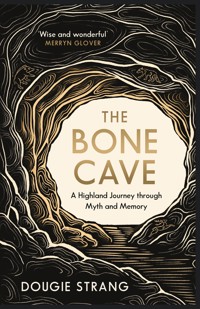
This is a book about stories – old stories of people and place, and of the more-than-human world. A vivid account of a journey through the Scottish Highlands, The Bone Cave follows a series of folktales and myths to the places in which they're set. Travelling mostly on foot, and camping along the way amid some of Scotland's most beautiful and rugged landscapes, Dougie Strang encounters a depth of meaning to the tales he tracks – one that offers a unique perspective on place, culture, land ownership and ecological stewardship, as well as insights into his own entanglement with place. Dougie sets out on his walk at the beginning of October, which also marks the start of the red deer rut. The bellowing of stags forms the soundtrack to his journey and is a reminder that, as well as mapping invisible landscapes of story, he is also exploring the tangible, living landscape of the present. Longlisted for the Highland Book Prize
Sie lesen das E-Book in den Legimi-Apps auf:
Seitenzahl: 382
Veröffentlichungsjahr: 2023
Das E-Book (TTS) können Sie hören im Abo „Legimi Premium” in Legimi-Apps auf:
Ähnliche




















The Bone Cave
First published in 2023 by
Birlinn Limited
West Newington House
10 Newington Road
Edinburgh
EH9 1QS
www.birlinn.co.uk
Copyright © Dougie Strang 2023
The right of Dougie Strang to be identified as Author of this work has been asserted by him in accordance with the Copyright, Designs and Patents Act 1988.
All rights reserved. No part of this publication may be reproduced, stored or transmitted in any form without the express written permission of the publisher.
ISBN: 978 1 78885 644 7
British Library Cataloguing-in-Publication Data
A catalogue record for this book is available from the British Library
Designed and typeset by Hewer Text UK Ltd, Edinburgh
Papers used by Birlinn are from well-managed forests and other responsible sources
Printed and bound by Clays Ltd, Elcograf S.p.A.
To Em, Fern, Mara
Tachraidh d’ fhiadh fhèin riut fhathastYou’ll meet your own deer yet
Contents
Map
Author’s Note on Place-names
Introduction: The Other Landscape
1 Cleaning the Cailleach’s Well
2 The Stag and the Blade
3 The Loch beneath the Loch
4 West Coast Male
5 The Bell in the Bone Cave
6 Conival
7 Bealach Horn
8 Cranstackie
9 A’ Mhòine
10 Diarmaid’s Grave
11 Welcoming the Stranger
12 Rubh’ Arisaig
13 Carlotta’s Eyrie
14 Rois-bheinn
15 The Post Road
16 Poison in the Poet’s House
17 Tigh nam Bodach
18 Campbell Generosity
19 In the Black Wood
20 On the Road to the Isles
21 Taking Quartz to the Cailleach
A Note on the Stories
Select Bibliography
Acknowledgements
Author’s Note on Place-names
The spelling of place-names can be inconsistent, no more so than in Gaelic, where there are sometimes a handful of spellings for a particular place, depending on the map used, reference cited or local usage. This is in part because Scottish Gaelic orthography only began to be standardised in the mid-eighteenth century but also because many of the mapmakers didn’t speak the language. Throughout this book, I have used current Ordnance Survey spellings, unless quoting from historical texts.
Introduction: The Other Landscape
This is a book about stories – old stories of people and place, and of the more-than-human world. Hamish Henderson, folklorist and poet, famously observed that traditional culture is like a ‘carrying stream’, one where the surface ripples and changes, always renewing itself, but where a deep current endures. Hamish’s metaphor conjures a landscape of myth and lore that lies within, or adjacent to, the physical landscape, akin to what the mythologist Clarissa Pinkola Estés calls rio abajo rio, ‘the river beneath the river’. This book’s concern is with that other, adjacent landscape, with the stories that shape it, and with the ways that our own lives can be caught in its flow.
What follows is an account of two walks in the Scottish Highlands: one short, in spring; the other longer, in autumn. The walks were not based on established routes like the Great Glen Way or the Cape Wrath Trail. Instead, I used stories as waymarks – folktales and myths, primarily from Gaelic tradition – and I made my way between the places that held those stories according to chance and circumstance. It seemed like a suitably quixotic strategy for a middle-aged man on walkabout, and my hope was that the tales I was tracking – their ambiguity and their otherness – would help to loosen me, make me more pliant to the land I was walking through, deepen my relationship with it.
We tend to think of folktales as belonging anywhere and nowhere, like the fairy tales of the ‘Cinderella’ and ‘Jack and the Beanstalk’ variety; tales where a hero or heroine sets out on an adventure, surmounts various challenges, and gains at the end great riches and the hand in marriage of a prince or princess. Many such tales have been gathered from Gaelic oral tradition – in the 1860s, John Francis Campbell of Islay published Popular Tales of the West Highlands, which contains numerous examples of the type, and which is still considered to be one of Europe’s finest folktale collections.
The tales I’m interested in are of a different order: they’re less abstract and more specific, more rooted in place. A monstrous boar scars the side of a mountain, a scar still known today as Sgrìob an Tuirc, the ‘Furrow of the Boar’. A hunter raises his gun to a deer, but before he can shoot, the deer takes the form of a woman. Another hunter receives an uncanny gift from the Cailleach – an elusive figure who is remembered in place-names throughout the Highlands, and whose presence haunts this book.
While tracking these stories – mapping that other landscape – I discovered a depth of meaning to them that provides an unfamiliar perspective on contemporary issues such as land ownership and ecological stewardship. And at a time when so many questions are being asked about our relationship to place and to the other species that we share place with, I’m convinced that these stories deserve to be shared more widely, that they remain vital in the sense of being both alive and necessary.
Chapter 1
Cleaning the Cailleach’s Well
The wind was fierce on the ridge. At the summit I sheltered in the lee of the cairn, crouching among stones and moss, the tiny green hands of alpine lady’s mantle. I stayed too late on top, thrilled by the views as the sun set behind the peaks and ridges of Lochaber. Below me, the moor began to heave and shift in the dark as though it was unmoored, as though the lochs dotted across it were the only fixed points, glinting the last of the light. Dropping down from the summit, I searched along the western slope of the ridge, among banks of turf and exposed peat hags. Water seeped to the surface in dips and creases, but you wouldn’t call them pools.
It was late and time to stop even before I stepped into the bog. When I pulled out my leg it was cast to the knee in wet, black peat, and it was heavy, like a false leg, or someone else’s, so that I had to shake it until it felt like my own. I pitched my tent in the dark on a patch of firm ground, pulled off wet clothes and put on all my dry spares, and then crept into my sleeping bag. My head torch threw shadows that billowed with the tent in the wind.
Dòmhnall Donn-shùileach, ‘Brown-eyed Donald’, is camped one evening on the ridge of Beinn a’ Bhric and is striking a flint to light a fire to cook his supper, when the Cailleach appears at his side out of the darkness. ‘Greetings, mistress,’ he says, with as much calm as he can muster, ‘and from where did you come?’
‘Oh well, I was on top of Beinn a’ Chrùlaiste when you struck the first spark of your flint, Donald of the brown eyes,’ she replies, casually.
‘You will have been running then,’ says Donald, just as casual, knowing full well that Beinn a’ Chrùlaiste is a full day’s walk to the west.
‘Oh, no,’ says the Cailleach, ‘just strolling along, I was.’
They continue with their banter as Donald builds the fire and sets a pot on it; and even though he is ravenous hungry, having spent all day hunting on the hill, even though his teeth are swimming in his mouth at the thought of the venison bubbling in the pot, Donald is sure to offer the Cailleach the best portion of the meal. They share their supper in companionable silence, and then the Cailleach thanks Donald and disappears into the dark, leaving him to spend a fitful night, wrapped in his plaid, wondering if she might return and insist that she snuggle her bony, crony body next to his.
This is the first part of a tale I heard many years previously, told in a pub in Edinburgh by traditional storyteller Jamie MacDonald Reid. It stayed with me, in part, because the mountain is so intrinsic to the narrative – the tale’s rootedness in a specific place, Beinn a’ Bhric, where I was now camped, gave it substance and lodged it more vividly in my memory. The significance of the encounter between the Cailleach, the ‘Old Woman’, and Brown-eyed Donald the hunter, and their relationship to a wider body of Gaelic folklore, was not yet clear to me; but I was excited to be tracing the tale’s provenance on the mountain, like following a stream to its source.
Beinn a’ Bhric means ‘Speckled Mountain’, speckled like a brown trout or like the back of a red deer calf. It’s one of the mountains that form a rim around the wide, elevated bowl of Rannoch Moor – a bowl that held the last ice of the last Ice Age. Twelve thousand years later, Rannoch Moor is still rising by a few millimetres each year: a long, slow decompression after the burden of a mile’s depth of ice. No roads cross the moor, but there is a railway line, and the Glasgow-to-Fort William train trundles along it twice a day and back again. Once, as a passenger on the train, I experienced a kind of agoraphobia – at least I think that’s what it was.
I was in my mid-twenties, travelling north to Fort William in February, one of only a handful of passengers spread between the two carriages. We crossed the moor late in the afternoon, and it looked dismal in the half-light of winter. Thin, wet snow smeared every surface, the lack of definition confusing the space between things. Peering out of the window, the mountains seemed both far away and looming, and I became disorientated, holding onto my seat while at the same time floundering out on the moor. The sensation was brief but overwhelming. I’ve never been so lost. I pulled myself together – that’s how it felt, as though I had to haul some dislocated part of me back onto the train – and spent the rest of the journey unnerved, buried in a book for distraction, grateful as night fell that the windows reflected back the lights of the carriage, keeping out the dark.
Twenty-five years later, and I was out on Rannoch Moor again, or rather, above it, sleeping fitfully. The wind jolted me awake, and for a moment I thought that the tent had untethered and was slipping from the ridge. I lay in the dark, pressed to the ground while the wind beat at the flysheet, and thought about my family, my two daughters when they were young – those times when they would wake in the night in a storm, afraid, and I would pretend that the house was a ship, heaving on the sea’s swell, so that I staggered as I walked from the bedroom door to their bunks, asking, ‘Avast me hearties, what ails thee?’ Teenagers now, they still remember the stories I’d tell to soothe them, and the funny house that we lived in, with its straw-bale walls and timber mezzanine – a house that you would imagine might sail and list in the wind. The memory of being there for them was a solid truth, like a stone, weighting me to the side of the mountain.
Beinn a’ Bhric is twin-peaked – the summit to the west, which gives it its name, is smaller in height and less shapely than its neighbour, Leum Uilleim, ‘William’s Leap’. The pair stand shoulder to shoulder, conjoined by a curving ridge, with Coir’ a’ Bhric Beag, the ‘Little Speckled Corrie’, clasped between them. The mountain rises above Corrour Railway Station at the north-western edge of Rannoch Moor and provides the backdrop to a well-known scene in the film Trainspotting. Fans still catch the train to Corrour, the highest railway station in the British Isles, to take pictures and pose at the spot where Renton delivers his soliloquy on national identity: It’s shite being Scottish . . .
*
By morning the wind had eased and cloud huddled around the ridge of Beinn a’ Bhric. I was inside the cloud, the air wet and cold, and there was no summit or sight of other mountains. I cut out a small circle of turf on a level bank and unpacked the bag of kindling and the half-dozen lengths of firewood that I’d carried in my rucksack. My fire was a compact sun, unnaturally bright against the grey of the mist. I set a pot of water to boil and willed the flames to lift the cloud and conjure the actual sun. I made tea, ate oatcakes and a cold, sweet apple, and carefully tended my fire on the mountain in the clouds. It was the morning of 1 May, Beltane according to the old Celtic calendar – the word’s meaning most likely a compound of ‘bright’ and ‘fire’.
After the fire died, I poured water over the ashes and replaced the circle of turf, tramping it firm, then took down my tent and packed my rucksack. The wind had shifted, thinning the cloud so that gaps were opening and I could look down into Gleann Iolairean, and across to the grey lochans on the plateau of Meall a’ Bhainne. I took out my map and gauged my position relative to what I could see around me, checking that I was in the right place.
When I’d sat down to look at Beinn a’ Bhric on a large-scale map, before setting out to climb it, I’d noticed below the summit the name Fuaran Cailleach Beinn a’ Bhric, the ‘Well of the Old Woman of Beinn a’ Bhric’, and felt the thrill of discovery. Jamie MacDonald Reid’s tale didn’t mention a well, but here was confirmation of an association between the Cailleach and the mountain, as well as a hint of other stories still to be found. As for the location of the well: in Gaelic, fuaran usually means a well in its natural state, an undug pool or spring, so it was possible that the peat bog I’d stumbled into the night before, with its few inches of surface water, might be all there was to find.
The side of the mountain steepened below me. I clambered down to where a stream had formed a gully between two crags, and then followed its course back up amongst the folds of the slope, hoping it might lead to what I was looking for. Rags of cloud drifted across the mountainside. I startled a hare that was crouched in a dip to the left of the stream, encroaching on the tolerated space between us as though I had nudged a tripwire. It sprang away into the mist and left my body charged with adrenalin.
I found the Cailleach’s well tucked in a hollow, hidden from above and below. Even at a short distance, you could walk by without noticing it. It was an oval pool, gravel-lined and clear, like a portal, with the stream I had followed pouring from the lip of it. The water tasted like stone. I filled my water bottle and cupped my hands and washed my face.
Local tradition tells that the Cailleach cleans her well on the first morning of May. In her absence, I rolled up my sleeves and cleared some of the silt that had built up around the outflow. After a few minutes of scooping and splashing, my arms were numb with cold. When I stopped, the pool returned to stillness.
Dropping beneath the cloud, I followed the stream back to the gully, intending to scramble down into Gleann Iolairean, and to walk out from there via the head of Loch Treig to the railway station at Corrour. A bird flew past, contouring the crags: a swallow, unexpected in this place and at this height. It tilted its body away from me in alarm, flashing its orange breast and looking back with a tiny, black eye. Small, quick life, heart the size of a tic tac, following an old ellipse from Scotland to Africa and back, carrying the sun from the south on its breast. Now I was blessed. Now it was the first day of summer.
Chapter 2
The Stag and the Blade
Stories attach themselves to places, building up layers of meaning over time. On my first visit to Beinn a’ Bhric, I uncovered one of those layers, tracing the presence of the Cailleach in the mountain’s topography. That visit was a reconnaissance, an initial foray into tracking stories in the landscape. As I waited for the train at Corrour Station, I’d looked back up at the mountain and understood that this was the beginning of an abiding relationship with it.
Th rough the summer, I delved into the traditions and lore associated with Beinn a’ Bhric, uncovering more folktales in books and recordings, as well as fragments of song and pibroch tune. They were all place-specific, a density of meaning concentrated on a single mountain. Such a concentration is not, of course, unique to Beinn a’ Bhric; wherever you dig, you find that the land brims with culture, and I soon discovered a whole body of corresponding tales that related to the Cailleach and to the hunting of deer.
My trip to Beinn a’ Bhric kindled the desire to go for a longer walk, one that would offer more glimpses of that other, storied landscape, and so, one autumn morning, I found myself travelling by train through Perthshire, past ploughed fields and stubble fields, and wind turbines on low hills, blades gleaming in the sun; past a field with grazing cows that were clustered in groups like guests on a lawn at a wedding.
It was five months to the day since I’d camped on Beinn a’ Bhric, and now I was setting out with the whole of October ahead of me; my first solo, long-distance walk since marriage and parenthood. There had been other trips – day walks and the odd weekend – but this was different, a chance to walk without timetables or the need for a swift return. It felt timely: I’d turned fifty; my children, as teenagers, were beginning to shape their own lives; and I’m lucky, my wife and I both understand the gift of occasional solitude.
North of Blair Atholl, the fields become moors and the hills become mountains, and the train’s engine strained as it pulled us up and over the Pass of Drumochter, before easing as we approached Dalwhinnie at the head of Loch Ericht. The loch fills a cleft between Ben Alder and the mountains west of Drumochter – a spear of water nearly fifteen miles long, pointed at Rannoch Moor. A way in, or rather, a way out: the loch is one of a number that formed when glacial ice melted and spilled from the great bowl of the moor.
Dalwhinnie was quiet and dull beneath a cloudy sky, and I was the only person to step off the train onto the platform. Surrounded by mountains and sitting at a height of over a thousand feet, the village is one of the least sunny and most consistently cold in the UK. I noticed the chill as I walked past a straggle of houses to the village edge, where I stuck out my thumb and gained a quick hitch along the A889 to Laggan. The driver was a cheerful estate agent whose black Labrador leaned forward from the back of the car and licked my face – ‘kisses’ said the estate agent, chuckling, as I wiped dog slaver from my cheek. And then I was walking west into the wind, following the course of the River Spey, with the mountains ahead, and beneath my feet, under the tarmac, General Wade’s Military Road.
Rain scoured my face, driven by gusts of wind. I wrapped myself in waterproofs, pulled my hood low, and followed Wade’s Road as it skirted a nameless grey loch that had been formed by the damming of the River Spey. Two wooden boats were moored close to the shore, one painted green, one painted blue, both straining at their moorings in the wind. The rain came in squalls, with sunshine bursting through the clouds in between, turning the grey loch luminous.
After the 1715 Jacobite Rising, General George Wade was commissioned to construct a network of military roads in the Scottish Highlands, to help enforce the rule of the British State. The most challenging of those linked the barracks at Ruthven in Strathspey, fifteen miles to the north of Dalwhinnie, with Fort Augustus at the head of Loch Ness. It did so by crossing the Monadhliath Mountains via the Corrieyairack Pass. Wade and his road builders breached the pass in 1731, completing the commission. Fourteen years later, it was the Jacobites, under Charles Edward Stuart, who gained most advantage from the use of the network. On 27 August 1745, British troops under the command of General John Cope retreated from their intended march over the Corrieyairack. Fearing an ambush near the top of the pass, they went north instead to Inverness, leaving uncontested the main route into Perthshire for the Jacobite clans of the Northwest Highlands.
I’m not much interested in the doings of Charles Edward Stuart, an aristocrat whose failed quest to claim the British throne brought terrible consequences to the people of the Highlands; but I’d always wanted to climb the Corrieyairack Pass. During those intense, joyous, exhausting first years of parenthood, I would occasionally dig out my Ordnance Survey map of Northern Scotland and trace a line along the shore of a loch or over a bealach, or pass, between two mountains. It was a vicarious pleasure, imagining myself there by reading the topography of the map; but it was also a form of commitment to walks I might take in the future. The Corrieyairack Pass was one I often traced, and now, though the rest of my route was to be guided by chance and by folktales – that most unreliable of narrative forms – the pass seemed an appropriate place to begin a journey into the north and west.
*
Late in the afternoon, I crossed a bridge over the River Spey and passed an estate yard bustling with 4x4s, trailers and Argocats. Through the open door of a shed, I saw the body of a red deer stag hanging by its tied hind legs from a hook on the ceiling. A ghillie was in the shed, standing with his back to me, his attention focused on the carcass. It was an odd first encounter with one of the creatures that would be, more than any other, my companions on the journey. I was glad the ghillie didn’t notice me, and I walked on quickly, as though I’d witnessed something illicit or profane: the stag upside down, the bucket catching its blood; the ghillie with an apron over his tweeds, busy with knives.
An hour later, at dusk, another stag, very much alive, paused as it crossed the road ahead of me and turned to look. It was young, only a couple of tines on each antler. I stopped too, and for a moment we regarded each other in silence.
When I think about red deer, I think about how there are too many of them – the population stands at around 400,000, which is more than there’s ever been in Scotland – and how they overgraze the land, stripping young trees of their foliage and decimating seedlings, so that there is no chance for woodland to regenerate naturally. I think about how some estate owners maintain high numbers of deer, even feeding them in winter, to ensure there’s plenty to be killed in the shooting season. And I think about the fact that, in many parts of the Highlands and Islands, there are more deer than people.
Abstract thoughts disappear when you meet a young stag at dusk on General Wade’s Road, with forestry pressing either side, and with the silhouette of its head and antlers unmistakable, like an imprinted memory or a pattern recognition handed down from hunter ancestors.
I had no wish to harm the stag and felt instead a wary empathy – two strangers meeting on a night-time road, each surprised and curious to find the other there. The stag jumped the road-side fence and disappeared. I followed it into the forest, clambering over the fence with none of its elegance, hoping to find a place to camp for the night.
The ground was poorly drained, and the trees, mostly spruce, were spindly. Storms had uprooted many of them, and I had to manoeuvre around and over those that lay criss-crossed on the forest floor. In places, fallen trunks were useful as bridges for crossing patches of bog. A stand of tall larch trees signalled drier ground not far from a bend in the Spey where it looped around the forest plantation, and I could hear the murmur of the river through the trees. Fallen needles formed a thick carpet beneath the larch and were heaped in wind-drifts against their trunks. I pitched my tent, gathered dead branches, and cleared space to light a fire to cook my evening meal.
Throughout the month, I planned to cook on open fires where it was practical and sensible to do so. It’s a contentious issue in the Highlands. Every year, campers cause damage with badly looked-after fires, especially in the dry months of early summer; but in October the ground is usually damp with autumn rain, and I was a careful and conscientious fire-tender. I also carried a stove in my rucksack, a mini Trangia, but was keen to preserve fuel when possible. More than that, to set my campfire and tend it after dark served a deeper need than the means to cook a meal: it was the day’s walk rewarded, the hearth around which a forest or a glen became home for the night.
The moon rose above A’ Bhuidheanach, ‘The Yellow Ridge’, and glowed amongst the crowns of the trees. I was grateful to be warm, dry and fed. My only concern was the pain that throbbed in both my feet.
I’d made a mistake. My old walking boots were cracked and no longer waterproof. I was on a tight budget but didn’t want to buy cheap, so I had replaced them with a second-hand pair, bought on eBay for £40; the same brand as my old ones, listed as my size and barely worn. When they arrived, they were too tight. I took them to the cobblers to be stretched, tried them out on a couple of day walks in the weeks leading up to October, and convinced myself they would be fine, especially if I wore thin socks. They weren’t.
In the last of the firelight, I applied plasters to the blisters on my heels and my toes, then went to bed and slept beneath trees that surged and keened in the wind. October is rut month for red deer, and in the night, I heard stags roaring on the other side of the Spey.
The Gaelic for ‘deer’ is fiadh, the same word for ‘wild’; they are also traditionally known as crodh-sìthe, ‘fairy cattle’. In the folklore of the Highlands, there is no creature more otherworldly, more fey, than the fiadh. In many tales a hunter will raise his bow or gun to shoot a deer, only for it to take the form of a woman – always a woman – turning to a deer again when the weapon is lowered. Murdoch Macpherson, seventeenth-century hunter of Strathspey, known as Muireach Mac Iain, is said to have met one of these shape-shifting deer on An Dùn, a hill near Dalwhinnie, to the east of where I was camped.
It is late in the afternoon and Muireach Mac Iain, with skill and guile, has stalked a deer so close that he can look it in the eye. He raises his gun, and the deer takes the form of a woman, fairer than any he has seen; but when he lowers his gun, it’s a deer again. After much to-ing and fro-ing between forms, from deer to woman and back, eventually the deer stays deer, and Muireach succeeds in shooting it.
Immediately after the kill, overcome with weariness, he rolls himself in his plaid and falls asleep next to the body of the deer. At dusk, he’s woken by a voice thundering in his ear: ‘Muireach, Muireach, you have this day slain the only maid on An Dùn!’
Muireach Mac Iain jumps to his feet. ‘If I have killed her, you may eat her,’ he says, and he leaves An Dùn as fast as he might, taking home no venison for the larder that evening.
Like the Cailleach’s encounter with Brown-eyed Donald on Beinn a’ Bhric, this is clearly not a typical folk or fairy tale: Muireach Mac Iain is no hero, and he’s certainly not returning with great riches; nor is it a fable, for there’s no moral imperative. Instead, Muireach’s encounter with the deer-woman explains nothing and speaks only of a relationship to a world that is mysterious, beautiful, savage – a hunter’s world.
*
In the morning, I discovered that my map – the one I had traced with imagined routes during those early years of parenthood – was out of date. It didn’t show the construction track for the upgrade of the Beauly–Denny power line, or the new 165-foot-high pylons, marching up and over the Corrieyairack Pass. It didn’t show the industrial compound between Garvamore and Melgarve, with its corrugated sheds and wire fence festooned with blue ‘keep out’ signs, its coils of armthick cable and stacked ceramic insulators as big as my children, and its giant diggers with their orange lights flashing; the glare and growl of it all.
The Scottish Government has set an ambitious target for renewable energy production. Much of our electricity already comes from wind turbines and from hydropower, and the capacity of the existing transmission network is inadequate to cope with further expansion. Hence the Beauly–Denny upgrade, so that more power generated in the Highlands can be sent to the Central Belt.
The Garvamore compound is situated close to where a friend of mine is adamant that he once had an encounter, not with shape-shifting deer, but with little silver buddha-men, fat-bellied and glowing by the river.
He’d been camped by one of the Spey’s many pools and had got up to relieve himself in the night. Because he was only half-awake, it seemed unremarkable that the silver men should be there; bewilderment came with full waking in the morning. My friend is level-headed, not one for such encounters. Whatever it was he saw – or dreamt he saw, despite his insistence – it is unlikely to be repeated now that the pylons dominate the glen, and the compound with its bright lights looms above the pools.
The tarmac road ends at Melgarve, and the old military road continues, climbing up into Corrie Yairack. The meaning of the name is disputed, but it seems to be an anglicisation of Coire a’ Gheàrraig, suggesting ‘Corrie of the Short Burn or Spring’. Either way, to climb the corrie is to appreciate the toil of building the road: each stone you step on has been excavated from the hillside, carried and carefully planted; mile upon mile of back-breaking work, in all weather and for poor pay, no doubt.
After a particularly steep section, where the road is forced to zigzag up the side of the corrie, I stopped to rest and eat lunch by a cairn. It was a sheltered spot, surrounded by crags and gullies – a good place for an ambush – and I understood why General Johnnie Cope might have had second thoughts about leading his redcoat soldiers up into it. Looking back, despite the wide strath of the Spey and the Cairngorms rising in the distance, what I saw was the line of giant, antlered pylons. Somewhere on the hill a stag was bellowing, as though he too was affronted by the sight of them.
*
An ugly concrete shed stands at the top of the Corrieyairack Pass, at a height of 2,500 feet. On its locked, rusted door a sign reads: The safety of men’s lives depends on the equipment stored in this shed. The shed is a remnant from the first power lines that ran over the pass. Taking shelter from the wind in its lee, I caught my breath before turning my back on Speyside. The land continued to rise either side of me, north to the top of Corrieyairack Hill, south to Carn Leac; but this was where I wanted to be, at the pass, with Glen Mor, the ‘Great Glen’, opening below.
The Great Glen Fault splits Scotland diagonally, stretching south and west from the Moray Firth and the North Sea to Loch Linnhe and the Atlantic. It is part of a major fault in the Earth’s crust and can be traced northwards all the way to Svalbard in the Arctic. In Scotland, physically and culturally, it’s not as significant a divide as the Highland Boundary Fault which runs roughly parallel, some fifty miles to the south, and which marks the transition from the Lowlands to the Highlands. Instead, Glen Mor is like a great sword stroke slicing across the shoulders of the Highlands, severing one mountainous region from another. Not as significant, but a severance nonetheless: beyond Glen Mor, the landscape of the North-west becomes one of the most remote, rugged and sparsely populated in Europe.
My feet were sore, my rucksack heavy on my back after the climb out of Corrie Yairack, and around me the mountains were saturated and grey; but I was elated to be here, to be crossing over like so many had done before: the drovers, packmen, merchants and reivers, the people who had used this pass long before General Wade and his road builders pitched up; an old route for cattle and commerce, for the exchange of news and the passing back and forth of stories.
It is a fine day and Donald Cameron, known as Dòmhnall Mòr Òg, ‘Big Young Donald’, is out on the moor with his dog and his gun. He’s as renowned a hunter as Muireach Mac Iain of Speyside, but he is from Lochaber, to the west of the Monadhliath. His step is light on the moor, and the sun is warm on his face. Early in the afternoon he encounters some people cutting peats at a bank. They are strangers to him, but they invite him to join them and to share their food. He’s not hungry, but they insist, calling him by his name. Donald’s dog wants nothing to do with the strangers; it keeps its distance, hackles raised.
The tairsgeirean, the peat spades, are set aside, and a blue woven cloth is spread. There’s butter, cheese, oatcakes, finer than any Donald has tasted. After the meal, he thanks them, and they bid him farewell, calling, ‘Long may it be, Dòmhnall Mòr Òg, before you bring down a deer.’
‘I’ll hope not,’ he replies, taking his leave; and sure enough, it isn’t long before he reaches the heights of the moor and sees a fine strong stag. He raises his gun to shoot, but taking aim, it’s a woman that is in his sights, with pale complexion and curling red hair. He lowers the gun, and it’s a stag, raises it, and it’s a woman, and he sees that she is combing through her hair, and that with each stroke of the comb, lice are falling from her curls like winnowed chaff. Three times he raises his gun, and on the last he loads it with a bent silver sixpence instead of a lead ball. This time the stag stays stag, and he shoots it dead, the silver sixpence piercing its heart.
When he goes to gralloch the stag – to take its guts out – he finds in its belly the same butter, cheese and oatcakes that he had eaten with the strangers at the peat-bank. He stands and folds his gun under his oxter, and he and his dog go home without venison for the larder that evening.
It was raining hard as I followed Wade’s Road across the boggy watershed of the Monadhliath. Cloud shrouded the mountains on the other side of Glen Mor, occasionally lifting enough to reveal wind turbines arranged in neat patterns on the slopes. An eight-wheeled Argocat passed me on the track, driven by a young ghillie, who waved. It was followed minutes later by a smart, black 4x4 pick-up. I nodded to the driver and saw the shapes of two figures in the rear seats of the cab, the clients, obscured by tinted windows. The stag that they’d shot was sprawled in the open back, sodden with rain, its slack head bumping against a wheel arch.
The popular image of modern hunting in Scotland is of honourable ghillies practising their craft with skill, regard for tradition and patient tolerance of the behaviour of their clients, as though it’s they, the ghillies, who ennoble the act and govern the relationship. There is some truth in this, and I have a good deal of respect for many of the ghillies and stalkers I’ve met, although the persistence of illegal poisoning and trapping on some private estates suggests that not all live up to the ideal; and when it comes to the relationship between ghillie and client, everyone knows who really wields the power.
A friend once told me a family tale about his grandfather, who as a young man worked as a ghillie on a Highland estate between the wars. He was tasked with rowing a party of women across a loch to their picnic spot. Because they were fashionable young ladies, they were smoking cigarettes. ‘You must think it scandalous to see us smoking,’ one of the women said to the ghillie, who replied, perhaps without thinking, perhaps mischievously: ‘Och no, we see the tinker-wives doing it all the time.’ He was dismissed from service later that day. His children’s children remember his perceived insolence with pride.
Roads and power cables cross the mountains. The land is not wild land. The deer which roam the hills are a commodity, stocked and then stalked in the shooting season. There are shiny black cars outside the big house on the estate. The upper reach of the Spey, one of Scotland’s finest rivers, has been dammed to divert extra water to the aluminium smelter at Fort William. The Spey dammed and diverted is not the same Spey. The hills bristle with the blades of wind turbines.
It’s complicated. During my month of walking, many of the locals I met were in favour of sporting estates, wind farms and fish farms, hydro-electric power stations, mono-crop forestry. They want jobs for themselves and their children that don’t rely solely on the tourist dollar; and for sure, given accelerating climate change, wind and hydro are attractive alternatives to oil and gas.
I actually like the look of wind turbines, despite their intrusion: the elegance of their slow, enormous turning, especially when there is a group of them, like choreographed dancers or those whirling Sufi mystics. But the bigger question is not about aesthetics or jobs or ownership; it’s about whether this is tenable, whether a system that relies on ever more industrialisation of the land, and extraction from it, can or should be sustained.
I camped for the night by the bridge at Lagan-a-bhainne, the ‘Hollow of the Milk’. My feet were cramped and sore, my left heel badly blistered, and I was painfully aware of how stupid I’d been to set out wearing tight, second-hand boots. That evening, the rain was too persistent for a fire, so I crouched in my tent and cooked dinner on the stove by the light of my head torch.
*
In the morning, I followed the old stone road as it curved round and down the southern side of Glen Tarff. Mist clung to the hills, and where the sun filtered through, thickets of birch glowed. The wind turbines and the pylons were out of sight, and wildflowers grew in the road’s verges, with self-heal still in flower. Below me, by the river, a sparrowhawk glided from one thicket of birch to the next. On the slope above, a stag and half a dozen hinds studied and then dismissed me. Around a bend in the road, the pylons veered back into view, and the whitewashed cottages of Fort Augustus gleamed in the distance, clustered at the head of Loch Ness.
A rusted sign on the gate at the bottom of the glen proclaimed: Wade’s Road is a scheduled ancient monument. Any person causing damage is liable to prosecution by the Secretary of State. I closed the gate behind me and thought about the construction tracks of the Beauly–Denny power line, gouged into the hill; the industrial compound between Garvamore and Melgarve; the metal march of the pylons.
Chapter 3
The Loch beneath the Loch
The Caledonian Canal passes through the middle of Fort Augustus before opening out into Loch Ness. Designed by Thomas Telford and William Jessop, its construction early in the nineteenth century, linking Fort William to Inverness via Lochs Oich, Lochy and Ness, means that there is a continuous body of water running the length of the Great Glen Fault. Strictly speaking, this makes an island of the North-west Highlands.
A crush of tourists was taking selfies on the canal bridge when I crossed over. I was limping with the pain in my feet and thought about booking a pitch at the campsite in the village, but its name, Cumberland’s Campsite, strengthened my resolve to carry on. Naming your business after a duke whose epithet is ‘the Butcher’, and who, in the aftermath of Culloden, encouraged his troops to commit what nowadays would be considered war crimes against the defeated Jacobite soldiers, as well as against the local civilian population, doesn’t seem sensitive to the history of the area. The village itself is also named for the duke, William Augustus, who was youngest son of King George II. Before being re-named, it was known in Gaelic as Cille Chuimein, after Saint Cummein of Iona, who reputedly built a church there in the seventh century.
It was a busy place, for October. I found a public telephone and phoned my wife, asking her to post my old walking boots to Ullapool, care of the Ceilidh Place, and to book me a bed in their bunkhouse for a couple of nights.
During my month’s walk, I wanted to step away from the world of phone calls and texts, emails and 24-hour newsfeeds, so I hadn’t brought a smart phone or a radio. It meant no GPS or weather forecasts, but I had a map and compass, and suitable kit to engage with whatever weather autumn in the Highlands might present; and I’d packed a non-smart mobile phone, wrapped in a waterproof bag in my rucksack, in case of emergency.
I gave myself five days to reach Ullapool, time enough for the Royal Mail to deliver my old boots while I stopped to rest my feet and then hitched my way there. At the local shop in Fort Augustus, I stocked up on food supplies and blister pads, and bought myself treats. I’d planned to eat simple camping food on my journey – porridge, oatcakes, stew – but I’m no ascetic: after three days on General Wade’s Road, I was glad of the chance to buy chocolate and whisky.
The woman serving at the counter lamented that there was never now a quiet season, that this year was the busiest ever and that the cheap pound just kept the tourists coming. Everyone I spoke to in the village offered an opinion on the busy-ness. Because I was a walker with a rucksack, it seemed that I was spared their reproach. When I stopped to check times at a bus stop, an old woman – small, thin-lipped, wrapped in a beige raincoat – told me, unprompted, that it was ‘Outlander that was bringing them’. She went on to explain that normally it would have quietened down by now, but instead, ‘The bloody campervans are still clogging up the roads.’ It was a complaint I was to hear again and again: the campervan craze, and the lack of infrastructure to accommodate them.
There was no bus due, so I walked to the edge of the village to hitch north on the A82, following the shore of Loch Ness. I knew of a quiet place to camp and hoped to reach it later that day.
*
‘Where are you from?’ The question was friendly but probing, and very Scottish – that insistence that the place where you were born is more important, when assessing character, than your profession or social standing. The driver, a middle-aged man, was quick to tell me that he himself had lived in the area for over twenty years, though he added, quietly, as though regretful of the fact, it wasn’t where he was from.
I grew up on the outskirts of Glasgow, on one of the new estates that bulges at the edge of the city; brick and pebbledash terraced and semi-detached houses for the aspirational working class. My parents moved there from Springburn when they married, part of the exodus from inner-city tenements, and my mother still lives in the house that they bought. But when I left home, I moved around and made choices that dislocated me ever further from ‘where I’m from’. As we drove into Invermoriston, I answered the driver nonetheless: ‘Glasgow originally, now living in the south-west near Lochmaben, if you know it.’ He nodded, satisfied, placing me.




