


Erhalten Sie Zugang zu diesem und mehr als 300000 Büchern ab EUR 5,99 monatlich.
- Herausgeber: Crown House Publishing
- Kategorie: Ratgeber
- Sprache: Englisch
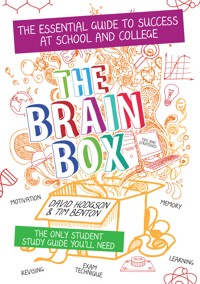
The Brain Box - a personal journal for each student to be their best at school - boost grades, improve motivation, memory, learning and understanding, exam techniques. It will help teachers prove they apply many Ofsted guidelines, but will also appeal to parents. By using Neuro Linguistic Programming and explaining neuroscience the authors take students on their journey from building their profile to looking at what motivates them, their ambitions, and their future goals. Case studies, anecdotes of 'success'/motivation are littered throughout and questions are posed to get students thinking about their journey.
Sie lesen das E-Book in den Legimi-Apps auf:
Seitenzahl: 191
Veröffentlichungsjahr: 2014
Das E-Book (TTS) können Sie hören im Abo „Legimi Premium” in Legimi-Apps auf:
Ähnliche














This is for all of the students and staff who have contributed ideas and inspiration for this book and for the many who will use it.
CONTENTS
INTRODUCTION
The rules for this book – there are no rules!
This book is yours.
That means you can do what you like with it.
Grab a notebook and use it with this book to interact, answer questions, make notes and to doodle.* There are quizzes and other tools that will help you get to know yourself better.
By the time you’re finished with it, this book should be a mess. It will have been your companion through your exams and, like a good friend, it will have helped you get through the tough stuff.
Love this book. And make it your own.
WHAT DO YOUR DOODLES SAY ABOUT YOU?
ONE OF A KIND
There are seven billion people on this planet, yet we’re all unique! We have different talents and abilities. We all have something positive to offer the world.
Just take a look at the end of your thumb. There’s the proof, right there! Your fingerprint is unique to you. No one else has it. No one ever will.
That makes you different to everyone else. But different in a good way.
We’re all different.
There are some people who like cheese. Others hate it.
Some people love thrash metal, others indie, some just want to listen to chart stuff.
Some people love to play computer games all the time, some just like to watch TV or hang out with their friends.
It would be a boring world if we were all the same, if we all thought the same and wanted to do things in the same way.
And it’s like that with revision. It’s like that with learning.
How we learn can be as individual as a fingerprint.
Hopefully this book will help you to work out your way of doing things.
Once you’ve worked out the best methods, you’re sorted. You can keep on learning. You’ll do better, get smarter and keep growing.
Then you can make your mark on this world.
Create a profile like this:
Name: .................................................................
Age: ....................................................................
School: ................................................................
Revision makes me (write down the ones which apply):
Relationship status (write down the ones which apply):
My idea of happiness is:
..........................................................
..........................................................
..........................................................
..........................................................
When I grow up, I want to be:
..........................................................
..........................................................
..........................................................
Status right now:
..........................................................
..........................................................
..........................................................
..........................................................
..........................................................
RIGHT HERE, RIGHT NOW …
Which one of these statements applies to you, right now at the start of things? Read the section below that’s meant for you.
I’m massively stressed about my exams. Read ‘Stressed’
I’m working well right now. Read ‘Working well’
I want to do well so I’m reading this to find out if there’s anything else I can do to improve myself. Read ‘What else?’
I always do well in tests so I’m not too bothered. Read ‘Not bothered’
I want to revise, but I don’t know how. Read ‘I want to but …’
Nothing works for me, I can’t remember anything. Read ‘Nothing works’
Life’s too short to revise. Read ‘Life’s too short’
I don’t care how I do. Read ‘Don’t care’
I say I don’t care how I do. But I do really. Read ‘Do care, really’
Stressed
So you’re massively stressed about your exams.
You probably have a really clear idea about where you’re heading in life and know that it starts now. Maybe you feel a weight of pressure to do well, either for your parents or your teachers. Maybe you have an older sibling who excels academically and you feel you need to compete – doing as well as them or even better.
You aren’t the first person to feel this stress, and you won’t be the last. There are scores of other young people, up and down the country, who feel the same way. But that doesn’t make your feelings any less real. What you need to do is manage your stress – you are more likely to mess up if you don’t get a handle on your anxiety.
First off, you need to talk about the pressure and how it is making you feel. Talk to friends, a teacher you get on with or a parent. Maybe there is a school adviser or counsellor. Just talking about your anxieties will help.
There are bits and bobs in this book that you should read – browse the stuff about the brain (and read all the ‘Inside the Brain Box’ sections), particularly the bits on what stress does to you. Forewarned is forearmed! Read about motivations – do you want to do well for the right reasons (see page 62)? You might have always got good grades at school and haven’t really experienced failure. However, we all fail sometimes. That’s just life! We need to know how to deal with it and, more importantly, know that it isn’t the end of the world. Even if you fail all your exams (and we doubt you will), you will find a way to move forward. Read what we have to say about dealing with failure (page 58) – it will help you to realise that there is always a way forward.
If you need specific revision tips, look at our suggestions in Chapter 4.
If panic is making you avoid revision, read our thoughts on that too (see page 106).
Also read what we have to say about time management and making sure your life is in balance (see page 137). If all you have is great exam results, you may not have all you need …
Working well
You’re thinking, I’m already working well right now.
Hey! Good for you. But don’t get complacent! Pace yourself. Read what we have to say about making a planner (see page 111) and keep going.
There is a danger that you’re working hard not smart, so check out what we’ve got to say about effective revision (see Chapter 4). Also, if you’re doing the same things all the time you might get bored, so make sure you’re shaking it up from time to time. Read what we’ve written about keeping it fresh in Chapter 3.
What else?
You want to do well, so you’re reading this to find out if there’s anything else you can do to improve yourself.
Great attitude! What you’ve realised is that success comes in many forms. Good grades are part of this, and you’ll find some brilliant tips to sharpen up your revision sessions in Chapter 4.
But it’s also important to be a rounded individual. Have you considered work experience? Is your only hobby getting to the next level on Call of Duty? How do you spend your spare time and holidays? What are you putting out there on Facebook or Twitter? It’s no good having great grades if the Internet is awash with reasons for future employers not to give you a great job! Have a look at our thoughts on this (see page 62).
Why not try out some of the suggestions for time management (see page 137)? These could help you raise your game.
Make sure, of course, that you also follow our advice for exam success in Chapter 5, because that will be a great start.
Not bothered
You always do well in tests so you’re not too bothered.
Oh, so you’re a clever one! Good for you! But that won’t always be enough. At some point, we all realise that we need to work harder at some things than we think we do. Some of us have always done well in school, but then find GCSEs need more work than we thought. Others discover this at A level – many people come unstuck in sixth form because they got their GCSE grades with little effort. Some people reach college or university before they realise, for the first time, that they have to work hard. Others get their first job and then discover they aren’t as brilliant as they always thought they were.
Why take the risk? Work hard now. No one ever looks back at school and thinks, ‘I wish I’d worked less!’ No one ever gets the top grades at GCSE with little work. No one achieves the top grades in their A levels without serious hard graft.
Read what we have to say about your competition (see page 64). Being good isn’t enough any more. You might find this section a real wake-up call.
I want to but …
You want to revise but don’t know how.
Well, good news! You have this book! Schools are usually great at telling you that you have to revise and even what to revise, but often not how to revise. Read all our tips on revision in Chapter 4. Some will work for you, others won’t. Use the ones that do and avoid the ones that don’t, but don’t be afraid to try things out.
Nothing works
Nothing works for you – you can’t remember anything.
Ah! That’s not true. You just aren’t revising in the right way. Read what we have to say about finding the right way to work (see page 101).
We can all learn, but we need to find the best methods for us. Once we have the tools, we’ll be unstoppable. We also need to be in the right mood (see pages 24–39).
Life’s too short
You think life is too short for revision.
But if you end up doing a job you hate, things will really drag. If you think schoolwork is boring, wait until you see the options open to you after you’ve flunked out.
Read what we have to say about goal setting (see page 61) and motivation (see page 65). In the bigger scheme of things, knuckling down and revising takes up only a short period of time, but the effort will be worth it.
Don’t care
You say you don’t care how you do.
We’re aware this may be the only bit of this book you’ll read, so we’ve probably only got about 10 seconds to make a difference.
Start the countdown …
10. Life can be crap. But just because it might have been in the past, doesn’t mean it always will be (see page 20).
9. We know you don’t believe it now, but you’ve got more to offer than you think (see page 11).
8. Just because it feels hopeless, doesn’t mean it is.
7. Your teachers don’t hate you, so stop fighting them. People will help you. You aren’t worthless, regardless of what you feel.
6. Life isn’t fair, but you can make it better.
5. Someone will one day think you are amazing. That may seem hard to believe right now. Try to care about your future, because one day it will matter to you.
4. Yesterday has gone, but you still have tomorrow (see page 21). Every day is a new start.
3. The voice in your head – the one that tells you everything is a waste of time and nothing can change – it’s lying!
2. The voice in your head which says all that negative stuff about you is also lying.
1. If you try, things will get better: you are smarter and more capable than you realise. Really.
We hope you decide to read some more.
Do care, really
You say you don’t care how you do – but you do really.
Wow. It must be hard keeping up a front all the time, pretending you’re one thing but really you’re another. It’s probably sapping all your energy!
Chill. Relax. Be yourself.
And stop reacting badly all the time and making such a fuss! The only person you’re ultimately going to hurt is yourself. Get a grip! You may be worried about what your friends think, but they may not even be in your life in five years’ time. It’s time to step up for you.
You know all those things you want from life? No one is going to just give them to you. You need to work for them. That starts now. Sorry if that sounds harsh, but sometimes we need a reality check.
If you’re busy pretending to be something you’re not, it will take its toll. If you’re lashing out at people and being stroppy all the time, you’re going to feel very alone. This may lead to stress. Stress and worry make a real mess of us. It is good to have a healthy body, but it is just as important to have a healthy mind. Read what we have to say about looking after your mental health (page 32).
If you really do care, do something about it!
GETTING THINGS WRONG … GETTING THINGS RIGHT
Most people struggle to remember names when introduced to a small group of people for the first time.
Why is that?
First, WRONG MOOD. This is because when we’re introduced we’re paying attention to ourselves not the person we’re about to meet!
We may not even make eye contact because we’re worrying about how bad our new haircut looks or whether we’re dressed right. Maybe we’re feeling nervous for a dozen other reasons. We don’t even hear them say their name because we’re not really listening.
Second, WRONG TECHNIQUE. We can all remember names if we follow a few simple rules.
When we first meet someone, we should make eye contact, smile as we shake their hand and say, ‘Hello, my name is David.’
We then raise our eyebrows (the cue for them to speak) and after they say, ‘Hi, I’m Paul,’ we repeat their name out loud: ‘Hello Paul, pleased to meet you.’
As we say their name out loud, we think of something weird which will help us associate their name with something about them. A rhyming word is good – so if Paul is tall or small we can use the rhyme, tall Paul tall Paul. If he looks like a famous Paul, we could imagine him dressed like Paul McCartney. Try it – it works!
Third, WRONG PRACTICE. Practice is vital. Practice develops skill and peak performance.
If you use this technique, you’ll get better at remembering names. The more you do it, the easier it will become. After a while, it will be second nature. It’s great to pick up good habits, which will help you to be a more excellent version of yourself.
There are plenty more techniques in the book to try, so keep reading!
The process of learning and revising effectively is the same as remembering names effectively. We can learn and revise in this way too.
People often don’t learn well because they aren’t paying attention. Their minds are somewhere else during lessons and they simply don’t hear it.
Nerves also limit us by turning our negative energy inwards, making us focus on ourselves rather than the learning (which is daft when you think about it).
Being able to enter the right mood for learning, revising and exams is crucial and fairly easy, when you know how.
We don’t learn how to learn, but this is easy to correct. The rules of learning well in class, at home and in exams are covered in this book. Knowing the rules will save you time and effort and turbo-boost your performance!
We need to practise the techniques described in this book to improve our skill and performance.
* We tend to focus better when we’re doodling, so become a doodler! You don’t have to be an amazing artist – just do what comes naturally. Sooner or later, you’ll start remembering what you were doing/studying just by looking at the doodles. Try it!
CHAPTER 1
AT THE START
DEALING WITH ME!
BELIEFS
Beliefs are fascinating. They make us who we are.
Some beliefs are very useful and some are limiting.
Some strong beliefs can be permanent, whilst others are fleeting. We might once have believed in the tooth fairy or Father Christmas. We may believe we’ll never be able to ride a bike. We may believe we love certain people, animals or objects.
But what are your beliefs around learning, school, education and your intelligence?
They will have a MASSIVE impact on your future.
What are you avoiding because you don’t think you can do it?
If you believe, you can achieve, innit!Dizzee Rascal
David says:
A teacher recently told me the mantra she shares with all of her students:
Be bigger than your problems.
The more I reflected on these five words the better they sounded.
It’s so simple yet very profound. We only ever need to be just a bit bigger than the challenge before us.
When have you been bigger than a problem you faced?
Be bigger than your problems.
What used to make you scared (but doesn’t any more)? What changed?
When we’re young, we’re scared of all sorts of things: the dark, exotic foods, buttons, wasps, Doctor Who and things that live under our bed!
As we get older, we get scared of what might happen.
Most of the things we are afraid of don’t exist or may never happen.
The only thing we should be scared of is not living life to our full potential. Sadly, many people are too afraid to do this. Don’t be one of them!
Tim says:
I was recently forced to attend a roller-disco (it’s a long story). I am over 40; these things should not happen to me. My wife says, ‘Come on! It will be fun. Put the boots on.’ Well, I’m reasonably up for new experiences, so despite my spider-sense telling me this was a very bad idea, I put on the roller-boots. I got to my feet and wobbled forward a few steps.
‘I can’t do this!’ I shouted to my wife, Clare.
‘Yes, you can,’ she said, ‘just glide!’
‘Glide? GLIDE? I’m on wheels!’ I say. ‘I want to go back!’ I add.
‘You can’t,’ Clare says. ‘It’s a one-way system – you have to go all the way round.’
For the next ten minutes (and it seemed like hours), I make my undignified passage around the edge of the room.
It was at this point that my friend, Simon – who had never roller-skated in his life and is also in his forties – speeds up and does what can only be described as a pirouette. On wheels. On flippin’ wheels.
‘I thought you said you’d never skated before!’ I fumed.
‘I haven’t,’ said Simon, looking far too cheerful.
‘Well, how on earth are you doing it?’ I asked, utterly incredulous. ‘How come you aren’t falling over?’
‘I just assumed I could do it,’ Simon explained, with a shrug. ‘I’ve always been good at sport, and most sports come naturally to me.’
He assumed he’d be good.
This made sense. I’d put the boots on and assumed I would not be able to do it.
Dizzee Rascal was right: if you tell yourself you can do something, you stand far more chance of succeeding. Likewise, if you are negative and assume you won’t be able to do something, the chances are you will fail.
DARE
It’s a simple little word. What does it make you think about?
Truth or dare? (A great game, which normally ends with someone mooning a lorry driver!)
The song by Gorillaz?
Daredevil?
Dan Dare?
The River Dare?
Taking risks?
Bungee jumping?
Parachuting out of a plane?
Daring your mates to do something? (‘Go on – I dare you!’)
Add your own:
.......................................................
.......................................................
.......................................................
.......................................................
.......................................................
.......................................................
How about daring to believe in your abilities and intelligence?
Often this is something we don’t dare do.
OK. Write down what you think you can get in your exams. When the results come through, what do you expect to see? Put the subject first, then the grades.
.......................................................
.......................................................
.......................................................
.......................................................
.......................................................
Have you dared to believe in yourself? Were there any grades below C? If there were, you’re selling yourself short: aim higher.
Now, cross out the grades you wrote and replace them with what you would love to see when the results come out. Not what you think you’re going to get – what you’d like to get. What would make you over the moon?
Do you think you could achieve these grades instead?
The people who get those grades are out there. They are just like you. They get those results, not because they are cleverer than you or better than you, but because they dare to believe it’s possible, and they put the work in.
These are now your target grades. This is what you’re aiming for.
Mini brain upgrade
A great belief to have is ‘I am a learner.’
What have you learnt so far in life (write down the ones which apply)?
Add any more that you’re particularly proud of.
What else do you want to learn to do?
Impossible is just a word thrown around by small men who find it easier to live in the world they’ve been given than explore the power they have to change it. Impossible is not a fact. It’s an opinion. Impossible is not a declaration. It’s a dare. Impossible is potential. Impossible is temporary. Impossible is nothing.
Muhammad Ali
ARE YOU BENDY?
Are you fixed? Or are you flexible?
Are you stuck? Or can you grow?
Are you open? Or are you closed?
I went to the gym the other day to see my personal trainer.
‘Can you help me do the splits?’ I asked.
‘It depends,’ he replied. ‘How flexible are you?’
I said, ‘I can do Tuesdays.’
Boom! Boom!
Some people have a fixed mindset. They say, ‘I can do this’ but ‘I can’t do that’. They don’t believe they are capable of growing, of learning. They are limited by their own beliefs.
Others have a flexible mindset. They are able to grow. They say, ‘I can do this’ and ‘I can’t do that yet’. The ‘yet’ is important. It shows they believe that they can change. Because they think they can, they probably will.




