


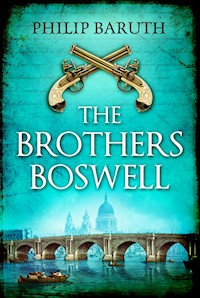
Erhalten Sie Zugang zu diesem und mehr als 300000 Büchern ab EUR 5,99 monatlich.
- Herausgeber: Corvus
- Kategorie: Gesellschafts- und Liebesromane
- Sprache: Englisch
30th July, 1763. Two striking figures part the heaving crowd at London Bridge. Peddlers cease their haggling, ferrymen grow quiet, beggars stop and stare. Even the stink of the Thames seems to fade in the presence of Dr Samuel Johnson and James Boswell - history's most famous friends. Boswell, as charismatic and meticulously coiffed as Johnson is bullish and badly dressed, is eager to advance himself in literary society. Today he is to accompany the great Dr Johnson on an excursion up the Thames - and he is determined that nothing will go wrong. But another Boswell is watching from the shadows, insanely jealous of his elder brother's meteoric rise through London's coffeehouses and whorehouses, tenements and theatres, soirees and salons. He has two golden pistols in his pocket, a ferryboat at his disposal... and murder in his heart.
Sie lesen das E-Book in den Legimi-Apps auf:
Seitenzahl: 508
Veröffentlichungsjahr: 2010
Das E-Book (TTS) können Sie hören im Abo „Legimi Premium” in Legimi-Apps auf:
Ähnliche




















Copyright
First published in the United States of America in 2009 by Soho Press.
This edition first published in Great Britain in 2010 byCorvus, an imprint of Grove Atlantic Ltd.
Copyright © Philip Baruth 2009. All rights reserved.
The moral right of Philip Baruth to be identified as the authorof this work has been asserted in accordance with theCopyright, Designs and Patents act of 1988.
All rights reserved. No part of this publication may bereproduced, stored in a retrieval system, or transmitted in any form or by any means, electronic, mechanical, photocopying, recording,or otherwise, without the prior permission of both the copyright owner and the above publisher of this book.
This is a work of fiction. All characters, organizations, and eventsportrayed in this novel are either products of the author’s imaginationor are used fictitiously.
First eBook Edition: January 2010
ISBN: 978-0-857-89060-3
Corvus
An imprint of Grove Atlantic Ltd
Ormond House
26-27 Boswell Street
London WC1N 3JZ
www.corvus-books.co.uk
TO JOE CHANEY,
the sort of friend you call when it becomes
necessary to go to Scotland.
Contents
Cover
Copyright
PART ONE
Chapter 1
Chapter 2
Chapter 3
PART TWO
Chapter 4
Chapter 5
Chapter 6
Chapter 7
PART THREE
Chapter 8
Chapter 9
Chapter 10
PART FOUR
Chapter 11
Chapter 12
Chapter 13
Chapter 14
Chapter 15
PART FIVE
Chapter 16
Chapter 17
PART SIX
Chapter 18
Chapter 19
PART SEVEN
Chapter 20
Coda
Chapter 21
PART ONE
TheRiverine Excursion
Saturday 30 July
Mr. Johnson and I took a boat and sailed down the silver Thames. I asked him if a knowledge of the Greek and Roman languages was necessary. He said, “By all means; for they who know them have a very great advantage over those who do not. Nay, it is surprising what a difference it makes upon people in the intercourse of life which does not appear to be much connected with it.” “And yet,” said I, “people will go through the world very well and do their business very well without them.” “Why,” said he, “that may be true where they could not possibly be of any use; for instance, this boy rows us as well without literature as if he could sing the song which Orpheus sung to the Argonauts, who were the first sailors in the world.”
He then said to the boy, “What would you give, Sir, to know about the Argonauts?” “Sir,” said he, “I would give what I have.” The reply pleased Mr. Johnson much, and we gave him a double fare. “Sir,” said Mr. Johnson, “a desire of knowledge is the natural feeling of mankind; and every man who is not debauched would give all that he has to get knowledge.”
We landed at the Old Swan and walked to Billingsgate, where we took oars and moved smoothly along the river. We were entertained with the immense number and variety of ships that were lying at anchor. It was a pleasant day, and when we got clear out into the country, we were charmed with the beautiful fields on each side of the river.
—From Boswell’s London Journal, 1762–1763
London, England
Saturday, the 30th of July, 1763
11:42 A.M.
1
IN THE RARE event that one man must follow two others without being observed, follow them closely from first light to summer dusk, certain conditions are best met. Those being followed should stand out vividly from the world passing around them; he who follows, of course, should not. And the following itself should occur in the thick of a crowd as alien and uncaring as is practicable.
All of which is to say that conditions today are very near the ideal.
Having shaken off its morning torpor, Fleet Street has moved without interval into the irritability of early afternoon. Carters jostle peddlers, and servants swarm the lane between shop windows and the row of posts protecting them from the street. Everyone seems to be wrestling some greasy package home, or if not, then envying his neighbor’s. A coach comes rocking out of Hen-and-Chicken Court and drives straight at the crowd, only to have the ranks suddenly part and reform, swallowing it whole. Sullen chairmen jog by bearing their sedans, beggars sprawled against the wall pull in their ankles only at the last instant, and neither party seems aware of the interaction, or lack thereof. All is one general fabric of gray and brown discontent, no particle detachable from the whole.
Until I spot the two of them, coming along in the distance.
They are framed momentarily by the thick stone arch of Temple Bar, and the effect is uncanny, like the first seconds of a magic lantern show, when the pretty pictures suddenly begin to crawl in the candlelight. It is not just the movement that strikes one, but the meaning. For once the painted emblems have started into motion, there is a palpable significance, a meaning, an inevitability to their progress. One understands intuitively that the images will not stop until the catastrophe. And therein lies the viewer’s chief satisfaction.
Of course in this case, given that the plot and the catastrophe are of my own composition, my satisfaction in watching the pair advance is at least doubled.
Once the two of them make their way beneath the Temple arch, though, once their movements are no longer properly framed, they are simply two gentlemen again, picking their way along down Fleet. But two gentlemen such as the City has never seen before and will never see again. There is no mistaking them for anyone else, you may take my word. Especially with the larger, older, and testier of the two so very much larger and older and testier. Even plagued as he is by phantom pains in his back and his legs, Samuel Johnson bulls forward through the Saturday morning crowd, not walking his oaken stick but brandishing it.
He is fifty-four years of age, a large-boned, large-nosed, large-eyed, big-bellied man, and the smaller and less determined catch sight of him at the last second and scatter as he comes. Here is what they see bearing down on them just before they jump: the vast body is packed into a rusty brown suit of clothes, waistcoat creaking at the buttons, flashing the dull white shirt beneath. Black worsted stockings and old black shoes, shoes rarely wiped and currently spattered, silver buckles half the size of the prevailing fashion because small buckles are at once conservative and cheap. A small unpowdered wig, brown and shriveled, rides the head like a mahout.
Johnson’s mood seems cheerful enough this morning, for Johnson, and he carries this good humor truculently along with him as he comes.
The younger man striding brilliantly alongside seems small only by way of comparison. In his own right he is brutishly healthy, leaning but never quite toppling to fat. Of just under middling height, maybe five feet six inches all told. The complexion is dark by City standards, but tinged with rose at his neck and plump cheeks. And he is radiantly happy, anyone can perceive this, no matter the distance.
The importance of the day’s outing to the younger man shows in every considered detail of his appearance: he is wearing his own hair, but meticulously dressed, powdered, and tied back with sober black silk; snowy stockings; a military cock to his hat that he has affected rather than earned; and a smart, silver-hilted, five-guinea blade got by hoaxing Mr. Jefferys, sword-cutter to His Majesty. He wears his genteel new violet frock suit, with its matching violet button, as though it were a coronation outfit. And his shoes have been wiped to within an inch of their lives. This is James Boswell, age twenty-two.
And what makes you simply want to murder the pair of them, more than anything else, is the perfectly ludicrous way they seem to complete one another. Not quite opposites, but different in a thousand complementary ways. Two odd human fractions who have stumbled somehow onto the secret of the whole number.
It is this sense of completion that draws heads around as they saunter down Fleet, not the barking volume of their talk, which is high enough, of course. And it is this wholeness that brings the occasional snicker, from the coal-heavers and the milk-women and the bankers. Those doing the snickering tell themselves and one another that they’ve never seen such a mismatched pair in all their lives, sweet Jesus, but this is a thin attempt at self-comfort. If, rather than matched, these two men are mismatched, then north is south, hot cold, and our own lots in life momentarily less meager.
The truth is easier to see, but a great deal harder to recognize, and to accept: these two men have one another suddenly, and don’t seem much to need anybody else. Their friendship of two months could not be any more clearly destined to last two lifetimes.
The sight of them suggests a completion we all seek in our friendships, our whole lives long, and do not find; at a deeper, blacker level, it is what we seek from the cradle each inside ourselves, and never discover. We are fragments scattered about loose in the world, yet in some way now these two men are not, not any longer.
What can all the rest of us do, then, but point them out on the street and laugh?
JAMES’S DELIGHT AT walking down Fleet Street with his hero lends him an almost visible shimmer. Just as evident, though, is his anxiety that some small thing may unexpectedly cloud the skies of Johnson’s amiability. Even in his joy he is continually scanning the older man’s face for weather signs.
Oh, this James is solicitous, and for this too you could murder him.
But after all, currying favor is James’s explicit purpose for coming up to London in the first place. Somehow he has secured permission to spend the bulk of this year begging a commission in the King’s Guard from those who would vastly prefer not to give it him. And to that official errand James has added another entirely his own: to worm his way into the hearts and affections and appointment books of as many full-scale London authors and notables as he can manage in the space of nine months.
It took six of those months merely to make the acquaintance of Johnson, author of the Dictionary itself, England’s undisputed and ill-tempered literary lion. But having done so, James has wasted no time parlaying the acquaintance into a friendship, and that friendship into something now just shy of actual foster-fatherhood.
This morning, he showed up on Johnson’s Inner Temple doorstep at just a touch past nine-thirty for their ten o’clock meeting, so afraid was he of being thought less than punctual. He stood for a moment, pondering. Lifted his fist to knock, dropped it without knocking. Then, lest he seem overeager and boyish, James strolled around the corner, looking to kill time, looking for amusement.
I stood and watched him all the while he stood and watched Fleet Street.
He settled his attention on the Temple Bar, as well he might: set into cornices of the stone arch are statues of Charles I, the Stuart martyr, and Charles II, whose itch for actresses brought women to the English stage. And something else: on iron pikes atop the stone pediment sit two now-desiccated heads. For reasons that no one including James knows, James is all but addicted to the terrifying jolt of a good hanging or dismemberment; these two skulls, circled by flies and touched with the gore of history, seize and hold his attention.
He is predictable, is James.
A sharp little shopkeeper hard by the Bar sized up the situation and trotted out with a cheap pair of spyglasses, half-penny the look, and James delightedly fished in his pocket for change. Then, after having his sleeve pulled twice, and paying cheerfully for two more long looks, James simply struck a bargain to buy the glasses outright.
After another ten minutes, when he had finished searching the desiccated heads for meaning, for sensations, he dropped the glasses into his deep coat pocket and retraced his steps to #1 Inner Temple Lane.
I followed after a moment, marveling at the endless seepage of unforeseeable detail into even the tightest plans, the capillary action of disaster. Who but the Lord Himself could have foreseen that James would suddenly acquire the ability to see great distances? The ability to search the boats before and behind him on the river every bit as casually as he might search his own waistcoat pockets?
Not for the first time, I wondered if the Lord might be plotting against me, somehow, and I added the spyglasses to Johnson’s stick and James’s sword, the small running mental list of objects to which I must pay particularly close attention this day.
SO HERE IT is now, just before noon, and they have had their late-late-morning coffee at Child’s, and a separate dish of chocolate for James. They have sauntered for a good twenty minutes under the leafy trees of Hare Court, tuning up their voices and their respective pomposities. And now they’re off for their true lark of the day—a float down the eastern stretch of the Thames.
But of course this is Dictionary Johnson, who birthed the entire sanctioned English lexicon from his own singularly overstuffed vocabulary, and so a float down the river cannot remain merely a float. God forbid.
A riverine excursion, they’re calling it. And it sounds so altogether grand that I have decided to take a riverine excursion of my own.
They come down Middle-Temple Lane, a moist wind filling their noses, and there, in the dark frame created by the Harcourt Buildings, lies the silver water of the Thames. They lift their well-fed faces at the pleasant shock of the river: the glittering length of it just behind a line of unremarkable city roofs, coiling through the city with all the drowsy power of a boa constrictor. And on it, every device for flotation known to mankind, moving everywhere and at every speed at once: wherries and barges, sloops and fish-smacks, skiffs and cheap wooden bottoms and the occasional grand racing yacht, twelve oarsmen pulling all at once. Gulls crash and tilt and screech overhead, and the stink of fish and water rot comes up sharp with the wind.
As the two men approach the Temple Stairs, and the loafing watermen sense the approach of custom, a predictable form of hell breaks loose. Everyone shouts at once, addressing their shouts to Johnson alone because they all have the menial’s highly developed nose for power.
Westward or Eastward, Sir! Row you straight, row you quiet!
Sculler! Sculler, maybe, gents? Sculler!
He’ll drown you, that one! Don’t be daft, Sir. Oars here now!
For all their crowding and jostling, the watermen observe a thin protective bubble around their marks, pawing the air but never once putting a hand to Johnson’s coat. And he points without hesitation to a young man about fifteen years old, standing off to one side, and barks, “Take us out then, boy,” and the crowd of rivermen explodes in curses and righteous indignation.
The boy leads them quickly down the center stair to the river. He is wearing the arms of the King on his uniform, and no doubt this is part of the reason Johnson chose him. Johnson has a pension of 300£ a year from the King, and I imagine that in some secret way the King’s arms signify to Johnson not only the great and benevolent power of the Crown, but the great and benevolent power of Sam Johnson. And, too, the King’s men are watched more carefully by the Crown, and so they are less likely to cheat you, more likely to get you there clean and dry. Not much less, and not much more, but a bit.
After some fiddling, the boy draws his narrow red sculler up flush to the step, and Johnson climbs ponderously aboard. The long craft bobbles and then steadies. When Johnson is seated in the center, James steps relatively lightly into the rear, checks his seat for water, finds none, and sits.
And as they draw away, holding their hats—James’s violet suit shrinking slowly to the size of an orchid—one of the bigger watermen on the stair breaks off shouting curses at the boy piloting the sculler, turns abruptly toward the spot where I’m standing, and crooks his finger at me.
THE BIG WATERMAN has his head shorn down to the scalp. Sweat stands from the tough brown skin as he hauls his oars. He is forty-five maybe, or fifty. He wears the arms of the Lord Mayor, a looser and less appetizing outfit than the King’s. A pile of smooth river rocks stands in the bilge wash beside his own seat, just to one side of his boot, within easy reach. He is a very strong man, outfitted with the several weapons natural to his trade, and he pulls the oars with just this awareness in his air.
It’s the Lord Mayor’s men that dominate the movement of stolen merchandise on the river, and in the back of the sculler, behind my seat, I can see a nasty set of long gaffs and hooks, these for retrieving goods thrown from ships, these for cadging fish from passing smacks when traffic is tight. And, no doubt, for the occasional pitched battle between boats, battles for which guns are too loud and knives too short. Lord Mayor’s men view the river as the sea, and the sea as a sovereign entity unto itself.
Johnson and James are a short ways ahead of us, gliding along near the center of the river. Traffic moves quicker there, and the view is more pleasant. The wind is a caress, not the cuff you get peering south from the Temple. The ride is smoother as well; no need to row around wharves and stagnant debris and docks and moored vessels, as you do continually nearer the banks. As my sculler is doing at the moment.
“What do you want with ’em?” the waterman says suddenly.
“I beg your pardon?”
“What d’you want with the folk we’re pacin’ is what I mean, sir.”
I say nothing.
He keeps his head down, eyes on the mucky bit of bilge rolling back and forth across the little hull. He could look back into the shade under the thin green woolen canopy, but he does not. He does not want to push too hard, does not want to risk the shilling I have promised him. When I offered him three times the standard fare, as long as he would shadow another boat, keep mum, and take my lead on the water, the waterman didn’t bat an eye. “Glad to be of service, sir,” he had said, pumped full of sudden courtesy.
But now he cannot leave it alone.
“Nothing but curious, sir,” he drawls. “A man likes to know why he goes where, don’t he?” He scratches at his leg, then the slick crown of his scalp. A pair of rowers passing the other way yell a sudden, friendly volley of obscenities at him, but he shows no sign of hearing or recognition. He continues to pull the oars and to watch the roll of bilge water. “For a jest or to come at a shilling, is why people usually follow people,” he continues. “Or to catch a girl’s sneakin’ about. Always struck me there’s the couple ways of it.”
I have my eyes on the river.
The waterman is jovial now, enjoying the sound of his own voice in the open air, and the anger gathers slowly in my chest, not for the first time this morning. I can feel it stirring abruptly inside me, the anger, a large dog awakened by a small noise.
He clucks his tongue. “Your clothes are too swell for a footpad, my fine friend. There ain’t no lady in the sculler there to follow. And you don’t strike me as bein’ in a joking mood, you don’t mind me saying.” He spits over the gunwale. “And so I’m curious, now, nothing but that. A hint of why we’re running behind these two? I’ll be close as the grave, trust me, sir.”
Again, I say nothing for a moment, and then reach into my pocket and bring up a pair of coppers, holding them out on my palm for an instant. And then I pitch them over the side and into the water. Almost immediately, a young mudlark near the boat dives to catch the coins before they can touch silt. “Your fare is tuppence lighter, man,” I say. “The full shilling was for quiet, and following my instructions.”
He holds up a hand to signal enough, attends to his oars, swinging his head up and about to avoid other boats, and to keep James and Johnson’s red sculler in sight. Although the woolen canopy keeps off the sun, it blocks the wind, and without that breath of air the day is hottish, a creeping late July heat. And the wool traps the light stench of the waterman’s little boat itself, fish and sweat and damp wood and river slime. But it is the sight of the two of them on their excursion, the bigger and the slightly less big, sitting in their merry little boat out there in the very center of the Thames, never quiet but always talking, talking, talking that saps the pleasure from the ride.
After only five minutes or so on the river, I see their red skiff abruptly angle through the cluttered forest of masts toward the Old Swan Stairs. I have already told the waterman to expect as much, and he draws quickly across the flow of traffic to allow me to watch them come in for their landing. Predictable, to a fault. Greenwich is another long pull down the river, so why are they rowing in at the Swan, disembarking, walking the seven crowded blocks around London Bridge to the rank fish-market at Billingsgate and then re-embarking for Greenwich?
Because, my friends, James is nobody’s hero: he has not got the heart for the bit of white water under the spans, or the way the boat drops away from you suddenly when you shoot the bridge. And why else? Because they are both of them cheap. They’ll both squeeze a crown until King George weeps, and the fare doubles at the bridge.
But as I watch them re-bobble their way heavily back out of the sculler, I have a thought. A mudlark is treading water not so far from us, and I wave him over.
“Hey there you, lark,” I call, as softly as one can.
He swims to me at a leisurely pace, his strong arms dipping and flashing in the water. Once beside the boat, he keeps himself suspended in the water with slow, easy movements of his thick legs and cupped hands. Mudlarks spend hours a day in the current, carrying and finding and ferreting out things that are awkward for men on a boat or on shore to come at. No doubt this waterman and this mudlark have worked together at some point in the past, to move some package of something off the river before it could be stamped and taxed, but they ignore one another now.
“See that red sculler there,” I say, “putting off passengers at the Stair now?”
The mudlark looks, turns back. He has sharp features, good teeth, and the articulate shoulders of a man who swims for his living. A penny pouch hangs dripping from his neck, a rusted knife from his belt. He narrows an eye at me, trying to figure out what my game might be. “Aye. I see ’em right enough.”
“There’s a half-penny for you if you pull the coat of that boy rowing them, and ask him what the two gentlemen talked about. There’s a penny, though, if you remember it when you get back here to me, remember it all exactly.”
“Penny, eh? There’s a generous man.”
“A penny if you have the details exact.”
The mudlark nods his head slowly, and then gives a wink and rolls over in the water. His milky outline glimmers, darkens, and then vanishes, before he sounds, like a dolphin, a good thirty feet from the boat. In a moment his hand reaches out of the water near the Stair, and halts the boy’s sculler.
They talk for a moment, and then the mudlark slips back into the water and makes his way back to where the waterman holds us still in the river.
Instead of treading water this time, the mudlark hauls himself directly up onto the small gunwale of the boat and perches there, bringing his feet over the edge and sliding them into the warm bilge at the boat’s bottom. His body has long ago become a thing of the river, sleek and beach-white, nipples dark wet sand-dollars. His hair is slick and brown as an otter’s coat. He clucks his tongue at the waterman, who continues to ignore him, continues to fail to recognize him.
“Well, then,” I say. “What said he?”
The lark seems to have all the time in the world, and he examines his water-wrinkled hands and dirty fingernails before speaking. Then he rubs the muscles of his left arm, as though it is sore, before meeting my eye. The look is direct, a bit defiant, a bit provoking.
And then he says, “It’s to be like that, is it?”
By definition, to traffic with the mudlarks is to traffic in nonsense, but I have no time for it this morning. I rest my hand on the hilt of my sword and lean out of the canopy’s shade. “If you have anything to report, friend, I have what I promised. Good as my word.”
The waterman clears his throat loudly, nudging it along, and the lark finally purses his lips and nods. He rubs his hands together briskly. “Good as your word, then. Well, sir, the boy says the two men talked about speakin’ in old languages. All the way from Temple Stair.”
I wait, but nothing more is forthcoming. “Old languages, you say?”
“That’s it. Like Greek or Roman. What a man should learn o’ that, and how much, and if, and so on. Like that.”
I reach into my pocket, letting the music of the coins work. “Anything else the boy said?”
He thinks for a second, eyes on the small change now sifting in my hand. Then he’s got it. “The big one asked the boy what he’d give to know about the Argo Knights. The first sailors in the world, the big one said.”
“The Argonauts, you mean.”
“That’s it, sir.”
“And the boy replied?”
“The boy replied he’d give whatever he had.”
I’m amazed again at the ability of the river to teach every man on it, no matter how young, to cant so flawlessly. “My, what a simple, artless thing to have said. And the big one liked that, I imagine.”
The lark gives a canny look, nods, blows water from his nose out over the gunwale. He turns back, smirking at his own crassness. “Boy said the big one give him a double fare for that.” There’s a silence, and then the mudlark brushes his wet hair from his brow. He is searching my face again, scrutinizing it. I realize he’s waiting for his coin, and I fish it out of my pocket. He takes the penny, works it into the small leather bag about his neck, gives the cord a tug to seal it up.
And then, as though lost in an afterthought, he looks up at me solemnly and says, “I’d give all I’ve got to know them Argonauts as well, sir.”
“Fine, then. Give me the penny pouch there on your neck, and I’ll teach you.”
He snorts at that and slides back into the water, leaving the damp mark of his arms on the gunwale. As his churning legs take him away from us, he says, very distinctly, “Well, and if you’ll kiss my arse, sir, I’ll teach you somethin’ as well.”
With that, the waterman is up from his seat, a rock in his hand. He cocks his arm, but the mudlark has already darted beneath the water, so there is no way to tell whether the rock finds its mark when the waterman fires it into the Thames. In a moment the swimmer’s head surfaces several boats away, bobbing in the center of a ragged wedge of swans. And there is something ancient and timeless, something Grecian about the sight of him there in the current, the fine wet brow crowned with swans.
He blows me a kiss.
The waterman heaves another rock, and the lark’s head vanishes in the chaos of white wings.
It is good to know the snippet of talk about the Argonauts. No doubt James is already thinking about how to frame this bit of classical chat in his journal. He is keeping a journal of his year in London, oh yes, he certainly is, with entries for every day down to the most insipid. He has become really quite fanatical about keeping it up, and he has read me some of the entries of which he was particularly proud. Once or twice he has given me a handful of pages to read for myself, just a snippet he cannot resist sharing.
He has never let me read through the thick packet on my own, although I know he has friends who have seen the lot. Friends who receive regular installments through the post, like a serial novel written at a penny a word.
And I will admit, I envy him that bundle, because this journal of his gives him the chance to take the stuff of his life and spread it all out carefully in his mind and then cherry-pick it, rearrange it, and lay it all calmly together again. What is fine, what is extraordinary, what is brilliant becomes more so; what is ugly and unwanted is cast aside.
He can make of himself just such a character as he pleases in the romance of his own life. And he can pick his readers as he might his servants.
This scene today, though, needs no touching up after the fact: the two of them sailing down the Thames, as Johnson instructs his young prodigy in the shape of human history and knowledge—this is just as James would have it, but exactly, to a tittle. Which is to say that James has done all of the important scene-shaping in his own mind, long before he proposed the jaunt to Johnson, long before he prompted the conversation about the usefulness of ancient languages. All so that tonight or tomorrow he may tell his journal an entirely true story about playing Plato to Johnson’s Socrates. He has found a way not merely to write a true romance but to live it as well, and I do envy that.
And so I imagine him stepping off the sculler now, relentlessly searching the Old Swan Stairs for choice bits with which to flesh out tonight’s entry. He is repeating Johnson’s phrases over and over to himself, no doubt, rehearsing them so he cannot forget, God forbid.
Above all, he is avidly watching himself live out the most perfect day of his life, which means that the most perfect day of his life has only half his attention in the doing of it, something that strikes me as ironic and sad.
But the ironies do not end there, of course. Although there is no way for James to know it, the fact is that he may not himself be the one to record today’s outing in his London journal. I may be doing so in his stead, depending on the directions the day’s events take. And so today I am on the lookout for choice bits as well. Everything rests on the outcome of today’s excursion.
If matters work out favorably, Johnson and James and I may share a pleasant ride together back to London this evening. If not, I may return by water alone, certainly not an outcome to be wished, but a real and unpleasant possibility. In which case, I will use my copy of James’s key to let myself into his Downing Street lodgings. The bundle of manuscript I will pull from the little mahogany tea-chest that James purchased last November to hold it, then unknot the twine binding it. Then I will take a glass of negus and record this day, down to the wash of insignificant details that have given the morning its savor: the extra dish of chocolate, the bit of mercenary chat with the boy rowing the sculler, not excepting the Argo Knights themselves. And in addition I will include even those snippets that James—who includes everything, no matter how seamy or silly— would decline to include.
The manuscript journal of James’s year in London will never see print, as he now hopes, but it will be complete in every important sense: an artistic whole. And it will be treasured in the archives at Auchinleck for as long as I live, and after. Before I leave London, I will do for James what he will no longer have the power to do for himself: fashion an end to the romance he has woven of his own ephemeral existence.
And if you knew James as I know him—as only a younger brother can know an older—you would understand that all of this will constitute an act of the utmost kindness.
2
ONE OF THOSE piddling details even James would decline to include about the most perfect day of his life: what he did prior to showing up on Johnson’s doorstep this morning.
He left Downing Street an hour before daybreak, whistling a silky air in the quiet street. It is difficult to shadow a man at that hour; there are few enough about to make any single shape stand out after a block or more. And I cannot risk even a single close glance, as there is not a man alive who knows my clothing, my walk, my air so well as James. But the difficulty was more apparent than real: in turn, I know James well enough to predict where he was most likely headed.
And so I waited for him a block and a half away, in St. James’s Park. During the day the Park is drill-ground for the Footguard, and playground for ladies and gentlemen of the Court, and of course at ten o’clock in the evening, the Park’s many doors are all closed and locked with a great show of punctuality. And it all means absolutely nothing: there are seven thousand official keys scattered about the city, and ten thousand counterfeits taken in wax from these original seven.
As a result, the Park is a very different place after dark and before the dawn. This difference is what James continually craves and must have.
At that hour, with the moon down and the sun still skulking below the horizon, the forest in the center of the Ring remains an impenetrable black. The endless winding brick wall surrounding the Park is likewise invisible in the darkness. But within this gloom, the vast empty dirt-packed space of the Ring itself takes on a dull luminosity, picks up the leavings of the moon and gives back a quarter-light, just enough to perceive the outline of figures moving at one slowly from the trees.
And they come, these figures, these women, at the first hint of movement. Stepping out from the oaks, rising from dark prone humps on the dirt. Country girls in chip hats and red cloaks, middle-aged jades simulating country girls in chip hats and red cloaks. Faces pallid with ceruse. And in snagged yarn stockings and leather shoes. Home-spun gowns and gypsy hats. Greasy cotton dresses topped by small natty capes, these coqueluchons thrown open with a butcher’s matter-of-factness, should you rest your gaze at the bodice, even for a moment.
These women are gifted, more than most, with the predatory intuitions of the city. They came toward me when I entered the park, but after three or four steps they stopped, rested on their scraped leather heels, sensing. They marked the value of my suit, the angle of my hat, the drop of my lace. But even in the quarter-light there was something off-putting in my air, and they slowly moved off again. They saw in my stride that my purpose here in the Park was not complementary to their own. That I was somehow, just perceptibly, working at cross-purposes.
There is a large stair that drops down in stages from a set of townhouses in the southeast corner of the Park wall, and they allowed me to step unmolested into the shadow of that stair and lean against the damp brick.
But when James sauntered through a small archway away off to my left, the woman nearest him picked up his trajectory immediately, because there was nothing at all in his air that bespoke caution, or prudence. Far from it, in fact. The violet suit managed to pierce even the dark at the wall, and when he moved to the Ring, it was nothing like the furtive movements these women must see so often. No, he approached them with a clear relish, like a fond country squire come to rough-house with his pack of hunting dogs.
James knows very well the codes and the jealousies of these women, and he played with their need. The small young tart who picked him up as he entered wore a long blue hooded cloak, and James received her with a delicate bow. They began to walk the Ring together. No doubt he was asking price, name, any fictitious scrap of personal history—born in Shropshire, married young, widowed, new to the trade this night—because he collects these mendacious little wisps for his journal, the way other men collect porcelain or statuary.
In his turn, James is always a highwayman, or a black-listed actor, or a half-pay officer, a bit deaf from cannon fire. His assumed characters are always plucky but impoverished, and nearly always will James try to wheedle his way out of paying for what crude pleasures he takes. Very occasionally he saves a shilling or two this way, but it is the pretense itself that always delights James. As much as they are about having sex, these expeditions into the park are always also about having other selves, silly childish romanticized selves, and it is impossible to say which particle of his need I find the more pitiable.
This morning he was careful not to take the first woman’s hand, nor did he allow his own arm to be taken. Instead, he strolled along, with the nymph strolling beside him, until—at some line invisible to him and to me—the nymph grew a bit more frantic and tried to halt his progress, tried to jolly him and pull at his coat, hook it with her nails. But James did not halt. He ambled just past the invisible line, saying what would amount to his good-byes, until the next woman drifted out from the trees, to cover her own sixteenth of the Ring. He repeated this process again and again, with drab after disposable drab.
In this way, James had what he most desired: their need for his money, expressed as need for James himself, and brought to its most powerful expression again and again at each invisible boundary.
When he eventually selected, he selected not one but two, a tall and a short, black hair and blonde, and he took them to a segment of the wall past the Old Horse Guards building. I could smell the metallic tang of the ceruse, they passed so close to my own blind. He took them to a kind of shallow brick alcove where the women unhooked and unlaced and set ajar the fronts of their gowns, and slouched casually against him as he moved his hands over them. He dropped his face into the common mass of their hair, inundating himself with their smell, their reality. The taller woman used the flat of her hand to burnish the front of his breeches, with as much care and passion as she might use to whitewash spit from a tavern wall.
He stood and fondled them and bartered lies with them, those two Shropshire innocents new to the trade. A veteran of the wars in the Havana, he whispered, a peer of the Realm cruelly cheated of my inheritance. But it went no further, no further than what James innocently calls toying. It went no further because James did not come to the Park in search of consummation, but merely to have his passion tuned for his real tryst of the morning. A young Edinburgh girl, actually, come up to Town just two days ago. A girl James knows quite well.
One Peggy Doig. A housemaid, and mother of his eight-month-old natural son.
Fortunately, dear Peggy’s lodgings lay up the Strand, on a perfect bee-line between the Park and Johnson’s rooms in the Temple, and so once James had settled his double reckoning, and then fastidiously splashed his hands at a street well near Charing Cross, there was no need for him to take even a step out of his way.
FROM HER FAMILY’S dingy tenement on the south back of the Canongate in Edinburgh, Peggy Doig has traveled to London and landed finally in a flat above a disheveled chandler’s shop up the Strand. Still, it must seem awfully grand to her. The building rubs shoulders uncomfortably with an iron-monger on one side and a coffin-maker on the other. From her bitty garret window, she can no doubt take in both the stench of the smelting fire and the sweet pine-shavings smell of new death. The shop is owned by her brother-in-law, the candle-maker.
Her older sister keeps house here and works on-again-off-again as a parish midwife. Twice has the parish sent a different young girl to clean house for the couple, to allow Peggy’s sister to devote herself entirely to wrestling infants from the growing number of parishioners out of whom they must be wrestled. Twice has the couple found fault with the young mop-squeezers in question and sent them away. One was beaten—badly, I take it—and then sent packing, though she is agreed to have been so provoking as to have asked for it.
Eventually it was decided within the larger Doig family that rather than clean house for an aging widow in Edinburgh, at poor wages, Peggy might just as well serve her sister in London for none. If the family knew that the father of her bastard had also been in London for a year, they seem not to have cared a whit.
The girl wrote James a short, inarticulate note two days ago, explaining and all but apologizing for her sudden presence in London, and finally offering—should he have a moment free some afternoon—to meet and pass on tidings of his child.
This letter of Peggy’s I have now, this moment, in my coat pocket.
I found it nestled in the lining of James’s tea-chest last night, alongside a small packet of letters to John Johnston, a childhood friend who has managed the whole awkward affair of the birth this year that James has been in England. It was Johnston who attended the mother following the birth, held the infant, and saw to it that the boy was named Charles, in accordance with the wishes of the father, who happened that night to be attending a rout thrown by the Countess of Northumberland, some four hundred miles away. It was Johnston who passed on the money to set the child up with a wet-nurse, and to keep the Doigs from noising the business about.
This whole packet of letters I have in my pocket, in fact, the stiff paper rasping against the cloth. It rides there like a hornets’ nest, fragile, intricate, almost entirely defined by its potential for pain.
James wrote back that he’d love to see her, and see her for more than a moment, but that she must arrange something private for them.
And so yesterday Peggy wrote James a second letter, much more to the point. It told him the number of the house, how to enter by the doorway of the coffin-maker next door, which served her staircase just as well, how to reach the room she now had of her own, the garret four flights up. The garret itself had no lock—this by design, one must imagine, to make the watching and the beating of housemaids that little bit easier on the chandler’s wife. The letter hinted that the chandler would be occupied by his early customers— it was all but unheard of for him to leave his shop before the noon meal—and that the midwife would be sitting with a woman in the last hours of her confinement. Peggy might steal an hour or more before she began her work for the day, she said, by working twice as fast in the afternoon. James was to rap thrice at the garret door.
She said that it would be sweet to see him again, after such an absence. Sweet, that was the very word she used.
I could have told her that James would not be content with an hour. But she didn’t need anyone to tell her about James and his particular appetites, after all.
For the record, I was right: it was more than two and a half hours from the time he entered to the time James exited the coffin-maker’s door and stood again on the street. He couldn’t have looked any more self-satisfied. Rather than attract attention by dashing away, he made a point of pausing and seeming to examine a small dark mahogany coffin standing erect in the window. He studied it from several angles, playing the grieving father. Then, to complete the effect, he called the carpenter over and dickered with him over the child’s box for a moment or two, before cheerfully giving it up and heading on up the Strand.
I stayed with him until he finally rang for Johnson, and I watched the two of them walk arm in arm to Child’s, where they took their seats and called for their coffee. And then I turned back to the coffin-maker’s shop, and Peggy’s garret.
I had about forty-five minutes, as near as I could reckon it. The coffee would take them at least half an hour, and you could bet your soul the two wouldn’t be leaving before James had had his dish of chocolate as well.
BEFORE SHE MET James, Peggy was housemaid to Mrs. MacKenna, who still owns the floor above the Boswell flat in Parliament Square. By chance James saw the girl one morning, sprawled in the staircase, scrubbing the steps with a pail of damp sand.
Her hands were brown from rottenstoning the widow’s risp and doorknob. But her small feet were bare and white, and James was immediately entranced by them.
He wrote later to Johnston that they were more temptation than any man could stand, these two dainty lumps of muscle and toenail. “My father,” he wrote, “had always insisted that stockings and shoes be worn in the tenement’s common staircase, and given that this was the express wish not simply of a fellow tenant, but of a High Court Justice, it was obeyed by all the building’s inhabitants as a very commandment. And yet here was this girl, and here were her pretty naked feet, lying like opals cast among the sand.”
I thought of these words because the feet were the first part of her I saw when I rapped thrice, then turned the handle very quietly, and opened the door an inch or two. They lay there on the counterpane before me, the very feet themselves. And to me they seemed like the feet of a young housemaid, just as much as would support her in wielding a broom, nothing more nor less. A bit dustier at the sole than one might wish them. Nothing to covet. Nothing to make a man risk an inheritance.
She’d obviously decided to have a well-deserved catnap before setting about the cleaning her sister had assigned her for the day. The morning light was falling on her from the garret window, and she was curled in it, a drowsy dark-haired creature, with her back to me.
But she was not yet asleep. “Mr. Boswell,” she murmured, without raising her tousled head. Instead, she moved a strand of hair from her face, clearing her pretty profile, and then lay the arm down again, quiescent.
I made a humming noise in my throat that might be taken for assent. Not an intelligible word, hence not a lie, but a sound.
And in this case, of course, even a yes would not have been entirely amiss.
At the sound, a hint of mischief touched up the corner of her mouth. She was enjoying London, it seems. I stepped into the room and closed the door behind me. My boots on the floorboards, I imagine, sounded no different than the oh-so-careful step of her child’s sire.
“You said I shouldn’t see you for many months,” she murmured, her voice thick with half-sleep. The voice was also playful and pleased, pleased that Mr. Boswell had not refused to see her altogether in London but had in fact come all the way to her room and broken his passion to her again, after so many months of silence; pleased that he had deigned to speak with her about their child, almost as though they were parents, man and wife even, they two together, rather than merely two dumb creatures who had come together in a rut to multiply; pleased that he could not resist returning this morning for more of her; pleased with the world, suddenly; pleased as punch with herself.
She stretched on the bed, in nothing but a rumpled white smicket, unbending the white leg with its tracery of black down, languidly flexing the foot, no doubt bracing for the grip of James’s hands on her thigh, her shoulders, her hip. As I say, she needed no one to tell her of his appetites.
It was a quiet, warm little room, although I could hear horses’ hooves and ostlers’ curses drifting up from the Strand. Other than the small bed, the garret was devoid of furnishings. Almost entirely devoid: her battered travel trunk she had covered with a strip of cheap lace, and on this strip she had placed her pins, a brush, her mob cap. A tiny, pretend dressing table.
I went to the bed and sat at the bottom of it. My weight caused her body to dip toward me slightly on the straw-filled matt. She did nothing to counter the movement, but rested almost coyly in mid-motion, so that a simple nudge at her hip would have brought her rolling over to me. This is how ready to hand she was for him. I took one of the dags from its holster in the lining of my coat, and I laid it across my knee.
“Good Mr. Boswell,” she cooed, eyes still closed, still facing the wall, still waiting. So passive was she in this foolery with James that she could not initiate even a look. She must wait to be rolled to her back, she must wait to be gazed upon.
I reached out a hand and took the hem of the smicket in my fingers, tugged it down sharply where it had ridden up on her leg.
“Cover yourself and be a woman, Peggy Doig,” I whispered back at her.
Her head jerked around, and in that instant I had my left hand over her mouth, and her head pushed back into the tan sack she’d been allowed as a pillow. Before she could struggle more than a bit, I brought the pistol up from my knee and touched the fat gold heart-shaped butt to her flushed cheek, held it there, the snubbed barrel an inch from her eye.
The kiss of the gold had its effect: she slumped back, limp as milktoast, breath coming in strained little hitches, but the eyes as open and seeing, no doubt, as they had ever been during her eighteen dun years of life.
Even before I could speak, the eyes began to swim.
I held her mouth, but I tipped the dag back from her face. “Peggy Doig, I want you to know that everything James knows, I know as well. I know that the chandler is below-stairs, and that you fear him only slightly less than you fear death itself. And so I know what will happen in the next ten minutes.”
She watched me, and there was recognition in that gaze, as I knew there would be. I went on, softening my tone.
“I will put away my pistol, you will lie still. And we will talk together. And then I shall leave, good as my word. But should you scream, I will scream louder, I will absolutely raise the house, and I will inform your brother-in-law of the details of your morning, or at least the last two and a half hours of it. I will show him your letters to James, and James’s by way of return. And he will need to leave off peddling his candles and bad beer and soap. You are not kind to him, or to your sister, in these little missives, you know. And so when he’s read them, you will suffer the fate of the previous mop-squeezers in this house, that is, to be beaten until you cannot walk, and then to be pitched out into the gutter like so much dirty tallow.”
I slowly pulled my hand from her mouth, and drew back.
“It’s you,” she managed to whisper. There was bewilderment in the word, and some faint whiff of something like betrayal.
“Me,” I said. She has seen me with James, seen me loafing at the Cross in Edinburgh, something half-glimpsed a hundred times but never brought into focus.
From my pocket, I drew the packet of letters, her last of yesterday on top and visible beneath the green silk ribbon. The swimming eyes closed tightly, and her face was suddenly wet, shining in the stray rays from the window.
“Open your eyes, Peggy Doig.”
She did so, managing a few strained, miserable words as well. I saw that her hands were clenching and unclenching mindlessly on the counterpane. “But what is it ye want, sir? I’ve not done anything to—”
I brought out the second dag from its pocket beneath my right arm, and she was immediately silent. I held the two of them in front of her, and we looked at them together. They were lovely things, the pair of them, Doune locks so that they might be half-cocked, ready to fire as they were drawn. Shortened barrels for riding snug in a fitted inside pocket, each no longer than the tip of my finger to the heel of my hand. Balanced in the way that only a brace of Highland flintlocks will balance.
And of gold. Not merely inlaid with gold, not merely gold-mounted, but entirely of gold, though not polished up: the deeper luster of gold gentled into everyday use, like a wedding band or a dark golden comb. They were like something royalty might wear or wield, that massy and that enchanting, without hollow or alloy. Only the shot and the powder itself were black, deep in their chambered hearts. And even those bullets the smith dusted with gold, so intent was he upon completely transforming the brutal into the lovely.
“Bonnie things, aren’t they, Peggy Doig?”
She knew better than to say no. “If ye say so, sir.”
Peggy had never before seen such things, clearly. And neither had I before these came into my possession. Only blue steel is strong enough to bear repeated firing without melting or exploding, everyone knows it. But the maker of these cared nothing for constant use. These were designed to be used once or, in great necessity, twice each. The goldsmith who had them before me told me they were poured for an assassin in King George’s pay: each dag designed to fire one bullet into the head of one target, and then the pair to be melted down and converted into the killer’s reward. George had ordered one bullet for Bonnie Prince Charlie, and the other for Flora Macdonald, the Prince’s ally on the island of Skye, she who dressed him as a waiting maid and spirited him to France.
At least this was the goldsmith’s cant. But whatever the truth of their history, the dags have spoken to my heart these last weeks in London, the wonder and the rage, and for that reason I can sit sometimes in my small room near the Bridge and stare down at the pair of them in my hands for an hour or even two together, and never note the ticking of the clock. If envy truly has a color, that color is not green, but gold.
I clinked the barrels one against another, and she flinched.
“Shall I ask my questions, then?”
She drew in a little shudder of breath, laid her head back on the pillow, eyes on the window. Then she nodded. Her hand went to the linen at her thigh, and she drew the garment down further, held it down, hand knotted in the thin material. She didn’t want me to see the move, because she was thinking about how to guard what lay beneath, despite what I’d said. But I looked at the hand, then back into her eyes.
“You needn’t worry about your woman’s honor. I could not be less interested, I assure you. And I think it only fair to point out that your excessive concern comes a bit late in the game. But I am here to do two things, and the first is to satisfy my own curiosity. I must ask you those few things I have no way of knowing for myself. First off, what did James have to say about your own situation today? What said he on that score?”
“My situation, sir?”
“Don’t play the fool. That situation in which you and James searched diligently beneath one another’s clothing and discovered a baby.”
A short pause. “He said I mustn’t ever fall into such a scrape again.”
I laughed, quietly but from deep down. I could not help myself, for the life of me. “I thought as much. That was merely a question to confirm what I knew had to be so. Now my real question, Peggy Doig, that which only you can answer for me.”
She braced for it, and I could see authentic curiosity kindling.
“It is this.” I took in the young, spotless skin, the artless cascade of her hair. Her nose was long and very thin, turned down at the tip, a single element of elegance in an otherwise freckled, rustic face.
“Why do you let him make a nothing of you?”
She brought her gaze back to me, but there was perplexity there. “Sir?”
“A nothing,” I whispered at her. “He pushed you or he wheedled you into giving yourself up to him in Edinburgh, and he treated you like a rag doll he kept in a closet above the flat, to play with at his leisure. And when he’d played with you and got you with child, he threw you back into the closet where he found you, with ten pounds for your trouble.”
Someone yelled in the street, and she waited before answering me, as though the voice might belong to someone coming to her aid. But then she spoke. Her own voice was gravelly with swallowed tears, but she defended him—and, I suppose, the child. “He’s taken notice of the lad, sir. He’s said the boy’s to be called Boswell. He’s said he ain’t ashamed if ’tis known.”
“Of course it is to be called Boswell. Do you not see? Everything must bear his name, like a knock-off pamphlet. This is hack publication, not fatherhood.”
“He’s set us up a nurse for him. The boy’s to be schooled when he’s of an age.”
“It means nothing, you silly hamely




