


Erhalten Sie Zugang zu diesem und mehr als 300000 Büchern ab EUR 5,99 monatlich.
- Herausgeber: BookThug
- Kategorie: Für Kinder und Jugendliche
- Sprache: Englisch
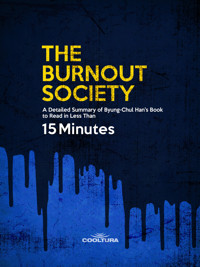
In his book "The Burnout Society," Byung-Chul Han presents the paradigm shift that has led humanity from the disciplinary society toward the achievement society. From a repressive society, based on the negativity of prohibitions, toward a hyperactive society, overabundant in stimuli and information, based on total positivity. The verb that defines the achievement society is not "I must" but "I can"; contemporary man believes himself free, but paradoxically lives at war with himself. The achievement society, Han says, engenders the infinite pain of the exhaustion of the self.
Sie lesen das E-Book in den Legimi-Apps auf:
Seitenzahl: 15
Veröffentlichungsjahr: 2025
Das E-Book (TTS) können Sie hören im Abo „Legimi Premium” in Legimi-Apps auf:
Ähnliche






•
FOREWORD
The Tired Prometheus
The contemporary subject, the performance-driven subject who is at war with himself, believes himself to be free but is chained like Prometheus, posits Byung-Chul Han in his book. Prometheus’ relationship with the eagle that devours his liver is the relationship of modern man with himself, a relationship of self-exploitation where the pain that seems infinite is exhaustion. Seen in this light, Prometheus is the original figure of the society of exhaustion.
Kafka has already reinterpreted the myth in relation to fatigue, a healing fatigue that closes wounds: “The wound closed with fatigue,” writes Kafka. The present essay, says Han, leads to a reflection on a healing fatigue that results from “a gentle disarming of the self.”
•
Neural violence
In this chapter, Byung-Chul Han uses the metaphor of different types of diseases to characterize each era. Thus, he asserts that in the 20th century, antibiotics put an end to the bacterial era and ushered in a new era. The author points out that although some fears of a flu pandemic persist (The Burnout Society was written more than a decade before the Covid-19 pandemic), we have left the viral era behind thanks to immunological techniques.
Pathologically speaking, says Han, the beginning of the 21st century is neuronal. Depression, attention deficit hyperactivity disorder (ADHD), borderline personality disorder (BPD), and occupational burnout syndrome (OBS) are the pathologies of today. These pathologies do not occur because of the negativity of the other, but because of an excess of positivity.
The last century was characterized by a clear division between inside and outside, friend and foe, self and other; an immunological scheme that also governed the Cold War and its characteristic military language of attack and defense. This biological mechanism also extended to the social sphere and entailed a blindness, since everything foreign was rejected even when it had no hostile intent. The immune system




