


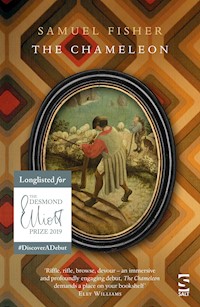
7,19 €
Mehr erfahren.
- Herausgeber: Salt
- Kategorie: Gesellschafts- und Liebesromane
- Sprache: Englisch
John is infinite. He can become any book, any combination of words – every thought, act and expression that has ever been, or ever will be, written. Now 800 years old, John wants to tell his story. Looking back over his life, from its beginnings with a medieval anchoress to his current lodgings beside the deathbed of a Cold War spy, John pieces together his tale: the love that held him together and, in particular, the reasons for a murder that took place in Moscow fifty years earlier, which set in train a shattering series of events. Samuel Fisher's debut, The Chameleon is a love story about books like no other, weaving texts and lives in a family tale that leads the reader on an extraordinary historical journey, a journey of words as much as of places, and a gripping romance.
Das E-Book können Sie in Legimi-Apps oder einer beliebigen App lesen, die das folgende Format unterstützen:
Veröffentlichungsjahr: 2018
Ähnliche




















THE CHAMELEON
by
SAMUEL FISHER
SYNOPSIS
John is infinite.
He can become any book, any combination of words – every thought, act and expression that has ever been, or ever will be, written. Now 800 years old, John wants to tell his story.
Looking back over his life, from its beginnings with a medieval anchoress to his current lodgings beside the deathbed of a Cold War spy, John pieces together his tale: the love that held him together and, in particular, the reasons for a murder that took place in Moscow fifty years earlier, which set in train a shattering series of events.
Samuel Fisher’s debut,The Chameleonis a love story about books like no other, weaving texts and lives in a family tale that leads the reader on an extraordinary historical journey, a journey of words as much as of places, and a gripping romance.
PRAISE FOR THIS BOOK
‘Riffle, rifle, browse, devour – an immersive and profoundly engaging debut,The Chameleondemands a place on your bookshelf’ —ELEY WILLIAMS
‘A book narrated by a constantly transmuting, text-shifting book? I was quickly won over by the bibliophiliac verve and deep humanity of this Borgesian novel.’ —DAVID ROSE
REVIEWS OF THIS BOOK
‘The Chameleoncould be considered something of a love story, both about books, and between the people that read them. It follows the story of a family through the years, the memories that shaped them, and the impact of past events on their relationship through the years. In the early stages of the novel we meet a man who is approaching the final days of his life, but in this novel a man’s mortality is portrayed from the perspective of someone infinite, someone who has lived for centuries.’ —The Owl on the Bookshelf
‘A fantastic new talent (recommended by Eley Williams!) … [a] mesmerising debut novel (and it really is brilliant).’ —The Book Hive
‘Over the weekend I read and hugely enjoyedThe Chameleonby Samuel Fisher. It is a novel narrated by an 800-year-old shapeshifting book. It can turn into any book it wants to. It tells the story of the people who have owned it down the years.’ —SCOTT PACK
‘As well as being a new novelist, Fisher is also a founder of Peninsula Press, a small independent publisher whose list to date shows a predilection for innovative and experimental voices. It’s a partiality replicated in this wonderful, funny and audacious debut. Who knows what my copy ofThe Chameleonwill turn into while my back is turned but I look forward to discovering whatever voice or artefact Samuel Fisher will throw himself into next.’ —JOHN BOYNE, The Irish Times
‘You might expect a debut by a bookseller to be a hymn to the joy of books, but writing from the actual viewpoint of a book (here the narrator, who can transform himself into any combination of words, places himself at the centre of various events over the past 800 years) takes that love to a whole new level. Fisher has so much fun with this tricksy conceit that the very human story he settles on (amid nods to Virginia Woolf, Jorge Luis Borges and Dylan Thomas), of a cold war spy looking back on a life, takes time to hit home. That it eventually does is testament to his infectious enthusiasm for the power of the novel.’ —BEN EAST,The Observer
‘Be it a love story, a thriller or a work of history, a written account makes those it depicts last forever. Revelling in its own wizardry,The Chameleonweaves a captivatingly reflexive tale around the life-giving possibilities of the printed word … Fisher practices a deft sampling technique, mixing in snippets of literary classics into his tale and reflecting on their relevance. The result is a compelling narrative and a subtle meditation on literary history.’ —Hackney Citizen
‘It seems only natural that if a bookseller was going to write a novel, it should be about books. Fortunately that’s exactly what Wivenhoe’s Samuel Fisher has done althoughThe Chameleon, which was released by cool indie publishers Salt this week, is a very different kind of book altogether. That’s because Samuel’s main character John can become any book, any combination of words, every though, act and expression that has ever been, or will ever be, written.’ —NEIL D’ARCY JONES,Colchester Gazette
‘This is undoubtedly a literary novel about a family and relationships, but also it’s about a love of books and it’s a spy story. It’s not surprising that the author set up a bookshop, you can almost imagine him spending time rooting through the stock and absorbing stories for this novel.’ —PAUL BURKE,Nudge-Book Magazine
‘The concept of a self-aware book is the kind of literary conceit that, in the wrong hands, could lead to the worst excesses of post-modern fiction. The book does, after all, identify with Borges’ tale of the infinite library as though it’s “an autobiography written by a future version of myself”. Roger’s story, in turn, is essentially quite a slight vignette that would struggle to fill a novel on its own. But by marrying them together, Fisher balances and intermingles the two strands so that they sustain an engrossing, satisfying and quite touching novel. Greater love hath no book than that it would transform itself into a biography of its most cherished owner.’ —ALASTAIR MABBOTT,The Herald
The Chameleon
Samuel Fisher is a bookseller at Burley Fisher Books, an independent bookshop in East London, as well as a director of independent publisher Peninsula Press.
For Mum O.L.R.M.
‘Je ne dis les autres, sinon pour d’autant plus me dire’Michel de Montaigne, 1580
‘I quote others only in order the better to express myself’William Hazlitt, 1850
‘I do not speak the minds of others except to speak my own mind better’
Donald Frame, 1943
‘I only quote others to make myself more explicit’
John Cohen, 1958
‘I only quote others the better to quote myself’
M.A. Screech, 1993
1
Have you everheard the fable of the Ass and the Lion’s hide?
An Ass once found a Lion’s hide that some hunters had left out to dry in the sun. Sensing an opportunity, the Ass put on the hide and walked back to the village of his master. At his approach all fled, both man and beast, terrified by his ferocious appearance. It was a proud day for the Ass, and in his delight he raised up his voice and brayed. In that instant everyone knew it was him and they were no longer scared. His master beat him around the ears and cursed him for his deception after which the Ass returned to the fields, his tale at an end.
It’s a simple story, and plainness has always been synonymous with truthfulness. However, it’s not my favourite way of telling it.
Let us suppose, for a moment, that the Ass did not speak. Suppose the Ass simply stood and watched as the world fled before him, happy and proud to roam free in his new dominion without fear. But then, as time passed, the Ass became lonely, and eventually forgetful. It came to a point when the Ass no longer remembered that he was wearing the hide. And when eventually the people and animals returned and the Ass opened his mouth to tell them that it all had been a game, he had forgotten how to speak.
Now we have a story that goes to the heart of my problem.
You see, all I have ever wanted is to be honest. But right from the very start I haven’t known whether I was an Ass or a Lion, or whether I was one wearing the skin of the other. Truth cannot exist on its own, apart. When nothing is certain, nothing can be true.
It has taken eight hundred years for me to open my mouth. I have listened, but have been unable to make a sound.
Soon enough we’ll find out whether I’ll bray or roar.
2
My story startswith two bodies. The first is right here in front of me, tucked between white sheets. The other is sprawled out on the polished floor of a convention centre in Moscow, a lifetime ago.
It is, I suppose, slightly misleading to call them bodies. They’re not dead. Not yet.
I should tell you where I am.
I’m in the master bedroom of a house. The same bedroom of the same house that I have occupied for the past fifty years. Around me are the people that – for better or for worse – I have come to call my family. It is morning.
Jessica is holding her granddad’s hand. It’s a simple gesture – her dainty fist closed around his knotted fingers – but I would give anything to spend ten seconds in her place now, to feel his fading warmth. I have always longed for the fluency of touch.
The fact is, I think Roger is going to die today. And it’s with this in mind that we’ll need to return to that other body, to balance the scale. So let’s go back to the exhibition centre in Moscow, 1959.
In a dome in Sokol’niki Park a cultural exchange was taking place. The dome was stuffed with Americana: kitchen appliances and muscle cars. Roger was there to meet a friend.
In one section of the exhibition there was a film playing on repeat. It opened with a narrator purring over images of the night sky, a vision of celestial unity. Then there were rows on rows of clapboard houses, shot from above, with picket fences on the front lawns and swimming pools in the gardens, cut with shots of the Grand Canyon, the Rocky Mountains. The great American West.
Groups of comrades were bussed in from the factories. They were given the tour, shown a microwave and a vacuum cleaner. They sat behind the wheel of a Cadillac. But really they were there to find faults. The Americans had come to tell a story, but the Soviets wanted to tell one of their own.
At the centre of it all was a collection of American art, curated to showcase the best works of the preceding three decades. Stark paintings of the frontier were hung next to canvases exploding with colour and shape.
There was one painting that was particularly popular. It depicted a high society dinner in a New York banqueting hall. Yellow was dominant, from the half-empty glasses of champagne to the silk crepe of a dowager’s elaborate ball gown, giving the whole scene a jaundiced hue. The chair of the American selection committee had wanted to have it removed. The title of the painting was Welcome Home, and it was in front of this painting that Roger had arranged to meet his friend.
Now I’ve started telling this story, I don’t know that I’ll ever be able to stop. The details pile up. My pages will grow and grow until they plaster the walls and the windows – until they block out the light. This room will become a perfect simulacrum of my mind.
Remembering that day in 1959 is lending a new sharpness to objects in the present. On the table beside Roger’s bed there is a drawing in a little clip frame. Jessica drew it for Roger when she was barely out of nappies, in a period when she and her mother were staying here. It’s the typical scene, two stick figures beside a house. There are marshmallow clouds and a sun smiling down from one corner. At the bottom, below the house and the figures, the words ‘Jess and Grandpa’ are spelled out in uncertain letters. It’s a scene that almost every child draws for their parents or grandparents – one of the first stories that children learn to tell. The one about the house and the family. The one about home.
Next to the drawing, in an older, more elaborate frame is a sepia photograph of Margery herself. She would have been only a few years older than Jessica is today when it was taken. The hair is different, and the nose, but the eyes are unmistakable.
Beside the table sits Ruth: Jessica’s mother, Margery’s daughter. She’s clutching a small, calf-bound volume. Holding it to her chest, just over her heart.
It’s one of those books that doesn’t seem to exist until it’s needed, until these moments of original fear when faith – inborn and subliminal – rises to the surface. The accumulated legacy of faith – that’s the comfort it brings. It’s a book that has presided over weddings and funerals, baptisms and confirmations. It connects the dots between Ruth and her antecedents and the moments they themselves groped for the eternal. It’s freighted with their joy and their terror.
I should know. I’ve spent more time as a family bible than anyone.
Roger and his friend wanted to meet somewhere busy in Moscow that day, so as to draw less attention. A crowd in which they could lose any surveillance.
Is this what success looks like to you? the man asked Roger, staring up at the decadent scene before him. As he spoke two grey-looking men approached through the crowd.
Roger was saying something about the gaucheness of American money, but I had stopped listening. They laughed and just as Roger’s friend turned to reply, one of the men bumped into him.
Within a couple of seconds the first man had disappeared into the crowd, trailing a mumbled apology. The smile froze on Roger’s friend’s face as his hand went to his thigh and then to his chest. He blinked once and I watched as a new dawn, one of terror, broke across his face. He began to fall, and at that moment the second man arrived to catch him.
We need to get something straight. I am not the average storyteller – and mine is not the average story.
As we go on you may find it strange that I presume to know Roger. I don’t just mean in the way that a mother might know a child, or a husband his wife. More than that. I can make the speculative leap between his actions and his thoughts.
But the fact is, I do. I know the lineage of these actions, the forgotten ancestors of each twitch and affectation. I was there at the conception of each habit and at the birth of each desire. I have watched, and I have watched, and I have watched. Accusations of arrogance would be misplaced. There is no place for pride in this: the quiet accumulation of the minutiae of a human life.
My love for him defies the usual categories. It is a kleptomaniacal passion for each thread of his history. The collection and preservation of these threads has been the great work of my love, which fuels and defines it.
But I apologise. How remiss of me. I didn’t finish. I am getting to be rather old myself, you see. So yes, you may find it strange when I tell you that, as Roger watched a bead of sweat trace a line down his friend’s forehead, as this friend was carried away by a man who – miraculously – arrived to catch him before he had even begun to fall, Roger’s mind was somewhere else. Slowly receding through the crowd, he was thinking of another story, one about a monastery in a far-flung place, and of the terrible things that had happened there.
As to what he’s thinking here and now, I couldn’t guess. Even I can’t follow the thread into that twilight land.
It has been over fifty years since that day in the convention centre, but it seems a fitting event with which to begin the telling of this story, which is now drawing to a close.
If go back to the newspapers for that day in 1959, in one of the tabloids you will find a photo. It shows a man in a Colonel’s uniform in a dead faint, being carried away by another man with bovine eyes, under the headline yankee art proves too much for the reds. In the background you can see Roger, looking in horror at his friend, his body half-turned to disappear into the crowd. If you look very closely, you’ll see me, poking out of the left top pocket of his blazer. I should introduce myself.
My name is John, and I am this book.
3
Often, when aplace is very familiar, it becomes difficult to recall the ways in which it has changed.
It’s a problem of aspect. From my viewpoint here on top of the bookshelf, it’s hard for me to see the room any way other than how it is today – the way it has been for perhaps the last fifteen years.
I see Roger. I see the bed.
But if I imagine myself plucked from the shelf by an invisible hand and placed at Roger’s side, then, all of a sudden, the years fall away.
I look up and find that a point which had seemed merely a slight discolouration in the paintwork – perhaps a trick of the light – is in fact a shallow crater in the plaster. It’s an inch deep, a couple of inches across.
This room hasn’t always been Roger’s bedroom. It was the day that I came to the house, and it is again now, but for a while it belonged to his daughter Ruth.
Ruth had been furious, in the beetroot-faced way that only toddlers and the criminally insane can be. It hardly matters what for. But it was the wall of this room that felt the full force of her fury, transferred through the corner of a red building block by Ruth’s surprisingly strong throwing arm.
From the bed I’m now swept by that same invisible hand to the floor, peeling back another ten years. I’m on the loose floorboard, the one that would groan every time adolescent Roger turned in his sleep. Silenced for the years that – carpeted in pea-green pile – it served as Ruth’s nursery, it groans again now as Jess leans forward out of her chair to sweep Roger’s limp fringe from his face.
And with that moment of tenderness the years restratify and compress. The invisible hand places me back on the shelf.
This room bears witness, as I do. It cannot do otherwise. And that is because, like me, it has no direct say in its aspect – in the way that it stands in relation to the years that pass over it.
I’m being circumspect. My imagination isn’t my only transport; I might not be able to move, but I can change.
Let me explain: I met Roger on a bus.
I began that day1 in the house of a filing clerk in whose dour company I had seen out the Blitz. I had been trying everything to induce him to slip me into his briefcase so that I might make my escape. When he caught sight of me that morning on the kitchen table, while eating his toast, it was with some surprise. He had left me the night before as an entirely different book.2
I hate toast. I really do. The crumbs get caught between your pages and then slip down to your gatherings. Like a stone in your shoe, one wet with saliva. So spare a thought, toast munchers. Have some compassion.
There was something about that book, perhaps the seductively bold red-on-black dust wrapper, which made it irresistible to Bill. As he was passing the table on his way to the door he paused and I found myself plunged into his briefcase. My spine came to rest against a spam sandwich.
When he opened up his case on the bus he became frantic – his pristine copy of the Christie was nowhere to be found. In his frustration he left the copy of that week’s Spectator3– which had mysteriously found its way into his briefcase – on the seat next to him.
I was snapped up by a leather-gloved hand and found myself confronted by a puffy face caked with powder, framed by a tartan nylon hood. This woman read my cover disdainfully. Then, to my disgust, she removed one of her gloves and licked her finger before turning my pages. I’ve made my thoughts about saliva clear.
I was powerless to do anything when she rang the bell and rolled me up, stuffing me into her handbag as she breezed past the conductor and out onto the street. Nelson’s column loomed above.
Now I was in a predicament. As a rule, I avoid going coverless. It’s risky, it makes me ephemeral and disposable. I had gone out on a limb that day because I was bored and desperate. And now, not only was I coverless, I was also at the mercy of the elements. You see, books are indoor creatures by necessity – we’re made of frailer stuff than flesh.
Exempting, of course, when we’re made from flesh.
I tried it once – anthropodermic biblioplegy. Though I suppose what I did would be autoanthropodermic biblioplegy.
I’m being drawn irresistibly sideways. Hold onto the woman with the forlorn magazine poking out of her handbag for a moment – we’ll come back to her. If this is to be a chapter of changes then this will be instructive.
My transmogrification into human flesh was a much earlier, aborted, attempt at setting myself down: an unmitigated disaster. Dressing that way attracts entirely the wrong crowd.
I thought I would try out being a found text. I’d write an entirely new book, engineer a situation where I would be discovered and hey presto! I would announce myself. I wanted something headline grabbing. My first thought was a heretical pamphlet, but that would only have caught the attention of a certain kind of reader. Then I thought perhaps something on divorce – it worked pretty well for Milton.
When the solution came, it hit me like a bolt of horrible brilliance: a murder confession.
The binding of this book is made from the flayed skin of John Roberts, at his request.
The autoanthropodermy was ancillary to the main idea, it just seemed neat for the murderer’s confession to be bound in his own skin. It was uncomfortable – scratchy. Human skin doesn’t tan well, not nearly so well as vellum. It is thin and brittle and curls up at the corners.
I want to beg the forgiveness of God for the things which I here do confess. I murdered my wife, Eleanor Roberts, in the heat of a jealous passion and it is my wish that this confession be bound up in my own skin as a penance for the barbarous crime that I visited upon her. I am soon to be hanged for these crimes and while I await my fate it is my desire to tell my story to the chaplain of this gaol so that my story may be a warning to others who
Once I got started I just couldn’t stop.
I took my style queues from the handbills published by the Ordinary of Newgate. Supposedly responsible for the spiritual care of the condemned, he sold their ‘confessions’ for sixpence at executions.
John Roberts gave me the release that I had been looking for; he was the empty cup into which I poured all of my impotent rage and frustration, shored up in my pages through centuries of passive immobility, to give this newfound agency the name of action.
I had him sleeping, eating, drinking. I had him fishing and chopping wood. I craved anything physical. The majority of the account covered the summer running up to the murder of his wife, spent tramping through East Anglia looking for farm work. While there was call for Eleanor as a milker, John’s hands were rough and unschooled. Every place they stopped at he was told there was nothing for him until harvest. John would sleep rough while he waited for Eleanor, drinking away her wages.
What started out as a murder confession evolved into a pantheistic tract. It was those days and nights that he spent alone in the woods and fields that gave me licence to inhabit him fully and, through him, to occupy the world that I was creating around him. When it came to describing the act itself, which took place in a poky room above an inn near Cambridge, I took scant pleasure. I cursed myself for picking a conceit that demanded such a swift conclusion, though having a defined, parenthetical structure within which to explore my selfhood was reassuring.
I made no attempt at covering my tracks or obscuring details. Part of me has always wanted to get caught.
At that time I was situated in the house of a banker on Cheapside – Nathan Mayer Rothschild. He was straightening his papers, getting ready to go out for the evening, when he came across me. He opened me up and his eyes went immediately to the inscription. He read it once, then again, before dropping me back onto the table. His raised his hands to the ceiling in horror.
However, it wasn’t horror that showed itself in his eyes, but curiosity. Tentatively, his hands snaked back towards me. When he picked me up it was with his fingertips, but as he turned the first page he licked his lips. And that’s when I knew that I had him. He forgot about his plans for that evening entirely and sat and read on into the night.
My thirst for experience had led to a text over-abundant in mundane detail. Rothschild lapped it up. People never want to see evil in a great black shroud, carrying a sickle. No. You want to see it with its trousers down as the outhouse door swings open in the breeze.
And there’s the sweet horror of it, that closeness, the possibility you feel just under the skin, imagining for a moment that it could have been you. That’s what I was looking for. As Rothschild’s bilious, bloated face floated above me, filled with excitement – that’s what I wanted to feel: that I might reach out and choke the life out of him.
It was curiosity, of a different order entirely, that attracted me to Roger. As I mentioned, I met him on a bus.
Let’s return to the lady with the tartan nylon hood, and to where we left her, standing by the bus stop in Trafalgar Square. And I, stuffed into her handbag, fearing my own destruction.
She didn’t move far. I slipped into the depths of her handbag, ensconced in a frilly handkerchief scented with lavender. It’s a scent that always makes me think of corpses – of masked rottenness.
By the time the lady opened her bag and pulled me out I found that I was on a bus once more.4For her part, the lady was astonished to find that – instead of a copy of theSpectator– she held a copy of a rather saucy nautical romance in her hand. Surprise didn’t inspire a more endearing configuration of her facial features than had contempt, so I was glad when she put me down on the seat in front of her.
I hardly had a moment to congratulate myself on another lucky escape before someone sat down beside me, dropping a bag on top of me and plunging me into darkness.
A moment more and I felt the bag lifted from my cover and there he was. There was Roger.
His hair was wet with the rain; there were droplets caught in the fine hairs of his eyebrows. As he scanned my cover, he licked his lips.
That’s when I knew I had him. It’s how I always know.
He looked around for whomever had left me, his eyes coming to rest on those of the lady sitting behind. His face reddened with the heat of her disapproval before breaking, suddenly, into a disarming smile.




