


11,49 €
Mehr erfahren.
- Herausgeber: Titan Books
- Kategorie: Gesellschafts- und Liebesromane
- Sprache: Englisch
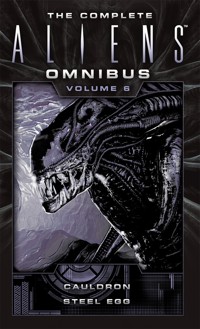
The sixth book in The Complete Aliens Omnibus, an essential collection for fans of Twentieth Century Fox's iconic blockbuster action-packed science fiction film Aliens, comprised of Cauldron and Steel Egg.In Cauldron, on the spaceship Umiak, an elite troupe of cadets is forced into servitude by an unscrupulous captain taking the ship to a smuggler's rendezvous. During the transaction aboard the eerily silent Virginia, the cadets unwittingly transport an unexpected cargo: a hive of hibernating aliens. As the aliens begin to awake, a terrifying battle erupts between the cadets, the smugglers, the captain, and the emergent monsters. The cadets soon realize that in space, no one can hear them scream.Steel Egg tells the story of the first encounter - someone battled them, and survived. Aliens and humans have fought before! When a human spaceship discovers a vast egg-shaped vessel in Saturn's orbit, the crew powers in to investigate. Thinking the ship might contain usable metal for Earth, they force their way aboard. Three teams split up to explore the ship. Already the aliens have awoken. The first of all the battles unfolds.
Das E-Book können Sie in Legimi-Apps oder einer beliebigen App lesen, die das folgende Format unterstützen:
Veröffentlichungsjahr: 2018
Ähnliche

















CONTENTS
Cover
Also Available from Titan Books
Title Page
Copyright
The Complete Aliens? Omnibus Volume 6
Aliens? Book 1: Cauldron
Dedication
1
2
3
4
5
6
7
8
9
10
11
12
13
14
15
16
17
18
19
20
21
22
23
24
Aliens? Book 2: Steel Egg
Dedication
Author?s Note
1
2
3
4
5
6
7
8
9
10
11
12
13
14
15
16
17
18
19
20
21
22
23
24
25
About the Authors
Also Available from Titan Books
THE COMPLETE
OMNIBUS
VOLUME 6
ALSO AVAILABLE FROM TITAN BOOKS
THE COMPLETE ALIENS™ OMNIBUS
VOLUME 1
VOLUME 2
VOLUME 3
VOLUME 4
VOLUME 5
VOLUME 6
VOLUME 7 (DECEMBER 2018)
DON’T MISS A SINGLE INSTALLMENT OF THE RAGE WAR BY TIM LEBBON
PREDATOR: INCURSION
ALIEN™: INVASION
ALIEN VS. PREDATOR:
ARMAGEDDON
READ ALL OF THE EXCITING ALIEN NOVELS FROM TITAN BOOKS
ALIEN: OUT OF THE SHADOWS
ALIEN: SEA OF SORROWS
ALIEN: RIVER OF PAIN
ALIENS: BUG HUNT
ALIEN: THE COLD FORGE
THE OFFICIAL MOVIE NOVELIZATIONS
ALIEN
ALIENS
ALIEN3
ALIEN: RESURRECTION
ALIEN: COVENANT
ALIEN: COVENANT - ORIGINS
ALIEN ILLUSTRATED BOOKS
ALIEN: THE ARCHIVE
ALIEN: THE ILLUSTRATED STORY
THE ART OF ALIEN: ISOLATION
ALIEN NEXT DOOR
ALIEN: THE SET PHOTOGRAPHY
THE COMPLETE
OMNIBUS
DIANE CAREYAND JOHN SHIRLEY
TITANBOOKS
The Complete Aliens Omnibus: Volume 6
Print edition ISBN: 9781783299126
E-book edition ISBN: 9781783299119
Published by Titan Books
A division of Titan Publishing Group Ltd
144 Southwark Street, London SE1 0UP
First edition: June 2018
1 3 5 7 9 10 8 6 4 2
This is a work of fiction. Names, characters, places, and incidents either are the product of the author?s imagination or are used fictitiously, and any resemblance to actual persons, living or dead, business establishments, events, or locales is entirely coincidental. The publisher does not have any control over and does not assume any responsibility for author or third-party websites or their content.
? and ? 2007, 2018 Twentieth Century Fox Film Corporation. All rights reserved.
No part of this publication may be reproduced, stored in a retrieval system, or transmitted, in any form or by any means without the prior written permission of the publisher, nor be otherwise circulated in any form of binding or cover other than that in which it is published and without a similar condition being imposed on the subsequent purchaser.
A CIP catalogue record for this title is available from the British Library.
Did you enjoy this book?
We love to hear from our readers. Please email us at [email protected] or write to us at Reader Feedback at the above address.
To receive advance information, news, competitions, and exclusive offers online, please sign up for the Titan newsletter on our website
www.titanbooks.com
THE COMPLETE
OMNIBUS
VOLUME 6
BOOK 1
CAULDRON
DIANA CAREY
Special thanks and devotion to Captain Alley and my shipmates aboard the Pilot Schooner Virginia, for drawing a wayward seafarer back to Chesapeake Bay.
And there we were…
1
Pan-Galactic Cruiser Virginia
Chesapeake Class, Near-Space Registry Tango Lima Fox 33
Dual Classification 200-Pack
Captain Nicholas Alley, Special Override Authority
Heat doesn’t rise. Cold sinks. Everybody knows that.
Nobody admits it.
A punch in the ship’s side would confirm the whole theory and wreck a pretty good day.
“Jonsy, adjust the pitch! Correct the amplitude right now, right now!”
The captain’s call skittered under the whine of the ship’s engines in the grip of oscillation. Jonsy Coyne perspired over the helm console that spoke to him in that sonorous female robot voice: “Transverse oscillation on longitudinal axis thirty-two degrees. Correct now, correct now, correct now.”
“We’re not supposed to have a center of gravity yet!” Jonsy spat, that little wedge of spittle formed in the right side of his mouth, the same as when he was a teenager trying to apply for a job.
“It’s that moon,” Captain Alley called over the howling mechanical struggle. “We’re too close. The ship thinks we’re trying to land on it. Track the imbalance. Find our gimbal. Give the ship a new protocol. Hurry up!”
Droplets of sweat fell from the end of Jonsy’s hooked nose and slapped onto the console, just as a second band started flashing and the warning vixen droned, “Transverse axis pitch through center of gravity forty-four degrees. Correct now, correct now, correct now.”
Oily palms twisted the gimbal joysticks. Jonsy shouted “There goes the pitch amplitude!”
The captain’s voice cut through to Jonsy’s rattling brain. “Breathe through your nose and ignore it or we’re going to be dead in about thirty seconds.”
“I’m not ready for dead!”
“You’re halfway there, skeleton boy.” Nicholas Alley squeezed his compact form past Jonsy to the helm support station, his hands flashing across the switches and keys like they did on the strings of his old guitar. “Keep an eye on our apparent altitude. Tell me if there’s a change. Stay calm, stay calm, lean into it… close that circle of declination. Not too fast—”
Jonsy blinked at the captain’s talent for dispensing humor and horror at the same time. His pale eyelashes picked up beads of sweat from his cheeks and flipped them up into his eyes as he burned with hatred for Alley’s contagious stability. He managed to slow down and push the right buttons in the right sequence. He didn’t want to be the only one who panicked! Plain embarrassment was the final force that held Jonsy down to a job when all his senses said, “Scream and run, idiot!”
But Nick Alley was a longtime tug skipper and tight maneuvers were a way of life for him. The crew of the Virginia had heard all about those days. Suddenly, those days were today.
He spouted orders one after the other, deliberately speaking clearly and even slowly, so he wouldn’t have to waste time repeating. “Colleen, lose the draggers. We need speed. Gunny, compensate with thrust. Dave, give us more aft thrusters, favor starboard. Power astern, one quarter… bow thrusters, one half—everybody work together, quick! Jonsy, keep that helm equalized! Rockie, make sure all the coms are in sync. No blackouts, now. Make sure everybody can hear me. Compensate for engine noise!”
From the aft quarter where she was supposed to be working the intra- and inter-ship communication grid, Jonsy’s wife Rockie blurted, “Why can’t we just land?!”
“Only if you want to retire here,” Alley responded, his eyes scanning back and forth, back and forth, flitting from one display unit to the next and back. “You, me, and the Board of Interplanetary Trade.”
“Once we’re down we can’t launch again!” Jonsy cranked the gimbals, gaining some ground before the enormous transport ship slipped sideways to starboard. He wanted to stop fighting the ship and hand over the problem to somebody else, but how would that look? Rockie would never respect him. Rockie’s respect came dear.
Even in the midst of action, impending destruction, he stole a glance at her, to appreciate her slick black hair, cut in a bowl around her dark exotic face, two carefully trimmed strands curving just under almost perfectly round cheekbones. In a world of homogenous genetics, where people looked more and more ordinary and races blended to a medium-tan, Roxanne Coyne was an exotic star. How did I get her? How did I deserve her?
“If we go down another fifteen degrees, we’ll have to land,” the chief mate warned from the stabilization cube. Nobody knew Clyde very well yet, but he was a friend of the captain’s and that got him a command job aboard. He seemed to know his stuff and wasn’t pushy, a good quality in a career sailor who had just stepped aboard a matter of days ago. “Nick, you want me to calculate an approach?”
“No, I want to fight it!”
“Fight’n it, aye.” He tapped the communications grid on the arm of his chair. “All hands, no approach, no approach. Push for rafting maneuvers, everybody!”
Jonsy tried to feel part of the amalgamous body of effort, the whole crew working in sync at stations all over the massive cruiser. The cooperation to save their ship and each others’ lives, their passengers and cargo, was cut now by Rockie’s glare as she cast her resentful eyes at Clyde. Jonsy saw it. Suddenly he was suspicious, too.
Rockie stumbled forward and gripped the back of Jonsy’s chair with her long brown fingers, as if she could control the situation if she controlled Jonsy. But the chair pivoted and almost threw her off her feet. Jonsy wasn’t putting enough weight into the chair to stabilize it, but was instead working the controls at a crouch. His knotted thighs pressed back against the edge of the seat, and for a moment it was as if Rockie were the ventriloquist and Jonsy the puppet.
Captain Alley saw something on a monitor and reacted. “Shift four degrees lateral port, Jonsy. Clyde, give him thruster support aft. Move, move, hut, hut. Let’s save our behinds!”
How did he do that?
Clyde, almost reclining now in his chair—a bizarre vision for a moment of action—pressed his knees forward into the cushioned bar below the thruster panel, gritted his teeth as if he were physically moving the ship with his body, and pressed into his task. Spikes of perspiration made his short-cropped hair gleam like a helmet. Straight blond brows were drawn over a pair of unblinking keen eyes. To Jonsy, Clyde looked like one of those kids’ action-figure toys, with a small wiry body and two strong arms protruding from wide shoulders, always held in a ready-to-strike pose.
Why can’t I have arms like that? And hair that glistens at the right moments? Why can’t I be shorter and quicker? Is Rockie looking at him? Jonsy’s whole body made a single tremendous shudder, a sympathetic vibration that buzzed through the whole ship from the cargo holds to the flank bays, and up to the pilot house. For a moment he couldn’t believe what he saw and felt—the Virginia heaved like a big horse finding that last bit of energy to levitate itself from a ditch.
Was it true? Did he see what he thought he was seeing? Yes!
“Gimbals are stabilizing,” Jonsy rasped.
“How are we doing with the moon?” Alley asked.
“Losing its grip,” Clyde reported, victory lacing his choked voice.
Jonsy almost whooped, but his joy was swallowed by a huge black shadow that crossed two of his screens. “Collision! Captain—!”
Nick Alley was suddenly at his side. Together they scanned the twelve high-resolution screens showing different parts of the Virginia’s black exterior, bare processed metal gleaming with day-glow markings. No longer in the grip of the moon’s gravity, the elephantine ship swung freely toward the twenty-deck Mequon.
“Brace yourselves!”
Almost immediately on Alley’s words came the collision, a grinding crunch as the thousand-foot Virginia knocked hips with the Mequon. Both ships were enormous bulk carriers, but hanging in space, without the grip of the moon, there was no resistance except for the mass of the ships themselves. The triple-hulled Virginia swung over and jammed into Mequon’s port quarter. Kinetic energy transferred in a thrumming bongongong down the sides of both ships and they began to swing through space together, like a giant bell and its clapper.
“Use it!” Alley commanded. “Aft grapples, take in! Ease line four, take both spring lines!”
Clyde stood up and reached for the sensitive dials. “Easing four… taking two and… three.”
“Hold three… take one! Jonsy, help him!”
Jonsy stumbled out of his seat and dived for the line dials. He caught a glimpse of Rockie’s eyes watching his every move.
This went on for four minutes, easing umbilicals and taking orders. Each minute was a stepdown in the level of tension as the two ships shimmied against each other, bow to bow, stern to stern, flank bays touching, all buffered by auto-compensating gas-filled fenders and self-adjusting grapples that would keep compensating whenever they sensed drift. The ship groaned and endured hollow booms inside her massive boxy frame, her length almost proportional to her height, yet she had a series of sculpted curves that ran the length of her hull and gave her a streamlined, attractive appearance that worked well in ads because the human eye found them pleasing. Inside, the holds and bays were so big that echoes were unavoidable, despite considerable devotion to special sound-inhibiting structures, resins, and compounds. Virginia was a high-class VIP cruiser, posh and polished on her passenger decks, but she was also a state-of-the-art bulk carrier, and cargo was her real bread and butter.
“Rafting complete,” Clyde reported. “All umbilicals taken in. Hardpoints established, fenders engaged. And… we… are… rafted.”
“That is what we in the industry call ‘a narrow escape’!” the captain exuded, and clapped his hands together once in sharp punctuation. “Sheesh, what a morning! Can’t believe we didn’t die.” He put his nose to the monitor showing the panoramic gray side of the other ship and the giant painted letters M E Q and part of a U. “What the hell is going on over there? I want to talk to Butch Burton right now! What was the point of that?! They almost took us both down!”
The pilot house fell into a busy silence for a few moments as Rockie did her only job—inter- and intra-ship communications, recordings, and network interface. She had been in training to do other things, but was too comfortable in her one duty to bother studying very hard for anything else. Besides, she had other plans.
With a moment finally to spare, Jonsy cannily gazed at his wife, and noticed that she was watching Clyde.
“I can’t get an answer to our hail,” Clyde reported, clearly annoyed. “Oh—there it is, here it is… They want to doa fully automated transfer. Right now it’s just the ship talking to us.”
“Burton just doesn’t want us to see his face after that mess of a rafting,” Captain Alley deduced. “Fine! I’m not in the mood for a name-calling session. If they want to hide, let ’em. Jonsy, do your thing.” He handed Jonsy a flat plastic sealed case the size of a man’s palm. “Let’s board this zoo and get going for our rendezvous with the Umiak before I rip off a binding strake and beat that guy to a pulp with it.”
Jonsy accepted a grimy little rag from Rockie and mopped his face as he steadied himself before the intership coordination console. He gave his wife a glance of both relief and amazement that they weren’t now cleaning up from a major disaster. Falling back into routine felt good, but weird at the same time. He wished there were a cooling-down period. His voice betrayed his unsteadiness as he made the formal required announcement into the computerized loading system. “This is John C. Coyne, Chief Bosun, PCG Virginia, authorization Zebra Roxanne nine-four-five. Confirm identification and tie-in with PCG Mequon.”
While the computer system happily processed his voiceprint and passcode, he cracked the plastic case by bending it slightly until it made a noise, which then released a compound inside. Once mixed, the compound began to glow bright green in narrow rows that spelled out a numerical and key-word code. Jonsy continued speaking into the system, the way a person talks to a machine. “Begin transfer clearance procedure of test cargo containers Alpha, Beta, Charlie, limited clearance code as follows: One. Yellow. Eight. Emerald. Three. Eight. Niner. Five. Everglade. Go for auto-check.”
“That’s what I like!” Alley slapped Jonsy on the back, making Rockie jump half out of her jacket. “This is the fun part! Rockie, put me on shipwide. Thanks, kid.” The captain flexed his shoulders to shake off the morning’s stress and leaned over the communications relay. “Attention all personnel, passengers, guests, mascots, and stowaways, this is your intrepid captain speaking to you from the bridge of a sweetheart of a ship that just saved its own ass and yours too. Now you can tell your grandchildren that you once participated in a near-miss collision with a transfer vessel the size of a city block and almost got to write your name on a moon. So shake it off and go to your nearest viewing screen, open a can of your favorite lubricant, and kick back for the sideshow of all time, which will begin in roughly—”
He looked at Jonsy.
“Sixty-five minutes,” Jonsy supplied.
“Approximately one hour, after we clear the first three as test containers. This is the best part, watching two gigantic spaceships co-mingle by doing all the work themselves. Ladies and gentlemen and other life-forms, I give you the brilliant human enterprise of fully automated supercontainer transfer! Autographs will be signed later in the VIP lounge where all bribes, tips, and kisses will be accepted with a somewhat craggy smile. We will be giving out a prize to the person who can answer the following question: What was the capital of Assyria? Yee-ha!”
He grinned at the bridge crew and pulled out a cigarette.
“I can see why everybody hates you so much,” Clyde commented. “You’re such a hard-ass.”
“A hard-ass, sir,” Alley required, lighting up.
“Oh—sir. Pardon.”
“Let’s do some visual scans and see if there’s damage that requires immediate attention, or what can be done robotically or what needs hands-on, and all that. Let’s keep the EV activities to a minimum until we’re on our way. Don’t want to take a chance of squishing anybody while we’re rafted up.”
Jonsy evaluated whether or not to speak. “Are… you gonna lodge a shipmaster malconduct complaint?”
“I should. But, hey, everybody’s entitled to a screw-up now and then. Burton’s probably kicking himself a lot harder than I want to kick him. He can’t afford to lose his license. Still got children living at home. He’s got a forty-three-year-old daughter who’s still ‘finding herself.’”
“You’re too forgiving.”
“Gotta be forgiving in space. It’s cold and lonely. Forgiveness is the only warmth.”
“Plus you get to avoid the hassle,” Clyde commented.
“What? Avoid two weeks of bureaucratic protocol and forms and depositions and hair-pulling? Yeah, someday I’ll be the slob who needs to be cut some slack.”
Nick Alley scanned the bank of screens that displayed the ship’s exterior from many angles—forward and abaft of the beams, on both the quarters, the bows, the flank bays, the tumblehome, the hull, and the cap-structure. When she moved through space, the Virginia created a velvet-black spot in space, delineated only by the beautiful emblems, logos, call letters, and her gigantic name in hyper-bright gold paint, and, most impressive, a bigger-than-life mural of the strange United States ironclad Monitor once again plying the waters of Norfolk Harbor, blocking the bigger Confederate ironclad Merrimack from achieving her goal of dominating those waters. In one of history’s greatest coincidental equinoxes, the rafty Monitor, with its hatbox turret, and the Merrimack, a metal roof with a hull underneath, moved in space seemingly without artificial support. Nobody spent money on painting the naturally black hulls of modern cargo haulers, but everybody spent it on proudly displaying identities and loyalties with complex dazzlepainting, scrollwork, mosaics, murals, and chromataphoric enameled renderings that changed in the constant self-illuminants embedded into the outer structure like theatrical fresnels. In the tradition of the European exploration ships the 1600s, a ship’s brightly patterned hull was a badge of the financial success of their owners and captains. Giant dazzlepainted movers plowed the charted spacelanes in an eruption of commerce. Artists made big fortunes with clever illumination using lights and paint. The perfect amalgamation of frugality and décor was always in demand. How cleverly could a giant black billboard be decorated so that the display was provocative while profits could still be made?
Besides, Captain Alley thought, it made a good story for the kid passengers. And then came the punch line… the ironclad Merrimack had been made from the plated-over hull of a ship called the CSS Virginia. Oooooh. Aaaaah.
On Virginia’s massive black side, the signature encounter of her namesake’s history sailed now through open space, forever engaged. No longer locked in 1862, the Battle of Hampton Roads had moved to outer space and would live in elegant immortality.
Flushed with the relief of having corrected the dangerous approach, the captain smiled. The art of bringing two ships together was as dicey in space as it had ever been on water, just a fact of life. For millennia, ships had been the workhorses in the most hostile environs mankind had traversed. Into the tropics, the arctic, the Horse Latitudes, the Great Lakes, Hudson Bay, enduring storms and doldrums, the typhoons and ice and biting flies, ships had been the mothers of progress. When mankind moved into space, he moved in ships. Finally, after decades of ferrying only the hardiest sacrificial pioneers and soldiers into space, Earth had taken the next step. Space was now a pathway for more than just mining, salvage, military, and bare-bones settlements clinging by fingernails to the scruffy cusp of new ground. Ships were safer now, spacelanes charted, guides experienced, and regulations relaxed. Now, an embryonic market appeared for tourism, entertainment, capitalism, and even plain old education for its own sake. Today there were chances to go to space just to look around. A whole new breed of ships was being constructed for these purposes, the newest of which was the Virginia. She was a tour and museum vessel, taking people out into space while conducting seminars and presentations of the history and future of human expansion.
Those were the passenger decks, anyway. In the multiple holds, the Virginia, like all other ships in space, shuttled cargo. Every last inch of room aboard was packed with necessities for outlying settlements and the bright new cities springing up where once there had been only outposts.
And then there were the people who were still pioneering spirits. They rode the ship on one-way tickets to new lives. This ship might be the last civilized habitat they would experience for a long time.
Captain Alley believed in all those missions, and he nodded in agreement with his thoughts.
He really believed.
* * *
“If this gets out, we’re dead.”
On a ship in space, night and day were said to blur into one continuous night, but that wasn’t true. Jonsy Coyne had always felt the difference. Now, preparing for a loading maneuver, it was all-hands-on-deck, but Jonsy felt the tug of lightheadedness, as if it were the depth of the night. Ordinarily he would have been asleep right about now. But he couldn’t think about that. He only had minutes to commit subterfuge.
Sweat sheeted his face and chest, leeching through his crew shirt, a new layer of sweat, worse than the sweat from the rafting maneuver just forty minutes ago. This was a full-body paste, as if he’d lathered himself with oil. He could barely keep a grip on the bosun’s box, a hand-held computer unit specially made to store and manage the ship’s complex cargo manifests, locking codes, transfer orders, loading plan, and myriad other necessities of a job with endless details. Jonsy buttoned through scan after scan, manipulating the codes to accept the complex deceptions he had forced the machine to digest. To do what needed to be done today, he had severed the link between his personal box and the ship’s mainframe. He still didn’t believe it had worked, or that it would keep working. The ship’s computer was probably looking for the bosun’s box link right now, sending out signal after signal, trying to get a response, calling and calling like a desperate mother bird. Any minute now it would set off alarms, send out warnings, make announcements in that wily lady’s voice, and the cover would be blown right off the pot.
He and Rockie huddled in a blade of shadow in the ship’s cavernous and dim starboard hold. Lights were at a minimum, to save energy, creating a cave-like environment of narrow, dark passages and high, sheer walls. Shadows made sharp black knife-shapes that speared the cavern. They hid next to one of the three test-loaded containers he had just boarded from the Mequon, close enough that Jonsy’s bosun’s box could connect directly with the locking panel on this specific container. The test-load, part of the procedure for every transfer, had gone flawlessly, in record time—only nine minutes—and that somehow made him nervous. At his order, the two ships had seamlessly shifted six containers, three each, to make sure the cranes, airlocks, winches, grav-shifters, and other mechanisms in the jungle-like loading canopy were working properly. Regulations were satisfied. In a few minutes, the remaining five thousand house-sized containers aboard Virginia would be switched with over eight thousand containers waiting aboard the Mequon. The ships were linked up, entertaining the final transfusions before intership autoload. Once it started, there would be no stopping it without giving away their plan. Rockie’s plan.
Frantically manipulating the bosun’s box, Jonsy looked up, up, up at the huge Brittany-blue container. The other two test containers, he didn’t care about. This one… this was the one. This battered old container with scratches that showed its many layers of paint, with dents that decried its dependability. It had seen many transfers, but none like this. He’d jiggered every protocol to make sure this old blue jug was one of the first three. Its coded locking system, only inches from his face, placidly displayed its authorizations, all faked. He kept thumbing the controls as if he were playing a computer game, countermanding every successive protest from the system. He chased each code protest as it popped up, leading to the next one. The box didn’t like what he was doing, and he coddled it one protest at a time. He prayed it would soon run out of failsafes and relax, and allow this container to remain aboard.
“Rockie, are we completely, I mean completely sure about this?”
“Honey, we’re sure!”
He leered at the container as if seeing through its walls to the cryogenic tubes inside, to the contents held there in stasis. Fourteen very important, very rare, and monumentally dangerous tubes. The bosun’s box kept flashing red anger at him, and he kept tapping away the flush. Red, green, red, green, red, yellow, green… red…
“Illegal to own, illegal to transport, illegal to experiment on—what if these things are infected or viral? What if they’re toxic? I don’t want to fiddle with a bomb like that.”
“It’s nothing like that,” she insisted.
“It’s something like that! Why else would anybody pay us so much?”
“So much, honey.” Rockie put her teeth together and parted her lips, sucking in the fragrance of ambition. She clasped his lanky torso in a full-body hug, hunching to make him feel taller. “Enough to start a whole new life. Enough to buy our own transport ship! You’ll be a captain, like you deserve. This is a dream come true, our dream, coming true! This isn’t the time to lose your nerve. The job is done. All we have to do is ride it out.”
She spoke with dangerous intensity, as if their secret were the secret of the century, the one great secret a couple could share, the secret that would only bear the weight of two people. To tell anyone else would snap it like sugar threads.
Squirming in her embrace, Jonsy nearly choked on his own bile. “Maybe we should drop it right now, fess up, y’know, give in… Do we know what, y’know, what we’re doing? The laws are ironclad on this. No transportation of these—these animals—these creatures, whatever they are, in any stage…
“You can’t even transport any dangerous substance without a whole bible of paperwork, never mind these monsters. No weaponized cells or bacteria, no cloneable tissue—What we’re doing carries a mandatory death sentence, Rockie—death. Y’know, death? I looked up the history of these things… it’s not pretty, I’m telling you.”
He stole a quick glance up at the massive blue container with the yellow chevrons. All around them, here in the starboard hold, thousands of containers waited to be moved. Each container was stamped with giant bright markings that identified it, like the rectangular bodies of dressed knights’ horsesin repose on a tournament ground, each declaring the colors of its house.
And in the cavern of transport containers, this one box, this blue one with the yellow chevrons… this battered old gravity-puffer seemed to know it was completely alone today.
Rockie pursed her lips and tipped her chin up to bring her mouth close to his. “They’re dead, baby, they already had their death sentence. They died in the—what’d they call that stage? You know the right words.”
“It’s the… the proto-xenomorphic stage, between the infant stage and the adult stage.”
“See how in control you are?” She flickered her eyes at him and smiled in admiration. “You know they’re just dead tissue, just frozen cells for somebody to play with or mount or—who cares? Remember what you told me? There’s that clause permitting transportation of non-living scientific research specimens.”
“Not this kind. There’s no loophole these things can squeeze through.”
“They’re frozen, baby. Dead, dead, dead, tissue, tissue, tissue. Like clipped fingernails. Like hair on the barber’s floor. They can’t hurt anybody. Unless maybe you eat ’em.” Her shoulders rolled back and forth in a series of shrugs as she cast off his worries.
“I guess…” His gaunt face hurt. Tense muscles twitched, his lips, cheeks, eyes. Code after code flashed between his fingers, faster and faster as the system fought the new protocol pattern he was forcing down its throat. “What would anybody want these things for?”
“What do we care?” Rockie dismissed, waving her long fingers. “Medical experimentation, science research… maybe a museum wants to put them on display. Remember once you moved that frozen mammoth so it could be thawed and stuffed?”
He nodded, managing a smile. “Taxidermists must be a little sick in the head, y’know?”
The bosun’s box flickered with warnings. It was being scanned by the mainframe. Where are you? Why aren’t you answering? Do I have to shut you down?
Banishing thoughts of being fired, or arrested, charged, imprisoned, maybe even executed, he let Rockie lead the way by feeding his ambitions. While he poked the box’s feeder panel, calming it down, his wife caressed the corner of the big illegal container.
“I found this deal,” Rockie said. “You know my sources are good. It’s a shortcut to success. Just this once, baby.”
“You’re too much with shortcuts,” Jonsy murmured. “You need to get that prison colony out of your head.”
“It made me tough.” Her eyes turned to hard obsidian disks. “Tough, so I would be ready for today. My whole childhood in that pot of criminals, it carved me for today. Guards for foster parents. They taught me the only things they knew—angles. Guards know all the angles. This is fate playing out.”
In the murmur of impending activity, the Virginia hummed with hot systems. Everybody, every circuit was happy to be alive and blessed with duties. Roxanne’s eyes narrowed to the Polynesian wedges that Jonsy had first found so irresistible. He imagined her on some tropical island, raising her hands to the gods of fire, with flowers around her wrists and vines around her head like a crown.
“That place,” she uttered. “Nobody there was worthy of respect. Everything was a scam or a deal or a dodge. You don’t get respect and you don’t give any.” She turned to him and surveyed him from head to foot in a way that made him feel bigger than he was. “Now I’m married. A respectable woman with a husband who works a respectable job.”
“Maybe we shouldn’t shake the tree,” he attempted again.
“Why settle for peanuts? You should be more! Have more! You shouldn’t be taking orders from somebody else. You have all it takes to be a captain.”
“I don’t have a commercial captain’s license—”
“But if you own your own ship, you don’t need one. That’s ancient maritime law. You taught me that. You have all the contacts to get your own cargos. Why should you wait around on some long list, hoping for some bureaucrat to give you permission to make your own fortune? Forget it! Success is in your hand, right there!” She tapped the bosun’s box. “It’s just this once. You’ve never cheated a freight manifest before. You’re entitled one little cheat. One little step to get you all the way up the ladder.”
“Just let me finish before they find me…”
The container’s locking panel began to flash numbers at him in coded sequence, matching the new codes he had forced into the bosun’s box against all its failsafes. He had to let them come up, kill them, replace them, then do it again with slightly altered codes. The box was now communicating with the container, giving new loading and locking codes that would disguise the fact that it was completely contraband. If his thumb slipped, if one numeral was wrong, the container’s own security system would start blaring. The Virginia would hear it, and all the alarms would wake the dead.
The shadows slicing down around him seemed blacker by the moment. Eyes of night predators leered at him from the depths—or were those just the pairs of red safety lights? In his left ear, Rockie’s voice murmured on, as smooth as a buzz from fine wine.
“And we can strike gold today, baby, you and me… Tomorrow you won’t be just a bosun on somebody else’s ship. Tomorrow you’ll be on the market for your own ship! You know everybody in every spaceport. Shouldn’t all this be yours? Just because you didn’t come up through the military, you don’t have some big backer, just because other people got lucky, shouldn’t you be lucky just once? You need connections to move up. Today, we’ve got the connections. If we just do this one time. Just once!”
Eyes… those were only lights, just faint red lights to help him in his escape.
Jonsy nodded, pumped up by her enthusiasm, like the last time and the time before as she kept his ego from slipping into despair. He knew he was good enough. All he needed was the down payment on a ship.
He’d never cheated before. Never once betrayed a captain or an owner or an employer. He knew Rockie would go further than he would himself, push acquaintances and use connections if she could find them, and somehow she had found them. What kind of people was she dealing with? After all this, would they come through? Or would he and his wife be hung out to dry?
“I didn’t go through all the training for being a captain,” he sputtered. “I don’t have a master’s ticket—”
“I can get you whatever you need to show anybody.” Rockie saw the doubt in his face. She could always see through him. So she kept talking. Talking, so that his thoughts would be crowded out. “It doesn’t matter how deep into debt we go. You’ll be able to get cargo. No approval from anybody else. No standing around with your hat in your hand. Own the ship… own the ship… Keep that in front of your mind. Own the ship… own the ship.”
Her enthusiasm and confidence infected him. The creatures inside, the contraband tissues inside, they were all dead. Some rich nose-picker probably fancied to hang them on his wall and pretend he hunted them. So what? Who would it hurt?
And he knew… the manipulation he’d done on the codes and locks and overrides, the hiding of combinations inside other combinations, the blurring of identities between these containers… what he had done, nobody would ever know. In a gross violation of every regulation ever invented, two of the containers had the same identification protocol. At first, the idea had just been a challenge. Rockie had dared him to do it. She pretended she didn’t believe he could, and he hadn’t been able to sleep until he did it. He had to prove to Rockie that he was worthy of this marriage. How else could a man like him hold a woman like her?
The container panel and the bosun’s box abruptly began to flash a bright chartreuse clearance code—identical numerals, identical letter codes. Done! It worked!
He dropped sideways against the container, pressing his shoulder to its cool side, the locking panel flashing softly on his face. You did it, did it, did it…
His fingers clenched on the bosun’s box, now vibrating softly as it reconnected with the ship’s mainframe, pretending it had nothing to report. In the glow of Rockie’s gaze, he swallowed a couple of times, and found his voice.
“It is just once.”
2
With its dark passages, looming escarpments of stacked containers, and dim pathways lit only by energy-efficient blood-red lamps, the belly of a transport ship was an unsettling place, almost nightmarish. The pathways were nothing more than metal bridges, hooded by the bridges overhead, each one completely movable, so there was access to the containers, no matter how high they were stacked. Preparing for an autoload, this cave-world was as bright as it would ever get—generally the containers reposed in near-darkness, because so much was automatic and machines didn’t need eyes.
Despite the difficulty in seeing very deep into the hold, Nicholas Alley enjoyed watching the gantry cranes, rotating winches, and grav-floaters move house-sized containers along the centerline bulkhead of the self-trimming holds, using drums and mooring cleats, chafe gear, self-adjusting winches, drum ratchets, lock-downs, and tricks of gravity efficient only in space. Because of the gravity tricks used in heavy-load transfer, and the constant pressurization and depressurization of the hold as the automatic shifting went on, the crew was able to take most of this time off. No humans were allowed into the hold during auto-transfer, so the system was free to change pressure, increase it to crushing strength, or drop to the vacuum of space as needed to move and stack the giant containers as if they were children’s building blocks. Only Jonsy and a couple of bosun’s mates were at work in their various cockpits, overseeing the transfer. The two ships would automatically coordinate with each other, making sure that the bulk cargo was exchanged in a way that maintained balance so the ship could hold her course without straining against her own mass. Imbalance caused thruster stress and wasted energy. When balance was no longer possible, when more cargo needed to be moved off one ship than was compensated for on the other, the ships would begin a process of artificial compensation with computerized tricks of imaginary ballast.
“Everybody ready?” Alley flopped into the comfortable chair that had been saved for him. Around him, his crewmen were chipper and pleased with themselves, having survived their close shave this morning. Usually, those things happened only in safety drills, and today had been the payoff for drilling.
The crew on a ship like this was a total of twenty, but ten of those attended to the forty passengers on the upper decks of the ship. Even in space, people liked the idea of “upper” and “lower,” though those concepts didn’t really apply, and some of the “upper” decks were technically lower than the “lower” decks. Still, the VIPs were given the idea they weren’t riding in steerage, even though space was at a premium and the cabins were small. Elegant, but small. The stewards and other attendants ran that part of the ship like a hotel, and seldom did the two crews mesh.
The crew that tended the ship, those Alley felt were the real crew, those who didn’t rotate off every season, had grown into a family typical of the ancient bond between shipmates. They were more than just people who worked together, more than just people who traveled together. They were people who had to work in close quarters, under situations of dullness and duress. Even if they hated each other, they had to work as if they didn’t, and they had to trust each other with their lives. After all, you had to sleep some time, and that meant somebody else was driving.
The normal ebbs and tides that happen between people, especially those living in tight quarters, were suspended today for the sake of enjoying the autoload and having a sort of in-house picnic. This was official time off, not just off-watch, and tensions of all sorts were eased for now. There were only a handful of them, counting Alley and Clyde as the two commanding officers. The others each had his own specific duty and skills. There was some crossover, of course, but spaces were limited and each person was of particular value for the sake of his or her own job. Three of the crew were bosun’s mates, all stationed in critical positions in cockpits to oversee the load. They all reported to Jonsy, who was in his cockpit right now, and probably Roxanne was with him. Those two were a little weird. Clingy.
The ship’s cook, Keith Kavanaugh, was doing his chef imitation, wearing a big white piece of paper rolled into a tube as a hat, handing out trays of bread glazed with a red-and-white substance.
“What’s this?” Alley asked.
“Sourdough rolls drizzled with peppermint,” the big bearded man said. In another life, with more white than gray hair, he could’ve been Santa Claus.
“Ah… more cuisine from the dark side,” Colleen said. She was their coxun, a small-engine specialist who ran and maintained the pumps, motors, drivers, and a hundred winches, windlasses, gantry motors, and all the motive power that pushed things other than the ship itself. It was a big job on a ship that moved heavy loads internally. In preparation for this autoload transfer, she had been on the job twenty hours a day for the past three days. This was her reward—to sit and watch.
Keith gave her a double helping of the drizzled rolls. “I consider this a signature dish.”
Dave LaMay, a platinum-blond surfer-type, the ship’s second mate and extra-vehicular specialist, intercepted the second roll Keith was handing to Colleen. “I thought the salad with chocolate chips was your signature dish. You lied to me, didn’t you?”
“That was last week.”
“Okay, kiddies,” Alley continued, touring the happy faces around him, “today we’re moving the equivalent of forty-seven working farms, ranches, and zoos, as well as fundamentals for sixteen wildlife sanctuaries, campgrounds, and controlled natural habitats. Entire food chains from algae on up. Clyde, let’s hear that manifest.”
“Starting with the ones closest to us, the red containers with the gold ‘XG’ have ten thousand Merino sheep and a couple thousand Highland cattle and Texas longhorns, right along with sixty border collies.”
Two by two, enormous boxes, beautiful in their way, floated by on gantry cranes and rotating cranes, up ramps and down the centerline travel system as Clyde gave the crew the tour and their imaginations did the rest of the work.
“There goes a pack of macaque monkeys, some specially bred alligator/crocodile hybrids, ninety or so various pit vipers, tree snakes, mambas, and the mice and moles to feed them, some cobras to eat the other snakes… And that one with the orange markings, it’s carrying three million micropods.”
“Three million?” Dave “Gunny” Gunn, sitting between Voola and Clyde, was the ship’s engineer, responsible for the smooth running of the main engines and all the thrusters that maneuvered the Virginia, both in space and in close quarters. He had a boyish face under a cap of auburn hair, and a welcoming personality that they all appreciated. He had sweated through the bumpy rafting maneuver this morning and had been only nominally relieved to find out that none of it had been because of a mechanical fall-off. “Three million of what?” he persisted.
“These would be… silkworms.”
“Silkworms! They’re serious out on Zone Emerald, aren’t they?”
“Oh, they’re serious,” Alley assured. “They’re planning to manage all this wildlife on separate ranches, and gradually build an ecosystem. They’ve been transplanting bugs, plants, and birds for about five years now, and they’re moving on to larger animals.”
“How can they do that?” asked Voola Vendini, a comedic name for a no-nonsense woman. As the ship’s nurse, she was responsible for the crew’s general health, but was, even more crucially, the ship’s interior maintenance chief, the one responsible for making sure the ship’s transport decks were clean, orderly, well-appointed, and even, in some places, sterile. To her, cleanliness was both science and religion. Her large-boned body and the barrel of extra pounds she carried belied the fact that she could clean the whole ship in half a day and was untiring in her fastidiousness. Every ship in the merchant fleet wanted her, and Virginia was lucky to have her. She was everyone’s mother—or at least their silver-haired auntie from the old country. Almost never completely at rest, she sat here now mending a fabric-sheathed bone splint with a micro-stapler.
“Whole-planet ecosystem is too complik-kated,” she insisted, “to put on some Noah’s Ark. It won’t not work.”
“That’s right,” Colleen confirmed. “Two at a time, and all… two butterflies, two mealybugs, two congressmen…”
Dave LaMay leaned toward her, tucked his chin, and gave her a look of intense inquiry. “Voola… you’re Dutch.”
“I am not Dutch,” Voola declared without looking at him. “I am an American.”
“She’s Eastern-European,” LaMay injected. “It’s got to be Romania.”
“Turkey,” Clyde contributed.
“Or,” Captain Alley invited, “maybe it’s none of anybody’s business. Just ignore them, Voola. You have the captain’s permission to spit on them if necessary.”
“I will no spit. I am an American. Dat’s all dere is toot.”
“She’s got a point about the animals,” Colleen caught up the previous conversation. “They’ll fiddle till they get some kind of hybrid that’ll destroy everything. Like the hooved imports in Australia that finally had to be hunted out before they wrecked everything.”
“Those weren’t hybrids,” Clyde said. “Those were imports.”
“Still. L’Dave, hand me some more of those yum-yums.”
“Yum-yums on approach… Incoming!”
“Zone Emerald’s a haven of scientists and geniuses,” Alley explained. “The best brains Earth could produce. They’ve got naturalists, animal husbandry guys, whatever they need. It’s a long-term plan. Ranching and farming and hunting, controlled natural preserves… and they’re ready to see what evolution does on its own once they turn it loose. They’ll end up with whole new species in a hundred years, like the Galápagos Islands or Australia.”
“Sounds like playing God to me,” Dave said.
Gunny snorted, “So what?”
At the same time, Clyde elaborated, “Mankind’s been playing God since we learned to control fire.”
“Somebody always says that!” Alley protested. “Every time technology makes a leap forward, somebody says, ‘Oh, no, we’re playing God! Eeee!’ They keep oh-noing until they need their particular disease cured, then it’s a ‘modern miracle.’ People always say that. It’s a ‘modern miracle’ if it comes out good, but it’s ‘playing God’ when they don’t know how it’s going to turn out.”
Dave put his chin up vauntingly and shook his blond hair from his eyes. “Captain, are you calling me a hypocrite?”
“Are you being hypocritical?”
“I don’t know, but I’ll certainly check my files and report back to you.”
“We can spit you out an exhaust lock and not notice.”
“I’m an EV specialist. I can live in space. I have a snorkel.”
“Hey, here come the elephants,” Clyde interrupted. He pointed at four white containers moving on collapsible boom davits, swinging elegantly together, emblazoned with giant green pine trees and the name of their parent shipping company, “FOREST CARTAGE.” “Twenty-nine African elephants. Probably a whole family.”
“Right behind them are the four hundred thoroughbred horses, some Arabians, Fresians, and… Clydesdales. Wow, Clydesdales… they’re big, aren’t they?”
Alley nodded and swallowed a sip of punch. “There’s a Scottish nobleman who’s moved his entire estate there from the Borders, rock by rock, house and all, and he’s establishing his own mini-Scotland.”
“No kidding.”
“I’ve met him a couple of times. He’s one of the main sponsors of the cultural and strategic operations on the ship we’re going to meet up with.”
“The Umiak.”
“Such beautiful name for ship,” Voola said, wistfully pausing in her work. “Umiak.”
Alley smiled. “He made the connection with the travel agency on Earth that’s supporting a whole scholarship program for teenagers to gain spacefaring skills.”
“Is he a former spacefarer?” Colleen asked.
“Nope. Just a former dreamer. Now he makes other people’s dreams come true. I love rich people.”
Keith made a face. “You love rich people?”
“Sure! Only a wealthy and productive society can explore and expand. I love expansion! Besides, when’s the last time you were employed by a poor man?”
The cook paused and stood to his full height. “That’s true… I never thought about that! Now we know why you’re the captain.”
“Be proud. Virginia is going to be known as the ship that helped supply a new Atlantis, a dream colony. Well, not a colony for long—they’re working on a new constitution, with the goal of becoming an independent republic. Limited government, maximum freedom, property rights, individual rights, and the only things in herds will be the animals. They’re doing it on January seventh, the colony’s seventy-sixth year. Zero one, zero seven, year seventy-six. It honors the year 1776 on Earth.”
“How do they get seventy-six years?” Gunny asked. “That colony’s been there for almost two centuries.”
“The first century was eaten up just with terraforming. This coming year marks the seventy-sixth year of their colonial charter.”
“That’s nice. I like that.”
“Imagine this,” Clyde went on. “We, fellow shipmates, are carrying no less than five woolly mammoths. Real woolly mammoths from the Ice Age. Check that!”
“I guess they’re partially cloned and partially bred, using African elephants,” Alley said.
“What are they going to do with mammoths and all these other big animals?”
“Beats me. Maybe use them for big game hunting or who knows what.”
“Oh, brilliant,” LaMay commented. “Bring back prehistoric animals so they can be hunted to extinction again?”
Everybody laughed.
“Either way, they’re dead,” Colleen said.
Alley sat forward. “Hey! Are these in the same container as our elephants?”
“No,” Clyde said, “but the same shipper.”
“I’ll bet we’ve got mammoths and their mommies! Sure, that makes sense! How about us—sitting here on the cusp of scientific advancement, bringing the Ice Age to the Galactic Age!”
As the crew applauded merrily, Colleen asked, “So what’s the capital of Assyria? Because we’re all dying to know.”
“Chicago,” La May said.
“Nineveh,” Volla offered.
“The correct answer,” Alley told them, “is ‘I don’t know,’ followed by a scream.”
Laughter rolled through the observation deck as the crew kicked back in their lounges and appreciated themselves and the infectious humor of their captain. But even humor and contentment didn’t cloud his alertness. He sat up, peering at one of the monitors. “What’s that?”
Clyde tilted sideways. “Got a blip?”
“One of the test containers. Why’s the loading code amber instead of green?”
“Might be a system infection. I’ve seen that before.”
“It’s not an alert about clearance?”
Dave leaned forward to look. “That would show up in red or orange.”
“Maybe you’d better have a look,” Alley said to Clyde. “Do it quick, so we can get cracking.”
“Having a look, aye.”
Clyde got up, briskly stepped through the tangle of his shipmates’ legs, and disappeared into the companionway.
* * *
“This is so dangerous… I should ring the bell on myself right now before I jump out the airlock and put myself out of my misery. The captain could lose his license… if this gets out, we’re just dead—just dead—”
No longer in the main starboard hold, Jonsy and his wife were now up in the safety of the bosun’s cockpit, a protected bubble where the loading master could oversee operations. Now they looked down at the rows upon rows of stacked spaceworthy containers, each of which would soon be dancing on cranes, one after the other. Only the three test containers, down there to the left, would be left in repose, having already been transferred. Jonsy kept glancing at that one container, the hot potato in his pocket, as if he expected it to suddenly come to life.
Rockie closed her hand on his arm and pinched off his tirade. “What do you care about the captain? He’s nothing to us.”
“Everybody likes him,” Jonsy sputtered. “Everybody wants him for a friend. That dope Colleen and Gunny and Dave, even my stevedores. They want to listen to him more than to me. That’s not the chain of command. They’re supposed to listen to me first. How does a captain do that? All my other captains, they were bastards. We didn’t want to be around them so much. How does he act so friendly and stay a captain? How does he keep discipline?”
“You’re as good as he is.” Quietly overruling his doubts, she moved closer, the scent of her hyacinth shampoo making his head swim. “This is it! When you’re a captain, you can do anything you want. Anything. You can be a tyrant or a god, or whatever you want. Any style you want. Make up your own style… be your own legend.
“Listen, baby, listen. I listen when the captain talks. I overhear when the officers talk. I know what’s happening. All these years in space, hardscrabble people, hardscrabble lives…you don’t have to like the captain to listen to what he says about that, how he talks about mankind’s dreams, how we’re going out into space now for riches and development…we conquered all the frontiers, we put clothes on the natives, and now it’s happening… Look at Zone Emerald! Not a prison colony! Not a shake-and-bake! A palace for rich people, a shining new city, all the time expanding… and what do they want? Stuff! They want all the things that anybody wants that can be shipped— everything from shoes to poodles—”
“From forks to fountains,” Jonsy assisted.
“And when the wealthy start moving…
“There’s more wealth to be earned,” he recited. “Investors coming in with capital. There are fortunes to be made—”
“Fortunes,” she hissed, twisting her body as if in a dance, but without taking a step, and her eyes gleamed. “To be made. This is the time to go! The boom time that doesn’t last very long. This is the Gold Rush of space!”
Jonsy let her spin intoxicants as he worked the bosun’s cockpit dashboard in preparation for the main autoload. He wasn’t doing anything illegal now, but his hands still felt dirty. His only job now was his regular one, to facilitate the clearances for the ship to take over its unloading and loading, in coordination with the Mequon’s automatic system.
“It’s done now,” Rockie murmured, sensing that he needed encouragement. “The hard part is over. The little ugly whatevers are aboard in their peapods, sleeping away eternity while they make us rich.”
“Don’t even talk about them. I don’t want to chance some ship system picking up our conversation and recording it.”
“There’s nothing like that here—”
“I don’t want to take chances!”
“Okay, baby, okay… you’re the man.”
Jonsy elbowed her away enough to free his arm when he noticed what was happening with the electronics. “Damn! The airlocks aren’t engaging. It’s supposed to be completely secure in the hold… I’m supposed to be able to open the space doors! Why aren’t they working?”
“Did you do a bio-scan?” Rockie suggested. “Maybe there’s a mouse or something in there being picked up by the infrareds. The space doors won’t open unless there are no life-forms—”
“The container!” Jonsy’s whole body went cold, his hands numb, as he peered through the big observation window down into the hold. “Crap! Somebody’s down there!”
Rockie crushed her hands to her mouth. “Clyde! What could he want? Why is he there?”
“Let me handle it!” His panicked whisper broke into a squawk. “Stay here!”
She seized his arm. “Make it sound good! Tell him, just say, ‘Clyde, this is my job, go do your own job, I’ve got my own system going and I don’t have time to teach you’—”
“Don’t tell me what to say! Stay here!”
* * *
The cavernous starboard cargo bay was chilly. The air was dry. Dry enough that Jonsy was forced to clear his throat as he approached the blue container with the yellow chevrons. He might otherwise have wanted to sneak up on Clyde, to put forth a kind of proprietorial stealth that would prove he was more proficient at slipping through the canyons between containers. He was the bosun, this was his territory. He was the expert at the safari of the ship’s hold.
But his cover was blown. When he came around the corner to the broad side of the container, Clyde was unflapped at his sudden appearance.
“Hey, what are you doing?” Jonsy asked. “I’m trying to close the hold off so I can open the space doors and start the autoload.”
“I know, but I’m checking something,” Clyde said. He didn’t honor Jonsy with a glance, but poked relentlessly at the container’s black-and-silver locking panel.
Jonsy tried to sound authoritative. “But, y’know, as long as you’re down here, you’re gumming up the works. We can’t get started.”
“It can wait a minute or two. There’s a blip on this container’s clearance code.”
“Oh—oh, yeah, it had a little flurry, but I combed it through. It’s just an older-style lock. Uh, hey, Clyde, don’t forget you’re supposed to lock down EV activity until after we’re, y’know, all loaded up.”
“I won’t forget. What’s in this container?”
“Uh, it’s chickens.” Jonsy held up the bosun’s box showing the codes and lock-down authorizations. “Eight thousand chickens in individual cryopods. A whole poultry farm ready to be… farmed. Plucked. Egged. Whatever they do on a poultry farm.”
“Cryopods? Isn’t this one of the old gravity-puff containers that holds cargo in zero-G and keeps it in the middle with puffs of air?”
“Uh… it’s been converted to cryo.”
“Why would anybody do that?” Clyde’s straight brows made a single serious line across his forehead. “I thought the black ones with the red stripes over there had the chickens.”
“Uh, well, yeah… they all do.”
“Are they from the same source as this one?”
“Yeah, it’s a shipping company out of Cargo City. Those orange ones are theirs too, loaded with ducks and quail, pheasants, game birds… There are fifty-two containers filled with just pigs and hogs and wild boar—”
“But if this one and those all have the chickens in stasis, why don’t they look the same as each other if they’re from the same shipping source?”
“Uh… I’ll check. But that happens all the time. Even old and banged up, these jugs are valuable.”
“Not that valuable.” While Jonsy made a show of playing on his bosun’s box, Clyde pecked persistently at the coded locking system, but the signals kept flashing orange—access denied. “How come every time I try to unlock it, it goes ‘tilt’ like it doesn’t want me to look inside?”
“Maybe because you’re not authorized to look,” Jonsy contrived, letting his exasperation show. “I’m the bosun, not you. I’m supposed to be the one minding the locking systems.”
Clyde glanced at him. “What’s your problem?”




