


9,99 €
Mehr erfahren.
- Herausgeber: Atlantic Books
- Kategorie: Gesellschafts- und Liebesromane
- Sprache: Englisch
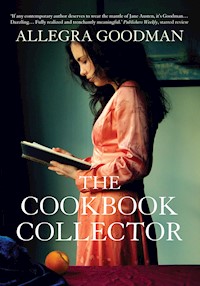
Two sisters, opposite in every way: twenty-eight-year-old Emily is a CFO of an internet start-up, twenty-three-year-old Jess is a graduate student in philosophy. Pragmatic Emily is making a fortune in Silicon Valley, romantic Jess works in an antiquarian bookstore. Emily's boyfriend is fantastically successful. Jess's boyfriend is an environmental activist. But the dot-com bubble must burst, while Jess's work on a cache of rare cookbooks uncovers strange erotic drawings and marginalia that bring her closer to their mysterious collector... Rich in ideas and characters, The Cookbook Collector is a novel of substitutions: reading cookbooks instead of cooking, speculating instead of creating, collecting instead of living. But above all it is about holding on to what is real in a virtual world: love that lasts.
Das E-Book können Sie in Legimi-Apps oder einer beliebigen App lesen, die das folgende Format unterstützen:
Veröffentlichungsjahr: 2011
Ähnliche



















The Cookbook Collector
Allegra Goodman is the author of six novels, including Kaaterskill Falls – a finalist for the National Book Award. Her novel Intuition was shortlisted for the Welcome Trust Book Prize, and longlisted for the Orange Prize 2009. She lives with her family in Cambridge, Massachusetts.
Also by Allegra Goodman:
The Other Side of the Island
Intuition
Paradise Park
Kaaterskill Falls
The Family Markowitz
Total Immersion
The COOKBOOK COLLECTOR
ALLEGRA GOODMAN
First published in the United States in 2010 by The Dial Press, an imprint of The Random House Publishing Group, a division of Random House, Inc., New York.
This trade paperback edition first published in Great Britain in 2011 by Atlantic Books, an imprint of Atlantic Books Ltd.
Copyright © Allegra Goodman, 2010
The moral right of Allegra Goodman to be identified as the author of this work has been asserted by her in accordance with the Copyright, Designs and Patents Act of 1988.
All rights reserved. No part of this publication may be reproduced, stored in a retrieval system or transmitted in any form or by any means, electronic, mechanical, photocopying, recording or otherwise, without the prior permission of both the copyright owner and the above publisher of this book.
This novel is entirely a work of fiction. The names, characters and incidents portrayed in it are the work of the author's imagination and not to be construed as real. Any resemblance to actual persons, living or dead, events or localities, is entirely coincidental.
1 3 5 7 9 10 8 6 4 2
A CIP catalogue record for this book is available from the British Library.
ISBN: 978 1 84887 539 5
eBook ISBN: 978 0 85789 311 6
Printed in Great Britain
Atlantic Books An imprint of Atlantic Books Ltd Ormond House 26-27 Boswell Street London WC1N 3JZwww.atlantic-books.co.uk
To Irene Skolnick and Susan Kamil colleagues, friends, believers
I can live no longer by thinking.
AS YOU LIKE IT, v.ii.50
Contents
PART ONE
Friends and Family
PART TWO
Light Trading
PART THREE
High Fliers
PART FOUR
Best Offer
PART FIVE
Free Fall
PART SIX
Risk
PART SEVEN
The Bottom Line
PART EIGHT
Closely Held
Acknowledgments
PART ONE
Friends and Family
Fall 1999
1
Rain at last. Much-needed rain, the weathermen called it. Rain drummed the little houses skyrocketing in value in Cupertino and Sunnyvale. Much-needed rain darkened the red tile roofs of Stanford, and puddled Palo Alto’s leafy streets. On the coast, the waves were molten silver, rising and melting in the September storm. Bridges levitated, and San Francisco floated like a hidden fortress in the mist. Rain flattened the impatiens edging corporate lawns, and Silicon Valley shimmered. The world was bountiful, the markets buoyant. Reflecting pools brimmed to overflowing, and already the tawny hills looked greener. Like money, the rain came in a rush, enveloping the Bay, delighting forecasters, exceeding expectations, charging the air.
Two sisters met for dinner in the downpour. Emily had driven up from Mountain View to Berkeley in rush-hour traffic. Jess just biked over from her apartment. Emily carried an umbrella. Jess hadn’t bothered.
“Look at you,” said Emily.
“Mmm.” Jess brushed the raindrops from her face. “I like it.” University Avenue’s stucco and glass storefronts were streaming. Runoff whooshed into the storm drains at her feet.
“You’re getting soaked.”
Jess swung her bike helmet by the straps. “I’m hydrating.”
“Like a frog?”
“You don’t have to be amphibian to hydrate through your skin.”
“Get under the umbrella!”
Jess had a theory about everything, but her ideas changed from day to day. It was hard for Emily to remember whether her sister was primarily feminist or environmentalist, vegan or vegetarian. Did she eat fish, or nothing with a face? Uncertain, Emily let Jess choose the restaurant when they went out to dinner.
“The two of them nibbled samosas at Udupi Palace, and Emily said, “I’m sorry I kept rescheduling.”
“That’s okay.” It was two weeks past Jess’s twenty-third birthday, and the restaurant with its paper place mats looked small and plain for a palace, but Jess didn’t mind.
“Veritech has been insane,” Emily explained, “and Jonathan was here. . . .”
“Oh, Jonathan was here,” Jess echoed in a teasing voice. “What did you do with Jonathan?” She often took this tone about Emily’s boyfriend. The longer the relationship went on, the more serious it seemed, the more she teased. Jess didn’t like him.
“He was just here very briefly on his way to L.A.,” Emily said. “The last couple of weeks have been—”
Jess interrupted, “I’ve been insane too.”
“Really?” Emily realized she sounded too surprised and added, “Doing what?”
“I’m taking the Berkeley, Locke, Hume seminar, and logic, and philosophy of language. . . .” Jess paused to sip her mango lassi. “And working and leafleting.”
“Again?”
“For Save the Trees. And I’m also taking Latin. I think I might be as busy as you.”
Emily laughed. “No.” She was five years older and five times busier. While Jess studied philosophy at Cal, Emily was CEO of a major datastorage start-up.
“We’re filing,” Emily explained.
“I know,” Jess said in a long-suffering voice.
Jess was the only person in the world bored by the IPO, and Emily loved that about her. “I got you a present.”
“Really? Where is it?”
“You’ll see. It’s in the car. I thought we could take it back to your place so you can try it on.”
“Oh,” Jess said cheerfully, which meant, “I don’t mind that you got me clothes again.”
“You wanted something else,” Emily fretted.
“No, I didn’t.”
“You did.”
“No! Nothing specific. Maybe a horse. Or a houseboat. That would be nice. And a photographic memory for verb tables.”
“Why are you taking Latin, anyway?”
“Language requirement,” Jess said.
“But you know French.”
“I don’t really know French, and I need an ancient language too.”
Emily shook her head. “That program seems like such a long haul.”
“Compared to going public after two and a half years? It’s true.”
The sisters’ voices were almost identical, laughing mezzos tuned in childhood to the same pitch and timbre. To the ear, they were twins; to the eye, nothing alike. Emily was tall and slender with her hair cropped short. She wore a pinstriped shirt, elegant slacks, tiny, expensive glasses. She was an MBA, not a programmer, and it showed. Magnified by her glasses, her hazel eyes were clever, guarded, and also extremely beautiful. Her features were delicate, her fingers long and tapered. She scarcely allowed her back to touch her chair, while Jess curled up with her legs tucked under her. Jess was small and whimsical. Her face and mouth were wider than Emily’s, her cheeks rounder, her eyes greener and more generous. She had more of the sun and sea in her, more freckles, more gold in her brown hair. She would smile at anyone, and laugh and joke and sing. She wore jeans and sweaters from Mars Mercantile, and her hair . . . who knew when she’d cut it last? She just pushed the long curls off her face.
Jess leaned forward, elbow on the table, and rested her head on her hand. “So, Emily,” she said. “What’s it like being rich?”
Emily began to speak and then caught herself. “I don’t know,” she answered truthfully. “I haven’t tried it yet.”
They hoisted Jess’s bike into Emily’s car and drove to Durant with the hatchback open. “Look at that,” Emily said. She’d lucked into a legal parking space.
Jess lived at the edge of campus, where fraternities sprang up in every style, from Tudor to painted gingerbread. To the north, the university rose into the hills. John Galen Howard’s elegant bell tower overlooked eucalyptus groves and rushing streams, the faculty club built like a timbered hunting lodge, the painted warnings to cyclists on the cement steps: DISMOUNT. To the south, Jess’s neighborhood boasted the best burrito in the city and the best hot dog in the known universe, Pegasus Books with its used fantasy and science fiction novels, People’s Park, where bearded sojourners held congress at the picnic tables. Amoeba Music, Moe’s, Shakespeare & Co. Buskers playing tom-toms, sidewalk vendors selling incense and tie-dyed socks. Students, tourists, dealers, greasy spoons of many nations.
Jess’s building was Old Hollywood–hacienda style: stucco, red tile, and wrought iron. Sconces lit the entryway where the mailboxes were set into the wall. Jess paused, looking for her mail key. “Oh, well,” she said.
An elderly neighbor climbed the steps. “Hey, Mrs. Gibbs, how are you?” said Jess, unlocking and holding the door open. “Do you remember my sister, Emily?”
“We have not had the pleasure.” Mrs. Gibbs was a petite black woman with freckles on her nose, and she wore a white nurse’s uniform under her black raincoat. White dress, white stockings, green rubber boots. Mrs. Gibbs placed her hand on Emily’s head. “May you always be a blessing.”
“That was strange,” Emily whispered as Jess led the way up the stairs.
“She’s a friend.”
“What do you mean, ‘friend’?” Jess tended to collect people. She was friendly to a fault. She went through little fascinations, and easily fancied herself in love. “Do you actually know that woman?” Emily’s voice echoed in the stairwell. “Does she usually put her hands on people’s heads?”
Jess held open the door to her apartment, a real find, despite the rattling pipes and cracked tile in the bathroom. Eleven-foot ceilings, plasterwork like buttercream, closets deep enough to sublet. “She’s lived in the building for, like, thirty years,” said Jess, as if that explained everything.
Her roommates Theresa and Roland lolled on the couch watching Wuthering Heights on Masterpiece Theatre. Theresa was studying comparative literature and writing a dissertation that had something to do with migration, borders, and margins. She’d grown up in Honolulu but couldn’t swim. Roland was lanky and wore pleated pants and a dress shirt and gold-rimmed glasses; he worked as a receptionist in the dean’s office.
“Hey,” said Jess.
Roland held up a warning finger. “Shh.”
Jess led her sister into her bedroom. The walls were lined with overloaded Barnes & Noble folding birch bookcases. Piles of sweaters and Save the Trees leaflets filled a papasan chair. A battered wood table from the street served as desk for an ancient IBM desktop computer. On the wall hung a framed Ansel Adams poster, the black-and-white image of a glistening oak coated and crackling with ice. On her bulletin board, Jess had pinned photos of their father, Richard, and his wife, Heidi, and their little girls, Lily and Maya.
“Maybe you should dry off before you try on the . . .” Emily was rummaging in her shopping bag as Jess peeled off her socks and her damp sweater. “I have something else in here for you.” She produced a thick prospectus.
“Initial Public Offering for Veritech Corporation, Sunnyvale,” Jess read off the cover.
“Right. You should read all of that. And also these.” Emily handed Jess a wad of papers. “This is our Friends and Family offering. You fill this out and send a check here.” She pointed to an address.
“Why?”
“You’re eligible to buy one hundred shares at eighteen dollars a share. So you need to mail in a check for eighteen hundred dollars.”
Jess grinned in disbelief. “Eighteen hundred dollars?”
“No, no, no, you have to do this,” Emily said. “After the IPO, the price will go through the roof. Daddy’s buying. Aunt Joan is buying. . . .”
“Maybe they can buy some for me too.”
“No, this is important. Stop thinking like a student.”
“I am a student.”
“Just leave that aside for the moment, okay? Follow the directions. You’ll do really, really well.”
“How do you know?”
“Have you heard of Priceline?”
“No.”
“Sycamore Networks?”
Jess shook her head as Emily rattled off the names of companies that had gone public in 1999. The start-ups had opened at sixteen dollars, thirty-eight dollars, and were now selling for hundreds of dollars a share. “Just read the material, and mail the check. . . .”
“But I don’t have eighteen hundred dollars,” Jess reminded her sister.
“So borrow.”
“All right, will you lend me eighteen hundred dollars?”
Emily lost patience. “If you’d just temporarily give up your aversion to money . . .”
“I don’t have an aversion to money,” Jess said. “I don’t have any. There’s a big difference.”
“I don’t think you understand what I’m giving you,” said Emily. “I get only ten on my Friends and Family list.”
“So it’s sort of an honor,” said Jess.
“It’s sort of an opportunity. Please don’t lose this stuff. You have ten days to take care of this. Just follow through, okay?”
“If you insist.” Emily’s bossiness brought out the diva in Jess.
“Promise.”
“Promise,” Jess said. After which she couldn’t help asking, “Do I still have to try on the clothes?”
“Here’s the blouse, and the jacket. Here’s the skirt.” Emily straightened the blanket on Jess’s unmade bed and sat on top.
The skirt was short, the jacket snug, and they were woven in a rust and orange tweed. The blouse was caramel silk with a strange lacquered finish, not just caramel but caramelized. Jess gazed for a moment at the three pieces. Then she stripped off the rest of her clothes and plunged in.
“Oh, they’re perfect,” said Emily. “They fit perfectly. Do you have a mirror?”
“Just in the bathroom.”
“Here, brush your hair and tie it back. Or put it up. Go take a look.”
Jess padded off to the bathroom and peeked at herself in the mirror, where she saw her own bemused face, more freckled than she remembered. The tweed jacket and the silk blouse reminded her of a game she and Emily had played when they were little. They called themselves Dress-Up Ladies and teetered through the house on high heels. Sometimes Emily would wear a satin evening gown, and pretend she was a bride. Then Jess would be the flower girl, with scarves tied around her waist. That was before their father gave away their mother’s clothes.
“Can you see?” Emily called from the bedroom.
“It’s really nice,” Jess called back.
“It’s a Vivienne Tam suit,” said Emily when Jess returned.
“Thank you. I could tell by the . . . label.” Jess sat down cautiously on her desk chair. Comically, experimentally, she tried crossing her legs.
“You hate it,” Emily said.
“No! It’s really very pretty” Jess was already undressing.
“Just say you’ll wear it once.”
“I’ll wear it to your IPO.” Jess pulled on a giant T-shirt and sweatpants.
“You aren’t going to the IPO. It’s not a wedding.”
“Okay, I’ll wear it to your wedding.” Jess flopped onto the bed. “Don’t you miss him?”
“We’re used to it.”
“I never would be,” Jess declared, and added silently, Never in a million years. She would never deny herself the one she loved, or make excuses for him either. She’d never say, It’s complicated, or We have to be patient. Love was not patient. Love was not kind. It didn’t keep; it couldn’t wait. Not in her experience. Certainly not in her imagination.
“What did Dad and Heidi get you?” Emily asked.
“Just the tickets home for Thanksgiving. And they sent me pictures from the kids. See—Lily wrote her name, and a rainbow.” Jess spread their half sisters’ drawings over the bed. “I think these scribbles are from Maya. And I have Mom’s letter here somewhere. . . .”
Their mother, Gillian, had passed away when Emily was ten and Jess was only five. Fighting breast cancer, suffering from long treatments, alternately hoping and despairing as the disease recurred, Gillian had cast about for ways to look after her daughters when she was gone. She’d then learned that some patients wrote letters to their children for their birthdays. Jess and Emily each had a set of sealed envelopes.
Jess pulled her letter from a stack of notebooks on the floor. “It’s short.” The letters got shorter and shorter. Reading them was hard, like watching their mother run out of air.
“Dear Jessie,” Emily read aloud as she smoothed the creased paper, “I am trying to imagine you as a young lady, when all I see is a five-year-old girl waving her little legs in the air—that’s the sign that you’re tired. I imagine you with your hair untangled. Your sister tried to brush your hair this morning and you wouldn’t let her. I wish you would” Emily paused a moment, sat up straighter on the bed and continued. “Surely by now you are embarking on a profession. If you have not yet embarked, please do!
“Ahem,” said Emily.
“I have embarked!” Jess protested. “A doctoral program is embarking.”
“She means working.”
“Philosophy is work. And I also have a job.” By this, Jess meant her part-time job at Yorick’s, the rare-book store on Channing where she did her reading in the afternoons.
“I don’t mean a job—” Emily read, and then stopped short. “She knew what you were going to say.”
Jess giggled, because Emily treated the letters like such oracles.
“I don’t mean a job. I am talking about a career, and a vocation. George Eliot wrote ‘that things are not so ill with you and me as they might have been, is half owing to the number who lived faithfully a hidden life’—but that was more than one hundred years ago. I’m hoping that you and your sister will set your sights a little higher.” A little higher, Emily thought, as she placed the letter on the bed, and yet Gillian had been a mother, no more, no less. Would she have done more if she had lived? Much more? Or just a little? Jess was sorting through her mail on the floor. “You aren’t even listening,” Emily accused her.
“Yes, I am. Things are not so ill with you and me.”
“You never take these letters seriously.”
“I do! Of course I do. I’ve read them all—lots of times.”
Emily was shocked. “All of them? Up to the end?”
“Yeah, I read them all at once when I was twelve.”
“You did not!” Emily had always looked forward to her birthday letters and missed them now. Gillian had only written them up to age twenty-five. “That’s just wrong.”
“Why? She never said you have to wait for your birthday every year.”
“But that was the intent!”
Jess considered this. “Maybe. I just opened all of mine at once. Then I got into Dad’s computer and opened the WordPerfect files.”
“Why would you do something like that?” The idea was foreign to Emily. Not only dishonorable, but self-defeating, like peeking to see how a book ends. “Didn’t you feel bad?”
“No. Yours were better than mine, anyway.”
“You read mine?”
“They were more interesting,” Jess confessed cheerfully.
“Jess.”
“Well, you were older, so she knew you better.”
“I’m sorry,” said Emily.
“Sorry that you’re older?” Jess hit her sister with a pillow. “Why are you so sad tonight?”
“I’m not sad,” Emily retorted, but she was; she was. Birthdays saddened her. She missed their mother, and she did miss Jonathan, although she wouldn’t talk about it. He had his own start-up on the East Coast and they didn’t see each other enough. Of course Jess knew that. She knew what Emily kept hidden, and so their time together was difficult, and also sweet.
Jess found what she was looking for on the floor, a photo of Lily and Maya in red and green plaid nightgowns. “Look at this.”
Emily examined the picture. “Have you noticed how Heidi likes Christmas colors?” she asked Jess. “It’s like she celebrates Christmas all year round.”
“Mmm.” Jess loved her sister most when she was catty. Emily was so disciplined, as a rule. Jess waited for those occasions when Emily said an unkind word. There was nothing cozier than talking about their father and his house in Canaan, Mass.—the house where they had not grown up. Nothing sweeter than wondering how Heidi got their father to go running—about which they felt the same way—pleased and also secretly a little angry, because he had never felt the need to exercise before. They discussed the cuteness of their half sisters, aged three and one; they never forgot to speak of this, but they reverted quickly to Heidi and how she didn’t cook. On the one hand, they were supposed to fly east for Thanksgiving, and on the other hand, they would be eating at a restaurant.
“It’s the worst of both worlds,” said Emily. “Guilt without home cooking.”
“I think I’d be afraid of Heidi in the kitchen,” said Jess, and Emily could not stop laughing. It was as if all their talk before, about the IPO and the birthday letters and the suit had been a prelude to this—the real conversation about their father and the family, all new people: Heidi and the little girls. Jacinta, the live-out nanny, who kept house and took care of dinner, but unfortunately took off weekends. Elmo, the new goldfish, who had arrived without the children’s knowledge after the first Elmo went belly-up. Richard was new too, someone who changed diapers.
They talked until almost midnight. Then Emily said she should be going, but the rain fell outside and thrummed the streets, and it was so warm in Jess’s room that she stayed a little longer, and longer still, until she began to forget about driving back across the Bay to Mountain View. The rain poured down, and she and Jess kept whispering until sleepily, half-dreaming, they began to talk about the old days, the vanished time when their mother was alive. Emily remembered better than Jess, but when Jess was with Emily, she remembered too. Their mother had white hands, long tapered fingers, and when she kneaded dough, her wedding ring clinked against the bowl. She was always singing softly as she played the piano with her white hands. She accompanied Emily’s dance recitals and she could play anything, but Chopin was the one that Gillian loved. She played Chopin every night, and when she turned the pages, she wasn’t really looking at the music. She knew the saddest Waltzes by heart. The saddest were the ones that she knew best, and she would play at bedtime, so falling asleep was like drifting off in autumn forests filled with golden leaves.
2
Yorick’s Used and Rare Books had a small storefront on Channing but a deep interior shaded by tall bookcases crammed with history, poetry, theology, antiquated anthologies. There was no open wall space to hang the framed prints for sale, so Hogarth’s scenes of lust, pride, and debauchery leaned rakishly against piles of novels, folk tales, and literary theory. In the back room these piles were so tall and dusty that they took on a geological air, rising like stalagmites. Jess often felt her workplace was a secret mine or quarry where she could pry crystals from crevices and sweep precious jewels straight off the floor.
As she tended crowded shelves, she opened one volume and then another, turning pages on the history of gardens, perusing Edna St. Vincent Millay: We were very tired, we were very merry, / We had gone back and forth all night on the ferry . . . dipping into Gibbon: The decline of Rome was the natural and inevitable effect of immoderate greatness. Prosperity ripened the principle of decay . . . and old translations of Grimm’s Fairy Tales: They walked the whole day over meadows, fields, and stony places. And when it rained, the little sister said, “Heaven and our hearts are weeping together.
During her first days at Yorick’s, the bell had startled Jess when a customer arrived, and she’d been reluctant to stop reading. Then the shop owner, George Friedman, had reminded Jess that he paid her to help others, not simply to help herself to books. He didn’t have to tell Jess twice. Now she engaged every customer she had the pleasure to meet. She greeted and advised, volunteering opinions literary, philosophical, or poetic. George rued the day.
Jess had a look about her—an unsettling blend of innocence and pedantry. She fixed her gray-green eyes upon the customers and said, “You like Henry James? Really?” as if she couldn’t quite believe it. Or she’d warn the purchaser of a multivolume history of domestic life in Victorian England, “You know, this is a history of women’s work based almost exclusively on male sources.”
“It’s a free country,” George called out from the back room. Or sometimes, sotto voce, behind the counter, “Just ring up the damn books.”
She came in three afternoons a week, and while he’d hoped those would be times he could absent himself, George didn’t like leaving Jess alone to chase away the odd shopper who came in off the street. True, Yorick’s was more of a project than a business, but he planned to break even one of these years. Jess had to be watched. She was well read, opinionated, unconcerned with profit. Also George liked watching her.
He was old money, a Microsoft millionaire now returned to Berkeley where he’d gone to college in the seventies, majoring in physics with a minor in psychotropics. He had worked in the Excel group when a longhaired physicist was not so uncommon, and Bill Gates still lived in a conventionally pretty house with a computer on the kitchen counter. Microsoft had been feisty in George’s day, competing for market share. By the time he left, the place was expanding geometrically, so that construction crews and moving trucks and summer interns swarmed the Redmond campus. Podlike buildings multiplied around the shallow pool known as Lake Bill. Theme cafeterias sprang up with different cuisines in each. The company picnic began to look like a county fair, except that the band playing was Chicago, flown in for the occasion.
As share prices soared, George’s friends had bought cars. They began with sports cars, and then they bought vintage cars, and finally, they bought kits and built custom cars from scratch. Then George’s friends bought houses on Lake Washington. They bought small houses, and then bigger houses, and then they renovated those houses and commissioned furniture: sculptural dining tables and beds and rocking chairs in bird’s-eye maple. They collected glass, and bought Chihulys by the dozen. They retired and purchased boats and traveled, and some started little companies and foundations of their own, and others flew to cooking classes in Tuscany and hosted fund-raisers for Bill Clinton. Along the way, they married and divorced, raised children, and came out, not necessarily in that order.
Like his friends, George retired, traveled, and donated to worthy causes. But he was eccentric as well. He was a reader, an autodidact with such a love for Great Books that he scarcely passed anymore for a Berkeley liberal. Strange to say, but at this time in his life George would have had a happier conversation with Berkeley, the philosopher, than with most of his old Berkeley friends.
He bought a Maybeck house in the hills and looked down upon the city he’d once loved. Previously antiwar, at thirty-nine his new concern was privacy. He grew suspicious—his friends said paranoid—of technology, and refused to use e-mail or cell phones. He feared government control of information and identity and loathed the colonizing forces of big business as well. He became a benefactor of the Free Software Foundation, boycotted the very products with which he’d made his fortune, and called Microsoft the Evil Empire, although he still owned stock. In the eye of the Internet storm, George sought the treasures of the predigital age. He wanted pages he could turn, and records he could spin. Eschewing virtual reality, he collected old typewriters and dictionaries and hand-drawn maps. He began acquiring rare books and opened Yorick’s.
The store was really an excuse to buy, but George ran it like a business. He was a shrewd, competitive dealer, and rarely fell in love with his own stock. He never sold or traded from his personal library, which was small, select, and static, but when it came to Yorick’s, George was a glutton and a libertine. Once he claimed ownership and the first flush of happiness faded, he would part with just about anything for the right price. A first edition of Thomas Bewick’s 1797 History of British Birds flew into
Yorick’s and then out again in weeks. George treasured a copy of My Bondage and My Freedom inscribed by Frederick Douglass to the woman who bought his freedom, but he sold the volume to a small bright-eyed Stanford professor. He might have considered donating some of his acquisitions to deserving libraries, but he preferred playing the open market, and spurned research institutions. More than once at auctions, he broke librarians’ hearts, only to flip his purchases to other private dealers.
Perhaps George was too attuned to profit. Or perhaps he was just fickle, and could not give himself fully to possessing lovely things. Presumably if he had gone into therapy he’d have learned the answer to these and other questions. Old girlfriends seemed to find the notion irresistible, but he was the independent, rumpled sort, and refused ironing out. Some found his refusal irresistible as well.
Yorick’s was not always the kind of adventure George wanted. Good help proved elusive. Graduate students, budding novelists, future screenwriters, manic-depressive book thieves—he’d seen them all. With a kind of gallows humor he had printed up a questionnaire that he distributed to those seeking employment. When Jess had turned up, inquiring about a part-time job, he showed her the dark crammed store, the thicket of history, philosophy, and literary criticism in the center, fiction all along the walls and trailing into the back room where random stacks cluttered the floor. Then he returned to his desk and handed her his printed list of questions.
“Could I borrow a pen?” Jess asked, after digging in her backpack and turning up a handful of change and a warped chocolate bar. She was young. She had the clear-eyed beauty of a girl who still believed that, as they used to say, she could be anything she wanted to be. Of course she would not consider herself a girl. The word was offensive, but she had a girl’s body, delicate shoulders, and fine arms, and like a girl, she had no idea how fresh she looked.
George handed Jess a black ballpoint, and she took the questionnaire and filled it out right on the other side of his desk. He tried not to stare, although she was leaning over. Casting his eyes down, he resisted the impulse to turn up the sleeve covering her writing hand.
When Jess finished, she returned the questionnaire and waited, expecting George to read her answers right away. He ignored her. When she hovered longer he said, “Give me a couple of days and I’ll call you.”
But he read the completed questionnaire as soon as she left.
1.
Full name: Jessamine Elizabeth Bach
2.
Are you a convicted felon? No
3.
Are you an unconvicted felon? Not to my knowledge
4.
Are you currently taking or dealing illegal drugs? No
5.
Are you sure? Pretty sure
6.
Circle one. A bookstore is: a meeting place, a mating place, a research room, a library, or a STORE, as the name suggests. Store for convicted felons?
7.
Circle one. It’s acceptable to wear earphones or use cell phones or notebook computers at work: rarely, sometimes, if I am day-trading, NEVER. Own none of the above
8.
Circle one. It’s acceptable to take money from the register: rarely, sometimes, if I really need to pay my dealer, NEVER. Wow, sounds like you’ve been burned. Sorry!
9.
Short answer: No more than three sentences, please. Why do you want to work here? I want to work here because I really need the money for day-trading (just kidding). I love books and am well qualified to talk about them if you need someone knowledgeable. You have a great philosophy section, and as I mentioned, I am a grad student in philosophy.
10.
Why in your opinion is this store named Yorick’s? Hmm. I think this is a trick question. You want us to say because of “Alas, poor Yorick” in “Hamlet,” but I can tell from looking at you that you are one of those guys who reads “Tristram Shandy” over and over again, so I’m guessing you named the store after Parson Yorick in the novel.
George read this last answer twice. The phrase one of those guys chafed. Was she saying he was simply an esoteric type? He fancied himself original, and he was miffed, or thought maybe he should be, for although he had a sense of humor, he exercised it primarily at others’ expense. He found Jess a little flip, but she seemed sane, an unlikely arsonist. She’d do.
She often came late, but when she set to work, Jess straightened out pile after pile of books, shelving them alphabetically from Aquinas to Wittgenstein. She cut up cardboard boxes and crafted dividers to separate Aristotle from Bacon, Kant from Kierkegaard, and taped up little signs printed with a laundry marker: ACHTUNG! If you are looking for philosophers of the Frankfurt School, please visit our Social Theory section. She shelved all histories of utopian communities together, volumes on Oneida and the Shakers and Fourierism, and she created a separate section titled “Polar Exploration” for books on Martin Frobisher, Admiral Byrd, and Shackleton. Sometimes she disappeared. He’d find her kneeling on the floor, poring over The Letters of Sir Walter Scott, or The Lives of the Lord Chancellors, or leafing through a tome on Japanese monetary policy. Once he nearly tripped over her. She’d crouched down with a history of Byzantine hymnology balanced on a bottom shelf.
“Oh, I didn’t see you.”
“Sorry.” She scrambled to her feet. “I was trying to figure out whether to shelve this in Religion or Music.”
“I wonder if it’s worth having sections for just two or three books,” said George, as he passed into the other room.
She took this as criticism and called after him, “Maybe some of the sections are small now, but they could grow.”
Later, she appeared at his desk and said, “I know the sections help.”
“The main ones are useful.”
“Well, if you think they’re useful, you could thank me.” He said nothing and she added, “Gratitude is important.”
“I agree.” He turned back to the package he was opening.
He liked provoking her, just a little. Caught between polite dignity and anger, Jess was very cute. This was despicable on his part; she should probably sue him. He was male and he was straight; two strikes against him right there. And he was unmarried, although not for lack of trying. Admittedly, all the trying had been on the part of his girlfriends. George had always wanted to get married—but not to them! Until quite recently he’d begun each relationship hoping that at last he’d found the one that he was looking for. He had heard the other narrative—the one women told—about the story of a man who moves on restlessly, seeking pleasure, shutting his eyes to the life he might have shared, but George knew differently. In his mind he tried again and again to marry; he kept looking, but all he found was neurosis and neediness. He had lived for two years with a woman named Andrea who suffered from depression. Later he’d been involved with an anthropologist who threatened suicide when he broke up with her. And then there was Margaret. Generally he avoided thinking about her. He almost never spoke of her, even to himself. Frayed by long experience with the angry other sex, George preferred to keep his distance, especially if he liked a woman. He knew that everything he said or did could be used against him.
She hurried in one day, out of breath. “Sorry I’m late. I just finished reading An Enquiry Concerning Human Understanding.”
“Is it such a page-turner?”
“Actually, yes, once you get into it. . . .”
“I’ve always thought that Hume is overrated.”
She stared at him in astonishment and then realized that he was making fun of her. “When I told that lady I thought Henry James was overrated, I just meant his later work.”
“Good to know,” said George.
Jess stood for a moment with her hands on her hips, then turned on her heels and disappeared into Fiction.
He could see that she had something on her mind, because at the end of the day she began hovering again. She had a way of turning up behind his desk, as if she wanted to see what he was reading. He found it irritating when she appeared suddenly like that, even though he did the same to her. He buried his book under papers and auction catalogs and spun his old swivel chair around.
“Yes, Jessamine?”
“I was wondering something.”
“Does it have to do with money?”
His directness startled her. “My sister’s company is going public, and I can buy one hundred shares at eighteen dollars each, so I need eighteen hundred dollars.” Jess said it all in a rush. “I was wondering if you could kind of give me my future paychecks in advance. And then I’d pay you back.”
“Do I know you’d still be working for me?”
Jess nodded solemnly.
“Really? Then you’d be my longest-lasting employee.”
“Oh, I could pay you back right away because the shares are going way up.”
“What’s the company?”
“It’s Veritech.”
“Veritech! That’s your sister?”
“Yeah, she’s the CEO.”
“She could just give you the money herself.”
“She wants me to stop thinking like a student.”
He suppressed a smile and said nothing.
“So will you?”
“No,” George said slowly. “I think your parents would be a better bet.”
She shook her head.
“Well, you don’t want to ask, but they’re the ones to do it.”
“Eighteen hundred is less than the complete Ruskin,” Jess blurted out. “You want two thousand for that.”
“The Ruskin is thirty-seven volumes in morocco,” George said.
“So?”
“Just ask your mom and dad.”
She frowned.
“Here, I’ll show you.” George unlocked his glass-fronted bookcase and took down the first volume and handed it to her.
Her fingers couldn’t help caressing the red leather, as he knew they would. Unconsciously, she lifted the book to her face and brushed it against her cheek.
“Ruskin’s worth two thousand, don’t you think?”
“No,” said Jess. “I don’t like him,” and she returned the book.
“I think I’m going to make Yorick’s by appointment only,” George told his friend Nick Eberhart that Sunday at Nick’s house, a Craftsman Style extravaganza. Nick was younger than George, and taller. When he started to lose his hair he had shaved his head so that he had a sleek and streamlined look. He had left Microsoft some years after George and amused himself with designing and selling screen savers: fish that appeared to swim across the computer monitor, shooting stars, flying toasters with tiny wings. After the flying toasters became the subject of a contentious lawsuit with another screen-saver company, Nick gave up the business and began dabbling as a private investor. He built his house a few blocks away from George’s place and became a model citizen, serving on the neighborhood council. A couple of times a week, he and George went running in Tilden Park.
“It’s cute the way you call it running,” said Nick’s wife, Julia, and she laughed as she went searching for Nick’s knee braces. Julia was a curiosity to George. Ten years younger than Nick, she was blond, athletic, green-eyed. A Jewish girl from Malibu.
George remembered the housewives of his youth. His own mother, Shirley, for example. She and her friends had raised the children and looked after their husbands. They’d volunteered in the schools, maintained the social fabric of the neighborhood. Remembered birthdays, planned parties, kept track of what belonged to whom and who belonged to which. Long before George heard of feminism, his mother had taught him the plight of women. Shirley had been unusually direct, Midwestern.
“I have bad news.” George remembered his mother’s matter-of-fact voice as he sat with his sister at the kitchen table after school. He was eight, his sister, Susan, six. “Robbie’s mother is in the hospital.”
“Why?” Susan asked, while George remembered that Robbie had not come to school that day.
“Well, she collapsed.”
“Doing what?” George asked.
“Doing everything.” Shirley poured the children cups of milk.
“But how did she collapse?” asked George.
“She got depressed.”
“Why?”
Susan didn’t understand; she was too young, but what Shirley said next shocked George more than anything he’d heard in his whole childhood—far more than his father’s so- called facts of life. “The truth is, it’s exhausting to take care of other people.”
He thought he was dreaming in the yellow kitchen. The floor shifted under his feet. That was how it felt to suspect for the first time that he might be other people.
But there was Julia, returning triumphant with the black knee braces, and kissing Nick good-bye. She did not look depressed at all, this latter-day housewife with the MBA and the beautiful two-year-old son, Henry.
As Nick drove up Wildcat Canyon Road, George said, “The problem with a brick-and-mortar store is dealing with people all the time.”
Nick glanced at George as he powered up the hill in his SUV. “I thought that was the point of the store.”
“I don’t really like people,” said George. “I think I’d rather just work as a private dealer and have done with it. If I could get decent help, it would be different.”
“The new one quit on you?”
“I’m sure she will. They don’t even give notice; they just leave. It’s tedious. I’m tired of it.”
“You get tired easily,” Nick pointed out.
“No, I don’t.” Nick missed the point. George didn’t tire, he was constantly disappointed. Dissatisfied. He was always looking for the next thing. He had the mind of a researcher, restlessly turning corners, seeking out new questions. But he was not a researcher; he was simply rich.
Nick parked at Inspiration Point with its view of hills and reservoirs like winding rivers far below.
“I don’t like kids,” George grumbled.
“You’re great with kids,” Nick countered with a new father’s evangelism. “Henry loves you.”
“No, I mean the kids who work for me. I don’t like dealing with them. I’m supposed to be, you know, employer, confessor, personal banker. It’s ridiculous. And they’re so ignorant. God.”
“You’re talking about the new one.” A little of the old Nick came through here, a smile, as if to say, You bring her up a lot, when of course George had only mentioned Jess once, or possibly twice, in passing.
“All of them,” he said doggedly, and Nick knew, even as they walked up to the trailhead and stretched and started jogging up the Ridge Trail with its canyon views, that George was in one of his apocalyptic moods, half bemused, half horrified. Pedantic. Of course Nick had heard George fume before about the end of Western Civilization, the death of books, the literary tradition either forgotten or maligned. Unfortunately, George didn’t quietly despair about these matters; he wrote letters on the subject and served on the board of something called the Seneca Foundation that opposed bilingual education in the schools. George was always reading, not just voraciously, but systematically, the way scientists read, the way technocrats read when they decide to take a position on Western Civilization. Plato first, then Aristotle, Augustine, Aquinas—chronologically, George had built his portfolio of great books. Years ago, he’d read Jack Kerouac and Allen Ginsberg and Thomas Pynchon. Now he pored over Dante and Herodotus. He’d become one of those people who felt he had to defend Shakespeare. He had not aged gracefully. “They’re all ignorant,” George said. “The new one actually reads, but only to pass judgment. This is the way kids learn today. Someone told them how you feel is more important than what you know, and so they think accusations are ideas. This is political correctness run amok.”
Nick picked up the pace, hoping to outrun George’s rant. He passed a man walking a brown and white beagle, and an elderly couple in straw hats.
“What was it Jess said today . . . ?” George panted, trying to keep up. “Ruskin is a dogmatic, self-indulgent, sexually repressed misogynist with an edifice complex.”
Nick smiled. “Sounds just like you.”
Was he dogmatic? George asked himself as he drove home on switchbacks between trees, Bay views, and sky. Maybe, but only for good cause. Self-indulgent? Only sometimes, and at least he admitted to the fault. He should get some credit for that. Sexually repressed? No, easily bored. Misogynist? He took a hairpin turn. Hardly. He loved women!
George pulled off Buena Vista onto Wildwood, then parked halfway over the curb and collected his mail. Edifice complex hit close to home. George adored his house, and as Nick could attest, he had become obsessed with its restoration. He’d spent years and more money than he cared to admit. Still, even here, he pleaded innocent. Obsession, yes. Self-indulgence, no. The restoration was about Bernard Maybeck, not George Friedman. He was just a steward to Maybeck’s vision. The research he and his designers had done, the ceramic tile, the salvaged wood, the light fixtures, and the hardware had been a labor of love, not ego. He had been patient, looking for the perfect door hinges. He had allowed his shingles to weather naturally, enduring months when his Californian beauty looked like a molting bird, until at last the cedar darkened and his wisteria came into its own.
Walking under a wooden trellis built like a Shinto torii, he climbed two flights of winding outdoor stairs, past eucalyptus, oak, and pine. Tree house and temple, George’s home seemed bigger inside than outside. Tossing his mail onto a table, he switched on lights so that his great beamed living room glowed bloodred and deepest green and glinting gold. The fireplace was manorial. The square staircase turned and turned again in the entryway and all the way up, George could view his framed collection of antique maps. Early novels filled his personal library, first editions of Austen, Defoe, Fielding, Smollett. American poets, almost all signed. He owned a copy of Edna St. Vincent Millay’s The Harp-Weaver inscribed to her lover George Dillon: To my darling George. A signed copy of Sandburg’s The People, Yes as well as Frost, Cummings, Ezra Pound. He collected first editions of dystopian satires: Gulliver’s Travels, Animal Farm, 1984, Brave New World, Erewhon. His dictionaries were magnificent, all English and American. First editions of Webster’s, first fascicles of the OED, and, most precious, a 1765 Dictionary of the English Language that had belonged to Mrs. Thrale.
Oak tables displayed platoons of typewriters: downstrike typewriters, upstrike typewriters, vintage World War I typewriters, turn-of-the-century typewriters—a 1901 Armstrong, a Densmore 1, a brass 1881
Hamilton Automatic, even an 1877 Sholes & Glidden in its case—each perfect in its kind, primed and polished so the metal shone.
He scarcely glanced at any of these things, but he needed them nonetheless. The collections illustrated each of George’s interests in turn, from vintage machines, to poetry, to maps; just as fish give way to bears, and bears to beaked birds’ heads on carved totem poles. Some kept journals. Some raised children. George told his life history with objects. His boyish treasures and pirate games now took the form of Northwest explorers’ charts. His childhood superheroes metamorphosed into a complete run of Classic Comics, sealed in archival sleeves in the glass cabinets of his butler’s pantry. The gold evenings of his youth he stored up in Ridge, Heitz, and Grgich, his California wines.
In the kitchen he minced shallots with his good Japanese knife. He poured himself a glass of Chateau Montelena Chardonnay and admired its deep almond hue. Liquid possibly too good for cooking, but he used it anyway, poaching the sole with shallots in the wine and butter. He set a place in the dining room, poured another glass of the Chard, and ate his dinner. He was nothing if not civilized.
And yet, he was dissatisfied. The fish tasted bland, the Chard too buttery. Over time, his appetites had changed. He had been young, of course, like everybody else. He had loved a girl and she had hurt him, as first girlfriends did, and he had recovered and avenged himself, more or less, on all the others—although he never considered his behavior vengeful. In his youth his desires had been simple: to drink, to smoke, to screw, and to hang out with his friends, none of whom were women. He inhaled women too quickly, devouring what he most admired: their salt-sweet taste, their arch and sway. In that experimental age—George’s teens and twenties, America’s seventies—he took what he wanted, running girls and nights together in a haze of pot and alcohol.
Death shook George. His younger sister overdosed, and he lost his taste for the so-called counterculture. As he approached thirty he took stock—considering the women he had seduced, the drugs he had abused—and a new desire consumed him: to live better, or at least less self-indulgently to give more, to start a family. The resolutions were heartfelt, the results were mixed. He lived with one woman and then another, and willed himself to fall in love, but he did not, and so he grew more solitary, even as he hungered for companionship. He mourned that no one in the world was right for him, even as his girlfriends branded him an opportunist and a libertine. In the worst of these love-storms, he applied himself in penance to his dissertation, and finished in record time. He had no interest in academia and scarcely remembered why he’d begun studying thermal dynamics in the first place. Therefore, he took the job at Microsoft and drove north to Seattle, where he worked long days building Excel. Yearning for substance apart from his share price, which was always rising, inexorably rising, he began to read. Reading, he began to buy.
From the beginning, he had expensive taste. A copy of The Whale, later known as Moby-Dick, inscribed by Melville to Nathaniel Hawthorne. The first self-published poetry that Robert Frost pressed into his sweetheart’s hand. An 1831 Audubon with its black-eyed birds poised to fly, beating their plumed wings against the page. He dealt with ordinary books, of course, but only rarities excited him. Pushing forty George was hard to please, and difficult to surprise. He had established bulwarks of skepticism against disappointment. And yet he hungered for the beautiful, and the authentic—those volumes and experiences impossible to duplicate. How sad, he thought, that desire found new objects but did not abate, that when it came to longing there was no end.
3
Although Jess was antimaterialistic, she thought about money all the time. Independent-minded, she was insolvent. There was her graduate stipend, of course—enough to keep her in brown rice and sprouts—and, fortunately, the job at Yorick’s, but none of this sufficed.
Not this time, she told herself. Not this time, as if she were still a child. And she put off calling her father from one day to the next. She lay awake at night trying to figure out how to raise the Friends and Family funds without falling back upon the patriarchy.
Even when she didn’t ask for help, conversations with her computer-scientist father were difficult. Jess had not followed Emily to MIT, but matriculated at Brandeis instead. Nor had she studied applied math like her sister, but declared philosophy her major. If she had pursued analytic philosophy, logic, even linguistics, her father might have understood, but Jess avoided these areas, and spent college contemplating Plato’s dialogs, Renaissance humanism, and the philosophes, abandoning the future, as her father saw it, and consigning herself to the dead languages and footnotes of the past.
If Richard disapproved of philosophy as a major, he liked it even less as a doctoral program, and often asked Jess what she intended to do with her degree, and where she thought she would find a job. These questions offended Jess and also bored her; they were so transparent. Her father had a new family, and he would be paying for college yet again when he was old. “Have you considered how you will support yourself?” he inquired, but what Jess heard was, “My resources are not infinite.” She was not about to ask for an extra eighteen hundred dollars and listen to him carry on about her “theoretical phase.”
She wished Emily hadn’t told her about the Friends and Family offering. Money had never interested her before, and now she wanted it. If she had the Veritech money she wouldn’t have to worry about the overdraft on her bank account or wonder how she would make ends meet over the summer between TAships. She did think like a student. That’s what she was.
Of course Jess had never wanted wealth, but the idea of a little money entranced her. Suppose her hundred shares at eighteen dollars became one hundred shares at one hundred dollars. She would have ten grand. As she drifted off to sleep, she dreamed her eighteen hundred shares were growing like Jack’s beanstalk outside her window. Ten thousand dollars, one hundred thousand dollars—enough to live on and to give away! In her dreams the money climbed from seed to vine. Emily’s company would work its magic. All Jess needed was a handful of beans.
She tried to borrow from her roommates, but Theresa was broke and Roland skeptical. He read the Veritech prospectus and pointed out, “It says here the company doesn’t make a profit.”
“I don’t think that matters,” Jess said. “Hardly any companies make profits these days.”
“Really?”
“I mean, not yet.”
“And it says this is a high-risk investment.”
“But it’s Emily’s company. It’s not high-risk,” said Jess.
Roland shook his head. “Call me old-fashioned.” He returned the prospectus.
“I’d pay you right back.”
“But you can’t be sure the stock will go up.”
“Why do you have to be my roommate?” Jess demanded, half-laughing. “Why do I get the only person in the entire country who doubts Veritech is going way up?”
“I don’t doubt,” said Roland loftily, “I suspend judgment. Socially liberal, fiscally conservative, baby.”
Jess’s ten days were almost over. Still, she didn’t mention the Friends and Family offering when she spoke to her father on the phone.
“Everything’s okay?” Richard asked.
“Yup, how are you?”
“We’re all fine. Heidi had a paper deadline this week. Lily had an ear infection.”
“Oh, poor Lily.”
“She’s fine,” said Richard, after which Jess spoke to the three-year-old on the phone.
“One potato, two potato, three potato four, five potato, six potato, eleven potato more, five potato, six potato, seven potato eight . . .”
After several minutes, Jess asked, “Could I talk to Dad?”
“Hello, this is Blue Bear. Hello. Come to my house.” Blue Bear’s voice sounded like a balloon running out of air. “A, B, C, D, E, F, G, H, I, J, K, elemenopee,” Blue Bear chanted faster and faster. Lily began giggling. “QRSTUVWXYandZ. ABCDEFGQRSTelemenopee.”
“Could I talk to your daddy?” Jess asked again, but Blue Bear hung up, and Richard didn’t call her back.
“I can’t believe you haven’t taken care of it,” Emily scolded on the phone. “What are you waiting for?”
“Well . . .” She could hear Emily typing in the background, multitasking as usual.
“It’s not very difficult,” Emily said.
“I don’t have eighteen hundred dollars.”
“Didn’t you call Dad? All you have to do is ask him nicely.”
Now Jess saw what Emily wanted. She wanted Jess to talk sweetly to her father, after which he would help her, and they would get along again. Emily was a firm believer in getting along, no matter what, and seemed to think if you behaved considerately, real feeling followed. But how could affection bloom in rocky soil? What were words without love? Only dust. Jess could not live in such a xeriscape.
“You did call him,” Emily said.
“Of course.”
“And did you ask him?”
“Well . . . not yet.”
If only George had written her a check. He was so rich; he must be to own a store like Yorick’s. And he had heard of Veritech. He understood about technology and knew she’d pay him back immediately. But he had to say no. He loved saying no.
He was strange and self-absorbed. He asked questions and then wandered away before he heard the answers. Then when Jess asked a question of her own or tried to start a conversation, he interrupted.
“I’ve read some Trollope—” she would begin.
“And you were offended by the foxhunting?” George broke in.
“I see no reason,” she mused, “that books are more expensive because of who owned them. It’s—”
“The way things work,” George cut her off.
He was attractive and he knew it, but he pretended he had no idea. Therefore he was both vain and disingenuous. Tall, or so he seemed to Jess, he looked Italian with his dark skin and dark eyes. Very old—again, from Jess’s point of view—where anyone past thirty harked back to another era altogether. Despite his years, George had a powerful body, a broad chest, a face of light and shade, a glint of humor even in his frown. When he wasn’t lobbing his sarcastic comments, he seemed scholarly and peaceful, like a Renaissance St. Jerome at work in his cave of books. All he needed was a skull on his desk and a lion at his sandaled feet. He wore T-shirts, jeans, rimless reading glasses, sometimes tweed jackets. He had the deep didactic voice of a man who had smoked for years and then suddenly quit and now hated smokers everywhere. He never watched television, and he never tired of telling people so. But the most pretentious thing about him was his long hair. With his chestnut locks threaded gray, he was a fly caught in amber, the product and exemplar of a lost world.
“I’m working on the money,” Jess told her sister. “Could I just explain?”
“There’s nothing to explain.” Emily’s voice was tense. “You know what you have to do. Take care of it.”
Later, waiting for her laundry in the basement, Jess weighed her choices: angering Emily, or asking Richard. Take care of it. Easy for Emily to say. Financially independent Emily got along beautifully with Richard. Ah, Marx was right about so many things—especially the moral superiority money afforded.
Perched atop a churning washing machine, she heard the clank of metal. Had she left her keys in her jeans pocket? A handful of coins? She wished her grandfather were still alive and she could call him. She had been close to her father’s father.
Mrs. Gibbs wheeled in her laundry. She pushed it in a little cart with her detergent on top.
“Good evening.” Mrs. Gibbs produced a change purse segmented with compartments for each kind of coin. Extracting quarters, she began lining them up in the slots of the machine opposite Jess. “How are you?” Mrs. Gibbs inquired as she loaded her whites.
“I’m okay,” said Jess.
Mrs. Gibbs shot Jess a penetrating look.
“I’m fine.”
“Fine sitting down here all alone?”
“I was just thinking.”
“Fine isn’t good,” said Mrs. Gibbs. “Fine isn’t right.”
“I’m okay. My sister is annoyed with me. I said I’d do something and I can’t.”
“Breaking a promise,” Mrs. Gibbs intoned.
“No!”
“Mmm,” said Mrs. Gibbs and suddenly all the machines around Jess seemed to hum with disapproval.
“I’ll figure it out.”
“Mmm.”
“I’m not depressed or anything,” Jess reassured her neighbor.




