


2,00 €
Mehr erfahren.
- Herausgeber: Edizioni Savine
- Kategorie: Fantasy und Science-Fiction
- Sprache: Englisch
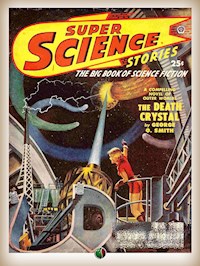
One by one, forty of the Earth's greatest scientists vanished into that world beyond the universe—until one man, doomed by its fatal rays, carried humanity's last hope back the blinding, twisted corridors that led through—
A compelling novel of outer worlds
Das E-Book können Sie in Legimi-Apps oder einer beliebigen App lesen, die das folgende Format unterstützen:
Veröffentlichungsjahr: 2022
Ähnliche
















The DEATH CRYSTAL
By GEORGE O. SMITH
CHAPTER ONE
The Shape of Danger
They looked at the crystal in horror.
It was the horror of the serpent, or of the Gorgon's head. They were fascinated; in that moment not one of them could have torn his gaze away. All work ceased. The noises in the concrete-walled room died until the whish of breathing and the thumping of hearts could be heard.
Then panic caught them, and fought against training. Panic cried, Run! and training said, Remove yourself quickly.
With the motion-saving efficiency of the emergency drill, each man turned from his position and walked rapidly towards whichever exit was nearest.
Actually, they could not outrun the danger any more than one can duck a rifle bullet or outrace the atomic bomb. But they went, five men and one woman, out through the zigzag corridors towards a mirage of safety.
One man remained.
Dave Crandall stepped forward and picked the crystal from its place in the evaporation dish. He turned, doused hand and crystal under a faucet, and then dropped the crystal on an anvil. He hit it with a heavy hammer. Anvil and crystal rang musically, and the crystal rebounded and flew through the air unharmed.
Cursing under his breath, Dave Crandall darted, picked it up again, and looked around wildly.
There were vats of acid handy; an electronic furnace glowed white-hot through its slit; a tunnel gaped unexcitingly but in its depths were the invisible radiations of the atomic pile. None of these would work soon enough.
Dave turned to the desk. He flipped open the end of the pneumatic message tube and popped the crystal into the chamber. There was the whroooom! of pumped air, a few tinkles as the crystal hit the sides of the tube on its way down.
Then from somewhere outside the concrete-walled room came the awesome blast. The wave-front traveled down the zigzag passages and Dave thought he could almost see it. The roar deafened him.
Dave went out through the zigzag passage.
A mile across the plain, a billowing white cloud was rising.
Claverly greeted Dave. Claverly was a bit shaken, and more than a little abashed. "The relay station," he said, pointing at the rising cloud.
"Oh?" remarked Crandall. He asked, frowning, "Anybody in there?"
"No."
Crandall smiled wryly. "That's a relief," he said. "But I didn't have time to ask where that tube went. I might have blown up the administration building."
Claverly laughed. "About all you've done is to cut a large hole in the coast-to-coast pneumo," he said. "No jury in the world would convict you."
DeLieb came around from the other side of the building. "There," he said, "but for the Grace of God—" pointing at the billowing pillar of smoke. "Thanks, Dave. This makes you unique, you know."
"Unique?"
"You are the only living man who has seen one of those devils' rocks in operation."
"We were all there," objected Dave, "and how about the Manhattan Crystal?"
"In the first place, the Manhattan Crystal is furnishing New York with electrical power—from a generating plant twenty miles outside New York, telemeter-controlled, and completely unattended. Montrose and Crowley and their associates who first made the crystal went up trying to reproduce it at Brookhaven. So did Brookhaven. Harvard, Purdue, Caltech, and Argonne went up trying to make one, too."
"But you were there, too, and you've seen it."
DeLieb nodded. "It is a six-sided crystal about three inches long, with a pyramidal point at either end, and about three-quarters of an inch across the hexagonal flats. It is clear with a trace of blue tint. So much we know, Dave. But what shape was it when you tossed it into the tube?"
"Cubical, and full of flashing red glints," said Dave.
"And why were we suddenly scared bright green?"
"Because it began to change shape before our eyes," said Dave.
"And it was still fluid when we—left."
"I think so," said Dave uncertainly.
DeLieb turned and went into the laboratory again, with the others following. He inspected the anvil and straightened up with a wry smile. There was the dent on the soft iron, made by the crystal under Dave's blow. "That," said DeLieb, "is the impact of a hexagonal crystal slightly distorted. A hexagonal form half-changed to a cubical shape. So, Dave Crandall, you are the only man alive to have seen such a crystal. Who knows the shape of the Manhattan Crystal by now?"
Steps clicked along the other zigzags. Phelps came in through one. "No hits," he said, "one run, and the only error was shutting off the cross-country pneumo. Tough. But the country got along without the shipment of short-lived radioisotopes before and it'll have to do without them again until they get the tube put together. Nice going, Crandall."
Behind him was Jane Nolan—Doctor Jane Nolan. Like her colleagues, Jane Nolan was often quoted in texts, had made several contributions to science, and was an authority on several subjects. She was not a beautiful woman; but her quiet air sometimes permitted a rather interesting personality to show through. Men forgot her mature thirty years and her lack of breath-taking beauty and dated her; then found themselves at once intrigued by her personality and completely baffled by her quick mind—and then went elsewhere in search of wide-eyed pulchritude.
Deep interest or honest admiration often lighted up her face and made it handsome if not beautiful. She looked very attractive now as she went to Crandall.
"That was brave," she said.
"Self-preservation," he said.
"We have that too," she replied with a slight smile. "And we also know that we cannot outrun that sort of thing. But we ran."
He smiled at her cheerfully. "I'm not a scientist," he said. "I'm just a newspaperman, remember? Perhaps I'm just too ignorant to realize the degree of danger."
Jane Nolan shook her head. "You've either seen the remains or pictures of them, of the other labs that failed. You know—"
"Look," he chuckled, "let's put it this way. We were dead ducks anyway. The devil himself couldn't have outrun that explosion without jet assistance." He turned to Claverly, "If I'd had any sense, I wouldn't have tried to smash it. I should have known that belting it with a hammer wouldn't have stopped it—if anything, it should have hastened the explosion."
"I hardly think so," said Claverly thoughtfully. "Remember that the crystal is not an explosive in itself. Or so we believe. Anyway—"
"Anyway, thanks to Dave, we still have our lab," said Jane. "Let's get back to work."
Dave shook his head. There was no point in arguing with them. They called him brave. Nuts! Nine great laboratories had gone skyward with their complement of scientists, trying to reproduce the fabulous Manhattan Crystal which was now furnishing the city of New York with electrical power. And with the deadly record of nine to nothing against them, the scientists continued to try. Theirs was the true bravery. It was a deadly experiment, and one that was not permitted—
Dave looked startled. "I thought the government insisted that these experiments be run by telemeter control?"
"They are."
"Then what in the hell were we doing here?" demanded Crandall.




