



Erhalten Sie Zugang zu diesem und mehr als 300000 Büchern ab EUR 5,99 monatlich.
- Herausgeber: Books on Demand
- Kategorie: Gesellschafts- und Liebesromane
- Sprache: Englisch
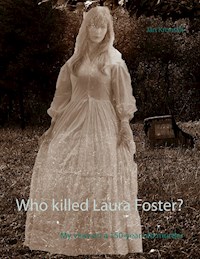
Who killed Laura Foster? This question has been asked ever since 1866, when she was killed. On May 1st. 1868, a man known as Tom Dooley was hanged for the murder in Statesville in North Carolina. Since the hanging many legends have been told about the case, and many of these tell that Tom Dooley was actually innocent, and that his jealous, married lover, committed the crime. Books have been written about the case, songs have been sung, plays have been performed and even a movie was made, but the question will probably never be answered as, 150 years have passed since the hanging and a couple more since the killing. This novella is just my suggestion of what may have happened in late May 1866 in western Wilkes County, North Carolina. Even if the novella is for large parts based on known and documentable facts, the solution to the riddle is pure fiction.
Sie lesen das E-Book in den Legimi-Apps auf:
Seitenzahl: 113
Veröffentlichungsjahr: 2019
Das E-Book (TTS) können Sie hören im Abo „Legimi Premium” in Legimi-Apps auf:
Ähnliche



















For my family who have been forced to listen to me talk about Tom Dooley for 18 years and especially for my son Tim who has faithfully followed me on many of my journeys to the places where the events took place.
Thank you to all the people from Caldwell, Iredell and Wilkes counties in Western North Carolina who have helped and inspired me along the way.
A special thank you to Charlotte and Bill Barnes who introduced me to almost everyone else and to Margaret Carter Martine and Sharon Carter Underwood for letting me use their mother’s painting as the cover illustration.
Cover illustration:
Copy of a painting by Edith Marie Ferguson Carter (1930 – 2014).
Courtesy of Whippoorwill Academy and Village, Ferguson, North Carolina.
Table of Contents
Author’s Foreword
Publisher’s prologue
The Background
The newspaper article
Life goes on in the hills and the valley
A confession
Ann Melton’s secret
Publisher’s Epilogue
A final word from the author
Author’s Foreword
On May 1st 1868 Thomas C. Dula (later known to the world as Tom Dooley) was hanged on Depot Hill on the southern outskirts of Statesville in Iredell County, North Carolina for the murder of his girlfriend, Laura Foster in neighboring Wilkes County almost two years earlier.
All through the trial and even standing at the gallows Tom Dooley claimed his innocence and swore that hadn’t some of the witnesses committed perjury, he wouldn’t have been convicted.
Soon after the execution and maybe even before that, rumors spread in the community where the murder had taken place that Tom did not kill Laura Foster, and that the real killer was his jealous, married lover, Ann Melton, in some stories assisted by her maid, Pauline Foster, and that Tom only helped to bury the body because he loved Ann. Over time these rumors developed into several different legends and when the case was made famous by the Kingston Trio’s hit in 1958, The Ballad of Tom Dooley, which had been recorded several times before, these legends had a revival and became popular again and they live on to this day.
One persistent legend tells, that before her death, Ann Melton told the physician, who treated her “something that would have saved Tom from the gallows”. This novella is partially based on this legend. It also includes material from several other legends including one, that I have only heard once, and which may have been invented by the man who told it to me, as I have never heard or read about it elsewhere, but as it fitted well into my story, I used it anyway.
I have put the prologue and epilogue in the mouth of a fictional, modern day lawyer from Raleigh, but all the other people mentioned in the novella are historical characters, and except from the plot and my suggested solution to the riddle, everything else, like the family relationships between the involved, what was said at the trial and so on can be verified by the few existing trial records, historic census records, marriage licenses, birth and death certificates and other public records together with contemporary newspaper articles, and other public and private records.
Most of the people I mention in this book still have living descendants, and I have spoken to a few of them. My intention is not to insult their ancestors, but only to tell a tale, a tale about how it could have happened.
So please read this novella as a piece of fiction, not as a history book.
Brøndby, Denmark, December 2018 Jan Kronsell
Publisher’s prologue:
My name is Matthew Murphy and I'm a lawyer in Raleigh, North Carolina. I work for C. A. Murphy and Associates, Attorneys at Law. The firm was founded by my great-great-grandfather in 1910, and ever since that, the family has produced at least one lawyer in each generation. My great-great-grandfather, my great-grandfather and my grandfather have all gone to a better place, unless the old saying is true, that the Devil takes all lawyers. Today I'm running the firm together with four other lawyers and an office staff of 10. About one year ago, we were notified, that the building, that had housed our offices since my great-great-grandfather expanded from an office in his own home in 1920, was to be torn down to give room for a residential building to create housing space for Raleigh’s ever growing population. We therefore had to look for new accommodations, which actually came at the right time, as business has been growing a lot lately, and we may have to employ more people soon.
We found a new place in a modern office building, not far from the old place, and rented a larger office, where there is room for further expansion. So about one month ago, we started to pack everything in boxes in order to be ready for our move. One afternoon my secretary entered my office, carrying a thick, brown and dusty envelope in her hand. She told me, she had discovered this envelope behind a filing cabinet, and that it looked as if it had been there for years, and that I'd better take a look at it. On the front of the envelope was only a few words written in a handwriting, that I recognized as my great-great-grandfather's from all the old documents that my father had forced me to read, when I first started in the firm. The writing only said: "Do not open this envelope until 1989 at the earliest." This sounded strange as we are now in 2018, so I called my father who has retired but is still very much alive and kicking and as sharp as always, but he knew nothing about the envelope and had neither seen it, nor heard of it at least as far as he remembered, so it must have been hidden behind the filing cabinet for 50 years or more, as my father started in the firm in 1967.
I decided to open the envelope, and inside I found another thick and rather strange looking rhombus shaped envelope that was apparently homemade, and seemed to be very old. It was closed with strings and sealed in four places with wax seals. Along with the envelope was a rather long letter, also handwritten. I will not go through the letter, as it contained a lot of things that had nothing to do with the envelope, but it was certain that the sender of the letter had been a close friend of my great-great-grandfather. Near the end of the letter was a passage that mentioned the envelope though:
"Sometime in 1888, I received the enclosed envelope from my father. He made me swear that I would make sure that it would not be opened until one hundred years after his death. In 1889 my father passed away and I have kept the letter until now. I hope that you, my dear friend and attorney, will relieve me of the responsibility, as I fear that I have not very much time left myself, and I will not let my children in on this strange matter. I know that you, as my lawyer, will do as requested and as a friend I trust you to do so."
There was a bit more in the letter, and it was signed
Kings Creek, North Carolina, January 12th, 1925.
Your friend
George Hill Carter
As I was rather busy at the time, and almost 30 years had passed since the letter was supposed to have been opened, I postponed it to a later time as I didn't think that a few more days would matter. I brought the envelope back home with me that night, but I didn't get to open it, until the following weekend. Before opening the envelope, I had done a bit of research and discovered that Kings Creek was a small populated place in Caldwell County in the western part of the state, and that there had actually at one time lived a George Hill Carter in that area, a physician who had died back in 1926, so I guessed that this was the man, who had sent the letter to my great-great-grandfather.
When I finally opened the envelope I found a large bundle of papers tied together with a string. They were all written in a handwriting that was rather hard to read and sometimes I had to use a magnifying glass, and even sometimes had to guess, but the manuscript was clearly written by an educated man. The manuscript told a story that I had actually been aware of but didn't know much about, and when I later researched it, I discovered, that what was in the manuscript did appear in many versions of the story, except for the most essential and personal parts, that only the author and a few others would know.
As per the author's request I have therefore decided to publish this manuscript. If what it contains is correct, one man will finally get justice as it was clear from the manuscript that he had been treated unjustly. But I will let the author tell his story even if I had made some changes in order to modernize the language just a little bit and corrected the spelling where the original spelling was different from how we spell today. I have added some punctuation of which there was almost none and a few line breaks here and there. Finally, I have divided the long manuscript into a few chapters. These chapters and their headings are all my inventions. I have added a few comments along the way just to clarify some things, that probably is not known today. These comments are typed in the same font as this prologue and placed in square brackets.
The Background
Kings Creek, October 1887
I write this to clear something of my mind that has been weighing heavily on my conscience for almost 15 years. When I first learned what I am about to tell you, I had to swear never to tell anybody for as long as I lived though, and that promise I have kept, even if it has been very hard for me. But now I will try to clear my conscience before I die as I fear I have not long time left to live. I will give this letter to my son in a closed and sealed envelope and make him swear that he and his descendants will not open it until at least one hundred years after my passing. The story I am about to tell has probably long been forgotten when this letter is finally opened. At least I hope it is, and anyone involved in the matter will be long gone like me. I have to tell my story though as a great injustice was done. Even if the man, suffering from this injustice has already been dead for almost 20 years, I hope that his immortal soul and maybe mine as well, if such a thing exists, will be redeemed, when the truth is finally revealed. But let me begin with telling you, what the background for my confession actually was – if you could call this a confession, as I actually do not confess anything myself, except for a guilty conscience.
My name is George Nicholas Carter. I was born and raised in Shelton, Virginia, but at the age of 27, after having completed my medical studies, I moved from my home in Virginia to North Carolina, more specifically to a small town called Hamptonville. Here I joined forces with another physician that I had met at the medical school. His name was Abel Cowles, and we both stayed in the home of his father, Josiah Cowles, a very wealthy plantation owner and politician. Once while I was there, Abel's older brother, Calvin, who owned a general store in the small settlement, Elkville in western Wilkes County, came for a visit. Together with him was another landowner from the area known as Happy Valley, where Calvin had established his store. This man was Catlett Jones who was later to become my father-in-law. Calvin Cowles invited me and his brother to visit him in Elkville which we did, some months later. While there I met the youngest daughter of Catlett Jones, Juliet, and I fell hopelessly in love with her.
Fortunately, she returned my love, and in 1851, I moved to the area, settling on land, that I bought from one of Catlett Jones' neighbors. In 1852 I married Juliet, and I have stayed in Kings Creek ever since, and they will bury me here, next to Juliet, when my time is up. But let me get back to my story; and excuse an old man for letting his mind and memories lead him astray from time to time.
Twenty-one years ago a young girl by the name of Laura Foster disappeared from my neighborhood in Yadkin Valley in the western part of North Carolina never to be seen alive again. Laura Foster had for some time been a patient of mine as she was suffering from the terrible disease known locally as "the pox", but better known in the medical world as syphilis. Unfortunately, many others in both my local area and elsewhere suffered from this disease before, under and after the terrible Civil War, and the disease is still plaguing our nation. A young man, Thomas C. Dula, another patient of mine, also suffering from




