


4,99 €
Mehr erfahren.
- Herausgeber: Olympia Press
- Kategorie: Gesellschafts- und Liebesromane
- Sprache: Englisch
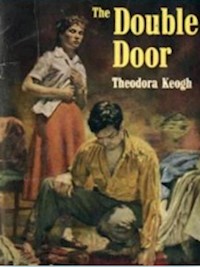
This is a tale of sensuality and sadism in 1950s New York.
Das E-Book wird angeboten von und wurde mit folgenden Begriffen kategorisiert:
Das E-Book können Sie in Legimi-Apps oder einer beliebigen App lesen, die das folgende Format unterstützen:
Veröffentlichungsjahr: 2016
Ähnliche




















The Double Door
Theodora Keogh
This page copyright © 2007 Olympia Press.
http://www.olympiapress.com
1
2
3
4
5
6
7
8
9
10
11
12
13
14
15
16
17
18
19
20
21
All characters in this book are fictitious,
and any resemblance to persons, living or
dead, is purely coincidental
1
THE YOUNG MAN with the wheelbarrow turned down Sixty-fifth Street. It was that brief interval between dusk and dark and in the uncertain light things were disproportionate. One could no longer judge distances. The thick dusk seemed to come not only between the eye and its object but between the ear and its reverberation. The young man's wheelbarrow became a thing of magic: it glowed with half a dozen crimson lights as though giant fireflies had settled on it. The young man was wheeling danger signals to an opening that had just been made in the surface of the street. He crossed an avenue, debonair and at ease. His place here was secure, his destination important. He settled the red lanterns carelessly, in case anyone was looking, and accurately, because he was conscientious, and then walked off into the night. The street, nursing its fresh and gaping wound, was silent. It was a district of private houses, more and more of a rarity in central New York. Big business hovered; not so far away, the monster shadow of Rockefeller Center was stretching its claws, but here, in Sixty-fifth Street the skies were as yet unpierced. In No. 7 only one window was lit up, like a dirty yellow eye, at the very top. No. 5, however, was clear-eyed; the light from there streamed out into the street in white rectangles. There would really have been no need for the little red lanterns. No. 5 and No. 7, side by side, touching shoulder and flank, looked as different as could be: born at different times, one would have sworn, and from different parents. Yet they were joined. An artery as heavy and brutal as that which binds Siamese twins ran through them both. Their bloods met in it and fought and were sickened. This artery, this freak passageway, was through the Duke Charles de Tudelos' bedroom. Here there was a double door which he often used and which other people used too. The Duke found it quite natural that two houses should belong to him. He was immensely rich, or rather his wife was. If he needed two houses to express his personality, he had the right to own them. At this instant he was coming through from No. 7 to No. 5. The double door was always open. Sometimes, especially of late, his wife Sheila would stand there for minutes on end, looking down the dark old-fashioned halls of her husband's other home. She would not go in, however. He could count on that. He half expected to find her there now, near the double door, and was preparing a scene. After all, they had guests downstairs and someone should be there. Guests were such pigs, one could never trust them hostless for long! Charles was tired. He loosened the sash of his robe and sat on his bed. The lids of his large eyes drooped and twitched. He hesitated between a purge and a benzedrine tablet: perhaps the benzedrine tablet now, and the purge before he went to bed. He sighed. Things were getting out of control again, and, after all, it was his wife's money. People had no consideration! Charles de Tudelos often wondered what he would have done had Sheila not fallen in love with him. Would he have been happier? Freer, certainly; less plagued by a conception of life which was not his own and which split his actions and his thoughts in two. He switched on the phonograph—part of his built-in set—and put a needle on the disc that was already there. A voice came out: “Si mes vers avaient des ailes...” If my verses had wings. How tender and womanly that little song sounded in New York! In Paris it was an ordinary dime-a-dozen song, but here it brought back all the sad, sweet thrill of love that is not quite reciprocated. A young girl, one might fancy, sacrificing herself, effacing herself, for love of an important man—a general or a great artist. She only asks that he take his pleasure of her, and his comfort, while she stays in obscurity, singing melodiously at a darkening window. The only person who had ever loved him, Charles, that way was Sheila, and it was she who had been important then rather than he. It was to him that she had come with all her father's wealth. To him: the nobody, the go-between, the gigolo. Beneath his silk robe Charles' feet tapped uncomfortably at the memory. He had on black, pointed shoes, and no one save himself could tell the difference between the left and the right. He supposed he should interchange them to make them last longer, but he was so used to the slight difference caused by use that it would be uncomfortable. Maybe the next time he had them resoled— The cobbler, there was a brawny fellow! With this reflection he stood up and took off his robe, turning away from the mirror so as not to see his narrow chest, his thin, flabby upper arm. The skin was gathered and ocher in the indentations of his body. Diet and purge had failed to eliminate the paunch that hung from his waist. He quickly put on a white shirt, and as he did so, heard someone going down the stairs of No. 7, past his open door and on down to the street. He did not turn his head. The little room upstairs in No. 7 would, he knew, now be dark over the dark street. “Charles, are you coming down soon?” He turned quickly to where the voice came from. Sheila, his wife, stood in the study just beyond his room; to the good side, that was, well into No. 5. “Comme tu es ennuieuse!” he cried. “How you torment me! Can't you stay quiet for an hour without coming to make me scenes?” He spoke in a high, nasal voice which shot up from his lungs to ricochet down through his long, curved nose. Although nothing his wife had actually said justified his harsh and irritated reply, yet he was certain she was coming to quarrel, and his certainty was rewarded when Sheila burst immediately into tears. Sheila was a big woman with long, thin legs and a full body. She had a hennaed friz about her face, and this face was also long and terribly pale. Tears (of all varieties) had literally worn furrows in her cheeks and almost extinguished the original twinkle of her small eyes. “They're your guests,” she shrilled. “All of them. Not one is my friend.” As if to make him manly despite himself, as a revenge or a punishment, Sheila's voice was glued to the roof of her head. It was like the piping of a petulant and sickly bird. Charles was sure she did it on purpose. No matter how high a note he reached in affectation and rage, that sickly little bird-bitch outflew him easily. He stamped his pointed foot as he answered her: “Why do you say that? You are constantly insinuating things. If you want to ask anyone to our house all you have to do is to pick up the phone or give an order to the secretary.” “But I wouldn't like to have my friends here with that awful mob. You insult them yourself.” “How dare you speak that way of some of the greatest society of New York and Europe!” He was working himself up and could probably be heard by the guests themselves. She came a step further towards his room and said in her precise accent: “Why do you agree not to let Candy go down there if you think of them so highly?” At these words the husband and wife looked surprised, stopped in their tracks, and took time to reflect. Charles, still without trousers, wondered if his legs appeared ridiculous below his white shirt tails and if the large vein below his ear were not overswollen. It throbbed. Sheila concentrated on gazing at the bedside lamp. By half shutting her swimming eyes, she made a rainbow and the exercise made her feel childish and protected. Neither thought of Candy, because Candy was too troubling for serious thought. One could bully and instruct, one could even kiss and admire, but one could not, one dare not, think deeply of Candy. “Well, if you go away, cherie, and let me dress I'll come down.” “Oh, it's all right,” she said. “I'm going to my room now anyway.” She turned and wandered off aimlessly with her awkward, toed-in gait. Her thin feet, her long, calfless legs appeared touching and girlish. Beneath the hopeless maturity of her body they had remained frail and young. The sight of them made Charles uneasy, they were an indication of what he feared. Suppose his wife in one of her clumsy, immature moments were to say something so direct that he would have to understand her? In a way, the idea of such a thing thrilled as much as it horrified him. He put on his trousers and brushed his hair—it was dyed black—into a lifeless sheen. He powdered his face carefully, and to no effect, since the shadow sprang out again on cheek and jaw. Taking a hairpin, he dipped it into the contents of a jar and ran it along the inside of his eyelids. It was kohl that he used. Next he took out his handkerchief and sprinkled it with an extremely musky perfume. By this time the benzedrine had taken effect and he felt much better. A kind of exaltation had replaced his lassitude. Now he could go among his guests. He hurried down the stairs, making inarticulate cries of greeting. The Duquesa, who had not closed the door of her room, heard the patter of his feet on the stairs and his greetings to the crowd that thronged their house almost every day. It was true that none of them were friends of hers and that in her heart she at once envied and despised them all. She was too worldly not to know why they came and too innocent to derive any satisfaction from the power of her tremendous wealth. Life was what she wanted: a close, ardent, simple life, such a one as she would never have. She walked back again into Charles' study and wandered idly about the room, trailing her hands over desk and chair. From the two big windows she could look out on the street and see the light from the floor below reflected on the broken slabs of tarred paving. Her mind, as she wandered back and forth, felt heavy and dense. What a terrible burden love was and how bitterly long it lasted! Charles, of course, had never loved her at all, and every day she made him ugly scenes so that by nightfall the collection and rehearsal of them added fresh weight to her leaden brain. When she thought about her life, there were only three days of it that were sweet, and they were long past. To recall them was a necessity for Sheila; to replace each incident, each word and gesture. There had been, besides and to begin with, a kiss: the only one she had received from a man in her whole life that was neither forced nor dutiful. Lately, even this kiss was marred in her memory by doubt. Sheila was crying again now, and from both her long cheeks the powder was quite gone, leaving her brow and chin unnaturally white. Her tears were not really those of grief but simply of habit. She began talking aloud to herself, softly yet vehemently, punctuating her thought: “No, no—I'll show him— Tomorrow I'll be different—Surely I will, I will—” She repeated these phrases again and again; tomorrow, by some miracle, she would be so perfect that her husband would fall at her feet in adoration. Sheila was a monster and Charles often told her so. The six red lanterns in the street began to attract her notice as she tired of her emotion. They winked in the frosty air. She pressed her face against the cold windowpane and stared out at the danger signals while an idea took possession of her. It was one of those ideas or impulses that come to girls and women during periods of change. She went quickly into her own room and started opening and shutting drawers. Being accustomed to having someone else put all her things in order, she did not know where to look. Finally she gave up and stood helplessly in the center of the jumble she had made: drawers half out, closets ajar, hats thrown on bed and chair. The solution occurred to her as she was returning to the study. Of course, her brooch! It was the very thing, and made of gold, which added to her mental picture. As she removed it, the stuff of her dress caught and she jerked at the pin angrily until it came free with some velvet threads still attached. Sheila decided to perform her rite while sitting at the desk which the secretary used during the day. From her seat there she could just see the street. She looked at it steadily as she pushed up the sleeve from her left arm and jabbed the pin into the intense white of her skin. She gave a little cry. The pain astonished her. She had not expected to feel anything and was indignant at doing so. At that moment someone coming from the other house walked through the Duke's room and appeared timidly at the threshold of the study. It was a monk dressed in a white robe, with a book in his hand. “Ah, good evening, Pere Laborde.” Sheila gave him a glance full of disdain. She knew he hated her presence here because it morally obstructed the freedom of his passage from one house to the other. He noticed her rolled-back sleeve and the heavy drop of blood on her arm. “Good evening,” he returned. “Have you hurt yourself?” Sheila got the impression of his physical recoil, not at her slight wound but at the thought, the obscure, feminine impulse, behind it. “I was going to make six,” she answered spitefully, and looked out again at the street, “but it hurts too much after all.”
2
* Candy's diary: .......My name is Maria Tudelos and I am called Candy de Tudelos. It seems when I was at that stage of infancy where one is a genius, the word was forever on my lips, and at about that time Papa bought his title, which explains both changes. Yesterday was my fifteenth birthday and Pere Laborde gave me this diary, with a little speech about the pure and sacred thoughts of a young girl. I want to use the first few pages to explain what I am. (Why? Do I want anyone to read this? How vulgar!) First, my looks. I am rather tall for my age, with thin legs, thank God (or thank Mama). Two months ago I thought I was getting fat but I dieted. Aside from this I appear to be the perfect jeune fille bien elevee—rather old-fashioned. A long tail of black hair swinging against my spine, drawn back from a scrubbed face. I wear blouses or sweaters and brown, shined oxfords with beige socks. All very well but don't be deceived (dear reader?), there are other aspects. Let me turn my head just a little, not too much, as my profile is pure cameo, but just a little—so— There! Don't you see that flattish, wooden look? That almost stupid look? And my eyes, they narrow, aren't they? Papa thinks that by keeping me quiet and studious and not letting me have friends he can drive the Indian (there, the word is out!) blood from my veins. Does he think he has done so already? Oh how he would love to be the noble Spaniard he pretends! Alas! He never went to Spain at all until after he was married. He comes instead from some small country in South America which it is my affectation not to know the name of. How ashamed he is of that. I am not ashamed. I am ashamed of nothing. I was born without shame. To go on with the fascinating subject of my looks, my nose is straight and about the same thickness all the way, as though a white line had been drawn down the bridge as actresses do. My lashes, upper and lower, are black, shiny and long and my skin is clear, aside from a few freckles which I inherited from Mama along with my legs and which hardly ever show. Shall I escape spots altogether or will they come later? My mouth is small, what the French call spirituelle, with curved lips, curved on the inside, that is. The line starts deep at the corners and forms a little beak in the center, like the lips of old statues, only not as thick— What else? Oh yes, I have nice hands. Along my arms and wrists I have— not down, dear reader—but hairs. They are like straight black threads. Are you shocked? Do I like them? I think I do. They are the finest and thinnest of black lines and the skin between them looks very white. In my role of jeune fille bien elevee I have as yet no figure, so I will leave that to your imagination, especially as I know Pere Laborde will try and read this on the sly and a priest should know nothing about women. (Don't worry, I am sure you are spotless in that respect.) Now I shall reluctantly pass on to my character. In what part of me is my soul? In what part of me is my heart? This is my biggest secret and it is extraordinary that I have known it as far back as I can remember, since I was two and a half years old, to be exact. Poor Mother carries her heart in her bosom and her soul on her cheeks, where it is continually bathed in tears. As for Papa, he can never find his at the right moment and there is always a great search going on, and then, when he finally gets hold of something, like as not it is the wrong one for the occasion. I find that those observations are quite clever but perhaps I read them somewhere— Oh, I was going to tell you where kept things. In my head. They fit in neatly and can be controlled by my mind, which is clear at all times. The next question is who does Candy love in the world? The answer to that is a blank. I know nothing at all of the subject and have never seen any evidences of it around me. To pass on—what interests Candy de Tudelos? *** As Candy wrote these words she stopped and put the pointed end of her penholder between her teeth. They, the teeth, still had bands with elastics on either side, but she had said nothing about them in her description. To her mind's eye they had been removed long ago. What interest Candy de Tudelos? Her inner eye traveled over the surface of her quiet, studious, child's life: the lessons with Pere Laborde, the books she got from The Society Library, the walks with her maid Josie; and the early supper she took upstairs in her own room at night. The supper, she thought, represented her life the best: an omelette, a salad, a little fruit. No, it was not in these things her interest lay and she could find no others. Was she simply biding her time? That must be it. The moment would come, it had to, when she would feel between her fingers the veritable stuff, the pure silk, of existence. Candy thought a few minutes more and then wrote another sentence in her diary. After her last question—What interests Candy de Tudelos?—she put the words: No. 7. Then she closed the book, which was made of a beautiful, pink pigskin. The edges of the thick pages were gold, and she now locked it with a little gold key. 'Where shall I hide my key?' she mused, and wondered further: 'Just how difficult do I wish to make the search?' Candy was forever asking herself questions, not in anguish or soul-searching, as is sometimes the case with adolescents, but clearly, out of her clear, crystal heart whose place she thought to know so well. She got up, smoothing her skirt and walked to the bureau. The stately, almost arrogant quality of her walk was mixed with the awkwardness of extreme youth and lack of sufficient muscular training. The result was baffling. At this moment Josie, maid, governess and duenna, came nervously into the room. “Ah Josie, where shall I hide the key to my diary?” “Why Miss Candy, you may hide it wherever you like, I am sure no one would read anything of yours without asking. It would certainly be dishonest.” Josie blinked her eyes rapidly behind thick, distorting lenses. “Do I detect irony, my dear Josie? Denying a thing does not help. Besides, I people to pry. Of course I don't mean you! I want the people to be able, after a long, humiliating search, to find the key and read all about themselves. Can't you see them, fumbling and hasty, horrified at such a good picture of all they thought I didn't notice?” “Miss Candy, how foolish you are today!” Josie was blushing, which she did unevenly, and looking furtively towards the door. She was afraid of being overheard. “But Josie, to see it. They'd be blushing just as you are now, just as badly, but from rage. And then, just as they got to the worst bit, I'd come in and there they'd be!” Candy came up to the older woman and took her rough hand. “Don't be so nervous, darling Josie. What if anyone come in now, this very moment? are doing nothing but scolding me, a very virtuous occupation, the perfect thing to be caught doing. Anyway, I am not talking of anyone in particular. You, Josie, are my only friend in this whole house—or in the other, either.” Still clasping that rough, calloused hand, Candy put her face very near the servant's and tried to look in her eyes. She repeated softly: “Or in the other house either. Isn't that so?” Josie's eyes, enlarged behind their lenses, could be seen sliding and shifting. She could not meet the young girl's gaze. The smooth, cool beauty of that face so close to hers hurt her, made her wish to cry. How young those features were and, as a whole, how utterly youthless! 'She should be playing with children her own age, going to school like everyone else. It's a stupid crime and can only pay for it in the end,' thought Josie. She said aloud: “Miss Candy, the best friend of every man or woman is the one that bore them.” “How sweet! Why couldn't I think of that myself? Rather risque though, don't you think? All mixed up with conceiving, which I'm not supposed to know about.” “Which you know about and which I shan't talk about, and if you don't behave I shan't ask you to walk to Fifty-first Street as I had planned. Your mother suggested I take you as that piano teacher isn't to be here any more.” Candy turned away carelessly. Josie was not deceived. The child had paled. She was not one to whine or stammer, but she sometimes showed her hand by the pallor which extinguished the color of her cheeks and lips. Now a few freckles above her eyebrows could be seen quite plainly. Poor Candy! Her life, with its sparse interest, was continually being cut out from under her. Just as an occupation took hold and its teacher gained her attention, some strong, passionate blast would blow them out of the house, teacher and occupation both, out of her life. Now she dropped the key in a drawer and said casually: “Very well, Josie, I'll just put on my coat.” They went out a few minutes later. The day was cold and there were patches of ice on the streets from old —now that had melted and frozen. There was a wind, too, which blew great eddies of dust in their faces. “Josie,” cried Candy, “smell the sewers!” She made a grimace. “I suppose we shall have that smell the rest of the winter.” As Candy spoke, one of the workmen came up, putting on his jacket. He wrenched at the sleeves to force his muscular arms all the way in. He was a stocky young fellow with black curly hair, the workman who nightly set up the red lanterns on the street. Overhearing the girl's remark, he looked at her an instant as he drew abreast. His face was brown but not ruddy. The drops of sweat still clinging to brow and upper lip gave him that touching air of virility that is the beauty of young, simple men. Candy's eyes were on exactly the same level as his. She was on the sidewalk, while he was still in the street, and so their glances locked. His eyes also were fringed with thick, black lashes, but they were more open than hers; large, liquid, Italian orbs fixed on Candy. “Hey, Giovanni! Hurry up! We ain't got all day.” It was another workman's voice and the young man blinked. His stare was broken and he passed on hurriedly to where his companion waited. “Keep your shirt on, Mike,” he called loudly. “I'm coming as fast as I can.” His voice sounded thick. His words were reformed in a white mist in front of his face. Candy, who had been walking arm in arm with Josie, drew away abruptly, making Josie drop her purse. “Miss Candy! Whatever is the matter with you today? Do you know what I think?”—She was about to say that it was time Candy went to parties or else to boarding school, but she restrained herself. After all these years she would have been a fool if she had not at least learned how to hold her tongue. Aside from Harris the butler, she was the oldest retainer in the Tudelos household, and the reason was that she was ugly, had looked old since the age of twenty-five, and never stood up for herself or anyone else. Candy, however, did not hear the question. She walked skittishly on the icy street and clenched her hands in their peccary gloves. The bitter wind that flicked dust and specks of coal against her face felt warm on her cheeks. Such a rush of warmth mounted in her veins that she was half stifled. She opened the collar of her brown, belted coat and let the wind blow in on her neck and the top part of her breast. The skin there grew mottled, chafed by the unaccustomed cold, but she felt nothing. Could she have bared her whole breast, she would have done so. “Josie,” she cried, “how slow you are! I am so happy, Josie! Josie, is it nicer to be young or old?” She leaned her head from side to side so that the air would reach and cool the throbbing lobes of her ears. The servant answered her: “They say youth is the only thing worth having in the world, Miss Candy. I wouldn't know. I never had pleasure when I was young and I can't say being old is much better. But there you are, I'm only a poor woman. It is the rich who can enjoy life.” Josie spoke this last in a jargon false and set with repetition and use. These, for some reason, were the sentiments expected of such as she. Far from offending, they gave satisfaction, bringing a secret, triumphant smile to the lips of her employers. Candy, however, stopped prancing and said sharply: “How stupid you are, Josie. Stupid and false. I told you you were my only friend and I ask you a simple question. Why do you give me the same act you would give to Mama? Why are you so insipid?” “Call it what you like, it's the truth.” Josie went back on her dignity. Candy laughed. “Mother and Father are so rich and they're deliriously happy, aren't they? It's touching to see two people so united, so in love.” “Miss Candy, a joke's a joke, but you must not speak ill of your parents before me. It isn't proper.” “Speak ill? Why I was only saying nice things. I was talking about love, and do you know why? Do you? I'll tell you why, since you keep on mincing primly along with your mouth closed. I'll just tell you anyway. Because I'm in love! That's why—there!” “In love!” Josie was utterly surprised. “In love with whom?” Candy took hold of Josie's arm once again and said nothing for a few moments. Then, hugging the poor, scrawny, sinewy arm against her own, she cried: “I am in love with Josie. Your banality has captured my heart. The beauty of your prominent bones has enthralled my senses. you marry me?”
Lesen Sie weiter in der vollständigen Ausgabe!
Lesen Sie weiter in der vollständigen Ausgabe!
Lesen Sie weiter in der vollständigen Ausgabe!
Lesen Sie weiter in der vollständigen Ausgabe!
Lesen Sie weiter in der vollständigen Ausgabe!
Lesen Sie weiter in der vollständigen Ausgabe!
Lesen Sie weiter in der vollständigen Ausgabe!
Lesen Sie weiter in der vollständigen Ausgabe!
Lesen Sie weiter in der vollständigen Ausgabe!
Lesen Sie weiter in der vollständigen Ausgabe!
Lesen Sie weiter in der vollständigen Ausgabe!
Lesen Sie weiter in der vollständigen Ausgabe!
Lesen Sie weiter in der vollständigen Ausgabe!
Lesen Sie weiter in der vollständigen Ausgabe!
Lesen Sie weiter in der vollständigen Ausgabe!
Lesen Sie weiter in der vollständigen Ausgabe!
Lesen Sie weiter in der vollständigen Ausgabe!
Lesen Sie weiter in der vollständigen Ausgabe!
Lesen Sie weiter in der vollständigen Ausgabe!




