


Erhalten Sie Zugang zu diesem und mehr als 300000 Büchern ab EUR 5,99 monatlich.
- Herausgeber: epubli
- Kategorie: Fachliteratur
- Sprache: Englisch
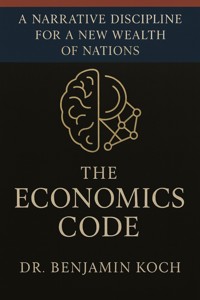
What if everything you were taught about economics was only the beginning? The Economics Code is not just another economics book—it is a new blueprint for understanding how the world works. Rejecting the cold abstractions of outdated textbooks, this revolutionary volume rewrites the rules of the discipline in human terms—story by story, concept by concept, system by system. Without a single chart or equation, Dr. Benjamin Koch reveals how value is created, who gets to define it, and why the future of economics depends on rediscovering its meaning. From barter to blockchain. From scarcity to sovereignty. From industrial machines to algorithmic minds. Whether you're a first-year student, a lifelong academic, or an everyday citizen searching for clarity in a chaotic world—this is your book. No jargon. No gatekeeping. Just the most powerful story never fully told: how economies shape us, and how we can shape them back. Accessible. Manipulative. Addictive. Essential. "Finally, a book that doesn't just explain economics—it liberates it." The Economics Code represents a watershed moment in the evolution of economics education. This landmark text redefines the discipline as a narrative science, rebalancing mathematical abstraction with linguistic clarity, historical continuity, and intuitive comprehension. It speaks not only to economists, but to scholars of history, sociology, law, political theory, and the emerging cognitive sciences. Written in a fluent, scientific prose style accessible to undergraduates yet insightful enough for doctoral curricula, this book eliminates the barrier of charts, graphs, and formulae in favour of textual coherence, timeless examples, and memory-anchoring storytelling. Every chapter integrates economic theory with its real-world implications—past, present, and projected future. Bridges the gap between popular readability and scholarly rigour, offering an entirely new foundation for how economics is taught, learned, and lived.
Sie lesen das E-Book in den Legimi-Apps auf:
Seitenzahl: 267
Veröffentlichungsjahr: 2025
Das E-Book (TTS) können Sie hören im Abo „Legimi Premium” in Legimi-Apps auf:
Ähnliche











Imprint
Title:
The Economics Code: A Narrative Discipline for a New Wealth of Nations© 2025 Dr. Benjamin Koch. All rights reserved.
Author and Publisher:
Dr. Benjamin Koch
Global Publication – Print & Digital Edition Published in 2025
Legal Disclaimer:
This publication is provided for educational and informational purposes. All rights reserved. No part of this work may be reproduced, distributed, stored in a retrieval system, or transmitted in any form or by any means—electronic, mechanical, photocopying, recording, or otherwise—without explicit prior written permission from the author, except as permitted by applicable law for academic citation, review, or personal educational use.
Distribution:
This book is published independently and made available worldwide via academic and public platforms, including libraries, institutions of higher education, and digital publishing services. It is authorised for both print and electronic circulation.
Note for Libraries and Universities:
This work is intended for integration into educational collections, university reading lists, and academic archives. Citation of this edition should reference the full title, author, and year of publication.
Digital and Print Availability:
This title is distributed globally in physical and digital formats. Layout, typesetting, and cover design prepared by the author.
THE ECONOMICS CODE
This work would not have been possible without the persistent encouragement and inspiration from those who refuse to accept that the world must remain as it is. Special thanks to the many readers, students, and collaborators who shaped the questions behind this book, and to those who believed in the necessity of a new way of teaching economics—not as a mechanical system, but as a living, narrative discipline.
To the thinkers past and present who questioned the orthodoxies, and to every ordinary citizen who ever asked 'why does it have to be this way?'—this book is for you.
A Narrative Discipline for a New Wealth of Nations
Dr. Benjamin Koch
Preface
A New Discipline for a Changing World
Economics is not merely a science of numbers. It is a discipline of interpretation—of incentives, of power, of structure, and of desire. For over a century, economics has shrouded itself in the aesthetics of objectivity: charts, equations, technical diagrams, and the illusion of neutrality. But behind every curve and coefficient lies a human story. And it is this story—told with precision, depth, and honesty—that this book sets out to reclaim.
The Economics Code is not a textbook in the traditional sense. It does not ask you to memorise models or regurgitate diagrams. It does not assume that clarity requires simplification, or that expertise must arrive only through abstraction. Rather, this book operates under the radical assumption that economics, at its most powerful, is a narrative discipline: a way of reading the world that connects motives to mechanisms, markets to meaning, and decisions to destiny.
Why This Book Was Necessary
It is often said that economics is the study of choice under scarcity. But such a definition is both narrow and inert. What, after all, defines scarcity? Who structures the choices? Why are certain decisions framed as rational, while others are dismissed as irrational or inefficient? What if the most important forces in economic life—trust, dignity, fairness, obligation—reside not in balance sheets but in moral codes, cultural memory, and institutional habit?
Most existing texts treat economics as a self-contained machine. You plug in assumptions, crank the gears, and observe the results. But real economic life is messier. It is recursive, adaptive, emotional, and political. It is not only about how people allocate resources, but why they believe what they believe, how they act when nobody watches, and who gets to set the frame within which decisions are made.
This book was born from a dissatisfaction with the reductionism that has come to dominate economic education. The student learns how to draw a supply curve long before they are invited to understand what work feels like. They analyse the marginal utility of goods before considering how goods acquire meaning. They are taught to see efficiency as an ideal before understanding the costs—psychological, ecological, spiritual—that efficiency often conceals.
And so, this book was necessary. Not as a refutation of economic science, but as a restoration of its human code.
How to Read This Book
You do not need to be an economist to understand economics. You need curiosity, patience, and the courage to unlearn some of the assumptions that have been handed to you under the guise of truth.
This book assumes you are intelligent, but not initiated. It respects your intuition. It speaks in full paragraphs, not fragments. It offers examples not to simplify, but to illuminate. It favours rhythm over rigidity, tone over technicality, and above all, meaning over memorisation.
Each chapter builds on the last, tracing the evolution of economic ideas through time, society, and imagination. The structure is deliberate: historical, then institutional, then psychological, then systemic, then transformative. The aim is to reveal that economics is not a series of separate topics—but a coherent worldview, a map of how we live, produce, distribute, and belong.
What This Book Is (And What It Is Not)
This book is not a manual. It is not a how-to guide for markets. It is not a collection of exercises or downloadable content. It does not pretend that the answers to our deepest economic questions lie in policy tweaks or academic papers.
Instead, this book is an invitation—to see the world differently, to think economically in the most profound sense of the term. It is a narrative journey through the logic of exchange, the history of power, the seduction of growth, the disillusionment of late capitalism, and the emerging architectures of digital and post-growth economic life.
It is also not politically neutral. It does not pretend that economics is free from values. Every economic framework carries ethical assumptions. Every metric hides a hierarchy. Every budget reveals a philosophy of who matters, and why.
This book makes those assumptions visible. Not to argue for ideology, but to make ideology conscious.
A Word on the Title
The Economics Code refers not only to the encoded structures through which economic behaviour is governed—tax systems, price signals, incentive designs—but also to the deeper, often invisible cultural coding that shapes how we interpret fairness, competition, debt, property, and profit. The word “code” implies a system of logic, but also a secret. Something to be cracked, revealed, unlocked. This book does precisely that.
The subtitle, A Narrative Discipline for a New Wealth of Nations, deliberately echoes Adam Smith. It positions this work as a conceptual heir—but not a copy. The “new wealth” spoken of here is not limited to capital or income. It refers to a broader conception of human flourishing, one that includes time, dignity, creativity, community, and planetary sustainability.
This book offers an economics that knows its history, confronts its present, and dares to imagine its future.
To the Reader
Whether you are a student, a sceptic, a policy-maker, a citizen, or a curious mind seeking to understand the operating system behind the headlines—this book is for you.
It asks much, but gives more. It will not flatter you, but it will trust you. It will not lecture you, but it will lead you. It will not reduce complexity, but it will give you the language to navigate it.
If we get it right, this book will not only teach you how the economy works. It will change how you see yourself within it.
Welcome to the code.
Table of Contents
Preface
A New Discipline for a Changing World
Part I – Foundations of Economic Meaning
Where Incentives Begin, and How the World Came to Care About Value
1.What Is Economics, Really?
2.From Barter to Bureaucracy: The Origins of Exchange
3.Incentives: The Hidden Language of All Human Systems
4.The Myth of Scarcity and the Birth of Price
5.Trade, Trust, and the First Markets
6.The Rise of Property: From Land to Symbol
7.Labour, Time, and Meaning: The Economics of Human Energy
Part II – The Engine Room of Civilisation
How We Built Societies Through Economic Structure
8.Feudalism: The Economics of Inherited Power
9.Mercantilism and the Birth of the Nation-State Economy
10.The Enlightenment and the Rise of Rational Self-Interest
11.The Industrial Revolution: Machines, Men, and Markets
12.Adam Smith and the Illusion of the Invisible Hand
13.Karl Marx and the Logic of Contradiction
14.Capitalism as a Psychological Project
15.Colonialism, Resource Extraction, and Global Inequality
Part III – The 20th Century and the Economics of Control
Money, Crisis, and Institutions in a Century of Volatility
16.Money: Fiction, Faith, and Function
17.The Gold Standard and the Global Imagination
18.Keynes vs. Hayek: The Battle Over the State
19.Central Banks and the Manufacturing of Confidence
20.Inflation: Power, Panic, and Price Signals
21.Depression and Recovery: Economics Under Pressure
22.Welfare Economics and the Social Contract
23.The Cold War of Ideas: Planned vs. Free Markets
24.The Neoliberal Turn: Deregulation, Debt, and Discipline
25.Globalisation and the Tyranny of Trade Orthodoxy
Part IV – The Present in Collapse and Convergence
What Today’s Crises Reveal About the Economic Operating System
26.Digital Labour and the Monetisation of Attention
27.Housing: From Shelter to Speculation
28.Education as Economic Sorting Mechanism
29.Health, Risk, and the Business of Longevity
30.Climate Capitalism: Can the Market Save the Earth?
31.Inequality and the Illusion of Mobility
32.Debt Cultures and the Psychology of Credit
33.Supply Chains, Fragility, and the Myth of Efficiency
34.Work Without Meaning: The Crisis of Purpose in Modern Labour
35.Why Economists Miss Everything: Modelling Versus Reality
Part V – The Future of Economics
Post-Growth, Digital Sovereignty, and the Ethics of Value Creation
36.The End of Growth? Economics Beyond Expansion
37.Universal Basic Income and the Value of Time
38.Post-Scarcity Systems: Economics in Abundance
39.Cognitive Capitalism and the Future of Human Output
40.Digital Currencies and the Reprogramming of Money
Part VI – Systems, Code, and Control
41.Economics of Belonging: Localism and Cultural Value
42.The Economics of Care, Community, and Cooperation
43.AI, Automation, and the Death of Labour Value
44.Sovereignty in the Algorithmic Age
45.Rewriting the Rules: A Manifesto for Economic Renewal
Appendices
•A: Glossary of Key Economic Ideas
•B: Annotated Timeline of Major Economic Paradigms
•C: Foundational Thinkers: A Biographical Cross-Reference
•D: Reading Recommendations for the Incurably Curious
•E: The 100 Most Influential Economic Phrases in Context
Part I – Foundations of Economic Meaning
Chapter 1: What Is Economics, Really?
The discipline that studies everything—and nothing at all
We are taught to believe that economics is the study of choice under conditions of scarcity. It sounds elegant. It sounds tidy. It sounds definitive. But it is also deeply misleading.
The problem is not that the definition is wrong—it is that it is small. Too small for the world we inhabit, and far too small for the minds we hope to educate. Economics, in practice, does not merely study choice or scarcity. It studies desire. It studies fear. It studies how humans make decisions under pressure, under ideology, under constraint, under delusion. It studies what we value, how we measure that value, and who gets to decide what counts.
And yet, the way economics is usually taught—especially at the university level—obscures that reality. Students are often introduced to the discipline not through the human world, but through abstract diagrams. Supply curves. Budget lines. Production possibility frontiers. These models are not inherently wrong. They are just prematurely introduced. And in doing so, they construct a false image of economics as a neutral science, insulated from culture, politics, psychology, or history.
This book begins with a different premise: that economics is first and foremost a way of seeing. A lens. A worldview. And that before we quantify it, we must first understand what it’s trying to explain.
Economics as Interpretation
Imagine a group of strangers standing at a street corner. One is selling flowers. Another is checking their phone for stock prices. A third is on the phone negotiating the price of shipping containers across a continent. A fourth is protesting rising rent. A fifth is simply asking for change.
All of them are behaving economically. But each action is nested in a radically different system of values, constraints, and beliefs.
Economics, at its most powerful, allows us to interpret these actions. Not merely to describe them in equations, but to uncover the invisible frameworks beneath them. It asks questions like:
• Why does one person have capital and the other only labour?
• What makes the flower seller's effort “productive,” but the
protester’s effort “resistance”?
•Who decides the cost of housing, and why do we pretend that it
emerges naturally from the market?
These are not questions of math. They are questions of meaning. And they go to the very heart of what economics should be: a method of decoding the patterns of behaviour and structure that define how we live.
The Illusion of Objectivity
Much of modern economic education rests on a myth: that the discipline is free from ideology. That it is a kind of natural science, like physics or chemistry, revealing eternal truths about price, efficiency, and equilibrium.
This is not only false—it is dangerous. Because every economic model is built on assumptions. Every equation embeds a worldview. Every so-called neutral recommendation is based on some vision of how the world should work. And when those assumptions go unquestioned, they do not become apolitical—they become invisible. And what becomes invisible becomes powerful.
To say that “markets allocate resources efficiently” is not a neutral statement. It is a belief about human behaviour. It assumes that efficiency is the highest good. That what we can measure is more important than what we cannot. That social outcomes can be justified by individual choice.
These are not conclusions. They are values. And if economics refuses to acknowledge them as such, it ceases to be a science and becomes a theology—one that worships rationality, growth, and equilibrium without ever examining the costs.
The Real Subjects of Economics
So what, then, is economics really about?
It is about the design of incentives. The distribution of power. The construction of belief systems. The language of legitimacy. It is about how we organise human life at scale, and who benefits from that organisation.
It is about systems. But it is also about feelings. About how insecurity alters decision-making. About how people respond to risk, to debt, to status, to shame. About how culture encodes economic norms without needing to make them explicit. About why we call some work “productive” and other work “unskilled.” About why value, even when quantified, remains essentially subjective.
Economics is about the architecture of everyday life. Who eats. Who owns. Who decides.
And it is about time. Time spent, time saved, time wasted, time hoarded. There is no economic concept more intimate, or more elusive, than time. And yet, textbooks rarely treat it as anything other than a variable in an equation.
Economics Without a Mask
In the chapters ahead, we will examine trade not only as an engine of growth, but as a story of trust, betrayal, and geography. We will examine inflation not only as a monetary phenomenon, but as a symptom of fear. We will examine labour not only as a factor of production, but as the experience of being human under obligation.
We will move from feudal estates to digital labour platforms. From Smith to Marx to Hayek to the post-growth visionaries of today. From debt jubilees in ancient Mesopotamia to central bank liquidity traps in the 21st century. We will do so without charts, because this book believes you are smart enough to think in full paragraphs. Because you deserve prose that teaches and provokes—not just diagrams that summarise.
This book is an act of translation. Not from economics to English, but from abstraction to meaning. It is an attempt to pull back the curtain and show the architecture of a discipline that, for too long, has pretended to be neutral while shaping every corner of life.
And it all begins with a simple truth:
Economics is not about money. It’s about how we live.
Chapter 2: From Barter to Bureaucracy
The Origins of Exchange, and the Myth of the Primitive Trade
The story we are told goes something like this: once upon a time, people traded chickens for shoes. If you had too many eggs and needed a cloak, you would find someone with wool and make a swap. But then, one day, it became too hard to find someone who wanted exactly what you had and had exactly what you needed. So we invented money—a neutral medium of exchange—to make things easier.
It is a tidy story. And it is almost entirely false.
Anthropologists have long discredited the “barter myth” as a Eurocentric fiction, retroactively imposed on history to justify a market logic that did not yet exist. No actual human society operated on widespread, direct barter. None. Not even as a transitional stage. Instead, what we find in ancient records and oral cultures is something far more complex—and far more revealing: credit, obligation, and trust as the foundations of economic life.
Before we had coins, we had promises. Before we had markets, we had relationships. And before we had prices, we had records—often spiritual, sometimes bureaucratic, always social.
The Architecture of Early Economies
In Mesopotamia, one of the earliest cradles of civilisation, temples operated as the central economic nodes. Farmers would bring surplus grain as offerings or taxes; in return, they received rations, protection, and status. These were not free markets. They were systems of centralised redistribution—a logic closer to taxation than to trade.
The Sumerians used clay tablets to record who owed what to whom. These were not receipts in a modern sense, but social memory devices. The economy was not a series of independent exchanges—it was a system of relational accounting, embedded in hierarchy and ritual.
Similarly, in ancient Egypt, land was allocated by the state, grain was stored in communal granaries, and workers were paid in rations of bread and beer. In many ways, the economy was run not by the “invisible hand” of the market, but by the very visible hand of the scribe.
Exchange, then, was never just about goods. It was about maintaining status, fulfilling obligation, and aligning oneself with power. Barter is what happens when the system collapses. Bureaucracy is what happens when it works.
The Real Origins of Value
To understand how value emerged, we must look not to markets but to ritual.
In many premodern societies, key economic exchanges took place during festivals, religious ceremonies, and rites of passage. Cattle were not just livestock—they were symbols of wealth, lineage, and social standing. Shells were not merely decoration—they were currency in the form of memory. Potlatch feasts among Indigenous peoples of the Pacific Northwest involved ritual gift-giving that bound communities into networks of reciprocal obligation.
These systems were not primitive. They were highly organised, and in some cases, morally superior to modern capitalism. Because they recognised that economics is not about the optimisation of utility, but about the stabilisation of meaning.
Money did not emerge to solve the problem of barter. It emerged to formalise what already existed: a web of social commitments too vast to track informally. It was a technology of trust—and later, of control. Bureaucracy as Economic Infrastructure
One of the most overlooked truths in economic history is that bureaucracy precedes capitalism. Long before corporations, there were censuses. Long before GDP, there were grain ledgers. Long before banks, there were priests with tablets.
Why? Because in any society more complex than a village, coordination requires abstraction. You must be able to count what you cannot see. You must be able to tax what has not yet been harvested. You must be able to enforce a claim without physical possession.
Bureaucracy allows all of this.
It is not a failure of markets. It is a precondition for markets. Every price signal depends on a system of measurement. Every wage depends on a notion of time. Every transaction depends on a unit of account that someone must define, stabilise, and legitimate. That “someone” is almost always an institution.
Even today, the economy functions not because individuals are rational, but because bureaucracies make them legible. Tax authorities, census offices, zoning boards, education ministries, customs inspectors—all of these act as the unseen infrastructure of economic life.
If this sounds unromantic, that is because it is. But it is also foundational. Economics, at its core, is not just about supply and demand. It is about making human activity measurable, predictable, and enforceable.
From Ritual to Rulebook
As civilisations expanded, these relational economies began to shift into legalistic systems. What began as customs became rules. What began as generosity became expectation. And what began as a reciprocal web of obligations slowly hardened into property rights, tax codes, and monetary systems.
What we now call “markets” emerged not from freedom but from structure. And structure is not neutral.
A tax system reflects a philosophy of who should contribute. A land registry reflects a theory of who should own. A contract law regime reflects a belief about what kinds of promises can be enforced. None of these are natural. They are inventions. And every invention serves someone.
The modern economy is not a spontaneous order. It is a coded order— an accumulation of rules, institutions, and interpretations layered over millennia. It began not with barter, but with bureaucracy and belief.
And it continues to evolve.
Why This History Matters
Understanding the real origins of exchange is not merely academic. It changes how we view today’s economic systems.
If you believe economics began with barter, you will believe that money is neutral, that markets are natural, and that government is an intrusion. But if you understand that economics began with obligation, ritual, and institutional control, then you will see that markets are not default systems—they are designed environments.
That means they can be redesigned.
And this is the deeper truth we must carry forward:
Economies do not emerge. They are built. And what is built can be rebuilt.
Chapter 3: Incentives
The Hidden Language of All Human Systems
Every economy, at its core, is an operating system for behaviour.
It structures choice, assigns consequence, and channels desire into action. And at the heart of that operating system is a mechanism so pervasive, so quietly powerful, that it governs decisions from the boardroom to the family kitchen. That mechanism is incentive.
Incentives are not just rewards or punishments. They are codes of influence, embedded in our institutions, our cultures, and our stories. They are the subtle nudges, the grand designs, and the quiet expectations that make certain actions feel natural—and others unthinkable. They are how systems speak to individuals.
And yet, few concepts in economics are so widely misunderstood.
The Myth of the Rational Actor
Standard economic theory begins with a fiction: homo economicus, the rational actor who weighs costs and benefits with machine-like clarity and acts to maximise their self-interest. This tidy creature is the foundation of microeconomic modelling and much of policy design. But it is also a profound distortion of how human beings actually behave.
Real people are not calculators. They are storytellers, social mimics, moral agents, and emotional reactors. They are swayed by framing, primed by culture, and tethered to relationships. They respond to incentives, yes—but only in the context of interpretation. An incentive that looks like a carrot to one person may feel like a leash to another.
And so the question is not merely “What is the incentive?” but rather:
• How is the incentive understood?
• Who created it, and why?
• What behaviour does it reward—and what behaviour does it
quietly suppress?
Incentives Are Never Neutral
Take wages, for example. At first glance, a salary is a simple incentive: you exchange your labour for compensation. But what does that wage signal? Is it a measure of your value? Your time? Your obedience? Your willingness to conform?
A low wage may disincentivise effort—or it may create dependency. A high wage may motivate performance—or mask exploitation. Bonuses can encourage excellence—or foster sabotage. Commissions can drive sales—or corrode trust. Incentives are tools—but they are also narratives, and they shape not only what people do, but how they feel about doing it.
Consider school grades. Are they incentives for learning—or mechanisms of conformity? What about tax deductions? Are they rewards for contribution—or discounts for those who already have more?
Every incentive is also an ideology.
Systemic Incentives and Structural Outcomes
One of the most important shifts in economic thinking is from individual-level incentives to systemic incentive architectures.
In other words: it’s not just about how one person responds. It’s about what kinds of patterns the system encourages over time.
If a political economy rewards short-term profit, it will produce short-termism—even at the cost of long-term collapse. If a legal system incentivises litigation over mediation, it will produce adversarial relationships. If a housing market rewards speculation over habitation, it will prioritise investment returns over community stability.
This is the essence of incentive design: to understand that the rules we set shape the world we get.
Bad incentives don’t always fail immediately. In fact, the most dangerous incentives are those that succeed in the short term—while quietly eroding trust, dignity, or resilience in the long run.
Invisible Incentives: Culture and Compliance
Many of the most powerful incentives are not designed—but inherited. They come through culture, tradition, and unspoken expectation. They are not written in law but enforced through norms.
In a corporate office, the official rule may be that everyone can take breaks. But the real incentive structure—what gets promoted, who gets praised, how time is tracked—may tell a different story.
In a family, a child may be told they can “be anything.” But subtle cues—who gets interrupted, who gets celebrated, who bears emotional labour—communicate the real incentive landscape.
The absence of punishment is not the same as the presence of permission. And in complex societies, the most powerful incentives are not carrots or sticks—they are filters: what gets attention, what gets investment, what gets ignored.
Understanding these hidden layers is critical. Because until we see the incentive, we cannot escape its gravitational pull.
Incentives as Scripts for Identity
Incentives do not only shape behaviour. They shape self-concept. Over time, we internalise the incentive structures we live within. We begin to define success by them. We begin to calibrate morality around them.
If we are rewarded for extraction, we come to believe that extraction is efficiency. If we are rewarded for silence, we call it professionalism. If we are rewarded for consumption, we call it happiness.
Thus, the danger is not only behavioural—it is ontological. The wrong incentives can turn good people into harmful agents without them ever noticing. Not because they are bad—but because the system made goodness irrational.
This is why economics must move beyond charts and ask ethical questions. Not just: “What works?” But also: “What does it teach us to want?”
Designing the Future
The great project of 21st-century economics is not only to measure outcomes—but to redesign incentive architectures for a future we can live with.
This means:
• Incentivising care, not just capital.
• Rewarding long-term stewardship over short-term gains.
• Designing policies that nurture intrinsic motivation, not just
extrinsic compliance.
• Shifting what we celebrate—from accumulation to contribution,
from dominance to dignity.
It means recognising that every system teaches. Every rule is a teacher. Every incentive is a form of economic pedagogy.
And the future will be shaped not just by what we reward—but by what we refuse to reward.
At every level—from household budgets to global finance—the question of incentives is the question of design.
And design is never innocent.
If you want to understand a system, follow its incentives. If you want to change a system, change what it rewards.
Chapter 4: The Myth of Scarcity and the Birth of Price
How artificial limits became the foundation of economic thought
Scarcity is the founding myth of economics.
It is the first concept taught, the lens through which every model is viewed, and the justification for nearly every decision. Scarcity, we are told, is the reason we must choose. The reason some go hungry while others feast. The reason we need markets, money, and managers of distribution. It is the fundamental constraint that gives economics its very purpose.
But what if scarcity is not a given? What if scarcity, in many cases, is not natural, but manufactured—not a fact, but a function?
And what if the very idea of price—the golden measure of value in modern economics—is not a neutral reflection of scarcity, but a socially constructed tool to distribute power under the guise of allocation?
What Scarcity Really Means
In textbook definitions, scarcity simply means that wants exceed means. There are more things people desire than there are resources to satisfy those desires. Therefore, economics must decide how to allocate limited resources among competing uses.
It seems intuitive. After all, there is only so much oil, so much land, so much time. Surely that means scarcity is real.
And yes, in a narrow sense, it is. Physical limits exist. Not everything can be had at once. But that is not the same as saying scarcity is the organising logic of human society. In fact, most traditional societies did not organise their economies around scarcity. They organised around abundance, obligation, or sufficiency.
In hunter-gatherer cultures, people shared because everyone understood that resources fluctuated, and social cohesion mattered more than private hoarding. In subsistence farming communities, land was rotated communally. The idea that people should compete for resources, that there is never enough to go around, is not a universal truth. It is a modern ideology.
And like all ideologies, it serves someone.
Artificial Scarcity
The true function of scarcity in economics is not descriptive—it is prescriptive. Scarcity creates urgency. It justifies hierarchy. It makes rationing appear rational. It makes inequality appear necessary.
And perhaps most dangerously, it makes price appear fair.
But many of the scarcities we treat as natural are in fact manufactured:
• Patents make information scarce by restricting its use.
• Copyright makes culture scarce by enforcing ownership.
•Gated communities make housing scarce by zoning exclusivity.
•Planned obsolescence makes resources scarce by designing decay.
• Paywalls make knowledge scarce by enclosing the commons.
Even food, the most basic human need, is not scarce in absolute terms. The world produces enough calories to feed every person on the planet. The problem is not supply. It is distribution. It is politics. It is infrastructure. It is profit incentives.
Scarcity is not always about lack. Often, it is about control.
The Invention of Price
Once scarcity is established as the central fact of life, price emerges as its translator. Prices tell us what things are worth, we are told. They coordinate supply and demand. They ensure that resources flow to their most efficient use.
But what is a price, really?
A price is not an intrinsic measure. It is a consensus hallucination: the amount of one thing people are willing to exchange for another, in a given context, under given conditions, subject to power, perception, and pressure.
Price is a mirror—yes—but a funhouse mirror. It reflects distortion. It reflects advantage. It reflects the rules of the game.
When clean water is priced cheaper than bottled sugar, it says nothing about the true value of health. When a hedge fund manager earns more in an hour than a teacher earns in a year, it does not reflect the marginal productivity of labour—it reflects the marginal politics of finance.
Price, like law, is a system of




