


Erhalten Sie Zugang zu diesem und mehr als 300000 Büchern ab EUR 5,99 monatlich.
- Herausgeber: The Lilliput Press
- Kategorie: Poesie und Drama
- Sprache: Englisch
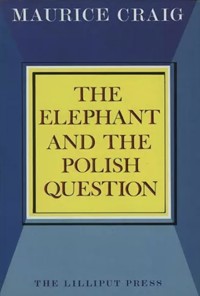
Part meditation, part autobiography, part exploration, part miscellany, The Elephant and the Polish Question is the distillation of a literary life of more than forty years. Owing something to Trivia, the Notebooks of Samuel Butler, and Norman Douglas, it touches on many subjects about which the author has thought but not hitherto had the chance to write, from coincidences to funerary customs, from book-collecting to ship-design, and from prose style to the art of trespass. Snapshots of childhood, friends and personalities blend with reflections on education, music, architecture, the decay of travel, the evolution of language, and much besides. Maurice Craig seeks the hidden links between his recurrent preoccupations, occasionally bringing to light a facet of something that looks like – and may even be – truth. Anecdotal and analytical by turn, the author is resolute in retrospect, believing that only the past is knowable. There are vivid set-pieces such as the obsequies of William Butler Yeats, visits to No. 10 Downing Street and other notable buildings, and the undeservedly little-known vicissitudes of the Druce-Portland Case. While himself incapable of consciously telling an untruth, the author proves himself a connoisseur of forgery and imposture. He has, in a back-handed sort of way, enjoyed life its contradictions and discontinuities. The reader who is prepared to follow him, or to browse at his own pace, will be rewarded.
Sie lesen das E-Book in den Legimi-Apps auf:
Seitenzahl: 484
Veröffentlichungsjahr: 1989
Das E-Book (TTS) können Sie hören im Abo „Legimi Premium” in Legimi-Apps auf:
Ähnliche
















The Elephant and the Polish Question
Maurice Craig
THE LILLIPUT PRESS DUBLIN
FOR AGNES WITH LOVE
CONTENTS
TITLE PAGE
DEDICATION
AUTHOR’S NOTE
MACHINERY AND MORALS
OUT OF IRELAND
THE INWARD ASPECT
THE DRUCE-PORTLAND CASE AND OTHER IMPOSTURES
NOTES ON LANGUAGE
CODA
INDEX
COPYRIGHT
AUTHOR’S NOTE
A number of people of various nationalities wrote books on the elephant. The Englishman wrote one called Elephants I HaveShot; the Frenchman’s was a slim and elegant volume called Les Amours de l’Éléphant; the German book was in two volumes, called Prolegomena zu Vorskizzen zur Elephantenwissenschaft with most of the verbs huddled together in Band II; and the contribution of the Pole was called The Elephant and the PolishQuestion.
In the most recent form in which I have encountered this tale, in an Argentinian newspaper, the animal was the camel and the country, needless to say, Argentina. But it is the same story, and it is of universal application.
Some passages in this book, written between 1984 and 1987, may read strangely in the light of recent events. I have left them as they stand, as a truthful record of what I felt and thought. The ends are not yet, and the wheel may take another turn.
MACHINERY AND MORALS
I
THE GENESIS of this book is very simple. For a long time I have thought about, and have wanted to write about, a great many subjects which found no place in any of my published books, all of which are on comparatively restricted themes and all of which, except the first, were written because a publisher asked me to write them. A great deal of this material might, in other times, have taken the form of essays, or, had I been a novelist, might have been put into the mouths of characters or passed off as commentary. Some of it might have been cast into the form of broadcast causeries, and indeed some of it was. But literary forms have an inevitable tendency to solidify and become rigid. I recall that the word which we now know as ‘sermon’ started life meaning no more than a string of casual ruminations on this and that. That is what it meant in Horace’s time, and his ‘sermones’ have come to be known indifferently as his ‘satires’: another word which has since acquired a narrow meaning.
I am as open to the temptation to sermonize as others are, and sometimes tempted, also, to a satirical vein, but reluctant to be confined by too narrow a form. The Life and Opinions ofTristram Shandy, Gent.: now there is a title for you, however ill it fits the book it belongs to. My life will hardly by itself engage a reader’s attention, though my opinions may, particularly when they interact with experience.
A friend who has read the bulk of this work has complained that it is lacking in urbanity, a quality which he is good enough to say he has found in my previous books. I think that I can see why this is so.
Urbanity is the fruit of ease. When you are at ease with your subject-matter you can afford to be urbane. In writing my books I have usually been in command of my subject. I have mastered it to the extent of thinking I know how it is or was and how I should present it in a coherent way. The subject has usually been a rather small one, at least by the standards of the world at large. And, good or bad, my books have reflected, I hope not complacency, but at least some confidence that I had a package to deliver.
But now my attention has been turned to those discontinuities and contradictions, in myself and in the world at large, which have troubled me and which I want to explore and probe.
A book which sets out to be about one thing can, as we all know, end up by being about something else, and this can be true even of a paragraph. When I was at school I was often reproached for being ‘tangential’, because in the middle of discussing something I would see an analogy with something else and would be diverted by this. This still happens to me in conversation, but in my books I have always had to suppress it. Now, perhaps, is the time to let it have its head. After forty years between the shafts might not the draught animal be turned out to grass? No longer bound to draw its load to or from the market, might it perhaps roll on its back and wave its hoofs in the air? or at least canter round the field for the fun of it? Engines, it is true, always run better under load. But, to vary the metaphor, there are things to be picked and gathered in the course of a country walk which may be worth the trouble of bringing home.
Much, though not quite all, of this book was written at the Tyrone Guthrie Centre at Annaghmakerrig, Co. Monaghan, a place where it is possible to lay aside all worldly things except tobacco, the wireless and one good meal a day.
Nobody can expect to find here any thoughts which have not occurred to other people. But, just possibly, there may be some juxtapositions of thought which have not occurred or been recorded before. A tangent, it will be remembered, is a prolongation in a straight line of the course which the body was pursuing immediately before its release. As a child I used to think that if I swung a chestnut on a string round my head and suddenly let go, it would shoot straight away from my head. I now know that this is not so, and that its course, if extrapolated backwards, would miss me by a distance equal to the length of the string plus that of my arm. To that extent, perhaps, the trajectory of a thought may have some independence of its author.
Metaphors of this kind come readily to me. Though completely without training in mechanics or physics, and having done no ‘science’ at school, I am at heart a Victorian mechanistic materialist, a dealer in rods and levers, billiard-balls, lines of force and moments of inertia. I love machines, but only when I can understand them, and everything I think I understand I tend to see as a machine.
Little boys, they say, want to be engine-drivers when they grow up. At least they used to, in the days of steam locomotives. I cannot imagine that the inducement is nearly so strong nowadays when the engine is simply a long nondescript box giving out a loud thrumming noise and, usually, a bad smell also, even when stationary, in a station.
I did not grow up, in this sense, till I was sixty-two, when the small model engineering club to which I belong resumed operation of its railway, newly laid out in the foothills of the Dublin mountains with money provided, I am glad to say, by the EEC. The locomotives and the rolling-stock are provided and operated by us, on Saturday afternoons, ostensibly for the benefit of all comers aged between nought and about ten, but in fact, of course, for our own amusement.
This was where, and how, I finally learnt to drive a coal-fired steam locomotive, how to keep the four or five variables: steam-pressure, height of fire, water-level, throttle-opening and speed, in harmony with one another. The problem is not unlike that of making a speech in public: managing the elements of tone, vocabulary, speech-rhythm, syntax and, last but not least, sense and content, without coming a cropper.
I have lived a very quiet life and it is extraordinary that I should be writing about it at all. But now that I have finished writing about buildings what else is there for me to write about? At least I am not doing it at anyone else’s insistence, so it has perhaps the merit of an acte gratuit. In any case, when the general noise level is lowered, some quiet things get heard.
One of the achievements of which I am most proud was not achieved by me at all but by someone else. When the Four Courts was restored after the devastation of 1922 they did several things which they ought not to have done, and left undone some which they ought to have done. Until I drew attention to these (in an appendix to my Dublin) I do believe that nobody noticed them. Everybody repeated, parrot-wise, that reinstatement had been scrupulous and complete etc. etc.
Most of what was wrong could not be put right. But there was one thing which could. The dies (recessed rectangular panels) in the centres of the blocking-course above the cornice on the wings had been, doubtless through ignorance, omitted, giving them a bald and meaningless appearance.
For something like twenty years I pestered successive architects in the Board of Works. Then, to my delight, in the early seventies, Gerald McNicholl, then Principal Architect, put them back, having first, with characteristic courtesy, told me he was going to do so.
Every time I pass the Four Courts I get a lift from seeing and remembering this. But I do not suppose that one person in ten thousand notices it.
That is one great advantage which buildings have over printed books: they can be put right even after they have, so to speak, ‘gone to press’. They can also be corrupted in the course of their working lives, and this, alas, is what more often happens.
II
I do not greatly care for children and I very much resented being a child myself. I was always very impatient to be delivered from that status. My own children have given me much more pleasure since they grew up than they ever did when they were small.
It is the same with animals. Kittens are all very well, but the company of an adult cat is incomparably more rewarding. I am well aware that according to Konrad Lorenz all domesticated animals are in some respect fixed in an infantile mode with respect to their owners. No doubt this makes up some part of the pleasure of ‘owning’ them. But it is much less true of cats than of other creatures.
I agree with the schoolboy who wrote that ‘the pleasures of youth are as nothing to the pleasures of adultery’. People who do not share my enjoyment in playing with toy boats and driving toy trains no doubt think that I have never grown up. Let them. If that were the only respect in which I have not grown up as I ought to have done, I would be more contented than I am. Perhaps if I were as fully grown up as I should be, I would take more pleasure in the society of children.
III
I have noticed something about Annaghmakerrig. Not just the peace, the solitude, the freedom from interruption – no post, no television, virtually no telephone – not even the fact that it is so skilfully and unobtrusively run. It is the size of the rooms. The room I have at present is about 27 feet by 15, and they are mostly about this size. It is sparsely furnished: a bed, a table, three chairs, and against the walls a bookcase, chest of drawers and wardrobe. As a result, I can walk about in it, backwards and forwards. To me this is even more important than the view out of the windows, though others might put these advantages in a different order.
At home in Sandymount my library, where I work, is so small and so full that I cannot move about in it without tripping over something. It is, consequently, difficult to think in it. When I have the house completely to myself I put my typewriter on Agnes’s* father’s desk in the drawing-room. The drawing-room, though also somewhat too full of furniture for comfort – my comfort I mean of course – is at least long and has, at one end, a view over a large open green space and, at the other, a view straight out to sea.
When I lived on a top floor in Merrion Square over forty years ago I had two very small rooms, but the view I commanded was of the whole length of the square as far as Leinster House about 800 feet away. In the evenings this vast space would be flooded with a deep sapphire-coloured light. My cat had the run of the roofs of Merrion Square East and the whole of the North side of Upper Mount Street, while, as I lay in my bath of a Sunday morning, I could hear a sound denied to the rest of Europe: the retired opera-singer Margaret Burke Sheridan, singing in her bath. Neither the lumière nor the son were reflected in the rent, which was twenty-five shillings a week.
But there is no doubt that indoor architecture cannot be made to work without a much more generous allowance of space than is nowadays customary. I once spent a fortnight at a summer school in one of the newly built colleges of the University of York. It was like being in gaol.
Of course I have been spoiled. I returned recently to Magdalene for a dinner. They could not put me in my old rooms as they had done once before, because they are now part of the enlarged library. They accommodated me in a reasonably sized (old) bed-sitter; but I did get a glimpse of some of the new rooms. Though well designed, they had more of the cell than the room about them and I did not envy their oceupants.
What must it be like, to live in Leningrad, where indoor space is so sparsely rationed while outdoor space is provided with such lavish splendour? Back to Merrion Square I suppose, only more so. Maybe if I were a state-favoured writer I would be given a dacha: an Annaghmakerrig all of my own? I doubt it.
IV
There is a great difference between what one would like to do and what one would like to have done. For example, when I saw on the television Mr Aspinall sitting on the grass beside his enormous female tiger a small part of me envied him because I love cats, and tigers are the grandest possible kind of cat. When, a minute or two later, Mr Aspinall, still sitting on the ground, was playing with the tiger’s kittens while Mrs Tiger prowled around in the same enclosure, I envied him rather less (and also rather more) and I trembled for him, even though I knew that had anything terrible actually happened I would not be watching the film. Yet, at the time when the film was made, only a day or two earlier, it was all perfectly real, and Mr Aspinall was perhaps in great danger. Certainly at the back of my mind was the knowledge that two of his keepers had been killed not long before. My motive in watching had little if anything in common with that which impels people to watch a man being pushed in a wheelbarrow on a wire stretched across Niagara Falls. From that I would have averted my face in horror. But Mr Aspinall’s tiger was sublime: beauty and terror incarnate.
It is much more pleasant to be somebody who has written a book than to be somebody who is going to write one. But both conditions are much more agreeable than that of the man who is actually writing. One longs to be safely out of the enclosure with the door locked and the tiger on the other side of the wire.
V
Among the few recollections of my childhood is that of a holiday or holidays taken at Ballynahinch Spa. Though less than twenty miles from Belfast, the small town of Ballynahinch was then very rural indeed, and the Spa still more so. Through the grounds of the small hotel, which was an old whitewashed house belonging to a Mr Flynn, there wound a small river, slow-flowing, with level banks, from which we launched our paper boats. Near it, I seem to recall a circular or octagonal pump-house from which we once – and once was enough – drew glasses of murky water tasting of sulphur.
Like all small boys, we preferred the back parts of the hotel to the front. Butter, in those days and in that place, was still made in a dash-churn, a large round tapering wooden vessel closed by a wooden disc through which protruded the handle of the dash. By prolonged agitation butter was produced, and this fascinated us.
Even more fascinating was Mr Flynn’s performance on Saturday nights. He must (I now suppose) have had drink taken. He would plant himself in the middle of the hotel lounge with his feet apart, hook his thumbs into the armholes of his waistcoat, throw back his head and sing:
Never since then, in any place or at any time, have I seen or heard those words or the tune they go to, which is as clear to me now as when I first heard it at the age of six or seven. If the purpose was to impress the juvenile mind, success was complete. I was dimly aware that my elders (not my parents, who were at the time doubtless cruising in the Mediterranean, but our governess and others) were somewhat embarrassed by Mr Flynn’s performance, and this is probably part of the reason why I remember it so vividly. It has also helped to suggest my later opinion that his afflatus was not only evangelical but alcoholic as well.
Once, when I was between the ages of eight and thirteen – I cannot be more precise – I decided that I would remember a chosen moment for the rest of my life. There was nothing particular about the moment except that I had decided to choose it. I was on my way back to school. The train was somewhere between Dundalk and Drogheda. I was standing up in the middle of the compartment, facing North with a bit of West in it, looking down at the seat I had just been sitting in, which was the seat in the North-West corner (the train was of course going South). ‘I shall always remember this moment,’ I said to myself. And I have.
VI
I can think of no pleasure greater than that of visiting a railway-works, such as many railways formerly maintained but which no longer exist except perhaps in India. When I was quite young I visited two. The father of my school-friend Michael Booth was an engineer in the Great Southern Railway so that at the age of twelve or so we had a memorable visit to the great works at Inchicore, while at about the same time or a little later, thanks to my father’s friendship with the Chief Mechanical Engineer of the Belfast and County Down Railway, we had a similar visit to the works at Queen’s Quay.
In such works locomotives were built, rebuilt, repaired, re-boilered and serviced: there were drop-hammers for forging, hearths for smiths’ work, giant lathes for turning and skimming wheels, and most dramatic of all, you could see, hear and smell the red-hot steel tyres being lowered and shrunk on the driving-wheels.
Many years later, when I was about forty, I had the same pleasure, unexpectedly, on a smaller scale. Jeanne† and I had taken a trip by motor-boat from Tossa de Mar round several headlands to the neighbouring village of San Feliu de Guixols. I may have looked at the church of San Feliu – I probably did – but I remember nothing of it. What I do remember is that this was the terminus of a narrow-gauge line to Gerona, with little tank-engines, passenger-stock and everything originating from, I think, Munich some fifty or sixty years earlier, which were dealt with in a little works where all the machinery was driven by a vertical steam-engine in one corner, all in good going order and busily at work. Well, fairly busily. The Spaniards were good mechanics in those days, the sort of good mechanics you always come across in a relatively underdeveloped country possessing high-grade equipment which it cannot afford to replace with new but has learnt to look after properly. We were, after all, not very far from the factory in which the Hispano-Suizas had been built and which was again in use making the Pegasos. A little later I was to sample the same Spanish husbandry in the loving care with which the fifty-year-old steamers in the Canaries were maintained. There were, to be sure, special circumstances. Wages were low in Franco’s Spain, and the inter-insular schedules were such that they spent quite long periods in port during which their crews could do a lot of polishing and painting and treat them as the drivers on the old-style railways treated their engines. Furthermore, Mr Juan March, who owned the company, owned also the dockyard in which their annual overhauls were carried out, and because the ships were engaged on the postal service, the government paid a large proportion of the cost, so that there was every inducement not to skimp it.
As so often, a state of affairs which seemed delightful was sustained by a system for which no defence was possible. Even in real life this can be so, and in art it is even more so. Thus my abhorrence of whale-hunting does not prevent me from enjoying Moby Dick and especially the film made from it by John Huston. On the other hand, though I have made several unsuccessful efforts (to my shame) to read the Iliad, I have read the Odyssey right through with great pleasure at least once (both, I hasten to add, in translation). This, no doubt, brands me as less than fully adult, for the reason quite clearly is that the subject-matter of the Odyssey attracts me while that of the Iliad repels me.
VII
I remember hardly anything from my early childhood, at least so far as I can recall, though it is always possible that some stimulus could trigger off a recollection long dormant. One thing I do remember was the sound of goods trains being shunted at night in the marshalling yards of the Great Northern Railway a mile or two away: the characteristic clattering as each unbraked waggon bumped into the next and so on all down the line, like dominoes. The sound seemed to carry farther at night: at any rate this sound is one I associated with lying in bed, awake. I don’t suppose I lay awake for long, being a perfectly normal boy in that respect at least.
We went for a summer holiday to Enniskerry a year before I went to school in Dalkey, when I was about seven. I remember the horseshoe forge (of a kind I now know to be a common type all round the Dublin area) which was, of course, in those days still an active forge, and the blacksmith’s name was Byrne: not surprisingly as it is about the commonest name in Wicklow. That was my first visit to Dublin, but about Dublin itself I remember nothing at all from that time, and little enough from the five years I spent there at school in Dalkey. Small boys, it is clear, do not see architecture (and in that respect most of them never grow up). I do remember Baggot Street with the tram-standards down the middle of the street where the trees are now: this I saw on my visits to the dentist Mr Friel whose enormously bushy eyebrows I also remember, looming over me. He must have been in Fitzwilliam Square or Fitzwilliam Place, and so were the Pringles: surgeon Seton Pringle whose son was at school with me. I went there sometimes on the rather rare occasions when we were let out, and remember how enormous the Dublin houses were compared with ours in University Square, Belfast, and the great space behind them, backing on to the Grand Canal.
The most indelibly memorable experience of that period was the appearance of the R101 over Dublin in the year 1929. Though I had not the slightest interest in air travel, then or at any time since, as a ten-year-old schoolboy I could not but be fascinated by the idea of a vessel the size of the Mauretania floating overhead. Somehow we got wind of her approach, and in the very early morning of November 18 1929 a tiny speck appeared over the Kish or the Bailey, well out to sea. There were wide seats under the window-sills of our dormitory, and we knelt on these in our pyjamas, oblivious of the chill, watching the speck grow bigger and bigger and rounder and rounder. She passed to the East and South of us, circling round Dalkey or Killiney Hill no doubt, so that we saw her at full length, at no great height, with her propellers whirring and the long strip of saloon window clearly visible, finally disappearing in the direction of Dublin.
This was one of the very few extended flights she made, before setting out on her fatal journey towards India, a disaster compounded of political meddling, moral cowardice and physical courage (all the necessary ingredients, I notice in passing, for war). In my memory it was only a matter of days or at most weeks before we heard that she had crashed in flames into a low hillock near Beauvais. But looking it up recently I found that there was in fact nearly a year between, during which she was lengthened in a vain attempt to improve her buoyancy. The force of the dramatic impact, covering both events, had moved them closer together.
An even more famous public disaster than that of the R101 left a small trace on my childhood memories. In about 1926 or 1927 when I was seven or eight, a man came to dinner with my parents, and at the time I remember being told that he was Mr Wilding and was a naval architect, by then, I think, living in Liverpool or it may have been Glasgow. I believe that it was not until many years later that I identified him as Edward Wilding the assistant chief designer, under Thomas Andrews, of the Titanic. It is, of course, possible that I remember his name because I was told at the time of the Titanic connexion: but I think not. My parents used to relate how my father saw her sail down Belfast Lough on her way to Southampton, and my mother saw her sail down Southampton Water on her way to Cherbourg, Queenstown and points West.
Nearly every maxim has a contrary which is equally true. Suppose, for instance, we wish to draw a moral from the loss of the Titanic. It is almost certain that had the ship met the iceberg head-on she would have survived. The first three or four compartments would have crumpled up (as later happened with the Stockholm) and many lives would have been lost: but she would have floated. As it was, she took avoiding action and as a result grazed the iceberg so that five compartments – one too many – were opened to the sea, and nothing thereafter could save her or most of those on board.
It would be rash to draw from this the conclusion that trouble should always be faced head-on and never evaded. There are times when avoidance – and even evasion, that subtly different manoeuvre – is the right course of action, and the trouble does, indeed, ‘go away’. But no amount of proverbial wisdom avails to tell us which tactic will serve us best on any particular occasion. We have to decide for ourselves. Whatever we do, there will nearly always be some ready-made piece of proverbial wisdom to justify what we have done.
The disaster to the American Challenger bears a very close resemblance to that of the R101. In both cases the technical people expected a disaster and wondered only how long it would be in coming, and said so, but were ignored by those in charge, or their testimony suppressed. In both cases the programme was hurried forward against expert advice, for political reasons. Lord Thomson, the Air Minister, was on board the Rl0l. Reagan, however, was not on board the Challenger.
It gives me little satisfaction to recall that about two years before the Zeebrugge ferry disaster I wrote a letter to The IrishTimes drawing attention to the fact that this class of vessel is inherently unstable in the event of accident. This has of course always been known to naval architects and to anyone who has occasion to study the subject, such as a model-builder. I did not write out of the blue, but as a contribution to a correspondence about other aspects of safety at sea.
(As a small child, I showed reluctance to enter a rowing-boat on the grounds that it was ‘an old boat with low walls’. I react today in exactly the contrary sense, greatly preferring a conventional vessel with adequate subdivision to one with a large free surface on the car-deck and too much top-hamper.)
The disaster was a paradigm of everything which is wrong with the current phase of capitalism. Not only was the vessel being operated in a criminally negligent fashion, gathering speed and going into a turn in the open sea with her bow doors open and her trim forrard adversely altered to speed up her turn-round in port, she was also one of the most strikingly ugly of a class noted for ugliness, and to compound all this she had been hubristically christened as provocatively as possible: Heraldof Free Enterprise. Herald of free enterprise indeed. I have seldom seen a less convincing performance than that of the chairman of the company on the television a day or two later, blandly assuring us that nothing was amiss and that it was nobody’s fault.
Some years ago Courtaulds (I think it was) held a solemn thanksgiving service for not having been taken over by Dupont (or some such), in St Vedast’s Church, Foster Lane, which had been gutted during the war, but rebuilt and fitted out with hardwood joinery and plasterwork picked out with aluminium paint so that it looked, most appropriately, just like a boardroom.
VIII
Another of my few recollections from early childhood – it must have been in about 1924 or 1925 – is of my mother telling my father how her father (my grandfather) was experimenting with wireless and, with his crystal set and the aid of no doubt cumbrous aerials, could get this station and that station, and of my father’s callous rejoinder, ‘The old man is cracked.’ My grandfather laboured under the disadvantage of being English, and my father, like others of his kind, did not suffer Englishmen gladly. I have often wondered how he came to marry an English wife. I expect it was to provide himself with an unlimited series of opportunities for sniping at her compatriots: opportunities which he did not neglect. In this I have neither taken after my father as I have in some things, nor reacted against him as I have in others. I have a dispassionate view of the English and, I hope and believe, a just appreciation of their better qualities, and of course I know them very much better than my father did.
Neither of my parents was much occupied with religion. My father appears to have been, like me, of a non-religious temperament. It probably helped that all or nearly all his sisters married clerics. My mother, on the other hand, was brought up as a devout atheist, which, in later life, gave her feelings of guilt. The moral of this I take to be that there is no use in giving people a present of freedom, because it goes bad and turns into bondage of some other kind. The only freedom worth having is the kind you have to work for. In this it is the exact opposite of money (though money can, in favourable circumstances, be converted into, i.e. exchanged for, freedom).
IX
When I want to startle a certain kind of person I remark casually that we once had a cook who was a cousin of the Empress Eugénie. This rather bizarre conjunction came about as follows. Eugénie de Montijo’s mother was a Miss Kirkpatrick, the daughter of the American consul at Malaga. Exactly what the connection was between Kirkpatrick and Miss Brown of Co. Armagh I do not know, but I have no reason to suspect anything out of the ordinary. For a short period during the 1930s there was a fashion for having what was called a ‘lady cook’, meaning a lady who not only cooked your dinner but sat down with you to eat it as well and was your social equal. I remember Miss Brown dimly but lost sight of her completely afterwards. She, however, had clearly not lost sight of me, because when I was first married in 1945 she very kindly sent us a wedding present which I still have. In fact not so long ago I came across the card which accompanied it, but that I have since lost.
The game of remote connections can be quite enjoyable. When I first went into the English Office of Works in 1952, General Gordon’s sister was still living in a grace and favour apartment in Hampton Court. General Gordon died in 1885. (Before anyone objects and points out that by the time I went into it it was no longer the Office of Works but had become a ‘Ministry’, I reply that I am still the proud possessor of an Office of Works pass in which the word ‘Office’ has been cancelled by two ruled pen-lines and the word ‘Ministry’ substituted in a clerkly hand. I found that again the other day while clearing out old papers.) Everybody has heard of someone’s aunt who in her young days danced with an old gentleman who had fought at the battle of Waterloo, or some variant of this pattern. I was once sitting with some English antiquarians in a pub in Northampton and the talk ran along those lines. I decided to startle them, and told them that in 1948 I had been living as tenant in the house of a man whose father had been condemned to death in 1848. This was not strictly true, as Charles Gavan Duffy was not actually condemned to death but merely tried for treason (the jury disagreed twice). But I was confident that nobody present knew enough Irish history to contradict me. Nor did they.
As a general rule I do not attach much importance to dates and places of birth. But I do take great pleasure in two things: one, that my birthday, October 25 1919, is the same date as that on which (by the Russian calendar) the storming of the Winter Palace took place in 1917; and two, that the great Wall Street Crash happened on my tenth birthday in the year 1929. As for my place of birth, it is a source of some satisfaction that the house later became the Senior Common Room of Queen’s University and is now the Department of Modern History. I had difficulty in restraining myself from drawing attention in the caption to plate 259 in The Architecture of Ireland to the fact that the author’s birthplace is just visible on the extreme left of the picture.
I share my birthday with Mícheál MacLiammóir who was born exactly twenty years earlier, and with Picasso.
When the backwash of the Wall Street Crash reached Belfast about two years later I was very well aware of it, because the linen tycoons were toppling like ninepins all around us.
X
I find it hard to believe that, at the age of ten or eleven, I was awarded a medal for dancing at Mr Leggatt Byrne’s Académie de Danse. But I was. I found the medal thirty or forty years ago and have since lost it again. I have no recollection of winning it, or of taking any pleasure in dancing, then or at any other time. I can only suppose that, as all small children are full of potentiality in what seems to be every possible direction, I conformed to the general rule.
Soon after that I must have taken against dancing: against doing it and against watching it, presumably because it was done and enjoyed by people I disliked. Whatever the cause, the effect was permanent. Of all the major arts, the ballet is the one which has least meaning for me. I cannot see that those gestures and gyrations add anything to the music or convey any meaning which could not be better conveyed by other means.
The exception is certain kinds of comic dancing. Groucho’s dance in the train in Marx Bros at the Circus, for example, is a delight to me, as are all of Groucho’s dances, though they never go on long enough. Not merely is it very funny, but I can see that, in dancing terms, it is very well done. The same goes for the little dances occasionally done by Laurel and Hardy or by Morecambe and Wise.
Fred Astaire is another pair of shoes. When I was in my teens my contemporaries at school were besotted by the Astaire-Rogers films. That was enough for me. I faced firmly in the opposite direction and excluded all that sort of thing from my cosmos. If this sounds small-minded, as indeed it was, I can only plead that my contemporaries had already made clear to me their contempt for almost everything that I held dear. It was all very childish, no doubt, but we were, after all, still little more than children. By the time that I was free to make my own choices I was too preoccupied with other matters.
But long afterwards, indeed very recently, when Fred Austerlitz (to give him his original name) died full of years and honour, and was written and spoken of, seriously, as one of the great artists of the century, I had the opportunity of seeing those films of the 1930s on the television. And indeed they were captivating. The sheer accomplishment, inventiveness, wit and technical perfection is clear even to one as ignorant of the subject as I. But it is more than a mere conjuring trick or piece of sublime juggling, though it is that as well. However graceful and ethereal the performance, it has, nearly all the time, comic overtones; partly because in the plot Astaire is a put-upon figure in an essentially comic situation, but partly also because, until he begins to dance, he is so far from being a matinée idol. Not to put too fine a point on it, he is, facially speaking, downright ugly: a joli laid. And this is, of course, an enormous advantage. It means that people like me are automatically on his side.
XI
My grandfather died in 1876 when my father was only four. My grandmother continued to trade as ‘James Craig Ballymoney’ for many years afterwards. The business was the usual country mixture of ironmongery, hardware, clocks and watches, building materials and the like. I never heard that it included undertaking but it would not surprise me. My two uncles emigrated to North America and died, a great while since, and as my father was a doctor there was no one to carry on the business. I just faintly remember my grandmother who lived into her nineties.
My grandfather (or my grandmother) claimed to be a ‘clock maker’ as did every provincial shopkeeper who sold clocks, and grandfather clocks with ‘James Craig Ballymoney’ on their faces are still occasionally seen. I owe to William Stewart, who lives in Lucan but who came from Ballymoney, the information that my grandfather (or, of course, my grandmother) claimed to be a tuner of concertinas. Whether this, like the repairing of clocks, involved sending them to Belfast or some larger centre, or whether he kept a leprechaun in a back room tuning them, we will never know.
It is thanks to William Stewart that I know that my grandmother did her bit for the ruination of Ireland a hundred years ago. He has a bill furnished by my grandmother to his grandfather in 1886, for the supply of large quantities of cement. In due course cement, ousting lime-mortar, was to do more damage to our building stock than any other single cause. Ignorant owners were to be talked into believing that their damp gables could be cured by a coat of cement, and many square miles of wall were to be needlessly, carefully and hideously repointed in cement in the ‘snail-track’ style. This process, alas, still goes on.
It occurs to me that my lack of interest in my forebears may be a manifestation of extreme egotism. Some other people seem to regard their forebears with a kind of reverent wonderment, as though they felt humble at the idea that so many conjunctions were necessary to result in their own existence, which they see as a mere by-product.
I see my own existence as a by-product, indeed, but it is the only one of these existences which interests me. Unlike many other people, however, I am keenly interested in some former existences, as Gibbon, Schubert, Frederick II of Hohenstaufen, Peter the Great, Landor and so on: none of whom has any connection with me, but who were all choice spirits. Therein I show my egotism: or is it just intellectual snobbery?
I am interested in the life of, say, Einstein, though I could not have found anything to say to him had I met him. The perception of destiny which such a man had inspires great respect and even awe. But I am not awed by, for example, Napoleon.
Little pattern to be observed in this.
I would have welcomed the opportunity of meeting Sydney Smith: who would not? What an odd coincidence, by the way, that two of the greatest wits in the history of English letters should have inhabited the same village. One almost uniquely combined brilliant wit with goodness of heart and a complete absence of malice, while the other, just as witty, was one of the nastiest customers on record. The village was, of course, Combe Florey, and the other wit was Evelyn Waugh.
It is, when I come to think of it, very odd that throughout my childhood I never took the slightest interest in the natural world, so that now I cannot tell one bird from another, nor do I know the name of even the commonest flower. To be exact, I know all their names because I have met them in the pages of the poets, but have not any idea which flowers the names belong to. ‘Nature study’ was not then taught to children, though I recall that we had a book called The Sea Shore Shownto the Children and I picked up a little about fishes and seaweed in which I had rather more interest, reinforced by the experience of holidays. Presumably my elders sometimes said to me, ‘Look, dear, that’s a finch’ or ‘a tit’, or whatever it might be; but if they did I took no notice and certainly I never asked.
I am told, on the other hand, that I was constantly making out what was written on the sides and the insides of the trams. We all have our own reality, and for me the written and printed word is more real than anything else. ‘Spitting is a disgusting habit, offensive to fellow-passengers and stated by the medical profession to be the source of serious disease.’ This literary gem, prominently displayed on an enamel tablet inside the trams, furthered my education in syntax, vocabulary and hygiene, as well as reminding me of what I was not in much danger of forgetting, the great respect accorded in North-East Ulster to the medical profession.
To this day, unless I am asleep, or swimming, or in my bath, I am probably reading, even when, for example, I am driving a car. I will tell elsewhere one of the odd results of this habit. If there is nothing else to read I will read the telephone directory or a seed catalogue or even the fashion page. But like most habitual readers I have more than one way of reading.
XII
Is English the only language in which the first person pronoun is given a capital letter? It has the result of making any author who chooses to write in propria persona look more egotistical, in print, than he intends to be. An author writing in French can so much more easily slip by unobtrusively as ‘je’. There are ways around this difficulty. Instead of saying ‘I do not know’ one can resort to ‘we do not know’ or ‘it is unknown to me’ (small ‘m’ you notice), or one can cast oneself as ‘one’. Each has its drawback. ‘The present author’ is a cumbrous device, though still in use by some.
You can, of course, write a long narrative all about yourself in the third person, like Julius Caesar or Thomas Hardy or Sean O’Casey. Whatever about Caesar, Hardy did it with intent to deceive, and it stimulated O’Casey to tedious and embarrassing prolixity.
There is no satisfactory equivalent in English for ‘man’ in German or ‘on’ in French. In restricted contexts one can use ‘one’, as I have just done. But when the attempt is made to use ‘one’ as a substitute for ‘I’ out of some vulgar belief that to use the first person pronoun is not quite ‘good form’, the results are ineffably ridiculous, especially when ‘one’ is continually repeated. ‘One’s coat and hat are taken by a flunkey and put one doesn’t know where. One is then kept waiting, afraid to take out one’s watch lest one be caught consulting it …’ and so forth.
The Americans had at one time, and may for all I know still have, though I am not aware of having seen it in anything written lately, a very sensible system whereby when ‘one’ has been introduced, correctly, as the impersonal pronoun, to denote an unspecified person, it is thereafter followed by ‘he’ or ‘him’ as the case may be. It sounds odd to our cisatlantic ears because we are not used to it, and like other American usages it has an archaic flavour; but there is no doubt that it is the right thing to do and I wish that we did it also.
I listen rather carefully, not so much to what people say as to the way in which they say it. For example, fairly early on in the present phase of the troubles in North-East Ulster, the BBC commentators had occasion to refer to Stormont, which they had clearly never heard of before. I caught them once or twice referring to it as ‘The Stormont’ on the analogy presumably of ‘The Storting’‡ of Norway: for all the world as though it had a thousand-year history behind it, rather than being a trumpery affair cooked up (and abolished) within my lifetime.
Similarly when, in rather recent years, the Church of England took to following the example of the Church of Ireland and holding synods, the gentlemen of the BBC took to handling this strange word as though it were a piece of easily breakable china, pronouncing it ‘syn-od’ with a carefully enunciated short ‘o’ in the second syllable, rather than giving it the indeterminate short vowel which we give to, for example, the last syllable of ‘stupid’.§ English people, I fancy, do not use this indeterminate vowel as much as we do, for I remember an English author transcribing Yeats as having said ‘wickud’: presumably an Englishman would have said ‘wickid’ or ‘Wicked’. I know someone with an exaggeratedly (and clearly cultivated) ‘English’ accent who habitually pronounces ‘provost’ as ‘provist’. By now, of course, she does it to annoy.
In the good old bad old days, when novels were full of laboriously transcribed attempts to indicate the pronunciation of Irish and other non-English speakers, they would habitually write ‘shure’. But in fact the difference between the Irish and the English pronunciations of this word lies not in the initial consonant but in the vowel which follows it: English people pronounce it ‘shaw’: so that ‘shaw’, ‘shore’ and ‘sure’ all sound the same from their lips.
I note, however, that when I come across the American spelling of ‘color’ I want to pronounce it ‘collar’ rather than ‘culler’ which is how I pronounce it when I find it written ‘colour’. But spelling is a funny business at the best of times. I sometimes ask people how would they feel about the Pazzi Chapel if it were spelt the Patsy Chapel.
To return to the BBC. As I write, two people both called Botha, South Africans, are in the news. As one man, and apparently simultaneously, the news-readers and commentators of the BBC have tortured their lips into something like ‘Buöta’: which for all I know may be correct. But why? Were they all instructed by the same person and at the same time? In the ordinary way, they would scorn to give the slightest attention to the pronunciation of Callaghan or Haughey. Not that RTE is without fault; far from it: not long ago I caught it pronouncing Ramelton with the stress accent on the first syllable instead of the second …
I have known for a long time that Parnell pronounced his name with the accent on the first syllable. I well remember his sister-in-law Mrs John Howard Parnell. It was the Irish people who displaced the accent and gave the great leader’s name a resonance which has not yet altogether died away.
Parnell: the very word is like a knell. Though he has been dead for nearly a century, and died twenty-eight years before I was born, I can hardly hear the name without a shiver of the spine. It is the same with his portrait in the Nationai Gallery. Though not a specially good painting and by an artist I have never heard of, it seems endowed with that air of cold command which makes it impossible for me to walk past it as though it were the portrait of nobody in particular. It is the same at the recumbent megalith in Glasnevin, or in the woods of Avondale. A very powerful ghost.
Even the ranks of Tuscany are not immune to the spell. A historian friend of mine, of Unionist sympathies, admitted to me that while he would speak of Sir John Párnell and Sir Henry Párnell and Thomas Párnell the poet, it would be an injustice to treat Charles Stewart so.
Vixere fortes ante Agamemnona … it is surely because of Yeats and Joyce that this magic still clings about the name. I had read The Trembling of the Veil at an impressionable age, and ‘Ivy Day in the Committee Room’ and the opening chapter of Portrait of the Artist when not much older. Yeats’s later Parnell poems came out at about the same time:
Come, fix upon me that accusing eye.
I thirst for accusation….
Such is the power of the spell that it is only now that I notice that in those poems the scansion demands that the name be pronounced in the historically correct, and not the mythological, way:
And Párnell loved his country,
And Párnell loved his lass
though, in another poem of the group, he makes him rhyme with ‘fell’. But Yeats, being a genius, could do as he damn well liked.
Most anglicisms provoke me to, at most, contemptuous amusement. One provokes me to rage, and that is the intrusive ‘r’: ‘the Inca Rempire’, for example, heard recently. If Beethoven had been a modern Englishman, his last words would have been
Comedia Finita Rest.
It is not even as though they cannot sound two such vowels without putting a consonant between them. I have a test sentence which I lay before suitable subjects, asking them to read it aloud:
I saw a copy of War and Peace.
Unbelievably, it always comes out as
I sor a copy of Waugh and Peace.
I heard an English weatherlady on the wireless carefully saying ‘faw aw five degrees’. But of course, what between the wireless and the television and ‘improved’ communications generally, it will not be long before Ireland goes the way of England. By then, all being well, I will be dead.
Hosanna Rin Excelsis
XIII
The little I now know about Nature, which I have learnt mostly from the television and from my son Michael, does not seem much to resemble the beneficent power invoked and celebrated by Wordsworth. Nevertheless I believe that Wordsworth was right. It will not do to explain him and the other nature poets simply as being in reaction against the industrial revolution. After all, when Wordsworth declared that Earth hath not anything to show more fair he was looking not at the countryside but at an unusually large town, which, even more surprisingly, he saw as ‘All bright and glittering in the smokeless air’ (my italics).
The truth is what was going on inside Wordsworth’s head is much more interesting to us than what was going on around him, whether he was in London or among the Lakes.
At the age of twelve or thirteen I read avidly a number of authors whom I should now find quite unreadable: Harrison Ainsworth, Fenimore Cooper, Bulwer-Lytton, Dumas père and Victor Hugo, the last two of course in translation. Revisiting, for example, The Last Days of Pompeii I have been astonished at the badness of the prose style, and wondered how I could ever have ploughed through such stuff. But a child is mercifully uncritical. He is so impatient to get on with it and see what is going to happen next that he does not notice the great banks of verbiage which lie in his way; he thrusts them impatiently aside and plunges on regardless.
Most writers (and many who are not writers) have had the same experience. Hardy certainly did, and some flavour of Harrison Ainsworth clung to him to the end. Time itself cured me of tolerance for such prose, but the quantity of erroneous history which I absorbed from such books was more difficult to get rid of. To this day I have some difficulty in purging Pompeii of the Grand Guignol characters with which Bulwer peopled its streets.
XIV
It surprises me now to recall that at the age of fifteen I developed a bad stammer – obviously a symptom of the turmoil of adolescence. My father was not noticeably sympathetic to this misfortune, which he met with impatience shading into ridicule. But a kindly clergyman called Mr Whitfield, who taught the form I was in, had suffered from the same affliction when young, and gave up his evenings to instructing me in ways of outwitting it. Certain vowels and consonants were to be avoided. I was taught to identify these and always to avoid beginning a sentence with any of them. Having jumped off from the secure ground of a pronounceable phoneme, I could nearly always get the momentum to carry me over the ‘enemy’ sound before it had time to trap me. As a result, I formed the habit of examining and discarding several alternative openings very quickly before opening my mouth, and turning the sentence around so that it became manageable. This became second nature so that in time I almost forgot about the stammer and it gave up trying and went away.
Some older people were unbelievably kind to me. Richard Rowley, for example, lent me his copy of the first edition of Ulysses when I was seventeen: something I cannot, alas, imagine myself doing in similar circumstances. In its original, wrappered, state, it was peculiarly vulnerable to damage, being large and heavy, but I hope and believe that I took proper care of it.
Mrs Kathleen McCloy and her sister Fay Kyle did much to brighten the intellectual horizon of my youth. They were both early graduates of Trinity to which they were much attached. They were well travelled and well read in both English and French. They lived in a house full of books, off the Malone Road. They took me seriously and expected much of me; more, I fear, than I ever delivered during their lifetimes.
Two sayings of Kathleen McCloy remain in my memory. ‘There are only two opinions which matter about anything you have written: your own and the Holy Ghost’s.’ The practical value of this saying may seem problematical, but I have found it comforting even if the Holy Ghost has mostly held his peace.
‘The best service a parent can do for a child is a healthy dose of neglect.’ I could well have done with more neglect than my parents ever gave me, so my appreciation of this aphorism was at the time heartfelt and I took it to heart so that my own children have had plenty of neglect from me of which I think they are reasonably appreciative, to judge by results.
When I was a child I had a poorish grasp of medium-scale topography. I could hold in my head the relationship between the streets immediately round where I lived, and a few radial routes in familiar directions, but did not connect these latter with each other at all clearly. Places to which I went by tram or train occupied a different kind of space. I never quite grasped the topography of the town of Shrewsbury though it is not very big, and the routes out of it on which we were allowed to go by bicycle were learnt by pure rule of thumb and never put in relationship to one another.
The first city which I made real sense of was Paris, and after that Dublin. I learnt quite quickly to get about Cambridge, though having two principal and parallel streets which ultimately meet at right angles it gave me some trouble. I learnt, as a bicyclist and later as a motorist, a good many practical (and often original) ways of getting about London, but never fitted them together to make a coherent whole and quickly forgot them all as soon as I stopped living there.
I visit sometimes in my dreams a town or city which has a rather coherent and consistent topography. I could not draw a map of it, but when I arrive in it I can usually find my way about. I think it is a rather tidied-up version of Liverpool which I used to explore three or more times a year on my way to and from boarding-school.
I have never, so far as I can recall, read anyone else’s attempt to give an account of this aspect of their experience. I am not capable, as many people are, I gather, of summoning up visual images comparable in clarity to the aural ‘play-backs’ which I can summon at will. The only times when such images appear briefly before my ‘mind’s eye’ is during the few seconds between sleeping and waking, while on my way out of sleep into the waking world. At these times the sensual paradise may float like a mirage, across still water, the invitation to the voyage, the embarkation for Cythera.
XV
I have not much use for the kind of narrative in which the author tells the world how miserable he was at school. I was not more miserable than an unathletic bookish boy might reasonably be expected to be. The one really unforgivable feature of school life was the total want of privacy. No matter how old you were nor how high you rose in the school, you were compelled to share space with at least three other boys. This, I now know, was not the case in other comparable schools, and considering the scale of the fees I can find no excuse whatever for it.




