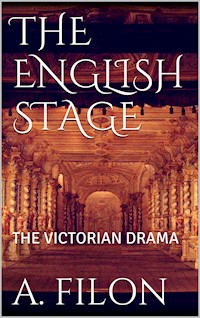
The English Stage - Augustin Filon - E-Book

The English Stage E-Book

Augustin Filon

0,0
2,99 €

oder
-100%
Sammeln Sie Punkte in unserem Gutscheinprogramm und kaufen Sie E-Books und Hörbücher mit bis zu 100% Rabatt.

Mehr erfahren.
Beschreibung

There are, in the England of to-day, two schools of dramatic criticism, whose divergence of opinion is clearly marked. They are called “New Critics” and “Old Critics,” though accidents of date or age are hardly at all accountable for their antagonisms; it is possible that during the next few years the old criticism may become rejuvenated and that the new criticism may age. For my part, I have sided with neither the one nor the other, because the rôle of neutral is best suited to a foreigner. I have supplemented my own personal impressions by quotations, taken impartially from both camps, of what has struck me in their criticisms as noteworthy, or happy, or true. I think that the new school is right in wishing to free the English theatre from foreign influences, and in its efforts to give the drama a moral value and an ideal. But I think the old school is not far wrong when it defends, to a certain extent, the more popular forms of dramatic art, and when it would have the drama follow the indications of success, and not isolate itself from that public of whose feelings it should be the living expression.

Das E-Book können Sie in Legimi-Apps oder einer beliebigen App lesen, die das folgende Format unterstützen:

EPUB

Veröffentlichungsjahr: 2015

Bewertungen
0,0
0
0
0
0
0
Mehr Informationen
Mehr Informationen
Legimi prüft nicht, ob Rezensionen von Nutzern stammen, die den betreffenden Titel tatsächlich gekauft oder gelesen/gehört haben. Wir entfernen aber gefälschte Rezensionen.


Augustin Filon

The English Stage

UUID: 39571774-2244-11e5-bec2-119a1b5d0361
This ebook was created with BackTypo (http://backtypo.com)by Simplicissimus Book Farm

Table of contents

INTRODUCTION

PREFACE

CHAPTER I

CHAPTER II

CHAPTER III

CHAPTER IV

CHAPTER V

CHAPTER VI

CHAPTER VII

CHAPTER VIII

CHAPTER IX

CHAPTER X

CHAPTER XI

CHAPTER XII

CHAPTER XIII

Footnotes:

INTRODUCTION

I have rarely had a more welcome task than that of saying a few words of introduction to the following essays, and of heartily commending them to the English reading public. I am not called upon, nor would it become me, to recriticise the criticism of the English drama they contain, to reargue any of the issues raised, or to vent my own opinions of the persons and plays hereafter dealt with. My business is to thank M. Filon for bringing us before the notice of the French public, to speak of his work as a whole rather than to discuss it in detail, and to define his position in relation to the recent dramatic movement in our country.But before addressing myself to these main ends, I may perhaps be allowed to call attention to one or two striking passages and individual judgments. The picture in the first chapter of the old actor’s life on circuit is capitally done. I do not know where to look for so animated and succinct a rendering of that phase of past theatrical life. And the pilgrimage to the deserted Prince of Wales’s Theatre also left a vivid impression on me, perhaps quickened by my own early memories. In all that relates to the early Victorian drama M. Filon seems to me a sure and penetrating guide. All lovers of the English drama, as distinguished from that totally different and in many ways antagonistic institution, the English theatre, must be pleased to see M. Filon stripping the spangles from Bulwer Lytton. To this day Lytton remains an idol of English playgoers and actors, a lasting proof of their inability to distinguish what is dramatic truth. The Lady of Lyons and Richelieu still rank in many theatrical circles with Hamlet as masterpieces of the “legitimate,” and Money is still bracketed with The School for Scandal. It is benevolent of M. Filon to write dramatic criticism about a nation where such notions have prevailed for half a century.The criticism on Tennyson as a playwright seems to me equally admirable with the criticism on Bulwer Lytton, and all the more admirable when the two are read in conjunction. Doubtless Tennyson will never be so successful on the boards as Lytton has been. Becket is a loose and ill-made play in many respects, and succeeded with the public only because Irving was able to pull it into some kind of unity by buckling it round his great impersonation of the archbishop. But Becket contains great things, and is a real addition to our dramatic literature. It would have been a thousand pities if it had failed. On the other hand, the success of Lytton’s plays has been a real misfortune to our drama. You cannot have two standards of taste in dramatic poetry. Just as surely as the circulation of bad money in a country drives out all the good, so surely does a base and counterfeit currency in art drive out all finer and higher things that contend with it. In his measurement of those two ancient enemies, Tennyson and Lytton, M. Filon has shown a rare power of understanding us and of entering into the spirit of our nineteenth-century poetic drama. “ “ “ “ “ “ “    

Lesen Sie weiter in der vollständigen Ausgabe!

Lesen Sie weiter in der vollständigen Ausgabe!

Lesen Sie weiter in der vollständigen Ausgabe!

Lesen Sie weiter in der vollständigen Ausgabe!

Lesen Sie weiter in der vollständigen Ausgabe!

Lesen Sie weiter in der vollständigen Ausgabe!

Lesen Sie weiter in der vollständigen Ausgabe!

Lesen Sie weiter in der vollständigen Ausgabe!

Lesen Sie weiter in der vollständigen Ausgabe!

Lesen Sie weiter in der vollständigen Ausgabe!

Lesen Sie weiter in der vollständigen Ausgabe!

Lesen Sie weiter in der vollständigen Ausgabe!

Lesen Sie weiter in der vollständigen Ausgabe!

Lesen Sie weiter in der vollständigen Ausgabe!

Lesen Sie weiter in der vollständigen Ausgabe!