


7,00 €
Mehr erfahren.
- Herausgeber: Garnet Publishing
- Kategorie: Gesellschafts- und Liebesromane
- Sprache: Englisch
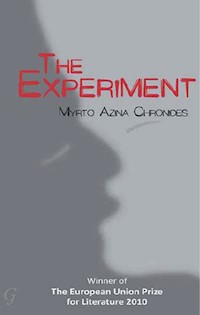
Winner of the European Union Prize for Literature 2010 The Experiment can be described as 'a study of erotic love and the soul'. The two main characters undertake to write a play together, as an experiment, to see if they can succeed where others have failed, in achieving true collaboration and union through their writing. They come up with the story and the plot together; she writes the female character, he the male. She, 'a woman in perpetual search', is an unbowed woman who claims her freedom and he, 'a wise man, a believer in the Socratic, "All I know is that I know nothing"', participate in the experiment on equal terms. The erotic couple is called to recognize, through writing and literature, his/her other half, his/her mate and eventually the self as other. The result of this experiment is a stream of consciousness and a collection of tales in which themes such as love, sex, religious etacy, psychiatry and myth are intertwined. The book's style is unique, as it attempts to unify subtly connected narratives, partial tales that lean toward the structure of a more synthetic prose piece, but which cannot be regarded as either novella or novel. The book in its original Greek was awarded the prestigious European Prize for Literature in 2011. The aim of this prize is to put the spotlight on the creativity and diverse wealth of Europe's contemporary literature in the field of fiction, to promote the circulation of literature within Europe and encourage greater interest in non-national literary works. Translated into English, The Experiment offers the reader a unique and enriching reading experience which transcends literary and cultural norms.
Das E-Book können Sie in Legimi-Apps oder einer beliebigen App lesen, die das folgende Format unterstützen:
Veröffentlichungsjahr: 2012
Ähnliche




















The Experiment
Myrto Azina Chronides
Translated from Greek by Irena Joannides
The Experiment
Published by
Garnet Publishing Limited
8 Southern Court
South Street
Reading
RG1 4QS
UK
www.garnetpublishing.co.uk
www.twitter.com/Garnetpub
www.facebook.com/Garnetpub
blog.garnetpublishing.co.uk
English edition © Myrto Azina Chronides and Irena Joannides, 2013
This translation is based on the Greek edition first published by Armida Publications, 2009
All rights reserved.
No part of this book may be reproduced in any form or by
any electronic or mechanical means, including information
storage and retrieval systems, without permission in writing
from the publisher, except by a reviewer who may quote
brief passages in a review.
First Edition
ISBN: 9781859642931
British Library Cataloguing-in-Publication Data
A catalogue record for this book is available from the British Library
Typeset bySamantha Barden
Jacket design byGarnet Publishing
Printed and bound in Lebanon by International Press: [email protected]
Strange dream, and it seems that I gave birth to it at a heavy price: great agony. I still feel my muscles tight and my breath short. Platon Était Malade, Claude Pujade-Renaud
The Experiment I
‘Grab the other end!’ he called out to her, breathless. She rushed to help him.
‘Why are you trying to carry it by yourself?’ she protested. ‘How much fun would it be, if you ended up with a hernia?’
He did not answer, just smiled faintly.
‘It looks great!’ she said, once they had placed it in front of the window. ‘It’s so wonderful that I might not put anything else in the room!’
‘I’m glad that you still like it in the actual space,’ he said. ‘Things often look different in shop windows.’
‘Yes, but I had imagined it right here, next to the window,’ she said, and tenderly ran her hand across the wooden desk.
‘Sometimes I wonder if you’re a fetishist,’ he teased.
‘It’s true. I do love things . . . the soul that’s hidden inside them . . . the soul that lies dormant until a hand reaches out and caresses them.’
‘Metaphorically speaking, of course; or are you an advocate of pantheism?’ he said and chuckled.
She scrunched up her nose and pinched his arm.
‘What do you think you’ll put in front of your desk?’ he asked light-heartedly.
‘A mattress or a plush rug.’
‘A mattress in our study? Are you mad?’
‘Why? Do you think that’s too bold? What about a settee or a recliner then?’
‘I don’t know. You decide. This is your dream home. You’re free to do as you like.’
‘And what are you? Part of my dream, or part of my reality?’
‘Choose what you want me to be, and I’ll try to play the part. We’ll see what comes of it in the end.’
‘Although I’m not used to you acting this way, and I’m sure that you will rebel soon, yes, let me direct this. You know that I’ve always wanted to be a director.
‘So, the desk will be here in the corner, in front of the window, we’ll bring a second chair for you, and . . . the room will remain empty at the end. I’ll just hang heavy velvet drapes, so we can isolate ourselves whenever we like, and put down a monochromatic rug.’
‘Are we going to share the same desk?’
‘You’ll understand why, eventually. Anyway, we’ve already agreed that I’ll be the one directing this scenario. For now, just imagine my mother’s enormous chandelier in the middle of the room . . . Come now, let’s walk down to the river . . . to unwind after the move.’
***
‘Remember?’ he asked. ‘Remember how you dragged me here to look at it in the middle of the night? You said: “I found a house just like I’d dreamt it.” And we came here, to this desolation, turned on the headlights, and . . .’
‘And you said: “God, it looks like an old, haunted mill in some fairy tale . . . as though the miller, with his bed cap, is about to scowl at us from the window . . .”’
‘ “Don’t let it fool you,” you reassured me. “I’ll make it so beautiful, so alive, that you’ll love it. And I wasn’t thinking only of myself,” you continued. “There are crop fields and bushes all around, and the river is in the distance – pieces of your dream.” ’
They came to the river. Not much water was passing through it. Small ponds had created a habitat for crabs. The water was clean.
‘Have you ever eaten these crabs?’ he asked.
‘No, but I know that they fry them up in batter – at least that’s what my grandmother used to say. Don’t touch them though! I adore them!’
‘Oh, my crazy love,’ he said. ‘I wouldn’t dream of it – as if I don’t know you! So, tell me your plan. Something’s on your mind . . . I can tell from the distracted look in your eyes.’
‘I think we should write something together.’
‘Have you lost your mind? Never in the history of literature has this been achieved. Many writers have attempted it, but the result has always ended up being kitsch.’
‘That’s exactly the challenge! And we shall be the ones to succeed.’
‘But what are we going to write? How do you envision it?’
‘Well, I feel that your writing possesses a dramatic quality, a theatrical articulation. Let’s write a play together. What do you say?’
‘What can I say? I’m speechless. I can’t even begin to imagine how this would work.’
‘Why is it so difficult? Don’t we share our bed? Your side and mine and then . . . come together?’
‘What an analogy! So, you mean that you will write, like a new Cassiane, and I will add to it, like a new emperor?’
‘Mock all you want,’ she laughed, ‘but you’ve already promised to let me direct. Come on, sweetheart, don’t ruin my mood – it’s not like you spoil me a whole lot!’
He shrugged his shoulders with apprehension and fixed his gaze on the sky. She kissed him friskily and started running towards the house.
***
‘Are you still in love with me, even after living together?’ he asked while they were sipping wine on the back porch, surrounded by pine trees.
‘Before winter comes, I’m going to build a huge, stone fireplace–’
‘Are you avoiding the question?’ he interrupted.
She got up and went to him.
‘Look into my eyes,’ she urged him. ‘That is not something I can hide from you.’
He stroked her hair and sat her down on his lap.
‘Hindus believe that love has many stages, starting with the first – the purely carnal – all the way to the seventh. I think that this is where we are now.’
‘Which is?’
‘Which is the stage when souls feel as though they are partaking of the divine essence; in other words, as though they are the same person.’
‘Is that how you feel about us?’
‘Yes, and that’s why I believe that this experiment will succeed – writing something together, I mean.’
He sighed.
‘I’m sceptical because I don’t understand how you see this working. Could you tell me a bit more?’
‘We’ll each do what we do best. We’ll come up with the story, the plot, together. You’ll be responsible for the articulation and the scenes. We’ll write a biography for each of the characters; you’ll write the male and I the female characters.’
‘So it will be a multi-character play.’
‘Not necessarily. We’ll discuss that.’
He pensively stroked her back. She rested her head on his shoulder.
‘I’m sleepy,’ she murmured.
‘Don’t go to bed yet. Stay . . . keep me company a little longer. We’ll be able to hear the sounds of the night soon . . .’
She nestled even deeper into his arms, and her dress gathered up around her thighs, revealing her bare legs. He began to caress her slowly.
‘I don’t want to make love,’ she said.
‘Aren’t you excited that this is the first night in our new house?’
‘I want to make love when they deliver the rug, right there, in front of our desk . . . just like that, in cold blood. And then, while we’re writing, I don’t want you to touch me.’
‘What’s going on with you? Is there something I should know?’
‘I just want us to transfer the sexual tension into the writing.’
‘But it will be difficult for both of us.’
‘Let’s try it, for the sake of the experiment.’
He straightened her dress, covering her thighs. She stood up.
‘I’m going to bed,’ she said. ‘I love you. Don’t ever forget it!’
***
The sun that rose from behind the mountain – like a potato crisp coming out of a bag – found her standing at the window. He was still asleep, partly uncovered.
She shut her eyes tightly to hold the aura that radiated from his body inside her.
‘Good morning,’ he said with a hoarse voice.
Before she could answer, he had propped himself up on his elbows and continued: ‘I’m quite eager to see the result. Let’s start the experiment!’
A broad smile appeared on her face.
May 2002
.
The Characters In The Play
SHE: A woman in search of herself, perfectly portrayed in the following words by Albert Camus: ‘The north wind that blows inside me is too strong to leave room for complete loyalty.’
HE: A wise man, a believer in the Socratic: ‘I only know that I know nothing.’
THE OTHERS: At times co-stars, at times extras, in a play that is entirely dramatic, or that touches on comedy.
.
Preface
For myth is at the beginning of literature, and also at its end.
‘Parable of Cervantes and the Quixote’ in Labyrinths: Selected Stories & Other Writings, Jorge Luis Borges
‘What do you think your life will be like with me?’ he asked her.
‘Certainly not ordinary,’ she replied playfully.
‘Tell me more!’
‘I would wake up in the morning and say to you: “Close your eyes tightly so the light doesn’t blind you.” I’d swiftly kiss your hand, which would be unintentionally sliding towards me, and get up feeling happy about the new day. Before leaving the room, I would fumble under the sheets for the big snake, which would be writhing, trying to get away from me. I would open the window so that a river of sun could pour inside.’
‘But, so far, everything you’ve described is ordinary. What’s so special . . .?’
‘I’m just getting started; don’t interrupt!
‘I would open the closet door, and tiny demons would invade the room. They would climb all over us, penetrate our flesh, and swing from our hair. And while you’d be thinking about how soft and white my skin is, about how shiny and golden my hair, they would interrupt your thoughts by throwing veils – like curtains – between us, and around us. They would spread thorns and mines and rivers around our bed, so I would not be able to reach you easily. Characters from fairy tales and white stallions would leap out from under the chairs and I, like a magician, would reveal flowers from my bosom and white clouds from your embrace.
‘Then the scene would turn golden, like the desert, and at its centre, our bed would be an oasis – water gushing everywhere. Look!’
(The following is not read but heard, according to Jorge Luis Borges:)
‘Ooooh! Anna’s mouth moaned, distorted by pleasure.’
February 2002




