


8,63 €
Mehr erfahren.
- Herausgeber: Seren
- Kategorie: Poesie und Drama
- Sprache: Englisch
One of the most significant voices of his generation from Wales, a new book by Duncan Bush is an eagerly awaited event. The Flying Trapeze, his sixth poetry collection and the first to appear after his notable 'Midway', is characteristically unsentimental, tough-minded, and fiercely lyrical. Many poems are inspired by places he has lived in or travelled to including: Australia, Greece, Germany, France, Luxembourg and the United States. In 'Avedon's Drifters' he chronicles marginal lives as portrayed in masterly black and white photographs: vagrants, gypsies, minor criminals, the burnt-out, the bereft. In contrast there are poems like 'A Blood Rose' steeped in the full-blooded colours of the tango, and 'Golden Girl' in praise of superlative athletes. There is also a touch of bitter political satire in pieces like 'Mitterand's Last Supper', 'A Season in Sarajevo' and 'Lahore'. There are some fine, unexpected nature poems, which pinpoint the tension in his poetry between a sensual rapture and a knowing cynicism. The Flying Trapeze is an excellent new collection, never less than subtle, smart and true.
Das E-Book können Sie in Legimi-Apps oder einer beliebigen App lesen, die das folgende Format unterstützen:
Seitenzahl: 39
Veröffentlichungsjahr: 2012
Ähnliche












The Flying Trapeze
for A
Duncan Bush
The Flying Trapeze
Seren is the book imprint of
Poetry Wales Press Ltd.
57 Nolton Street, Bridgend, Wales, CF31 3AE
www.serenbooks.com
Facebook: facebook.com/SerenBooks Twitter: @SerenBooks
The right of Duncan Bush to be identified as the author of this work has been asserted in accordance with the Copyright, Designs and Patents Act, 1988.
© Duncan Bush 2012.
ISBN: 978-185411-572-0
A CIP record for this title is available from the British Library.
All rights reserved. No part of this publication may be reproduced, stored in a retrieval system, or transmitted at any time or by any means, electronic, mechanical, photocopying, recording or otherwise without the prior permission of the copyright holder.
The publisher acknowledges the financial assistance of the Welsh Books Council.
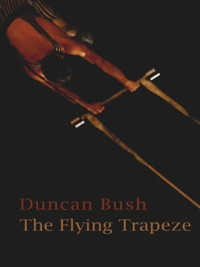
Cover photograph © Spencer Dixey Printed in Bembo by Berforts Group, Stevenage.
Author’s website: www.duncanbush.com
Contents
ONE
The Young Man on the Flying Trapeze 9
Couch Grass 10
Ruskin and Millais and Effie and Rose 11
Abandoned Orchard 12
Cider Orchard Story, near Pershore: Verbatim 14
Interregnum, near Worcester 15
Sudden Death of An Acquitted Suspect in a Gangland Killing 16
A Blood Rose 17
Duende Tango 18
On Being Anthologised 19
In Memory of Basil Bunting 20
A Provincial Affair 21
Lahore 23
TWO
The Rom Out of Romania 27
East Side Story 29
A Season in Sarajevo 31
Still Living at Sixteen 32
L’Enfance de Rimbaud 40
Rimbaud’s Childhood 41
Douce France 42
Mitterand’s Last Supper 46
La Cène de Tonton 48
Wear 50
THREE
Golden Girl 2000 53
Motel Pool Gossip Party 54
The Dreaming 55
Donald George Bradman, 1907-2001 56
FOUR
Fragonard’s Lovers 59
West 86th Street 61
Obituary Page 62
Avedon’s Drifters 63
Hellas 66
Telemachus 68
Back in Arcadia 70
Acknowledgements 72
ONE
The Young Man on the Flying Trapeze
Something appealing in these five-legged man-headed portal bulls in the B.M. hallway,
their folded-back wings fledged like olivetrees. The date-palm trunk’s bark’s
diamond-checked like a pistol-grip and the snarling she-lion’s stuck
with spears as an orange is with cloves. And the men, with their square astrakhan beards,
hair of braided skeps and Sphinxes’ smiles, such calm
they have, such unemphatic authority in their eyes and lifted hands – all gone
with Ashurbanipal and his lion hunts, the neat incomprehensible cuneiform,
and god-built Nineveh an allotment-dig of reddish dust.
Seventy thousand Assyrians left, Saroyan said, but that in 1933 and the young man
in his story learning to cut hair in San Francisco, half the city out of work: an Assyrian
not yet last of a once-great people now alive one at a time, himself the whole race.
Couch Grass
Slow green fire, shaggy pelt of the plot’s neglect,
each shock-haired tussock levered loose with the fork-prongs
rough-edged enough to crisscross your palms with cuts.
Gloved you straighten shaking soil, Perseus brandishing
the Medusa head like a trophy scalp. Tossed, it hisses
in the bonfire’s yellow smoke. Underground it’s already rife
as new rumour in deltas of knotted fibres, coarse white jointed net
that will spread choking the earth
if not the Earth aswing in its old string bag of meridians.
Ruskin and Millais and Effie and Rose
No one, least of all his bride of hours, ever knew what took place between John Ruskin’s manly sideburns that traumatic wedding-night.
Did he behold un-nymphlike pubic hair – or menstrual blood? The vagina dentataof his mid-Victorian nightmares?
Years later – marriage annulled for non-consummation, Effie gone to Millais, Rose La Touche dead, and the accelerating
downslope wobble to madness begun – he drew Moss and wild strawberry, as ever from nature: mossy mounds soft-tangled as finches’ nests,
and tiny tooth-edged strawberry trefoils spilling unfruited from the dark-cleft, back-sprawled, unmistakably voluptuous rock.
Abandoned Orchard
It had long grown to rank savannah, all summer a tangle of waist-tall seeded grass, of umbellifers and bramble, neglect and nesting birds. There were always bullfinches and whitethroats, and chiffchaffs like headlice in the topmost leaves. One day I saw a hawfinch there, saw it plain on a blackthorn branch, confirmed it in the circle of my binoculars. And it became an orchard in allegory. It was the garden of fallen apples. At the end of October I filled both side-pockets with walnuts I could reach from the verge outside, stretched at tiptoe, fingertips loosing each one out of the gaped green case. We ate them at Christmas. Pinned to the lintel was a spray of mistletoe cut at dusk on the shortest day from an outhanging branch of an old appletree abloom with it. I smeared the pearls in the groin-crease of my own appletree, wondering if the seed – embryonic, nucleate, ungraspable as frogspawn




