


60,99 €
Mehr erfahren.
- Herausgeber: John Wiley & Sons
- Kategorie: Wissenschaft und neue Technologien
- Serie: Essential Forensic Science
- Sprache: Englisch
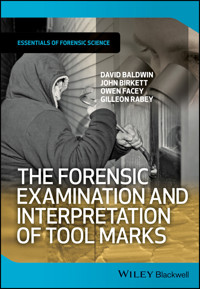
The Forensic Examination and Interpretation of Tool Marks brings together key techniques and developments in the field of tool marks in forensic science and explains clearly how tool mark analysis can be used within forensic investigation.
The purpose of this book is to bring together as much of this information as possible in an accessible manner. The book deals with all aspects of tool mark evidence from crime scene to courtroom. The examination of a wide variety of different tool marks are discussed, including those made by specific tools such as saws and in complex materials such as bone.
The general principles and techniques used in tool mark examinations can also be applied to some other closely related fields. Therefore, sections on the examination of manufacturing marks, including those on plastic film items, and physical fit comparisons are also included.
The book will be of interest to a wide range of people and not just to tool mark examiners and people studying forensic science. It will be of use to crime scene examiners, officers investigating crimes where tool marks are found and members of the legal professions.
- Brings together key techniques and developments within the field of tool mark investigation.
- Includes material on examining tool marks at the crime scene and in the laboratory, interpretation and evaluation issues and how tool mark evidence should be presented in court.
- Covers specialized tool mark examinations, manufacturing marks, including those on plastic film items, and physical fits.
- Includes a large range of illustrations and photographs.
- Invaluable reference for practicing forensic scientists, students of forensic sciences, members of the legal professions and crime scene investigators, enabling them to recognise the importance of tool marks within an investigation.
- An extremely valuable resource in the on-going debate regarding the evidential value of tool marks in court.
- Part of the ‘Essentials in Forensic Science’ book series.
Sie lesen das E-Book in den Legimi-Apps auf:
Seitenzahl: 407
Veröffentlichungsjahr: 2013
Ähnliche


















Table of Contents
Title Page
Copyright
About the Authors
David Baldwin
John Birkett
Owen Facey
Gilleon Rabey
Series Foreword
Essentials of Forensic Science
Foreword
Preface
About the Companion Website
Chapter 1: Introduction
1.1 Overview of contents
1.2 A brief history of tool marks
1.3 General aspects of marks' comparison
1.4 Training requirements for examiners
1.5 Good forensic practice
1.6 Examination and comparison strategy
1.7 Environment and equipment
1.8 Quality assurance
1.9 A brief summary
References
Chapter 2: Tool Manufacture
2.1 Introduction
2.2 Working with metal
2.3 Creating a tool ‘blank’
2.4 Finishing processes
2.5 Wear, corrosion and damage
References
Chapter 3: Scene Examination
3.1 Examining and recording the scene
3.2 General preliminaries
3.3 Forced entry marks—levering
3.4 Forced entry marks—other
3.5 Entry by cutting
3.6 Theft of metal
3.7 Examination of machines
3.8 Pathology samples
3.9 Collecting suspect tools
References
Chapter 4: Initial Laboratory Examination
4.1 General preliminaries
4.2 Mainly impressed marks
4.3 Mainly dynamic marks
4.4 Saw marks
4.5 Post-mortem samples
4.6 Alphanumeric punches
4.7 Using tool marks for intelligence purposes
References
Chapter 5: Detailed Laboratory Examination
5.1 First considerations
5.2 Presentation of material to the comparator
5.3 Impressed marks
5.4 Marks with striations
5.5 Saw marks
5.6 Specialised marks
5.7 Other considerations
References
Chapter 6: Interpretation and Evaluation
6.1 Introduction
6.2 Considerations as the laboratory examination progresses
6.3 Other considerations
6.4 Verification
6.5 After the examination
6.6 Quality assurance
References
Chapter 7: Manufacturing Marks: Involving Tool Mark Related Examinations
7.1 Introduction
7.2 Screws
7.3 Insulated cable
7.4 Copied coins
7.5 Security ties/tags
Reference
Chapter 8: Physical Fits: Involving Tool Mark Related Examinations
8.1 Introduction
8.2 Scene examination
8.3 Categories of physical fit and laboratory examination
8.4 Evaluation
Chapter 9: Plastic Film Examinations
9.1 Introduction
9.2 The ‘blown film’ process
9.3 Laboratory considerations
9.4 Laboratory examination and evaluation
References
Chapter 10: Summary
References
Glossary
Supplemental Images
Index
This edition first published 2013 © 2013 by John Wiley & Sons, Ltd
Registered office: John Wiley & Sons, Ltd, The Atrium, Southern Gate, Chichester, West Sussex, PO19 8SQ, UK
Editorial offices: 9600 Garsington Road, Oxford, OX4 2DQ, UK
The Atrium, Southern Gate, Chichester, West Sussex, PO19 8SQ, UK
111 River Street, Hoboken, NJ 07030-5774, USA
For details of our global editorial offices, for customer services and for information about how to apply for permission to reuse the copyright material in this book please see our website at www.wiley.com/wiley-blackwell.
The right of the authors to be identified as the authors of this work has been asserted in accordance with the UK Copyright, Designs and Patents Act 1988.
All rights reserved. No part of this publication may be reproduced, stored in a retrieval system, or transmitted, in any form or by any means, electronic, mechanical, photocopying, recording or otherwise, except as permitted by the UK Copyright, Designs and Patents Act 1988, without the prior permission of the publisher.
Designations used by companies to distinguish their products are often claimed as trademarks. All brand names and product names used in this book are trade names, service marks, trademarks or registered trademarks of their respective owners. The publisher is not associated with any product or vendor mentioned in this book.
Limit of Liability/Disclaimer of Warranty: While the publisher and authors have used their best efforts in preparing this book, they make no representations or warranties with respect to the accuracy or completeness of the contents of this book and specifically disclaim any implied warranties of merchantability or fitness for a particular purpose. It is sold on the understanding that the publisher is not engaged in rendering professional services and neither the publisher nor the authors shall be liable for damages arising herefrom. If professional advice or other expert assistance is required, the services of a competent professional should be sought.
Library of Congress Cataloging-in-Publication Data
Baldwin, David, Forensic consultant.
The forensic examination and interpretation of tool marks / David Baldwin, John Birkett, Owen Facey, Gilleon Rabey.
pages cm
Includes bibliographical references and index.
ISBN 978-1-119-97246-4 (cloth) – ISBN 978-1-119-97245-7 (pbk.) 1. Tools–Identification. 2. Evidence, Criminal. 3. Forensic sciences. 4. Criminal investigation. I. Title.
HV8077.5.T66B35 2013
363.25′62–dc23
2012050081
A catalogue record for this book is available from the British Library.
Wiley also publishes its books in a variety of electronic formats. Some content that appears in print may not be available in electronic books.
Cover image: Left: iStockphoto / Pixel_Pig; Right: iStockphoto / Viktor Pryymachuk; Bottom: author supply
About the Authors
David Baldwin
David joined the Metropolitan Police Forensic Science Laboratory (MPFSL) in London in 1974 and worked in the General Chemistry and Blood Alcohol Departments. In 1977 he gained a BSc (Honours) degree in Chemistry from the Polytechnic of North London. In 1996 the MPFSL was merged with the Home Office Forensic Science Service (FSS), with that organisation ultimately becoming The Forensic Science Service®, where David worked until its closure in March 2012. He was the Principal Scientist for Marks in The Forensic Science Service, having been a Senior Court Reporting Scientist for many years involved in the examination of cases involving manufacturing marks, including those on plastic film items, tool and footwear marks, paint and glass. In the role of Principal Scientist he was responsible to senior management for quality and technical aspects of marks' work in the organisation. Between 2005 and 2012 David served as the Chair of the steering committee of the European Network of Forensic Science Institutes (ENFSI) Working Group Marks, helping to standardise and improve forensic science examinations throughout Europe.
John Birkett
Like David, John started work at the MPFSL in 1974, after gaining a BSc (Honours) degree in Chemistry from Birmingham University. He worked in the Drug Section for a short time before transferring to the then General Chemistry Department, which was eventually to become known as ‘Marks and Traces’. Here he was involved in the examination of cases involving contact traces such as paint and glass as well as footwear marks, locks and keys and, of course, tool marks until the FSS closed in March 2012. As a Senior Court Reporting Scientist, he worked on many thousands of cases involving tool marks for police forces throughout England and Wales as well as checking the work and findings of his colleagues in many more. John has given expert testimony in many courts from Magistrates' to Coroners', including the Central Criminal Court (also known as The Old Bailey). In the late 1970s the MPFSL set up a database of tool marks from unsolved offences to look for otherwise unsuspected links between scenes of crime. The marks were also screened against tools submitted from offenders. This became part of the Marks' Intelligence Index database and John was responsible for running that until 2011. Between 1995 and 2003 John served on the steering committee of the ENFSI Working Group Marks.
Owen Facey
Owen graduated from London University in 1964 with a PhD in Physical Chemistry, having already obtained a BSc (Honours) degree in Chemistry, and spent the next five years as a research fellow in what are now called ‘condensed matter materials’ in England, Canada and the United States. On returning to the United Kingdom he joined the Metropolitan Police Forensic Science Laboratory in 1970 and worked in the General Chemistry Department, which undertook the developing areas of footwear and tool marks as well as chemical analysis of all materials other than drugs and poisons. Tool marks became one of Owen's main interests, although he also reported chemical traces, footwear marks and manufacturing marks, including those on plastic bags. Owen was a Senior Court Reporting Scientist responsible for managing a team and carried out some research and development work. He was also involved in writing the procedures used in the initial accreditation of various departments such as chemistry, documents, firearms, traffic accidents and metallurgy. He left the Laboratory in 1999, which had become the Forensic Science Service in 1996. Owen became a consultant forensic scientist working mainly for Forensic Alliance, now LGC Forensics, and Forensic Access. In this period he undertook defence as well as prosecution work, retiring from active casework in 2010; since 2007 he has been a research fellow at Staffordshire University.
Gilleon Rabey
Gilleon started work at the London Laboratory of the Forensic Science Service in March 1998 with a first class BSc (Honours) in Human Biology, which she gained in 1997 from the University of Leeds. Her first job was as a DNA Analyst, working in the busy DNA Casework Unit, processing DNA samples from serious and high profile crimes. She progressed to reporting National DNA Database matches and a future as a forensic biologist beckoned. The unusual move to reporting tool and footwear marks occurred following the successful completion of her MSc degree in Forensic Archaeological Science in 2002 from University College London, where she developed an interest in tool marks (in bones). She became a Senior Court Reporting Scientist, also specialising in lock and key comparisons, and was involved in writing support manuals and standard operating procedures for tool mark examiners prior to leaving the FSS at the end of 2011, preceding its closure in 2012.
Series Foreword
Essentials of Forensic Science
The world of forensic science is changing at a very fast pace in terms of the provision of forensic science services, the development of technologies and knowledge and the interpretation of analytical and other data as it is applied within forensic practice. Practicing forensic scientists are constantly striving to deliver the very best for the judicial process and as such need a reliable and robust knowledge base within their diverse disciplines. It is hoped that this book series will provide a resource by which such knowledge can be underpinned for both students and practitioners of forensic science alike.
It is the objective of this book series to provide a valuable resource for forensic science practitioners, educators and others in that regard. The books developed and published within this series come from some of the leading researchers and practitioners in their fields and will provide essential and relevant information to the reader.
Niamh Nic DaéidSeries Editor
Foreword
I had the great pleasure to collaborate with the authors when I joined the now defunct Forensic Science Service (FSS) in 2000. I was hired to carry out research and to work with forensic practitioners on interpretation issues. DNA evidence was at the forefront of all minds, but my forensic background and practice was with marks. The authors of this book, colleagues from the marks' and traces' department of the FSS, gave me forensic asylum and allowed me to act at times as their ‘interpretation troublemaker’. It led us to confront (often foolish) ideas and to develop compromises that we have tried to promote within the profession at large.
Four words are used in the Introduction to describe the expected qualities of a forensic statement: logical, transparent, balanced and robust. They also apply to this book, and allow the field to move from a set of whispered secrets within the trade to a structured body of knowledge from which one can be trained to be an examiner. In a long-awaited addition to any good forensic library, the authors contribute, in a very accessible form, their extensive knowledge and experience in this specialized area. Unfortunately, and for decades, the field of tool marks' examination has not received specific attention. It is viewed by many that treatment by pure analogy to the consideration of footwear marks or marks left by firearms on bullets or cartridge cases is sufficient when dealing with the other tools. The analogy carries merit up to a certain point, but this book very elegantly shows its limits and invites the reader to realise that this area of forensic science is a discipline on its own.
Tool marks were fully recognized by the early pioneers of forensic science as the main means of reconstructing events and helping establish indirect relationships with potential culprits (typically through the size of tools). Alphonse Bertillon is probably the first to have published a full detailed case study of the tool marks recovered from the desk of a murdered financier (Archives d'Anthropologie crimininelle et de Médecine légale, 1909, 753–782). Rodolphe-Archibald Reiss, in his 1911 book Manuel de police scientifique I. Vols et homicides, makes extensive reference to their contribution in investigations and presents documented examples from his practice on offences against property. One of the first murder investigations by Reiss, in 1911, dealt with striated marks left by a hatchet on the skull of the victim, a Mrs Seewer. Compared with any other marks that can be left by a perpetrator on a scene, none speaks more about the offence itself than potential recovered tool marks.
This book's Introduction provides some definitions used within the area and elements of good training and practice that are developed in subsequent chapters. In Chapter 2, the reader is then taken through the manufacturing process of tools. This is a key component that is often minimized or ignored in training. To become a proficient examiner, there is a requirement to learn about this topic by, for example, visiting manufacturing sites and not working from an assumption that ‘it has probably been manufactured that way’.
Chapter 3 conveys an essential message to all investigating agencies: detailed knowledge of the types of marks that can be obtained from crime scenes is paramount to success. Covering levering, gripping, cutting, impact or saw marks (with or without striations) both on objects and on body parts, the chapter deals with all types of criminal activities that lead to tool marks and the operational constraints to secure them properly. It will convince any forensic scientist of the appealing diversity of the work of a tool mark examiner. Chapter 4 deals with the planning and initial examination.
The entire volume is full of operational advice and good practices that will speak to all practitioners. It also invites them to carry out a pre-assessment of the case in close collaboration with the submitting agency and forensic scientists from other disciplines e.g. drugs, traces (paint, fibres,…), biological traces (blood, saliva, epithelial cells, …), fingerprints. In today's forensic science where the risks of contextual bias are used as a reason to separate the laboratory from the field definitively, this chapter delivers a crucial message: a close connection between the submitting agency and examiners is the only way to provide a value-added service from a multidisciplinary perspective.
The potential contribution of this field is made perfectly clear: (1) in an evaluative mode—to help associate recovered marks with potential tools and (2) the often neglected investigative contribution—offering leads in the investigation as to the type and size of the tool(s) involved and as an intelligence instrument (through scene linking). The detailed laboratory examination of tool marks is then covered in Chapter 5. Again, this chapter gives very astute practical advice that has not been disclosed elsewhere to my knowledge.
Chapter 6 deals with the interpretation and evaluation of the findings. The authors give their opinions as to the best practice. It is suggested that a two-stage approach is adopted: firstly, an interpretation decision is made as to whether or not the compared marks can be deemed to be matching or not matching; secondly, the practitioner will assign—or evaluate—the weight to be assigned to the ‘matching’ cases (the ‘not matching’ ones leading to a conclusion of exclusion). The difficulties associated with the evaluation are clearly exposed and serve as an excellent basis for adopting a logical approach. However, I would not say that I adhere to all the proposals made by the authors, as I need to maintain my ‘troublemaker’ status. For example, it is my contention that reporting conclusive links in an absolute way should stop rather than continue on, if we want to confer a scientific status to the discipline. All forensic evidence should be considered as corroborative, even physical fits. Also, I would ban completely terms such as random, individual, or unique from the vocabulary of any forensic examiner. Finally, I would link the steps of the reporting scales strictly to declared ranges of likelihood ratios. In this chapter, the authors make their point in such an open and transparent manner that it creates a healthy room for debate.
Chapter 7 focuses on manufacturing marks (with an obvious focus on tool marks) with a few case studies. The reader will appreciate the range of cases, marks and associated specialized knowledge this discipline covers. Various types of physical fits are dealt with in Chapter 8, with the correct emphasis again on the importance of the scene of crime examination. Plastic film examination (Chapter 9) can help in cases involving wrapping and packaging. Not only could the questions relate to the source, but also to events of a reconstruction and the use of the material, whether it is pigmented or transparent plastic bags, wrapping film or self-adhesive tapes. This chapter brings home one key message that is applicable to the entire book: a detailed knowledge of the manufacturing chain is required in order assess properly the potential contribution of such examinations and to interpret the forensic findings observed.
This book provides a short but detailed overview of the specialized subject of tool marks' examination. It cuts to the chase and conveys with passion the key foundations of the discipline. It is written by four very enthusiastic and experienced practitioners, who master the provision of evidence from crime scene to courtroom. They agreed to share their vast knowledge acquired though their dozens of years spent as colleagues and friends on specialized casework. They bring to the field an essential and collegial building block. Not only are the technical aspects thoroughly covered, with a lot of practical advice, but also, and on an equal footing, the authors put to the forefront the questions of scene examination, establishment of the exact requirements, pre-assessment and case assessment and interpretation. This book is aimed at students in forensic science, but, without any doubt, will become a standard textbook for all forensic scientists dealing with tool marks.
Christophe ChampodUniversity of LausanneSchool of Criminal Justice, Institute of Forensic Science
Preface
Much has been published in the way of scientific papers on tool marks, but there has been very little written in the way of a definitive text on the matter, unlike footwear or tyre marks, which have several books dedicated to each topic. With a collective 129 years of experience of working in forensic science in the United Kingdom, and having examined many thousands of tool marks between us, it seemed logical for us to write a book on the subject. This book is written as part of a series for forensic science students and aims to summarise the benefit of our experience, detailing what we feel is best practice, based on established and validated methods used in the United Kingdom. Reference will be made to the practices of other countries, but the methodology may vary, not least because of what is acceptable by the jurisdiction of the courts. We hope that this book will not only capture the interest of potential future tool mark examiners, but also raise the awareness of those involved in associated professions, such as investigators or barristers, who may never have encountered tool marks before.
Tool marks offer the potential for obtaining very good evidence. They can be left at any crime scene, in any substrate, where an offender has used a tool to commit an offence. Almost by definition, tool marks must be crime marks, as people tend not to jemmy their own doors open! Nor are they likely to happen by accidental contact, as some force is normally involved in their production. Tool marks can offer information about the size and type of the tool responsible and have the potential to contain gross and microscopic detail that has been produced by irregularities on the surface of the tool responsible. The irregularities on the surface of a tool relate to features of their manufacture and use. Any features visible in a mark can be used to exclude or show a level of association with a particular tool recovered during a criminal investigation.
The field of tool marks does not stop at the comparison of conventional burgling tools with marks recovered from scenes of crime. If something has been hit, punctured or cut with a tool, there is potential for marks to be left that could, theoretically, be compared. Anyone who has watched archaeological programmes will have seen bones being examined for marks made by butchery or flint arrowheads and swords, or wooden structures having marks left by ‘axes’. In tool marks, almost anything is possible as the authors have encountered much variety in the types of tool used and substrates marks have been made in.
Contact with police officers and scene examiners over the years has shown that many do not appreciate the evidential value of tool marks (potentially the equivalent of a ‘full ident’ in fingerprint terms) or what can be achieved by retrieving and examining them properly under laboratory conditions. Sadly, all too many tool marks are left in situ at the crime scene, after a presumption has been made that they are too poor quality to contain any detail, based on, for example, size, depth or substrate, without examining them microscopically to confirm that this is or is not the case.
It is hoped that in this book we can highlight how small an area the experienced tool mark examiner can work their ‘miracles’ on, if there is detail in a mark that can be visualised and the correct tool has been recovered. The perception can be that a tool mark needs to show the full width and be deeply impressed, but that is only a small proportion of viable marks that may be found at a scene. Shallow, partial impressed marks can be just as useful, if found and recovered. In addition, cut marks, grazing marks and sliding/slippage marks should not be ignored, even though they do not obviously show the shape or size of the tool responsible. If it can be recovered a mark can be examined to determine what made it and to compare with marks from other scenes or tools from suspects. There are no guarantees, but without a detailed examination in the laboratory, it would be all too possible to dismiss the marks as unsuitable.
In addition to the quality of detail that a tool mark may contain (so long as it is located and recovered from the crime scene in the first place), there are some other very important factors that must be considered in order to obtain the right results and the strongest level of evidence possible, which we will cover in more detail in the book. First and foremost, any casting materials used by scene or tool mark examiners need to be able to replicate fine detail in a mark. Proper lighting and having the best equipment available are also essential to resolve and enhance the detail.
However, all this would still be fruitless in the absence of a fully competent tool mark practitioner who knows how to use the equipment properly to obtain the best results. The examiner has to be able to visualise marks on a whole range of materials and to get them into a form suitable for presenting to a comparison microscope (comparator). To carry out the comparison it is also necessary to determine how the marks were made to know which part of the tool could have been responsible and to make suitable test marks. In order to interpret the results of any comparisons, the examiner should know how tools are made and the type of detail that can be produced by different manufacturing processes, as well as the type of detail that can be acquired through wear and damage as the tool is used.
In some countries, tool mark examination falls within the purview of firearm examiners, since the comparison of striations on fired bullets and firing pin marks on cartridge cases are also tool mark examinations, albeit specialised ones. In other countries, examiners within departments of ‘general chemistry’, ‘criminalistics’ or ‘marks and traces’ deal with tool marks. Whichever department in a laboratory deals with tool marks is not important so long as the examiners are fully trained and competent, and maintain and update their knowledge and competence regularly. There is a need for the examiners to deal with more than just the odd case now and then and concentrating the examinations to a relatively small group has its benefits. Since 1995, the ENSI Marks' Working Group has enabled information to be exchanged by means of regular bulletins and conferences that are open to examiners from all over the world.
Although not traditional ‘tool’ marks as described above, we have included physical fit and manufacturing mark examinations in the book (including those involving plastic films such as bags and tapes) as there are certain aspects of tool mark examination that apply to them as well. Either knowledge of detail left by the machinery during manufacture is required to evaluate any findings or tool mark techniques are employed to carry out a comparison. These are other areas of forensic examination that are not commonly encountered in scientific text and so it was felt necessary to include them for completeness.
We are grateful to the input we have had throughout our careers from colleagues in the Metropolitan Police Forensic Science Laboratory (MPFSL) and the Forensic Science Service (FSS) and from laboratories in other countries, particularly in Europe, who have added to our knowledge. Also, thanks should be given to various firms who, over the years, have allowed access to their factories to see tools being made. We thank our former colleagues from the Forensic Science Service, Denise Kelly for checking draft material for relevance and accuracy and Dr Philip Davis for allowing us to use photographs taken on a factory visit. In addition, we must not forget our spouses, Deborah Baldwin, Carol Birkett, Kikuko Facey and Liam Rabey, family and friends for their support, especially in the hectic two months or so as the book finally came together. Gilleon would particularly like to thank her mother Nicola Moulds and other obliging babysitters (Katie Dalziel, Paula Keay, Alistair and Andrew Moulds), for looking after her son Malcolm so that she could work on the book without interruption. She would also like to thank Chris Hadkiss, who was DNA Unit Manager at the Forensic Science Service in 2002, for giving her the opportunity to move to the Marks' and Traces' Department. John would also like to thank his mother-in-law for allowing him to mock up a burglary in action on her windows and doors and to his wife Carol for photographing him in action!
David BaldwinJohn BirkettOwen FaceyGilleon Rabey
About the Companion Website
This book is accompanied by a companion website:
www.wiley.com/go/baldwin/forensictoolmarks
The website includes:
Powerpoints of all figures from the book for downloading
PDFs of tables from the book
Lesen Sie weiter in der vollständigen Ausgabe!
Lesen Sie weiter in der vollständigen Ausgabe!
Lesen Sie weiter in der vollständigen Ausgabe!
Lesen Sie weiter in der vollständigen Ausgabe!
Lesen Sie weiter in der vollständigen Ausgabe!
Lesen Sie weiter in der vollständigen Ausgabe!
Lesen Sie weiter in der vollständigen Ausgabe!
Lesen Sie weiter in der vollständigen Ausgabe!
Lesen Sie weiter in der vollständigen Ausgabe!
Lesen Sie weiter in der vollständigen Ausgabe!
Lesen Sie weiter in der vollständigen Ausgabe!
Lesen Sie weiter in der vollständigen Ausgabe!




