


Erhalten Sie Zugang zu diesem und mehr als 300000 Büchern ab EUR 5,99 monatlich.
- Herausgeber: The History Press
- Kategorie: Sachliteratur, Reportagen, Biografien
- Sprache: Englisch
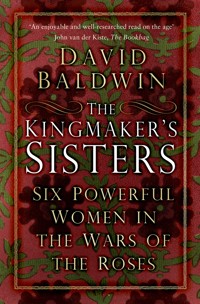
Warwick the Kingmaker, the Earl of Warwick & Salisbury whose wealth and power was so great that he could effectively decide who would rule England during the Wars of the Roses (1455-1487), had six sisters: Joan, Cecily, Alice, Eleanor, Katherine and Margaret. They all married powerful noblemen who fought on opposing sides during this turbulent period. The Kingmaker's Sisters examines the role that they played in late fifteenth-century England, as wives, mothers and homemakers, but also as deputies for their absent husbands, and how the struggle between the Yorkists and the Lancastrians affected them and their families. Scholarly but accessible, this is the first history of the Wars of the Roses to be written from this perspective, and will appeal to general readers, historians of the period and those with an interest in feminist history.
Sie lesen das E-Book in den Legimi-Apps auf:
Seitenzahl: 314
Veröffentlichungsjahr: 2011
Das E-Book (TTS) können Sie hören im Abo „Legimi Premium” in Legimi-Apps auf:
Ähnliche
















THE KINGMAKER’S
SISTERS
THE KINGMAKER’S
SISTERS
SIX POWERFUL WOMEN IN THE WARS OF THE ROSES
DAVID BALDWIN
First published 2009
The History Press
The Mill, Brimscombe Port
Stroud, Gloucestershire, GL5 2QG
www.thehistorypress.co.uk
This ebook edition first published in 2011
All rights reserved
© David Baldwin, 2009, 2011
The right of David Baldwin, to be identified as the Author of this work has been asserted in accordance with the Copyrights, Designs and Patents Act 1988.
This ebook is copyright material and must not be copied, reproduced, transferred, distributed, leased, licensed or publicly performed or used in any way except as specifically permitted in writing by the publishers, as allowed under the terms and conditions under which it was purchased or as strictly permitted by applicable copyright law. Any unauthorised distribution or use of this text may be a direct infringement of the author’s and publisher’s rights, and those responsible may be liable in law accordingly.
EPUB ISBN 978 0 7524 7990 3
MOBI ISBN 978 0 7524 7989 7
Original typesetting by The History Press
CONTENTS
ILLUSTRATIONS
TABLES
INTRODUCTION
1 The Neville Family
2 The Sisters’ England
3 The Sisters and the Wars c. 1450–1461
4 The Sisters in the First Reign of Edward IV
5 The Sisters and the Wars 1469–1471
6 The Sisters in the Second Reign of Edward IV
7 The Sisters at Home
8 The Sisters in the Reign of Richard III
9 The Sisters in the Reign of Henry VII
10 A Good Ending
EPILOGUE
APPENDIX ONE
Memorials of the Kingmaker’s Sisters
APPENDIX TWO
Will of Lady Katherine Hastings
APPENDIX THREE
The Sisters’ Letters
TIME CHART
NOTES & REFERENCES
BIBLIOGRAPHY
ILLUSTRATIONS
1 Richard Neville, Earl of Warwick and his countess Anne Beauchamp, from the family tree in the Beauchamp Pageant (British Library, re-drawn by Geoffrey Wheeler)
2 Middleham Castle, Yorkshire where the sisters would have lived as children (author)
3 William Fitzalan and Joan Neville, Earl and Countess of Arundel, effigies, Fitzalan Chapel, Arundel Castle, Sussex (G. Wheeler)
4 Detail of the head of Joan Neville, Countess of Arundel (photographed during restoration in 1982, G. Wheeler)
5 & 6 Henry Beauchamp and Cecily Neville, Duke and Duchess of Warwick, portrayed as ‘weepers’ on the tomb of Richard Beauchamp, Earl of Warwick, St Mary’s Church, Warwick (author)
7 John Tiptoft, Earl of Worcester, Cecily Neville (nearest camera), and another wife, effigies, Ely Cathedral, Cambridgeshire (G. Wheeler)
8 Bisham Priory, Berkshire, where the Earl and Countess of Salisbury were re-buried in February, 1463, re-drawn from the painting probably by William Abell (c.1463) in the Salisbury Roll (The Duke of Buccleuch and Queensberry, re-drawn by Geoffrey Wheeler)
9 Cawood Castle Gatehouse, Yorkshire, part of the palace of the archbishops of York where Warwick, his sisters, and many members of the nobility attended the banquet held to celebrate George Neville’s enthronement in September, 1465 (author)
10 Thomas, Lord Stanley, Eleanor Neville, and two others, effigies in Ormskirk Church, Lancashire, drawn by William Dugdale in 1664 (author)
11 The ‘Hastings Tower’ at Ashby de la Zouch Castle, Leicestershire, home of William, Lord Hastings and Katherine Neville (author)
12 The west tower of Kirby Muxloe Castle, Leicestershire, where Katherine may have spent part of her widowhood (author)
13 Ravensworth Castle, Yorkshire. The early fourteenth-century tower gatehouse and adjoining archway, home of Henry, Lord Fitzhugh and Alice Neville (author)
14 The Marmion Tower. The fifteenth-century gateway tower at West Tanfield, Yorkshire, where Alice Neville spent part of her widowhood and from where she wrote to the mayor, aldermen and council of York (author)
15 John de Vere, Earl of Oxford and Margaret Neville, re-drawn from Daniel King’s original 1653 illustration of their tomb effigies in Colne Priory Church, Essex, destroyed c.1730 (Geoffrey Wheeler)
16 Castle Hedingham, Essex. John de Vere’s bridge over the now dry moat (www.castleuk.net)
17 Signature of Richard Neville, Earl of Warwick (from Fenn’s Original Letters Written during the Reigns of Henry VI, Edward IV and Richard III, 1787, vol. 2)
18 Signature of Eleanor Neville, Lady Stanley (John Rylands University Library, Arley Charter 30/2, re-drawn by Geoffrey Wheeler)
19 Signature of Alice Neville, Lady Fitzhugh (Fenn’s Original Letters, vol. 2)
20 Signature of Margaret Neville, Countess of Oxford (Fenn’s Original Letters, vol. 2)
21 Signature of Katherine Neville, Lady Hastings (Huntington Library, HAP Box 4 (29))
22 Seal of Katherine Neville, Lady Hastings (Huntington Library, HAP Box 4 (29))
TABLE 1
THE CHILDREN OF RALPH NEVILLE, EARL OF WESTMORELAND AND JOAN BEAUFORT
TABLE 2
THE CHILDREN OF RICHARD NEVILLE, EARL OF SALISBURY
TABLE 3
THE KINGMAKER’ S SISTERS AND THEIR HUSBANDS
Joan (d. 1462) m. William Fitzalan, Earl of Arundel (d. 1487)
Cecily (d. 1450) m. 1. Henry Beauchamp, Duke of Warwick (d. 1446)
2. John Tiptoft, Earl of Worcester (ex. 1470)
Eleanor (d. c.1472) m. Thomas, Lord Stanley (d. 1504)
Alice (d. after 1503) m. Henry, Lord Fitzhugh (d. 1472)
Katherine (d. 1503/4) m. 1. William, Lord Harrington (k. 1460)
2. William, Lord Hastings (ex. 1483)
Margaret (d. 1506), m. John de Vere, Earl of Oxford (d. 1513)
TABLE 4
SOME GRANDCHILDREN OF RICHARD NEVILLE, EARL OF SALISBURY
TABLE 5
THE KINGMAKER, HIS FATHER, HIS BROTHERS-IN-LAW, AND THEIR SONS, IN THE WARS OF THE ROSES
Battle
Yorkist
Lancastrian/Tudor
First St Albans
Salisbury, Warwick
None
Blore Heath
Salisbury
None
Ludford Bridge
Salisbury, Warwick
Arundel, Fitzhugh
Northampton
Warwick
Stanley
Wakefield
Salisbury, Harrington
None
Mortimers Cross
Hastings
Second St Albans
Warwick, Arundel
Fitzhugh
Towton
Warwick, Arundel, Stanley, Hastings
None
Edgecote
None
Fitzhugh
Losecoat Field
Worcester, Hastings
None
Barnet
Hastings
Warwick, Oxford
Tewkesbury
Hastings
None
Bosworth
Richard Fitzhugh, Thomas Fitzalan
Oxford, Stanley
Stoke
None
Oxford, George Stanley, Edward Hastings
A NOTE ON THE TABLES
R obert Neville, Bishop of Salisbury and Durham (Table 1) is portrayed in some family trees as the second son of the first Earl of Westmoreland and Joan Beaufort, but is said elsewhere to have been their fifth son. The confusion arises because three short-lived sons, Thomas, Henry and Cuthbert, were born to the Earl and Countess between the birth of their eldest son Richard, the future Earl of Salisbury, in 1399, and Robert’s arrival in 1404. Robert was therefore his parents’ fifth son, but only the second to reach maturity. It is incorrect to show William, Lord Fauconberg, George, Lord Latimer, and Edward, Lord Abergavenny (or Bergavenny) as the second, third and fourth sons and Robert as the fifth.
The order of the Kingmaker’s sisters is not entirely certain (Table 2). Joan and Cecily were certainly the eldest and second eldest, and Margaret the youngest, but we cannot tell if Eleanor was older than Alice or vice versa. Eleanor, who married Thomas, Lord Stanley, is also said to have been wedded to Edmund Beaufort, Duke of Somerset, who was killed at the first battle of St Albans in 1455 (M. Hicks, Warwick the Kingmaker (Oxford, 2002) p. 117; M.J. Bennett, The Oxford Dictionary of National Biography (Oxford, 2004) vol. 52, p. 237), but this is a mistake. The Eleanor who married Somerset was a daughter of Richard Beauchamp, Earl of Warwick, not Richard Neville, Earl of Salisbury.
INTRODUCTION
Richard Neville, Earl of Warwick the famous – perhaps infamous – ‘Kingmaker’ had six sisters: Joan, who was a few years older; Cecily, who was about the same age and who may have been his twin; and Eleanor, Alice, Katherine and Margaret who were younger. They all married wealthy and influential noblemen. Joan’s husband was William Fitzalan, Earl of Arundel, while Cecily was espoused first to Henry Beauchamp, Duke of Warwick, and, after his death, to John Tiptoft, Earl of Worcester. Eleanor wed Thomas, Lord Stanley; Alice, Henry, Lord Fitzhugh; Katherine, William, Lord Harrington, and secondly, William, Lord Hastings; and Margaret, John de Vere, Earl of Oxford. These men not infrequently found themselves at odds in the Wars of the Roses, and the ways in which this affected their wives, both as individuals and as part of an extended family, will form a central theme of this book.
It is less easy to weave together the lives of six people than to deal with a single biography, but a major advantage is that we can make more comparisons, and draw more parallels, than would be possible if our focus was limited to just one – or even two – of them. Three of the sisters died comparatively young, Cecily in 1450, Joan in 1462, and Eleanor before 1472, but their remaining siblings survived into the early years of the sixteenth century. Three, Cecily, Alice, and Katherine, were widowed, Cecily and Katherine when they were still young and after only a few years of marriage. They soon remarried, but Alice, who was older when Lord Fitzhugh died, remained single for more than thirty years, and Katherine outlived Lord Hastings, her second husband, by over twenty. They all bore at least one of their husbands a child, although Anne, Cecily’s daughter, and George, Margaret’s son, predeceased them. Joan, Eleanor, and Katherine each had a number of children, and Alice as many as eleven.
The sisters’ husbands, a duke, three earls, and four barons, would have worked harmoniously with the King and with one another in normal circumstances, but these were not ‘normal’ times. Henry, Duke of Warwick, Cecily’s first husband, died in 1446 before the outbreak of the ‘Wars of the Roses’, but of the others, three, the Earl of Worcester and Katherine’s husbands Lords Harrington and Hastings, were dedicated Yorkists who all met violent deaths. Margaret’s husband, the Earl of Oxford, was a staunch Lancastrian; Henry, Lord Fitzhugh, seems to have been committed primarily to Warwick, his brother-in-law; the Earl of Arundel fought for the Yorkists at second St Albans and Towton but thereafter played little part in either war or politics; and Thomas, Lord Stanley managed to accommodate himself to whichever party governed by making himself indispensable to all. Some who became widowers, the Earl of Worcester and Lord Stanley for example, soon married other noblewomen, but the Earl of Arundel did not take another wife although he outlived Joan Neville by a quarter of a century. The sisters’ own social network helped to bind the family together, and may have prevented their husbands’ relationships from collapsing altogether during periods of stress.
There is no modern – or even older – biography of any of the sisters in any of the standard collections, and a trawl through the back numbers of the Ricardian (the journal of the Richard III Society) produced not a single article devoted to them. They feature to a greater or, more usually, lesser, extent in biographies of Warwick, their brother,1 and are noticed in the short ‘lives’ of their husbands included in The Oxford Dictionary of National Biography and The Complete Peerage.2 Eleanor is briefly mentioned in Barry Coward’s The Stanleys, Lords Stanley and Earls of Derby (Manchester, 1983), and Cecily finds a place in R.J. Mitchell’s biography of her second husband John Tiptoft (London, 1938), but they have never been studied in depth. We must therefore begin almost from scratch, and some interesting material is available when we scratch beneath the surface. Only a little personal information survives for the Countess of Arundel, and the Duchess of Warwick and Countess of Worcester; but there are two manuscript letters written by Lady Stanley, two sent by Lady Fitzhugh that have been printed, and a number of documents that illuminate the lives of Lady Hastings and the Countess of Oxford. Only Katherine Hastings has left an extant will – it is doubtful if some of the sisters, particularly those who died in their husband’s lifetimes, ever made them – but we do possess the last testament of her husband William, executed by Richard, Duke of Gloucester in 1483, together with those of the Earl of Oxford, who outlived his wife Margaret by some seven years, and Thomas, Lord Stanley who survived Eleanor by more than thirty. Accounts seldom exist from so remote a period, but the Huntington Library holds a fragment of one of Katherine’s arrears rolls, and there are some references to Margaret in a receiver-general’s account and in a household book kept by her husband. It is sometimes argued that it is unrealistic to attempt biographies of those who lived in the Middle Ages because the detailed, personal information that would make this possible is simply not available; but these and other papers allow us to glimpse the sisters’ personalities and relationships, and tell us something about the dramatic changes of fortune that could beset ladies at the highest levels of society in the later fifteenth century. Their husbands and sons may have reaped the rewards – and sometimes lost their heads – in the process, but it was invariably wives and mothers who smoothed troubled waters while they awaited better days.
I would like to thank the following who provided information in response to my inquiries: Anne Marie Anderton (The John Rylands University Library, University of Manchester), Bruce Jackson (County Archivist, Lancashire Record Office), Mary L. Robertson (Chief Curator of Manuscripts, Huntington Library), Sara Rodger (Assistant Librarian, Arundel Castle), D.J. Salmon (Assistant Archivist, North Yorkshire County Record Office), John Ashdown-Hill, Lesley Boatwright, Kenneth Hillier, James Ross, J.R. Wignall, and not least students who attended courses based on the book at Vaughan College, Leicester, and the Doddridge Centre, Northampton, and who shared their thoughts on the sisters with me. I am particularly grateful to Professor Tony Pollard for reading my typescript and suggesting a number of improvements, to Geoffrey Wheeler for providing some of the illustrations and for his constant interest in the project, and to my wife, Joyce, who, although not a historian, helped in many other ways.
David Baldwin
1
THE NEVILLE FAMILY
The Nevilles are an example – perhaps the example par excellence – of how a minor aristocratic medieval family could rise from relative obscurity to enjoy a place at the heart of both the royal house and government. A dynasty that could produce a male heir in each generation could hardly fail to add to its acres and influence as rivals and relatives alike were extinguished; but this needed to be complemented by judicious marriages to heiresses and by an ability to sniff which way the political wind was blowing. Rich rewards were available to those who successfully negotiated the pitfalls, but disaster awaited any who were found wanting. Some heiresses were the survivors of what McFarlane has called ‘enfeebled stocks’1 (the result of their families intermarrying too often), and a bad political decision, be it to support the reigning king or a rival claimant, could result in execution and forfeiture. An attainted heir might slowly work his way back into royal favour, but his prospects would have been seriously damaged in the short term.
Many noble families were able to accomplish some of these things for part of the time, but few could rival the almost flawless progress of the Nevilles. In generation after generation they wedded heiresses, sired large numbers of children by them, and accumulated a rich landed estate centred on the castles of Raby and Brancepeth in County Durham and Middleham and Sheriff Hutton in Yorkshire. It was in 1397, in the aftermath of his coup against those noblemen who had resisted his will ten years earlier, that Richard II raised Ralph Neville, the then head of the family, to the earldom of Westmoreland,2 but Ralph did not allow his gratitude to cloud his view of the political situation or take his eye off the main chance. When Henry Bolingbroke landed at Ravenspur in July 1399, Ralph, the husband of Henry’s half-sister Joan Beaufort, was among the first to join him, and he bore the royal sceptre when the usurper was crowned king as Henry IV. He proved his loyalty by resisting the rebellions of the Percies in 1403 and the Duke of Norfolk and Archbishop Scrope two years later, a sequence of events that effectively eliminated his main rivals and further enhanced his authority in the restless north.
Earl Ralph married twice and fathered some twenty-three children, nine by his first wife Margaret Stafford and fourteen more by the Countess Joan. John, his eldest son by his first wife, had first claim on his father’s title, but these older children of the first brood lacked the royal connections of their younger siblings of the half-blood. It was presumably thanks to Joan’s influence that Richard, her eldest son, married Alice Montacute, heiress to the earldom of Salisbury, and his brother Robert, the churchman of the family, became first Bishop of Salisbury and then Bishop of Durham. Four other sons secured heiresses to baronies, becoming Lords Fauconberg, St Maur, Latimer, and Bergavenny, while four daughters were contracted to the Dukes of Buckingham, Norfolk and York, and the Earl of Northumberland. These arrangements would, in due course, help Norfolk and Northumberland to recover the titles forfeited by their brother and grandfather in Henry IV’s reign, and there were doubtless others who found that a connection with Earl Ralph and his countess could improve their relations with the Crown or enhance their prospects. It was the culmination of many years of patient planning and hard work.
When Earl Ralph died in 1425 he left his Durham estates to his grandson Ralph (John, his eldest son, had predeceased him), but the Yorkshire lands were settled on the Countess Joan. She had no intention of allowing them to pass to the offspring of her husband’s first wife, and the scene was set for decades of friction between the ‘senior’ and ‘junior’ branches of the family. John had rather surprisingly acquiesced in this arrangement, and Ralph the younger, who was still a minor, could do nothing to prevent it; but the latter did not conceal his displeasure after he came of age in 1429. In 1435 the Chancellor was informed that ‘owing to the grievous differences which have arisen between Ralph Earl of Westmoreland and his brothers John and Thomas on the one hand, and Joan Dowager-Countess of Westmoreland and her son Richard Earl of Salisbury on the other hand, [who] have of late assembled, by manner of war and insurrection, great routs and companies upon the field, which have done all manner of great offences as well in slaughter and destruction of the King’s lieges as otherwise, which things are greatly against the estate and weal and peace of this realm’3. The Privy Council appointed three arbitrators and the differences were patched up for the moment: but the problem is typical of the disputes that could beset an inheritance when a man reared two families. The eldest son could not have everything, and his half-brothers could never have enough!
The second Earl Ralph continued to contest the arrangement after his step-grandmother died in 1440, but could make little headway against Salisbury whose royal connections and superior service both in France and on the Scottish border always stood him in good stead with the Crown. Another ‘compromise’ in 1443 all but settled the matter in Salisbury’s favour, and Westmoreland would have been poorer than some fourteenth-century lords of Raby if he had not inherited lands from his mother, Elizabeth Holland. Salisbury’s power had previously been drawn from his wife’s Montacute estates in the West Country, but his new possessions, the valuable lordships of Middleham, Sheriff Hutton, and Penrith in Westmoreland (which the King had given his parents when they married), made him a force to be reckoned with in northern England. It would be the younger Nevilles who would henceforward dispute the dominance of the region with the Percies, while the elder ‘senior’ branch of the family played only a supporting role.
II
Richard Neville, Earl of Salisbury proved himself a worthy successor to his father, not only in war and politics but also in his ability to raise a large family. Joan, his eldest daughter, the future Countess of Arundel, was born before 2 November 1424, followed by Cecily who would one day become Duchess of Warwick. Richard, the future ‘Kingmaker’, made his entry into the world in 1428, and was soon joined by three younger brothers, Thomas, John, sometime Earl of Northumberland and Marquess Montagu, and George, who became Bishop of Exeter and Archbishop of York. Two short-lived sons, Ralph and Robert, and three more daughters, Eleanor, who would marry Thomas, Lord Stanley, Alice, who would espouse Henry, Lord Fitzhugh, and Katherine, whose two husbands, William Bonville, Lord Harrington, and William, Lord Hastings, would both die violently, were born between 1433 and 1442, while Margaret, who was destined to become Countess of Oxford, completed the brood in about 1443. Twelve children in nineteen years sounds a very large number, but was by no means unusual at this period. Richard, Duke of York, and his duchess Cecily, Salisbury’s sister and brother-in-law, also produced twelve children between 1439 and 1455 (although only eight of these reached maturity), and York’s son, Edward IV, sired ten in fourteen years. Peasant women knew that prolonged breastfeeding would delay another pregnancy, but great ladies who employed wet-nurses did not have this option. The Church tried to discourage sex by banning it on Sundays, throughout Lent, and for almost half the year in total, but there is no evidence that fewer children were conceived.
The birth of each child would have been preceded and followed by a sequence of well-established customs, beginning when the mother-to-be ‘took her chamber’ – a well-furnished room with subdued lighting – about a month before she was due. She entered an exclusively female world from which even the male doctors who usually attended her were excluded, and depended on the skills of midwives aided by sacred relics borrowed for the occasion. A successful delivery would be an occasion for great relief and rejoicing, but the mother would not be permitted to join in the celebrations until she had been ritually purified by the ceremony of ‘churching’ forty days (six weeks) later. The Countess Alice and her children would have enjoyed the best care then available, but the process was inevitably hazardous and there may have been unrecorded stillbirths or deaths within a few hours.
The sisters’ first rite of passage, indeed almost the first act of their lives, was baptism, since babies who died unbaptised risked being caught in a kind of limbo between heaven and hell and their souls ‘lost’.4 Lay persons were allowed to anoint a child’s head with water and christen him or her in the name of the Trinity if death seemed imminent, but only a priest could decide if the makeshift ceremony had been performed adequately and the infant received into the Church and ‘saved’. All Salisbury’s children would have been carried to the font literally within hours of making their entry into the world.5 Godparents – two fathers and one mother for a boy, the reverse for a girl – would have been chosen well in advance, almost certainly with a view to creating a formal relationship between the infant and persons of some consequence. Today it is invariably grandparents who supplement the role of the parents in a child’s upbringing and godparents (where they exist) do little or nothing; but in the medieval era it was the godparents who were charged with protecting and instructing the infant, particularly if the parents became incapacitated. The gifts the godparents gave their new charges at their baptisms would have been generous, in keeping with their rank in society, and the parents doubtless hoped they would be followed by more favours as the years passed.
We do not know the identities of Salisbury’s daughters’ godparents, but the custom by which the most senior gave, or was invited to give, her name to the infant may afford some clues.6 Joan, the eldest, was almost certainly named for her grandmother, Joan Beaufort, and Cecily, Eleanor and Katherine for their aunts, Salisbury’s sisters, the Duchess of York, the Countess of Northumberland, and the Duchess of Norfolk. Margaret’s godmother may have been Margaret Beauchamp, eldest daughter of Richard Beauchamp, Earl of Warwick, and wife of John Talbot, Earl of Shrewsbury. Salisbury had entered into a close relationship with Earl Richard in 1436 (see below), and the families did not fall out over the inheritance until after 1449. Curiously, no child was called Anne after Salisbury’s other prominent sister, Anne, Duchess of Buckingham, and there does not appear to have been an Alice among the family’s close relatives. Possibly Alice was named for her mother, Alice Montacute, although it was Duchess Anne who lifted her from the font.
III
Salisbury’s offspring would have begun their lives as part of a growing and peripatetic nursery that moved slowly around his Countess’s principal manors in Wessex. They doubtless visited their grandmother, Joan, at Middleham and Sheriff Hutton, and began to live there more permanently after their father inherited the estates in 1440. Their earliest years would have been spent in the care of servants, partly because their parents were frequently absent on their own and the King’s business, and because convention dictated that noble ladies did not nurture their children on a day-to-day basis. Nurses and tutors became, in effect, surrogate mothers and fathers, but there was a sense of belonging based on the notion that the family’s collective prosperity required the full cooperation of all its members. Boys and girls were expected to accede to their parents’ wishes – and could expect harsh punishment if they objected – because the Church taught that to resist or disobey them was sinful. There are no specific examples of how the Nevilles disciplined their offspring, but the law did not protect children from parents who abused them and the principle of ‘spare the rod and spoil the child’ was applied throughout noble and gentle society. They may not have suffered like Elizabeth Paston who was ‘betyn onys [once] in the weke or twyes, and som tyme tywes on o [one] day, and hir hed broken in to or thre places’7 when she refused to marry the man her parents had chosen for her, but they knew the rules and the consequences of breaking them. Those in charge of noble households tried to maintain a quiet, ordered, atmosphere, particularly during mealtimes, but children were probably no less boisterous than they are today.
Formal lessons – in Latin and French, with a smattering of law and mathematics – began at the age of four, and became part of their regimen for the next few years. A typical day began with mass in the family chapel followed by a light breakfast of bread, cheese and ale (at six or seven o’clock according to the season) and then serious study until dinner at perhaps ten or eleven. Later, there would be more enjoyable lessons, riding, archery, dancing, learning to play a musical instrument or perhaps sewing and embroidery in the company of the ladies of the household. Supper followed in the late afternoon after Evensong, and then there would be time to play games such as ‘buck hide’, a form of hide-and-seek, or to amuse themselves with dolls before bedtime. It was a communal life in which privacy was almost non-existent. The girls would have slept together, the younger with the elder, and innocence would have been lost at an early age.
The most traumatic moment of their childhoods came when, at some time between the ages of seven and ten, they were sent into other noble households, the boys to learn the profession of arms and the girls the practical skills of a great lady. A system that separated children from their families this early may appear harsh by modern standards, but was probably no harsher than sending a child of similar age to a modern boarding school. Surviving letters show that homesickness was a common problem, but they undoubtedly learned self-reliance and formed friendships that would stand them in good stead later. The boys received a more comprehensive education (rather unfairly perhaps, since both sexes were expected to become competent estate managers), but all were ‘grown-up’ and ready to enter the adult world by the time they reached their early teens. Where Salisbury’s children went, when, and for how long, is entirely unknown to us, but none of the girls entered a convent. Noble fathers often gave a younger daughter to religion – two of the elder Ralph Neville’s daughters had entered the Minories in London, and Edward IV arranged for his youngest child, Bridget, to become a nun at Dartford – but the sisters were all destined for secular life.
It follows from this that Salisbury and his wife did not form a close bond with their children in infancy – that would come later – but the children would probably have seen little more of them had they remained at home. The Earl served as warden of both the western and eastern marches towards Scotland until 1435, and was also employed as captain of Berwick and as an ambassador to the King of Scots. He campaigned in Normandy with the Duke of York in the summer of 1436, and was appointed to the royal Council on his return to England. Sir Charles Oman remarks that his attendance at Council meetings was regular and ‘exemplary’, but observes that his new role would have kept him in London (and away from his family in northern England) ‘for the greater part of the next ten years’.8 His countess was by his side for much of this period and would only have seen her children at family gatherings, or possibly if one of them suffered a serious, life-threatening illness. The youngsters were probably in awe of their parents on the rare occasions they met them, and felt respect and admiration rather than love.
IV
It is likely that Salisbury began to think in terms of finding suitable marriage partners for his children from almost the moment they were born. In 1436 it was agreed that Cecily, his second daughter, would marry Henry, Lord Despenser, son and heir of the Earl of Warwick, and that his eldest son Richard would simultaneously wed Warwick’s daughter, Anne. The arrangement would have worked mainly to Cecily’s advantage if all the parties had enjoyed their normal life spans; but Henry and his only daughter were both dead by 1449, and the real beneficiary was Richard Neville the younger who became Earl of Warwick in right of his wife. Joan, Salisbury’s eldest daughter, married William Fitzalan, Earl of Arundel after 17 August 1438, but there was then an interlude of some fifteen years before Thomas, his second son, wed Maud Stanhope, Lady Willoughby in 1453.
Salisbury had undoubtedly done his best for his older children, but the negotiations had not always been easy or inexpensive. He had to promise to pay the Earl of Warwick the large sum of 4,700 marks (£3,233.66) before Warwick would allow his heir Henry to marry Cecily (Salisbury was clearly the suppliant in the matter), and the marriage of the young Earl of Arundel had to be bought from the Crown. Neither Richard, who was seven, nor Cecily, a year or two his senior, can have had any say in their parents’ arrangements and would not have been asked if they liked their intended partners or wanted to spend the rest of their lives with them. It had long been accepted that a marriage was valid only if the contacting parties consented to it, but was it possible, or practical, to ask infants if they agreed to something they would not have understood until they were older? The Church overcame this by allowing that children could be married at seven on condition that girls could repudiate the agreement at twelve and boys at fourteen, the ages at which they were deemed to reach puberty. A marriage that had been arranged years earlier could be annulled if the young couple refused to consummate it when they were able, but again, only the bravest of sons or daughters would have dared reject plans designed to benefit the whole family. A few fearless souls may have stood up to their parents, but the majority undoubtedly acquiesced.
So far, so good, but another potential difficulty was that so many Nevilles had married into the ranks of the higher nobility in previous generations that some unions that were politically and financially desirable fell within the prohibited degrees. These were widely drawn in the Middle Ages – fourth cousins and nearer relatives could not legally marry – and a papal dispensation would be needed to overcome them and ensure that any children born to the couple were legitimate. Such concerns would not have troubled the average peasant, but a lord whose heirs might be challenged by ambitious rivals could not be too careful. Salisbury probably felt a sense of relief as each child was suitably and lawfully wedded, but their happiness – whether they loved, or would grow to love, their life’s partners – would scarcely have entered his mind.
A twelve-year-old girl who could consent to marriage had clearly reached the age of discretion in the Church’s eyes, but other responsibilities were assumed at different ages. She would not be permitted to swear an oath or give evidence in court until she was between fourteen and sixteen, and was unlikely to be punished by the criminal law until she was thought old enough to know what she was doing.9 Sometimes, a child who had ‘accidentally’ killed another youngster would be imprisoned until the case could be heard by a travelling justice; but the ‘offender’ was normally pardoned unless it was clear that he or she had intended to cause serious injury. It is unlikely that any of the sisters ever found themselves in this situation, but serious accidents were inevitable in a society of open wells, boiling pots and unguarded fires.
V
The double wedding of 1436 amply repaid the time and money that Salisbury had invested in the marriages, but only because careful planning and good fortune walked hand in hand. If Henry, Cecily’s husband, had died without succeeding to his father’s Beauchamp lands then the coheiresses would have been the Earl’s three daughters by his first wife and the only daughter of his second marriage, young Richard’s spouse Anne. The Countess Isabel, Anne’s mother, had also been married twice, and the heirs to her Despenser estates would in these circumstances have been Anne and her daughter by her first husband. But Henry had inherited – he survived his father by seven years before dying in 1446 – and this allowed Anne, his only sister of the full blood, to claim the whole inheritance after Henry’s infant daughter died in 1449. Young Richard became Earl of Warwick in right of his wife, objections to their windfall being effectively stymied by the fact that the husbands of the two eldest half-sisters, John Talbot, Earl of Shrewsbury and Edmund Beaufort, Duke of Somerset were busy defending Normandy, and the third, George Neville, Lord Latimer, was a lunatic whose estates were in the custody of his brother, the Earl of Salisbury. The three ladies had to settle for a total of nine manors while a moiety of the Despenser lands was preserved for George, the son of Anne’s now deceased half-sister on her mother’s side of the family. Custody of this was granted to Cecily and her second husband the Earl of Worcester, but Worcester surrendered it to Warwick two months before his wife died in July 1450.10 George’s rights were ignored when he came of age in 1457, and Anne was cynically declared to be the sole heir of her mother in Edward IV’s first parliament in 1461.
Henry would have had a major role in the Wars of the Roses if he had lived for at least another decade, but alone among the sisters’ husbands he was destined to play no part at all. He was still only twenty-one when he died at Hanley Castle in Worcestershire (where he had also been born), on 11 June 1446, but had already been of service to the Lancastrian government. He was a royal councillor by 1441 (when he would have been only sixteen), and clearly stood high in royal favour when Henry VI raised him to the dukedom of Warwick in April 1445. The Rous Roll says that Pope Nicholas V invited him to become ‘captain of his wars’ (a mistake, since Nicholas did not succeed until 1447), and some of Rous’s other compliments are, as Christine Carpenter notes, ‘somewhat out of keeping with what is known of his career’. Did he really go to confession every day as Rous alleges, and did he ‘suffer no officer of his to oppress any man’, dismissing them if they refused to amend?11 It is more probable that his piety was conventional and his love of justice always subject to the needs of his coffers and lands.




