



1,99 €
0,49 €
Niedrigster Preis in 30 Tagen: 1,99 €
0,49 €
Niedrigster Preis in 30 Tagen: 1,99 €
Mehr erfahren.
- Herausgeber: Musaicum Books
- Kategorie: Geisteswissenschaft
- Sprache: Englisch
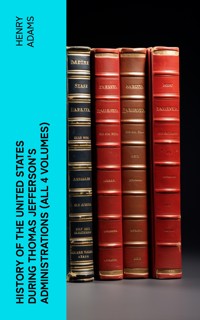
In 'The History of Thomas Jefferson Presidency' by Henry Adams, readers delve into a detailed account of the presidency of Thomas Jefferson, exploring the political landscape and major events of the time. Written in a sophisticated and scholarly style, Adams provides a thorough examination of Jefferson's leadership style, decisions, and impact on American history. The book is a blend of historical narrative and critical analysis, offering insights into the complexities of Jefferson's administration and its lasting effects on the nation. Adams' literary context as a prominent historian and writer adds depth and credibility to the text, making it a valuable resource for those interested in American history and political science. With meticulous research and eloquent prose, Adams presents a compelling portrait of one of America's most influential presidents. Readers will appreciate the depth of analysis and historical perspective provided in this enlightening work. In this enriched edition, we have carefully created added value for your reading experience: - A succinct Introduction situates the work's timeless appeal and themes. - The Synopsis outlines the central plot, highlighting key developments without spoiling critical twists. - A detailed Historical Context immerses you in the era's events and influences that shaped the writing. - An Author Biography reveals milestones in the author's life, illuminating the personal insights behind the text. - A thorough Analysis dissects symbols, motifs, and character arcs to unearth underlying meanings. - Reflection questions prompt you to engage personally with the work's messages, connecting them to modern life. - Hand‐picked Memorable Quotes shine a spotlight on moments of literary brilliance. - Interactive footnotes clarify unusual references, historical allusions, and archaic phrases for an effortless, more informed read.
Das E-Book können Sie in Legimi-Apps oder einer beliebigen App lesen, die das folgende Format unterstützen:
Veröffentlichungsjahr: 2020
Ähnliche












The History of Thomas Jefferson Presidency
Published by
Books
Table of Contents
Introduction
A republic tests its promises most severely when lofty principle collides with the urgencies of governing, and in Henry Adams’s rendering of Thomas Jefferson’s presidency that collision echoes across cabinet rooms, court chambers, bustling ports, frontier outposts, and the partisan press, where ideas of liberty and limits, of federal power and local will, of peace and preparedness, jostle for precedence while the world beyond the Atlantic sends shockwaves inward and the nation, still experimental, learns how habits, institutions, and personalities shape the arc of public life far more stubbornly than any single creed, campaign, or speech can hope to determine.
This introduction presents Henry Adams’s classic account of the Jefferson years as he told it in his History of the United States of America During the Administrations of Thomas Jefferson, first issued in the late nineteenth century. Across those volumes, Adams set out to narrate a formative passage of national development with literary poise, analytical steadiness, and a sense of drama suited to high politics. The result has long been read not only as history but as enduring literature, notable for its control of tone, patient architecture, and a supple style that gives complex events intelligible shape.
Henry Adams (1838–1918), historian and man of letters, wrote the History at a moment when the United States was reflecting on its earlier experiments from the vantage of the Gilded Age. Drawing on public records, diplomatic correspondence, and legislative debates, he pursued a narrative that balanced documentary rigor with a novelist’s eye for character and setting. First published between 1889 and 1891, the work gathers the Jefferson administrations into a sustained inquiry: how an avowedly republican executive would govern under pressure, and how institutions designed for simplicity would grapple with the world’s intricacies.
The central premise is straightforward and compelling: follow Jefferson’s presidency from inauguration through the principal tests of domestic order and foreign peril, paying close attention to the institutions that mediate decision-making. Adams observes the executive, Congress, and the judiciary as they define roles, contest boundaries, and respond to events that range from fiscal questions to maritime crises. The public sphere—pamphlets, newspapers, caucuses—becomes a stage on which policies are explained and contested. Without foreclosing outcomes, he establishes the stakes: whether a nation committed to limited government can manage expansion, commerce, and security without betraying its professed temper.
Part of the book’s classic status rests on its prose, at once restrained and pointed. Adams composes scenes with quiet irony, preferring understatement to declamation, and lets patterns emerge from accumulation rather than polemic. He is patient with evidence and attentive to cadence. Readers encounter a narrative that advances steadily, returning to themes with purposeful recurrence, so that episodes illuminate one another rather than flash and fade. This literary tact has influenced subsequent historical writing by showing how scrupulous documentation can coexist with elegance, and how measured irony can clarify without diminishing the seriousness of events.
Adams also forged a durable thematic frame: the tension between principle and practice in a republic guided by party. He traces how ideals of frugality, simplicity, and local preference confront the complexities of revenue, administration, and national cohesion. Partisanship supplies energy yet threatens coherence; reform impulses clash with the inertia of established methods. The presidency itself becomes a problem to be solved—how to lead without aggrandizing, how to persuade without overreaching—while the Constitution, still young, proves elastic enough to permit action but ambiguous enough to provoke enduring argument.
Equally central is the international predicament of a small power amid global conflict. Adams sets American debates against the convulsions of European warfare, where shifting alliances, commercial restrictions, and great-power calculations buffet neutral states. The oceans are not a moat but a marketplace and a battlefield of rights. Diplomatic correspondence, envoys’ dispatches, and cabinet consultations become the threads of a story about how a republic calibrates prudence and honor when provoked, and how the language of neutrality can fray under the strain of interests, insults, and necessity.
Adams pays steady attention to geography and growth, recognizing how space itself pressures policy. He examines questions of territorial administration, relations at far-flung borders, and the legal and political implications of incorporating new communities into a federal structure. Such developments test fiscal systems, military arrangements, and constitutional interpretation. They also expose the friction between egalitarian rhetoric and uneven realities on the ground. In Adams’s narrative, the map is never mere backdrop; it is a protagonist that complicates every design and gives institutional debates a concrete, sometimes unruly, dimension.
The book’s influence on later writers lies less in specific conclusions than in method and mood. Adams modelled how to sustain a long narrative without surrendering precision, to integrate diplomatic, legal, and political history without flattening differences, and to sketch leaders in context rather than in isolation. Many subsequent histories of the early republic follow his practice of reading policy through institutions and documents while keeping an eye on rhetoric and personality. His example licensed historians and biographers to embrace narrative momentum as a legitimate vehicle for serious argument.
Its durability also reflects Adams’s refusal to reduce history to triumph or failure. He presents a presidency that is improvisational yet coherent, vulnerable yet resourceful, principled yet pragmatic. Such balance has kept the History in print and in debate, taught and reissued across generations. Readers return for the craft as much as for the content: the careful pacing, the structural clarity, the discipline that lets evidence carry interpretation. As the field has evolved, the book’s scaffolding—chronology, institutional focus, documentary texture—remains a model for telling complicated national stories plainly.
To approach the book today is to discover a work that rewards attention to voice as well as to fact. Adams writes with a vantage shaped by his century, and his interpretive choices invite reflection about how histories are made: what sources are privileged, what silences persist, and how judgments are framed. Yet beyond historiographical interest, the story compels because it presents governance as a human undertaking, contingent and contested, where routine procedure and sudden decision share the stage, and where character and system meet in outcomes neither wholly planned nor wholly accidental.
The themes that animate this narrative—executive responsibility, partisan conflict, constitutional latitude, commerce in a dangerous world—remain immediate. Contemporary readers will recognize debates over the reach of federal power, the conduct of foreign policy, the ethics of expansion, and the standing of public reason amid party passions. That resonance, joined to Adams’s lucid architecture and steadfast attention to evidence, explains the book’s lasting appeal. It offers not a museum piece but a working instrument: a study of how a republic learns, sometimes painfully, to align conviction with capacity and to govern with eyes open to consequence.
Synopsis
Henry Adams’s study of Thomas Jefferson’s presidency situates the third president within the unsettled world of the early nineteenth century, when the United States faced partisan realignment at home and shifting power in Europe. Written in the late nineteenth century as part of a multi-volume history, the work proceeds chronologically and thematically, drawing on diplomatic correspondence and executive records. Adams frames the Jefferson years as a sustained test of a young republic’s institutions, following how ideals of limited government, commercial growth, and national independence were translated into policy. The narrative’s scope balances domestic administration with foreign pressures, emphasizing decision points rather than retrospective verdicts.
Opening with the change of administration in 1801, Adams traces the political implications of the electoral transition and Jefferson’s efforts to reorient the executive branch. Cabinet formation receives close attention, notably the partnership with the Treasury and State Departments in outlining fiscal and diplomatic priorities. Early measures to reduce public debt and curb federal expenditures are set against practical needs of governance. Adams follows debates over taxation, military posture, and administrative reform, showing how campaign principles became operating rules. The portrait of management style is grounded in routine decisions as much as grand statements, revealing the practical machinery behind professed republican simplicity.
Adams devotes sustained analysis to the judiciary as a crucible of early constitutional conflict. He recounts the legislative rollback of late Federalist judicial measures and the resulting institutional friction. The narrative highlights disputes that clarified the boundaries among branches, including controversies arising from commissions, jurisdiction, and the tenure of judges. Without treating courts as abstractions, Adams places landmark episodes within their political and administrative context, showing how legal doctrine evolved amid partisan struggle. Impeachment proceedings and defining cases are presented as tests of principle and prudence, with the broader question being how a constitutional order stabilizes after a sharp electoral shift.
Foreign affairs enter the story early through the Mediterranean, where Adams follows the interplay of commerce, tribute, and naval readiness. The administration’s approach to the Barbary powers is treated as a laboratory for policy, balancing negotiation with measured force. The narrative examines how a modest navy, fiscal restraint, and executive caution nonetheless produced sustained operations abroad. In recounting diplomacy, logistics, and command decisions, Adams emphasizes how external challenges forced the government to calibrate authority and strategy. The episode illustrates the administration’s preference to protect trade routes without accepting binding entanglements, while revealing the limits of economy in matters of security.
A central movement of the history is the territorial expansion that reshaped the nation’s prospects. Adams reconstructs the diplomatic opportunity that opened negotiations with France, the steps that led to acquisition, and the constitutional questions the transaction raised. The account follows the Senate’s role, administrative arrangements for new inhabitants, and the implications for federal power. Rather than treating the purchase as a single act, Adams follows its practical aftermath: surveying, governance, and integration. He underscores how expansion required legal innovation and policy coordination, while altering the strategic map and recalibrating relations with European empires still active on the continent.
The narrative then turns to the West, where exploration and administration tested executive capacity. Adams treats the commissioning of expeditions as an extension of statecraft, linking science, diplomacy, and commerce. He follows how territorial organization, trade regulation, and boundary discussions with neighboring powers demanded sustained attention. The book traces the careful management of relations among settlers, Indigenous nations, and foreign claimants, with an eye to how policy crafted in the capital translated into frontier realities. Throughout, Adams emphasizes procedures—appointments, reports, and statutes—that gave practical shape to the enlarged republic’s ambitions and restraints.
In Jefferson’s second term, European war presses upon American neutrality. Adams narrates the sequence of British and French measures affecting maritime trade, the impressment of seamen, and disputes that heightened public outrage. He details the administration’s shift from selective commercial restrictions to broader experiments in economic coercion, explaining the intended diplomatic leverage and the legal mechanisms adopted. The account follows deliberations in Congress and the cabinet as they weighed war preparedness against fiscal and political costs. By tracing implementation as well as intent, Adams shows how external pressure magnified domestic fault lines and forced a reconsideration of earlier assumptions.
Domestic reaction to trade restrictions forms a major strand, with Adams charting regional tensions, resistance, and enforcement dilemmas. He recounts legislative revisions that sought a workable balance between principle and practicality as the administration confronted evasion and economic distress. The narrative situates high-profile legal proceedings, including those involving Aaron Burr, within broader questions of executive discretion and judicial authority. As the term nears its close, Adams attends to the transition of leadership and the repositioning of policy tools, including modifications to commercial measures. The portrait is one of governance under strain, still operating within constitutional and partisan constraints.
Adams closes his treatment of the Jefferson years by reflecting on the presidency’s imprint on institutions, diplomacy, and political economy, without reducing events to a single judgment. The throughline is the tension between republican ideals and the stubborn facts of international power and domestic diversity. By emphasizing records, laws, and administrative choices, the work presents the period as a formative experiment in executive leadership under a written constitution. Its enduring significance lies in showing how early American policy was made—incrementally, argumentatively, and under pressure—offering a careful framework for understanding later debates about power, principle, and national purpose.
Historical Context
Henry Adams’s account of Thomas Jefferson’s presidency is set in the early nineteenth-century United States, with the federal government newly installed in Washington City after 1800. The Constitution, federal courts, and a rapidly maturing party system framed public life. Most Americans lived in rural communities tied to Atlantic markets through customs duties and shipping. Slavery was entrenched in the South, while the trans-Appalachian West drew migrants and speculators. Abroad, Europe was engulfed in the prolonged wars of the French Revolutionary and Napoleonic eras, making neutral trade precarious. Adams situates Jefferson’s administration within this volatile matrix of domestic institution-building and global conflict.
The election of 1800, often called the Revolution of 1800, brought the Democratic-Republicans to power and tested the resilience of constitutional mechanisms. A tie between Thomas Jefferson and Aaron Burr sent the contest to the House of Representatives, which chose Jefferson in early 1801. The experience prompted adoption of the Twelfth Amendment in 1804, refining presidential and vice-presidential balloting. Adams treats this peaceful transfer as a landmark in party government, highlighting the role of state delegations, party caucuses, and intense newspaper campaigning. He examines how Jefferson interpreted the result as a mandate to redirect policy while preserving constitutional continuity.
Jefferson’s program emphasized fiscal retrenchment and republican simplicity. With Treasury Secretary Albert Gallatin, he pursued debt reduction by curbing expenditures, scaling back the army and navy, and relying on customs revenue rather than internal taxes, including the repeal of the whiskey tax in 1802. Patronage shifted officeholders but left many institutional frameworks intact; notably, the First Bank of the United States continued until its charter’s expiry under a later administration. Adams analyzes these choices as both ideological and pragmatic, juxtaposing Jefferson’s suspicion of centralized finance with the practical need for revenue in a trade-dependent nation.
The judiciary became a central arena of conflict. Outgoing Federalists had passed the Judiciary Act of 1801 and filled new judgeships late in the Adams administration. Jeffersonians repealed the act in 1802, prompting constitutional challenges. In 1803, Marbury v. Madison asserted judicial review, a development Jefferson accepted in practice while resisting claims of judicial supremacy. The impeachment of Supreme Court Justice Samuel Chase in 1804–1805 ended in acquittal, reinforcing judicial independence. Adams treats these episodes as tests of separation of powers, noting Marshall’s legal statecraft and the administration’s political calculations in consolidating authority without open constitutional rupture.
The Louisiana Purchase of 1803, negotiated by Robert R. Livingston and James Monroe, doubled the nation’s territory after France regained Louisiana from Spain by the 1800 Treaty of San Ildefonso. The Haitian Revolution’s success weakened French colonial plans, facilitating the sale. Jefferson wrestled with constitutional scruples about acquiring territory yet endorsed the treaty, and Congress organized new territorial governments in 1804. Adams reconstructs the diplomacy with Napoleon and Spanish officials, emphasizing strategic gains on the Mississippi and the port of New Orleans. He also traces the immediate legal and administrative challenges of incorporating diverse populations and legal traditions into the republic.
Exploration followed acquisition. The Corps of Discovery under Meriwether Lewis and William Clark departed in 1804, traveled to the Pacific, and returned in 1806, collecting scientific data and mapping routes. Zebulon Pike’s expeditions probed the upper Mississippi and the Southwest. Adams underscores Jefferson’s Enlightenment sensibility, connecting curiosity about geography, flora, fauna, and ethnography with statecraft and commerce. He shows how federal patronage of science and exploration was not mere intellectual pursuit but an instrument of sovereignty, information-gathering, and future settlement, laying groundwork for transcontinental trade visions while disclosing the limits of federal capacity on a vast frontier.
Native nations stood at the center of western policy. Jefferson’s administration advanced a civilization program that promoted agriculture, trade factories, and treaty-making to secure land cessions. Pressure from settlers accelerated dispossession, especially in the Old Northwest and lower Mississippi Valley. Adams situates these policies in a longer arc of conflict that would later culminate in broader warfare, while keeping focus on Jeffersonian methods of negotiation and economic leverage. He examines the uneasy coexistence between republican ideals and coercive outcomes, and how disputes with Britain and Spain complicated boundary enforcement, Native diplomacy, and federal authority on the frontier.
At sea, the First Barbary War (1801–1805) tested Jefferson’s defense policies. When Tripoli challenged American shipping, the United States deployed frigates and smaller vessels, culminating in operations that restored a measure of protection and secured a treaty in 1805. Jefferson favored a leaner navy and coastal gunboats for economy, yet the conflict highlighted the continuing value of blue-water capabilities. Adams narrates the exploits of naval officers and the logistical strains on a pared-down establishment, using the episode to assess the administration’s balancing of republican frugality with the practical demands of maritime security and diplomacy in the Mediterranean.
The Napoleonic Wars reshaped the Atlantic economy. Britain’s Orders in Council and Napoleon’s Berlin and Milan Decrees, issued between 1806 and 1807, targeted neutral commerce. British impressment of seamen, culminating famously in the Chesapeake–Leopard affair in 1807, inflamed American opinion. Adams emphasizes how these overlapping regimes trapped United States shipping, exposed the fragility of neutral rights, and forced Jefferson to navigate between humiliation and war. He documents the administration’s diplomatic probes in London and Paris, the truncation of earlier commercial strategies, and the way European total war eroded the space for American mediation or profitable neutrality.
The Embargo Act of December 1807 halted American exports in an attempt to use economic coercion to change British and French policies. The measure spared war but devastated maritime regions, encouraged smuggling, and required increasingly strict enforcement acts in 1808–1809. As domestic discontent mounted, Congress replaced the embargo with the Non-Intercourse Act in early 1809, targeting only Britain and France. Adams assesses the embargo as a bold but costly experiment, premised on America’s commercial leverage. He shows how it reshaped internal politics, fostered nascent manufacturing in some areas, and left the nation still entangled in European crises.
Political life in Jefferson’s era was saturated by a partisan press and expanding associational culture. Newspapers aligned with the Democratic-Republicans, including the National Intelligencer, amplified administration views, while Federalist papers in New England and commercial ports mounted sharp critiques. Patronage and congressional caucuses structured careers and nominations, and the Twelfth Amendment reduced electoral uncertainty. Jefferson’s 1802 letter to the Danbury Baptists, invoking a wall of separation between church and state, reflected republican commitments to religious liberty amid revivalist ferment. Adams mines this media world as both archive and actor, showing how opinion formation constrained policy and magnified every constitutional maneuver.
Slavery shaped every major policy choice. The cotton economy, accelerated since the 1790s by the diffusion of the cotton gin, expanded into new territories. Congress, with Jefferson’s support, passed legislation to end the transatlantic importation of enslaved people effective January 1, 1808, as permitted by the Constitution. The Haitian Revolution’s independence in 1804 reverberated across the South, intensifying fears while affecting French colonial policy and the Louisiana Purchase context. Adams probes the contradictions between republican rhetoric and slaveholding realities, noting how territorial growth strengthened slave society even as the nation proclaimed universal principles and experimented with new modes of governance.
Everyday life was transformed by commercial integration and incremental technology. Turnpikes linked inland farms to ports; steamboat navigation leapt forward with Robert Fulton’s Clermont on the Hudson in 1807, hinting at a transportation revolution. Urban centers grew modestly, while most citizens still farmed, bartered, and relied on local markets. Customs duties from robust pre-embargo trade funded the state; when trade collapsed, fiscal strain followed. Adams connects these material conditions to policy choices, arguing that Jefferson’s preference for an agrarian republic coexisted with dependence on global commerce, and that shifts in shipping and prices quickly translated into political pressure and sectional argument.
Institutional development proceeded unevenly. The United States Military Academy at West Point was established in 1802 to professionalize the officer corps even as overall military expenditures declined. The small federal bureaucracy relied on the postal system for communication and on state governments for many functions, preserving a decentralized order. Regionalism sharpened under the embargo, especially in New England, where commercial distress fueled resistance. Adams treats federalism as a constant negotiation between national aims and local interests, mapping how issues of militia, internal improvements, and appointments illustrated the limits of central authority during Jefferson’s careful, economy-minded governance.
The career of Aaron Burr dramatized constitutional boundaries. After the 1804 duel that killed Alexander Hamilton ended Burr’s national prospects, suspicions grew regarding schemes in the Southwest. In 1806–1807, Burr was arrested and tried for treason in Richmond. Chief Justice John Marshall’s rulings demanded strict proof of an overt act of war, leading to acquittal. Jefferson, though not a direct litigant, pressed for conviction and furnished documents to prosecutors. Adams examines the episode as a legal and political crucible, weighing executive influence, judicial independence, and the difficulty of defining conspiracy in a sprawling republic with contested western borders.
Adams wrote decades after the events, publishing his volumes on Jefferson’s administrations in the late 1880s and early 1890s. A descendant of presidents, he nonetheless grounded his narrative in official correspondence, legislative debates, diplomatic papers, and newspapers. He brought a late nineteenth-century historian’s method and irony to early republican materials, aware of how a post–Civil War, industrializing nation might misread its agrarian past. The distance allowed him to synthesize American and European contexts, while his family’s Federalist lineage sharpened his sensitivity to partisanship. His analysis seeks documentation rather than hagiography, situating Jefferson’s statecraft within plausible constraints.
Culturally, the period blended Enlightenment legacies with revivalist currents later associated with the Second Great Awakening. Voluntary societies, Masonic lodges, and literary circles coexisted with frontier camp meetings and local common schools. Print culture flourished; cheap newspapers and pamphlets multiplied arguments about constitutionalism, religion, and trade. Scientific inquiry, including surveying and botany tied to exploration, enjoyed presidential patronage. Adams emphasizes how these patterns shaped political expectations: citizens judged leaders against ideals of public virtue, economy, and liberty, even as patronage and faction operated openly. The book’s portraits of actors move against this backdrop of civic aspiration and partisan combat. The imperatives of sovereignty in a world of empires return as final theme. Jefferson’s administrations reveal a republic seeking security through territory, commerce, and law while distrusting standing force. Adams highlights the tensions between ideals and instruments—gunboats versus frigates, embargo versus war, treaties versus frontier migration—that defined early American strategy. By correlating decisions with structural pressures, he shows policy as the art of the possible. The narrative closes as the country nears new storms, its institutions tested but intact, and its ambitions enlarged by choices made between 1801 and 1809.
Author Biography
Henry Adams (1838–1918) was an American historian, critic, and memoirist whose work probed the tensions between tradition and modernity in the United States and Europe. A descendant of prominent statesmen, he turned that vantage into searching studies of power, culture, and knowledge. His multi-volume History of the United States during the Administrations of Thomas Jefferson and James Madison set a benchmark for archival narrative, while later works, including Mont-Saint-Michel and Chartres and The Education of Henry Adams, examined medieval ideals and modern energies. Alongside essays and two anonymous novels, he forged a style at once elegant and skeptical, shaping debates about history, politics, and technology.
Educated at Harvard in the mid-nineteenth century, Adams absorbed a classical curriculum before pursuing further study in Europe, where German historical method and critical scholarship broadened his approach. During the American Civil War he served in London with the United States legation, observing diplomacy, finance, and the transatlantic press at close range. Those experiences sharpened his comparative instincts and introduced him to the documentary habits that would anchor his later histories. Early reading in Darwinian science, Comtean sociology, and English political economy also left a mark, even as he resisted doctrinaire systems. He returned home with a cosmopolitan perspective and a sharpened sense of inquiry.
Adams first made his name as a journalist and political essayist, reporting from Washington and writing for leading periodicals. In the early 1870s he edited a major review and, at Harvard, helped institutionalize seminar work and the close use of primary sources in medieval and modern history. His public commentary aligned with reform currents of the era, criticizing corruption and partisan patronage while insisting on administrative competence. Alongside articles, he produced biographical and historical studies that honed his command of financial policy, diplomacy, and party conflict. This blend of reportage, teaching, and research prepared the ground for his most ambitious undertaking.
The History of the United States during the Administrations of Thomas Jefferson and James Madison, published in nine volumes in the late nineteenth century, offers a panoramic account of the republic from 1801 to 1817. Adams combined exhaustive archival work with a lucid narrative that interweaves domestic politics, constitutional tensions, economic policy, and international affairs. He paid sustained attention to Atlantic contexts—British, French, and Spanish—and to the stresses of war, expansion, and finance on a fragile federal system. Widely praised for balance and scope, the History has remained a touchstone for historians of the early national period and for narrative history more broadly.
While advancing high scholarship, Adams also turned to fiction and cultural history to test ideas. Democracy, published anonymously, satirized the workings of Washington politics during the Gilded Age, exposing the seductions of power and the ambiguities of reform. Esther, another anonymous novel, explored tensions among art, religion, and scientific thought. In Mont-Saint-Michel and Chartres, initially circulated privately, he celebrated medieval architecture and the intellectual coherence he associated with the Virgin, Gothic form, and scholastic synthesis. The book blends travel, art history, and meditation, reflecting his conviction that an age’s symbols reveal its governing energies and its ideals of order.
The Education of Henry Adams, privately printed and later issued publicly after his death, recast autobiography as an inquiry into knowledge. Writing in the third person, Adams framed his life as a series of tests—of schools, journeys, sciences, and systems—culminating in his emblematic contrast between the Virgin and the Dynamo. He measured the disorienting acceleration of modern life against medieval conceptions of unity, invoking thermodynamics and mechanical power as metaphors for historical change. The work’s irony and intellectual candor won wide admiration, and it received a posthumous Pulitzer Prize, securing its place as a central text in American letters.
In his later years, Adams deepened his historical and cultural reflections, circulated essays and private printings among a network of readers, and continued wide travels that enriched his studies of art and architecture. Though skeptical about the capacity of institutions to manage accelerating complexity, he remained committed to careful evidence and clear prose. After his death, his reputation grew steadily: the History retained canonical status; Mont-Saint-Michel and Chartres became a classic of cultural interpretation; and The Education influenced historians, critics, and novelists. Today his work remains a touchstone for debates about technology, power, historical method, and the aims of an education.
The History of Thomas Jefferson Presidency
The First Administration of Thomas Jefferson (1)
Volume 1
Physical and Economical Conditions
According to the census of 1800, the United States of America contained 5,308,483 persons. In the same year the British Islands contained upwards of fifteen millions; the French Republic, more than twenty-seven millions. Nearly one fifth of the American people were negro slaves; the true political population consisted of four and a half million free whites, or less than one million able-bodied males, on whose shoulders fell the burden of a continent. Even after two centuries of struggle the land was still untamed; forest covered every portion, except here and there a strip of cultivated soil; the minerals lay undisturbed in their rocky beds, and more than two thirds of the people clung to the seaboard within fifty miles of tide-water, where alone the wants of civilized life could be supplied. The centre of population rested within eighteen miles of Baltimore, north and east of Washington. Except in political arrangement, the interior was little more civilized than in 1750, and was not much easier to penetrate than when La Salle and Hennepin[1] found their way to the Mississippi more than a century before.
A great exception broke this rule. Two wagon-roads crossed the Alleghany Mountains in Pennsylvania,—one leading from Philadelphia to Pittsburgh; one from the Potomac to the Monongahela River; while a third passed through Virginia southwestward to the Holston River and Knoxville in Tennessee, with a branch through the Cumberland Gap into Kentucky. By these roads and by trails less passable from North and South Carolina, or by water-ways from the lakes, between four and five hundred thousand persons had invaded the country beyond the Alleghanies. At Pittsburgh and on the Monongahela existed a society, already old, numbering seventy or eighty thousand persons, while on the Ohio River the settlements had grown to an importance which threatened to force a difficult problem on the union of the older States. One hundred and eighty thousand whites, with forty thousand negro slaves, made Kentucky the largest community west of the mountains; and about ninety thousand whites and fourteen thousand slaves were scattered over Tennessee. In the territory north of the Ohio less progress had been made. A New England colony existed at Marietta; some fifteen thousand people were gathered at Cincinnati; half-way between the two, a small town had grown up at Chillicothe, and other villages or straggling cabins were to be found elsewhere; but the whole Ohio territory contained only forty-five thousand inhabitants. The entire population, both free and slave, west of the mountains, reached not yet half a million; but already they were partly disposed to think themselves, and the old thirteen States were not altogether unwilling to consider them, the germ of an independent empire, which was to find its outlet, not through the Alleghanies to the seaboard, but by the Mississippi River to the Gulf.
Nowhere did eastern settlements touch the western. At least one hundred miles of mountainous country held the two regions everywhere apart. The shore of Lake Erie, where alone contact seemed easy, was still unsettled. The Indians had been pushed back to the Cuyahoga River, and a few cabins were built on the site of Cleveland; but in 1800, as in 1700, this intermediate region was only a portage where emigrants and merchandise were transferred from Lake Erie to the Muskingum and Ohio valleys. Even western New York remained a wilderness: Buffalo was not laid out; Indian titles were not extinguished; Rochester did not exist; and the county of Onondaga numbered a population of less than eight thousand. In 1799 Utica contained fifty houses, mostly small and temporary. Albany was still a Dutch city, with some five thousand inhabitants; and the tide of immigration flowed slowly through it into the valley of the Mohawk, while another stream from Pennsylvania, following the Susquehanna, spread toward the Genesee country.
The people of the old thirteen States, along the Atlantic seaboard, thus sent westward a wedge-shaped mass of nearly half a million persons, penetrating by the Tennessee, Cumberland, and Ohio rivers toward the western limit of the Union. The Indians offered sharp resistance to this invasion, exacting life for life, and yielding only as their warriors perished. By the close of the century the wedge of white settlements, with its apex at Nashville and its flanks covered by the Ohio and Tennessee rivers, nearly split the Indian country in halves. The northern half—consisting of the later States of Wisconsin, Michigan, Illinois, Indiana, and one third of Ohio—contained Wyandottes and Shawanese, Miamis, Kickapoos, and other tribes, able to send some five thousand warriors to hunt or fight. In the southern half, powerful confederacies of Creeks, Cherokees, Chickasaws, and Choctaws lived and hunted where the States of Mississippi, Alabama, and the western parts of Georgia, Tennessee, and Kentucky were to extend; and so weak was the State of Georgia, which claimed the southwestern territory for its own, that a well-concerted movement of Indians might without much difficulty have swept back its white population of one hundred thousand toward the ocean or across the Savannah River. The Indian power had been broken in halves, but each half was still terrible to the colonists on the edges of their vast domain, and was used as a political weapon by the Governments whose territory bounded the Union on the north and south. The governors-general of Canada intrigued with the northwestern Indians, that they might hold in check any aggression from Washington; while the Spanish governors of West Florida and Louisiana maintained equally close relations with the Indian confederacies of the Georgia territory.
With the exception that half a million people had crossed the Alleghanies and were struggling with difficulties all their own, in an isolation like that of Jutes and Angles in the fifth century, America, so far as concerned physical problems, had changed little in fifty years. The old landmarks remained nearly where they stood before. The same bad roads and difficult rivers, connecting the same small towns, stretched into the same forests in 1800 as when the armies of Braddock and Amherst pierced the western and northern wilderness, except that these roads extended a few miles farther from the seacoast. Nature was rather man's master than his servant, and the five million Americans struggling with the untamed continent seemed hardly more competent to their task than the beavers and buffalo which had for countless generations made bridges and roads of their own.
Even by water, along the seaboard, communication was as slow and almost as irregular as in colonial times, The wars in Europe caused a sudden and great increase in American shipping employed in foreign commerce, without yet leading to general improvement in navigation. The ordinary sea-going vessel carried a freight of about two hundred and fifty tons; the largest merchant ships hardly reached four hundred tons; the largest frigate in the United States navy, the "line-of-battle ship in disguise[3]," had a capacity of fifteen hundred and seventy-six tons. Elaborately rigged as ships or brigs, the small merchant craft required large crews and were slow sailers; but the voyage to Europe was comparatively more comfortable and more regular than the voyage from New York to Albany, or through Long Island Sound to Providence. No regular packet plied between New York and Albany. Passengers waited till a sloop was advertised to sail; they provided their own bedding and supplies; and within the nineteenth century Captain Elias Bunker won much fame by building the sloop "Experiment[2]," of one hundred and ten tons, to start regularly on a fixed day for Albany, for the convenience of passengers only, supplying beds, wine, and provisions for the voyage of one hundred and fifty miles. A week on the North River or on the Sound was an experience not at all unknown to travellers.
While little improvement had been made in water-travel, every increase of distance added to the difficulties of the westward journey. The settler who after buying wagon and horses hauled his family and goods across the mountains, might buy or build a broad flat-bottomed ark, to float with him and his fortunes down the Ohio, in constant peril of upsetting or of being sunk; but only light boats with strong oars could mount the stream, or boats forced against the current by laboriously poling in shallow water. If he carried his tobacco and wheat down the Mississippi to the Spanish port of New Orleans, and sold it, he might return to his home in Kentucky or Ohio by a long and dangerous journey on horseback through the Indian country from Natchez to Nashville, or he might take ship to Philadelphia, if a ship were about to sail, and again cross the Alleghanies. Compared with river travel, the sea was commonly an easy and safe highway. Nearly all the rivers which penetrated the interior were unsure, liable to be made dangerous by freshets, and both dangerous and impassable by drought; yet such as they were, these streams made the main paths of traffic. Through the mountainous gorges of the Susquehanna the produce of western New York first found an outlet; the Cuyahoga and Muskingum were the first highway from the Lakes to the Ohio; the Ohio itself, with its great tributaires the Cumberland and the Tennessee, marked the lines of western migration; and every stream which could at high water float a boat was thought likely to become a path for commerce. As General Washington, not twenty years earlier, hoped that the brawling waters of the Cheat and Youghiogheny might become the channel of trade between Chesapeake Bay and Pittsburg, so the Americans of 1800 were prepared to risk life and property on any streamlet that fell foaming down either flank of the Alleghanies. The experience of mankind proved trade to be dependent on water communications, and as yet Americans did not dream that the experience of mankind was useless to them.
If America was to be developed along the lines of water communication alone, buy such means as were known to Europe, Nature had decided that the experiment of a single republican government must meet extreme difficulties. The valley of the Ohio had no more to do with that of the Hudson, the Susquehanna, the Potomac, the Roanoke, and the Santee, than the valley of the Danube with that of the Rhone, the Po, or the Elbe. Close communication by land could alone hold the great geographical divisions together either in interest or in fear. The union of New England with New York and Pennsylvania was not an easy task even as a problem of geography, and with an ocean highway; but the union of New England with the Carolinas, and of the seacoast with the interior, promised to be a hopeless undertaking. Physical contact alone could make one country of these isolated empires, but to the patriotic American of 1800, struggling for the continued existence of an embryo nation, with machinery so inadequate, the idea of ever bringing the Mississippi River, either by land or water, into close contact with New England, must have seemed wild. By water, an Erie Canal was already foreseen; by land, centuries of labor could alone conquer those obstacles which Nature permitted to be overcome.
In the minds of practical men, the experience of Europe left few doubts on this point. After two thousand years of public labor and private savings, even despotic monarchs, who employed the resources of their subjects as they pleased, could in 1800 pass from one part of their European dominions to another little more quickly than they might have done in the age of the Antonines. A few short canals had been made, a few bridges had been built, an excellent post-road extended from Madrid to St. Petersburg; but the heavy diligence that rumbled from Calais to Paris required three days for its journey of one hundred and fifty miles, and if travellers ventured on a trip to Marseilles they met with rough roads and hardships like those of the Middle Ages. Italy was in 1800 almost as remote from the north of Europe as when carriage-roads were first built. Neither in time nor in thought was Florence or Rome much nearer to London in Wordsworth's youth than in the youth of Milton or Gray. Indeed, such changes as had occurred were partly for the worse, owing to the violence of revolutionary wars during the last ten years of the eighteenth century. Horace Walpole at his life's close saw about him a world which in many respects was less civilized than when as a boy he made the grand tour of Europe.
While so little had been done on the great highways of European travel, these highways were themselves luxuries which furnished no sure measure of progress. The post-horses toiled as painfully as ever through the sand from Hamburg to Berlin, while the coach between York and London rolled along an excellent road at the rate of ten miles an hour; yet neither in England nor on the Continent was the post-road a great channel of commerce. No matter how good the road, it could not compete with water, nor could heavy freights in great quantities be hauled long distances without extravagant cost. Water communication was as necessary for European commerce in 1800 as it had been for the Phœnicians and Egyptians; the Rhine, the Rhone, the Danube, the Elbe, were still the true commercial highways, and except for government post-roads, Europe was as dependent on these rivers in the eighteenth century as in the thirteenth. No certainty could be offered of more rapid progress in the coming century than in the past; the chief hope seemed to lie in the construction of canals.
While Europe had thus consumed centuries in improving paths of trade, until merchandise could be brought by canal a few score miles from the Rhone to the Loire and Seine, to the Garonne and the Rhine, and while all her wealth and energy had not yet united the Danube with other river systems, America was required to construct, without delay, at least three great roads and canals, each several hundred miles long, across mountain ranges, through a country not yet inhabited, to points where no great markets existed,—and this under constant peril of losing her political union, which could not even by such connections be with certainty secured. After this should be accomplished, the Alleghanies must still remain between the eastern and western States, and at any known rate of travel Nashville could not be reached in less than a fortnight or three weeks from Philadelphia. Meanwhile the simpler problem of bringing New England nearer to Virginia and Georgia had not advanced even with the aid of a direct ocean highway. In becoming politically independent of England, the old thirteen provinces developed little more commercial intercourse with each other in proportion to their wealth and population than they had maintained in colonial days. The material ties that united them grew in strength no more rapidly than the ties which bound them to Europe. Each group of States lived a life apart.
Even the lightly equipped traveller found a short journey no slight effort. Between Boston and New York was a tolerable highway, along which, thrice a week, light stage-coaches carried passengers and the mail, in three days. From New York a stage-coach started every week-day for Philadelphia, consuming the greater part of two days in the journey; and the road between Paulus Hook, the modern Jersey City, and Hackensack, was declared by the newspapers in 1802 to be as bad as any other part of the route between Maine and Georgia. South of Philadelphia the road was tolerable as far as Baltimore, but between Baltimore and the new city of Washington it meandered through forests; the driver chose the track which seemed least dangerous, and rejoiced if in wet seasons he reached Washington without miring or upsetting his wagon. In the Northern States, four mile an hour was the average speed for any coach between Bangor and Baltimore. Beyond the Potomac the roads became steadily worse, until south of Petersburg even the mails were carried on horseback. Except for a stage-coach which plied between Charleston and Savannah, no public conveyance of any kind was mentioned in the three southernmost States.
The stage-coach was itself a rude conveyance, of a kind still familiar to experienced travellers. Twelve persons, crowded into one wagon, were jolted over rough roads, their bags and parcels, thrust inside, cramping their legs, while they were protected from the heat and dust of mid-summer and the intense cold and driving snow of winter only by leather flaps buttoned to the roof and sides. In fine, dry weather this mode of travel was not unpleasant, when compared with the heavy vehicles of Europe and the hard English turnpikes; but when spring rains drew the frost from the ground the roads became nearly impassable, and in winter, when the rivers froze, a serious peril was added, for the Susquehanna or the North River at Paulus Hook must be crossed in an open boat,—an affair of hours at best, sometimes leading to fatal accidents. Smaller annoyances of many kinds were habitual. The public, as a rule, grumbled less than might have been expected, but occasionally newspapers contained bitter complaints. An angry Philadelphian, probably a foreigner, wrote in 1796 that, "with a few exceptions, brutality, negligence, and filching are as naturally expected by people accustomed to travelling in America, as a mouth, a nose, and two eyes are looked for in a man's face." This sweeping charge, probably unjust, and certainly supported by little public evidence, was chiefly founded on the experience of an alleged journey from New York:—
"At Bordertown we went into a second boat where we met with very sorry accommodation. This was about four o'clock in the afternoon. We had about twenty miles down the Delaware to reach Philadelphia. The captain, who had a most provoking tongue, was a boy about eighteen years of age. He and a few companions despatched a dozen or eighteen bottles of porter. We ran three different times against other vessels that were coming up the stream. The women and children lay all night on the bare boards of the cabin floor. . . . We reached Arch Street wharf about eight o'clock on the Wednesday morning, having been about sixteen hours on a voyage of twenty miles."
In the Southern States the difficulties and perils of travel were so great as to form a barrier almost insuperable. Even Virginia was no exception to this rule. At each interval of a few miles the horseman found himself stopped by a river, liable to sudden freshets, and rarely bridged. Jefferson in his frequent journeys between Monticello and Washington was happy to reach the end of the hundred miles without some vexatious delay. "Of eight rivers between here and Washington," he wrote to his Attorney-General in 1801, "five have neither bridges nor boats."
Expense caused an equally serious obstacle to travel. The usual charge in the Northern States was six cents a mile by stage. In the year 1796, according to Francis Baily, President of the Royal Astronomical Society, three or four stages ran daily from Baltimore to Philadelphia, the fare six dollars, with charges amounting to two dollars and a quarter a day at the inns on the road. Baily was three days in making the journey. From Philadelphia to New York he paid the same fare and charges, arriving in one day and a half. The entire journey of two hundred miles cost him twenty-one dollars. He remarked that travelling on the main lines of road in the settled country was about as expensive as in England, and when the roads were good, about as rapid. Congress allowed its members six dollars for every twenty miles travelled. The actual cost, including hotel expenses, could hardly have fallen below ten cents a mile.
Heavy traffic never used stage routes if it could find cheaper. Commerce between one State and another, or even between the seaboard and the interior of the same State, was scarcely possible on any large scale unless navigable water connected them. Except the great highway to Pittsburg, no road served as a channel of commerce between different regions of the country. In this respect New England east of the Connecticut was as independent of New York as both were independent of Virginia, and as Virginia in her turn was independent of Georgia and South Carolina. The chief value of inter-State communication by land rested in the postal system; but the post furnished another illustration of the difficulties which barred progress. In the year 1800 one general mail-route extended from Portland in Maine to Louisville in Georgia, the time required for the trip being twenty days. Between Portsmouth in New Hampshire and Petersburg in Virginia the contracts required a daily service, except Sundays; between Petersburg and Augusta the mail was carried thrice a week. Branching from the main line at New York, a mail went to Canandaigua in ten days; from Philadelphia another branch line went to Lexington in sixteen days, to Nashville in twenty-two days. Thus more than twenty thousand miles of post-road, with nine hundred post-offices, proved the vastness of the country and the smallness of the result; for the gross receipts for postage in the year ending Oct. 1, 1801, were only $320,000.
Throughout the land the eighteenth century ruled supreme. Only within a few years had the New Englander begun to abandon his struggle with a barren soil, among granite hills, to learn the comforts of easier existence in the valleys of the Mohawk and Ohio; yet the New England man was thought the shrewdest and most enterprising of Americans. If the Puritans and the Dutch needed a century or more to reach the Mohawk, when would they reach the Mississippi? The distance from New York to the Mississippi was about one thousand miles; from Washington to the extreme southwestern military post, below Natchez, was about twelve hundred. Scarcely a portion of western Europe was three hundred miles distant from some sea, but a width of three hundred miles was hardly more than an outskirt of the United States. No civilized country had yet been required to deal with physical difficulties so serious, nor did experience warrant conviction that such difficulties could be overcome.
If the physical task which lay before the American people had advanced but a short way toward completion, little more change could be seen in the economical conditions of American life. The man who in the year 1800 ventured to hope for a new era in the coming century, could lay his hand on no statistics that silenced doubt. The machinery of production showed no radical difference from that familiar to ages long past. The Saxon farmer of the eighth century enjoyed most of the comforts known to Saxon farmers in the eighteenth. THe eorls and ceorls of Offa and Ecgbert could not read or write, and did not receive a weekly newspaper with such information as newspapers in that age could supply; yet neither their houses, their clothing, their food and drink, their agricultural tools and methods, their stock, nor their habits were so greatly altered or improved by time that they would have found much difficulty in accommodating their lives to that of their descendants in the eighteenth century. In this respect America was backward. Fifty or a hundred miles inland more than half the houses were log-cabins, which might or might not enjoy the luxury of a glass window. Throughout the South and West houses shoed little attempt at luxury; but even in New England the ordinary farmhouse was hardly so well built, so spacious, or so warm as that of a well-to-do contemporary of Charlemagne. The cloth which the farmer's family wore was still homespun. The hats were manufactured by the village hatter; the clothes were cut and made at home; the shirts, socks, and nearly every other article of dress were also home-made. Hence came a marked air of rusticity which distinguished country from town,—awkward shapes of hat, coat, and trousers, which gave to the Yankee caricature those typical traits that soon disappeared almost as completely as coats of mail and steel head-pieces. The plough was rude and clumsy; the sickle as old as Tubal Cain, and even the cradle not in general use; the flail was unchanged since the Aryan exodus; in Virginia, grain was still commonly trodden out by horses. Enterprising gentlemen-farmers introduced threshing-machines and invented scientific ploughs; but these were novelties. Stock was as a rule not only unimproved, but ill cared for. The swine ran loose; the cattle were left to feed on what pasture they could find, and even in New England were not housed until the severest frosts, on the excuse that exposure hardened them. Near half a century afterward a competent judge asserted that the general treatment of cows in New England was fair matter of presentment by a grand jury. Except among the best farmers, drainage, manures, and rotation of crops were uncommon. The ordinary cultivator planted his corn as his father had planted it, sowing as much rye to the acre, using the same number of oxen to plough, and getting in his crops on the same day. He was even known to remove his barn on account of the manure accumulated round it, although the New England soil was never so rich as to warrant neglect to enrich it. The money for which he sold his wheat and chickens was of the Old World; he reckoned in shillings or pistareens, and rarely handled an American coin more valuable than a large copper cent.
At a time when the wealth and science of London and Paris could not supply an article so necessary as a common sulphurmatch, the backwardness of remote country districts could hardly be exaggerated. Yet remote districts were not the only sufferers. Of the whole United States New England claimed to be the most civilized province, yet New England was a region in which life had yet gained few charms of sense and few advantages over its rivals. Wilson, the ornithologist, a Pennsylvania Scotchman, a confirmed grumbler, but a shrewd judge, and the most thorough of American travellers, said in 1808: "My journey through almost the whole of New England has rather lowered the Yankees in my esteem. Except a few neat academies, I found their schoolhouses equally ruinous and deserted with ours; fields covered with stones; stone fences; scrubby oaks and pine-trees; wretched orchards; scarcely one grain-field in twenty miles; the taverns along the road dirty, and filled with loungers brawling about lawsuits and politics; the people snappish and extortioners, lazy, and two hundred years behind the Pennsylvanians in agricultural improvements." The description was exaggerated, for Wilson forgot to speak of the districts where fields were not covered with stones, and where wheat could be grown to advantage. Twenty years earlier, Albert Gallatin, who knew Pennsylvania well, having reached Hartford on his way to Boston, wrote: "I have seen nothing in America equal to the establishments on the Connecticut River." Yet Wilson's account described the first general effect of districts in the New England States, where agriculture was backward and the country poor. The houses were thin wooden buildings, not well suited to the climate; the churches were unwarmed; the clothing was poor; sanitary laws were few, and a bathroom or a soil-pipe was unknown. Consumption, typhoid, scarlet fever, diphtheria, and rheumatic fevers were common; habits of drinking were still a scourge in every family, and dyspepsia destroyed more victims than were consumed by drink. Population increased slowly, as though the conditions of life were more than usually hard. A century earlier, Massachusetts was supposed to contain sixty thousand inhabitants. Governor Hutchinson complained that while the other colonies quadrupled their numbers, Massachusetts failed to double its population in fifty years. In 1790 the State contained 378,000 people, not including the province of Maine; in 1800 the number rose to 423,000, which showed that a period of more rapid growth had begun, for the emigration into other States was also large.
A better measure of the difficulties with which New England struggled was given by the progress of Boston, which was supposed to have contained about eighteen thousand inhabitants as early as 1730, and twenty thousand in 1770. For several years after the Revolution it numbered less than twenty thousand, but in 1800 the census showed twenty-five thousand inhabitants. In appearance, Boston resembled an English market-town, of a kind even then old-fashioned. The footways or sidewalks were paved, like the crooked and narrow streets, with round cobblestones, and were divided from the carriage way only by posts and a gutter. The streets were almost unlighted at night, a few oil-lamps rendering the darkness more visible and the rough pavement rougher. Police hardly existed. The system of taxation was defective. The town was managed by selectmen, the elected instruments of town-meetings whose jealousy of granting power was even greater than their objection to spending money, and whose hostility to city government was not to be overcome.
Although on all sides increase of ease and comfort was evident, and roads, canals, and new buildings, public and private, were already in course of construction on a scale before unknown, yet in spite of more than a century and a half of incessant industry, intelligent labor, and pinching economy Boston and New England were still poor. A few merchants enjoyed incomes derived from foreign trade, which allowed them to imitate in a quiet way the style of the English mercantile class; but the clergy and the lawyers, who stood at the head of society, lived with much economy. Many a country clergyman, eminent for piety and even for hospitality, brought up a family and laid aside some savings on a salary of five hundred dollars a year. President Dwight, who knew well the class to which he belonged, eulogizing the life of Abijah Weld, pastor of Attleborough, declared that on a salary of two hundred and twenty dollars a year Mr. Weld brought up eleven children, besides keeping a hospitable house and maintaining charity to the poor.
On the Exchange a few merchants had done most of the business of Boston since the peace of 1783, but a mail thrice a week to New York, and an occasional arrival from Europe or the departure of a ship to China, left ample leisure for correspondence and even for gossip. The habits of the commercial class had not been greatly affected by recent prosperity. Within ten or fifteen years before 1800 three Banks had been created to supply the commercial needs of Boston. One of these was a branch Bank of the United States, which employed there whatever part of its capital it could profitably use; the two others were local Banks, with capital of $1,600,000, toward which the State subscribed $400,000. Altogether the banking capital of Boston might amount to two millions and a half. A number of small Banks, representing in all about two and a half millions more, were scattered through the smaller New England towns. The extraordinary prosperity caused by the French wars opened to Boston a new career. Wealth and population were doubling; the exports and imports of New England were surprisingly large, and the shipping was greater than that of New York and Pennsylvania combined; but Boston had already learned, and was to learn again, how fleeting were the riches that depended on foreign commerce, and conservative habits were not easily changed by a few years of accidental gain.




