


25,99 €
Mehr erfahren.
- Herausgeber: John Wiley & Sons
- Kategorie: Wissenschaft und neue Technologien
- Serie: RGS-IBG Book Series
- Sprache: Englisch
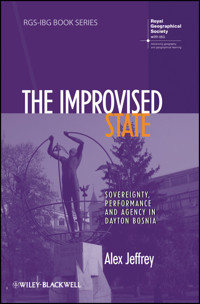
The Improvised State provides a highly developed account of the nature and outcomes of Bosnian state practices since the Dayton Peace Agreement. Jeffrey presents new and significant theories, based on extensive fieldwork in Bosnia, which advance understanding of state building.
- Provides a major contribution to recent academic debates as to the nature of the state after violent conflict, and offers invaluable insights into state building
- Introduces the idea of state improvisation, where improvisation refers to a process of both performance and resourcefulness
- Uses the theoretical framework of Pierre Bourdieu to explore how powerful agencies have attempted to present a coherent vision of Bosnia and Herzegovina following the conflict 1992-5
- Advances our understanding of the Bosnian state by focusing on the practices of statecraft fostered in the post-Dayton era
- Research based on four periods of residential fieldwork in Bosnia, which allowed a detailed analysis of political practices in the country
Sie lesen das E-Book in den Legimi-Apps auf:
Seitenzahl: 449
Veröffentlichungsjahr: 2012
Ähnliche



















Contents
List of Figures
Series Editors’ Preface
Acknowledgements
Abbreviations
Chapter One Introduction
1.1 States, Performance and Improvisation
1.2 Towards a Political Anthropology of the Bosnian State
1.3 Critical Geopolitics and Qualitative Research Strategy
1.4 Structure of the Book
Chapter Two The Improvised State
2.1 The State Idea
2.2 Performance and Performativity
2.3 Improvisation: Performed Resourcefulness
2.4 Improvising the State
Chapter Three Producing Bosnia and Herzegovina
3.1 Fault Line
3.2 Barrier
3.3 The Balkan Vortex
3.4 The General Framework Agreement for Peace
3.5 Conclusion
Chapter Four Performing Brčko District
4.1 Brčko District and Arbitration
4.2 Stability: Getting the Job Done
4.3 Security: Constructing Legality
4.4 Neutralization: Making People Think
4.5 Conclusion
Chapter Five Gentrifying Civil Society
5.1 Building Civil Society
5.2 Social Capital: The Autonomy of Civil Society
5.3 Cultural Capital: ‘Don’t Just Ask for Another Copy Machine!’
5.4 Beyond Gentrified Civil Society: Roma and Mjesne Zajednice
5.5 Conclusion
Chapter Six Enacting Justice
6.1 Spaces of Justice
6.2 Contesting the State
6.3 Enrolling Civil Society
6.4 Conclusion
Chapter Seven Becoming European
7.1 Europeanization and the State
7.2 Nested Balkanism
7.3 Conclusion
Chapter Eight Conclusion
References
Index
RGS-IBG Book Series
Published
Learning the City: Knowledge and Translocal AssemblageColin McFarlaneGlobalizing Responsibility: The Political Rationalities of Ethical ConsumptionClive Barnett, Paul Cloke, Nick Clarke and Alice MalpassDomesticating Neo-Liberalism: Spaces of Economic Practice and Social Reproduction in Post-Socialist CitiesAlison Stenning, Adrian Smith, Alena Rochovská and Dariusz ŚwiątekSwept Up Lives? Re-envisioning the Homeless CityPaul Cloke, Jon May and Sarah JohnsenAerial Life: Spaces, Mobilities, AffectsPeter AdeyMillionaire Migrants: Trans-Pacific Life LinesDavid LeyState, Science and the Skies: Governmentalities of the British AtmosphereMark WhiteheadComplex Locations: Women’s Geographical Work in the UK 1850–1970Avril MaddrellValue Chain Struggles: Institutions and Governance in the Plantation Districts of South IndiaJeff Neilson and Bill PritchardQueer Visibilities: Space, Identity and Interaction in Cape TownAndrew TuckerArsenic Pollution: A Global SynthesisPeter Ravenscroft, Hugh Brammer and Keith RichardsResistance, Space and Political Identities: The Making of Counter-Global NetworksDavid FeatherstoneMental Health and Social Space: Towards Inclusionary Geographies?Hester ParrClimate and Society in Colonial Mexico: A Study in VulnerabilityGeorgina H. EndfieldGeochemical Sediments and LandscapesEdited by David J. Nash and Sue J. McLarenDriving Spaces: A Cultural-Historical Geography of England’s M1 MotorwayPeter MerrimanBadlands of the Republic: Space, Politics and Urban PolicyMustafa DikeçGeomorphology of Upland Peat: Erosion, Form and Landscape ChangeMartin Evans and Jeff WarburtonSpaces of Colonialism: Delhi’s Urban GovernmentalitiesStephen LeggPeople/States/TerritoriesRhys JonesPublics and the CityKurt IvesonAfter the Three Italies: Wealth, Inequality and Industrial ChangeMick Dunford and Lidia GrecoPutting Workfare in PlacePeter Sunley, Ron Martin and Corinne NativelDomicile and DiasporaAlison BluntGeographies and MoralitiesEdited by Roger Lee and David M. SmithMilitary GeographiesRachel WoodwardA New Deal for Transport?Edited by Iain Docherty and Jon ShawGeographies of British ModernityEdited by David Gilbert, David Matless and Brian ShortLost Geographies of PowerJohn AllenGlobalizing South ChinaCarolyn L. CartierGeomorphological Processes and Landscape Change: Britain in the Last 1000 YearsEdited by David L. Higgitt and E. Mark LeeThe Improvised State: Sovereignty, Performance and Agency in Dayton BosniaAlex Jeffrey
Forthcoming
Spatial Politics: Essays for Doreen MasseyEdited by David Featherstone and Joe PainterIn the Nature of Landscape: Cultural Geography on the Norfolk BroadsDavid MatlessWorking Memories: Gender and Migration in Post-war BritainLinda McDowellFashioning Globalisation: New Zealand Design, Working Women and the ‘New Economy’Maureen Molloy and Wendy LarnerDunes: Dynamics, Morphology and Geological HistoryAndrew WarrenScalar Politics of Food in CubaMarisa Wilson
This edition first published 2013© 2013 John Wiley & Sons, Ltd.
Wiley-Blackwell is an imprint of John Wiley & Sons, formed by the merger of Wiley’s global Scientific, Technical and Medical business with Blackwell Publishing.
Registered OfficeJohn Wiley & Sons, Ltd, The Atrium, Southern Gate, Chichester, West Sussex, PO19 8SQ, UK
Editorial Offices350 Main Street, Malden, MA 02148-5020, USA9600 Garsington Road, Oxford, OX4 2DQ, UKThe Atrium, Southern Gate, Chichester, West Sussex, PO19 8SQ, UK
For details of our global editorial offices, for customer services, and for information about how to apply for permission to reuse the copyright material in this book please see our website at www.wiley.com/wiley-blackwell.
The right of Alex Jeffrey to be identified as the author of this work has been asserted in accordance with the UK Copyright, Designs and Patents Act 1988.
All rights reserved. No part of this publication may be reproduced, stored in a retrieval system, or transmitted, in any form or by any means, electronic, mechanical, photocopying, recording or otherwise, except as permitted by the UK Copyright, Designs and Patents Act 1988, without the prior permission of the publisher.
Wiley also publishes its books in a variety of electronic formats. Some content that appears in print may not be available in electronic books.
Designations used by companies to distinguish their products are often claimed as trademarks. All brand names and product names used in this book are trade names, service marks, trademarks or registered trademarks of their respective owners. The publisher is not associated with any product or vendor mentioned in this book. This publication is designed to provide accurate and authoritative information in regard to the subject matter covered. It is sold on the understanding that the publisher is not engaged in rendering professional services. If professional advice or other expert assistance is required, the services of a competent professional should be sought.
Library of Congress Cataloging-in-Publication Data
Jeffrey, Alexander Sam.The improvised state : sovereignty, performance and agency in Dayton Bosnia / Alex Jeffrey.p. cm.Includes bibliographical references and index.
ISBN 978-1-4443-3699-3 (cloth) – ISBN 978-1-4443-3700-6 (pbk.)1. Bosnia and Hercegovina–Politics and government–1992– 2. Sovereignty. 3. Geopolitics–Bosnia and Hercegovina. 4. Dayton Peace Accords (1995)JN2203.A58J44 2012320.94974–dc23
2012015743
A catalogue record for this book is available from the British Library.
Cover image © Alex JeffreyCover design by Workhaus
Dedicated to the memory of Ellie Maxwell (1977–2009)
List of Figures
1
Palestinian chair at the United Nations
2
Map of Yugoslavia in 1990
3
Brčko municipality and BiH after the GFAP
4
Monument to the Serb defenders of Brčko
5
Supervisory order creating Brčko District
6
Burnt apartment building, Brčko, April 2003
7
Dual script road sign, Klanac, Brčko District, February 2003
8
New house number, Brčko, July 2003
9
Farm well in Bukvik, Brčko District, June 2003
10
Examples of graffiti, Brčko town centre, December 2002
11
The State Court of Bosnia and Herzegovina, Sarajevo
12
The Judge’s Bench, Court Room Six, The CBiH, Sarajevo
13
PDP election poster, Brčko, 2002
Series Editors’ Preface
The RGS-IBG Book Series only publishes work of the highest international standing. Its emphasis is on distinctive new developments in human and physical geography, although it is also open to contributions from cognate disciplines whose interests overlap with those of geographers. The Series places strong emphasis on theoretically informed and empirically strong texts. Reflecting the vibrant and diverse theoretical and empirical agendas that characterize the contemporary discipline, contributions are expected to inform, challenge and stimulate the reader. Overall, the RGS-IBG Book Series seeks to promote scholarly publications that leave an intellectual mark and change the way readers think about particular issues, methods or theories.For details on how to submit a proposal please visit:www.rgsbookseries.com
Neil CoeUniversity of Manchester, UKJoanna BullardLoughborough University, UKRGS-IBG Book Series Editors
Acknowledgements
The arguments in this book have been developed over a decade of researching international intervention in Bosnia and Herzegovina. Part of the writing emerges from doctoral work conducted at the Geography Department at Durham University and funded by the Economic and Social Research Council (ESRC award number R42200134266). I am extremely grateful to my three supervisors, Joe Painter, Emma Mawdsley and Luiza Bialasiewicz, for their support and advice over this project and beyond. The arguments were refined through an ESRC-funded post-doctoral fellowship (ESRC award number PTA-026-27-0576), also at Durham University, and I would like to thank Ash Amin for his guidance and feedback through this process. Finally, the book proposal and the majority of the writing were completed while I was lecturing at Newcastle University’s School of Geography, Politics and Sociology. I would like to thank my colleagues over this period, in particular Nick Megoran, Matthew Rech, Alison Williams, Fiona McConnell, Rachel Woodward, Nina Laurie, Andy Gillespie, Martin Coward and Stuart Dawley. I am especially grateful to Raksha Pande who provided assistance with synthesizing literatures on improvisation and the state. Beyond these institutional contexts I am grateful to a range of people for advice and support over the writing period, in particular Colin McFarlane, Alex Vasudevan, Carl Dahlman, Dan Swanton, Peter Thomas, Briony Jones, Merje Kuus, Stuart Elden, David Campbell, Klaus Dodds and Lynn Staeheli.
The process of writing the book has been made considerably more straightforward by the expertise and support of those on the RGS-IBG Book Series editorial team; in particular I would like to thank Kevin Ward and Neil Coe for their extremely supportive and constructive editorial skills. I would also like to thank Jacqueline Scott and Isobel Bainton at Wiley-Blackwell for their advice and encouragement. The proposal and manuscript were strengthened through the feedback and suggestions of the anonymous referees; I am grateful for their assistance. I am also grateful to the publishers for the permission to draw on material from previously published material in three of the chapters of this book. Chapter Four contains material previously published in Political Geography 25(2) 203–227 (Elsevier, Philadelphia); Chapter Five contains discussions previously published in Development and Change 38(2) 251–274 (Wiley-Blackwell, Oxford), and a version of Chapter Seven appeared in Environment and Planning D: Society and Space 26(3) 428–443 (Pion, London).
There are a large number of people to thank who assisted with the empirical research for this book. In Brčko District I would like to thank Goran Mihailović, Saška Haramina, Mirella, Davor and Aleksa Ceran, Leila Jaserević, Gordana Varcaković, Kristina Varcaković, Elenora Emkić, Jack Richold, Catharina de Lange, Slawomir Klimkiewicz and Mary Lynch. In Sarajevo I would like to thank Zlatan Musić, Asim Mujkić, Damir Arsenijević, Refik Hodzić and Selma Hađzić. I would also like to thank Matt Bolton for his support and friendship since we met in Brčko in 2002. Many of the arguments in the book began as discussions with Matt, and I have benefited greatly from his wisdom.
Over the final months of the book writing I am indebted to the support and friendship of Michaelina Jakala, as research assistant on a two-year study of the public outreach strategies of the State Court of Bosnia and Herzegovina (ESRC award number RES-061-25-0479). I am grateful for her insightful reading of the manuscript and her wise advice. I am also grateful to her husband Martin and daughter Nia for being such great hosts in Sarajevo.
I would like to thank Craig Jeffrey, Jane Dyson, Ewan Jeffrey and my parents for all the help over the years, in particular Craig’s assistance in thinking through improvisation. The biggest thanks go to Laura Jeffrey. It certainly wouldn’t have been possible to complete this project without her support and help; I am forever grateful for all the interest, the careful readings, the ideas and the encouragement. A final big thanks and hug to Rufus and Clemence for making the time between writing so much fun.
This book is dedicated to Ellie Maxwell, an inspirational friend and colleague who worked tirelessly over her lifetime for causes in Bosnia and Herzegovina, particularly in the town of Brčko. Ellie and I met as fellow students at Edinburgh University, and it was through working for Firefly Youth Project in Brčko in 1999–2000 that I first became interested in the question of state building in Bosnia. Ellie is greatly missed, and all who knew her continue to be inspired by her insights, intelligence and compassion.
Abbreviations
ARBiH
Armija Republike Bosne i Hercegovine
(Army of the Bosnian Republic)
BiH
Bosnia and Herzegovina
CBiH
The Court of Bosnia and Herzegovina
CCI
Centri civilnih inicijativa
(Centre for Civil Initiative)
CSN
Court Support Network
DMT
District Management Team (in Br
č
ko District)
DP
Displaced Person
EU
European Union
FRY
Federal Republic of Yugoslavia
GFAP
General Framework Agreement for Peace (Dayton Peace Accords)
GTZ
Gesellschaft für Technische Zusammenarbeit
(German Technical Cooperation Agency)
ICG
International Crisis Group
ICTY
International Criminal Tribunal for the former Yugoslavia
IEBL
Inter-Entity Boundary Line
I-For
Implementation Force
IHC
International Housing Commission
IPTF
International Police Task Force
IRC
International Rescue Committee
JNA
Jugoslovenska narodna armija
(Yugoslav People’s Army)
MZ
Mjesna zajednica
(local community association)
NATO
North Atlantic Treaty Organization
NGO
Non-Governmental Organization
OHR
Office of the High Representative
OSCE
Organization for Security and Co-operation in Europe
OZNa
Odeljenje za zastitu narodna
(Department for the People’s Defence)
PIC
Peace Implementation Council
RRTF
Return and Reconstruction Task Force
RS
Republika Srpska
(sub-division of Bosnia and Herzegovina)
SDA
Stranka demokratska akcije
(Party for Democratic Action)
SDP
Socijaldemokratska partija Bosne i Hercegovine
(Social Democratic Party)
SDS
Srpska demokratska stranka
(Serb Democratic Party)
S-For
Stabilization Force
SIDA
Swedish International Development Corporation Agency
SNSD
Savez nezavisnih socijaldemokrata
(Alliance of Independent Social Democrats)
UN
United Nations
UNDP
United Nations Development Programme
UNHCR
United Nations High Commission for Refugees
USAID
United States Agency for International Development
USDA
United States Department for Agriculture
VOPP
Vance Owen Peace Plan
VRS
Vojska Republike Srpske
(Army of Republika Srpska)
WCC
War Crimes Chamber
ZOS
Zone of Separation
Chapter One
Introduction
Figure 1 Palestinian chair at the United Nations
Source: © Stan Honda/AFP/Getty Images
New York, 23 September 2011. The head of the Palestinian Authority, Mahmoud Abbas, is seeking a vote at the United Nations on an application for Palestinian admission to the UN as a member state. In the build-up to the request for the vote, Palestinian activists have produced a chair as a symbol of the desire for a Palestinian seat at the General Assembly of the United Nations. In the preceding weeks the chair has toured the Middle East and Europe, before taking pride of place at news conferences in New York in the lead-up to the vote. The symbolism is easy to grasp: the chair is covered in blue velour, marked with the UN olive branches encircling a symbol of another seat, on which the Palestinian Authority’s flag is imprinted. Underneath these images are sewn the words ‘Palestine’s Right: A full membership in the United Nations’. But underpinning this stark imagery are two more subtle assumptions: the first, that desire for Palestinian statehood could be fulfilled through the recognition granted by UN membership. Membership would serve as a symbol of statehood, despite not necessarily changing the forms of authority or territorial control in the West Bank and Gaza. Indeed, youth activists in Ramallah in the West Bank were keen to distinguish between the ‘emotional’ nature of international recognition and the unchanging ‘practical’ everyday experience of militarized check points: settlement construction and inhibited freedom of movement (see BBC, 2011). But the second assumption is reflected in the symbolism of the seat itself. The claim to Palestinian statehood is not made solely in a speech to the General Assembly of the UN, but is rather symbolized through the creation of the seat. The act of producing the seat, and its tour through Europe and the Middle East, provide a chance to perform statehood, to ground the legitimacy and effect of the claim through repeated enactments of the securing of a UN seat. In this sense, performance is at the heart of attempts to convey state legitimacy. The design of the chair draws on audience expectations of a ‘real’ UN seat, primed as they would be to recognize the appropriate colours and symbolism for UN furniture.
Lesen Sie weiter in der vollständigen Ausgabe!
Lesen Sie weiter in der vollständigen Ausgabe!
Lesen Sie weiter in der vollständigen Ausgabe!
Lesen Sie weiter in der vollständigen Ausgabe!
Lesen Sie weiter in der vollständigen Ausgabe!
Lesen Sie weiter in der vollständigen Ausgabe!
Lesen Sie weiter in der vollständigen Ausgabe!
Lesen Sie weiter in der vollständigen Ausgabe!
Lesen Sie weiter in der vollständigen Ausgabe!




