


1,99 €
Niedrigster Preis in 30 Tagen: 1,99 €
Niedrigster Preis in 30 Tagen: 1,99 €
Mehr erfahren.
- Herausgeber: DigiCat
- Kategorie: Poesie und Drama
- Sprache: Englisch
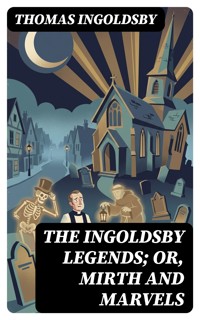
The Ingoldsby Legends; or, Mirth and Marvels is a fascinating anthology of whimsical tales that intertwine folklore, myth, and humor. Thomas Ingoldsby employs a distinctive narrative style, characterized by his rhythmic prose and rich, evocative imagery, which invites readers into a world where the supernatural mingles with the absurd. The collection showcases Ingoldsby's mastery of comic verse and exploration of Gothic themes, reflecting the literary context of early Victorian England, a period ripe with a burgeoning interest in folklore and the macabre. Through his satirical lens, Ingoldsby reinterprets traditional stories, breathing new life into them while also providing sharp social commentary. Thomas Ingoldsby, born Richard Harris Barham, was not only a clergyman but also a man of letters with a profound interest in the culture and folklore of his time. His own experiences within the British literary scene, coupled with his ecclesiastical background, infuse the stories with a rich understanding of human nature and societal norms. His ability to blend the sacred with the profane speaks to both his literary prowess and his desire to entertain, illuminating the paradoxes of his contemporaneous society. Readers seeking a blend of humor and spine-chilling tales will find The Ingoldsby Legends to be an exquisite addition to their literary collection. It beckons not just for amusement but for a deeper reflection on folklore's role within cultural storytelling. A poignant read for those intrigued by the intersection of comedy and Gothic literature, this collection promises to captivate and delight. In this enriched edition, we have carefully created added value for your reading experience: - A comprehensive Introduction outlines these selected works' unifying features, themes, or stylistic evolutions. - A Historical Context section situates the works in their broader era—social currents, cultural trends, and key events that underpin their creation. - A concise Synopsis (Selection) offers an accessible overview of the included texts, helping readers navigate plotlines and main ideas without revealing critical twists. - A unified Analysis examines recurring motifs and stylistic hallmarks across the collection, tying the stories together while spotlighting the different work's strengths. - Reflection questions inspire deeper contemplation of the author's overarching message, inviting readers to draw connections among different texts and relate them to modern contexts. - Lastly, our hand‐picked Memorable Quotes distill pivotal lines and turning points, serving as touchstones for the collection's central themes.
Das E-Book können Sie in Legimi-Apps oder einer beliebigen App lesen, die das folgende Format unterstützen:
Veröffentlichungsjahr: 2022
Ähnliche















The Ingoldsby Legends; or, Mirth and Marvels
Table of Contents
Introduction
This collection presents Thomas Ingoldsby’s The Ingoldsby Legends; or, Mirth and Marvels in its full variety, bringing together the tales, lays, and jocoserious miscellanies through which the author forged a uniquely comic Gothic. Under the playful mask of ‘Thomas Ingoldsby’—the literary persona of the English clergyman Richard Harris Barham—the pieces blend antiquarian curiosity with lively storytelling. From haunted chambers and nursery gossip to mock-saintly exploits and town-and-country misadventures, the selections here showcase a repertoire designed to entertain while poking fun at superstition and solemnity. Memoir, preface, and appendices frame the narratives, situating their mirth, marvels, and occasional moral in a wider life and times.
First issued as magazine contributions, the Legends emerged in print from 1837 onward, notably in Bentley’s Miscellany, before being gathered in three series published in 1840, 1842, and, posthumously, 1847. The present arrangement reflects that mixed provenance: verse and prose stand side by side; a Preface to the Second Edition acknowledges early reception; a concluding appendix preserves ancillary curiosities. Canonical pieces—such as The Spectre of Tappington and The Jackdaw of Rheims—appear with companion narratives and playful afterpieces, allowing readers to encounter the range that made Ingoldsby a household name and a mainstay of nineteenth‑century parlour reading.
In genre, this is a polymath’s cabinet. It includes comic ballads and verse ‘lays’ of saints; prose ghost stories and travellers’ yarns; dramatic burlesques such as Some Account of a New Play, complete with Acts I–V; narrated tales framed by character voices in The Nurse’s Story and Mrs. Botherby’s Story; occasional epigrams and songs; and retrospective material in a memoir and preface. Items like The Bagman’s Dog, The Witches’ Frolic, and Misadventures at Margate reveal how Ingoldsby exploits the possibilities of recitation, dialogue, and stage business, all within the accessible compass of short forms rather than extended novels.
Across the table of contents, certain preoccupations recur. Ingoldsby delights in exposing credulity and the mechanical habits of superstition while maintaining a genuine antiquarian interest in churches, saints’ days, relics, and parish histories. Domestic spaces become theatres of the uncanny in pieces about spectral visitors or unexplained sounds, yet the terror is tempered by common sense, wordplay, and sudden bathos. The saintly lays draw on medieval legend to stage miracles and moral twists, but their tone is mischievous rather than doctrinaire. Elsewhere, legal processions, coronations, and civic ceremonies prompt satire that is mischievous without descending into malice.
The stylistic signature is instantly recognizable: brisk anapaestic or trochaic movement in comic verse; catalogues and refrains that invite reading aloud; sudden shifts between Latinate gravity and homely idiom; and copious puns tied to place‑names, professions, and heraldic lore. Prose pieces carry mock‑scholarly introductions, facetious footnotes, and antiquarian asides that lend an air of learned authority to the wildest incidents. Names such as Hamilton Tighe or Sucklethumbkin are chosen for their sound as much as their sense. Above all, the author controls timing; a pause, a parenthesis, or a rhyme is exploited to spring the joke.
Historically, The Ingoldsby Legends formed one of the Victorian era’s most popular suites of light verse and comic narrative, circulating widely in periodicals and collected editions. Pieces such as The Jackdaw of Rheims, The Witches’ Frolic, and A Lay of St. Nicholas have remained familiar through anthologies and recitation. Their importance lies not only in entertainment value but in the way they mediate between magazine culture and the revival of medieval subjects, making learned lore sociable. They exemplify how a clerical wit could address a broad readership without condescension, pairing moral sentiment with laughter and a cultivated eye for place.
Readers new to Ingoldsby may approach the volume in any order, sampling a prose apparition, a saintly lay, or a dramatic travesty according to taste. The Memoir and Preface to the Second Edition provide orientation before the revels begin; the Appendix and Miscellaneous Poems extend the portrait beyond the core Legends. While each piece stands alone, rewards multiply as motifs, refrains, and locales reappear, weaving a lightly satirical map of churches, inns, and coastal towns. Attend to the framing voices—a nurse, a bagman, a parish busybody—as much as the marvels, and the mirth will be all the richer.
Historical Context
In early Victorian London, The Ingoldsby Legends emerged from the bustling world of magazine culture. Richard Harris Barham, a Church of England clergyman writing as 'Thomas Ingoldsby of Tappington Manor', began publishing the tales in Bentley’s Miscellany from 1837 under the editorship of Charles Dickens, and in other periodicals. Their popularity quickly prompted book publication: a First Series in 1840, a Second in 1842, and a posthumous Third in 1847, issued by Richard Bentley. The collection’s frame—papers discovered at a Kentish manor—mirrored the era’s taste for mock scholarship, while periodical seriality encouraged episodic variety across ghost stories, ballads, and theatrical parodies.
The Legends drew sustenance from the Gothic Revival and antiquarian enthusiasm sweeping Britain. Barham’s tenure as a Minor Canon of St Paul’s Cathedral gave him access to ecclesiastical libraries, charters, and hagiography that he burlesqued in lays of saints and mock-miracles. The Oxford Movement, launched in 1833 by John Keble, John Henry Newman, and E. B. Pusey, stirred debates on ritual, authority, and medieval tradition. Barham’s comic scepticism answered these currents by ridiculing credulity—Roman and Protestant alike—without abandoning a Tory Anglican affection for old forms. Such tensions animate A Lay of St. Nicholas, St. Dunstan, or The Jackdaw of Rheims, where piety, relics, and power collide.
Equally important was the Victorian passion for local lore. Barham’s ostensible seat, Tappington in Kent, pointed to a coastal county thick with smugglers’ tales, ruined priories, and parish legends. After the Napoleonic Wars, stories of clandestine runs across Romney Marsh and the Dover straits persisted in popular memory, informing The Smuggler’s Leap and kindred narratives. The founding of the Camden Society in 1838 and county histories by antiquaries legitimized collecting such materials. Poems like Netley Abbey trade on the era’s picturesque tourism, where ivy-clad ruins and whispered hauntings—the Spectre of Tappington, the Dead Drummer—were experienced as both historical curiosities and pleasurable shudders.
Rapid urban change supplied contemporary scenes for Barham’s comic eye. London’s omnibus, introduced by George Shillibeer in 1829, created a new microcosm of jostling classes, echoed in A Row in an Omnibus (Box). Steampackets and improved roads fed the seaside boom; Margate, long patronized by Londoners, became emblematic of mass leisure, a setting for Misadventures at Margate. Public fascination with aeronautics peaked after Charles Green’s celebrated 1836 voyage of the Great Nassau from Vauxhall to Germany; exhibitions advertised monster balloons. The 'Monstre' Balloon lampoons such scientific pageantry, showing how novelty, crowds, and journalism fashioned spectacles that rivaled any medieval marvel.
Political ceremony and punishment alike offered Barham ample targets. The festive tumult surrounding Queen Victoria’s coronation at Westminster Abbey in 1838 is refracted through comic dialect in Mr. Barney Maguire’s Account of the Coronation, a piece alive to metropolitan crowds and Irish migration. Conversely, Hon. Mr. Sucklethumbkin’s Story — The Execution registers the era’s fascination with public hangings at Newgate, events that drew huge audiences until reforms decades later. An expanding cheap press and the spread of literacy meant such occasions were reported, parodied, and recited across Britain. Barham mined this shared news culture, recasting headlines as humorous ballads and mock-heroic narratives.
Continental settings and the stage furnished additional frames. The Inquisition’s rituals, sensationalized in travelogues and Black Legend histories, underpin the satire of The Auto-da-fé. Francophile fashions and the July Monarchy (1830–1848) encouraged cross-Channel storytelling; pieces like The Black Mousquetaire wink at musketeer romance then popularized by feuilleton fiction. Meanwhile, Britain’s theatre—tightly regulated under the Licensing Act of 1737 until reform in 1843—favored burlesque, travesty, and melodrama outside the patent houses. Barham’s parodic Merchant of Venice and Some Account of a New Play exploit this milieu, treating Shakespeare, operatic conventions, and censors’ foibles as material for irreverent, topical mischief.
The collection’s style belongs to a wider nineteenth‑century revival of balladry and comic verse. From Bishop Percy’s Reliques to Walter Scott’s Minstrelsy and Thomas Hood’s playful rhymes, readers had learned to prize archaisms, refrain, and punning. Barham adapted these effects to magazine pacing, with mock-scholarly notes, macaronic Latin, and rollicking anapaests that suited recitation in parlors and on platforms. Illustrations by George Cruikshank and John Leech—masters of grotesque and caricature—enhanced the Legends’ visual wit and circulation. The Jackdaw of Rheims and The Lady Rohesia became party pieces, their blend of narrative verve and moral teasing emblematic of mid‑Victorian taste.
Under the merriment lay somber Victorian preoccupations with sin, death, and reform. The cholera epidemic of 1831–32, prison controversies, and efforts to rationalize the Church’s revenues formed part of the background that makes penitence, haunting, and sudden judgment believable in tales like The Blasphemer’s Warning, The Dead Drummer, or The Ingoldsby Penance! Barham’s own declining health preceded his death in 1845; the Third Series appeared in 1847 with a memoir that fixed his clerical wit in public memory. As Christmas periodicals popularized seasonal ghost stories, the Legends’ blend of laughter and shiver helped define a durable Victorian mode of popular superstition.
Synopsis (Selection)
Framing and Paratext (Memoir; Preface to the Second Edition; Appendix)
These pieces establish a mock-antiquarian voice and playful authorial persona, outlining the collection’s game of mingling folklore with farce.
They cue readers to expect facetious notes, pseudo-history, and shifting registers that keep fact and fancy in comic suspension.
Haunted and Supernatural Tales (The Spectre of Tappington; The Ghost; The Cynotaph; Legend of Hamilton Tighe; The Witches’ Frolic; Singular Passage in the Life of the Late Henry Harris, Doctor in Divinity; Netley Abbey; Fragment; Nell Cook!!; The Dead Drummer; Raising the Devil; The House-Warming!!; The Forlorn One; The Blasphemer’s Warning)
A suite of comic-gothic hauntings, witchly revels, revenants, and cursed locales turns dread into drollery while testing credulity against commonsense.
Moral comeuppance, ecclesiastical satire, and anticlimax recur, with brisk verse and anecdotal prose puncturing the pomp of the supernatural.
Tale‑tellers’ Stories (The Nurse’s Story; Patty Morgan the Milkmaid’s Story; Mrs. Botherby’s Story; Hon. Mr. Suckletthumbkin’s Story — The Execution; Mr. Peters’s Story — The Bagman’s Dog)
Nested yarns delivered in lively dialects and distinct voices spin tall tales of mishap, marvel, and narrow escapes.
They spotlight oral tradition as performance, where exaggeration, local color, and sly morals matter as much as the plot.
Ecclesiastical Lays and Romps (The Jackdaw of Rheims; A Lay of St. Dunstan; A Lay of St. Gengulphus; A Lay of St. Odille; A Lay of St. Nicholas; The Lay of St. Cuthbert; The Lay of St. Aloys; The Lay of the Old Woman Clothed in Grey; The Lay of St. Medard; The Ingoldsby Penance!)
Mock-hagiographic ballads parade saints, relics, and monastic mischief in rollicking meters that turn miracle into merry-making.
They mix churchly lore with brisk narrative and playful Latin tags, satirizing human foibles while dodging piety’s solemnity.
Chivalric and Continental Romances & Parodies (The Lady Rohesia; The Black Mousquetaire; Sir Rupert the Fearless; The Merchant of Venice; The Auto-da-Fé; The Lord of Thoulouse; The Knight and the Lady)
These send-ups of tourneys, duels, inquisitorial pomp, and courtly love blend swashbuckling incident with gothic melodrama and legalistic play.
Honor codes collide with practical absurdities, as pastiche and pun deflate heroic postures and fashionable continental airs.
Ballads of Crime, Sea, and Folklore (Grey Dolphin; The Smuggler’s Leap; Bloudie Jacke of Shrewsberrie; The Babes in the Wood; or, The Norfolk Tragedy)
Briny ventures, highway scrapes, and nursery-ballad tragedies are retold with brisk verse, gallows humor, and sly asides.
Fatalism wrestles with folly and law, as superstition, rumor, and local justice steer characters toward ironic fates.
Stage and Spectacle Satires (Mr. Barney Maguire’s Account of the Coronation; The “Monstre” Balloon; Some Account of a New Play [Acts I–V])
Public ceremony, technological fads, and theatrical convention are lampooned through bustling monologues and play-within-a-play pastiche.
The pieces revel in crowd psychology and showmanship, exposing how performance, publicity, and misperception reshape events.
Urban and Domestic Satires & Sketches (A Row in an Omnibus [Box]; Misadventures at Margate; Nursery Reminiscences; Aunt Fanny; The Wedding-Day; The Brothers of Birchington; Jerry Jarvis’s Wig; Unsophisticated Wishes; The Tragedy)
Everyday mishaps, seaside excursions, and family foibles become comic case studies in manners, class pretensions, and petty vanities.
Genial caricature and nimble rhyme turn small embarrassments into social satire, favoring wit over scold.
Recurring Motifs and Style
Across the collection, mock‑scholarship, jangling rhymes, puns, and playful footnotes keep terror and tenderness in humorous counterpoint.
Ingoldsby toggles between medieval pastiche and contemporary sketch, uniting them through brisk storytelling, burlesque, and moral irony.
Miscellaneous Poems (Hermann; or, The Broken Spear; Hints for an Historical Play; Marie Mignot; The Truants; The Poplar; My Letters; New‑Made Honour; The Confession; Epigram; Song; Epigram; Song; As I Laye A‑Thynkynge)
A grab‑bag of romantic fragments, historical conceits, reflective lyrics, and sharp epigrams showcases range from wistful to burlesque.
Themes of memory, reputation, love, and literary craft appear in compact forms that prize turn of phrase and neatly turned endings.
The Ingoldsby Legends; or, Mirth and Marvels
MEMOIR.
Richard Harris Barham, the "Thomas Ingoldsby" of literature, was born at Canterbury, December 6th, 1788. His family had long been residents in the archiepiscopal city, and had estates in Kent. He (Barham) used to trace his descent from a knight who came over to England with William the Conqueror, and whose son, Reginald Fitzurse, was one of the assassins of Thomas à Becket. After the deed Fitzurse fled to Ireland, and there changed his name to MacMahon, which has the same meaning. His brother Robert, who succeeded to the English estates, changed his patronymic to de Berham, converted in process of time into Barham.
Richard Barham was only between five and six years old when his father died, leaving him heir to a small estate in Kent. A portion of it consisted of a manor called Tappington Wood, often alluded to in the Ingoldsby Legends.
Richard was sent to St. Paul's School, and it was on his road thither, in 1802, that he met with an accident that endangered his life. The horses of the Dover mail, in which he was travelling, took fright and galloped off furiously: the boy put his right hand out of the window to open the door, when at that moment the coach upset; his hand was caught under it, and it was dragged along on a rough road and seriously mutilated. The surgeons, believing he would die, did not amputate the limb; and through the tender care of the headmaster's wife (he had been sent on to school) he recovered.
At school Barham formed some friendships which lasted his life: one of these school friends was afterwards his publisher, Mr. Bentley; Dr. Roberts, who attended him in his last illness, was another. He remained captain of St. Paul's School for two years, and when nineteen was entered as a Gentleman Commoner at Brasennose College. Here he was speedily elected a member of a first-class university club,—the Phœnix Common Room,—where he became acquainted with Lord George Grenville, Cecil Tattersall, and Theodore Hook, a friend of his after-life.
A specimen of his youthful humour has been preserved in an answer he made to his tutor, Mr. Hodson, when reproved by him for the late hours he kept and his absence from chapel. "The fact is, sir," said Barham, "you are too late for me." "Too late!" repeated the tutor. "Yes, sir; I cannot sit up till seven in the morning. I am a man of regular habits; and unless I get to bed by four or five at latest, I am really fit for nothing the next day." The habit that he had acquired of sitting up late continued during his life, and he believed that he wrote best at night.
His original intention had been to study for the Bar, but a very severe though short illness brought serious thoughts to the young man, and he determined to enter the Church, his mind having also been painfully impressed by the suicide of a young college friend; consequently he took Holy Orders, and obtained the curacy of Ashford, in Kent, from whence he was transferred to Westwell, a parish a few miles distant from his first one.
In 1814, when he had attained the age of twenty-six, Barham married Caroline, third daughter of Captain Smart of the Royal Engineers, a very charming young lady; and shortly afterwards he was presented to the living of Snargate, and accepted also the curacy of Warehorn. Both these parishes were situated in Romney Marsh, at the distance of only two miles from each other. The young clergyman took up his abode at Warehorn, a place then noted as a haunt of smugglers.
A second accident, by the upsetting of a gig, caused Mr. Barham a fracture of the leg, and it was during the seclusion entailed by this misfortune that he produced his first literary effort, a novel called Baldwin, for which he received £20; it issued from the Minerva Press, and was unsuccessful. He had scarcely recovered from this accident when the illness of one of his children took him to London, for the purpose of consulting Abernethy. Here he chanced to meet a friend, who was about to post a letter to invite a young clergyman to come up and become a candidate for a vacant Minor Canonry at St. Paul's. It suddenly struck him that the place might suit Mr. Barham, and they at once agreed that he should stand for it. He resigned at once his curacy and living, stood for the Canonship, and was elected. Thus in 1821 he exchanged Romney Marsh, its dulness and smugglers, for a residence in London and the society of a highly intellectual circle.
We will give here the testimony of a dear friend of the poet's, as to his character, at this time. "My first acquaintance with Mr. Barham," writes the Rev. John Hughes, "dated from his election into the body of Minor Canons of St. Paul's, of which Cathedral my late father was then a Residentiary. Mr. Barham had married early in life, and in every respect enviably. His previous career as a graduate of Brasennose College had thrown him much into contact with several gifted and accomplished men, upon whom a shred of Reginald Heber's mantle, and a smack and savour of the 'Whippiad,' had descended in the way of corporate inheritance, and his quick talents had mended the lesson. It was soon evident to the Dean and Chapter, and to my father in particular, that their new subordinate combined superior powers of conversation with most decorous and gentlemanly tact and attention to all points connected with his duties."
In 1824, Mr. Barham was appointed a priest in ordinary of the King's Chapel Royal, and was shortly afterwards presented with the incumbency of St. Mary Magdalene and St. Gregory-by-St. Paul. Mr. Barham was not an eloquent preacher, because he disapproved of all oratorical display in the pulpit, but he was an excellent parish priest, ever watchful over his flock, and delighting in doing good.
In 1825 a series of domestic sorrows fell on the Minor Canon. His dearly-loved eldest daughter died; her loss was followed at intervals by that of four of his other children, to all of whom he was devotedly attached. How deeply the gentle-hearted clergyman felt these severe afflictions, some touching lines in Blackwood's Magazine of that date testify, though he bore them with Christian resignation. "The best substitute for stoicism which a man of keen and sensitive feelings finds it possible to adopt, is to think a little less of his own sorrows, and more of those of others; and this," writes Mr. Hughes, "I believe to have been Barham's secret for bearing with equanimity the loss of more than one
He strove to be happy in making others so, especially those more congenial spirits who more directly shared in his affections.... Here it may not be amiss to notice one trait of character connected with the appointment which he held as chaplain to the Vintners' Company. Part of his duty in this capacity was to perform divine service at an almshouse in the vicinity of town, tenanted by certain widows of decayed members of the corporation. The old ladies quarrelled sadly, and Barham was in the habit of devoting one extra morning a week to a pastoral visitation of these poor isolated old women, for charity and decency's sake, and acted as arbiter and referee in their ridiculous feuds, with as much gravity as it was in his nature to assume on such an occasion." There was surely no small degree of self-denial in a man of such talent devoting his valuable time to such an office.
The expenses of an increasing family made Mr. Barham once more attempt literary work—this time successfully; and he contributed light articles in rapid succession to Blackwood, John Bull, and The Globe. He also assisted in the completion of Gorton's Biographical Dictionary. "Cousin Nicholas" appeared in Blackwood in 1878. It owed its publication to Mrs. Hughes, the mother of John Hughes, Esq.,—from whose account of Barham we have just quoted,—a most remarkable and highly-gifted woman, the friend and correspondent of Scott, Southey, etc. The MS. was in an unfinished state, having been laid by for some years, when Barham submitted it to this lady. So highly did she think of it, and so aware was she of the author's sensitive doubts, that she sent it off at once to Mr. Blackwood, who was greatly pleased with it, and at once inserted it in his magazine. The first Barham knew of the Blackwood. He was thus compelled to finish it, and worked up the catastrophe with great skill. Nor was this the only benefit he derived from this gifted friend. It was to her he was indebted for much of the material of the poems that have made his fame as a writer, though this was to come afterwards.
In 1831, Sidney Smith was appointed one of the Canons of St. Paul's, and thus two of our famous wits became intimate. On October 2, 1831, Sidney Smith read himself in as Residentiary at St. Paul's. He told Barham that he had once nearly offended Sam Rogers by recommending him, when he sat for his picture, to be drawn saying his prayers—with his face in his hat.
Mr. Barham was by no means an ardent politician, and he never used his pastoral influence on either side. For himself, he was a staunch Conservative, and never failed, in spite of any personal inconvenience, himself to record his vote. He told one amusing anecdote about an election. As he was landing from the steamer at Gravesend, where his vote was to be taken, it was raining heavily, and the passengers landing from the boat naturally put up their umbrellas. Partisans of both candidates lined the pier, watching eagerly to see what colours the arrivals wore. Barham, remembering a dead cat that had been thrown at him on a previous occasion, wore none; nevertheless he was detected. He heard the Tory partisans cry out, "Here comes one on our side." "You be blowed," said a voter in sky-blue ribbons, "I say he's our'n." "Be blowed yourself," was the reply; "don't you see the gemman's got a silk umbrella?"
In 1837 appeared the famous "Ingoldsby Legends" in Blackwood.
Of their production Mr. Hughes thus writes: "In my mother's presentation copy of the Ingoldsby Legends, written in Barham's own hand, occurs the following distich,—
The fact is that my mother, to whom Lockhart has alluded as a frequent correspondent of Scott and Southey, and who inherited a family stock of strange tales and legends, suggested the subject of 'Hamilton Tighe' to Barham. The original ghost story, in the circumstances of which he made some slight alteration, was said to have occurred in the family of Mr. Pye, the poet laureate, a neighbour and brother magistrate of my maternal grandfather, Mr. W., and the date of it was supposed to be connected with the taking of Vigo. This legend, which appeared in Bentley's Miscellany, was the first in the series, and is, as an illustration of his peculiar style, worth better criticism than my own. Suffice it to state that which my friend Miss Mitford can confirm, that the simple recitation of 'Hamilton Tighe' has actually made persons start and turn pale, and complain of nervous excitement. 'Patty Morgan the Milkmaid's Story' and the 'Dead Drummer' were transmitted also to him through the same medium,—the former having been recounted to us by Lady Eleanor Butler, as a whimsical Welsh legend which had diverted her much; the latter by Sir Walter Scott, who, having better means than most men of ascertaining facts and names, believed in their authenticity. I think, but am not certain, that the 'Hand of Glory' was suggested by a conversation at our house on the subject of country superstition. Of the source of the remaining legends I am ignorant, save that the basis of some of them was furnished by an old Popish book in the library of Sion College, from which, as from other sources, Barham was wont to gratify his love of heraldry and antiquarianism.... The Ingoldsby Legends were the occasional relief of a suppressed plethora of native fun.
"Many of these effusions were written while waiting for a cup of tea, a railroad train, or an unpunctual acquaintance, on some stray cover of a letter in his pocket-book; one in particular served to relieve the tedium of a hot walk up Richmond Hill. It was rather a piece of luck if he found time to joint together the disjecti membra poetæ in a fair copy; and before the favoured few had done laughing at some rhymes which had never entered a man's head before, the zealous Bentley had popped the whole into type. After all, the imputed instances of inadvertence (for no one who knew him would style it irreverence) chiefly occur in that part of the series in which his purpose, to my knowledge, was to quiz that spirit of flirtation with the Scarlet Lady of Babylon, which had of late assumed a pretty marked shape; and it was difficult to prosecute this end without confounding the Scriptural St. Peter with the Dagon of the Vatican."
We give these extracts from a letter written by Mr. John Hughes, of Donnington Priory, to Mr. Ainsworth, believing that the reprinted report of a personal friend will be more interesting than a condensed account of it. Mr. Hughes himself was a ripe scholar and a wit. He published poetical pleasantries, under the name of "Mr. Butler of Brasen-nose," in Blackwood and Ainsworth's Magazine, and was the father of Mr. Thomas Hughes, the author of Tom Brown's Schooldays.
"As regards the 'Dead Drummer,' the story was attested in a contemporary pamphlet, called A Narrative of the Life, Confession, and Dying Speech of Jarvis Matchan, which was signed by the Rev. J. Nicholson, who attended him as minister, and by another witness. The murder was not committed on Salisbury Plain, but near Alconbury in Huntingdonshire, and the culprit was hanged in chains at Huntingdon, August 2nd, 1786, for the wilful murder of Benjamin Jones, a drummer boy in the 48th Regiment of Foot, on August 19, 1780. Matchan's escape to sea, and the subsequent vision on Salisbury Plain, which wrung from him his confession, are given with great minuteness, and are as marvellous as any in the poem."
"Nell Cook," "Grey Dolphin," "The Ghost," and "The Smuggler's Leap" are Kentish legends, well known, though of course much embellished by the poet. "The Old Woman clothed in Grey" was taken from the story of a ghost that haunted an old rectory near Cambridge, whose custom it was to stroll about the house at mid-night, with a bag of money in her hand, which she offered to whomever she met; but no one was brave enough to take it from her.
The foundation of most of the legends on subjects of Popish superstition may be found in the Monkish Chronicles which the library at Sion College contains. He tells us that the "Jackdaw of Rheims"—one, by the way, of his most popular legends—was a version of an old Roman Catholic legend "picked up" out of a High Dutch author.
The strange details contained in "The Singular Passage in the Life of the late Dr. Harris" were communicated to Mr. Barham by a young lady on her sick-bed, who fully believed all she told him, and even urged the arrest of the young man, to whose arts she believed herself to be a victim. She retained the delusion as long as she lived. The story appeared first in Blackwood.
In 1839, Sidney Smith placed a Residentiary house, in Amen Corner, at the disposal of Mr. Barham, and the family moved into it in September. This dwelling dated from the erection of the Cathedral itself, and, having been long unoccupied, had become the stronghold of legions of rats, which had first to be destroyed before the family could settle in it.
In 1840, Mr. Barham succeeded, in course of rotation, to the Presidency of Sion College, which was held for one year only by the London incumbents in rotation.
The death of Theodore Hook, his life-long friend, occurred in 1841, and Mr. Barham was deeply affected by it. "One of the last parties at which Hook was present" (Mr. Barham's son tells us in his "Memoirs" of his father) "was at Amen Corner" (Barham's house). He was unusually late, and dinner was served before he made his appearance; Mr. Barham apologized for having sat down without him, observing that he had quite given him up, and supposed that the weather had deterred him.
"Oh," replied the former, "I had determined to come—weather or no."
The friends met only once more after that evening.
Within a year after taking up his abode at Amen Corner, a far heavier sorrow had fallen on Mr. Barham. His youngest son, a boy of great promise and precocious talent, died. His second son had died of cholera in 1832. This last blow fell heavily on the father. His elastic spirits had rebounded from the previous ones, but this loss was never fully recovered by him. The death of Hook, coming soon after, depressed him still more.
In 1842, Mr. Barham was appointed to the Divinity Readership of St. Paul's, and was permitted to exchange the living he held for the more valuable one of St. Faith; the duties of which were, also, less onerous than those of the parish in which he had worked for twenty years.
His parishioners felt the separation from their excellent pastor deeply, and no doubt their feelings were shared by him who had so long been their guide and sympathetic friend. Mrs. Barham was also greatly loved, and had rendered good service in the management of the school, and visiting the poor; a testimonial was presented to both by their grateful people, in the shape of a handsome silver salver.
His new living being contiguous to his old one, Mr. Barham did not change his residence, in which, in fact, he was permitted to live for the remainder of his life. But he was always delighted when a little leisure enabled him to go into the country and to the seaside, or to his native Kent to find legends; but such excursions were few and brief for the hardly worked clergyman.
Mr. Barham was one of the first members of the Archæological Association, instituted for the purpose of making trips to places where antiquarian research could be carried on; he had always possessed a great taste for, and much knowledge of, antiquarian subjects. He was also an excellent Shakspearian scholar, and could supply the context to any quotation made from the plays, and mention the play, act, and generally the scene from which it came. He was therefore deeply interested in the formation of the Garrick Club, of which he wrote the words of a glee song at the opening dinner (the music was by Mr. Hawes),—
On October 28, 1844, Her Majesty the Queen visited the city to open the Royal Exchange. Mr. Barham, his wife and daughters, had accepted an invitation from a friend to witness the procession, and, standing at an open window, he remarked that the cutting east wind then blowing would cost many of the spectators their lives. The speech seemed in his own case prophetic. In the course of the evening he was attacked by a violent fit of coughing, and his old friend and schoolfellow Dr. Roberts was called in. The poet rallied from this attack, but fresh ones succeeded it, and at length his articulation became impeded. He was advised to leave London for Bath, rest being absolutely necessary; but a meeting of the Archæological Association induced him to hurry back to town to attend it, and then other business pressed on him, and another attack followed. His son relates a little incident that shows Barham had begun to realize the serious nature of his illness. He had been for many years on the Committee of the Garrick Club, and by the rules of the society the names of the Committee were placed in a ballot box and six withdrawn, by chance, on St. George's day, which was the anniversary of the birth and death of Shakspeare. The first name drawn out that year was Barham's; but he was unanimously re-elected. When he was told of the circumstance, he said: It had been well to have accepted the omen, and filled up his place at once. In fact he never entered the Club again.
Mrs. Barham had also been ill; therefore he and she went together in the following May to Clifton, for change of air and rest; but unhappily they had only been a few hours in their lodgings before Mrs. Barham was taken dangerously ill, and unable to attend to her husband. Their eldest daughter soon joined them, and a slight amendment enabled her to bring them back to their home; but the expedition proved to have been a fatal one. Here Dr. Roberts, and the great surgeon Coulson, did all that was possible to save the life of the beloved poet. But they knew that their skill was vain, and their patient readily divined the truth that he was dying. He learned the certainty of the approaching end with perfect calmness and cheerfulness, only disturbed by anxiety about his wife, who was still extremely ill. He arranged his worldly affairs; received the Holy Communion with his household; and waited for the certain result of his malady with patience and resolution. His last lines, "As I lay a-thinking," referring chiefly to the death of his youngest son, were written, his son tells us, just before he left Clifton; he now desired that they might be sent to Mr. Bentley for publication.
He died on the 17th of June 1845. His life as a clergyman had been most useful and beneficial to his parishioners; his poems have cheered many a weary spirit, and been a source of much innocent household mirth.
The Ingoldsby Legends are not only remarkable for their humour; they are equally to be praised for their wonderful versification[1q]. That he was a perfect master of the language who could thus use every variety of stanza, and find rhymes for the most extraordinary, even technical words, no one can doubt; there are no harsh lines or imperfect rhymes in the Legends, and the wit and mirth are charmingly blended at times with touching pathos. The poet's antiquarian knowledge gives much effect, also, to his tales, and there is never anything in his most comic relations that would be unworthy the pen of a gentleman and a cultured scholar. England has cause to be proud of such a writer as "Thomas Ingoldsby," otherwise Richard Harris Barham.
PREFACE TO THE SECOND EDITION.
TO RICHARD BENTLEY, ESQ.
My dear Sir,
I should have replied sooner to your letter, but that the last three days in January are, as you are aware, always dedicated, at the Hall, to an especial battue, and the old house is full of shooting-jackets, shot-belts, and "double Joes." Even the women wear percussion caps, and your favourite (?) Rover, who, you may remember, examined the calves of your legs with such suspicious curiosity at Christmas, is as pheasant-mad as if he were a biped, instead of being a genuine four-legged scion of the Blenheim breed. I have managed, however, to avail myself of a lucid interval in the general hallucination, (how the rain did come down on Monday!) and as you tell me the excellent friend whom you are in the habit of styling "a Generous and Enlightened Public" has emptied your shelves of the first edition, and "asks for more," why, I agree with you, it would be a want of respect to that very respectable personification, when furnishing him with a farther supply, not to endeavour at least to amend my faults, which are few, and your own, which are more numerous. I have, therefore, gone to work con amore, supplying occasionally on my own part a deficient note, or elucidatory stanza, and on yours knocking out, without remorse, your superfluous i's, and now and then eviscerating your colon.
My duty to our illustrious friend thus performed, I have a crow to pluck with him,—Why will he persist—as you tell me he does persist—in calling me by all sorts of names but those to which I am entitled by birth and baptism—my "Sponsorial and Patronymic appellations," as Dr. Pangloss has it?—Mrs. Malaprop complains, and with justice, of an "assault upon her parts of speech:" but to attack one's very existence—to deny that one is a person in esse, and scarcely to admit that one may be a person in posse, is tenfold cruelty;—"it is pressing to death, whipping, and hanging!"—let me entreat all such likewise to remember, that as Shakspeare beautifully expresses himself elsewhere—I give his words as quoted by a very worthy Baronet in a neighbouring county, when protesting against a defamatory placard at a general election—
In order utterly to squabash and demolish every gainsayer, I had thought, at one time, of asking my old and esteemed friend, Richard Lane, to crush them at once with his magic pencil, and to transmit my features to posterity, where all his works are sure to be "delivered according to the direction;" but somehow the noble-looking profiles which he has recently executed of the Kemble family put me a little out of conceit with my own, while the undisguised amusement which my "Mephistopheles Eyebrow," as he termed it, afforded him, in the "full face," induced me to lay aside the design. Besides, my dear Sir, since, as has well been observed, "there never was a married man yet who had not somebody remarkably like him walking about town," it is a thousand to one but my lineaments might, after all, out of sheer perverseness be ascribed to anybody rather than to the real owner. I have therefore sent you, instead thereof, a very fair sketch of Tappington, taken from the Folkestone road (I tore it last night out of Julia Simpkinson's album); get Gilks to make a woodcut of it. And now, if any miscreant (I use the word only in its primary and "Pickwickian" sense of "Unbeliever,") ventures to throw any further doubt upon the matter, why, as Jack Cade's friend says in the play, "There are the chimneys in my father's house, and the bricks are alive at this day to testify it!"
"Why, very well then—we hope here be truths!"
Heaven be with you, my dear Sir!—I was getting a little excited; but you, who are mild as the milk that dews the soft whisker of the new-weaned kitten, will forgive me when, wiping away the nascent moisture from my brow, I "pull in," and subscribe myself,
[1]A reading which seems most unaccountably to have escaped the researches of all modern Shakspearians, including the rival editors of the new and illustrated versions.
THE INGOLDSBY LEGENDS.
FIRST SERIES.
The Ingoldsby Legends.
THE SPECTRE OF TAPPINGTON.
"It is very odd, though; what can have become of them?" said Charles Seaforth, as he peeped under the valance of an old-fashioned bedstead, in an old-fashioned apartment of a still more old-fashioned manor-house; "'tis confoundedly odd, and I can't make it out at all. Why, Barney, where are they?—and where the d—l are you?"
No answer was returned to this appeal; and the lieutenant, who was, in the main, a reasonable person,—at least as reasonable a person as any young gentleman of twenty-two in "the service" can fairly be expected to be,—cooled when he reflected that his servant could scarcely reply extempore to a summons which it was impossible he should hear.
An application to the bell was the considerate result; and the footsteps of as tight a lad as ever put pipe-clay to belt sounded along the gallery.
"Come in!" said his master.—An ineffectual attempt upon the door reminded Mr. Seaforth that he had locked himself in.—"By Heaven! this is the oddest thing of all," said he, as he turned the key and admitted Mr. Maguire into his dormitory.
"Barney, where are my pantaloons?"
"Is it the breeches?" asked the valet, casting an inquiring eye round the apartment;—"is it the breeches, sir?"
"Yes; what have you done with them?"
"Sure then your honour had them on when you went to bed, and it's hereabout they'll be, I'll be bail;" and Barney lifted a fashionable tunic from a cane-backed arm-chair, proceeding in his examination. But the search was vain: there was the tunic aforesaid,—there was a smart-looking kerseymere waistcoat; but the most important article of all in a gentleman's wardrobe was still wanting.
"Where can they be?" asked the master, with a strong accent on the auxiliary verb.
"Sorrow a know I knows," said the man.
"It must have been the devil, then, after all, who has been here and carried them off!" cried Seaforth, staring full into Barney's face.
Mr. Maguire was not devoid of the superstition of his countrymen, still he looked as if he did not quite subscribe to the sequitur.
His master read incredulity in his countenance. "Why, I tell you, Barney, I put them there, on that arm-chair, when I got into bed; and, by Heaven! I distinctly saw the ghost of the old fellow they told me of, come in at midnight, put on my pantaloons, and walk away with them."
"May be so," was the cautious reply.
"I thought, of course, it was a dream; but then,—where the d—l are the breeches?"
The question was more easily asked than answered. Barney renewed his search, while the lieutenant folded his arms, and, leaning against the toilet, sunk into a reverie.
"After all, it must be some trick of my laughter-loving cousins," said Seaforth.
"Ah! then, the ladies!" chimed in Mr. Maguire, though the observation was not addressed to him; "and will it be Miss Caroline, or Miss Fanny, that's stole your honour's things?"
"I hardly know what to think of it," pursued the bereaved lieutenant, still speaking in soliloquy, with his eye resting dubiously on the chamber-door. "I locked myself in, that's certain; and—but there must be some other entrance to the room—pooh! I remember—the private staircase; how could I be such a fool?" and he crossed the chamber to where a low oaken doorcase was dimly visible in a distant corner. He paused before it. Nothing now interfered to screen it from observation; but it bore tokens of having been at some earlier period concealed by tapestry, remains of which yet clothed the walls on either side the portal.
"This way they must have come," said Seaforth; "I wish with all my heart I had caught them!"
"Och! the kittens!" sighed Mr. Barney Maguire.
But the mystery was yet as far from being solved as before. True, there was the "other door;" but then that, too, on examination, was even more firmly secured than the one which opened on the gallery,—two heavy bolts on the inside effectually prevented any coup de main on the lieutenant's bivouac from that quarter. He was more puzzled than ever; nor did the minutest inspection of the walls and floor throw any light upon the subject! one thing only was clear,—the breeches were gone! "It is very singular," said the lieutenant.
Tappington (generally called Tapton) Everard is an antiquated but commodious manor-house in the eastern division of the county of Kent. A former proprietor had been High-sheriff in the days of Elizabeth, and many a dark and dismal tradition was yet extant of the licentiousness of his life, and the enormity of his offences. The Glen, which the keeper's daughter was seen to enter, but never known to quit, still frowns darkly as of yore; while an ineradicable bloodstain on the oaken stair yet bids defiance to the united energies of soap and sand. But it is with one particular apartment that a deed of more especial atrocity is said to be connected. A stranger guest—so runs the legend—arrived unexpectedly at the mansion of the "Bad Sir Giles." They met in apparent friendship; but the ill-concealed scowl on their master's brow told the domestics that the visit was not a welcome one; the banquet, however, was not spared; the wine-cup circulated freely,—too freely, perhaps,—for sounds of discord at length reached the ears of even the excluded serving-men as they were doing their best to imitate their betters in the lower hall. Alarmed, some of them ventured to approach the parlour; one, an old and favoured retainer of the house, went so far as to break in upon his master's privacy. Sir Giles, already high in oath, fiercely enjoined his absence, and he retired; not, however, before he had distinctly heard from the stranger's lips a menace that "There was that within his pocket which could disprove the knight's right to issue that or any other command within the walls of Tapton."
The intrusion, though momentary, seemed to have produced a beneficial effect; the voices of the disputants fell, and the conversation was carried on thenceforth in a more subdued tone, till, as evening closed in, the domestics, when summoned to attend with lights, found not only cordiality restored, but that a still deeper carouse was meditated. Fresh stoups, and from the choicest bins, were produced; nor was it till at a late, or rather early hour, that the revellers sought their chambers.
The one allotted to the stranger occupied the first floor of the eastern angle of the building, and had once been the favourite apartment of Sir Giles himself. Scandal ascribed this preference to the facility which a private staircase,communicating with the grounds, had afforded him, in the old knight's time, of following his wicked courses unchecked by parental observation; a consideration which ceased to be of weight when the death of his father left him uncontrolled master of his estate and actions. From that period Sir Giles had established himself in what were called the "state apartments;" and the "oaken chamber" was rarely tenanted, save on occasions of extraordinary festivity, or when the yule log drew an unusually large accession of guests around the Christmas hearth.
On this eventful night it was prepared for the unknown visitor, who sought his couch heated and inflamed from his midnight orgies, and in the morning was found in his bed a swollen and blackened corpse. No marks of violence appeared upon the body; but the livid hue of the lips, and certain dark-coloured spots visible on the skin, aroused suspicions which those who entertained them were too timid to express. Apoplexy, induced by the excesses of the preceding night, Sir Giles's confidential leech pronounced to be the cause of his sudden dissolution; the body was buried in peace; and though some shook their heads as they witnessed the haste with which the funeral rites were hurried on, none ventured to murmur. Other events arose to distract the attention of the retainers; men's minds became occupied by the stirring politics of the day, while the near approach of that formidable armada, so vainly arrogating to itself a title which the very elements joined with human valour to disprove, soon interfered to weaken, if not obliterate, all remembrance of the nameless stranger who had died within the walls of Tapton Everard.
Years rolled on: the "Bad Sir Giles" had himself long since gone to his account, the last, as it was believed, of his immediate line; though a few of the older tenants were sometimes heard to speak of an elder brother, who had disappeared in early life, and never inherited the estate. Rumours, too, of his having left a son in foreign lands were at one time rife; but they died away, nothing occurring to support them: the property passed unchallenged to a collateral branch of the family, and the secret, if secret there were, was buried in Denton churchyard, in the lonely grave of the mysterious stranger. One circumstance alone occurred, after a long-intervening period, to revive the memory of these transactions. Some workmen employed in grubbing an old plantation, for the purpose of raising on its site a modern shrubbery, dug up, in the execution of their task, the mildewed remnants of what seemed to have been once a garment. On more minute inspection, enough remained of silken slashes and a coarse embroidery to identify the relics as having once formed part of a pair of trunk hose; while a few papers which fell from them, altogether illegible from damp and age, were by the unlearned rustics conveyed to the then owner of the estate.
Whether the squire was more successful in deciphering them was never known; he certainly never alluded to their contents; and little would have been thought of the matter but for the inconvenient memory of one old woman, who declared she heard her grandfather say that when the "stranger guest" was poisoned, though all the rest of his clothes were there, his breeches, the supposed repository of the supposed documents, could never be found. The master of Tapton Everard smiled when he heard Dame Jones's hint of deeds which might impeach the validity of his own title in favour of some unknown descendant of some unknown heir; and the story was rarely alluded to, save by one or two miracle-mongers, who had heard that others had seen the ghost of old Sir Giles, in his night-cap, issue from the postern, enter the adjoining copse, and wring his shadowy hands in agony, as he seemed to search vainly for something hidden among the evergreens. The stranger's death-room had, of course, been occasionally haunted from the time of his decease; but the periods of visitation had latterly become very rare,—even Mrs. Botherby, the housekeeper, being forced to admit that, during her long sojourn at the manor, she had never "met with anything worse than herself;" though, as the old lady afterwards added upon more mature reflection, "I must say I think I saw the devil once."
Such was the legend attached to Tapton Everard, and such the story which the lively Caroline Ingoldsby detailed to her equally mercurial cousin Charles Seaforth, lieutenant in the Hon. East India Company's second regiment of Bombay Fencibles, as arm-in-arm they promenaded a gallery decked with some dozen grim-looking ancestral portraits, and, among others, with that of the redoubted Sir Giles himself. The gallant commander had that very morning paid his first visit to the house of his maternal uncle, after an absence of several years passed with his regiment on the arid plains of Hindostan, whence he was now returned on a three years' furlough. He had gone out a boy,—he returned a man; but the impression made upon his youthful fancy by his favourite cousin remained unimpaired, and to Tapton he directed his steps, even before he sought the home of his widowed mother,—comforting himself in this breach of filial decorum by the reflection that, as the manor was so little out of his way, it would be unkind to pass, as it were, the door of his relatives without just looking in for a few hours.
But he found his uncle as hospitable and his cousin more charming than ever; and the looks of one, and the requests of the other, soon precluded the possibility of refusing to lengthen the "few hours" into a few days, though the house was at the moment full of visitors.
The Peterses were there from Ramsgate; and Mr, Mrs., and the two Miss Simpkinsons, from Bath, had come to pass a month with the family; and Tom Ingoldsby had brought down his college friend the Honourable Augustus Sucklethumbkin, with his groom and pointers, to take a fortnight's shooting. And then there was Mrs. Ogleton, the rich young widow, with her large black eyes, who, people did say, was setting her cap at the young squire, though Mrs. Botherby did not believe it; and, above all, there was Mademoiselle Pauline, her femme de chambre, who "mon-Dieu'd" everything and everybody, and cried "Quel horreur!" at Mrs. Botherby's cap. In short, to use the last-named and much-respected lady's own expression, the house was "choke-full" to the very attics,—all, save the "oaken chamber," which, as the lieutenant expressed a most magnanimous disregard of ghosts, was forthwith appropriated to his particular accommodation. Mr. Maguire meanwhile was fain to share the apartment of Oliver Dobbs, the squire's own man: a jocular proposal of joint occupancy having been first indignantly rejected by "Mademoiselle," though preferred with the "laste taste in life" of Mr. Barney's most insinuating brogue.
"Come, Charles, the urn is absolutely getting cold; your breakfast will be quite spoiled: what can have made you so idle?" Such was the morning salutation of Miss Ingoldsby to the militaire as he entered the breakfast-room half an hour after the latest of the party.
"A pretty gentleman, truly, to make an appointment with," chimed in Miss Frances. "What is become of our ramble to the rocks before breakfast?"
"Oh! the young men never think of keeping a promise now," said Mrs. Peters, a little ferret-faced woman with underdone eyes.
"When I was a young man," said Mr. Peters, "I remember I always made a point of—"
"Pray how long ago was that? asked Mr. Simpkinson from Bath.
"Why, sir, when I married Mrs. Peters, I was—let me see—I was—"
"Do pray hold your tongue, P., and eat your breakfast!" interrupted his better half, who had a mortal horror of chronological references; "it's very rude to tease people with your family affairs."
The lieutenant had by this time taken his seat in silence,—a good-humoured nod, and a glance, half-smiling, half-inquisitive, being the extent of his salutation. Smitten as he was, and in the immediate presence of her who had made so large a hole in his heart, his manner was evidently distrait, which the fair Caroline in her secret soul attributed to his being solely occupied by her agrémens,—how would she have bridled had she known that they only shared his meditations with a pair of breeches!
Charles drank his coffee and spiked some half-dozen eggs, darting occasionally a penetrating glance at the ladies, in hope of detecting the supposed waggery by the evidence of some furtive smile or conscious look. But in vain; not a dimple moved indicative of roguery, nor did the slightest elevation of eyebrow rise confirmative of his suspicions. Hints and insinuations passed unheeded,—more particular inquiries were out of the question:—the subject was unapproachable.
In the meantime, "patent cords" were just the thing for a morning's ride; and, breakfast ended, away cantered the party over the downs, till, every faculty absorbed by the beauties, animate and inanimate, which surrounded him, Lieutenant Seaforth of the Bombay Fencibles bestowed no more thought upon his breeches than if he had been born on the top of Ben Lomond.
Another night had passed away; the sun rose brilliantly, forming with his level beams a splendid rainbow in the far-off west, whither the heavy cloud, which for the last two hours had been pouring its waters on the earth, was now flying before him.
"Ah! then, and it's little good it'll be the claning of ye," apostrophised Mr. Barney Maguire, as he deposited, in front of his master's toilet, a pair of "bran-new" jockey boots, one of Hoby's primest fits, which the lieutenant had purchased in his way through town. On that very morning had they come for the first time under the valet's depuriating hand, so little soiled, indeed, from the turfy ride of the preceding day, that a less scrupulous domestic might, perhaps, have considered the application of "Warren's Matchless," or oxalic acid, altogether superfluous. Not so Barney: with the nicest care had he removed the slightest impurity from each polished surface, and there they stood, rejoicing in their sable radiance. No wonder a pang shot across Mr. Maguire's breast, as he thought on the work now cut out for them, so different from the light labours of the day before; no wonder he murmured with a sigh, as the scarce-dried window-panes disclosed a road now inch-deep in mud, "Ah! then, it's little good the claning of ye!"—for well had he learned in the hall below that eight miles of a stiff clay soil lay between the manor and Bolsover Abbey, whose picturesque ruins,




