


0,49 €
Niedrigster Preis in 30 Tagen: 1,99 €
Niedrigster Preis in 30 Tagen: 1,99 €
Mehr erfahren.
- Herausgeber: Booksell-Verlag
- Kategorie: Gesellschafts- und Liebesromane
- Sprache: Englisch
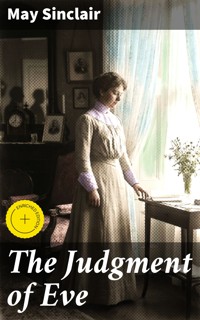
In "The Judgment of Eve," May Sinclair explores the intricacies of female identity and societal constraints in early 20th-century England. Through the lens of the protagonist, Sinclair delves into the dualities of self-perception and external perception, intertwining psychological realism with modernist techniques. The narrative masterfully dissects the public and private spheres of a woman's life, employing evocative language and fragmented structures that invite readers to grapple with the moral dilemmas faced by contemporary women. The novel'Äôs thematic preoccupations resonate with the broader feminist discourse of its time, embodying the tensions between tradition and modernity. May Sinclair, a prominent figure in the modernist literary movement, was deeply influenced by her own experiences and the sociopolitical landscape of her era. Her keen observations of women's roles and struggles are evident in her body of work, which often challenges gender norms and explores the complexities of psychological states. Sinclair's background in philosophy, coupled with her exposure to various literary circles, solidified her position as a pioneering novelist and thinker committed to elevating women's voices in literature. "The Judgment of Eve" is recommended for readers seeking a profound exploration of gender, autonomy, and psychological depth. Sinclair's incisive prose and innovative narrative structure captivate and provoke, urging readers to reflect upon the evolving roles of women in society. This novel not only marks an important contribution to feminist literature but also stands as a testament to Sinclair's literary prowess that continues to resonate with contemporary audiences. In this enriched edition, we have carefully created added value for your reading experience: - A succinct Introduction situates the work's timeless appeal and themes. - The Synopsis outlines the central plot, highlighting key developments without spoiling critical twists. - A detailed Historical Context immerses you in the era's events and influences that shaped the writing. - A thorough Analysis dissects symbols, motifs, and character arcs to unearth underlying meanings. - Reflection questions prompt you to engage personally with the work's messages, connecting them to modern life. - Hand‐picked Memorable Quotes shine a spotlight on moments of literary brilliance. - Interactive footnotes clarify unusual references, historical allusions, and archaic phrases for an effortless, more informed read.
Das E-Book können Sie in Legimi-Apps oder einer beliebigen App lesen, die das folgende Format unterstützen:
Veröffentlichungsjahr: 2019
Ähnliche


















The Judgment of Eve
Table of Contents
Introduction
A woman’s inner life can become a courtroom in which desire, duty, and self-knowledge contend for the final verdict.
May Sinclair’s The Judgment of Eve is a work of early twentieth-century British fiction, written in the psychological realist mode associated with modern-era experiments in representing consciousness. Set within an English social world shaped by respectability, family expectations, and the moral scrutiny of intimate communities, the novel turns from outward event toward inward consequence. Sinclair, known for her serious engagement with questions of mind and motive, uses this framework to examine how a life can be determined as much by private interpretation as by public fact.
The novel follows Eve as she moves through relationships and decisions that expose the strain between what she feels and what she is permitted to acknowledge. Rather than centering on sensational incident, the narrative attends to the accumulating pressures of thought, memory, and judgment, allowing the premise to unfold through close observation of emotional causality. The reading experience is therefore one of proximity: the novel asks the reader to inhabit shifting certainties and to notice how quickly moral categories harden, soften, and reform under the stress of lived experience.
Sinclair’s style is deliberate and analytic, with a tone that can feel both intimate and unsparing. The prose is attentive to nuance, tracking the gradations of hesitation, self-justification, and longing that conventional plots often compress or ignore. Even when scenes are outwardly restrained, the novel sustains tension through interior argument and the friction between social performance and private knowledge. This creates a distinctive rhythm: moments of apparent quiet are charged with implication, and psychological turns register with the weight of genuine consequence.
At the heart of the book is the question of how a woman comes to be judged and by whom, including herself. Sinclair explores the construction of moral authority in everyday life: the ways reputations are made, how narratives about female virtue or fault are circulated, and how readily sympathy is withdrawn when behavior becomes difficult to classify. The novel also probes the costs of self-denial and the perils of self-deception, insisting that ethical life is rarely a clean separation between right and wrong.
The Judgment of Eve continues to matter because it addresses dynamics that persist in contemporary culture, even when the social forms have changed. Public discourse still rewards simplified stories of innocence and blame, and private experience still resists those simplifications. Sinclair’s close attention to internal conflict anticipates modern conversations about agency, consent, emotional labor, and the invisible work of maintaining an acceptable identity. By focusing on how judgment operates as a social mechanism, the novel remains a sharp study of power in intimate settings.
For today’s reader, the book offers both a period portrait and a living inquiry into autonomy, responsibility, and the price of being seen. Its psychological realism rewards patience, inviting reflection rather than hurried verdicts, and its seriousness about inner life challenges assumptions about what counts as dramatic or important. Without relying on plot shocks, Sinclair composes a sustained examination of how individuals rationalize, endure, and change. The result is an introduction not only to Eve’s predicament but to the broader modern problem of moral certainty itself.
Synopsis
May Sinclair’s The Judgment of Eve is a short fiction that frames a woman’s inner life as the subject of a searching moral and psychological “judgment.” The narrative introduces Eve as a modern figure whose experiences are shaped by desire, self-scrutiny, and social expectation rather than by a single external crime. From the outset, the story places emphasis on how she thinks and feels, and on how surrounding conventions of femininity and propriety set the terms by which she is evaluated. The opening movement establishes a charged atmosphere in which private impulses and public standards are destined to collide.
paragraphs=[
As the story progresses, Eve’s situation becomes defined by a tension between the life she is expected to live and the life she senses within herself. Sinclair develops this conflict through close attention to perception and motive, tracing how small decisions and emotional pressures accumulate into something that feels like a case being built. Eve is not presented as a simple exemplar or warning, but as someone whose actions and hesitations arise from a complex mixture of longing, fear, pride, and the need to be understood. The narrative maintains a restrained, analytic stance, inviting readers to weigh sympathy against censure without being told what to think.
paragraphs=[
A central strand follows Eve’s interactions and the implicit “court” of opinion that forms around her, whether through direct confrontation or quieter, insinuating forms of appraisal. Sinclair is attentive to the language of judgment itself: how reputations are shaped, how motives are assumed, and how moral categories can be applied with confidence even when inner realities remain opaque. Eve’s choices are shown to have consequences not merely in events but in the shifting way she is seen—by others and by herself. This produces a steady escalation of psychological pressure, as if the verdict is being prepared long before any explicit reckoning arrives.
paragraphs=[
Running alongside the social dimension is Eve’s interior debate, in which she tests competing ideas of duty, love, and self-respect. The story explores how a woman might internalize the very standards that constrain her, turning them into a private tribunal. Sinclair’s method emphasizes nuance: the same impulse can appear generous or selfish depending on the frame applied, and the same act can be read as courage or transgression. Eve’s consciousness becomes the arena where external norms and personal truth contend, and where sincerity does not necessarily guarantee peace. The narrative’s momentum comes from this tightening circle of interpretation and self-interpretation.
Historical Context
May Sinclair’s The Judgment of Eve appeared in early twentieth-century Britain, a period marked by rapid social change and intense debate over women’s roles in public and private life. London and other urban centers were reshaped by expanded clerical employment, mass literacy, and new consumer and print cultures. The novel’s world is grounded in institutions central to middle-class identity—schools, churches, professional offices, and the family—where respectability and reputation carried tangible economic and social consequences. These pressures framed women’s choices about work, courtship, and marriage, and made private conduct a matter of public scrutiny.
Sinclair wrote during the late Victorian and Edwardian eras, when the “New Woman” became a prominent cultural figure in journalism and fiction. Increased access to secondary education and university study for women, alongside expanding white-collar work, challenged older assumptions that middle-class femininity was confined to domesticity. At the same time, law and custom still privileged male authority within marriage and property relations, and sexual double standards remained widely enforced through social norms. Such contradictions created a charged setting for narratives about autonomy, judgment, and the costs of transgressing expectation.
The women’s suffrage movement provides a major backdrop. The National Union of Women’s Suffrage Societies was founded in 1897, and the Women’s Social and Political Union began in 1903, bringing organized campaigns and public demonstrations to national attention. Debates over the parliamentary franchise were tied to wider questions about women’s capacity for citizenship, moral authority, and professional life. Suffrage arguments circulated in newspapers, pamphlets, and public meetings, shaping how readers understood women as political subjects. Fiction of the period often engaged these issues indirectly by dramatizing the constraints that made equal participation difficult.
Legal and institutional reform also shaped the era’s gender politics. The Married Women’s Property Acts (notably 1870 and 1882) strengthened married women’s rights to own and control property, while the Matrimonial Causes Act 1857 made civil divorce possible but remained unequal in practice. The Criminal Law Amendment Act 1885 raised the age of consent and intensified public debate on sexuality and protection. By the early 1900s, controversies over “purity,” prostitution, and moral regulation were still active in social policy discussions. These frameworks informed how female desire, respectability, and “fallen” reputations were policed.
British medicine and psychology were undergoing changes that affected attitudes toward women’s bodies and minds. Late nineteenth-century debates about hysteria, nervous illness, and the supposed effects of education on women coexisted with new clinical and psychological approaches. Psychoanalysis, developed by Sigmund Freud in the 1890s, reached British intellectual circles through translations and discussion, while other psychological schools also gained influence. Sinclair herself later engaged publicly with psychoanalytic ideas and helped introduce them to English literary culture. The era’s medicalized language of nerves and morality shaped how emotional conflict and social constraint were narrated.
The First World War (1914–1918) transformed British society and accelerated shifts in women’s work and public standing. Mass mobilization drew women into munitions, transport, agriculture, and expanded clerical roles, while wartime casualties disrupted family structures and expectations around marriage. Political change followed: the Representation of the People Act 1918 enfranchised many women over thirty who met property qualifications, and the Sex Disqualification (Removal) Act 1919 opened more professions and public offices to women. Postwar adjustment brought both expanded opportunities and renewed pressure to restore prewar gender norms, a tension often explored in contemporary fiction.
Sinclair’s literary context included the transition from Victorian realism to modernism, with experiments in narrative voice, interiority, and the representation of consciousness. She was associated with London’s intellectual networks and contributed criticism and fiction in a period when the novel was a key forum for social debate. Contemporary writers examined marriage, sexuality, and the costs of conformity, while reviewers and censors remained attentive to perceived moral transgression. The expanding periodical press and circulating libraries influenced what could be published and how it was received. This environment encouraged psychologically attentive narratives that still confronted public judgment.
Within these historical pressures, The Judgment of Eve reflects a society where women’s independence was negotiated through moral evaluation by family, employers, and community. By situating personal choices amid suffrage-era arguments, evolving legal standards, and persistent sexual double standards, the work engages the period’s central question of who has authority to judge women’s conduct. Its attention to reputation, emotional life, and institutional constraint aligns with early twentieth-century concerns about modern identity and social surveillance. Without relying on sensational revelation, the novel participates in contemporary critique by exposing how “respectability” could function as a form of control over women’s lives.




