


0,49 €
Niedrigster Preis in 30 Tagen: 1,99 €
Niedrigster Preis in 30 Tagen: 1,99 €
Mehr erfahren.
- Herausgeber: Booksell-Verlag
- Kategorie: Gesellschafts- und Liebesromane
- Sprache: Englisch
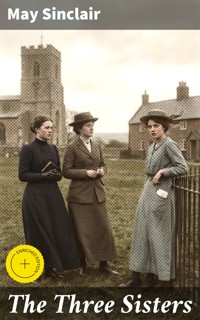
May Sinclair's "The Three Sisters" delves into the intricate dynamics of familial relationships against the backdrop of early 20th-century England. Written with a fluid, introspective style, the narrative explores the lives of three sisters, each representing distinct approaches to love, ambition, and societal expectation. Sinclair masterfully employs stream-of-consciousness techniques to illustrate the internal struggles of her characters, creating a rich tapestry of emotional depth and psychological insight. The book also reflects the emerging themes of feminism and individualism that characterized modernist literature during this period, placing it within the broader context of shifting gender roles in society. May Sinclair, a prominent figure in the modernist movement, was a prolific writer with a keen interest in psychology and women's issues. Her own experiences growing up in a Victorian household likely influenced her portrayal of the sisters' struggles for identity and independence. Sinclair's multifaceted career, which included involvement in feminist circles and exploration of psychological concepts, equipped her with the unique perspective necessary to navigate the complexities of her characters'Äô lives, ultimately weaving a narrative that speaks to the heart of human experience. This insightful work is recommended for readers interested in the interplay of family dynamics, societal norms, and personal aspirations. Sinclair'Äôs nuanced characters and innovative narrative style make "The Three Sisters" not only a compelling read but also a significant contribution to feminist literature. Engaging with this text offers not only enjoyment but also profound reflections on the nature of sisterhood and self-identity. In this enriched edition, we have carefully created added value for your reading experience: - A succinct Introduction situates the work's timeless appeal and themes. - The Synopsis outlines the central plot, highlighting key developments without spoiling critical twists. - A detailed Historical Context immerses you in the era's events and influences that shaped the writing. - A thorough Analysis dissects symbols, motifs, and character arcs to unearth underlying meanings. - Reflection questions prompt you to engage personally with the work's messages, connecting them to modern life. - Hand‐picked Memorable Quotes shine a spotlight on moments of literary brilliance. - Interactive footnotes clarify unusual references, historical allusions, and archaic phrases for an effortless, more informed read.
Das E-Book können Sie in Legimi-Apps oder einer beliebigen App lesen, die das folgende Format unterstützen:
Veröffentlichungsjahr: 2019
Ähnliche













The Three Sisters
Table of Contents
Introduction
Family loyalty can become a cage when love, duty, and selfhood pull in opposite directions. May Sinclair’s The Three Sisters is a work of early twentieth-century English fiction by a writer closely associated with literary modernism and psychological realism. Set within a domestic and social world shaped by class conventions and gendered expectations, the novel turns the familiar materials of family life into a sustained study of inner conflict. Sinclair is less interested in outward incident than in the pressures that accumulate quietly over time, and the book’s tension arises from what characters feel they must do, what they long to do, and what they cannot bring themselves to admit even to themselves.
The novel centers on three sisters whose lives are bound together by shared history and an entangling household intimacy. Their relationships—tender, competitive, protective, and at times strained—form the engine of the narrative, as each sister confronts choices about love, independence, and obligation. Without relying on melodrama, Sinclair presents the premise as a gradual unfolding: the sisters’ daily routines, conversations, and private reflections become the arena in which the most consequential decisions are made. The result is a story that feels at once intensely personal and sharply social, attentive to how seemingly small moments can alter the course of a life.
Readers often experience Sinclair’s fiction as inward, searching, and exacting, and The Three Sisters rewards attention to nuance. The voice is controlled and observant, with a tone that can be coolly analytic even as it remains sympathetic to human vulnerability. Sinclair’s prose privileges psychological contour over spectacle, inviting the reader to track hesitation, self-justification, and sudden clarity as they arise in thought and speech. The narrative energy comes from perception: what characters notice, what they avoid noticing, and how their interpretations of the same events diverge. This emphasis gives the book its distinctive intimacy and its quiet intensity.
A central theme is the shaping force of family roles and the difficulty of revising them once they have hardened into habit. Sinclair examines how sisters may serve as mirrors and measures for one another, offering belonging while also enforcing comparison. The novel attends to the ways affection can coexist with resentment, and how duty can disguise fear or desire. It also explores the social scripting of women’s lives—how ideals of respectability, romance, and self-sacrifice influence what feels imaginable, permissible, or safe. Against these pressures, the book asks what it might mean to claim a self that is not merely an extension of family expectation.
The Three Sisters also probes the moral texture of everyday life, where the boundaries between kindness and control, generosity and self-erasure, are rarely clean. Sinclair is attentive to emotional economies: who gives, who receives, and what is silently demanded in return. Misunderstandings matter not because they explode into public scandal, but because they accumulate into patterns that govern relationships. The novel’s realism is therefore ethical as well as social, examining how people rationalize choices and how they live with the consequences of decisions that seemed inevitable at the time. Its restraint keeps the reader focused on the complexity of motive.
For contemporary readers, the book remains pertinent because it treats identity as something negotiated within networks of care rather than chosen in isolation. Modern discussions of emotional labor, caregiving, and family systems find an antecedent in Sinclair’s depiction of how responsibility is distributed and how unevenly it can weigh. The sisters’ struggles also anticipate ongoing questions about autonomy within intimacy: how to honor commitment without losing agency, and how to pursue personal fulfillment without severing bonds. Sinclair’s patient attention to interior life speaks to readers accustomed to narratives that move quickly, offering instead a study in how change can be slow, resistant, and profoundly felt.
Approached today, The Three Sisters can be read both as a compelling domestic novel and as a modernist-leaning investigation of consciousness. Its drama is largely internal, yet it never becomes abstract; it remains grounded in the tangible realities of home, social expectation, and the intimate negotiations of family life. The pleasure of reading lies in its precision, its psychological candor, and its refusal to simplify complicated attachments. Sinclair’s enduring achievement is to show how private conflicts are shaped by public norms, and how the most consequential battles are often fought quietly, within the self, in the presence of those one loves most.
Synopsis
May Sinclair’s novel The Three Sisters follows the intertwined lives of three sisters in an English middle-class household shaped by duty, reputation, and limited prospects. The narrative introduces them within a domestic setting whose routines and expectations feel both protective and confining. Each sister is distinguished by temperament and desire, yet all are bound by shared history and a family order that discourages open conflict. From the outset, the book frames a central question: how can individual longing be pursued when family loyalty and social convention define what is permissible?
paragraphs
The early movement of the story dwells on the sisters’ daily negotiations with one another and with the wider community, where observation and judgement are constant. Their relationships are shown as intimate but fraught, with affection complicated by rivalry, dependence, and unspoken resentments. Sinclair traces how small choices—how one speaks, yields, or insists—accumulate into patterns that harden over time. The sisters’ interior lives are given weight as they weigh what they want against what they feel they owe. The household’s atmosphere becomes an arena in which conscience, pride, and fear quietly contend.
As the sisters’ circumstances shift, new pressures emerge from beyond the home, including the prospect of change through attachment, work, or social connection. The narrative follows their attempts to define themselves in relation to men, neighbours, and prevailing ideals of feminine conduct, while avoiding simple moral verdicts. Tensions rise as opportunities appear unevenly distributed among them, and what benefits one may threaten another. Sinclair keeps attention on the subtle mechanics of persuasion and self-denial, showing how each sister’s strategy for coping—compliance, control, or retreat—creates fresh complications in the family equilibrium.
Midway through, the novel deepens its focus on how memory and habit govern the present. Past family dynamics continue to dictate the sisters’ sense of what is possible, and long-established roles prove difficult to escape without cost. The story explores how emotional obligations can function like an inheritance, passed from parent to child and reinforced by a culture that prizes propriety. The sisters’ bonds are tested by the need to speak plainly about desire and disappointment, yet frankness risks exposing vulnerabilities they have spent years concealing from one another and from themselves.
As events continue, the sisters face sharper decisions that bring their values into conflict. Sinclair charts the difference between wanting happiness and believing oneself entitled to it, and she shows how ideals of sacrifice can become a means of self-protection as well as a weapon of quiet domination. The narrative remains closely attuned to the social landscape in which female ambition is constrained and emotional life is expected to remain decorous. The sisters’ interactions, marked by both tenderness and strain, reveal how love can coexist with the impulse to judge, correct, or possess.
The later sections sustain the tension between change and continuity, as the sisters confront the consequences of earlier compromises. Relationships harden or soften under the weight of time, and the household’s carefully maintained order is repeatedly challenged by circumstances that cannot be managed through silence alone. Sinclair’s method emphasises psychological realism: motives are mixed, and even generous acts may carry hidden needs. The novel keeps its outcome in view without relying on sensational turns, instead building a cumulative picture of how family life can shape, limit, and also shelter the self over years of living together closely.
Historical Context
May Sinclair’s novel The Three Sisters emerged from early twentieth-century Britain, a period marked by rapid social and cultural change. Published in 1914, it appeared on the eve of the First World War, when public debate about women’s roles, marriage, and professional life was unusually intense. Sinclair wrote within a literary marketplace shaped by circulating libraries, influential reviews, and a growing readership for psychologically oriented fiction. Her work belongs to a transition from late Victorian realism toward modernist experimentation, while still engaging recognizable domestic settings and social institutions.
Britain in the decades before 1914 was structured by class hierarchy and a strong ideology of respectability. Middle-class families were expected to display moral restraint, regulate courtship, and protect reputations; such expectations were enforced through church life, neighborhood surveillance, and legal norms governing property and inheritance. Women’s economic dependence remained common, despite expanding opportunities in teaching, clerical work, and certain professions. The “New Woman” debate of the 1890s and 1900s questioned conventional femininity and marriage, and fiction often used the family home as a site where these cultural tensions became visible.
Education and employment for women expanded significantly, though unevenly. Women’s colleges at Oxford and Cambridge grew in prominence, and universities and training schools widened access to credentials that could support paid work. Teaching and nursing were established respectable occupations, while offices increasingly hired female typists and clerks. Yet professional life for women was constrained by lower wages, limited promotion, and expectations of resignation upon marriage. These historical pressures inform narratives that examine how ambition, duty, and family obligation compete, and why unmarried or economically dependent women could face restricted futures even when capable and educated.
The organized campaign for women’s suffrage strongly shaped the pre-war public sphere. The National Union of Women’s Suffrage Societies pursued constitutional methods, while the Women’s Social and Political Union adopted militant tactics from 1905 onward. Government responses included surveillance, arrests, and imprisonment; hunger strikes and the 1913 “Cat and Mouse Act” became widely reported. Although The Three Sisters is not a manifesto, Sinclair wrote in a climate where women’s rights were debated daily in newspapers and public meetings. The suffrage struggle heightened scrutiny of gendered power, consent, and the costs of respectability.
Literary culture also shifted as modernism took shape. Writers and critics debated realism, symbolism, and new methods for representing consciousness and memory. Sinclair was associated with discussions of modern technique and is historically linked to early critical recognition of “stream of consciousness” in English-language fiction. Psychology, including popularized ideas about the unconscious, influenced both criticism and narrative style, encouraging closer attention to interior life and motivation. This context helps explain Sinclair’s emphasis on mental states, moral conflict, and the subtle pressures of family life rather than solely external event.
Religious and moral frameworks remained influential. Anglican institutions, Nonconformist communities, and prevailing Christian ethics shaped attitudes toward sexuality, marriage, and women’s conduct. Divorce existed but was socially stigmatized and legally complex, contributing to the cultural weight placed on maintaining appearances. Middle-class respectability was tied to ideals of self-control and sacrifice, particularly for women, and failures could result in lasting social consequences. Fiction of this period frequently scrutinized the gap between public virtue and private desire, using domestic spaces to reveal how moral norms could discipline individuals.
The economic and political environment also mattered. Britain was an industrial and imperial power with growing urbanization and a national press that amplified social issues. Debates about poverty, housing, and social reform—associated with the Liberal welfare measures of 1906–1914—coexisted with anxieties about national decline and international rivalry. While The Three Sisters focuses on personal relations rather than policy, the novel belongs to an era when social structures were being questioned and when the family was widely treated as a microcosm of broader social order.
Within these conditions, The Three Sisters reflects an Edwardian and late-Victorian inheritance while testing the limits of its moral and social codes. Sinclair’s attention to women’s constrained choices, emotional labor, and the authority exercised within families aligns with contemporary debates about gender equality and autonomy. The novel’s psychological realism corresponds to modernist-era interest in inner experience, and its depiction of respectability’s demands registers the era’s pervasive moral surveillance. Written just before wartime upheaval, it captures a society negotiating change, and it critiques how tradition and institution can shape lives as powerfully as overt politics.




