


1,99 €
Mehr erfahren.
- Herausgeber: Booksell-Verlag
- Kategorie: Religion und Spiritualität
- Sprache: Englisch
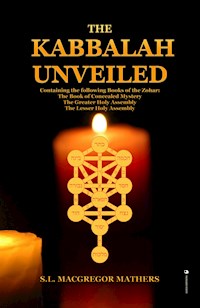
In "The Kabbalah Unveiled," S. L. MacGregor Mathers presents a seminal introduction to the mystical teachings of the Kabbalah, weaving together esoteric wisdom with profound insights into Jewish mysticism. This text not only distills complex philosophical ideas but also showcases Mathers'Äô unique literary style, characterized by a rich vocabulary and an accessible yet scholarly tone. The book is set against the backdrop of the late 19th century, a period of growing Western interest in Eastern philosophies and the occult, which influenced Mathers'Äô interpretive approach, bridging ancient texts with contemporary thought. S. L. MacGregor Mathers was a prominent figure in the Western esoteric tradition and a key member of the Hermetic Order of the Golden Dawn. His scholarly pursuits and personal experiences with mysticism and the occult deeply informed his work. Mathers was driven by an earnest desire to unveil the hidden aspects of the Kabbalah, which he viewed as a repository of ancient wisdom, leading to this pioneering translation and commentary on the Zohar, the foundational text of Kabbalistic thought. This book is highly recommended for anyone seeking to deepen their understanding of Kabbalistic teachings and their influence on Western esotericism. Mathers'Äô insightful analysis and comprehensive approach make it an invaluable resource for scholars, practitioners, and those with an interest in the spiritual traditions that intersect across cultures. In this enriched edition, we have carefully created added value for your reading experience: - A succinct Introduction situates the work's timeless appeal and themes. - The Synopsis outlines the central plot, highlighting key developments without spoiling critical twists. - A detailed Historical Context immerses you in the era's events and influences that shaped the writing. - A thorough Analysis dissects symbols, motifs, and character arcs to unearth underlying meanings. - Reflection questions prompt you to engage personally with the work's messages, connecting them to modern life. - Hand‐picked Memorable Quotes shine a spotlight on moments of literary brilliance. - Interactive footnotes clarify unusual references, historical allusions, and archaic phrases for an effortless, more informed read.
Das E-Book können Sie in Legimi-Apps oder einer beliebigen App lesen, die das folgende Format unterstützen:
Veröffentlichungsjahr: 2023
Ähnliche


The Kabbalah Unveiled
Table of Contents
Introduction
Esoteric tradition becomes most compelling when its promise of hidden order collides with the reader’s demand for clarity and proof. In The Kabbalah Unveiled, S. L. MacGregor Mathers presents an English gateway to materials drawn from the Zohar, offering not a novel or a devotional manual but an occultist’s translation and presentation of Kabbalistic texts for study. The work belongs to the genre of esoteric scholarship as practiced in the late nineteenth century, when English readers increasingly sought systematic access to Jewish mystical sources through translation. Its central gesture is to render a difficult corpus legible while preserving its aura of depth and mystery.
Rather than inventing a new mythology, Mathers frames the book as an unveiling of an already authoritative tradition, assembling translated passages and accompanying apparatus meant to guide a reader through unfamiliar concepts. The premise is simple in outline: to provide English-language access to key Kabbalistic ideas as expressed in classic textual sources associated with the Zohar, and to do so in a way that supports extended, careful reading. The experience is that of encountering a compendious, text-forward work in which the primary matter is the translated material itself. The author’s presence is felt through selection, arrangement, and explanatory framing more than through narrative.
The reading voice is formal, scholarly, and deliberately archaic in its gravitas, reflecting a period style of translation and commentary aimed at seriousness and authority. The tone assumes patience and commitment, inviting readers to linger over technical terminology, metaphysical propositions, and symbolic correspondences that build meaning across many pages. This is not a book that rewards skimming; its method asks the reader to treat the page as a site of study rather than entertainment. The cadence of the English often signals that one is reading a mediated text, and that mediation becomes part of the encounter. The overall effect is rigorous, solemn, and at times intentionally austere.
At its thematic core, the book turns on how language can gesture toward realities that resist ordinary description. It explores the tension between the ineffable and the articulated, between a transcendent source and the structured emanations or conceptual gradations through which that source is approached. The work’s orientation is metaphysical and symbolic, proposing that the universe, mind, and divinity can be spoken about through layered images and carefully handled terms. Readers will notice an insistence on order: hierarchies, relationships, and conceptual architecture that aim to make the unseen intelligible. Yet the text also preserves ambiguity, reminding the student that comprehension is partial and hard-won.
Because Mathers offers a translated presentation of foundational material, the book also raises questions about transmission and authority. What does it mean to approach Kabbalah through English, and through a compiler’s decisions about what to include and how to explain it? The Kabbalah Unveiled is therefore as much about reception as it is about content: a record of how a nineteenth-century esoteric scholar sought to make a specialized tradition available to another audience. The reader is invited to weigh the benefits of accessibility against the risks of flattening nuance. This dynamic encourages attentiveness not only to the mystical claims on the page but also to the scholarly and cultural frame that delivers them.
The book continues to matter because contemporary spiritual and intellectual life still wrestles with the relationship between inner experience and public reason. Modern readers, whether religious, secular, or academically curious, encounter here a model of systematic mystical thought that refuses to reduce itself to mere sentiment. It offers a vocabulary for discussing transcendence, cosmology, and symbolic interpretation in a disciplined way, even when one does not accept its premises. It also illuminates a longstanding Western appetite for Kabbalistic ideas, revealing how translation and interpretation shape what later readers take to be the tradition. In this sense it serves both as a study text and as a case study in the making of esoteric modernity.
Approached today, The Kabbalah Unveiled rewards readers who treat it as a demanding primary-source encounter rather than a quick introduction. Its pages can be read devotionally, philosophically, or historically, but the strongest experience comes from allowing its symbolic structures to accumulate and cross-reference over time. The lack of narrative suspense keeps the focus on contemplation and conceptual mapping, and the translation-centered form encourages slow rereading. Without spoiling any particular doctrinal sequence, it is enough to say that the book invites you to watch a world-picture assemble itself from dense, interrelated terms. What emerges is an encounter with a tradition that insists the deepest realities are approached through disciplined study, not instant insight.
Synopsis
S. L. MacGregor Mathers’s The Kabbalah Unveiled presents an English rendering and structured introduction to a major strand of Jewish mystical literature as mediated through the Latin scholarship of Christian Kabbalah. The work frames itself as a guide for readers who lack access to the primary languages, setting out aims of translation, clarification, and ordered presentation. It situates the material within the late nineteenth-century occult revival while emphasizing the older textual authorities from which it draws. The opening establishes the book’s scope and method: translating key passages, supplying explanatory notes, and mapping unfamiliar terminology onto a coherent scheme.
paragraphs.1
The central body of the book turns to the Zoharic tradition, particularly sections commonly associated with the “Book of Concealed Mystery” and its allied commentarial material. Mathers organizes the text so that readers can follow a sequence of brief propositions, interpretive expansions, and scholia-like remarks, often pausing to define technical terms. The argument is not a linear narrative but an unfolding metaphysical anatomy, moving from the notion of an unknowable first principle toward a structured account of emanation. Throughout, the reader is repeatedly asked to hold together paradoxical claims: concealment and revelation, unity and multiplicity, and transcendence and manifestation.
paragraphs.2
As the exposition advances, the work introduces the sefirotic framework as a key to understanding creation and the ordered relations between divine attributes. The text describes a dynamic progression in which differentiation arises through graded stages rather than sudden decree, and it treats these stages as both ontological and symbolic. Mathers’s annotations help connect the terse Zoharic statements to wider interpretive traditions, clarifying how titles, numbers, and hierarchies function. The presentation repeatedly returns to the problem of how finite existence can be spoken of without reducing the infinite, making language itself part of the tension the book examines.
paragraphs.3
A prominent portion develops the idea that cosmic structure is mirrored in the human being, so that anatomy, psychology, and spiritual aspiration become sites where the metaphysical scheme is reflected. The text explores the interplay of masculine and feminine polarities, equilibrium, and the consequences of imbalance, treating these as principles that operate across worlds and within the self. Mathers aims to render these motifs intelligible to an English occult readership while maintaining the dense symbolic character of the source. The result is a sustained attempt to show correspondences without collapsing them into simple allegory, keeping the system simultaneously abstract and practical in implication.
Historical Context
The Kabbalah Unveiled appeared in late Victorian Britain, when London publishing houses and learned societies fed a growing market for translations of ancient and esoteric texts. Samuel Liddell “MacGregor” Mathers (1854–1918) produced the work in English in the 1880s, drawing on Latin and earlier European editions of Jewish mystical writings. The period’s scholarship was shaped by expanding access to libraries and museums, and by a popular fascination with “Oriental” and antiquarian sources. Mathers’ volume entered a cultural environment where philology, comparative religion, and spiritual experimentation existed side by side.
Western knowledge of Kabbalah had long been mediated through Christian and scholarly channels. Renaissance and early modern authors such as Giovanni Pico della Mirandola and Johannes Reuchlin treated Kabbalistic ideas as resources for Christian theology, and seventeenth‑century compilers like Christian Knorr von Rosenroth published the Kabbalah Denudata (1677–1684), a major Latin anthology. By the nineteenth century, these works circulated in academic and occult circles, often detached from rabbinic contexts. Mathers’ translation tradition therefore reflects a layered reception history: Jewish mystical texts encountered through European intermediaries, editorial choices, and translated terminology.
Mathers’ immediate intellectual backdrop included the Victorian study of religion and language. Universities and publishers promoted critical editions of ancient sources, while scholars such as Max Müller popularized comparative approaches that placed Asian and Near Eastern traditions into broad historical frameworks. At the same time, antiquarian interest in the Bible’s languages and in post‑biblical Judaism grew among some theologians and Orientalists. This environment normalized translating sacred literature for educated lay readers. Mathers’ project, though aimed at an esoteric audience, relied on the era’s confidence in translation and compilation as means to render complex traditions accessible and systematized.
The 1870s–1880s also saw the rapid expansion of organized occultism in the English‑speaking world. The Theosophical Society was founded in New York in 1875 and quickly established a prominent London presence, encouraging syncretic readings of religious traditions and a search for hidden correspondences. British spiritualism, popular since the mid‑nineteenth century, provided another setting in which claims about unseen worlds and hierarchies were discussed publicly. Mathers moved within this broader milieu that valued esoteric “keys” to scripture and cosmology. His translation choices were shaped by readers who sought practical metaphysics rather than purely historical commentary.
Mathers’ own institutional context was the Hermetic Order of the Golden Dawn, founded in London in 1887–1888 by William Wynn Westcott, William Robert Woodman, and Mathers. The Order drew heavily on ritual magic, Hermeticism, and Kabbalah, and it made diagrammatic “Tree of Life” correspondences central to training. The Kabbalah Unveiled functioned as a major textual support for that program, supplying English readers with material used in lectures and grade work. Its appearance coincided with the Golden Dawn’s early development, when members sought authoritative sources to legitimize their synthesis of Western esotericism and to standardize terminology.
The book’s main textual source was the Zohar, the foundational work of Kabbalah, composed in medieval Spain and later canonized within Jewish mystical tradition. Mathers did not translate the entire Zohar; he presented selected treatises, including the Sifra di-Tzeniutha, the Idra Rabba, and the Idra Zuta, using earlier Latin renderings and scholarly apparatus available to him. This method reflects a common Victorian practice of selective translation to fit thematic aims and reader expectations. It also reveals the dependence of English occult reception on prior European editorial traditions rather than direct engagement with Hebrew and Aramaic manuscripts.
Late nineteenth‑century Britain was marked by tensions between established Christianity, scientific authority, and alternative spiritualities. Debates over biblical criticism, evolutionary theory, and the limits of materialism encouraged some educated readers to explore esoteric frameworks that promised reconciliation between spirituality and a rationalized cosmos. Translations of “secret doctrine” literature met this demand by presenting religion as an encoded science of symbols and emanations. Mathers’ work belongs to this response, offering a structured cosmology and technical vocabulary that could be aligned with ceremonial practice. It thus illustrates how Victorian seekers reinterpreted inherited traditions to address contemporary intellectual pressures.
Within its era, The Kabbalah Unveiled both reflects and contributes to the Western occult revival’s appropriation of Jewish mysticism. By presenting selected Zoharic texts through a Latin-to-English pathway and embedding them in a Hermetic interpretive frame, it exemplifies how Victorian esotericism valued universality, system, and correspondential symbolism. The work also indirectly critiques prevailing religious boundaries by treating Kabbalah as a philosophical and magical resource available beyond Jewish communal life. While not an academic study in the modern sense, it helped standardize English occult terminology and influenced subsequent esoteric literature, showing how translation served as cultural transmission and transformation in its time.
The Kabbalah Unveiled
INTRODUCTION.
I. THE first questions which the non-qabalistical reader will probably ask are: What is the Qabalah[1]? Who was its author? What are its sub-divisions? What are its general teachings? And why is a translation of it required at the present time?
2. I will answer the last question first. At the present time a powerful wave of occult thought is spreading through society; thinking men are beginning to awake to the fact that "there are more things in heaven and earth than are dreamed of in their philosophy;" and, last but not least, it is now felt that the Bible, which has been probably more misconstrued than any other book ever written, contains numberless obscure and mysterious passages which are utterly unintelligible without some key wherewith to unlock their meaning. THAT KEY IS GIVEN IN THE QABALAH[1q]. Therefore this work should be of interest to every biblical and theological student. Let every Christian ask himself this question: "How can I think to understand the Old Testament if I be ignorant of the construction put upon it by that nation whose sacred book it formed; and if I know not the meaning of the Old Testament, how can I expect to understand the New?" Were the real and sublime philosophy of the Bible better known, there would be fewer fanatics and sectarians. And who can calculate the vastness of the harm done to impressionable and excitable persons by the bigoted enthusiasts who ever and anon come forward as teachers of the people? How many suicides are the result of religious mania and depression! What farragos of sacrilegious nonsense have not been promulgated as the true meanings of the books of the Prophets and the Apocalypse! Given a translation of the sacred Hebrew Book, in many instances incorrect, as the foundation, an inflamed and an ill-balanced mind as the worker thereon, what sort of edifice can be expected as the result? I say fearlessly to the fanatics and bigots of the present day: You have cast down the Sublime and Infinite One from His throne, and in His stead have placed the demon of unbalanced force; you have substituted a deity of disorder and of jealousy for a God of order and of love; you have perverted the teachings of the crucified One. Therefore at this present time an English translation of the Qabalah is almost a necessity, for the Zohar[2] has never before been translated into the language of this country, nor, as far as I am aware, into any modern European vernacular.
3. The Qabalah may be defined as being the esoteric Jewish doctrine[2q]. It is called in Hebrew QBLH, Qabalah, which is derived from the root QBL, Qibel, meaning "to receive." This appellation refers to the custom of handing down the esoteric knowledge by oral transmission, and is nearly allied to "tradition."
4. As in the present work a great number of Hebrew or Chaldee words have to be used in the text, and the number of scholars in the Shemitic languages is limited, I have thought it more advisable to print such words in ordinary Roman characters, carefully retaining the exact orthography. I therefore append a table showing at a glance the ordinary Hebrew and Chaldee alphabet (which is common to both languages), the Roman characters by
which I have expressed its letters in this work; also their names, powers, and numerical values. There are no separate numeral characters in Hebrew and Chaldee; therefore, as is also the case in Greek, each letter has its own peculiar numerical value, and from this circumstance results the important fact that every word is a number, and every number is a word. This is alluded to in Revelations, where "the number of the beast" is mentioned, and on this correspondence between words and numbers the science of Gematria[3] (the first division of the so-called literal Qabalah) is based. I shall refer to this subject again. I have selected the Roman letter Q to represent the Hebrew Qoph or Koph, a precedent for the use of which without a following m may be found in Max Müller's "Sacred Books of the East." The reader must remember that the Hebrew is almost entirely a consonantal alphabet, the vowels being for the most part supplied by small points and marks usually placed below the letters. Another difficulty of the Hebrew alphabet consists in the great similarity between the forms of certain letters--e.g., V, Z, and final N.
5. With regard to the author and origin of the Qabalah, I cannot do better than give the following extract from Dr. Ginsburg's "Essay on the Kabbalah," first premising that this word has been spelt in a great variety of ways--Cabala, Kabalah, Kabbala, &c. I have adopted the form Qabalah, as being more consonant with the Hebrew writing of the word.
6. "A system of religious philosophy, or, more properly, of theosophy, which has not only exercised for hundreds of years an extraordinary influence on the mental development of so shrewd a people as the Jews, but has captivated the minds of some of the greatest thinkers of Christendom in the sixteenth and seventeenth centuries, claims the greatest attention of both the philosopher and the theologian. When it is added that among its captives were Raymond Lully, the celebrated scholastic metaphysician and chemist (died 1315); John Reuchlin, the renowned scholar. and reviver of Oriental literature in Europe (born 1455, died 1522); John Picus de Mirandola, the famous philosopher and classical scholar (1463-1494); Cornelius Henry Agrippa, the distinguished philosopher, divine, and physician (1486-1535); John Baptist Von Helmont, a remarkable chemist and physician (1577-1644); as well as our own countrymen, Robert Fludd, the famous physician and philosopher (1574-1637); and Dr. Henry More (1614-1687); and that these men, after restlessly searching for a scientific system which should disclose to them 'the deepest depths' of the divine mature, and show them the real tie which binds all things together, found the cravings of their minds satisfied by this theosophy, the claims of the Kabbalah on the attention of students in literature and philosophy will readily be admitted. The claims of the Kabbalah, however, are not restricted to the literary man and the philosopher; the poet too will find in it ample materials for the exercise of his lofty genius. How can it be otherwise with a theosophy which, we are assured, was born of God in Paradise, was nursed and reared by the choicest of the angelic hosts in heaven, and only held converse with the holiest of man's children upon earth. Listen to the story of. its birth, growth, and maturity, as told by its followers.
7. "The Kabbalah was first taught by God himself to a select company of angels, who formed a theosophic school in Paradise. After the Fall the angels most graciously communicated this heavenly doctrine to the disobedient child of earth, to furnish the protoplasts with the means of returning to their pristine nobility and felicity. From Adam it passed over to Noah, and then to Abraham, the friend of God, who emigrated with it to Egypt, where the patriarch allowed a portion of this mysterious doctrine to ooze out. It was in this way that the Egyptians obtained some knowledge of it, and the other Eastern nations could introduce it into their philosophical systems. Moses, who was learned in all the wisdom of Egypt, was first initiated into the Qabalah in the land of his birth, but became most proficient in it during his wanderings in the wilderness, when he not only devoted to it the leisure hours of the whole forty years, but received lessons in it from one of the angels. By the aid of this mysterious science the law-giver was enabled to solve the difficulties which arose during his management of the Israelites, in spite of the pilgrimages, wars, and frequent miseries of the nation. He covertly laid down the principles of this secret doctrine in the first four books of the Pentateuch, but withheld them from Deuteronomy. Moses also initiated the seventy elders into the secrets of this doctrine, and they again transmitted them from hand to hand. Of all who formed the unbroken line of tradition, David and Solomon were the most deeply initiated into the Kabbalah. No one, however, dared to write it down, till Schimeon Ben Jochai, who lived at the time of the destruction of the second temple . . . . . After his death, his son, Rabbi Eleazar, and his secretary, Rabbi Abba, as well as his disciples, collated Rabbi Simon Ben Jochai's treatises, and out of these composed the celebrated work called ZHR, Zohar, splendour, which is the grand storehouse of Kabbalism."
8. The Qabalah is usually classed under four heads[3q]:
(α) The practical Qabalah.
(β) The literal Qabalah.
(γ) The unwritten Qabalah.
(δ) The dogmatic Qabalah.
9. The practical Qabalah deals with talismanic and ceremonial magic, and does not come within the scope of this work.
10. The literal Qabalah is referred to in several places, and therefore a knowledge of its leading principles is necessary. It is divided into three parts: GMTRIA, Gematria; NVTRIQVN, Notariqon[4]; and ThMVRH, Temura.
12. Notariqon is derived from the Latin word nothrius, a shorthand writer. Of Notariqon there are two forms. In the first every letter of a word is taken for the initial or abbreviation of another word, so that from the letters of a word a sentence may be formed. Thus every letter of the word BRAShITh, Berashith, the first word in Genesis, is made the initial of a word, and we obtain BRAShITh RAH ALHIM ShIQBLV IShRAL ThVRH, Besrashith Rahi Eloim Sheyequebelo Israel Torah: "In the beginning the Elohim saw that Israel would accept the law." In this connection I may give six very interesting specimens of Notariqon formed from this same word BRAShITh by Solomon Meir Ben Moses, a Jewish Qabalist, who embraced the Christian faith in 1665, and took the name of Prosper Rugers. These have all a Christian tendency, and by their means Prosper converted another Jew, who had previously been bitterly opposed to Christianity. The first is BN RVCh AB ShLVShThM IChD ThMIM, Ben, Ruach, Ab, Shaloshethem Yechad Themim: "The Son, the Spirit, the Father, Their Trinity, Perfect Unity." The second is, BN RVCh AB ShLVShThM IChD ThOBVDV, Ben, Ruach, Ab, Shaloshethem Yechad Thaubodo: "The Son, the Spirit, the Father, ye shall equally worship Their Trinity." The third is, BKVRI RAShVNI AShR ShMV IShVO ThOBVDV, Bekori Rashuni Asher Shamo Yeshuah Thaubodo: "Ye shall worship My first-born, My first, Whose Name is Jesus." The fourth is, BBVA RBN AShR ShMV IShVO ThOBVDV, Beboa Rabban Asher Shamo Yesuah Thaubado: "When the Master shall come Whose Name is Jesus ye shall worship." The fifth is, BThVLH RAVIH ABChR ShThLD IShVO ThAShRVH, Bethulah Raviah Abachar Shethaled Yeshuah Thrashroah: "I will choose a virgin worthy to bring forth Jesus, and ye shall call her blessed." The sixth is, BOVGTh RTzPIM ASThThR ShGVPI IShVO ThAKLV, Beaugoth Ratzephim Assattar Shegopi Yeshuah Thakelo: "I will hide myself in cake (baked with) coals, for ye shall eat Jesus, My Body." The Qabalistical importance of these sentences as bearing upon the doctrines of Christianity can hardly be overrated.
13. The second form of Notariqon is the exact reverse of the first. By this the initials or finals, or both, or the medials, of a sentence, are taken to form a word or words. Thus the Qabalah is called ChKMh NSThRH, Chokhmah Nesethrah, "the secret wisdom;" and if we take the initials of these two words Ch and N, we form by the second kind of Notariqon the word ChN, Chen, "grace." Similarly, from the initials and finals of the words MI IOLH LNV HShMIMH, Mi Iaulah Leno Ha-Shamayima, "Who shall go up for us to heaven?" (Deut. xxx. 12), are formed MILH, Milah, "circumcision," and IHVH[6], the Tetragrammaton, implying that God hath ordained circumcision as the way to heaven.
14. Temura is permutation. According to certain rules, one letter is substituted for another letter preceding or following it in the alphabet, and thus from one word another word of totally different orthography may be formed. Thus the alphabet is bent exactly in half, in the middle, and one half is put over the other; and then by changing alternately the first letter or the first two letters at the beginning of the second line, twenty-two commutations are produced. These are called the "Table of the Combinations of TzIRVP," Tzirupa. For example's sake, I will give the method called ALBTh, Albath, thus:
11
10
9
8
7
6
5
4
3
2
1
K
I
T
Ch
Z
V
H
D
G
B
A
M
N
S
O
P
Tz
Q
R
Sh
Th
L
Each method takes its name from the first two pairs composing it, the system of pairs of letters being the groundwork of the whole, as either letter in a pair is substituted for the other letter. Thus, by Albath, from RVCh, Ruach, is formed DTzO, Detzau. The names of the other twenty-one methods are: ABGTh, AGDTh ADBG, AHBD, AVBH, AZBV, AChBZ, ATBCh, AIBT, AKBI, ALBK, AMBL, ANBM, ASBN, AOBS, APBO, ATzBP, AQBTz, ARBQ, AShBR, and AThBSh. To these must be added the modes ABGD and ALBM. Then comes the "Rational Table of Tziruph," another set of twenty-two combinations. There are also three "Tables of the Commutations," known respectively as the Right, the Averse, and the Irregular. To make any of these, a square, containing 484 squares, should be made, and the letters written in. For the "Right Table" write the alphabet across from right to left; in the second row of squares do the same, but begin with R and end with A; in the third begin with G and end with B; and so on. For the "Averse Table" write the alphabet from right to left backwards, beginning with Th and ending with A; in the second row begin with Sh and end with Th, &c. The "Irregular Table" would take too long to describe. Besides all these, there is the method called ThShRQ, Thashraq, which is simply writing a word backwards. There is one more very important form, called the "Qabalah of the Nine Chambers," or AIQ BKR, Aiq Bekar. It is thus formed:
300
30
3
200
20
2
100
10
1
000
00
0
000
00
0
000
00
0
Sh
L
G
R
K
B
Q
I
A
600
60
6
500
50
5
400
40
4
000
00
0
000
00
0
000
00
0
M final
S
V
K final
N
H
Th
M
D
900
90
9
800
80
8
700
70
7
000
00
0
000
00
0
000
00
0
T final
Tz
T
P final
P
Ch
N final
O
Z
I have put the numeration of each letter above to, show the affinity between the letters in each chamber. Sometimes this is used as a cipher, by taking the portions of the figure to show the letters they contain, putting one point for the first letter, two for the second, &c. Thus the right angle, containing AIQ, will answer for the letter Q if it have three dots or points within it. Again, a square will answer for H, N, or K final, according to whether it has one, two, or three points respectively placed within it. So also with regard to the other letters. But there are many other ways of employing the Qabalah of the Nine Chambers, which I have not space to describe. I will merely mention, as an example, that by the mode of Temura called AThBSh, Athbash, it is found that in Jeremiah xxv. 26, the word ShShK, Sheshakh, symbolizes BBL, Babel.
15. Besides all these rules, there are certain meanings hidden in the shape of the letters of the Hebrew alphabet; in the form of a particular letter at the end of a word being different from that which it generally bears when it is a final letter, or in a letter being written in the middle of a word in a character generally used only at the end; in any letter or letters being written in a size smaller or larger than the rest of the manuscript, or in a letter being written upside down; in the variations found in the spelling of certain words, which have a letter more in some places than they have in others; in peculiarities observed in the position of any of the points or accents, and in certain expressions supposed to be elliptic or redundant.
16. For example the shape of the Hebrew letter Aleph, A (see Plate I.), is said to symbolize a Vau, V, between a Yod, I, and a Daleth, D; and thus the letter itself represents the word IVD, Yod. Similarly the shape of the letter He, H, represents a Daleth, D, with a Yod, I, written at the lower left-hand corner, &c.
19. Other examples of deficient and redundant spelling, peculiarities of accent and pointing, &c., will be found in various places in the ensuing work.
21. Taking the whole of these mystical anagrams in proper order, Picus makes the following sentence out of this one word BRAShITh:--Pater in filio (aut per filium), principium et finem (sive quietum) creavit caput, ignem, et fundamentum magni hominis fœdere bono: "Through the Son hath the Father created that Head which is the beginning and the end, the fire-life and the foundation of the supernal man (the Adam Qadmon) by His righteous covenant." Which is a short epitome of the teachings of the "Book of Concealed Mystery." This notice of the literal Qabalah has already extended beyond its proper limits. It was, however, necessary to be thus explicit, as much of the metaphysical reasoning of the ensuing work turns on its application.
22. The term "Unwritten Qabalah" is applied to certain knowledge which is never entrusted to writing, but communicated orally. I may say no more on this point, not even whether I myself have or have not received it. Of course, till the time of Rabbi Schimeon Ben Jochai none of the Qabalah was ever written.
23. The Dogmatic Qabalah contains the doctrinal portion. There are a large number of treatises of various dates and merits which go to make up the written Qabalah, but they may be reduced to four heads:
(α) The Sepher Yetzirah[5] and its dependencies.
(β) The Zohar with its developments and commentaries.
(γ) The Sepher Sephiroth and its expansions.
(δ) The Asch Metzareph and its symbolism.
24. The SPR ITzIRH, Sepher Yetzirah, or "Book of Formation," is ascribed to the patriarch Abraham. It treats of the cosmogony as symbolized by the ten numbers and the twenty-two. letters of the alphabet, which it calls the "thirty-two paths." On these latter Rabbi Abraham Ben Dior has written a mystical commentary. The term "path" is used throughout the Qabalah to signify a hieroglyphical idea, or rather the sphere of ideas, which may be attached to any glyph or symbol.
25. The ZHR, Zohar, or "Splendour," besides many other treatises of less note, contains the following most important books, of which the three first are translated in this volume:
(α) The SPRA DTzNIOVThA, Siphra Dtzenioutha, or "Book of Concealed Mystery," which is the root and foundation of the Zohar.
(β) The ADRA RBA QDIShA, Idra Rabba Qadisha or "Greater Holy Assembly:" this is a development of the "Book of Concealed Mystery."
(γ) The ADRA ZVTA QDIShA, Idra Zuta Qadisha, or "Lesser Holy Assembly;" which is in the nature of a supplement to the "Idra Rabba." These three books treat of the gradual development of the creative Deity, and with Him the Creation. The text of these works has been annotated by Knorr von Rosenroth (the author of the "Qabalah Denudata,") from the Mantuan, Cremonensian, and Lublinensian Codices, which are corrected printed copies; of these the Mantuan and Cremonensian are the oldest. A species of commentary is also given, which is distinguished from the actual text by being written within parentheses.
(δ) The pneumatical treatise called BITh ALHIM, Beth Elohim, or the "House of the Elohim," edited by Rabbi Abraham Cohen Irira, from the doctrines of Rabbi Yitzchaq Loria. It treats of angels, demons, elemental spirits, and souls.
(ε) The "Book of the Revolutions of Souls" is a peculiar and discursive treatise, and is an expansion of Rabbi Loria's ideas.
26. The SPR SPIRVTh, Sepher Sephiroth, or "Book of the Emanations," describes, so to speak, the gradual evolution of the Deity from negative into positive existence.
27. The ASh MTzRP, Asch Metzareph, or "Purifying Fire," is hermatic and alchemical, and is known to few, and when known is understood by still fewer.
28. The principal doctrines of the Qabalah are designed to solve the following problems:--
(α) The Supreme Being, His nature and attributes.
(β) The Cosmogony.
(γ) The creation of angels and man.
(δ) The destiny of man and angels.
(ε) The nature of the soul.
(ζ) The nature of angels, demons, and elementals.
(η) The import of the revealed law.
(θ) The transcendental symbolism of numerals.
(ι) The peculiar mysteries contained in the Hebrew letters.
(κ) The equilibrium of contraries.
29. The "Book of Concealed Mystery" opens with these words: "The Book of Concealed Mystery is the book of the equilibrium of balance." What is here meant by the terms "equilibrium of balance"? Equilibrium is that harmony which results from the analogy of contraries, it is the dead centre where, the opposition of opposing forces being equal in strength, rest succeeds motion. It is the central point. It is the "point within the circle" of ancient symbolism. It is the living synthesis of counterbalanced power. Thus form may be described as the equilibrium of light and shade; take away either factor, and form is viewless. The term balance is applied to the two opposite natures in each triad of the Sephiroth, their equilibrium forming the third Sephira in each ternary. I shall recur again to this subject in explaining the Sephiroth. This doctrine of equilibrium and balance is a fundamental qabalistical idea.
30. The "Book of Concealed Mystery" goes on to, state that this "Equilibrium hangeth in that region which is negatively existent." What is negative existence? What is positive existence? The distinction between these two is another fundamental idea. To define negative existence clearly is impossible, for when it is distinctly defined it ceases to be negative existence; it is then negative existence passing into static condition. Therefore wisely have the Qabalists shut out from mortal comprehension the primal AIN, Ain, the negatively existent One, and the AIN SVP[7], Ain Soph, the limitless Expansion; while of even the AIN SVP AVR, Ain Soph Aur, the illimitable Light, only a dim conception can be formed. Yet, if we think deeply, we shall see that such must be the primal forms of the unknowable and nameless One, whom we, in the more manifest form speak of as GOD. He is the Absolute. But how define the Absolute? Even as we define it, it slips from our grasp, for it ceases when defined to be the Absolute. Shall we then say that the Negative, the limitless, the Absolute are, logically speaking, absurd, since they are ideas which our reason cannot define? No; for could we define them, we should make them, so to speak, contained by our reason, and therefore not superior to it; for a subject to be capable of definition it is requisite that certain limits should be assignable to it. How then can we limit the Illimitable?
31. The first principle and axiom of the Qabalah is the name of the Deity, translated in our version of the Bible, "I am that I am," AHIH AShR AHIH, Eheieh Asher Eheieh. A better translation is, "Existence is existence," or "I am He who is."
32. Eliphaz Levi Zahed, that great philosopher and Qabalist of the present century, says in his "Histoire de la Magie" (bk. i. ch. 7): "The Qabalists have a horror of everything that resembles idolatry; they, however, ascribe the human form to God, but it is a purely hieroglyphical figure. They consider God as the intelligent, living, and loving Infinite One. He is for them neither the collection of other beings, nor the abstraction of existence, nor a philosophically definable being. He is in all, distinct from all, and greater than all. His very name is ineffable; and yet this name only expresses the human ideal of His Divinity. What God is in Himself it is not given to man to know. God is the absolute of faith; existence is the absolute of reason, existence exists by itself, and because it exists. The reason of the existence of existence is existence itself. We may ask, 'Why does any particular thing exist?' that is, 'Why does such or such a thing exist?' But we cannot ask, without its being absurd to do so, Why does existence exist?' For this would be to suppose existence prior to existence." Again, the same author says (ibid. bk. iii. ch. 2): "To say, 'I will believe when the truth of the dogma shall be scientifically proved to me,' is the same as to say, 'I will believe when I have nothing more to believe, and when the dogma shall be destroyed as dogma by becoming a scientific theorem.' That is to say, in other words: 'I will only admit the Infinite when it shall have been explained, determined, circumscribed, and defined for my benefit; in one word, when it has become finite. I will then believe in the Infinite when I am sure that the Infinite does not exist. I will believe in the vastness of the ocean when I shall have seen it put into bottles.' But when a thing has been clearly proved and made comprehensible to you, you will no longer believe it--you will know it."
33. In the "Bhagavadgîtâ," ch. ix., it is said: "I am Immortality and also death; and I, O Arguna! am that which is and that which is not."1 And again (ch. ix.): "And, O descendant of Bharata! see wonders in numbers, unseen before. Within my body, O Gudâkesa! see to-day the whole universe, including everything movable and immovable, all in one." And again (ibid.) Arguna said: "O Infinite Lord of the Gods! O Thou who pervadest the universe! Thou art the Indestructible, that which is, that which is not, and what is beyond them. Thou art the Primal God, the Ancient One; Thou are the highest support of this universe. By Thee is this universe pervaded, O Thou of the infinite forms . . . . Thou art of infinite power, of unmeasured glory; Thou pervadest all, and therefore Thou art all!"
34. The idea of negative existence can then exist as an idea, but it will not bear definition, since the idea of definition is utterly incompatible with its nature. "But," some of my readers will perhaps say, "your term negative existence is surely a misnomer; the state you describe would be better expressed by the title of negative subsistence." Not so, I answer; for negative subsistence can never be anything but negative subsistence; it cannot vary, it cannot develop; for negative subsistence is literally and truly no thing. Therefore, negative subsistence cannot be at all; it never has existed, it never does exist, it never will exist. But negative existence bears hidden in itself, positive life; for in the limitless depths of the abyss of its negativity lies hidden the power of standing forth from itself, the power of projecting the scintilla of the thought unto the utter, the power of re-involving the syntagma into the inner. Thus shrouded and veiled is the absorbed intensity in the centreless whirl of the vastness of expansion. Therefore have I employed the term "Ex-sto," rather than "Sub-sto."
35. But between two ideas so different as those of negative and positive existence a certain nexus, or connecting-link, is required, and hence we arrive at the form which is called potential existence, which while more nearly approaching positive existence, will still scarcely admit of clear definition. It is existence in its possible form. For example, in a seed, the tree which may spring from it is hidden; it is in a condition of potential existence; is there; but it will not admit of definition. How much less, then, will those seeds which that tree in its turn may yield. But these latter are in a condition which, while it is somewhat analogous to potential existence, is in hardly so advanced a stage; that is, they are negatively existent.
36. But, on the other hand, positive existence is always capable of definition; it is dynamic; it has certain evident powers, and it is therefore the antithesis of negative existence, and still more so of negative subsistence. It is the tree, no longer hidden in the seed, but developed into the outer. But positive existence has a beginning and an end, and it therefore requires another form from which to depend, for without this other concealed negative ideal behind it, it is unstable and unsatisfactory.
37. Thus, then, have I faintly and with all reverence endeavoured to shadow forth to the minds of my readers the idea of the Illimitable One. And before that idea, and of that idea, I can only say, in the words of an ancient oracle: "In Him is an illimitable abyss of glory, and from it there goeth forth one little spark which maketh all the glory of the sun, and of the moon, and of the stars. Mortal! behold how little I know of God; seek not to know more of Him, for this is far beyond thy comprehension, however wise thou art; as for us, who are His ministers, how small a part are we of Him! "
apparently quoting from Proclus: "That the heaven is in the earth, but after an earthly manner; and that the earth is in the heaven, but after a heavenly manner." But inasmuch as negative existence is a subject incapable of definition, as I have before shown, it is rather considered by the Qabalists as depending back from the number of unity than as a separate consideration therefrom; wherefore they frequently apply the same terms and epithets indiscriminately to either. Such epithets are "The Concealed of the Concealed," "The Ancient of the Ancient Ones," the "Most Holy Ancient One," &c.
39, I must now explain the real meaning of the terms Sephira and Sephiroth. The first is singular, the second is plural. The best rendering of the word is "numerical emanation." There are ten Sephiroth, which are the most abstract forms of the ten numbers of the decimal scale--i.e., the numbers 1, 2, 3, 4, 5, 6, 7, 8, 9, 10. Therefore, as in the higher mathematics we reason of numbers in their abstract sense, so in the Qabalah we reason of the Deity by the abstract forms of the numbers; in other words, by the SPIRVTh, Sephiroth. It was from this ancient Oriental theory that Pythagoras derived his numerical symbolic ideas.
40. Among these Sephiroth, jointly and severally, we find the development of the persons and attributes of God. Of these some are male and some female. Now, for some reason or other best known to themselves, the translators of the Bible have carefully crowded out of existence and smothered up every reference to the fact that the Deity is both masculine and feminine. They have translated a feminine plural by a masculine singular in the case of the word Elohim. They have, however, left an inadvertent admission of their knowledge that it was plural in Gen. iv. 26; "And Elohim said: Let Us make man." Again (V. 27), how could Adam be made in the image of the Elohim, male and female, unless the Elohim were male and female also? The word Elohim is a plural formed from the feminine singular ALH, Eloh, by adding IM to the word. But inasmuch as IM is usually the termination of the masculine plural, and is here added to a feminine noun, it gives to the word Elohim the sense of a female potency united to a masculine idea, and thereby capable of producing an offspring. Now, we hear much of the Father and the Son, but we hear nothing of the Mother in the ordinary religions of the day. But in the Qabalah we find that the Ancient of Days conforms Himself simultaneously into the Father and the Mother, and thus begets the Son. Now, this Mother is Elohim. Again, we are usually told that the Holy Spirit is masculine. But the word RVCh, Ruach, Spirit, is feminine, as appears from the following passage of the Sepher Yetzirah: "AChTh RVCh ALHIM ChIIM, Achath (feminine, not Achad, masculine) Ruach Elohim Chiim: "One is She the Spirit of the Elohim of Life."
41. Now, we find that before the Deity conformed Himself thus--i.e., as male and female--that the worlds of the universe could not subsist, or, in the words of Genesis, "The earth was formless and void." These prior worlds are considered to be symbolized by the "kings who reigned in Edom before there reigned a king in Israel," and they are therefore spoken of in the Qabalah as the "Edomite kings." This will be found fully explained in various parts of this work.
42. We now come to the consideration of the first Sephira, or the Number One, the Monad of Pythagoras. In this number are the other nine hidden. It is indivisible, it is also incapable of multiplication; divide 1 by itself and it still remains 1, multiply 1 by itself and it is still 1 and unchanged. Thus it is a fitting representative of the great unchangeable Father of all. Now this number of unity has a twofold nature, and thus forms, as it were, the link between the negative and the positive. In its unchangeable one-ness it is scarcely a number; but in its property of capability of addition it may be called the first number of a numerical series. Now, the zero, 0, is incapable even of addition, just as also is negative existence. How, then, if 1 can neither be multiplied nor divided, is another 1 to be obtained to add to it; in other words, how is the number 2 to be found? By reflection of itself. For though 0 be incapable of definition, 1 is definable. And the effect of a definition is to form an Eidolon, duplicate, or image, of the thing defined. Thus, then, we obtain a duad composed of 1 and its reflection. Now also we have the commencement of a vibration established, for the number 1 vibrates alternately from changelessness to definition, and back to changelessness again. Thus, then, is it the father of all numbers, and a fitting type of the Father of all things.
The name of the first Sephira is KThR, Kether, the Crown.
The Divine Name attributed to it is the Name of the Father given in Exod. iii. 4: AHIH, Eheieh, I am. It signifies Existence.
Among the Epithets applied to it, as containing in itself the idea of negative existence depending back from it, are:
TMIRA DTMIRIN, Temira De-Temirin, the Concealed of the Concealed.
OThIQA DOThIQIN, Authiqa De-Authiqin, the Ancient of the Ancient Ones.
OThIQA QDIShA, Authiqa Qadisha, the Most Holy Ancient One.
OThIQA, Authiqa, the Ancient One.
OThIQ IVMIN, Authiq Iomin, the Ancient of Days.
It is also called:
NQDH RAShVNH, Nequdah Rashunah, the Primordial Point.
NQDH PShVTh, Nequdah Peshutah, the Smooth Point.
RIShA HVVRH, Risha Havurah, the White Head.
RVM MOLH, Rom Meolah, the Inscrutable Height. Besides all these there is another very important name applied to this Sephira as representing the great Father of all things. It is ARIK ANPIN, Arikh Anpin, the Vast Countenance, or Macroprosopus. Of Him it is said that He is partly concealed (in the sense of His connection with the negative existence) and partly manifest (as a positive Sephira). Hence the symbolism of the Vast Countenance is that of a profile wherein one side only of the countenance is seen; or, as it is said in the Qabalah, "in Him all is right side." I shall refer to this title again.
The whole ten Sephiroth represent the Heavenly Man, or Primordial Being, ADM OILAH, Adam Auilah.
Under this Sephira are classed the angelic order of ChIVTh HQDSh, Chioth Ha-Qadesh, holy living-creatures, the kerubim or sphinxes of Ezekiel's vision and of the Apocalypse of John. These are represented in the Zodiac by the four signs, Taurus, Leo, Scorpio, and Aquarius--the Bull, Lion, Eagle, and Man: Scorpio, as a good emblem, being symbolized by the eagle, as an evil emblem by the scorpion, and as of a mixed nature by the snake.
This first Sephira contained the other nine, and produced them in succession, thus:--
43. The number 2, or the Duad. The name of the second Sephira is ChKMH, Chokmah, Wisdom, a masculine active potency reflected from Kether, as I have before explained. This Sephira is the active and evident Father, to whom the Mother is united, who is the number 3. This second Sephira is represented by the Divine Names, IH, Yah, and IHVH; and among the angelic hosts by AVPNIM, Auphanim, the Wheels (Ezek. i.). It is also called AB, Ab, the Father.
44. The third Sephira, or Triad, is a feminine passive potency, called BINH, Binah, the Understanding, who is co-equal with Chokmah. For Chokmah, the number 2, is like two straight lines which can never enclose a space, and therefore it is powerless till the number 3 forms the triangle. Thus this Sephira completes and makes evident the supernal Trinity. It is also called AMA, Ama, Mother, and AIMA, Aima, the great productive Mother, who is eternally conjoined with AB, the Father, for the maintenance of the universe in order. Therefore is she the most evident form in whom we can know the Father, and therefore is she worthy of all honour. She is the supernal Mother, co-equal with Chokmah, and the great feminine form of God, the Elohim, in whose image man and woman are created, according to the teaching of the Qabalah, equal before God.




