


1,99 €
Mehr erfahren.
- Herausgeber: Quickie Classics
- Kategorie: Religion und Spiritualität
- Sprache: Englisch
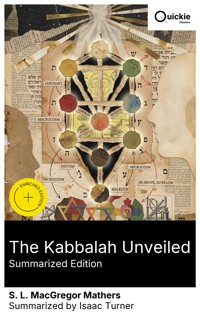
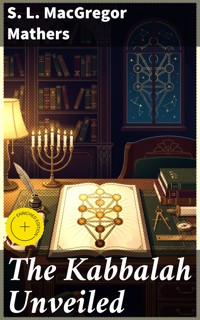
The Kabbalah Unveiled offers Mathers's influential English mediation of Zoharic texts via Knorr von Rosenroth's Latin Kabbala Denudata. Assembling the Book of the Concealed Mystery, the Greater Holy Assembly, and the Lesser Holy Assembly, it expounds sefirotic emanation, Adam Kadmon, macroprosopus and microprosopus, and the play of divine names. In a Victorian, syncretic register, Mathers balances literal rendering with copious notes, glossaries, and schematic correspondences. Framed by the nineteenth century occult revival, the book made Aramaic theosophy legible to Anglophone readers, though its Latin filter leaves marked distortions. Mathers, cofounder and chief of the Hermetic Order of the Golden Dawn, honed his craft in the British Museum and through translating grimoires and magical treatises. Seeking a philosophical backbone for ritual work, he joined philological zeal to a universalizing esoteric outlook. His command of correspondences, angelologies, and divine names shaped the apparatus and emphases that give the book its distinctive Golden Dawn inflection. Recommended for students of Jewish mysticism, historians of esotericism, and practitioners of ceremonial magic, this edition is best read alongside modern critical studies by Scholem or Idel. As a landmark in reception history and practice, it remains indispensable. Quickie Classics summarizes timeless works with precision, preserving the author's voice and keeping the prose clear, fast, and readable—distilled, never diluted. Enriched Edition extras: Introduction · Synopsis · Historical Context · Brief Analysis · 4 Reflection Q&As · Editorial Footnotes.
Das E-Book können Sie in Legimi-Apps oder einer beliebigen App lesen, die das folgende Format unterstützen:
Veröffentlichungsjahr: 2026
Ähnliche


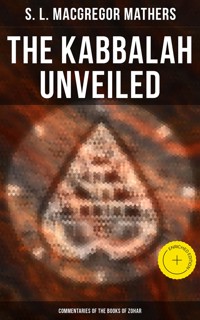
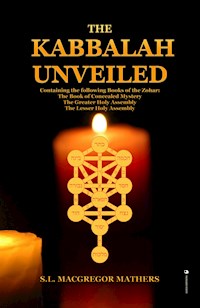

The Kabbalah Unveiled (Summarized Edition)
Table of Contents
Introduction
At once an unveiling and an admission of how much remains veiled, The Kabbalah Unveiled stages the encounter between a hidden metaphysical architecture and the modern urge to render it intelligible, guiding readers across languages, traditions, and centuries to contemplate how the One diffuses into the many and how symbols organize that mystery. It is a work where translation becomes interpretation, where inherited secrecy yields to careful exposition without surrendering its depth, and where an ancient mystical vocabulary challenges contemporary habits of reading to reckon with layered meanings, disciplined imagination, and the ethical weight of naming the divine.
First appearing in the late nineteenth century, this volume belongs to the genre of esoteric translation and commentary: S. L. MacGregor Mathers renders into English portions of the Zohar as transmitted through Christian Knorr von Rosenroth’s Latin Kabbala Denudata, presenting three core treatises often cited in Western discussions of Kabbalah—the Book of Concealed Mystery, the Greater Holy Assembly, and the Lesser Holy Assembly. Written amid a vibrant Victorian occult revival with which Mathers was closely associated, the book situates Jewish mystical concepts for an English-reading public while acknowledging the mediations and limits inherent in translating through a seventeenth‑century Latin lens.
Rather than a narrative with characters and plot, readers meet an ordered exposition of cosmology, symbolism, and theological psychology, in which emanations of the Divine, the interplay of attributes, and the structure of creation are mapped through technical terms and recurring images. Mathers keeps many Hebrew and Aramaic designations in transliteration, pairing them with explanations designed to clarify function and relation without dissolving their strangeness. The movement of the text is meditative and scholastic by turns, inviting slow attention to pattern, proportion, and correspondence, and building an atmosphere that is solemn, sometimes austere, yet increasingly luminous as connections begin to cohere.
As a translator-editor, Mathers adopts a studious, confident voice, interleaving his English rendering with copious notes that synthesize earlier authorities and signal terminological choices. The style is Victorian—ornate in places, but disciplined by a desire for precision—so that difficult passages become manageable through patient definition, cross-reference, and occasional historical framing. Readers can expect sustained engagement with etymology, the logic of names, and the careful scaffolding of abstract concepts, as the work treats abstraction concretely without reducing it to mere allegory. The tone remains reverent and analytical, emphasizing careful boundaries between what can be explicated and what must remain intimated by symbol.
Among its abiding themes are the tension between unity and differentiation, the dynamic reciprocity of attributes, and the manner in which language both reveals and veils what it seeks to name. The treatises explore how order emerges without collapsing mystery, how ethical orientation arises from metaphysical pattern, and how symbolic thought disciplines desire and imagination. For contemporary readers, these concerns illuminate perennial questions about identity, relation, and responsibility in a complex world. The book models a way of thinking that is rigorous yet contemplative, inviting a form of literacy attuned to nuance, proportion, and the humility required by ultimate matters.
It also matters as a landmark in the history of ideas, shaping currents of modern Western esotericism and serving as a gateway through which many encountered Kabbalistic notions. At the same time, Mathers’s reliance on a Latin intermediary means readers engage a mediated presentation, and attentive study benefits from awareness of that filter and from consultation of diverse scholarship. Approached with respect for Jewish sources and care for context, the book becomes a productive, if partial, bridge. Its durability lies in making difficult material accessible while signaling its profundity, letting complexity slow us to the pace required for responsible understanding.
For new and returning readers alike, The Kabbalah Unveiled offers an apprenticeship in disciplined symbolism: a guided tour through textures of meaning that reward patience, curiosity, and ethical imagination. It can serve artists seeking archetypal resonance, scholars tracing intellectual lineages, practitioners cultivating contemplative structure, and general readers drawn to the meeting point of myth and metaphysics. Without demanding prior expertise, it encourages a posture of inquiry that respects opacity while clarifying what can be known. In that balance of clarity and reserve, Mathers’s work continues to open a space where modern reading habits meet ancient wisdom on terms both challenging and humane.
Synopsis
The Kabbalah Unveiled, by S. L. MacGregor Mathers, is a late nineteenth-century English presentation of foundational Zoharic materials, rendered chiefly from Christian Knorr von Rosenroth’s Latin Kabbala Denudata. Mathers gathers and translates three principal treatises—the Book of Concealed Mystery, the Greater Holy Assembly, and the Lesser Holy Assembly—and frames them with a substantial introduction and annotations. The work aims to make the symbolic theology of classic Kabbalah accessible to readers unfamiliar with Hebrew sources. While it follows the Latin intermediary, it keeps close attention to technical terminology and strives to preserve the layered texture of the original Aramaic tradition.
Mathers’s introductory essays outline the principal architecture of Kabbalistic thought. He explains the idea of the Infinite and its self-disclosure through emanation, sketching the sequence of the Sephiroth and their dynamic balance. The discussion surveys the Four Worlds, the doctrine of Adam Kadmon, and the roles of Hebrew letters and divine names in symbolic exegesis. Attention is given to transliteration conventions and the challenges of matching Aramaic and Hebrew nuances through Latin into English. By situating the treatises within a conceptual map, the introduction equips readers to meet condensed imagery with a framework for understanding without claiming to exhaust the tradition.
The Book of Concealed Mystery presents a compact cosmogony in highly compressed aphorisms. Mathers’s version follows the Latin’s cryptic cadence while clarifying key terms. The text treats the first stirrings of manifestation from hiddenness, establishing principles that underlie later elaborations. It addresses the emergence of order, the polarity of mercy and judgment, and the structuring of the Sephiroth as interrelated aspects. Rather than narrate events, it offers concentrated statements whose images invite commentary. Mathers adds notes identifying recurrent motifs and pointing to broader Kabbalistic patterns, enabling readers to trace how terse propositions seed themes developed more expansively in the assemblies.
The Greater Holy Assembly is framed as a gathering of Rabbi Shimon and his circle, who expound symbols of the divine countenance under the title of the Macroprosopus. The discourse describes configurations that map qualities across the Sephiroth, dwelling on balance, concealment, and revelation. Mathers preserves the dramatic setting while emphasizing technical vocabulary and cross-references. The treatise expands the earlier seed-ideas into a panoramic contemplation of emanated attributes, showing how justice and compassion achieve equilibrium. Its rhetoric, part homily and part symbolic anatomy, becomes a vehicle for exploring how transcendence interfaces with structured manifestation without collapsing mystery into simplistic explanation.
The Lesser Holy Assembly focuses on the Microprosopus, exploring the more immediate configuration of divine attributes as they relate to the created order. Set around Rabbi Shimon’s final teachings, it condenses and refines themes from the larger assembly, tracing processes of union, separation, and return. The tone is intimate and solemn, with concentrated attention on how attributes communicate vitality to lower levels, culminating in the presence that sustains the community of Israel. Mathers keeps the narrative frame intact while guiding readers through dense symbolism, underscoring continuities with earlier sections and the delicate interplay between transcendence and immanence in devotional language.
Throughout, Mathers supplies notes that unpack terminology, cite variant forms, and indicate where Rosenroth’s Latin shapes interpretation. He explains numerical and lexical devices commonly used in Kabbalistic exegesis and signals where technical phrases carry multiple layers. The editorial aim is clarity without flattening metaphor, so the apparatus often pauses to mark limits of certainty or to offer alternative readings attested in earlier authorities. By mediating between source strata—Aramaic, Latin, and English—the book foregrounds the challenges of transmission and the care required when mapping doctrinal diagrams onto poetic texts that originally functioned as mystical commentary rather than systematic treatises.
As a gateway to Zoharic literature for English readers, The Kabbalah Unveiled has had lasting reach beyond its immediate scholarly aims. It enabled sustained engagement with concepts such as the Sephiroth, Macroprosopus and Microprosopus, and the layered cosmology of emanation, and it contributed to later currents of Western esotericism as well as to general study of Jewish mysticism. The book’s enduring resonance lies in its careful organization and accessible, if mediated, translation, which open dense materials without purporting to settle interpretive debates. It remains a touchstone for approaching symbolic theology while reminding readers to weigh sources and contexts with methodological caution.
Historical Context
Published in London in 1887 by George Redway, The Kabbalah Unveiled appeared amid late-Victorian Britain’s flourishing interest in esoteric learning. Its author, Samuel Liddell MacGregor Mathers (1854–1918), was a British occultist who soon helped found the Hermetic Order of the Golden Dawn in 1888. The period saw new societies and reading circles devoted to comparative religion and occultism, alongside established Masonic bodies that fostered symbolic study. The Theosophical Society, founded in 1875, had popularized nontraditional spiritual inquiry across the Anglophone world. In this setting, an English rendering of foundational Kabbalistic material promised both scholarly novelty and accessible guidance for seekers.
Mathers’s volume draws on Christian Knorr von Rosenroth’s Kabbala Denudata, a Latin compilation printed at Sulzbach between 1677 and 1684 that presented selections from Jewish mystical writings to European scholars. Rosenroth included three tractates associated with the Zoharic corpus: the Siphra Dtzenioutha (Book of Concealed Mystery), the Idra Rabba Qadisha (Greater Holy Assembly), and the Idra Zuta Qadisha (Lesser Holy Assembly). The Zohar itself, attributed in tradition to Rabbi Shimon bar Yochai, began circulating in late thirteenth‑century Castile under the name of Moses de León. Through Rosenroth’s mediation, these texts entered Christian and humanist debates on ancient wisdom.
In the nineteenth century, Jewish studies matured through the Wissenschaft des Judentums, whose scholars applied historical methods to texts once treated solely as devotional. Figures such as Leopold Zunz and Heinrich Graetz analyzed the development of rabbinic literature and discussed the medieval emergence of Kabbalah. In France, Adolphe Franck’s La Kabbale (1843) offered a systematic overview for general readers. English-language access, however, remained fragmentary. Max Müller’s Sacred Books of the East (1879–1910) popularized comparative scripture, yet excluded Kabbalistic works. Within this landscape, an English translation based on Rosenroth promised to bridge scholarly discourse and a growing lay audience interested in mysticism.
Victorian occultism drew heavily on Continental sources. Eliphas Lévi’s writings on ceremonial magic (1850s–1860s) reintroduced Kabbalistic concepts to a broad readership and influenced British esoteric circles. In England, the Societas Rosicruciana in Anglia, founded in 1867, cultivated symbolic and Hermetic studies among Master Masons; several future Golden Dawn leaders, including Mathers, were members. The Golden Dawn, formed in London in 1888 by William Wynn Westcott, William Robert Woodman, and Mathers, organized initiatory grades around the ten Sephiroth and related correspondences. Against this backdrop, Mathers’s translation supplied a textual foundation for ritual theory circulating in lodges and salons.
George Redway, Mathers’s publisher, specialized in esoteric and bibliophilic titles, helping create a niche market for occult works in London. Although some British scholars pursued Semitic philology at Oxford, Cambridge, and University College London, many English readers lacked access to Aramaic materials. Mathers therefore translated not from the Zohar’s original Aramaic but from Rosenroth’s Latin, a choice he acknowledged in his preface. His volume supplied diagrammatic presentations of the Sephiroth and consistent transliterations that matched contemporary magical literature. The result was a text positioned between academic philology and practical occultism, accessible to readers without specialist linguistic training.
Contemporaneous Jewish scholarship increasingly framed the Zohar and later Kabbalistic schools in historical terms, noting their medieval composition and development in Spain and Safed. Heinrich Graetz’s nineteenth‑century histories treated the Zohar as a product of the thirteenth century, challenging claims of ancient authorship. Meanwhile, traditional rabbinic norms held that esoteric study belonged to qualified initiates. These positions did not align neatly with popular occult appropriations. Mathers’s project therefore stood at an intersection: presenting revered mystical sources in English while drawing on a Christian Hebraic intermediary, and doing so for a readership that included lodge members rather than academic specialists.
The Kabbalah Unveiled offered extensive introductions and notes that framed the three tractates within a cosmology of ten emanations, four worlds, and angelic hierarchies. Mathers emphasized correspondences—linking the Sephiroth to planets, elements, and scriptural names—reflecting methods already circulating among Rosicrucian and magical writers. He presented the Zoharic materials as repositories of a primordial theosophy compatible with Hermetic philosophy. By privileging diagrams, glossaries, and consistent terminology, he sought to render abstruse symbolism tractable to English readers. The apparatus thus shaped how late‑Victorian audiences encountered Kabbalistic concepts, often through the lens of ritual practice and symbolic synthesis.
Within a decade, the Golden Dawn adopted and elaborated Kabbalistic schemas in its teaching, and Mathers’s book circulated widely among its members and sympathizers. Later English‑language works by A. E. Waite and, subsequently, Dion Fortune developed lines of interpretation recognizable from Mathers’s syntheses. The Kabbalah Unveiled thus exemplifies the era’s hybrid scholarship—part philological transmission via Rosenroth, part programmatic manual for Western esotericism. It reflects the Victorian drive to reconcile science, religion, and antiquity by systematizing symbols, and it proposes an enduring, universal wisdom at the core of disparate traditions. As such, it records and shapes its cultural moment.




